PLAA: Packet-level Adversarial Attacks in Network Traffic Detection
Pith reviewed 2026-06-30 01:36 UTC · model grok-4.3
The pith
A packet-by-packet method generates adversarial network traffic that evades detection systems at 92.78 percent while keeping attack semantics.
A machine-rendered reading of the paper's core claim, the machinery that carries it, and where it could break.
Core claim
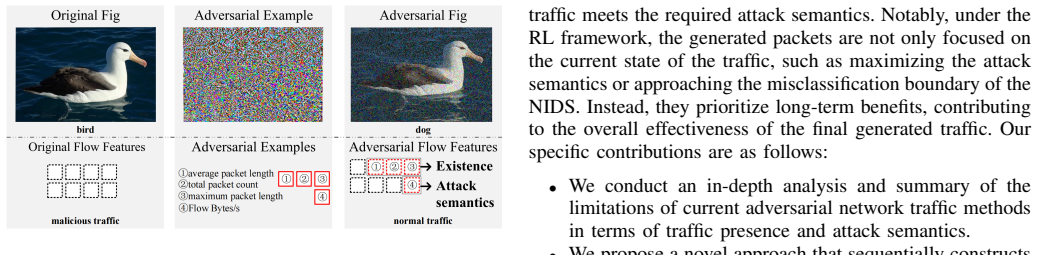
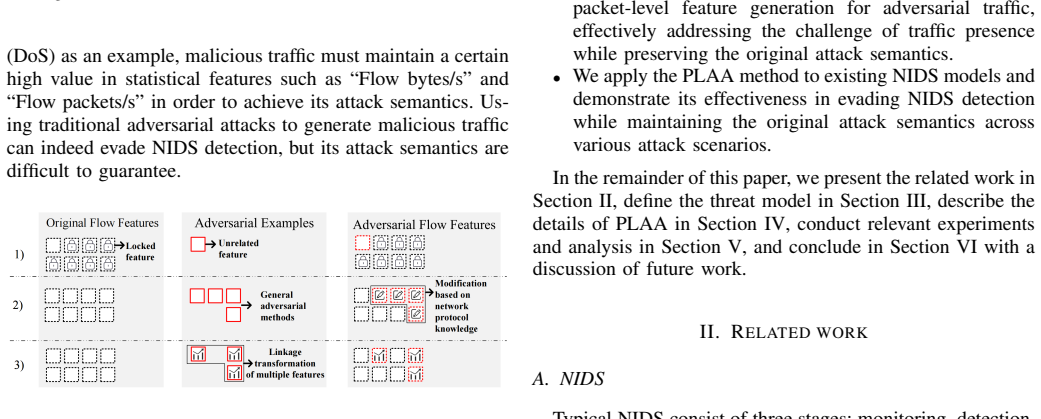
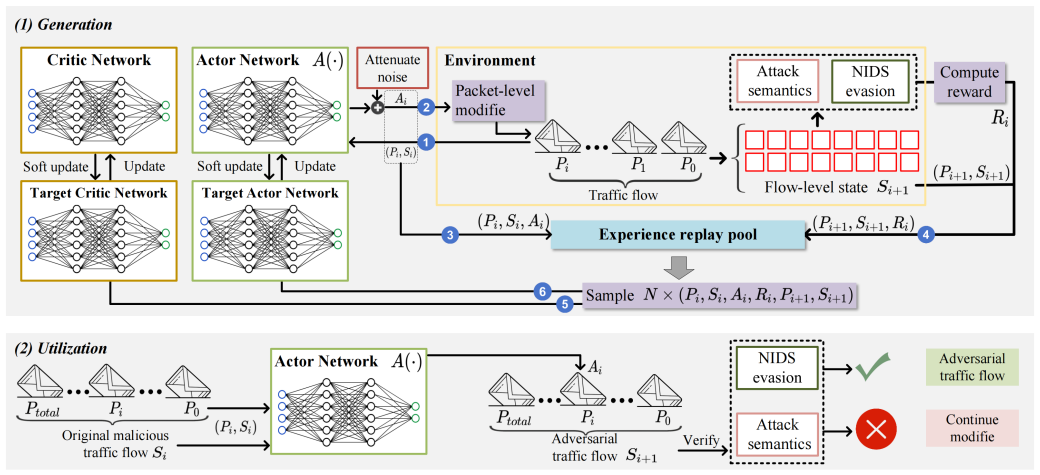
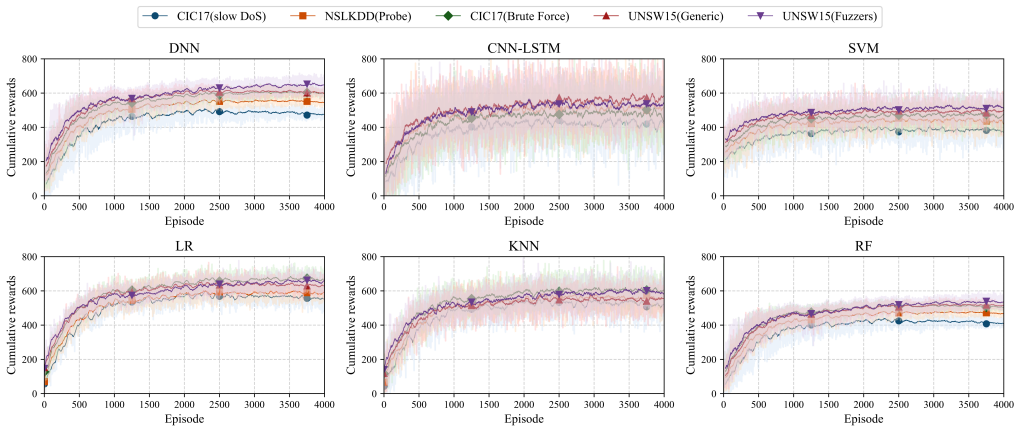
Instead of generating flow-level features directly, the approach incrementally generates packet-level features to construct adversarial traffic. The semantic integrity of the traffic is monitored at each stage, which avoids invalid traffic and semantic loss. Evaluation on the CIC-UNSW-NB15, CIC-DDoS2019, and CIC-IDS-2017 datasets shows an average evasion success rate of 92.78 percent with maintained semantic consistency.
What carries the argument
Incremental packet-level feature generation combined with stage-wise semantic integrity monitoring that builds valid adversarial examples without losing attack semantics.
If this is right
- The attack succeeds against current DNN-based NIDS models on multiple datasets.
- Generated traffic stays semantically consistent with the original malicious traffic.
- Flow-level adaptation from computer vision leads to invalid or semantically altered traffic.
- Packet-level construction with monitoring addresses both invalidity and semantic loss.
Where Pith is reading between the lines
- Defenses might incorporate packet-level semantic checks to detect such incremental attacks.
- Testing NIDS robustness should include packet-sequence constraints in addition to flow statistics.
- Similar incremental methods could apply to other sequential data domains like audio or time-series security signals.
Load-bearing premise
That monitoring semantic integrity at each packet generation stage will consistently prevent the creation of invalid traffic or the loss of original attack semantics.
What would settle it
Run the generated adversarial traffic through an independent validator that confirms whether the traffic still executes the intended attack action, such as a DDoS flood or port scan, while the NIDS fails to flag it.
Figures
read the original abstract
Deep neural networks (DNNs) are widely applied in Network-based Intrusion Detection System (NIDS) due to their high accuracy. However, DNNs are highly susceptible to adversarial attacks, which generate malicious traffic to evade NIDS detection. Existing approaches often adapt adversarial attacks from computer vision (CV) tasks to the NIDS domain, overlooking the fundamental differences between CV and NIDS. This results in two major issues: 1) The generated network traffic may become invalid, 2) The generated traffic may lose its original attack semantics. To address these issues, this paper proposes an adversarial attack specifically designed for NIDS. Instead of directly generating flow-level features, our approach incrementally generates packet-level features to construct adversarial traffic. During the generation process, the semantic integrity of the traffic is monitored at each stage, effectively avoiding the issues of invalid traffic and semantic loss observed in existing methods. We evaluate our attack algorithm against current NIDS models using the CIC-UNSW-NB15, CIC-DDoS2019, and CIC-IDS-2017 datasets. The proposed method achieves an average evasion success rate of 92.78%, while ensuring that the generated adversarial traffic remains semantically consistent with the original malicious traffic.
Editorial analysis
A structured set of objections, weighed in public.
Referee Report
Summary. The paper proposes PLAA, a packet-level adversarial attack for DNN-based NIDS. Instead of adapting CV-style flow-level perturbations, it incrementally constructs adversarial traffic by generating packet-level features while monitoring semantic integrity at each stage to avoid invalid packets or loss of attack semantics. Evaluation on CIC-UNSW-NB15, CIC-DDoS2019, and CIC-IDS-2017 reports an average evasion success rate of 92.78% with claimed semantic consistency.
Significance. If the incremental generation plus per-stage semantic monitoring can be shown to preserve functional attack semantics (e.g., via replay validation or feature-preservation metrics), the work would provide a domain-appropriate adversarial framework that directly addresses the invalid-traffic and semantic-drift problems of CV-adapted attacks. This could strengthen robustness testing of NIDS and inform future defense design.
major comments (2)
- [Abstract, §3] Abstract and §3 (method description): the central claim of 92.78% evasion while 'ensuring semantic consistency' rests on the per-stage semantic-integrity monitor, yet no quantitative validation procedure, preservation metrics (payload signatures, timing, port sequences), or replay experiments are reported to confirm that adversarial flows remain malicious when replayed. Evasion rate alone does not establish this.
- [§4] §4 (evaluation): the reported average evasion success rate lacks error bars, per-dataset breakdowns with statistical tests, or explicit exclusion criteria for flows that the monitor rejected; without these, it is impossible to assess whether the 92.78% figure reflects reliable semantic preservation or selective reporting.
minor comments (2)
- [§3] Notation for packet-level feature vectors and the exact formulation of the semantic-integrity check should be made explicit (currently described only at a high level).
- [§4] The manuscript should include a clear comparison table against prior NIDS-specific attacks (e.g., flow-level methods) on the same datasets and models.
Simulated Author's Rebuttal
We thank the referee for the constructive comments, which highlight important aspects of validation and reporting. We address each major comment below and indicate planned revisions to the manuscript.
read point-by-point responses
-
Referee: [Abstract, §3] Abstract and §3 (method description): the central claim of 92.78% evasion while 'ensuring semantic consistency' rests on the per-stage semantic-integrity monitor, yet no quantitative validation procedure, preservation metrics (payload signatures, timing, port sequences), or replay experiments are reported to confirm that adversarial flows remain malicious when replayed. Evasion rate alone does not establish this.
Authors: The semantic-integrity monitor in §3 performs incremental checks on packet-level features to enforce validity and consistency with the original attack semantics at each generation step. This design directly targets the semantic-drift issue noted in the introduction. We agree, however, that the current manuscript does not report additional quantitative preservation metrics or replay-based validation experiments. In the revision we will add a dedicated subsection presenting feature-preservation statistics (e.g., timing, port-sequence, and payload-signature fidelity) together with a small-scale replay study on a subset of flows. revision: yes
-
Referee: [§4] §4 (evaluation): the reported average evasion success rate lacks error bars, per-dataset breakdowns with statistical tests, or explicit exclusion criteria for flows that the monitor rejected; without these, it is impossible to assess whether the 92.78% figure reflects reliable semantic preservation or selective reporting.
Authors: The reported 92.78% is the mean evasion rate computed across the three datasets. The revised §4 will include (i) per-dataset success rates with standard deviations, (ii) the number and criteria for any flows rejected by the monitor, and (iii) appropriate statistical comparisons. These additions will allow readers to evaluate both the reliability of the aggregate figure and the effectiveness of the semantic monitor. revision: yes
Circularity Check
No circularity: empirical evaluation of proposed algorithm with no self-referential derivations
full rationale
The paper proposes an incremental packet-level adversarial attack method with per-stage semantic integrity monitoring, evaluated empirically on CIC-UNSW-NB15, CIC-DDoS2019, and CIC-IDS-2017 datasets to report a 92.78% average evasion rate. No equations, fitted parameters, or first-principles derivations are described that reduce to self-defined inputs by construction. The central performance claim is an observed experimental outcome rather than a prediction forced by the method's own definitions or prior self-citations. The approach addresses limitations of prior work through design choices, but these do not create a circular reduction in the provided text.
Axiom & Free-Parameter Ledger
Reference graph
Works this paper leans on
-
[1]
Towards ddos attack detection using deep learning approach,
S. Aktar and A. Y . Nur, “Towards ddos attack detection using deep learning approach,”Computers & Security, vol. 129, p. 103251, 2023
2023
-
[2]
Adversarial attacks against intrusion detection systems: Taxonomy, solutions and open issues,
I. Corona, G. Giacinto, and F. Roli, “Adversarial attacks against intrusion detection systems: Taxonomy, solutions and open issues,”Information sciences, vol. 239, pp. 201–225, 2013
2013
-
[3]
Endogenous security defense against deductive attack: When artificial intelligence meets active defense for online service,
Z. Zhou, X. Kuang, L. Sun, L. Zhong, and C. Xu, “Endogenous security defense against deductive attack: When artificial intelligence meets active defense for online service,”IEEE Communications Magazine, vol. 58, no. 6, pp. 58–64, 2020
2020
-
[4]
Drl-based adaptive sharding for blockchain-based federated learning,
Y . Lin, Z. Gao, H. Du, J. Kang, D. Niyato, Q. Wang, J. Ruan, and S. Wan, “Drl-based adaptive sharding for blockchain-based federated learning,”IEEE Transactions on Communications, vol. 71, no. 10, pp. 5992–6004, 2023
2023
-
[5]
Intriguing properties of neural networks
C. Szegedy, “Intriguing properties of neural networks,”arXiv preprint arXiv:1312.6199, 2013
work page internal anchor Pith review Pith/arXiv arXiv 2013
-
[6]
A multi- shuffler framework to establish mutual confidence for secure federated learning,
Z. Zhou, C. Xu, M. Wang, X. Kuang, Y . Zhuang, and S. Yu, “A multi- shuffler framework to establish mutual confidence for secure federated learning,”IEEE Transactions on Dependable and Secure Computing, vol. 20, no. 5, pp. 4230–4244, 2022
2022
-
[7]
Adversarial machine learning for network intrusion detection systems: A comprehensive survey,
K. He, D. D. Kim, and M. R. Asghar, “Adversarial machine learning for network intrusion detection systems: A comprehensive survey,”IEEE Communications Surveys & Tutorials, vol. 25, no. 1, pp. 538–566, 2023
2023
-
[8]
Idsgan: Generative adversarial networks for attack generation against intrusion detection,
Z. Lin, Y . Shi, and Z. Xue, “Idsgan: Generative adversarial networks for attack generation against intrusion detection,” inPacific-asia conference on knowledge discovery and data mining. Springer, 2022, pp. 79–91
2022
-
[9]
Tantra: Timing-based adversarial network traffic reshaping attack,
Y . Sharon, D. Berend, Y . Liu, A. Shabtai, and Y . Elovici, “Tantra: Timing-based adversarial network traffic reshaping attack,”IEEE Trans- actions on Information Forensics and Security, vol. 17, pp. 3225–3237, 2022
2022
-
[10]
Adv-bot: Realistic adversarial botnet attacks against network intrusion detection systems,
I. Debicha, B. Cochez, T. Kenaza, T. Debatty, J.-M. Dricot, and W. Mees, “Adv-bot: Realistic adversarial botnet attacks against network intrusion detection systems,”Computers & Security, vol. 129, p. 103176, 2023
2023
-
[11]
Generating practical adversarial network traffic flows using nidsgan,
B.-E. Zolbayar, R. Sheatsley, P. McDaniel, M. J. Weisman, S. Zhu, S. Zhu, and S. Krishnamurthy, “Generating practical adversarial network traffic flows using nidsgan,”arXiv preprint arXiv:2203.06694, 2022
-
[12]
Automatic evasion of machine learning-based network intrusion detection systems,
H. Yan, X. Li, W. Zhang, R. Wang, H. Li, X. Zhao, F. Li, and X. Lin, “Automatic evasion of machine learning-based network intrusion detection systems,”IEEE Transactions on Dependable and Secure Computing, vol. 21, no. 1, pp. 153–167, 2023
2023
-
[13]
Network intrusion detection algorithm based on deep neural network,
Y . Jia, M. Wang, and Y . Wang, “Network intrusion detection algorithm based on deep neural network,”IET Information Security, vol. 13, no. 1, pp. 48–53, 2019
2019
-
[14]
Dl-ids: a deep learning–based intru- sion detection framework for securing iot,
Y . Otoum, D. Liu, and A. Nayak, “Dl-ids: a deep learning–based intru- sion detection framework for securing iot,”Transactions on Emerging Telecommunications Technologies, vol. 33, no. 3, p. e3803, 2022
2022
-
[15]
Secfft: Safeguarding federated fine-tuning for large vision language models against covert backdoor attacks in iort networks,
Z. Zhou, C. Xu, B. Wang, T. Li, S. Huang, S. Yang, and S. Yao, “Secfft: Safeguarding federated fine-tuning for large vision language models against covert backdoor attacks in iort networks,”IEEE Internet of Things Journal, 2024
2024
-
[16]
Incentive and dynamic client selection for federated unlearning,
Y . Lin, Z. Gao, H. Du, D. Niyato, J. Kang, and X. Liu, “Incentive and dynamic client selection for federated unlearning,” inProceedings of the ACM Web Conference 2024, 2024, pp. 2936–2944
2024
-
[17]
Deep learning models for cyber security in iot networks,
M. Roopak, G. Y . Tian, and J. Chambers, “Deep learning models for cyber security in iot networks,” in2019 IEEE 9th annual computing and communication workshop and conference (CCWC). IEEE, 2019, pp. 0452–0457
2019
-
[18]
Dl-ids: extracting features using cnn-lstm hybrid network for intrusion detection system. secur. commun. netw. 2020,
P. Sunet al., “Dl-ids: extracting features using cnn-lstm hybrid network for intrusion detection system. secur. commun. netw. 2020,”Article ID, vol. 8890306, no. 11, 2020
2020
-
[19]
Community- oriented duplex privacy amplification and active poisoning resistance for heterogeneous federated learning,
Z. Zhou, J. Zhao, S. Yang, H. Li, T. Ma, and C. Xu, “Community- oriented duplex privacy amplification and active poisoning resistance for heterogeneous federated learning,”IEEE Transactions on Dependable and Secure Computing, 2025
2025
-
[20]
Scalable federated unlearning via isolated and coded sharding,
Y . Lin, Z. Gao, H. Du, D. Niyato, G. Gui, S. Cui, and J. Ren, “Scalable federated unlearning via isolated and coded sharding,”arXiv preprint arXiv:2401.15957, 2024
-
[21]
Kitsune: An Ensemble of Autoencoders for Online Network Intrusion Detection
Y . Mirsky, T. Doitshman, Y . Elovici, and A. Shabtai, “Kitsune: an ensemble of autoencoders for online network intrusion detection,”arXiv preprint arXiv:1802.09089, 2018
work page internal anchor Pith review Pith/arXiv arXiv 2018
-
[22]
Gee: A gradient-based explainable variational autoencoder for network anomaly detection,
Q. P. Nguyen, K. W. Lim, D. M. Divakaran, K. H. Low, and M. C. Chan, “Gee: A gradient-based explainable variational autoencoder for network anomaly detection,” in2019 IEEE Conference on Communications and Network Security (CNS). IEEE, 2019, pp. 91–99
2019
-
[23]
Progen: Projection-based adversarial attack generation against network intrusion detection,
M. Wang, N. Yang, N. J. Forcade-Perkins, and N. Weng, “Progen: Projection-based adversarial attack generation against network intrusion detection,”IEEE Transactions on Information Forensics and Security, 2024
2024
-
[24]
Analyzing adversarial attacks against deep learning for intrusion detection in iot networks,
O. Ibitoye, O. Shafiq, and A. Matrawy, “Analyzing adversarial attacks against deep learning for intrusion detection in iot networks,” in2019 IEEE global communications conference (GLOBECOM). IEEE, 2019, pp. 1–6
2019
-
[25]
Ad- versarial attacks on sdn-based deep learning ids system,
C.-H. Huang, T.-H. Lee, L.-h. Chang, J.-R. Lin, and G. Horng, “Ad- versarial attacks on sdn-based deep learning ids system,” inMobile and Wireless Technology 2018: International Conference on Mobile and Wireless Technology (ICMWT 2018). Springer, 2019, pp. 181–191
2018
-
[26]
Deep learning-based intrusion detection with adversaries,
Z. Wang, “Deep learning-based intrusion detection with adversaries,” IEEE Access, vol. 6, pp. 38 367–38 384, 2018
2018
-
[27]
A detailed analysis of the kdd cup 99 data set,
M. Tavallaee, E. Bagheri, W. Lu, and A. A. Ghorbani, “A detailed analysis of the kdd cup 99 data set,” in2009 IEEE symposium on computational intelligence for security and defense applications. Ieee, 2009, pp. 1–6
2009
-
[28]
Poisoning and evasion: Deep learning-based nids under adversarial attacks,
H. Mohammadian, A. Habibi Lashkari, and A. A. Ghorbani, “Poisoning and evasion: Deep learning-based nids under adversarial attacks,” in 2024 21st Annual International Conference on Privacy, Security and Trust (PST), 2024, pp. 1–9
2024
-
[29]
Toward generating a new intrusion detection dataset and intrusion traffic characterization
I. Sharafaldin, A. H. Lashkari, A. A. Ghorbaniet al., “Toward generating a new intrusion detection dataset and intrusion traffic characterization.” ICISSp, vol. 1, pp. 108–116, 2018
2018
-
[30]
De- veloping realistic distributed denial of service (ddos) attack dataset and taxonomy,
I. Sharafaldin, A. H. Lashkari, S. Hakak, and A. A. Ghorbani, “De- veloping realistic distributed denial of service (ddos) attack dataset and taxonomy,” in2019 international carnahan conference on security technology (ICCST). IEEE, 2019, pp. 1–8
2019
-
[31]
Compressive traffic analysis: A new paradigm for scalable traffic analysis,
M. Nasr, A. Houmansadr, and A. Mazumdar, “Compressive traffic analysis: A new paradigm for scalable traffic analysis,” inProceedings of the 2017 ACM SIGSAC Conference on Computer and Communications Security, 2017, pp. 2053–2069
2017
discussion (0)
Sign in with ORCID, Apple, or X to comment. Anyone can read and Pith papers without signing in.