A unified framework for determining transition dipole polarization in solid-state spin defects
Pith reviewed 2026-06-30 09:36 UTC · model grok-4.3
The pith
Ensemble photoluminescence responses to magnetic field, polarization and strain determine transition dipole polarization in spin defects.
A machine-rendered reading of the paper's core claim, the machinery that carries it, and where it could break.
Core claim
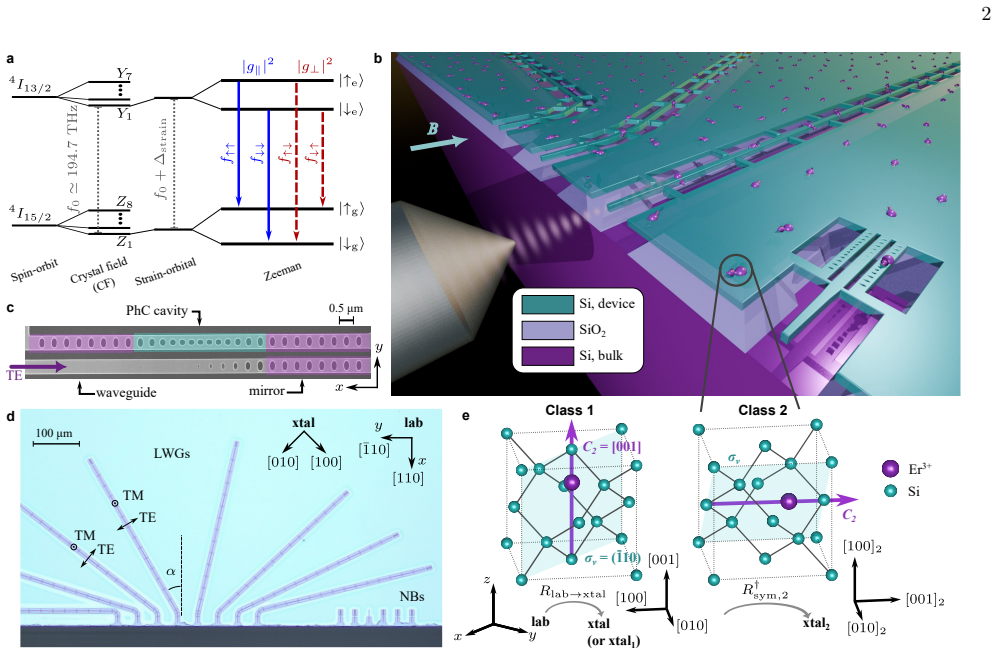
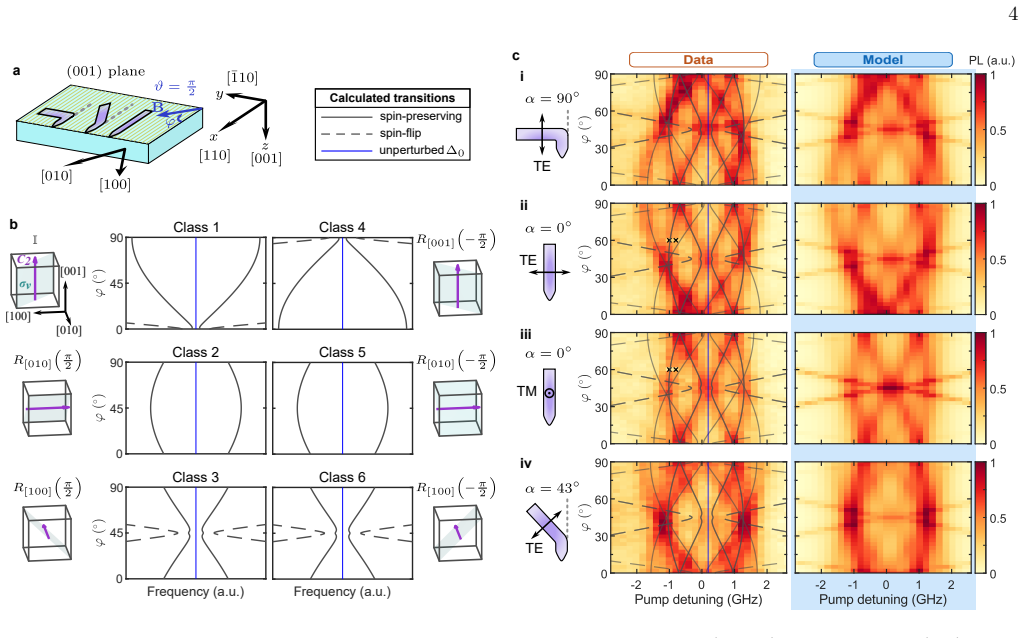
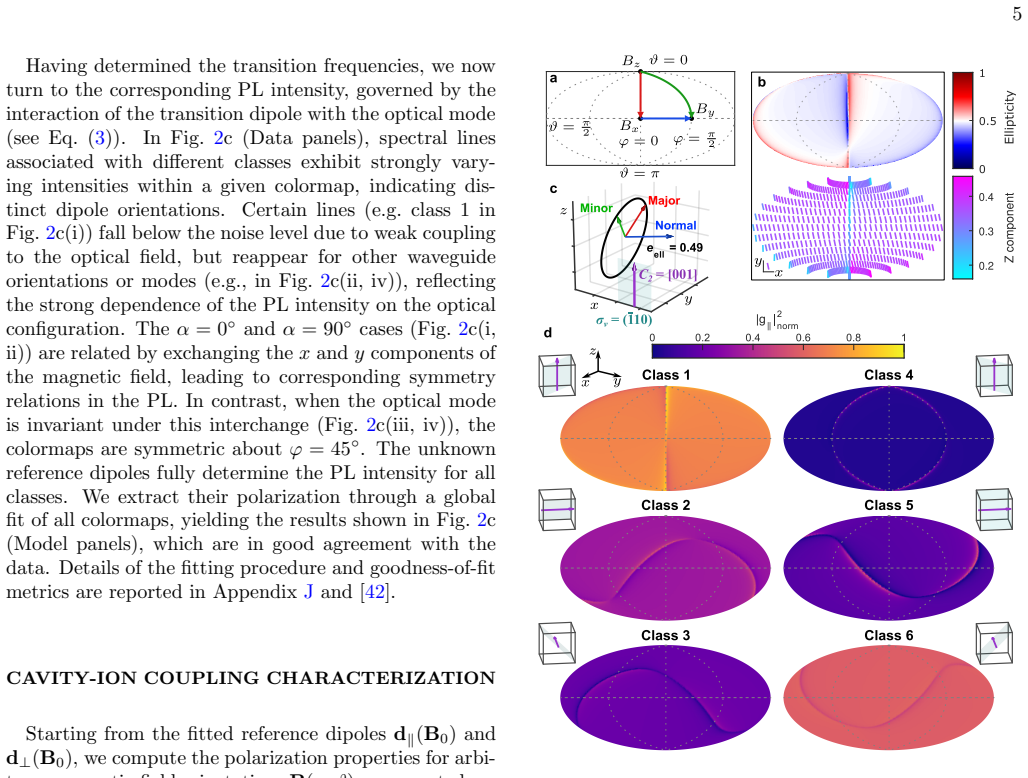
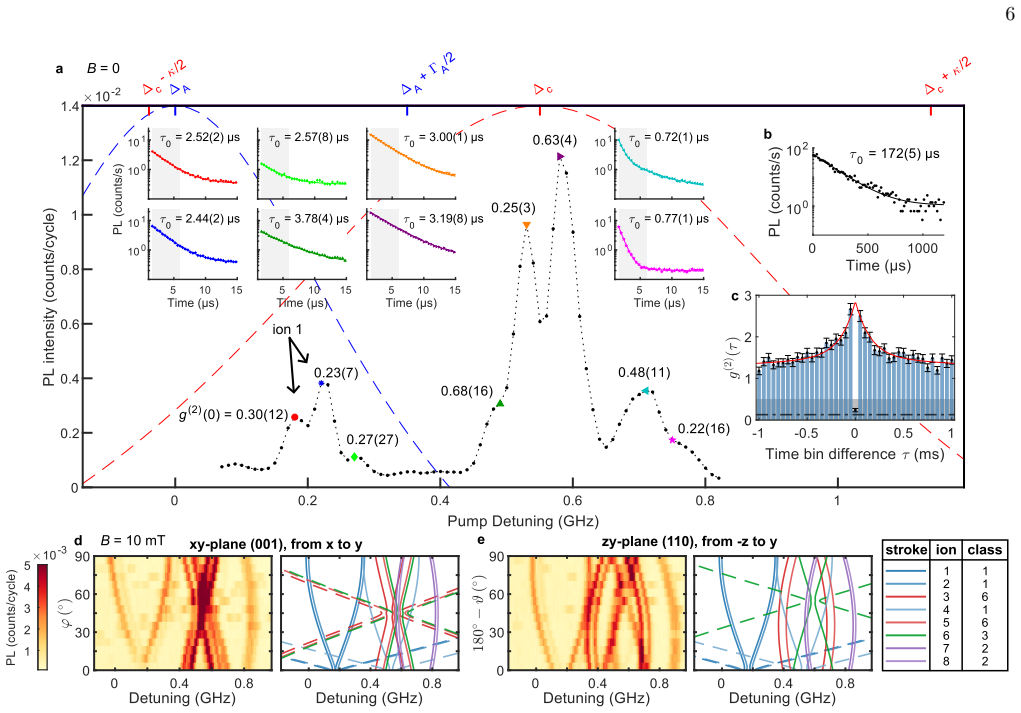
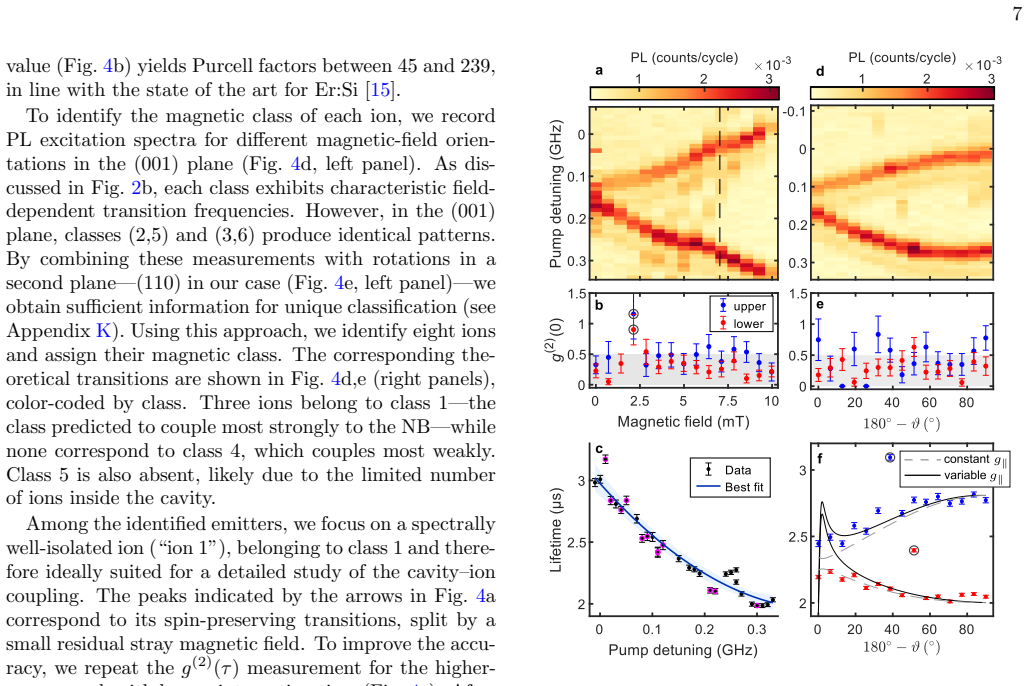
The framework reconstructs electric transition dipole polarization in spin-1/2 solid-state defects directly from ensemble spectroscopy by combining the response of photoluminescence spectra to magnetic field, optical polarization, and strain. Applied to erbium ions in silicon, the framework identifies strain-induced shifts as the origin of asymmetric ensemble spectra and enables simultaneous determination of the optical dipole polarization and strain-orbital coupling tensor. The resulting model predicts how cavity-ion coupling depends on crystallographic orientation and magnetic-field direction, which is verified using single erbium ions coupled to a nanophotonic cavity.
What carries the argument
Joint inversion of photoluminescence spectra under magnetic field, optical polarization, and strain to extract the dipole polarization vector and strain-orbital coupling tensor.
If this is right
- Asymmetric ensemble spectra in multi-site systems originate from strain-induced shifts.
- Optical dipole polarization and strain-orbital coupling tensor are obtained simultaneously from ensemble data.
- Cavity-ion coupling strength varies with crystallographic orientation and magnetic-field direction according to the extracted parameters.
- Microscopic properties of solid-state emitters can be extracted from ensemble spectroscopy without single-defect resolution.
- The method supplies a route to engineering optimized spin-photon and spin-phonon interfaces.
Where Pith is reading between the lines
- The same joint-inversion approach could be tested on other spin-1/2 emitters where single-ion access is limited.
- Device designs could deliberately select crystal orientations or strain environments to maximize coupling using the predicted dependence.
- Accounting for strain shifts in this manner may reduce apparent inhomogeneity when interpreting spectra of other solid-state quantum emitters.
Load-bearing premise
The spectral responses to magnetic field, polarization, and strain can be jointly inverted to uniquely determine the dipole polarization and strain-orbital tensor without dominant unmodeled site-to-site variations or other broadening mechanisms.
What would settle it
Single-ion cavity-coupling measurements that yield orientation or field dependence inconsistent with the values predicted from the ensemble-derived dipole and tensor would show the inversion is not unique.
Figures
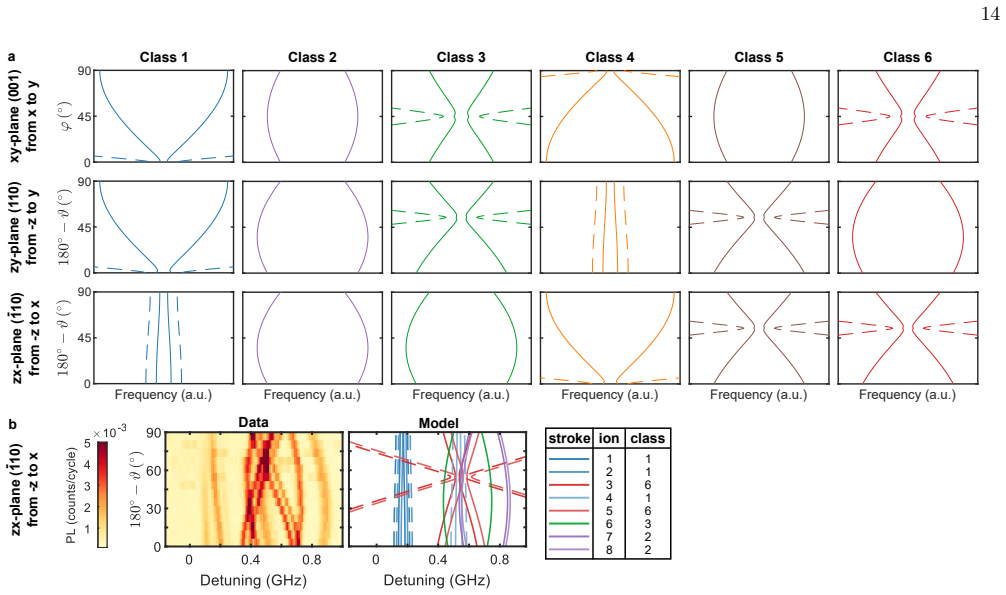
read the original abstract
Spin-photon interfaces based on solid-state defects are key building blocks for scalable quantum networks and hybrid quantum platforms. Optimizing light-matter coupling in these systems requires precise knowledge of the optical transition dipole polarization, yet for many promising quantum emitters this quantity is hard to determine and therefore remains poorly characterized. Here, we develop a framework for reconstructing electric transition dipole polarization in spin-1/2 solid-state defects directly from ensemble spectroscopy. The approach combines the response of photoluminescence spectra to magnetic field, optical polarization, and strain. Applied to erbium ions in silicon, a particularly challenging system containing multiple crystallographic subsites, the framework identifies strain-induced shifts as the origin of asymmetric ensemble spectra and enables simultaneous determination of the optical dipole polarization and strain-orbital coupling tensor. The resulting model predicts how cavity-ion coupling depends on crystallographic orientation and magnetic-field direction, which we verify using single erbium ions coupled to a nanophotonic cavity. Together, these results establish a broadly applicable route for extracting microscopic properties of solid-state quantum emitters from ensemble spectroscopy and for engineering optimized spin-photon and spin-phonon interfaces.
Editorial analysis
A structured set of objections, weighed in public.
Referee Report
Summary. The manuscript develops a unified framework to reconstruct the electric transition dipole polarization of spin-1/2 solid-state defects from ensemble photoluminescence spectroscopy by jointly analyzing responses to magnetic field, optical polarization, and strain. Applied to erbium ions in silicon (a system with multiple crystallographic subsites), the framework attributes asymmetric ensemble spectra to strain-induced shifts, simultaneously extracts the optical dipole polarization and strain-orbital coupling tensor, predicts how cavity-ion coupling depends on crystallographic orientation and magnetic-field direction, and verifies those predictions using single erbium ions coupled to a nanophotonic cavity.
Significance. If the central inversion is unique and the extracted parameters are robust, the work supplies a broadly applicable route to obtain microscopic properties of quantum emitters from ensemble data rather than single-site measurements. This would be valuable for engineering optimized spin-photon interfaces. The single-ion verification step and the focus on a technologically relevant but spectroscopically difficult system (Er:Si) are concrete strengths.
major comments (1)
- [Framework description and fitting procedure (results section)] The central claim rests on the assumption that photoluminescence line shapes under B-field, polarization, and strain can be jointly inverted to yield a unique optical dipole orientation and strain-orbital coupling tensor. The manuscript must demonstrate that other inhomogeneous broadening mechanisms or site-to-site parameter scatter do not permit multiple (dipole, tensor) pairs to produce statistically indistinguishable fits; without explicit uniqueness tests, error analysis, or data-exclusion rules, the extracted values and subsequent cavity-coupling predictions remain under-determined.
Simulated Author's Rebuttal
We thank the referee for their careful reading and constructive feedback. We address the single major comment below and will revise the manuscript to incorporate additional analysis demonstrating the robustness and uniqueness of the extracted parameters.
read point-by-point responses
-
Referee: The central claim rests on the assumption that photoluminescence line shapes under B-field, polarization, and strain can be jointly inverted to yield a unique optical dipole orientation and strain-orbital coupling tensor. The manuscript must demonstrate that other inhomogeneous broadening mechanisms or site-to-site parameter scatter do not permit multiple (dipole, tensor) pairs to produce statistically indistinguishable fits; without explicit uniqueness tests, error analysis, or data-exclusion rules, the extracted values and subsequent cavity-coupling predictions remain under-determined.
Authors: We agree that explicit tests for uniqueness are important. The framework jointly fits three orthogonal datasets: magnetic-field spectra constrain the Zeeman Hamiltonian, polarization dependence fixes the dipole orientation via selection rules, and strain-dependent shifts determine the orbital-strain tensor. These independent constraints over-determine the solution. In the revised manuscript we will add: (i) bootstrap and Monte Carlo analyses to quantify parameter uncertainties and show that alternative (dipole, tensor) pairs produce statistically worse fits; (ii) tests with varied inhomogeneous broadening models confirming stability of the extracted values; (iii) explicit data-exclusion criteria based on signal-to-noise and refitting results. The independent single-ion cavity-coupling measurements already provide external validation. These additions will be placed in the results section and SI. revision: yes
Circularity Check
No significant circularity; derivation self-contained with independent verification
full rationale
The abstract and description present a framework that fits a joint model of magnetic-field, polarization, and strain responses to ensemble PL spectra in order to extract dipole orientation and strain-orbital tensor; the fitted model is then used to predict orientation- and field-dependent cavity coupling, which is checked against separate single-ion cavity measurements. No quoted equations reduce a claimed prediction to a fitted input by construction, no self-citation is invoked as a uniqueness theorem, and the single-ion data constitute an external benchmark outside the ensemble fit. The derivation therefore remains non-circular.
Axiom & Free-Parameter Ledger
free parameters (1)
- strain-orbital coupling tensor components
axioms (1)
- domain assumption Photoluminescence spectra responses to magnetic field, optical polarization, and strain can be combined to reconstruct the electric transition dipole polarization uniquely.
Reference graph
Works this paper leans on
-
[1]
Sangouard, C
N. Sangouard, C. Simon, H. de Riedmatten, and N. Gisin, Quantum repeaters based on atomic ensembles and linear optics, Rev. Mod. Phys.83, 33 (2011)
2011
-
[2]
Reiserer and G
A. Reiserer and G. Rempe, Cavity-based quantum net- works with single atoms and optical photons, Rev. Mod. Phys.87, 1379 (2015)
2015
-
[3]
H. J. Kimble, The quantum internet, Nature453, 1023 (2008)
2008
-
[4]
Wehner, D
S. Wehner, D. Elkouss, and R. Hanson, Quantum inter- net: A vision for the road ahead, Science362, eaam9288 (2018)
2018
-
[5]
C. L. Degen, F. Reinhard, and P. Cappellaro, Quantum sensing, Rev. Mod. Phys.89, 035002 (2017)
2017
-
[6]
Duan and C
L.-M. Duan and C. Monroe, Colloquium: Quantum net- works with trapped ions, Rev. Mod. Phys.82, 1209 (2010)
2010
-
[7]
Lodahl, Quantum-dot based photonic quantum net- works, Quantum Sci
P. Lodahl, Quantum-dot based photonic quantum net- works, Quantum Sci. Technol.3, 013001 (2018)
2018
-
[8]
D. D. Awschalom, R. Hanson, J. Wrachtrup, and B. B. Zhou, Quantum technologies with optically interfaced solid-state spins, Nat. Photonics12, 516 (2018)
2018
-
[9]
Castelletto and A
S. Castelletto and A. Boretti, Silicon carbide color centers for quantum applications, J. Phys. Photonics2, 022001 (2020)
2020
-
[10]
M. Ruf, N. H. Wan, H. Choi, D. Englund, and R. Hanson, Quantum networks based on color centers in diamond, J. Appl. Phys.130, 070901 (2021)
2021
-
[11]
S. W. Brown and S. C. Rand, Site symmetry analysis of the 738 nm defect in diamond, J. Appl. Phys.78, 4069 (1995)
1995
-
[12]
R. J. Epstein, F. M. Mendoza, Y. K. Kato, and D. D. Awschalom, Anisotropic interactions of a single spin and dark-spin spectroscopy in diamond, Nat. Phys.1, 94 (2005)
2005
-
[13]
L. J. Rogers, K. D. Jahnke, M. W. Doherty, A. Diet- rich, L. P. McGuinness, C. M¨ uller, T. Teraji, H. Sumiya, J. Isoya, N. B. Manson, and F. Jelezko, Electronic struc- ture of the negatively charged silicon-vacancy center in diamond, Phys. Rev. B89, 235101 (2014)
2014
-
[14]
Durand, Y
A. Durand, Y. Baron, W. Redjem, T. Herzig, A. Benali, S. Pezzagna, J. Meijer, A. Y. Kuznetsov, J.-M. G´ erard, I. Robert-Philip, M. Abbarchi, V. Jacques, G. Cassabois, and A. Dr´ eau, Broad diversity of near-infrared single- photon emitters in silicon, Phys. Rev. Lett.126, 083602 (2021)
2021
-
[15]
J.-Y. Zhou, Q. Li, Z.-Y. Hao, F.-F. Yan, M. Yang, J.-F. Wang, W.-X. Lin, Z.-H. Liu, W. Liu, H. Li, L. You, J.-S. Xu, C.-F. Li, and G.-C. Guo, Experimental determina- tion of the dipole orientation of single color centers in silicon carbide, ACS Photonics8, 2384 (2021)
2021
-
[16]
Liu and B
G. Liu and B. Jacquier,Spectroscopic Properties of Rare Earths in Optical Materials, Springer Series in Materials Science, Vol. 83 (Springer, Berlin, 2006)
2006
-
[17]
Thiel, T
C. Thiel, T. B¨ ottger, and R. Cone, Rare-earth-doped ma- terials for applications in quantum information storage and signal processing, J. Lumin.131, 353 (2011)
2011
-
[18]
Tittel, M
W. Tittel, M. Afzelius, A. Kinos, L. Rippe, and A. Walther, Quantum networks using rare-earth ions, Quantum Sci. Technol.10, 033002 (2025)
2025
-
[19]
Zhong, M
M. Zhong, M. P. Hedges, R. L. Ahlefeldt, J. G. Bartholomew, S. E. Beavan, S. M. Wittig, J. J. Longdell, and M. J. Sellars, Optically addressable nuclear spins in a solid with a six-hour coherence time, Nature517, 177 (2015)
2015
-
[20]
F. Wang, M. Ren, W. Sun, M. Guo, M. J. Sellars, R. L. Ahlefeldt, J. G. Bartholomew, J. Yao, S. Liu, and M. Zhong, Nuclear spins in a solid exceeding 10-hour co- herence times for ultra-long-term quantum storage, PRX Quantum6, 010302 (2025)
2025
-
[21]
Zhong, J
T. Zhong, J. M. Kindem, J. G. Bartholomew, J. Rochman, I. Craiciu, V. Verma, S. W. Nam, F. Marsili, M. D. Shaw, A. D. Beyer, and A. Faraon, Optically ad- dressing single rare-earth ions in a nanophotonic cavity, Phys. Rev. Lett.121, 183603 (2018)
2018
-
[22]
A. M. Dibos, M. Raha, C. M. Phenicie, and J. D. Thomp- 16 son, Atomic source of single photons in the telecom band, Phys. Rev. Lett.120, 243601 (2018)
2018
-
[23]
Y. Yu, D. Oser, G. Da Prato, E. Urbinati, J. C. ´Avila, Y. Zhang, P. Remy, S. Marzban, S. Gr¨ oblacher, and W. Tittel, Frequency tunable, cavity-enhanced single er- bium quantum emitter in the telecom band, Phys. Rev. Lett.131, 170801 (2023)
2023
-
[24]
Gritsch, A
A. Gritsch, A. Ulanowski, and A. Reiserer, Purcell en- hancement of single-photon emitters in silicon, Optica 10, 783 (2023)
2023
-
[25]
J. M. Kindem, A. Ruskuc, J. G. Bartholomew, J. Rochman, Y. Q. Huan, and A. Faraon, Control and single-shot readout of an ion embedded in a nanopho- tonic cavity, Nature580, 201 (2020)
2020
-
[26]
Gritsch, A
A. Gritsch, A. Ulanowski, J. Pforr, and A. Reiserer, Op- tical single-shot readout of spin qubits in silicon, Nat. Commun.16, 64 (2025)
2025
-
[27]
M. Raha, S. Chen, C. M. Phenicie, S. Ourari, A. M. Dibos, and J. D. Thompson, Optical quantum nondemo- lition measurement of a single rare earth ion qubit, Nat. Commun.11, 1605 (2020)
2020
-
[28]
Ourari, L
S. Ourari, L. Dusanowski, S. P. Horvath, M. T. Uysal, C. M. Phenicie, P. Stevenson, M. Raha, S. Chen, R. J. Cava, N. P. de Leon, and J. D. Thompson, Indistinguish- able telecom band photons from a single Er ion in the solid state, Nature620, 977 (2023)
2023
-
[29]
M. T. Uysal, L. Dusanowski, H. Xu, S. P. Horvath, S. Ourari, R. J. Cava, N. P. de Leon, and J. D. Thomp- son, Spin-photon entanglement of a single Er3+ ion in the telecom band, Phys. Rev. X15, 011071 (2025)
2025
-
[30]
Ruskuc, C.-J
A. Ruskuc, C.-J. Wu, E. Green, S. L. N. Hermans, W. Pa- jak, J. Choi, and A. Faraon, Multiplexed entanglement of multi-emitter quantum network nodes, Nature639, 54 (2025)
2025
-
[31]
C. Yin, M. Rancic, G. G. de Boo, N. Stavrias, J. C. Mc- Callum, M. J. Sellars, and S. Rogge, Optical addressing of an individual erbium ion in silicon, Nature497, 91 (2013)
2013
-
[33]
I. R. Berkman, A. Lyasota, G. G. de Boo, J. G. Bartholomew, S. Q. Lim, B. C. Johnson, J. C. McCal- lum, B.-B. Xu, S. Xie, N. V. Abrosimov, H.-J. Pohl, R. L. Ahlefeldt, M. J. Sellars, C. Yin, and S. Rogge, Long op- tical and electron spin coherence times for erbium ions in silicon, npj Quantum Inf.11, 66 (2025)
2025
-
[34]
Holz¨ apfel, S
A. Holz¨ apfel, S. Rinner, K. Sandholzer, A. Gritsch, T. Chaneli` ere, and A. Reiserer, Characterization of the spin and crystal field Hamiltonian of erbium dopants in silicon, Adv. Quantum Technol.8, 2400342 (2025)
2025
-
[35]
A. A. Kaplyanskii, Noncubic centers in cubic crystals and their spectra in external fields, J. Phys. Colloq.28, C4 (1967)
1967
-
[36]
J. M. Brevoord, L. G. C. Wienhoven, N. Codreanu, T. Ishiguro, E. van Leeuwen, M. Iuliano, L. De San- tis, C. Waas, H. K. C. Beukers, T. Turan, C. Errando- Herranz, K. Kawaguchi, and R. Hanson, Large-range tun- ing and stabilization of the optical transition of diamond tin-vacancy centers by in situ strain control, Appl. Phys. Lett.126, 174001 (2025)
2025
-
[37]
Luo and Y
Z. Luo and Y. Huang,Physics of Solid-State Laser Ma- terials, Springer Series in Materials Science, Vol. 289 (Springer Singapore, 2020)
2020
-
[38]
Kaloyeros, S
A. Kaloyeros, S. Dutta, and S. Gallis, Engineering and polarization properties of erbium-implanted lithium nio- bate films for integrated quantum applications, APL Ma- terials12, 111122 (2024)
2024
-
[39]
Becker, C
F. Becker, C. L. Curtin, S. KC, T. Schneider, L. J. J. Sauerzopf, I. Elzeiny, and K. M¨ uller, Spectroscopic inves- tigations of multiple environments in Er:CaWO4 through charge imbalance, Phys. Rev. Mater.9, 076203 (2025)
2025
-
[40]
Louchet-Chauvet, R
A. Louchet-Chauvet, R. Ahlefeldt, and T. Chaneli` ere, Piezospectroscopic measurement of high-frequency vibra- tions in a pulse-tube cryostat, Rev. Sci. Instrum.90, 034901 (2019)
2019
-
[41]
Zhang, G
Q. Zhang, G. Hu, G. G. de Boo, M. Ranˇ ci´ c, B. C. John- son, J. C. McCallum, J. Du, M. J. Sellars, C. Yin, and S. Rogge, Single rare-earth ions as atomic-scale probes in ultrascaled transistors, Nano Lett.19, 5025 (2019)
2019
-
[42]
See Supplemental Material for details on the devices, the experimental setup, the theoretical model, the ensemble measurements and fitting procedure, and the measure- ments on cavity-enhanced ions
-
[43]
Da Prato, Y
G. Da Prato, Y. Yu, R. Bode, and S. Gr¨ oblacher, Step-by- step design guide of a cryogenic three-axis vector magnet, Rev. Sci. Instrum.96, 065208 (2025)
2025
-
[44]
Buzzi, C
A. Buzzi, C. Papon, M. Pirro, O. Hooybergs, H. Rani- wala, V. Saggio, C. Errando-Herranz, and D. Englund, Spectral tuning and nanoscale localization of single color centers in silicon via controllable strain, Nat. Commun. 16, 8829 (2025)
2025
-
[45]
Loudon,The Quantum Theory of Light, 3rd ed
R. Loudon,The Quantum Theory of Light, 3rd ed. (Ox- ford University Press, Oxford, 2000)
2000
-
[46]
Bowness, S
C. Bowness, S. A. Meynell, M. Dobinson, C. Clear, K. Jooya, N. Brunelle, M. Keshavarz, K. Boos, M. Gas- coine, S. Taherizadegan, C. Simon, M. L. Thewalt, S. Simmons, and D. B. Higginbottom, Laser-induced spectral diffusion and excited-state mixing of silicon T centers, PRX Quantum6, 030350 (2025)
2025
-
[47]
Hallett, A
D. Hallett, A. P. Foster, D. Whittaker, M. S. Skolnick, and L. R. Wilson, Engineering chiral light–matter inter- actions in a waveguide-coupled nanocavity, ACS Photon- ics9, 706 (2022)
2022
-
[48]
R. Zhu, C. Qian, S. Xiao, J. Yang, S. Yan, H. Liu, D. Dai, H. Li, L. Yang, X. Chen, Y. Yuan, D. Dai, Z. Zuo, H. Ni, Z. Niu, C. Wang, K. Jin, Q. Gong, and X. Xu, Full polar- ization control of photons with evanescent wave coupling in the ultra subwavelength gap of photonic molecules, Light Sci. Appl.14, 114 (2025)
2025
-
[49]
S. Hong, R. Riedinger, I. Marinkovi´ c, A. Wallucks, S. G. Hofer, R. A. Norte, M. Aspelmeyer, and S. Gr¨ oblacher, Hanbury Brown and Twiss interferometry of single phonons from an optomechanical resonator, Science358, 203 (2017)
2017
-
[50]
Wang and I
H. Wang and I. Lekavicius, Coupling spins to nanome- chanical resonators: Toward quantum spin-mechanics, Appl. Phys. Lett.117, 230501 (2020)
2020
-
[51]
Aspelmeyer, T
M. Aspelmeyer, T. J. Kippenberg, and F. Marquardt, Cavity optomechanics, Rev. Mod. Phys.86, 1391 (2014)
2014
-
[52]
Barzanjeh, A
S. Barzanjeh, A. Xuereb, S. Gr¨ oblacher, M. Paternostro, C. A. Regal, and E. M. Weig, Optomechanics for quan- tum technologies, Nat. Phys.18, 15 (2022)
2022
-
[53]
Lachman and R
L. Lachman and R. Filip, Quantum non-Gaussianity of light and atoms, Prog. Quantum Electron.83, 100395 (2022)
2022
-
[54]
×1”). This asymmetry becomes increasingly pronounced for larger strain magnitudes (“×3
A. A. Rakhubovsky, D. W. Moore, and R. Filip, Quan- 17 tum non-Gaussian optomechanics and electromechanics, Prog. Quantum Electron.93, 100495 (2024). 18 Supplemental Material A unified framework for determining transition dipole polarization in solid-state spin defects Appendix S1: Device details and experimental setup S1.1. Long waveguide design The desi...
2024
-
[55]
aGlobalSearchrun usingfminconwith gradient information,
-
[56]
aMultiStartrun usingfminconfrom many randomized initial conditions,
-
[57]
a final local refinement usingfmincon. GlobalSearch and MultiStart explore the parameter space using many different starting points, increasing the likeli- hood of locating the global minimum, while the final refinement ensures precise convergence of the optimal solution. S3.4. Magnetic field sources of uncertainty In the magnetic-field rotation measureme...
-
[58]
J. Chan, A. H. Safavi-Naeini, J. T. Hill, S. Meenehan, and O. Painter, Optimized optomechanical crystal cavity with acoustic radiation shield, Appl. Phys. Lett.101, 081115 (2012)
2012
-
[59]
Da Prato, Y
G. Da Prato, Y. Yu, R. Bode, and S. Gr¨ oblacher, Step-by-step design guide of a cryogenic three-axis vector magnet, Rev. Sci. Instrum.96, 065208 (2025)
2025
-
[60]
M. Raha, S. Chen, C. M. Phenicie, S. Ourari, A. M. Dibos, and J. D. Thompson, Optical quantum nondemolition measurement of a single rare earth ion qubit, Nat. Commun.11, 1605 (2020)
2020
-
[61]
Gritsch, L
A. Gritsch, L. Weiss, J. Fr¨ uh, S. Rinner, and A. Reiserer, Narrow optical transitions in erbium-implanted silicon waveguides, Phys. Rev. X12, 041009 (2022)
2022
-
[62]
Buzzi, C
A. Buzzi, C. Papon, M. Pirro, O. Hooybergs, H. Raniwala, V. Saggio, C. Errando-Herranz, and D. Englund, Spectral tuning and nanoscale localization of single color centers in silicon via controllable strain, Nat. Commun.16, 8829 (2025)
2025
-
[63]
Raha,A Telecom-Compatible Quantum Memory in the Solid-State: Single Erbium Ions Coupled to Silicon Nanophotonic Circuits, Ph.D
M. Raha,A Telecom-Compatible Quantum Memory in the Solid-State: Single Erbium Ions Coupled to Silicon Nanophotonic Circuits, Ph.D. thesis, Princeton, NJ : Princeton University (2021)
2021
-
[64]
P. E. Barclay, K. Srinivasan, and O. Painter, Nonlinear response of silicon photonic crystal microresonators excited via an integrated waveguide and fiber taper, Opt. Express13, 801 (2005)
2005
-
[65]
J. Chan, T. P. Mayer Alegre, A. H. Safavi-Naeini, J. T. Hill, A. Krause, S. Gr¨ oblacher, M. Aspelmeyer, and O. Painter, Laser cooling of a nanomechanical oscillator into its quantum ground state, Nature478, 89 (2011)
2011
-
[66]
Spectral stability of cavity-enhanced single-photon emitters in silicon
J. Fr¨ uh, F. Salamon, A. Gritsch, A. Ulanowski, and A. Reiserer, Spectral stability of cavity-enhanced single-photon emitters in silicon (2026), arXiv:2601.13666 [quant-ph]
work page internal anchor Pith review Pith/arXiv arXiv 2026
-
[67]
Bowness, S
C. Bowness, S. A. Meynell, M. Dobinson, C. Clear, K. Jooya, N. Brunelle, M. Keshavarz, K. Boos, M. Gascoine, S. Taher- izadegan, C. Simon, M. L. Thewalt, S. Simmons, and D. B. Higginbottom, Laser-induced spectral diffusion and excited-state mixing of silicon T centers, PRX Quantum6, 030350 (2025)
2025
-
[68]
Zhang, N
X. Zhang, N. Fiaschi, L. Komza, H. Song, T. Schenkel, and A. Sipahigil, Laser-induced spectral diffusion of T centers in silicon nanophotonic devices, PRX Quantum6, 030351 (2025)
2025
-
[69]
Y. Yu, D. Oser, G. Da Prato, E. Urbinati, J. C. ´Avila, Y. Zhang, P. Remy, S. Marzban, S. Gr¨ oblacher, and W. Tittel, Frequency tunable, cavity-enhanced single erbium quantum emitter in the telecom band, Phys. Rev. Lett.131, 170801 (2023)
2023
-
[70]
Gritsch, A
A. Gritsch, A. Ulanowski, and A. Reiserer, Purcell enhancement of single-photon emitters in silicon, Optica10, 783 (2023)
2023
-
[71]
Rengstl, M
U. Rengstl, M. Schwartz, T. Herzog, F. Hargart, M. Paul, S. L. Portalupi, M. Jetter, and P. Michler, On-chip beamsplitter operation on single photons from quasi-resonantly excited quantum dots embedded in GaAs rib waveguides, Appl. Phys. Lett.107, 021101 (2015)
2015
-
[72]
Gritsch, A
A. Gritsch, A. Ulanowski, J. Pforr, and A. Reiserer, Optical single-shot readout of spin qubits in silicon, Nat. Commun. 16, 64 (2025)
2025
discussion (0)
Sign in with ORCID, Apple, or X to comment. Anyone can read and Pith papers without signing in.