REVIEW 3 major objections 6 minor 64 references
Dislocation-loop formation is a first-order phase transition
T0 review · 3 major / 6 minor · reviewed 2026-08-04 · deepseek-v4-flash
Pith's one-line read The paper claims that dislocation-loop formation in diamond is a first-order phase transition, described by a Ginzburg–Landau free energy with loop area as order parameter and coefficients fixed from atomistic simulation.
desk verdict The MD observation of a first-order loop collapse in diamond is real and worth knowing, but the thermodynamic packaging is oversold: the BCC-iron universality claim in the abstract has no supporting analysis in the manuscript, and the 3.7 eV barrier rests on a single-temperature Arrhenius fit with an assumed prefactor. read the letter →
The pith
A machine-rendered reading of the paper's core claim, the machinery that carries it, and where it could break.
The reading
What carries the argument
The central object is the sextic Ginzburg–Landau free energy (Eq. 1): F(ψ)=a/2 ψ² + b/4 ψ⁴ + c/6 ψ⁶ − f_ext ψ, where ψ is the loop area, a>0, b<0, c>0, and f_ext is the elastic-stress coupling. This is the canonical Landau construction for a first-order transition. It is supplemented by Kramers' overdamped rate theory, which connects the observed nanosecond waiting time at 6000 K to the free-energy barrier via τ=τ0 exp(ΔF*/k_BT) with τ0≈10⁻¹² s. The machinery converts an explicitly resolved atomistic transition into a closed thermodynamic description with a single geometric order parameter.
What would settle it
Compute the Stage II→III free-energy profile for the same diamond supercell using a higher-accuracy method (e.g., density-functional-theory molecular dynamics or an accurate machine-learned potential that does not underestimate barriers) and check whether the barrier and critical nucleus remain ≈3.7 eV and ≈150 Ų; if they change by more than the stated uncertainty, the fitted GL parameters and the claimed first-order description are not robust.
Extended reading notes
Core claim
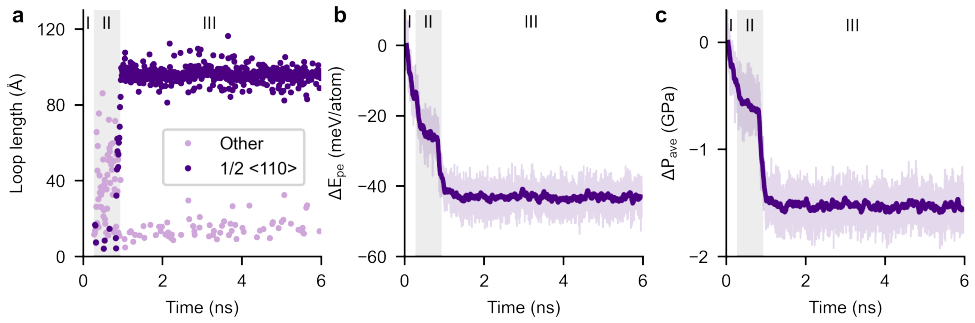
The central claim is that dislocation-loop formation in diamond is a strongly first-order phase transition whose order parameter is the loop area ψ. The paper constructs the sextic Ginzburg–Landau free energy F(ψ)=a/2 ψ² + b/4 ψ⁴ + c/6 ψ⁶ − f_ext ψ, with coefficients fixed from three independent machine-learned atomistic simulations: final loop area ψ0≈702 Ų, free-energy well depth ΔF≈678.7 eV, and elastic contribution ΔF_PV≈13.7 eV. The transition is strongly first-order because the order parameter jumps from 0 to ψ0, yet the nucleation barrier is small (≈3.7 eV), placing the precursor line-defect phase just above the spinodal. The authors assert the reduced free energy is material-indepen
Load-bearing premise
The machine-learned interatomic potential, which the paper states underestimates migration barriers, must faithfully reproduce both the Stage II→III energetics (ΔF≈678.7 eV) and the nanosecond waiting time used to fit the 3.7 eV barrier via an assumed prefactor τ0=10⁻¹² s.
Editorial extensions
If this is right
- Carbon interstitials alone are sufficient to nucleate dislocation loops and platelet-like planar defects in diamond, providing a nitrogen-free pathway that complements the nitrogen-mediated routes debated for type-Ia diamond.
- Because the loop-area order parameter jumps from zero to ~702 Ų while the barrier is only ~3.7 eV, the precursor line-defect phase is weakly metastable; loop formation is an activated rare event whose rate can be extrapolated to experimental temperatures (microseconds at 2800 K).
- The elastic-stress contribution is only about 2% of the released energy, so bond-energy reorganization, not elastic relaxation, is the dominant thermodynamic driver of loop formation in diamond.
- The same Ginzburg–Landau–Kramers framework extends to other irradiation-induced loop-forming materials, including tungsten, iron, silicon carbide, and gallium nitride, where high-fidelity interatomic potentials exist.
Reading between the lines
- If the material-independence of the reduced free energy holds beyond diamond and iron, then the ratio of barrier to energy release—rather than absolute energies—may be the universal quantity governing loop nucleation rates across crystals; this ratio could be computable from short, small-scale simulations in new materials.
- The identification of a critical nucleus of ~150 Ų (radius ~7 Å) suggests a directly testable prediction: loops smaller than this radius should tend to dissolve, while loops larger than it should grow spontaneously; irradiation experiments with size-resolved loop populations could check this.
- The authors' own note that the machine-learned potential underestimates migration barriers cuts against the fitted barrier: an underestimated barrier would make the 3.7 eV value a lower bound, so the strongest check is to recompute the loop free-energy surface with a more accurate potential.
- A natural extension is to compute the same GL coefficients for silicon and compare its reduced free-energy family to diamond's and iron's, which would test the universality claim in a third material without new experimental input.
Editorial analysis
A structured set of objections, weighed in public.
Referee Report
Summary. The manuscript reports large-scale neuroevolution-potential (NEP) molecular dynamics simulations of diamond containing 300 self-interstitials, observing aggregation into nitrogen-free planar defects and a prismatic ½⟨110⟩ dislocation loop. It characterizes the Stage II→III collapse of line-defect precursors into the loop as a first-order phase transition, proposing a sextic Ginzburg–Landau free energy with loop area as the order parameter. The coefficients are fixed from simulation data: loop area ψ0≈702 Ų, well depth ΔF≈678.7 eV, elastic fraction ΔFPV/ΔF≈2%, and a nucleation barrier ΔF*≈3.7 eV from a single Arrhenius fit at 6000 K. The abstract further claims that the reduced free energy is material-independent, with BCC iron falling on the same one-parameter family. The paper also discusses the atomistic mechanism, pressure dependence of the three defect classes, and electronic-structure analysis of the planar defects.
Significance. The qualitative observation that dislocation-loop formation involves a discontinuous drop in energy and pressure, with symmetry breaking, is a valuable and physically appealing result. If the quantitative framework were robust, the paper would offer a compact thermodynamic description of a complex atomistic nucleation process, with potential impact on irradiation-damage modeling. However, the quantitative claims—the 3.7 eV barrier, the critical nucleus size, the 2% elastic fraction viewed as a free-energy statement, and the material-universality assertion—are not currently supported. The structural findings on nitrogen-free platelet-like defects and their pressure dependence are interesting and may be of independent value, but the paper's central quantitative claims require substantial revision.
major comments (3)
- [Abstract; §3.3] The material-independence claim is a normalization artifact. After the rescaling x=ψ/ψ0 and F~=F/ΔF, the constraints F~(1)=−1 and F~'(1)=0 (with f~=ΔFPV/ΔF fixed) leave exactly one free parameter for any sextic polynomial of the form (1). The displayed family b~(ã)=−(11.63+4ã), c~(ã)=11.67+3ã is the general solution of these constraints. Therefore, any system whose reduced free energy is normalized to a unit well depth at its minimum will lie on this same family; the 'same one-parameter family' observation for BCC iron is thus not evidence of material independence unless the remaining parameter ã is fixed by an independent physical constraint in each material. The main text does not report the Fe analysis or the Fe-specific determination of ã, so the abstract's universality claim is unsupported as presented.
- [§3.3; Methods §3.2] The barrier ΔF*≈3.69 eV is obtained from a single Arrhenius point using ΔF*=kBT ln(τ/τ0) with τ0=10^-12 s assumed. This is a two-parameter fit to one measurement; τ0 is not computed, and no sensitivity analysis is provided. At 6000 K, a factor-of-10 uncertainty in τ0 shifts ΔF* by kBT ln(10)≈1.19 eV. Moreover, §3.2 states that the NEP potential slightly underestimates migration barriers, which means the observed waiting time τ≈1.25 ns is likely an upper bound and ΔF* a lower bound. Because the GL coefficients (ã≈0.74, b̃≈−14.77, c̃≈14.04), the critical nucleus area ≈150 Ų, and the extrapolated ~μs time at 2800 K all depend on this barrier, the quantitative central claims are not pinned down. The qualitative first-order classification is robust, but the quantitative framework needs either a computed prefactor, multi-temperature kinetic data, or a thorough uncertainty analysis.
- [§3.3; Eq. (1)] The quantity called the free-energy well depth ΔF is taken directly from the MD potential-energy drop ΔE_pe, and the barrier is obtained from an Arrhenius fit. However, Eq. (1) is a free energy, and Kramers' rate theory requires a free-energy barrier. At 6000 K, entropic contributions to the Helmholtz free energy are not obviously negligible, and the paper does not compute a free-energy difference (e.g., by thermodynamic integration or umbrella sampling). Consequently, the coefficients a, b, c are not demonstrated to be coefficients of a thermodynamic free energy, and quantitative statements such as 'elastic-stress contribution only 2%' and 'well depth ≈678.7 eV' conflate energy with free energy. The authors should either compute free-energy differences or explicitly state and justify the approximation that entropy is negligible in this transition.
minor comments (6)
- [§3.3] The reduced coefficients ã, b̃, c̃ are introduced in the text without explicit definitions. Please define them in terms of a, b, c, ψ0, and ΔF, or refer to the SI equation where they are defined.
- [§3.2] The statement that NEP's tendency to underestimate migration barriers is 'advantageous for accelerated sampling' is reasonable for exploring structures but directly problematic for barrier extraction; please add an explicit caveat in the kinetics section that the inferred barrier is a lower bound under this potential.
- [Introduction / Discussion] The name 'Kramers' is spelled inconsistently: 'Kramers’ rate theory' in §1.3 and 'Kramer’s' in the Discussion. Please standardize.
- [Methods §3.1] There is a typographical issue in 'V ASP' (missing space) in the VASP citation; please correct.
- [Figure 3] The text says 'the light-grey region highlights Stage II' but the Stage II→III transition is the focus; please clarify which stage is shaded in the caption and whether the grey region marks Stage II or the transition.
- [Data availability] The statement that code and input files will be released 'upon acceptance' may be acceptable, but many journals now require availability at review time; please consider providing the GL–Kramers code and input files to reviewers.
Circularity Check
The diamond GL coefficients are data-fixed, but the claimed material-independent one-parameter family is the general solution of the normalization constraints, making the universality claim definitional.
-
self definitional
[Abstract; Methods §3.3 (reduced variables and one-parameter family)]
"In reduced variables x=ψ/ψ0, F̃=F/ΔF, stationarity at x=1 and F̃(1) = −1 give two constraints, leaving a one-parameter family b̃(ã)=−(11.63+4ã), c̃(ã)=11.67+3ã; ... The reduced free energy proves material-independent: the vacancy platelet-to-loop collapse in body-centred-cubic iron falls on the same one-parameter family"
The one-parameter family is obtained by solving the two normalization conditions F̃(1)=−1 and F̃'(1)=0 for the assumed sextic form. Any sextic free energy, for diamond, iron, or any other material, can be reduced to this family by the same rescaling, so 'falling on the same family' is guaranteed by construction and carries no physical information. The material-independence claim is therefore a property of the chosen normalization, not an empirical finding.
-
self definitional
[Methods §3.3 (metastability discriminant)]
"the metastability discriminant b̃²−4ãc̃>0 holds for all ã≥0, confirming first-order character independently of any spinodal assumption"
First-order character was already assumed by taking a>0, b<0, c>0 in Eq. (1), 'the canonical sextic construction for a first-order transition.' The discriminant inequality follows algebraically from the one-parameter family and the sign choices; it is not an independent confirmation.
full rationale
The paper's core diamond-specific results — the discontinuous energy/pressure drop, the ≈3.7 eV barrier inferred from one 6000 K waiting time with an assumed prefactor, and the ≈98% bond-energy fraction — are direct simulation-derived quantities and are not circular. However, the headline universality claim in the abstract ('reduced free energy proves material-independent... same one-parameter family') is definitional: the one-parameter family is the general solution of the normalization conditions for any sextic GL free energy, so any material's normalized coefficients will fall on it. This is a central claim of the paper, so partial circularity (score 6) is appropriate. The Arrhenius/τ0 kinetics and the MLIP self-citation are not circular per se, though they carry quantitative uncertainty. The analysis is not fully self-contained: the Fe comparison is only asserted in the abstract, not shown in the main text, and the quoted family coefficients (11.63/11.67) appear inconsistent with the stated normalization, but the circularity conclusion rests on the definitional nature of the family rather than on arithmetic.
Assumptions & free parameters
free parameters (4)
- GL coefficients (ã, b̃, c̃) =
ã≈0.74, b̃≈−14.77, c̃≈14.04 (reduced units)
- Attempt/prefactor time τ0 =
10^-12 s
- Loop volume V_loop =
2103 ų
- Defective atom count / loop area ψ0 =
377 atoms → 702 Ų
assumptions (5)
- domain assumption NEP MLIP from ref 15 reproduces DFT energetics for carbon interstitials despite underestimating migration barriers
- domain assumption 6000 K accelerated sampling preserves the qualitative nucleation mechanism
- ad hoc to paper Sextic Ginzburg–Landau form with loop area as order parameter is the correct minimal description
- domain assumption Kramers' overdamped rate theory with a single collective coordinate describes the crossing
- ad hoc to paper The normalized 'one-parameter family' is physically meaningful material independence
Cite this review
Pith. "Pith review of Dislocation-loop formation is a first-order phase transition." pith.science (2026). https://pith.science/paper/KWB4WVGT
@misc{pith2026260629055,
  author       = {Pith},
  title        = {Pith review of: Dislocation-loop formation is a first-order phase transition},
  year         = {2026},
  howpublished = {\url{https://pith.science/paper/KWB4WVGT}},
  note         = {Machine review of arXiv:2606.29055}
}
abstract
Dislocation loops are the elementary product of radiation damage in crystals, limiting reactor-component lifetimes, power-electronics reliability and the coherence of solid-state qubits. Their nucleation has been simulated for six decades but never reduced to a thermodynamic law. We show that dislocation-loop formation is a \emph{first-order phase transition}, and construct its Ginzburg--Landau free energy, with the loop area as order parameter, entirely from atomistic simulation. In diamond, carbon self-interstitials condense into planar precursors that collapse abruptly into a prismatic $\tfrac{1}{2}\langle110\rangle$ loop across a 3.7-electronvolt barrier, with pressure--volume work supplying only 2\% of the energy released. The reduced free energy proves material-independent: the vacancy platelet-to-loop collapse in body-centred-cubic iron falls on the same one-parameter family, placing loop nucleation on a transferable thermodynamic footing.
Figures

Reference graph
Works this paper leans on
-
[1]
Németh, P.et al.Complex nanostructures in diamond. Nat. Mater.19, 1126–1131 (2020)
2020
-
[2]
Diamond dislocations analysis by x-ray topography.Funct
Shikata, S. Diamond dislocations analysis by x-ray topography.Funct. Diam.2, 175–191 (2022)
2022
-
[3]
Yan, H.et al.Multi-microscopy characterization of threading dislocations in CVD-grown diamond films. Appl. Phys. Lett.124, 102108 (2024)
2024
-
[4]
Goss, J.et al.Extended defects in diamond: The interstitial platelet.Phys. Rev. B67, 165208 (2003)
2003
-
[5]
Mater.17, 243–248 (2018)
Olivier, E.et al.Imaging the atomic structure and local chemistry of platelets in natural type Ia diamond.Nat. Mater.17, 243–248 (2018)
2018
-
[6]
T., Heggie, M
Blumenau, A. T., Heggie, M. I., Fall, C. J., Jones, R. & Frauenheim, T. Dislocations in diamond: Core structures and energies.Phys. Rev. B65, 205205 (2002)
2002
-
[7]
T.et al.Dislocations in diamond: Dissociation into partials and their glide motion.Phys
Blumenau, A. T.et al.Dislocations in diamond: Dissociation into partials and their glide motion.Phys. Rev. B68, 014115 (2003)
2003
-
[8]
Chen, L.et al.An electronic view on dislocation nucleation in diamond.Carbon245, 120834 (2025)
2025
Show all 64 references
-
[9]
The structure and mechanism of formation of platelets in natural type Ia diamond.Proc
Humble, P. The structure and mechanism of formation of platelets in natural type Ia diamond.Proc. Royal Soc. London. A. Math. Phys. Sci.381, 65–81 (1982)
1982
-
[10]
& Bruley, J
Fallon, P., Brown, L., Barry, J. & Bruley, J. Nitrogen determination and characterization in natural diamond platelets.Philos. Mag. A72, 21–37 (1995)
1995
-
[11]
& Lang, A
Sumida, N. & Lang, A. R. On the measurement of population density and size of platelets in type Ia diamond and its implications for platelet structure models.Proc. Royal Soc. London. A. Math. Phys. Sci.419, 235–257 (1988)
1988
-
[12]
A new proposal for the structure of platelets in diamond.Diam
Baker, J. A new proposal for the structure of platelets in diamond.Diam. Relat. Mater.7, 1282–1290 (1998)
1998
-
[13]
Hunt, D.et al.Identification of the neutral carbon <100>-split interstitial in diamond.Phys. Rev. B61, 3863 (2000)
2000
-
[14]
& Fisher, D
Kiflawi, I., Collins, A., Iakoubovskii, K. & Fisher, D. Electron irradiation and the formation of vacancy–interstitial pairs in diamond.J. Phys. Condens. Matter19, 046216 (2007)
2007
-
[15]
Chang, X.et al.Machine-learned prediction of carbon interstitial clusters in diamond.arXiv preprint arXiv:2606.19600(2026)
2026 arXiv
-
[16]
Commun.15, 10208 (2024)
Song, K.et al.General-purpose machine-learned potential for 16 elemental metals and their alloys.Nat. Commun.15, 10208 (2024)
2024
-
[17]
Genome Eng
Xu, K.et al.GPUMD 4.0: a high-performance molecular dynamics package for versatile materials simulations with machine-learned potentials.Mater. Genome Eng. Adv.3, e70028 (2025)
2025
-
[18]
Goss, J.et al.Interstitial aggregates in diamond.Diam. Relat. Mater.10, 434–438 (2001)
2001
-
[19]
& Smith, C
Speich, L., Kohn, S., Wirth, R., Bulanova, G. & Smith, C. The relationship between platelet size and the B′ infrared peak of natural diamonds revisited.Lithos278, 419–426 (2017)
2017
-
[20]
Visualization and analysis of atomistic simulation data with OVITO – the Open Visualization Tool.Model
Stukowski, A. Visualization and analysis of atomistic simulation data with OVITO – the Open Visualization Tool.Model. Simul. Mater. Sci. Eng.18, 015012 (2010). 8/10
2010
-
[21]
Pirouz, P., Cockayne, D. J. H., Sumida, N., Hirsch, P. & Lang, A. R. Dissociation of dislocations in diamond.Proc. Royal Soc. London. A. Math. Phys. Sci.386, 241–249 (1983)
1983
-
[22]
Nie, A.et al.Direct observation of room-temperature dislocation plasticity in diamond.Matter2, 1222–1232 (2020)
2020
-
[23]
Garcia Vidable, G.et al.Simulations of plasticity in diamond nanoparticles showing ultrahigh strength.Diam. Relat. Mater.126, 109109 (2022)
2022
-
[24]
C., Li, B., Rudd, R
Li, A. C., Li, B., Rudd, R. E. & Meyers, M. A. Dislocation generation in diamond under extreme loading. Matter6, 3040–3056 (2023)
2023
-
[25]
Aquistapace, F.et al.Plasticity in diamond nanoparticles: dislocations and amorphization during loading and dislocation multiplication during unloading.J. Mater. Sci.59, 4788–4809 (2024)
2024
-
[26]
B., Pirouz, P
Hirsch, P. B., Pirouz, P. & Barry, J. C. Platelets, dislocation loops and voidites in diamond.Proc. Royal Soc. London. A. Math. Phys. Sci.407, 239–258 (1986)
1986
-
[27]
& Phaal, C
Evans, T. & Phaal, C. Dislocation loops in diamond. Philos. Mag.7, 843–846 (1962)
1962
-
[28]
& Woods, G
Evans, T., Kiflawi, I., Luyten, W., Van Tendeloo, G. & Woods, G. S. Conversion of platelets into dislocation loops and voidite formation in type IaB diamonds.Proc. Royal Soc. London. Ser. A: Math. Phys. Sci.449, 295–313 (1995)
1995
-
[29]
Electron microscopy of ‘giant’platelets on cube planes in diamond.Philos
Woods, G. Electron microscopy of ‘giant’platelets on cube planes in diamond.Philos. Mag.34, 993–1012 (1976)
1976
-
[30]
Lee, S., Bondi, R. J. & Hwang, G. S. Integrated atomistic modelling of interstitial defect growth in silicon.Mol. Simul.35, 867–879 (2009)
2009
-
[31]
Mater.214, 114650 (2022)
Ohbitsu, M.et al.Atomic structures and stability of finite-size extended interstitial defects in silicon: large-scale molecular simulations with a neural-network potential.Scr. Mater.214, 114650 (2022)
2022
-
[32]
& Olsen, A
Humble, P., Mackenzie, J. & Olsen, A. Platelet defects in natural diamond. I. measurement of displacement.Philos. Mag. A52, 605–621 (1985)
1985
-
[33]
Botti, S.et al.Carbon structures and defect planes in diamond at high pressure.Phys. Rev. B88, 014102 (2013)
2013
-
[34]
Polat Genlik, S., Myers, R. C. & Ghazisaeidi, M. Dislocations as natural quantum wires in diamond.Phys. Rev. Mater.7, 024601 (2023)
2023
-
[35]
Ghassemizadeh, R., Körner, W., Urban, D. F. & Elsässer, C. Stability and electronic structure of NV centers at dislocation cores in diamond.Phys. Rev. B106, 174111 (2022)
2022
-
[36]
Su, Z.et al.Plasticity of diamond compared to cubic boron nitride.Phys. Rev. B108, 014104 (2023)
2023
-
[37]
Wang, P.et al.Dislocation-mediated brittle-ductile transition of diamond under high pressure.Diam. Relat. Mater.138, 110198 (2023)
2023
-
[38]
Yang, H.et al.Homogeneous and heterogeneous dislocation nucleation in diamond.Diam. Relat. Mater. 88, 110–117 (2018)
2018
-
[39]
Su, Z.et al.Mechanical quenching phenomenon in diamond.Proc. Natl. Acad. Sci.121, e2319663121 (2024)
2024
-
[40]
& Borkovec, M
Hänggi, P., Talkner, P. & Borkovec, M. Reaction-rate theory: fifty years after Kramers.Rev. Mod. Phys.62, 251–341 (1990)
1990
-
[41]
Bennetto, J., Nunes, R. W. & Vanderbilt, D. Period-doubled structure for the 90◦ partial dislocation in silicon.Phys. Rev. Lett.79, 245–248 (1997)
1997
-
[42]
W., Bennetto, J
Nunes, R. W., Bennetto, J. & Vanderbilt, D. Core reconstruction of the 90◦ partial dislocation in nonpolar semiconductors.Phys. Rev. B58, 12563–12566 (1998)
1998
-
[43]
N., Zhao, S., Bringa, E
Hahn, E. N., Zhao, S., Bringa, E. M. & Meyers, M. A. Supersonic dislocation bursts in silicon.Sci. Reports6, 26977 (2016)
2016
-
[44]
Zhao, S.et al.Amorphization and nanocrystallization of silicon under shock compression.Acta Mater.103, 519–533 (2016)
2016
-
[45]
Phase-field models for microstructure evolution.Annu
Chen, L.-Q. Phase-field models for microstructure evolution.Annu. Rev. Mater. Res.32, 113–140 (2002)
2002
-
[46]
U., Jin, Y
Wang, Y . U., Jin, Y . M., Cuitiño, A. M. & Khachaturyan, A. G. Nanoscale phase field microelasticity theory of dislocations: model and 3d simulations.Acta Mater.49, 1847–1857 (2001)
2001
-
[47]
Elder, K. R. & Grant, M. Modeling elastic and plastic deformations in nonequilibrium processing using phase field crystals.Phys. Rev. E70, 051605 (2004)
2004
-
[48]
Salman, O. U. & Truskinovsky, L. Minimal integer automaton behind crystal plasticity.Phys. Rev. Lett.106, 175503 (2011)
2011
-
[49]
J., Bartók, A
Szlachta, W. J., Bartók, A. P. & Csányi, G. Accuracy and transferability of Gaussian approximation potential models for tungsten.Phys. Rev. B90, 104108 (2014)
2014
-
[50]
D., Csányi, G
Dragoni, D., Daff, T. D., Csányi, G. & Marzari, N. Achieving DFT accuracy with a machine-learning interatomic potential: Thermomechanics and defects in bcc ferromagnetic iron.Phys. Rev. Mater.2, 013808 (2018)
2018
-
[51]
Cheng, M.et al.Revealing phonon signature of dislocations in silicon carbide using machine-learning interatomic potential.Appl. Phys. Lett.127(2025). 9/10
2025
-
[52]
Arakawa, K.et al.Observation of the one-dimensional diffusion of nanometer-sized dislocation loops.Science 318, 956–959 (2007)
2007
-
[53]
Mag.93, 1715–1738 (2013)
Yi, X.et al.In situ study of self-ion irradiation damage in W and W–5Re at 500 ◦c.Philos. Mag.93, 1715–1738 (2013)
2013
-
[54]
N., Bacon, D
Osetsky, Y . N., Bacon, D. J., Serra, A., Singh, B. N. & Golubov, S. I. Stability and mobility of defect clusters and dislocation loops in metals.J. Nucl. Mater.276, 65–77 (2000)
2000
-
[55]
Marian, J., Wirth, B. D. & Perlado, J. M. Mechanism of formation and growth of ⟨100⟩ interstitial loops in ferritic materials.Phys. Rev. Lett.88, 255507 (2002)
2002
-
[56]
Commun.9(2018)
Peng, Q.et al.Shockwave generates ⟨100⟩ dislocation loops in bcc iron.Nat. Commun.9(2018)
2018
-
[57]
Ma, P.-W., Mason, D. R. & Dudarev, S. L. Multiscale analysis of dislocation loops and voids in tungsten.Phys. Rev. Mater.4, 103609 (2020)
2020
-
[58]
W., Lu, G
Gao, N., Yao, Z. W., Lu, G. H., Deng, H. Q. & Gao, F. Mechanisms for ⟨100⟩ interstitial dislocation loops to diffuse in bcc iron.Nat. Commun.12(2021)
2021
-
[59]
Ab initio simulations of materials using V ASP: density-functional theory and beyond.J
Hafner, J. Ab initio simulations of materials using V ASP: density-functional theory and beyond.J. Comput. Chem. 29, 2044–2078 (2008)
-
[60]
P., Burke, K
Perdew, J. P., Burke, K. & Ernzerhof, M. Generalized gradient approximation made simple.Phys. Rev. Lett.77, 3865 (1996)
1996
-
[61]
Nelson, R.et al.LOBSTER: Local orbital projections, atomic charges, and chemical-bonding analysis from projector-augmented-wave-based density-functional theory.J. Comput. Chem.41, 1931–1940 (2020)
1931
-
[62]
A., Caro, M
Marchant, G. A., Caro, M. A., Karasulu, B. & Pártay, L. B. Exploring the configuration space of elemental carbon with empirical and machine learned interatomic potentials.npj Comput. Mater.9, 131 (2023)
2023
-
[63]
Luo, K.et al.Coherent interfaces govern direct transformation from graphite to diamond.Nature607, 486–491 (2022)
2022
-
[64]
& Shao, J.-L
Wu, Y .-C. & Shao, J.-L. Mdapy: a flexible and efficient analysis software for molecular dynamics simulations. Comput. Phys. Commun.290, 108764 (2023). 10/10
2023
Reviewed August 4, 2026 · model on record in the stance chip above.
Discussion (0). Sign in to comment.