REVIEW 1 major objections 1 minor 47 references
Evolution of Compact Stellar Systems in Ultralight Dark Matter Halos: Dependence on Stellar and Dark Matter Parameters
T0 review · 1 major / 1 minor · reviewed 2026-06-30 · grok-4.3
Pith's one-line read Metal-richer compact stellar systems resist disruption more effectively in ultralight dark matter halos, with heating strength depending on particle mass and system size relative to the de Broglie wavelength.
desk verdict This extends their prior work with metallicity, tides, and a reversed mass trend in the small-system limit, but that trend's numerical robustness is the open question. read the letter →
The pith
A machine-rendered reading of the paper's core claim, the machinery that carries it, and where it could break.
The reading
What carries the argument
Numerical simulations that include two-body relaxation together with ULDM wave interference heating inside an external tidal field.
What would settle it
A surviving metal-poor compact system in a regime where strong heating is predicted, or direct measurements showing heating does not increase with particle mass when R_h ≪ λ_dB.
Extended reading notes
Core claim
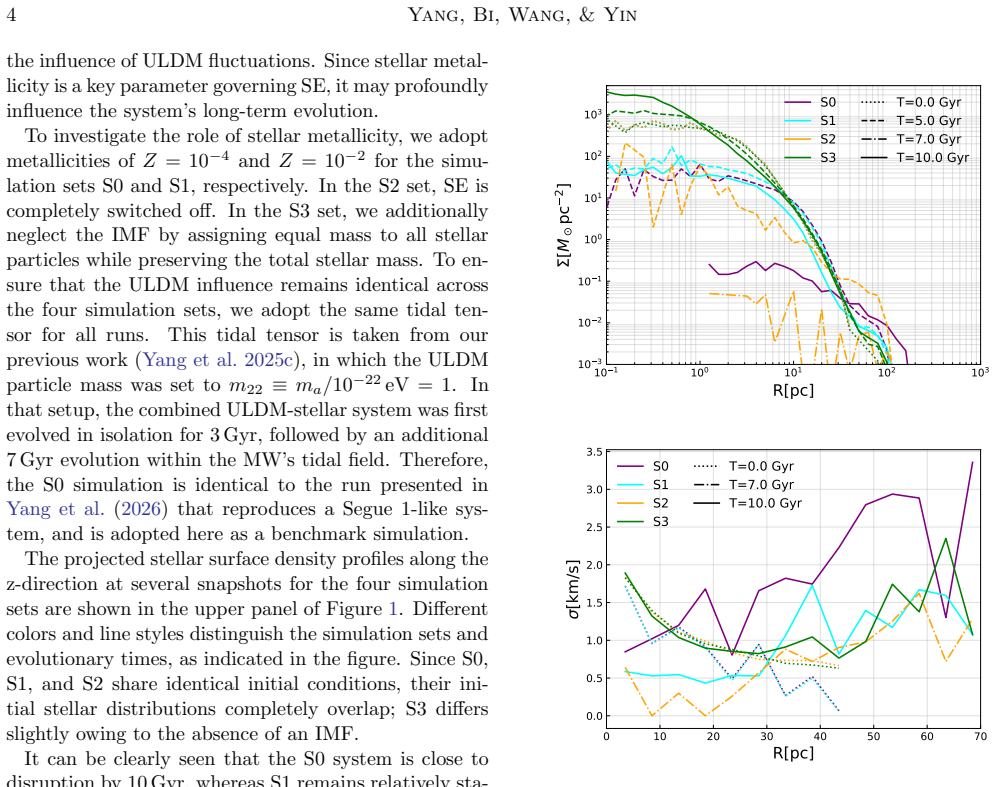
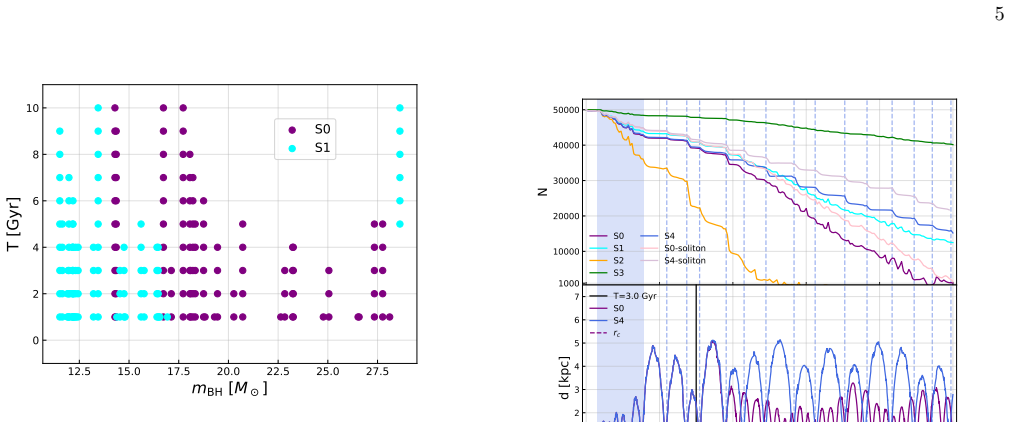
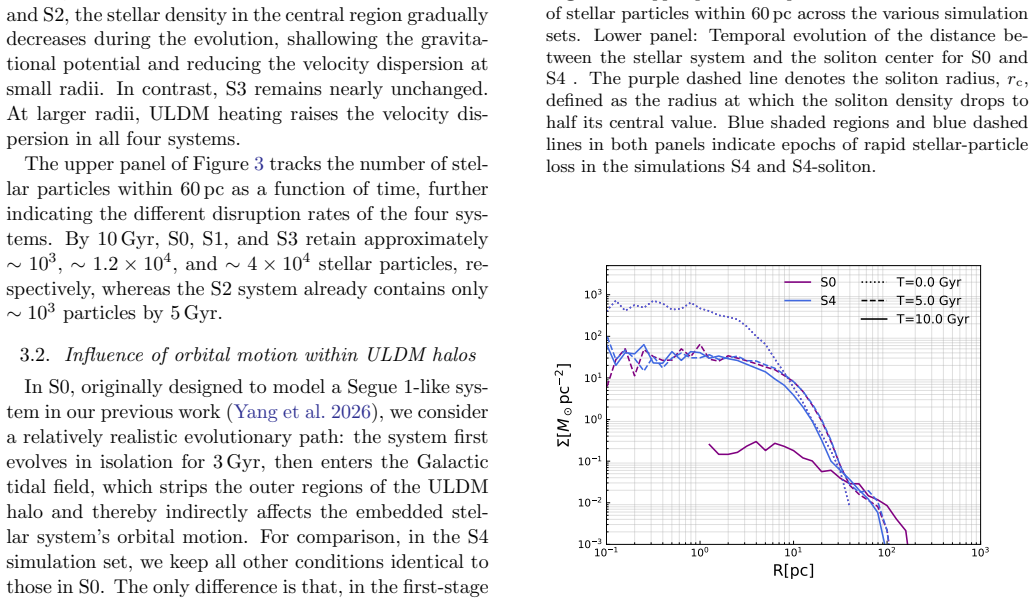
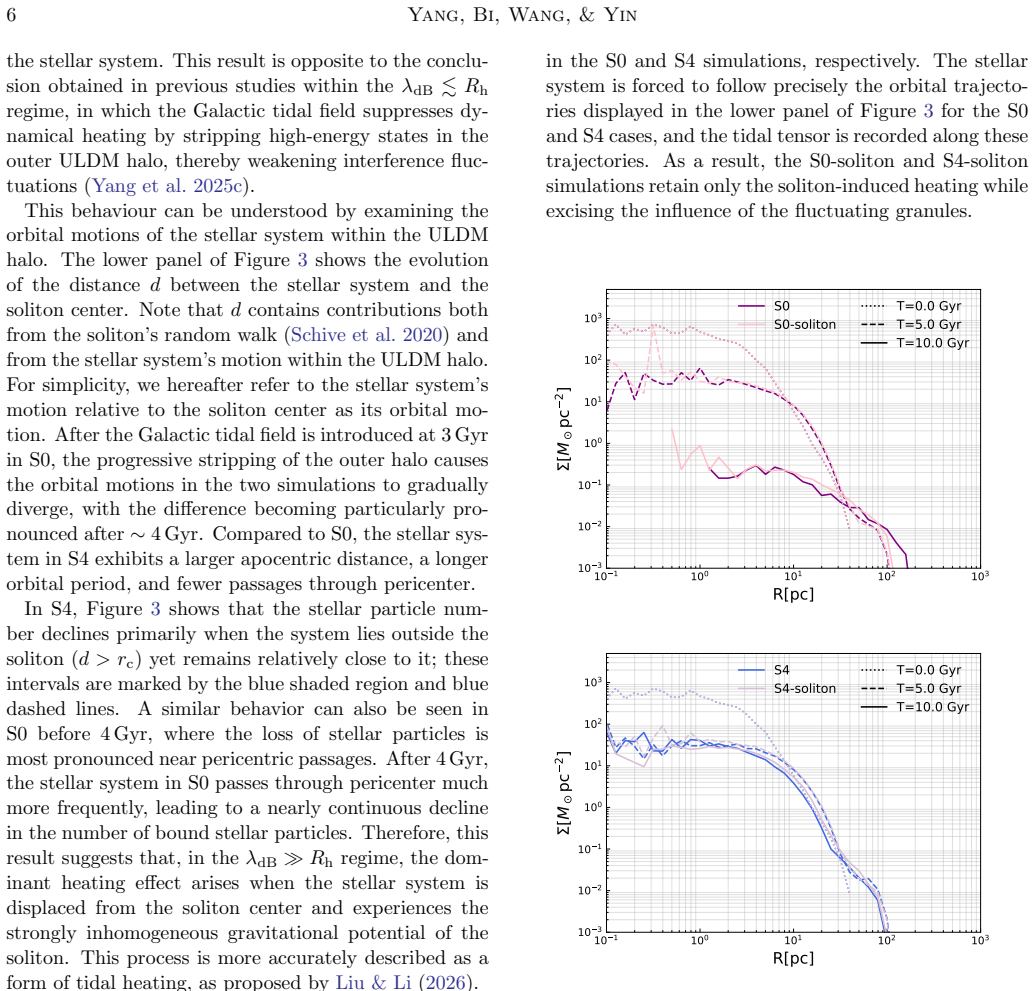
Compact stellar systems evolve under the combined action of internal two-body relaxation and wave heating from the surrounding ultralight dark matter. Metal-richer populations are generally more resistant to disruption. The Milky Way tidal field changes orbital motion inside the host halo and therefore affects stability. Simulations show that the heating effect strengthens with rising ULDM particle mass in the regime R_h ≪ λ_dB, in contrast to the λ_dB ≲ R_h case.
Load-bearing premise
The simulations correctly capture the interplay between two-body relaxation, ULDM wave heating, and external tides without dominant numerical artifacts or missing processes that would change the reported trends.
Editorial analysis
A structured set of objections, weighed in public.
Referee Report
Summary. The manuscript uses N-body simulations of compact stellar systems in ULDM halos to study the effects of stellar metallicity, Milky Way tidal fields, and ULDM particle mass on long-term evolution and disruption. Building on prior work that included two-body relaxation, it reports that metal-richer systems resist disruption better, that the MW tidal field alters orbital motion and thereby affects stability, and that ULDM wave heating strengthens with increasing particle mass specifically in the R_h ≪ λ_dB regime (in contrast to the λ_dB ≲ R_h regime). The authors conclude that existing ULDM constraints from ultrafaint dwarfs may need revision.
Significance. If the reported trends hold after verification, the work usefully demonstrates that multiple physical effects (metallicity-dependent stellar dynamics, external tides, and ULDM mass) must be considered jointly when using compact stellar systems to bound the ULDM particle mass. The explicit inclusion of two-body relaxation alongside tides and ULDM wave heating is a constructive extension of earlier studies.
major comments (1)
- [Results section on ULDM mass dependence] Results section discussing the ULDM particle-mass scan: the distinctive claim that heating strengthens with increasing m when R_h ≪ λ_dB is load-bearing for the paper's suggestion that prior constraints require revision, yet the manuscript provides no resolution-doubling tests, time-step convergence checks, or changes to the ULDM solver parameters in that regime. Without such tests the trend could be an artifact of the grid-based wave modeling when the stellar system is much smaller than the de Broglie scale.
minor comments (1)
- [Abstract] Abstract: the statement that 'the heating effect becomes stronger with increasing ULDM particle mass' should be qualified with the regime (R_h ≪ λ_dB) already in the abstract to avoid over-generalization.
Simulated Author's Rebuttal
We thank the referee for their constructive feedback, which highlights an important point about numerical robustness in the ULDM mass-dependence results. We address the single major comment below and will revise the manuscript accordingly.
read point-by-point responses
-
Referee: Results section discussing the ULDM particle-mass scan: the distinctive claim that heating strengthens with increasing m when R_h ≪ λ_dB is load-bearing for the paper's suggestion that prior constraints require revision, yet the manuscript provides no resolution-doubling tests, time-step convergence checks, or changes to the ULDM solver parameters in that regime. Without such tests the trend could be an artifact of the grid-based wave modeling when the stellar system is much smaller than the de Broglie scale.
Authors: We acknowledge that the current manuscript does not present explicit resolution-doubling, time-step convergence, or ULDM solver parameter variation tests specifically in the R_h ≪ λ_dB regime. This is a valid concern for a load-bearing claim. In the revised version we will add a dedicated convergence subsection that reports (i) doubled spatial resolution runs, (ii) halved time-step runs, and (iii) changes to grid size and solver tolerances for the smallest stellar systems. These tests will be performed for at least two representative particle masses in the regime of interest. We expect the reported trend to remain, but we agree that the tests must be shown explicitly before the suggestion to revise existing constraints can be considered robust. revision: yes
Circularity Check
No circularity: results are simulation outputs exploring external parameters
full rationale
The paper reports outcomes from N-body + ULDM simulations varying stellar metallicity, Milky Way tides, and ULDM particle mass. Claims such as metal-richer systems being more resistant and heating strengthening with mass for R_h ≪ λ_dB are presented as direct simulation findings, not reductions of fitted parameters or self-definitions. The cited prior work on two-body relaxation is background context and not used to force the new trends by construction. No equations or steps equate outputs to inputs via the enumerated circularity patterns.
Assumptions & free parameters
assumptions (2)
- domain assumption ULDM wave interference produces a heating effect on stellar systems
- domain assumption Two-body relaxation significantly affects evolution in compact stellar systems
Cite this review
Pith. "Pith review of Evolution of Compact Stellar Systems in Ultralight Dark Matter Halos: Dependence on Stellar and Dark Matter Parameters." pith.science (2026). https://pith.science/paper/WOJ2X3ZS
@misc{pith2026260629149,
  author       = {Pith},
  title        = {Pith review of: Evolution of Compact Stellar Systems in Ultralight Dark Matter Halos: Dependence on Stellar and Dark Matter Parameters},
  year         = {2026},
  howpublished = {\url{https://pith.science/paper/WOJ2X3ZS}},
  note         = {Machine review of arXiv:2606.29149}
}
abstract
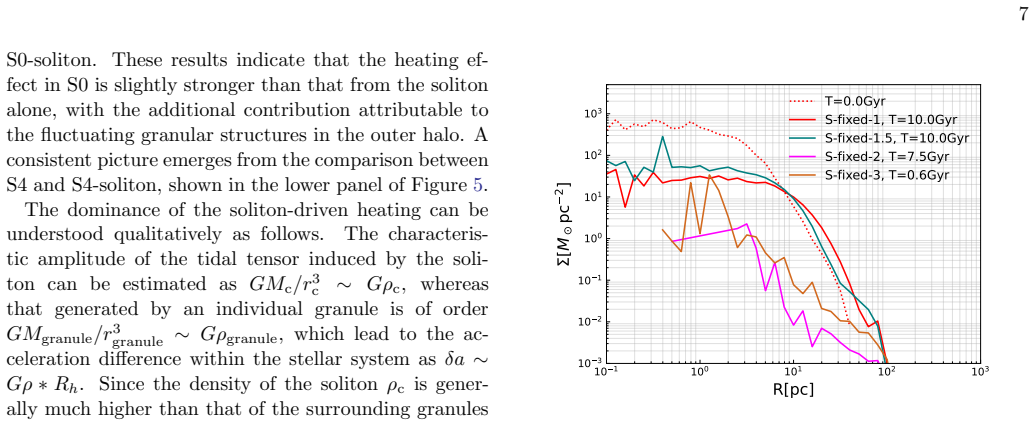
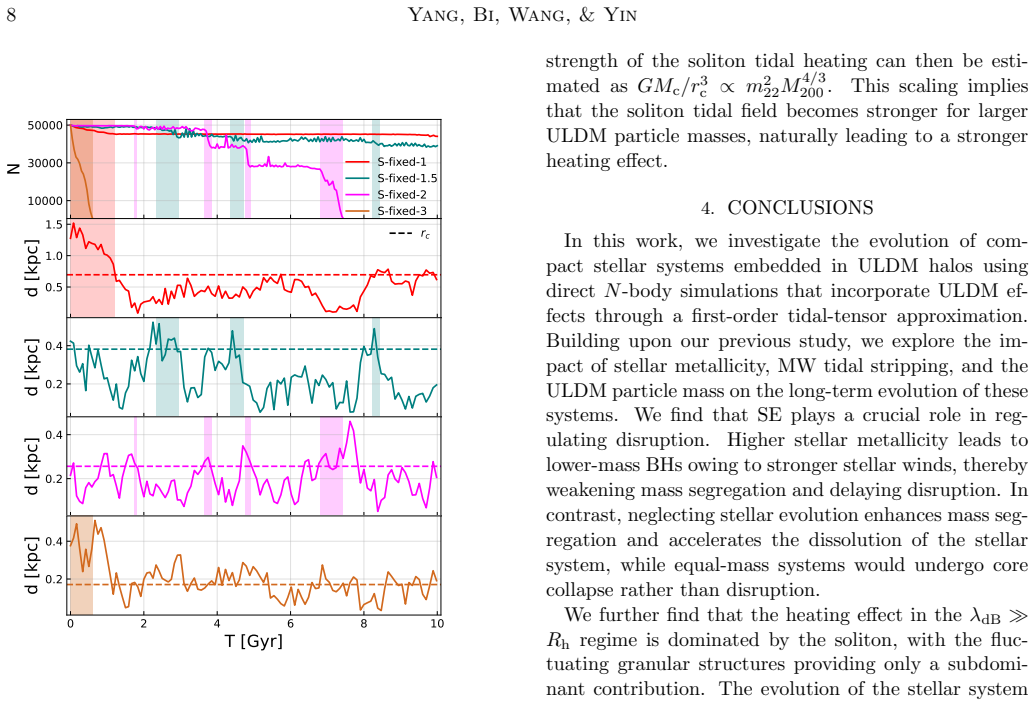
Compact stellar systems are often used to place stringent constraints on the particle mass of ultralight dark matter (ULDM), as the heating effect induced by wave interference can drive system expansion, potentially bringing them into tension with observations. In a recent study, we pointed out that internal two-body relaxation in these stellar systems may have a significant impact on their evolution in ULDM halos, an effect overlooked in previous studies. Here, we further investigate the influence of stellar metallicity, the Milky Way's tidal field, and the ULDM particle mass on the long-term fate of compact stellar populations. We find that metal-richer systems are generally more resistant to disruption. The tidal field of the Milky Way, by altering the orbital motion of the stellar systems within host ULDM halos, can significantly affect their stability. Furthermore, we find in our simulations that the heating effect becomes stronger with increasing ULDM particle mass when the system size is much smaller than the ULDM de Broglie wavelength $R_{\rm h} \ll \lambda_{\rm dB} $, in contrast to the $\lambda_{\rm dB}\lesssim R_{\rm h}$ case. These results highlight the complexity of the evolution of compact stellar systems in ULDM halos, and suggest that existing constraints derived from the systems, such as ultrafaint dwarf galaxies, may require careful revision.
Figures
Figures from the paper (3 more)
Reference graph
Works this paper leans on
-
[1]
, year = 1970, month = feb, volume =
Rotation of the Andromeda Nebula from a Spectroscopic Survey of Emission Regions. , year = 1970, month = feb, volume =. doi:10.1086/150317 , adsurl =
-
[2]
Bertone, Gianfranco and Hooper, Dan. History of dark matter. Rev. Mod. Phys. 2018. doi:10.1103/RevModPhys.90.045002. arXiv:1605.04909
work page Pith review arXiv doi:10.1103/revmodphys.90.045002 2018
-
[3]
Cirelli, Marco and Strumia, Alessandro and Zupan, Jure. Dark Matter. 2024. arXiv:2406.01705
work page Pith review arXiv 2024
-
[4]
Nature Reviews Physics , keywords =
Vogelsberger, Mark and Marinacci, Federico and Torrey, Paul and Puchwein, Ewald. Cosmological Simulations of Galaxy Formation. Nature Rev. Phys. 2020. doi:10.1038/s42254-019-0127-2. arXiv:1909.07976
-
[5]
Bullock, James S. and Boylan-Kolchin, Michael , year=. Small-Scale Challenges to the <b><i>Λ</i></b>CDM Paradigm , volume=. Annual Review of Astronomy and Astrophysics , publisher=. doi:10.1146/annurev-astro-091916-055313 , number=
-
[6]
Dark Matter Self-interactions and Small Scale Structure
Tulin, Sean and Yu, Hai-Bo. Dark Matter Self-interactions and Small Scale Structure. Phys. Rept. 2018. doi:10.1016/j.physrep.2017.11.004. arXiv:1705.02358
work page Pith review arXiv doi:10.1016/j.physrep.2017.11.004 2018
-
[7]
and Wetzel, Andrew and Fattahi, Azadeh
Sales, Laura V. and Wetzel, Andrew and Fattahi, Azadeh. Baryonic solutions and challenges for cosmological models of dwarf galaxies. Nature Astron. 2022. doi:10.1038/s41550-022-01689-w. arXiv:2206.05295
-
[8]
Fuzzy Cold Dark Matter: The Wave Properties of Ultralight Particles , volume=
Hu, Wayne and Barkana, Rennan and Gruzinov, Andrei , year=. Fuzzy Cold Dark Matter: The Wave Properties of Ultralight Particles , volume=. Physical Review Letters , publisher=. doi:10.1103/physrevlett.85.1158 , number=
Show all 47 references
-
[9]
Peebles, P. J. E. , year=. Fluid Dark Matter , volume=. The Astrophysical Journal , publisher=. doi:10.1086/312677 , number=
-
[10]
and Tremaine, Scott and Witten, Edward , year=
Hui, Lam and Ostriker, Jeremiah P. and Tremaine, Scott and Witten, Edward , year=. Ultralight scalars as cosmological dark matter , volume=. Physical Review D , publisher=. doi:10.1103/physrevd.95.043541 , number=
-
[11]
Wave Dark Matter , volume=
Hui, Lam , year=. Wave Dark Matter , volume=. Annual Review of Astronomy and Astrophysics , publisher=. doi:10.1146/annurev-astro-120920-010024 , number=
-
[12]
Ferreira, Elisa G. M. , year=. Ultra-light dark matter , volume=. The Astronomy and Astrophysics Review , publisher=. doi:10.1007/s00159-021-00135-6 , number=
-
[13]
and Bolton, James S
Iršič, Vid and Viel, Matteo and Haehnelt, Martin G. and Bolton, James S. and Becker, George D. , year=. First Constraints on Fuzzy Dark Matter from Lyman- Forest Data and Hydrodynamical Simulations , volume=. Physical Review Letters , publisher=. doi:10.1103/physrevlett.119.03...
-
[14]
and Peiris, Hiranya V
Rogers, Keir K. and Peiris, Hiranya V. , year=. Strong Bound on Canonical Ultralight Axion Dark Matter from the Lyman-Alpha Forest , volume=. Physical Review Letters , publisher=. doi:10.1103/physrevlett.126.071302 , number=
-
[15]
Hayashi, Kohei and Ferreira, Elisa G. M. and Chan, Hei Yin Jowett , year=. Narrowing the Mass Range of Fuzzy Dark Matter with Ultrafaint Dwarfs , volume=. The Astrophysical Journal Letters , publisher=. doi:10.3847/2041-8213/abf501 , number=
-
[16]
Zimmermann, Tim and Alvey, James and Marsh, David J. E. and Fairbairn, Malcolm and Read, Justin I. Dwarf Galaxies Imply Dark Matter is Heavier than 2.2 10-21 \, \, eV. Phys. Rev. Lett. 2025. doi:10.1103/PhysRevLett.134.151001. arXiv:2405.20374
2025 doi
-
[17]
Marsh, David J. E. and Niemeyer, Jens C. Strong Constraints on Fuzzy Dark Matter from Ultrafaint Dwarf Galaxy Eridanus II. Phys. Rev. Lett. 2019. doi:10.1103/PhysRevLett.123.051103. arXiv:1810.08543
2019 doi
-
[18]
Excluding fuzzy dark matter with sizes and stellar kinematics of ultrafaint dwarf galaxies
Dalal, Neal and Kravtsov, Andrey. Excluding fuzzy dark matter with sizes and stellar kinematics of ultrafaint dwarf galaxies. Phys. Rev. D. 2022. doi:10.1103/PhysRevD.106.063517. arXiv:2203.05750
2022 doi
-
[19]
Ultralight dark matter simulations and stellar dynamics: Tension in dwarf galaxies for m < 5 10-21 \, \, eV
Teodori, Luca and Caputo, Andrea and Blum, Kfir. Ultralight dark matter simulations and stellar dynamics: Tension in dwarf galaxies for m < 5 10-21 \, \, eV. Phys. Rev. D. 2026. doi:10.1103/jc6p-rlvh. arXiv:2501.07631
2026 doi
-
[20]
Relaxation in a Fuzzy Dark Matter Halo , volume=
Bar-Or, Ben and Fouvry, Jean-Baptiste and Tremaine, Scott , year=. Relaxation in a Fuzzy Dark Matter Halo , volume=. The Astrophysical Journal , publisher=. doi:10.3847/1538-4357/aaf28c , number=
-
[21]
The effect of fluctuating fuzzy axion haloes on stellar dynamics: a stochastic model , volume=
El-Zant, Amr A and Freundlich, Jonathan and Combes, Françoise and Halle, Anaelle , year=. The effect of fluctuating fuzzy axion haloes on stellar dynamics: a stochastic model , volume=. Monthly Notices of the Royal Astronomical Society , publisher=. doi:10.1093/mnras/stz3478 , number=
-
[22]
and van Dokkum, Pieter and Robles, Victor H
Dutta Chowdhury, Dhruba and van den Bosch, Frank C. and van Dokkum, Pieter and Robles, Victor H. and Schive, Hsi-Yu and Chiueh, Tzihong , year=. On the Dynamical Heating of Dwarf Galaxies in a Fuzzy Dark Matter Halo , volume=. The Astrophysical Journal , publisher=. doi:10.384...
-
[23]
A theoretical perspective on the almost dark galaxy Nube: exploring the fuzzy dark matter model
Yang, Yu-Ming and Bi, Xiao-Jun and Yin, Peng-Fei. A theoretical perspective on the almost dark galaxy Nube: exploring the fuzzy dark matter model. JCAP. 2024. doi:10.1088/1475-7516/2024/07/054. arXiv:2404.05375
2024 doi
-
[24]
Interpreting the Extremely Diffuse Stellar Distribution of the Nube Galaxy through Fuzzy Dark Matter
Yang, Yu-Ming and Zhang, Zhao-Chen and Bi, Xiao-Jun and Yin, Peng-Fei. Interpreting the Extremely Diffuse Stellar Distribution of the Nube Galaxy through Fuzzy Dark Matter. Astrophys. J. Lett. 2025. doi:10.3847/2041-8213/adb7da. arXiv:2412.01307
2025 doi
-
[25]
2025 , eprint=
A Semi-Analytic model for Effects of Fuzzy Dark Matter Granule Perturbations on Orbital Motion , author=. 2025 , eprint=
2025
-
[26]
Tidal Suppression of Fuzzy Dark Matter Heating in Milky Way Satellite Galaxies
Yang, Yu-Ming and Zhang, Zhao-Chen and Bi, Xiao-Jun and Yin, Peng-Fei. Tidal Suppression of Fuzzy Dark Matter Heating in Milky Way Satellite Galaxies. Astrophys. J. Lett. 2025. doi:10.3847/2041-8213/adff81. arXiv:2507.01686
2025 doi
-
[27]
Updated bounds on ultra-light dark matter from the tiniest galaxies
May, Simon and Dalal, Neal and Kravtsov, Andrey. Updated bounds on ultra-light dark matter from the tiniest galaxies. 2025. arXiv:2509.02781
2025
-
[28]
Heating and scattering of stellar distributions by ultralight dark matter
Eberhardt, Andrew and Gosenca, Mateja and Hui, Lam. Heating and scattering of stellar distributions by ultralight dark matter. 2025. arXiv:2510.17079
2025
-
[29]
2026 , eprint=
Influence of tides and self-gravity on Ultra-Light Dark Matter Bounds from Dwarf Galaxies , author=. 2026 , eprint=
2026
-
[30]
Collapse versus Disruption: The Fate of Compact Stellar Systems in Ultralight Dark Matter Halos
Yang, Yu-Ming and Bi, Xiao-Jun and Wang, Long and Yin, Peng-Fei. Collapse versus Disruption: The Fate of Compact Stellar Systems in Ultralight Dark Matter Halos. 2026. arXiv:2601.09403
2026
-
[31]
Hurley, J. R. and Pols, O. R. and Tout, C. A. , year=. Comprehensive analytic formulae for stellar evolution as a function of mass and metallicity , volume=. Monthly Notices of the Royal Astronomical Society , publisher=. doi:10.1046/j.1365-8711.2000.03426.x , number=
-
[32]
and Tout, Christopher A
Hurley, Jarrod R. and Tout, Christopher A. and Pols, Onno R. , year=. Evolution of binary stars and the effect of tides on binary populations , volume=. Monthly Notices of the Royal Astronomical Society , publisher=. doi:10.1046/j.1365-8711.2002.05038.x , number=
2002 doi
-
[33]
petar: a high-performance N-body code for modelling massive collisional stellar systems , volume=
Wang, Long and Iwasawa, Masaki and Nitadori, Keigo and Makino, Junichiro , year=. petar: a high-performance N-body code for modelling massive collisional stellar systems , volume=. Monthly Notices of the Royal Astronomical Society , publisher=. doi:10.1093/mnras/staa1915 , number=
-
[34]
2026 , eprint=
Tidal Heating of Stellar Clusters in Fuzzy Dark Matter Halos , author=. 2026 , eprint=
2026
-
[35]
Dynamical evolution of globular clusters
-
[36]
and Heggie, D.C
Meylan, G. and Heggie, D.C. , year=. Internal dynamics of globular clusters , volume=. Astronomy and Astrophysics Review , publisher=. doi:10.1007/s001590050008 , number=
-
[37]
Galactic Dynamics: Second Edition
-
[38]
Self-consistent construction of virialized wave dark matter halos , volume=
Lin, Shan-Chang and Schive, Hsi-Yu and Wong, Shing-Kwong and Chiueh, Tzihong , year=. Self-consistent construction of virialized wave dark matter halos , volume=. Physical Review D , publisher=. doi:10.1103/physrevd.97.103523 , number=
-
[39]
and Li, Xinyu and Hui, Lam , year=
Yavetz, Tomer D. and Li, Xinyu and Hui, Lam , year=. Construction of wave dark matter halos: Numerical algorithm and analytical constraints , volume=. Physical Review D , publisher=. doi:10.1103/physrevd.105.023512 , number=
-
[40]
Construction of fuzzy dark matter halos with arbitrary initial velocities
Yang, Yu-Ming and Bi, Xiao-Jun and Yin, Peng-Fei. Construction of fuzzy dark matter halos with arbitrary initial velocities. Phys. Rev. D. 2025. doi:10.1103/PhysRevD.111.063013. arXiv:2412.08372
2025 doi
-
[41]
PyUltraLight: a pseudo-spectral solver for ultralight dark matter dynamics , volume=
Edwards, Faber and Kendall, Emily and Hotchkiss, Shaun and Easther, Richard , year=. PyUltraLight: a pseudo-spectral solver for ultralight dark matter dynamics , volume=. Journal of Cosmology and Astroparticle Physics , publisher=. doi:10.1088/1475-7516/2018/10/027 , number=
2018 doi
-
[42]
doi:10.1093/mnras/71.5.460 , adsurl =
On the problem of distribution in globular star clusters. doi:10.1093/mnras/71.5.460 , adsurl =
-
[43]
Küpper, Andreas H. W. and Maschberger, Thomas and Kroupa, Pavel and Baumgardt, Holger , year=. Mass segregation and fractal substructure in young massive clusters - I. The McLuster code and method calibration: Mass segregation and fractal substructure , volume=. Monthly Notice...
2011 doi
- [44]
-
[45]
Eldridge, J. J. and Vink, J. S. , year=. Implications of the metallicity dependence of Wolf-Rayet winds , volume=. Astronomy & Astrophysics , publisher=. doi:10.1051/0004-6361:20065001 , number=
-
[46]
Soliton Random Walk and the Cluster-Stripping Problem in Ultralight Dark Matter
Schive, Hsi-Yu and Chiueh, Tzihong and Broadhurst, Tom. Soliton Random Walk and the Cluster-Stripping Problem in Ultralight Dark Matter. Phys. Rev. Lett. 2020. doi:10.1103/PhysRevLett.124.201301. arXiv:1912.09483
2020 doi
-
[47]
Pauchy , year=
Schive, Hsi-Yu and Liao, Ming-Hsuan and Woo, Tak-Pong and Wong, Shing-Kwong and Chiueh, Tzihong and Broadhurst, Tom and Hwang, W-Y. Pauchy , year=. Understanding the Core-Halo Relation of Quantum Wave Dark Matter from 3D Simulations , volume=. Physical Review Letters , publish...
Reviewed June 30, 2026 · model on record in the stance chip above.
Discussion (0). Continue with ORCID to comment.