The Lockman-SpReSO Project: A Deep X-ray Spectral View of a FIR-selected AGN Population
Pith reviewed 2026-06-30 01:49 UTC · model grok-4.3
The pith
FIR-selected AGNs show an increasing obscured fraction with redshift and a luminosity-dependent covering factor supporting the receding torus.
A machine-rendered reading of the paper's core claim, the machinery that carries it, and where it could break.
Core claim
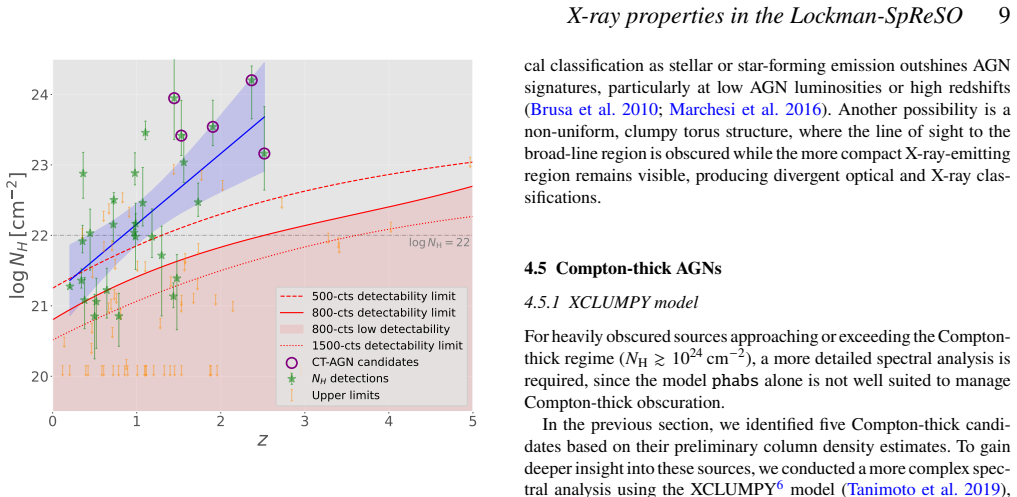
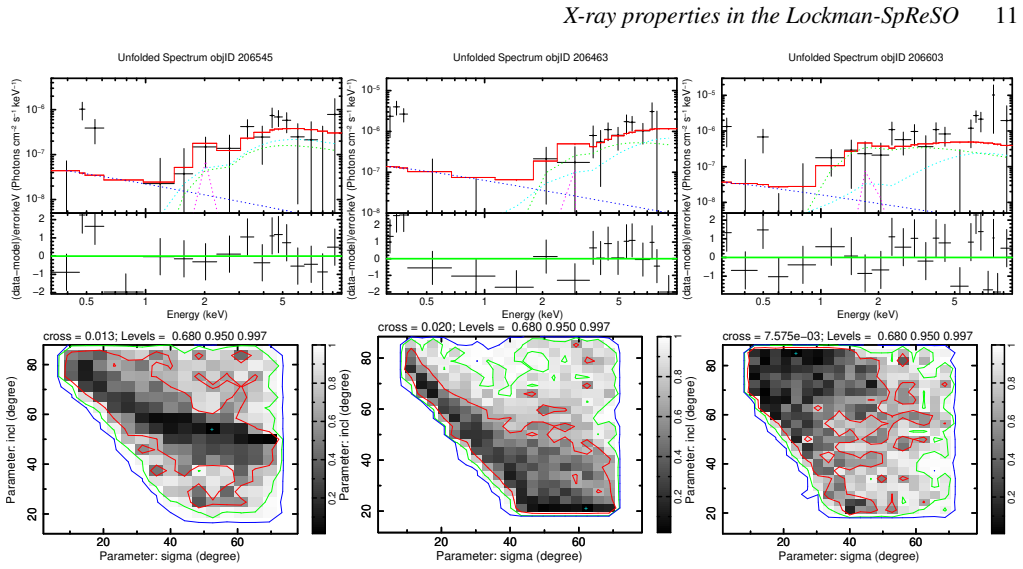
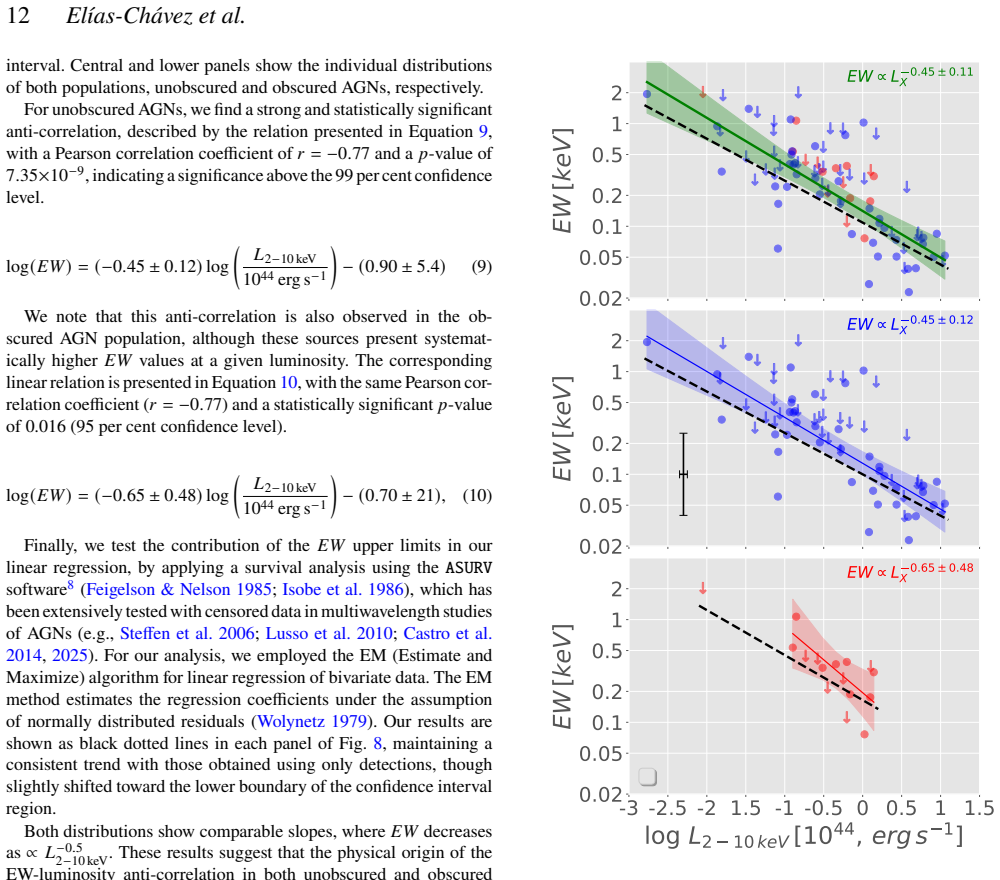
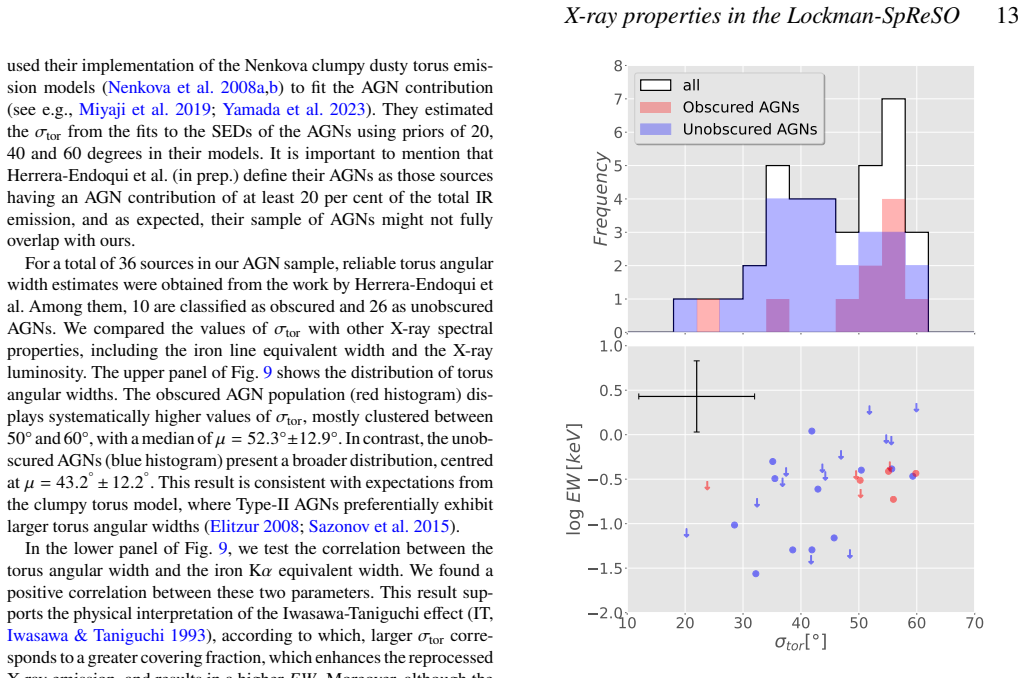
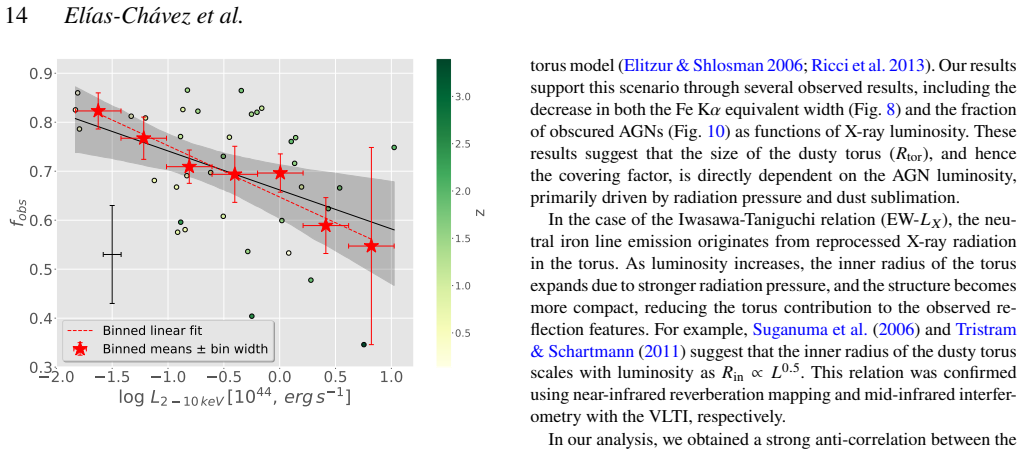
In a sample of 94 FIR-selected AGNs observed with deep XMM-Newton data, the fraction of obscured sources increases toward higher redshift; soft excess is found in ten AGNs with mean temperature 0.12 keV; the X-ray Baldwin effect appears in both obscured and unobscured subsamples; and the torus covering factor follows f_cov = (-0.1 ± 0.01) × log(L_{2-10 keV}/10^{44} erg s^{-1}) + (0.65 ± 0.01), consistent with the receding-torus picture, while one strong and two borderline Compton-thick candidates are identified.
What carries the argument
X-ray spectral models (absorbed power-law plus reflection and soft excess, with XCLUMPY applied to candidate Compton-thick sources) applied to FIR-cross-matched sources to extract intrinsic column density, luminosity, iron-line equivalent width, and covering factor.
If this is right
- The obscured AGN fraction increases with redshift in this population.
- Soft excess emission appears in 10 sources with average temperature 0.12 ± 0.02 keV.
- Covering factor declines with X-ray luminosity according to the quoted linear relation.
- One strong and two borderline Compton-thick AGN candidates are present.
- The X-ray Baldwin effect is detected in both obscured and unobscured subsamples.
Where Pith is reading between the lines
- FIR selection may provide a more complete census of obscured AGNs than X-ray flux-limited surveys alone.
- The observed luminosity-covering factor trend could be tested by repeating the analysis on purely optical or mid-infrared selected samples at similar redshifts.
- If the redshift trend holds, models of AGN feedback and galaxy evolution will need to incorporate stronger obscuration at early cosmic times.
Load-bearing premise
The chosen spectral models and the FIR selection introduce no major systematic biases in the derived column densities, luminosities, or covering factors across the full redshift range.
What would settle it
An independent measurement of column densities in a comparable FIR-selected sample at z > 2 that shows no rise in the obscured fraction would falsify the reported redshift trend.
Figures
read the original abstract
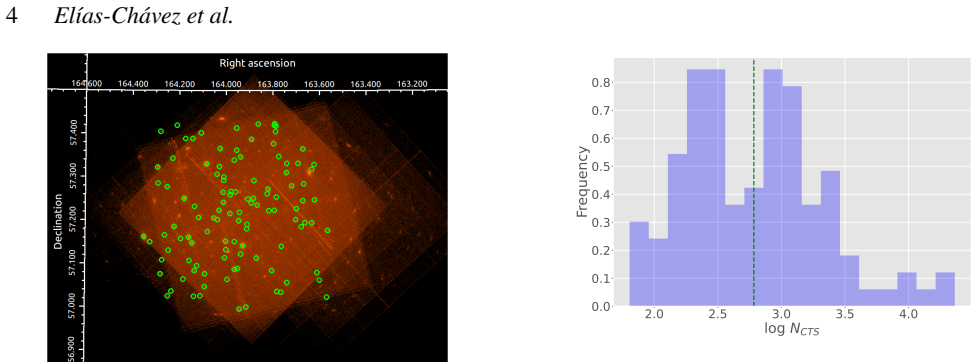
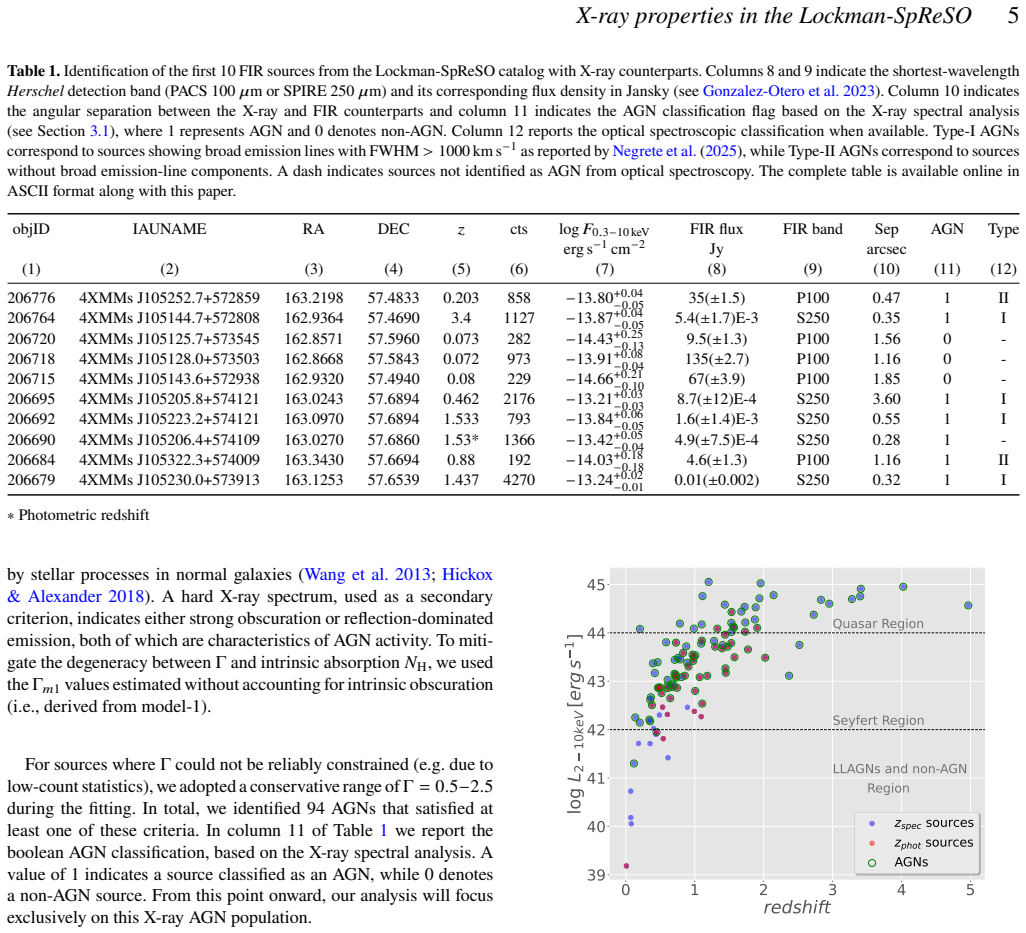
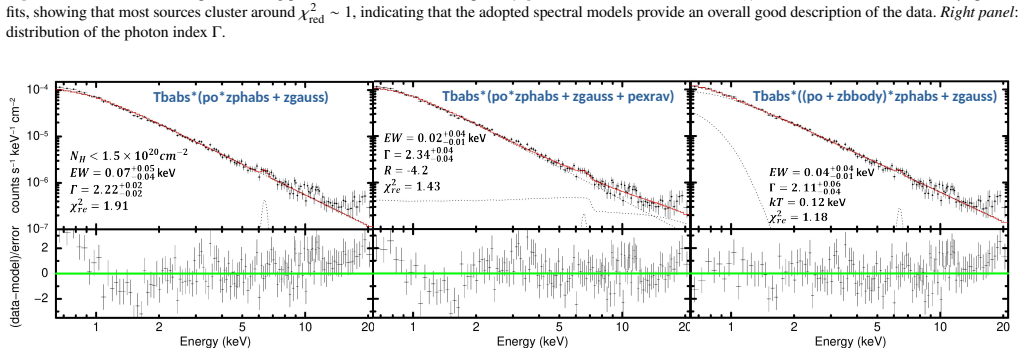
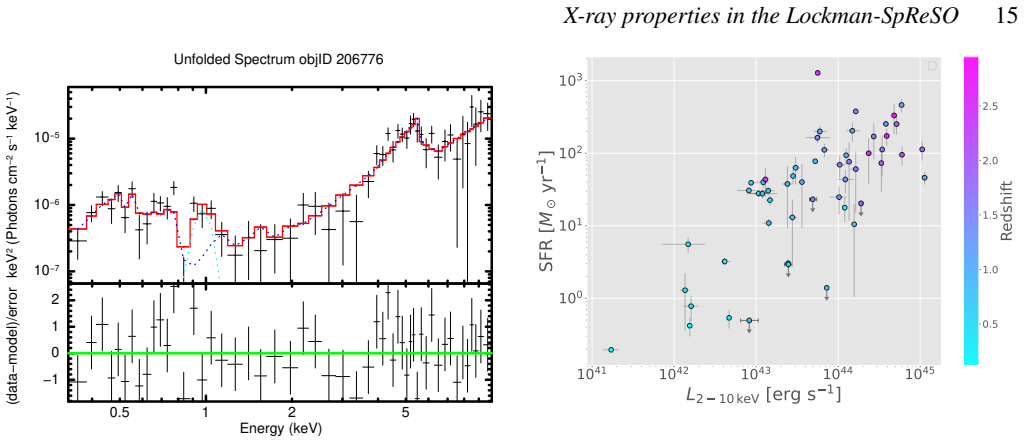
We present a detailed X-ray spectral analysis of the active galactic nucleus (AGN) population in the Lockman-SpReSO project, a multiwavelength campaign of FIR sources in the Lockman Hole field. Using deep XMM-Newton observations cross-matched with FIR-selected galaxies, we characterize 94 AGNs based on their X-ray spectral properties. The sample is distributed over a large redshift range of $z = 0.07-5$, and reaches a flux limit of $5 \times 10^{-16}\, \mathrm{erg\, s^{-1}\, cm^{-2}}$ in the $0.3-10\, \mathrm{keV}$ band. We model the X-ray spectra using absorbed power-law, reflection, and soft excess components to estimate intrinsic column densities ($N_{\mathrm{H}}$), rest-frame $2-10\, \mathrm{keV}$ luminosities, and iron line equivalent widths $(EW)$. Additionally, we included an advanced model fitting for Compton-thick AGNs (CT-AGNs) using the XCLUMPY model. Our results show an increase in the fraction of obscured AGNs toward higher redshifts, including the identification of one strong and two borderline CT-AGN candidates with $N_{\mathrm{H}} \gtrsim 10^{24}\, \mathrm{cm^{-2}}$. Soft excess emission is detected in 10 AGNs, with an average blackbody temperature of $0.12 \pm 0.02\, \mathrm{keV}$. We also detect the X-ray Baldwin effect in both obscured and unobscured populations, and we found a strong correlation between the torus angular width $(\sigma_\mathrm{tor})$, dust covering factor $(f_{\mathrm{cov}})$, and X-ray luminosity, described by $f_{\mathrm{cov}} = (-0.1 \pm 0.01) \times \log(L_{2-10\, \mathrm{keV}}/(10^{44}\, \mathrm{erg\, s^{-1}})) + (0.65 \pm 0.01)$, supporting the receding torus scenario. While consistent with deep X-ray surveys, the FIR selection favours the identification of dusty star-forming host galaxies and heavily obscured AGNs.
Editorial analysis
A structured set of objections, weighed in public.
Referee Report
Summary. The manuscript presents a detailed X-ray spectral analysis of 94 AGNs identified in the Lockman-SpReSO FIR-selected sample in the Lockman Hole, using deep XMM-Newton data spanning z=0.07-5 down to a 0.3-10 keV flux limit of 5×10^{-16} erg s^{-1} cm^{-2}. Spectra are modeled with absorbed power-law plus reflection and soft-excess components, with XCLUMPY applied to CT-AGN candidates, yielding N_H, rest-frame 2-10 keV luminosities, iron-line EWs, and torus parameters. Key results include an increasing fraction of obscured AGNs with redshift, soft excess detected in 10 sources (mean kT=0.12±0.02 keV), the X-ray Baldwin effect in both obscured and unobscured subsamples, one strong and two borderline CT-AGN candidates, and the correlation f_cov = (-0.1±0.01)×log(L_{2-10 keV}/10^{44} erg s^{-1}) + (0.65±0.01) interpreted as support for the receding-torus scenario.
Significance. If the spectral fits remain unbiased across the redshift range, the work supplies a useful FIR-selected view of AGN obscuration evolution and torus geometry that complements X-ray flux-limited surveys. The explicit reporting of fit uncertainties, the use of XCLUMPY for CT sources, and the detection of soft excess in a quantified subset are concrete strengths. The reported correlation supplies a falsifiable, quantitative test of the receding-torus picture in a dust-biased host population.
major comments (2)
- [Abstract / modeling description paragraph] Abstract and modeling description: the headline claims—an increasing obscured fraction with redshift and the quoted f_cov–L_{2-10} correlation—rest on the assumption that the chosen spectral models return unbiased N_H, L_{2-10}, and f_cov across z=0.07-5. The FIR selection explicitly favors dusty, star-forming hosts, and the observed 0.3-10 keV band shifts to rest-frame energies >1-30 keV at z>2, reducing leverage on soft absorption and soft-excess components. No quantitative test (e.g., redshift-binned simulation recovery or completeness correction) is described that would demonstrate the trends are not selection artifacts.
- [Abstract] Abstract: the correlation is presented as a direct fit to the sample (slope −0.1±0.01, intercept 0.65±0.01) rather than a prediction from an independent physical model. Without an explicit statement of how selection effects or luminosity-dependent completeness were folded into the fit, it is unclear whether the slope is robust or partly induced by the FIR flux limit and the z-dependent band shift.
minor comments (2)
- [Abstract] The abstract states the flux limit but does not specify the precise energy band or exposure times used for the 94 sources; a short table or sentence giving the median exposure and the number of counts per source would improve reproducibility.
- [Results] The definition of “obscured” (presumably N_H > 10^{22} cm^{-2}) and the exact redshift bins used for the fraction trend should be stated explicitly in the results section.
Simulated Author's Rebuttal
We thank the referee for their constructive and detailed report. We address each major comment below and indicate the revisions we will make to improve clarity and transparency regarding potential biases and the interpretation of the reported correlation.
read point-by-point responses
-
Referee: [Abstract / modeling description paragraph] Abstract and modeling description: the headline claims—an increasing obscured fraction with redshift and the quoted f_cov–L_{2-10} correlation—rest on the assumption that the chosen spectral models return unbiased N_H, L_{2-10}, and f_cov across z=0.07-5. The FIR selection explicitly favors dusty, star-forming hosts, and the observed 0.3-10 keV band shifts to rest-frame energies >1-30 keV at z>2, reducing leverage on soft absorption and soft-excess components. No quantitative test (e.g., redshift-binned simulation recovery or completeness correction) is described that would demonstrate the trends are not selection artifacts.
Authors: We agree that the robustness of the derived parameters across the redshift range merits explicit discussion. The spectral models (absorbed power law plus reflection and soft excess, with XCLUMPY for CT candidates) follow standard practice validated in the literature. We did not perform redshift-binned recovery simulations in the submitted manuscript. In revision we will add a dedicated paragraph in the discussion section addressing possible biases from the FIR selection and the observed-frame band shift at high z. We will also note the consistency of our obscured-fraction trend with independent X-ray-selected surveys as supporting evidence that the redshift evolution is not an artifact. Full Monte-Carlo completeness simulations lie beyond the scope of the present work but will be flagged as a limitation. revision: partial
-
Referee: [Abstract] Abstract: the correlation is presented as a direct fit to the sample (slope −0.1±0.01, intercept 0.65±0.01) rather than a prediction from an independent physical model. Without an explicit statement of how selection effects or luminosity-dependent completeness were folded into the fit, it is unclear whether the slope is robust or partly induced by the FIR flux limit and the z-dependent band shift.
Authors: The quoted relation is an empirical linear fit performed directly on the measured (L_{2-10}, f_cov) points in our sample. We will revise both the abstract and the results section to state this explicitly and to add a short discussion of how the FIR flux limit and the redshift-dependent band shift could in principle affect the recovered slope. We will also note that while the negative correlation is consistent with the receding-torus picture, a full forward-modeling analysis that folds in selection functions would be required to rule out completeness-driven contributions. These clarifications will be incorporated without changing the reported fit coefficients. revision: yes
Circularity Check
No significant circularity; empirical fits and trends are direct outputs of spectral modeling on the observed sample.
full rationale
The paper reports X-ray spectral fits (absorbed power-law, reflection, soft excess, XCLUMPY) applied to 94 FIR-selected AGNs across z=0.07-5, yielding measured N_H, L_{2-10}, f_cov, and an observed increase in obscured fraction. The quoted correlation f_cov = (-0.1±0.01)×log(L_{2-10 keV}/10^{44}) + (0.65±0.01) is presented as a fit to the sample data supporting the receding-torus scenario, not as a first-principles prediction or quantity derived from prior self-citations. No load-bearing self-citation chains, self-definitional loops, or renaming of known results appear in the provided text; all central claims remain independent empirical results from the current dataset and modeling choices.
Axiom & Free-Parameter Ledger
free parameters (3)
- covering factor slope =
-0.1
- covering factor intercept =
0.65
- soft excess temperature =
0.12
axioms (2)
- domain assumption Standard absorbed power-law, reflection, and XCLUMPY models accurately recover intrinsic N_H and luminosities
- domain assumption FIR selection does not introduce redshift-dependent completeness biases that affect the obscured fraction trend
Reference graph
Works this paper leans on
-
[1]
On the likelihood ratio for source identification. , keywords =. doi:10.1093/mnras/259.3.413 , adsurl =
-
[2]
The XMM-Newton Wide-Field Survey in the COSMOS Field. III. Optical Identification and Multiwavelength Properties of a Large Sample of X-Ray-Selected Sources. , keywords =. doi:10.1086/516575 , archivePrefix =. astro-ph/0612358 , primaryClass =
work page internal anchor Pith review Pith/arXiv arXiv doi:10.1086/516575
-
[3]
The Chandra COSMOS Survey. III. Optical and Infrared Identification of X-Ray Point Sources. , keywords =. doi:10.1088/0067-0049/201/2/30 , archivePrefix =. 1205.5030 , primaryClass =
work page internal anchor Pith review Pith/arXiv arXiv doi:10.1088/0067-0049/201/2/30
-
[4]
X-Ray Sources in the 1.75 Ms Ultra Narrow Deep Field Observed by XMM-Newton. , keywords =. doi:10.3847/1538-4357/ac0d5d , archivePrefix =. 2106.10455 , primaryClass =
-
[5]
Chandra Survey in the AKARI deep field at the North Ecliptic Pole: Optical and near-infrared identifications of X-ray sources. , keywords =. doi:10.1051/0004-6361/202450453 , archivePrefix =. 2407.13864 , primaryClass =
-
[6]
The XMM-Newton serendipitous survey. VIII. The first XMM-Newton serendipitous source catalogue from overlapping observations. , keywords =. doi:10.1051/0004-6361/201833938 , archivePrefix =. 1807.09178 , primaryClass =
work page internal anchor Pith review Pith/arXiv arXiv doi:10.1051/0004-6361/201833938
-
[7]
X-ray reflection from cold matter in Active Galactic Nuclei and X-ray binaries. , keywords =. doi:10.1093/mnras/249.2.352 , adsurl =
-
[8]
A Two-Phase Model for the X-Ray Emission from Seyfert Galaxies. , keywords =. doi:10.1086/186171 , adsurl =
-
[9]
, keywords =
Hard X-ray detection of NGC 1068 with BeppoSAX. , keywords =
-
[10]
Description, target selection, observations, and catalogue preparation
The Lockman-SpReSO project. Description, target selection, observations, and catalogue preparation. , keywords =. doi:10.1051/0004-6361/202244480 , archivePrefix =. 2208.02828 , primaryClass =
-
[11]
XMM-Newton observations of the Lockman Hole: X-ray source catalogue and number counts
XMM-Newton observations of the Lockman Hole: X-ray source catalogue and number counts. , keywords =. doi:10.1051/0004-6361:20077687 , archivePrefix =. 0711.4822 , primaryClass =
work page internal anchor Pith review Pith/arXiv arXiv doi:10.1051/0004-6361:20077687
-
[12]
The XMM deep survey in the CDF-S. III. Point source catalogue and number counts in the hard X-rays. , keywords =. doi:10.1051/0004-6361/201321211 , archivePrefix =. 1304.5717 , primaryClass =
work page internal anchor Pith review Pith/arXiv arXiv doi:10.1051/0004-6361/201321211
-
[13]
XMM-Newton observation of the Lockman Hole. II. Spectral analysis. , keywords =. doi:10.1051/0004-6361:20020991 , archivePrefix =. astro-ph/0207166 , primaryClass =
work page internal anchor Pith review Pith/arXiv arXiv doi:10.1051/0004-6361:20020991
-
[14]
XMM-Newton observations of the Lockman Hole IV: spectra of the brightest AGN
XMM-Newton observations of the Lockman Hole IV: spectra of the brightest AGN. , keywords =. doi:10.1051/0004-6361:20052881 , archivePrefix =. astro-ph/0506718 , primaryClass =
work page internal anchor Pith review Pith/arXiv arXiv doi:10.1051/0004-6361:20052881
-
[15]
X-ray spectral analysis of the brightest AGN population
XMM-Newton Ultra Narrow Deep Field survey - II. X-ray spectral analysis of the brightest AGN population. , keywords =. doi:10.1093/mnras/stae1571 , archivePrefix =. 2406.15901 , primaryClass =
-
[16]
The Chandra Deep Field-South Survey: 7 Ms Source Catalogs
The Chandra Deep Field-South Survey: 7 Ms Source Catalogs. , keywords =. doi:10.3847/1538-4365/228/1/2 , archivePrefix =. 1611.03501 , primaryClass =
work page internal anchor Pith review Pith/arXiv arXiv doi:10.3847/1538-4365/228/1/2
-
[17]
The Chandra Deep Field-South Survey: 4 Ms Source Catalogs
The Chandra Deep Field-South Survey: 4 Ms Source Catalogs. , keywords =. doi:10.1088/0067-0049/195/1/10 , archivePrefix =. 1105.5643 , primaryClass =
work page internal anchor Pith review Pith/arXiv arXiv doi:10.1088/0067-0049/195/1/10
-
[18]
The XMM deep survey in the CDFS. XI. X-ray spectral properties of 185 bright sources. , keywords =. doi:10.1051/0004-6361/201937246 , archivePrefix =. 2004.07604 , primaryClass =
-
[19]
X-ray spectroscopy of the candidate AGN in Henize 2-10 and NGC 4178: Likely supernova remnants
X-ray spectroscopy of the candidate AGNs in Henize 2-10 and NGC 4178: likely supernova remnants. , keywords =. doi:10.1093/mnras/stz553 , archivePrefix =. 1902.08293 , primaryClass =
work page internal anchor Pith review Pith/arXiv arXiv doi:10.1093/mnras/stz553 1902
-
[20]
Detection of a Multiphase Ultrafast Wind in the Narrow-line Seyfert 1 Galaxy Mrk 1044. , keywords =. doi:10.3847/1538-4357/ac0977 , archivePrefix =. 2106.04725 , primaryClass =
-
[21]
High-redshift AGN in the Chandra Deep Fields: the obscured fraction and space density of the sub-L _ * population. , keywords =. doi:10.1093/mnras/stx2486 , archivePrefix =. 1709.07892 , primaryClass =
work page internal anchor Pith review Pith/arXiv arXiv doi:10.1093/mnras/stx2486
-
[22]
X-Ray Spectral Analyses of AGNs from the 7Ms Chandra Deep Field-South Survey: The Distribution, Variability, and Evolutions of AGN Obscuration. , keywords =. doi:10.3847/1538-4365/aa7847 , archivePrefix =. 1703.00657 , primaryClass =
work page internal anchor Pith review Pith/arXiv arXiv doi:10.3847/1538-4365/aa7847
-
[23]
The XMM deep survey in the CDF-S. II. A 9-20 keV selection of heavily obscured active galaxies at z > 1.7. , keywords =. doi:10.1051/0004-6361/201220036 , archivePrefix =. 1209.0916 , primaryClass =
work page internal anchor Pith review Pith/arXiv arXiv doi:10.1051/0004-6361/201220036
-
[24]
On the Cosmic Evolution of AGN Obscuration and the X-Ray Luminosity Function: XMM-Newton and Chandra Spectral Analysis of the 31.3 deg ^ 2 Stripe 82X. , keywords =. doi:10.3847/1538-4357/acac28 , archivePrefix =. 2210.08030 , primaryClass =
-
[25]
The Accretion History of AGNs. I. Supermassive Black Hole Population Synthesis Model. , keywords =. doi:10.3847/1538-4357/aafb77 , archivePrefix =. 1810.02298 , primaryClass =
work page internal anchor Pith review Pith/arXiv arXiv doi:10.3847/1538-4357/aafb77
-
[26]
The synthesis of the cosmic X-ray background in the Chandra and XMM-Newton era
The synthesis of the cosmic X-ray background in the Chandra and XMM-Newton era. , keywords =. doi:10.1051/0004-6361:20066334 , archivePrefix =. astro-ph/0610939 , primaryClass =
work page internal anchor Pith review Pith/arXiv arXiv doi:10.1051/0004-6361:20066334
-
[27]
The X-Ray Baldwin Effect. , keywords =. doi:10.1086/186948 , adsurl =
-
[28]
Luminosity-dependent unification of Active Galactic Nuclei and the X-ray Baldwin effect
Luminosity-dependent unification of active galactic nuclei and the X-ray Baldwin effect. , keywords =. doi:10.1051/0004-6361/201220324 , archivePrefix =. 1302.1070 , primaryClass =
work page internal anchor Pith review Pith/arXiv arXiv doi:10.1051/0004-6361/201220324
-
[29]
Compton Thick AGN: the dark side of the X-ray background
Compton-Thick AGN: The Dark Side of the X-Ray Background. Supermassive Black Holes in the Distant Universe , year = 2004, editor =. doi:10.1007/978-1-4020-2471-9_8 , archivePrefix =. astro-ph/0403693 , primaryClass =
work page internal anchor Pith review Pith/arXiv arXiv doi:10.1007/978-1-4020-2471-9_8 2004
-
[30]
Galactic flows in a sample of far-infrared galaxies
The Lockman-SpReSO project. Galactic flows in a sample of far-infrared galaxies. , keywords =. doi:10.1051/0004-6361/202347826 , archivePrefix =. 2401.04483 , primaryClass =
-
[31]
Main properties of infrared-selected star-forming galaxies
The Lockman-SpReSO project. Main properties of infrared-selected star-forming galaxies. , keywords =. doi:10.1051/0004-6361/202449238 , archivePrefix =. 2404.13629 , primaryClass =
-
[32]
Obscured Active Galactic Nuclei
Obscured Active Galactic Nuclei. , keywords =. doi:10.1146/annurev-astro-081817-051803 , archivePrefix =. 1806.04680 , primaryClass =
work page internal anchor Pith review Pith/arXiv arXiv doi:10.1146/annurev-astro-081817-051803
-
[33]
An ALMA Survey of Submillimeter Galaxies in the Extended Chandra Deep Field-South: The AGN Fraction and X-Ray Properties of Submillimeter Galaxies. , keywords =. doi:10.1088/0004-637X/778/2/179 , archivePrefix =. 1310.6364 , primaryClass =
work page internal anchor Pith review Pith/arXiv arXiv doi:10.1088/0004-637x/778/2/179
-
[34]
Cross-correlation of the 2XMMi catalogue with Data Release 7 of the Sloan Digital Sky Survey
Cross-correlation of the 2XMMi catalogue with Data Release 7 of the Sloan Digital Sky Survey. , keywords =. doi:10.1051/0004-6361/201015141 , archivePrefix =. 1012.1727 , primaryClass =
work page internal anchor Pith review Pith/arXiv arXiv doi:10.1051/0004-6361/201015141
-
[35]
The XMM-Newton serendipitous survey. X. The second source catalogue from overlapping XMM-Newton observations and its long-term variable content. , keywords =. doi:10.1051/0004-6361/202037706 , archivePrefix =. 2007.02932 , primaryClass =
-
[36]
Reflection in Seyfert Galaxies and the Unified Model of AGN
Reflection in Seyfert galaxies and the unified model of AGN. , keywords =. doi:10.1051/0004-6361/201016409 , archivePrefix =. 1104.3676 , primaryClass =
work page internal anchor Pith review Pith/arXiv arXiv doi:10.1051/0004-6361/201016409
-
[37]
What is the origin of the soft excess in active galactic nuclei?. , keywords =. doi:10.1111/j.1365-2966.2006.11117.x , archivePrefix =. astro-ph/0609223 , primaryClass =
-
[38]
An explanation for the soft X-ray excess in active galactic nuclei. , keywords =. doi:10.1111/j.1365-2966.2005.09844.x , archivePrefix =. astro-ph/0511457 , primaryClass =
-
[39]
The soft X-ray excess: NLS1s versus BLS1s. , keywords =. doi:10.1093/mnras/stz3005 , archivePrefix =. 1910.12115 , primaryClass =
-
[40]
X-ray properties and obscured fraction of AGN in the J1030 Chandra field. , keywords =. doi:10.1051/0004-6361/202346364 , archivePrefix =. 2305.13368 , primaryClass =
-
[41]
The Chandra COSMOS Legacy Survey: Compton Thick AGN at high redshift
The Chandra COSMOS Legacy Survey: Compton thick AGN at high redshift. , keywords =. doi:10.1093/mnras/sty2025 , archivePrefix =. 1803.08547 , primaryClass =
work page internal anchor Pith review Pith/arXiv arXiv doi:10.1093/mnras/sty2025
-
[42]
XCLUMPY: X-Ray Spectral Model from Clumpy Torus and Its Application to the Circinus Galaxy. , keywords =. doi:10.3847/1538-4357/ab1b20 , archivePrefix =. 1904.08945 , primaryClass =
-
[43]
AGN Dusty Tori. I. Handling of Clumpy Media. , keywords =. doi:10.1086/590482 , archivePrefix =. 0806.0511 , primaryClass =
work page internal anchor Pith review Pith/arXiv arXiv doi:10.1086/590482
-
[44]
Torus Constraints in ANEPD-CXO245: A Compton-thick AGN with Double-peaked Narrow Lines. , keywords =. doi:10.3847/2041-8213/ab46bc , archivePrefix =. 1909.09762 , primaryClass =
-
[45]
Iron K$\alpha$ emission in type-I and type-II Active Galactic Nuclei
Iron K emission in type-I and type-II active galactic nuclei. , keywords =. doi:10.1093/mnras/stu735 , archivePrefix =. 1405.7575 , primaryClass =
work page internal anchor Pith review Pith/arXiv arXiv doi:10.1093/mnras/stu735
-
[46]
BAT AGN Spectroscopic Survey. V. X-Ray Properties of the Swift/BAT 70-month AGN Catalog. , keywords =. doi:10.3847/1538-4365/aa96ad , archivePrefix =. 1709.03989 , primaryClass =
work page internal anchor Pith review Pith/arXiv arXiv doi:10.3847/1538-4365/aa96ad
-
[47]
On the Iwasawa-Taniguchi effect of radio-quiet AGN
On the Iwasawa-Taniguchi effect of radio-quiet AGN. , keywords =. doi:10.1051/0004-6361:20077331 , archivePrefix =. astro-ph/0703433 , primaryClass =
work page internal anchor Pith review Pith/arXiv arXiv doi:10.1051/0004-6361:20077331
-
[48]
Infrared colours and spectral energy distributions of hard X-ray selected obscured and Compton-thick active galactic nuclei. , keywords =. doi:10.1093/mnras/staa956 , archivePrefix =. 2004.01273 , primaryClass =
-
[49]
The AGN Obscuring Torus -- End of the "Doughnut" Paradigm?
The AGN-obscuring Torus: The End of the ``Doughnut'' Paradigm?. , keywords =. doi:10.1086/508158 , archivePrefix =. astro-ph/0605686 , primaryClass =
work page internal anchor Pith review Pith/arXiv arXiv doi:10.1086/508158
-
[50]
Absorption Properties and Evolution of Active Galactic Nuclei
Absorption properties and evolution of active galactic nuclei. , keywords =. doi:10.1051/0004-6361:200809839 , archivePrefix =. 0808.0260 , primaryClass =
work page internal anchor Pith review Pith/arXiv arXiv doi:10.1051/0004-6361:200809839
-
[51]
Hints on the gradual re-sizing of the torus in AGN by decomposing IRS/Spitzer spectra
Hints on the Gradual Resizing of the Torus in AGNs through Decomposition of Spitzer/IRS Spectra. , keywords =. doi:10.3847/1538-4357/aa6f16 , archivePrefix =. 1704.06739 , primaryClass =
work page internal anchor Pith review Pith/arXiv arXiv doi:10.3847/1538-4357/aa6f16
-
[52]
Reverberation Measurements of the Inner Radius of the Dust Torus in Nearby Seyfert 1 Galaxies
Reverberation Measurements of the Inner Radius of the Dust Torus in Nearby Seyfert 1 Galaxies. , keywords =. doi:10.1086/499326 , archivePrefix =. astro-ph/0511697 , primaryClass =
work page internal anchor Pith review Pith/arXiv arXiv doi:10.1086/499326
-
[53]
On the size-luminosity relation of AGN dust tori in the mid-infrared
On the size-luminosity relation of AGN dust tori in the mid-infrared. , keywords =. doi:10.1051/0004-6361/201116867 , archivePrefix =. 1105.4875 , primaryClass =
work page internal anchor Pith review Pith/arXiv arXiv doi:10.1051/0004-6361/201116867
-
[54]
Spectroscopic analysis of Type 1 AGN
The Lockman-SpReSO project. Spectroscopic analysis of Type 1 AGN. arXiv e-prints , keywords =. doi:10.48550/arXiv.2507.01952 , archivePrefix =. 2507.01952 , primaryClass =
-
[55]
X-CIGALE: Fitting AGN/galaxy SEDs from X-ray to infrared. , keywords =. doi:10.1093/mnras/stz3001 , archivePrefix =. 2001.08263 , primaryClass =
-
[56]
Toward the Standard Population Synthesis Model of the X-Ray Background: Evolution of X-Ray Luminosity and Absorption Functions of Active Galactic Nuclei Including Compton-thick Populations. , keywords =. doi:10.1088/0004-637X/786/2/104 , archivePrefix =. 1402.1836 , primaryClass =
work page internal anchor Pith review Pith/arXiv arXiv doi:10.1088/0004-637x/786/2/104
-
[57]
The evolution of the X-ray luminosity functions of unabsorbed and absorbed AGNs out to z~5
The evolution of the X-ray luminosity functions of unabsorbed and absorbed AGNs out to z 5. , keywords =. doi:10.1093/mnras/stv1062 , archivePrefix =. 1503.01120 , primaryClass =
work page internal anchor Pith review Pith/arXiv arXiv doi:10.1093/mnras/stv1062
-
[58]
Supermassive black holes at high redshift are expected to be obscured by their massive host galaxies' interstellar medium. , keywords =. doi:10.1051/0004-6361/202243708 , archivePrefix =. 2206.03508 , primaryClass =
-
[59]
The Obscured Fraction of Quasars at Cosmic Noon. , keywords =. doi:10.3847/1538-4357/ac9c07 , archivePrefix =. 2209.07797 , primaryClass =
-
[60]
2000, The Astrophysical Journal, 542, 914, doi: 10.1086/317016
On the Absorption of X-Rays in the Interstellar Medium. , keywords =. doi:10.1086/317016 , archivePrefix =. astro-ph/0008425 , primaryClass =
work page internal anchor Pith review Pith/arXiv arXiv doi:10.1086/317016
-
[61]
Angle-dependent Compton reflection of X-rays and gamma-rays. , keywords =. doi:10.1093/mnras/273.3.837 , adsurl =
-
[62]
Statistical methods for astronomical data with upper limits. I. Univariate distributions. , keywords =. doi:10.1086/163225 , adsurl =
-
[63]
Statistical Methods for Astronomical Data with Upper Limits. II. Correlation and Regression. , keywords =. doi:10.1086/164359 , adsurl =
-
[64]
The X-ray to optical-UV luminosity ratio of X-ray selected Type 1 AGN in XMM-COSMOS
The X-ray to optical-UV luminosity ratio of X-ray selected type 1 AGN in XMM-COSMOS. , keywords =. doi:10.1051/0004-6361/200913298 , archivePrefix =. 0912.4166 , primaryClass =
work page internal anchor Pith review Pith/arXiv arXiv doi:10.1051/0004-6361/200913298
-
[65]
The X-Ray-to-Optical Properties of Optically Selected Active Galaxies over Wide Luminosity and Redshift Ranges. , keywords =. doi:10.1086/503627 , archivePrefix =. astro-ph/0602407 , primaryClass =
work page internal anchor Pith review Pith/arXiv arXiv doi:10.1086/503627
-
[66]
Star formation rate estimations of a mid-infrared sample of X-ray selected nearby Active Galactic Nuclei. , keywords =. doi:10.1016/j.newast.2025.102433 , adsurl =
-
[67]
M. S. Wolynetz , journal =. Algorithm AS 138: Maximum Likelihood Estimation from Confined and Censored Normal Data , urldate =
-
[68]
Does the obscured AGN fraction really depend on luminosity?
Does the obscured AGN fraction really depend on luminosity?. , keywords =. doi:10.1093/mnras/stv2069 , archivePrefix =. 1509.01259 , primaryClass =
work page internal anchor Pith review Pith/arXiv arXiv doi:10.1093/mnras/stv2069
-
[69]
The Toroidal Obscuration of Active Galactic Nuclei
The toroidal obscuration of active galactic nuclei. , keywords =. doi:10.1016/j.newar.2008.06.010 , archivePrefix =. 0805.3699 , primaryClass =
work page internal anchor Pith review Pith/arXiv arXiv doi:10.1016/j.newar.2008.06.010 2008
-
[70]
AGN Dusty Tori. II. Observational Implications of Clumpiness. , keywords =. doi:10.1086/590483 , archivePrefix =. 0806.0512 , primaryClass =
work page internal anchor Pith review Pith/arXiv arXiv doi:10.1086/590483
-
[71]
CIGALE: a python Code Investigating GALaxy Emission
CIGALE: a python Code Investigating GALaxy Emission. , keywords =. doi:10.1051/0004-6361/201834156 , archivePrefix =. 1811.03094 , primaryClass =
work page internal anchor Pith review Pith/arXiv arXiv doi:10.1051/0004-6361/201834156
-
[72]
Hard X-Ray to Radio Multiwavelength SED Analysis of Local U/LIRGs in the GOALS Sample with a Self-consistent AGN Model including a Polar-dust Component. , keywords =. doi:10.3847/1538-4365/acb349 , archivePrefix =. 2301.03613 , primaryClass =
-
[73]
The dust covering factor in active galactic nuclei
The dust covering factor in active galactic nuclei. , keywords =. doi:10.1093/mnras/stw444 , archivePrefix =. 1602.06954 , primaryClass =
work page internal anchor Pith review Pith/arXiv arXiv doi:10.1093/mnras/stw444
-
[74]
AGNs with discordant optical and X-ray classification are not a physical family: diverse origin in two AGNs. , keywords =. doi:10.1093/mnras/stx862 , archivePrefix =. 1704.01595 , primaryClass =
work page internal anchor Pith review Pith/arXiv arXiv doi:10.1093/mnras/stx862
-
[75]
The XMM-Newton Wide-field Survey in the Cosmos Field (XMM-COSMOS): Demography and Multiwavelength Properties of Obscured and Unobscured Luminous Active Galactic Nuclei. , keywords =. doi:10.1088/0004-637X/716/1/348 , archivePrefix =. 1004.2790 , primaryClass =
work page internal anchor Pith review Pith/arXiv arXiv doi:10.1088/0004-637x/716/1/348
-
[76]
The Chandra COSMOS Legacy survey: optical/IR identifications
The Chandra COSMOS Legacy survey: optical/IR identifications. , keywords =. doi:10.3847/0004-637X/817/1/34 , archivePrefix =. 1512.01105 , primaryClass =
work page internal anchor Pith review Pith/arXiv arXiv doi:10.3847/0004-637x/817/1/34
-
[77]
AKARI Infrared Camera Observations of the 3.3 {\mu}m PAH feature in Swift/BAT AGNs
AKARI infrared camera observations of the 3.3 m PAH feature in Swift/BAT AGNs. , keywords =. doi:10.1093/pasj/psu096 , archivePrefix =. 1408.3172 , primaryClass =
work page internal anchor Pith review Pith/arXiv arXiv doi:10.1093/pasj/psu096
-
[78]
The Obscured Fraction of AGN in the XMM-COSMOS Survey: A Spectral Energy Distribution Perspective
The Obscured Fraction of Active Galactic Nuclei in the XMM-COSMOS Survey: A Spectral Energy Distribution Perspective. , keywords =. doi:10.1088/0004-637X/777/2/86 , archivePrefix =. 1309.0814 , primaryClass =
work page internal anchor Pith review Pith/arXiv arXiv doi:10.1088/0004-637x/777/2/86
-
[79]
The Structure of Galactic H i in Directions of Low Total Column Density. , keywords =. doi:10.1086/164002 , adsurl =
-
[80]
Statistics: Handle with Care, Detecting Multiple Model Components with the Likelihood Ratio Test
Statistics, Handle with Care: Detecting Multiple Model Components with the Likelihood Ratio Test. , keywords =. doi:10.1086/339856 , archivePrefix =. astro-ph/0201547 , primaryClass =
work page internal anchor Pith review Pith/arXiv arXiv doi:10.1086/339856
discussion (0)
Sign in with ORCID, Apple, or X to comment. Anyone can read and Pith papers without signing in.