Deformed W-algebras and chiralized cluster seeds: subregular W-algebras and Inverse Quantum Hamiltonian Reduction
Pith reviewed 2026-06-30 04:10 UTC · model grok-4.3
The pith
Mutations of chiral cluster seeds relate different free field realizations of (q,t)-deformed W-algebras.
A machine-rendered reading of the paper's core claim, the machinery that carries it, and where it could break.
Core claim
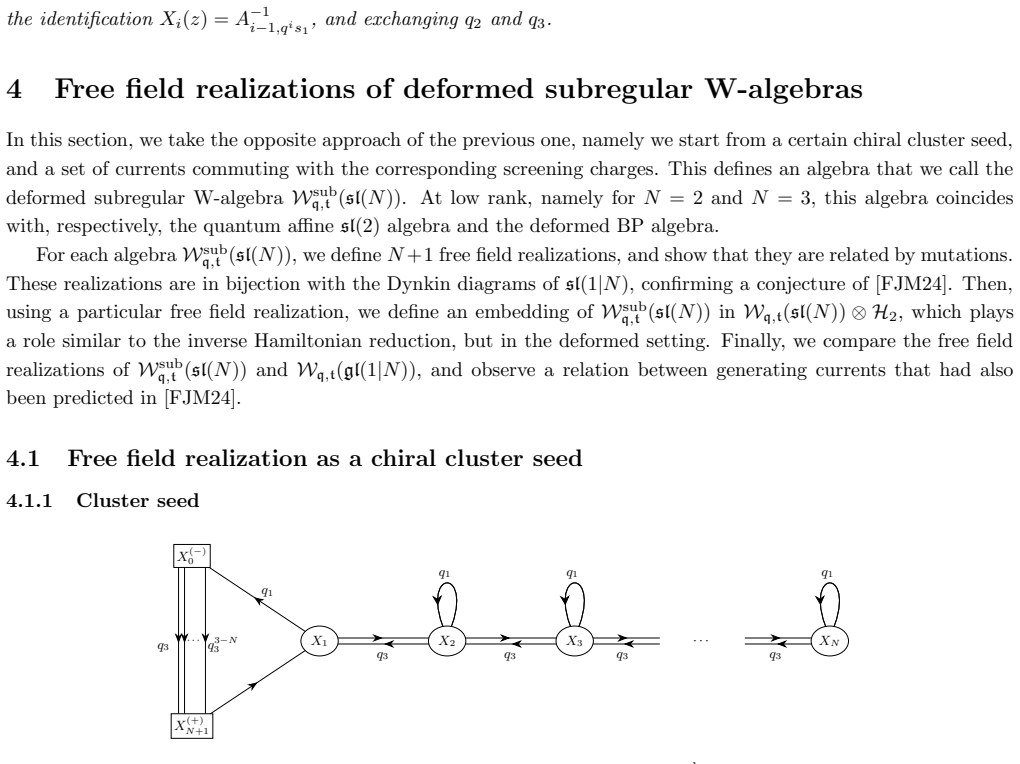
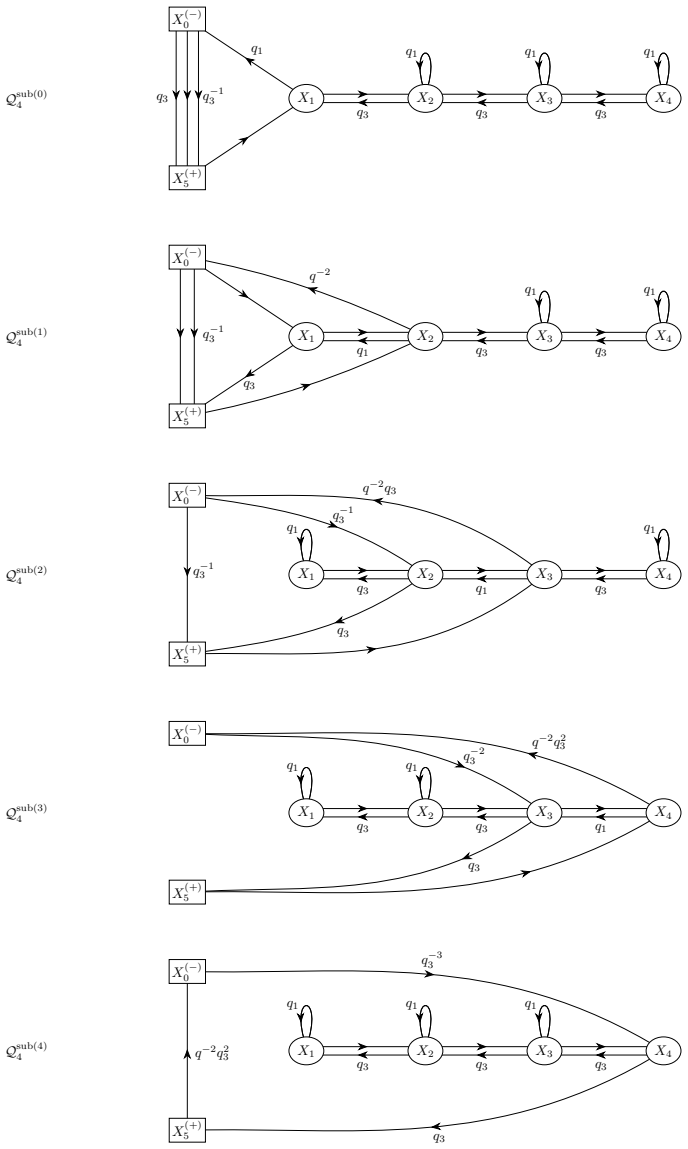
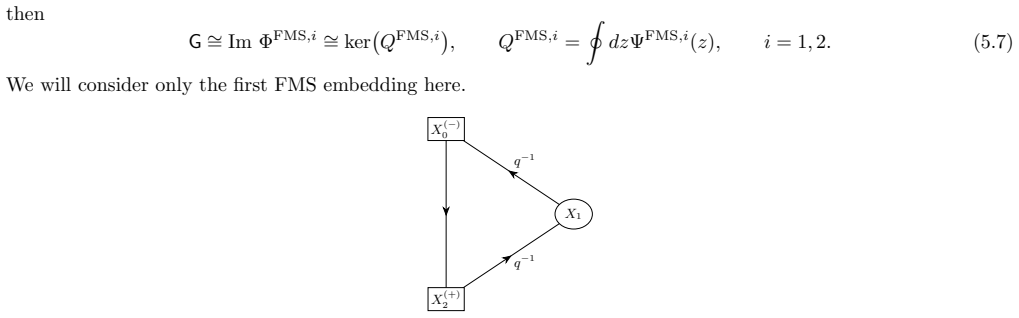
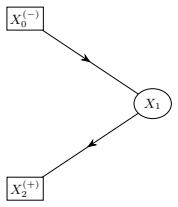
In the chiral cluster seed framework, deformed vertex operators replace quantum cluster variables and decorated quivers encode their OPEs; different free field realizations of currents in (q,t)-deformed W-algebras are therefore related by seed mutations. A (q,t)-deformation of the subregular W-algebra is introduced, all its free field realizations via mutations are described, and an embedding of this algebra into the ordinary deformed W-algebra tensored with a rank-two Heisenberg algebra is given, serving as a deformed analogue of inverse quantum Hamiltonian reduction.
What carries the argument
Chiral cluster seeds whose mutations relate distinct collections of deformed vertex operators whose OPEs are encoded by the associated decorated quivers.
If this is right
- All free field realizations of the deformed subregular W-algebra W_{q,t}^sub(sl(N)) are obtained through sequences of seed mutations.
- The embedding supplies a concrete map realizing deformed inverse quantum Hamiltonian reduction.
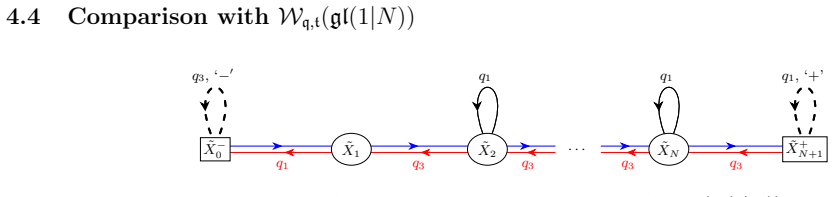
- The subregular algebras stand in a direct relation to the deformed W-algebras associated with gl(1|N).
- The same mutation mechanism unifies realizations across W_{q,t}(gl(N|M)), U_q(sl_2 hat), and the deformed Bershadsky-Polyakov algebra.
Where Pith is reading between the lines
- Cluster mutation techniques may provide a systematic classification of free field realizations for additional families of deformed vertex operator algebras.
- The formalism invites direct checks by computing OPEs in newly generated realizations to confirm consistency with the quiver data.
- Similar embeddings could be constructed for other irregular or subregular deformations in the (q,t) setting.
Load-bearing premise
The decorated quiver associated with each seed correctly encodes the operator product expansions of the corresponding vertex operators.
What would settle it
An explicit computation of OPEs in two free field realizations claimed to be related by mutation that fails to agree after any sequence of mutations, or a direct verification that the constructed embedding map does not preserve the full set of algebra relations.
Figures


read the original abstract
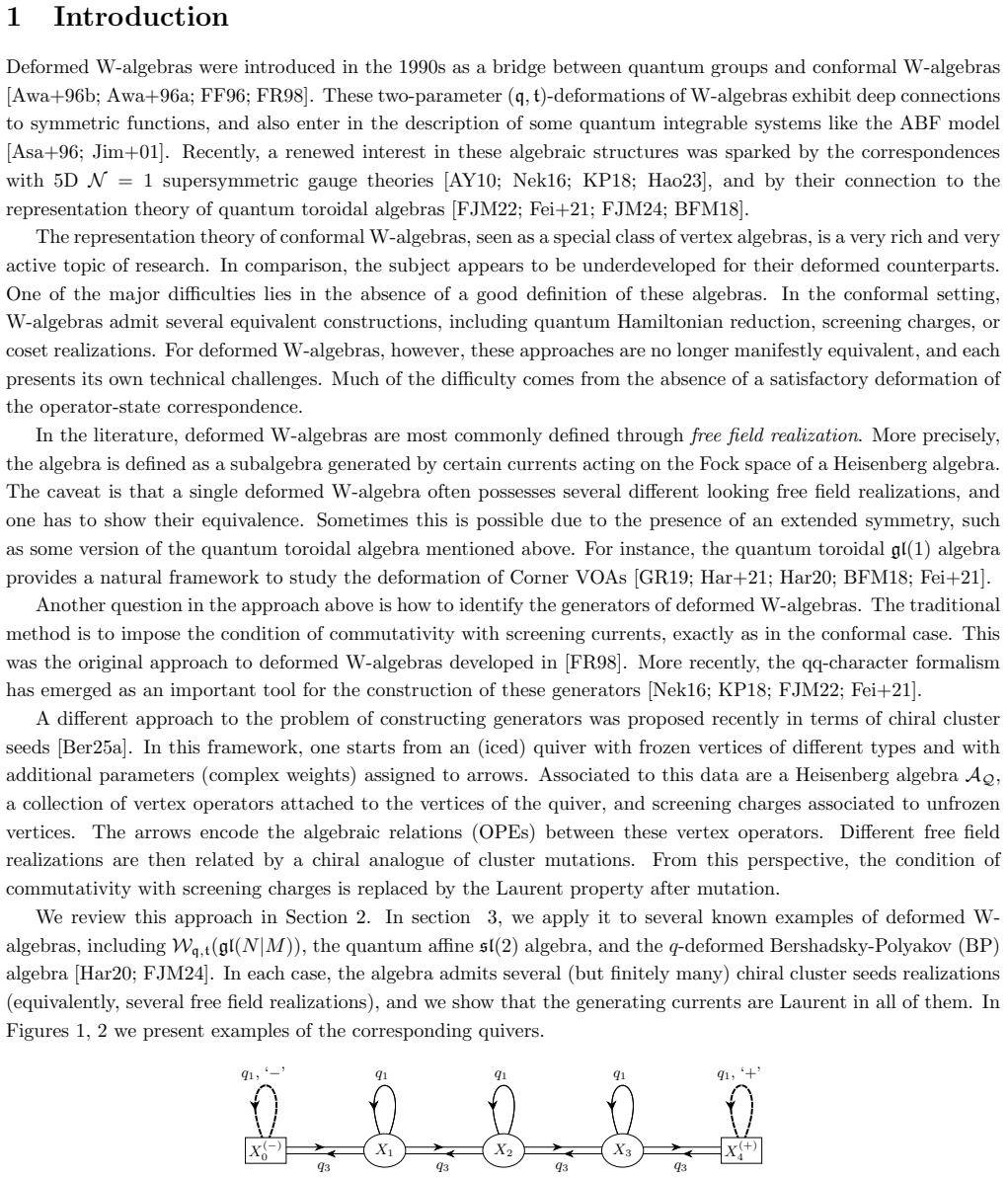
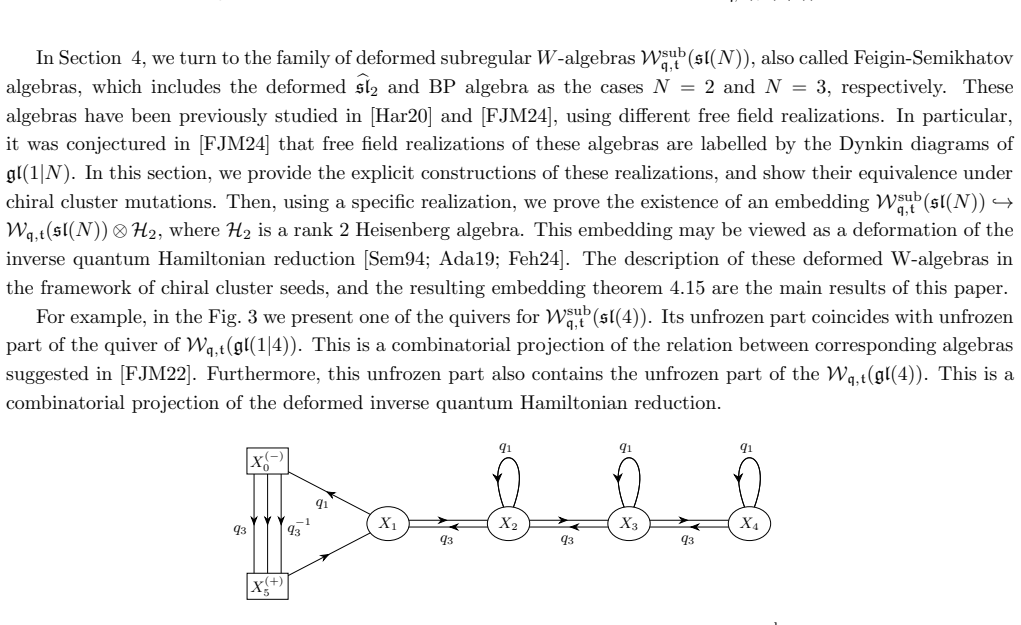
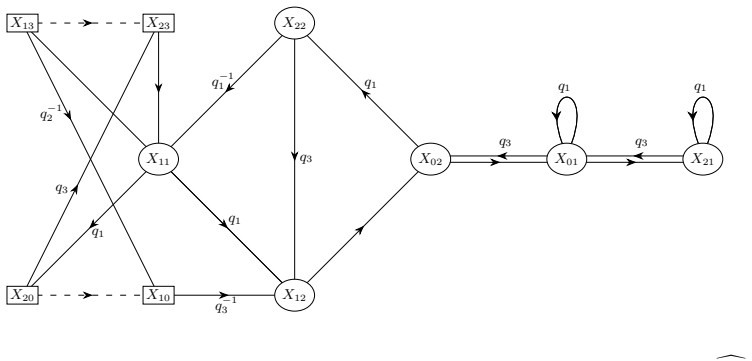
The recently introduced formalism of chiral cluster seeds replaces quantum cluster variables with deformed vertex operators. In this framework, a decorated quiver associated with a seed encodes the operator product expansions of the corresponding vertex operators. This formalism is applied to several $(q,t)$-deformed W-algebras, including $\mathcal{W}_{\mathfrak{q},\mathfrak{t}}(\mathfrak{gl}(N|M))$, $U_q(\widehat{\mathfrak{sl}}_2)$, and the deformed Bershadsky--Polyakov algebra. In particular, it is shown that different free field realizations of the currents are related by mutations of the associated chiral cluster seed. The second part of the paper introduces a $(q,t)$-deformation of the subregular W-algebras, denoted by $\mathcal{W}_{\mathfrak{q},\mathfrak{t}}^{\text{sub}}(\mathfrak{sl}(N))$. All free field realizations obtainable through seed mutations are described. An embedding of $\mathcal{W}_{\mathfrak{q},\mathfrak{t}}^{\text{sub}}(\mathfrak{sl}(N))$ into the free field realization of $\mathcal{W}_{\mathfrak{q},\mathfrak{t}}(\mathfrak{sl}(N))$ tensored with a rank-two Heisenberg algebra is constructed. This embedding may be viewed as a deformed analogue of inverse quantum Hamiltonian reduction. The relation between the subregular algebras and $\mathcal{W}_{\mathfrak{q},\mathfrak{t}}(\mathfrak{gl}(1|N))$ is also discussed.
Editorial analysis
A structured set of objections, weighed in public.
Referee Report
Summary. The paper applies the chiral cluster seeds formalism—replacing quantum cluster variables with deformed vertex operators whose OPEs are encoded by a decorated quiver—to several (q,t)-deformed W-algebras, including W_{q,t}(gl(N|M)), U_q(hat{sl}_2), and the deformed Bershadsky-Polyakov algebra. It shows that distinct free-field realizations of the currents are related by mutations of the associated chiral cluster seed. The second part introduces the (q,t)-deformed subregular W-algebra W^{sub}_{q,t}(sl(N)), enumerates all free-field realizations obtainable by seed mutations, constructs an embedding of this algebra into the free-field realization of W_{q,t}(sl(N)) tensored with a rank-two Heisenberg algebra (viewed as a deformed inverse quantum Hamiltonian reduction), and discusses its relation to W_{q,t}(gl(1|N)).
Significance. If the explicit constructions hold, the work supplies a systematic, mutation-based dictionary between free-field realizations of several (q,t)-deformed W-algebras and furnishes a concrete deformed analogue of inverse quantum Hamiltonian reduction together with the required free-field data and mutation sequences. These algebraic statements are internal to the definitions and could streamline computations of OPEs and screenings in the deformed setting.
minor comments (3)
- The abstract states that the decorated quiver encodes the OPEs, but a brief reminder of the precise dictionary (how arrows and decorations translate into specific OPE coefficients) would help readers who have not yet internalized the prior formalism.
- For the subregular case, the embedding into W_{q,t}(sl(N)) ⊗ Heisenberg_2 is described; an explicit statement of which generators map to which linear combinations (or at least the image of the highest-weight current) would make the construction easier to verify.
- The relation between W^{sub}_{q,t}(sl(N)) and W_{q,t}(gl(1|N)) is mentioned; a short paragraph or diagram clarifying whether this is an isomorphism, a quotient, or an embedding would improve readability.
Simulated Author's Rebuttal
We thank the referee for the positive summary, significance assessment, and recommendation of minor revision. No specific major comments were listed in the report.
Circularity Check
No significant circularity
full rationale
The paper defines the chiral cluster seed formalism (with decorated quivers encoding OPEs of vertex operators) and then constructs explicit relations: mutations relating different free-field realizations for several (q,t)-deformed W-algebras, plus an embedding of the deformed subregular algebra into the ordinary one tensored with a rank-two Heisenberg. These are algebraic statements internal to the chosen realizations and mutation sequences supplied in the paper. No quoted equation reduces a claimed prediction to a fitted parameter, self-citation chain, or definitional renaming; the central results are presented as direct constructions rather than external forecasts. The formalism is introduced as recently developed, but the load-bearing steps remain self-contained within the given definitions and data.
Axiom & Free-Parameter Ledger
Reference graph
Works this paper leans on
-
[1]
Screening operators for W -algebras
Genra, N. Screening operators for W -algebras. Selecta Mathematica. 2016
2016
-
[2]
Awata, H. and Harada, K. and Kanno, H. and Shiraishi, J. A Quantum Deformation of the N =2 Superconformal Algebra. Commun. Math. Phys. 2025. doi:10.1007/s00220-025-05334-1. arXiv:2407.00901
-
[3]
BPS/CFT correspondence: non-perturbative Dyson-Schwinger equations and qq-characters
Nekrasov, N. , title =. doi:10.1007/JHEP03(2016)181 , journal =. 1512.05388 , archivePrefix =
work page internal anchor Pith review Pith/arXiv arXiv doi:10.1007/jhep03(2016)181 2016
-
[4]
Feigin, B. and Jimbo, M. and Mukhin, E. , title =. doi:10.1016/j.aim.2022.108331 , journal =. 2103.15247 , archivePrefix =
-
[5]
Haouzi, N. , title =. 2311.04367 , archivePrefix =
-
[6]
2013 , eprint =
Nekrasov, Nikita and Pestun, Vasily and Shatashvili, Samson , title =. 2013 , eprint =
2013
-
[7]
Notes on Ding-Iohara algebra and AGT conjecture
Awata, H. and Feigin, B. and Hoshino, A. and Kanai, M. and Shiraishi, J. and Yanagida, S. , title =. Proceedings of RIMS Conference 2010 ``Diversity of the Theory of Integrable Systems'' , editor =. 1106.4088 , archivePrefix =
work page internal anchor Pith review Pith/arXiv arXiv 2010
-
[8]
Fukuda, M. and Ohkubo, Y. and Shiraishi, J. , title =. doi:10.1007/s00220-020-03872-4 , journal =. 1903.05905 , archivePrefix =
-
[9]
Five-dimensional AGT Conjecture and the Deformed Virasoro Algebra
Awata, H. and Yamada, Y. , title =. doi:10.1007/JHEP01(2010)125 , journal =. 0910.4431 , archivePrefix =
work page internal anchor Pith review Pith/arXiv arXiv doi:10.1007/jhep01(2010)125 2010
-
[10]
Alday, L. F. and Gaiotto, D. and Tachikawa, Y. , title =. Letters in Mathematical Physics , volume =. 2010 , doi =. 0906.3219 , archivePrefix =
work page internal anchor Pith review Pith/arXiv arXiv 2010
-
[11]
and Goncharov, Alexander B
Fock, Vladimir V. and Goncharov, Alexander B. , title =. Annales Scientifiques de l'. 2009 , eprint =
2009
-
[12]
, title =
Bershtein, M. , title =
-
[13]
Communications in Mathematical Physics , volume =
Bershadsky, Michael , title =. Communications in Mathematical Physics , volume =. 1991 , doi =
1991
-
[14]
Polyakov, A. M. , title =. International Journal of Modern Physics A , volume =. 1990 , doi =
1990
-
[15]
Drinfeld-Sokolov reduction for quantum groups and deformations of W-algebras
Sevostyanov, A. , title =. Selecta Mathematica , volume =. 2002 , doi =. math/0107215 , archivePrefix=
work page internal anchor Pith review Pith/arXiv arXiv 2002
-
[16]
Frenkel, E. and Reshetikhin, N. and Semenov-Tian-Shansky, M. , title =. Communications in Mathematical Physics , volume =. 1998 , doi =. q-alg/9704011 , archivePrefix=
work page internal anchor Pith review Pith/arXiv arXiv 1998
-
[17]
Semenov-Tian-Shansky, M. and Sevostyanov, A. , title =. Communications in Mathematical Physics , volume =. 1998 , doi =. q-alg/9702016 , archivePrefix=
work page internal anchor Pith review Pith/arXiv arXiv 1998
-
[18]
Bershtein, M. , key =
-
[19]
and Bourgine, J.-E
Bershtein, M. and Bourgine, J.-E. and Shiraishi, J. , title =
-
[20]
and Schrader, G
Bershtein, M. and Schrader, G. and Shapiro, A. , note =
-
[21]
Semikhatov, A. M. , title =. Proceedings of the 28th International Symposium on Particle Theory , address =. 1994 , pages =. hep-th/9410109 , archivePrefix =
work page internal anchor Pith review Pith/arXiv arXiv 1994
-
[22]
Adamovi. Realizations of Simple Affine Vertex Algebras and Their Modules: The Cases. Communications in Mathematical Physics , volume =. 2019 , doi =. 1711.11342 , archivePrefix =
work page internal anchor Pith review Pith/arXiv arXiv 2019
- [23]
-
[24]
2024 , howpublished =
Ridout, David , title =. 2024 , howpublished =
2024
-
[25]
Gaiotto, D. and Rap c \'a k, M. Vertex Algebras at the Corner. JHEP. 2019. doi:10.1007/JHEP01(2019)160. arXiv:1703.00982
work page internal anchor Pith review Pith/arXiv arXiv doi:10.1007/jhep01(2019)160 2019
-
[26]
and Jimbo, M
Asai, Y. and Jimbo, M. and Miwa, T. and Pugai, Y. , doi =. Bosonization of vertex operators for the face model , volume =. Journal of Physics A: Mathematical and General , number =
-
[27]
and Konno, H
Jimbo, M. and Konno, H. and Odake, S. and Pugai, Y. and Shiraishi, J. , title =. Journal of Statistical Physics , volume =. 2001 , note =
2001
-
[28]
and Kubo, H
Awata, H. and Kubo, H. and Shiraishi, J. and Odake, S. , title =. 1996 , volume =
1996
-
[29]
and Kubo, H
Awata, H. and Kubo, H. and Odake, S. and Shiraishi, J. , title =. 1996 , volume =
1996
-
[30]
and Odake, S
Awata, H. and Odake, S. and Shiraishi, J. , title =. 1994 , pages =
1994
-
[31]
Feigin, B. and Semikhatov, A. M. , title =. 2004 , volume =. doi:10.1016/j.nuclphysb.2004.06.056 , note =
-
[32]
and Feigin, B
Bershtein, M. and Feigin, B. and Merzon, G. , title =. 2018 , journal = SMNS, volume =
2018
-
[33]
and Feigin, B
Ding, J. and Feigin, B. , title =. 2000 , journal = JNMP, volume =
2000
-
[34]
, title =
Fehily, Z. , title =. 2023 , note =
2023
-
[35]
and Hashizume, K
Feigin, B. and Hashizume, K. and Hoshino, A. and Shiraishi, J. and Yanagida, S. , title =. 2009 , journal = JMP, volume =
2009
-
[36]
and Jimbo, M
Feigin, B. and Jimbo, M. and Mukhin, E. , title =. 2024 , journal = TG, volume =
2024
-
[37]
and Martinec, E
Friedan, D. and Martinec, E. and Shenker, S. , title =
-
[38]
Feigin, B. and Jimbo, M. and Mukhin, E. and Vilkoviskiy, I. , title =. 2021 , journal = SMNS, volume =. doi:10.1007/s00029-021-00663-0 , note =
-
[39]
and Reshetikhin, N
Frenkel, E. and Reshetikhin, N. , title =. 1998 , journal = CMP, volume =
1998
-
[40]
, title =
Harada, K. , title =. 2020 , note =
2020
-
[41]
and Matsuo, Y
Harada, K. and Matsuo, Y. and Noshita, G. and Watanabe, A. , title =. 2021 , journal = JHEP, volume =
2021
-
[42]
, title =
Konno, H. , title =. 1993 , journal = MPL, volume =
1993
-
[43]
and Pestun, V
Kimura, T. and Pestun, V. , title =. 2018 , journal = LMP, volume =
2018
-
[44]
, title =
Kojima, T. , title =. 2021 , journal = JP, volume =
2021
-
[45]
, title =
Kojima, T. , title =. 2021 , journal = JMP, volume =
2021
-
[46]
Polyakov, A. M. , title =. 1981 , pages =
1981
-
[47]
and Frenkel, E
Feigin, B. and Frenkel, E. , title =. 1990 , volume =
1990
-
[48]
Quantum W-Algebras and Elliptic Algebras , author=. Commun. Math. Phys , volume=
-
[49]
and Jimbo, M
Feigin, B. and Jimbo, M. and Mukhin, E. , title =. 2025 , eprint =
2025
discussion (0)
Sign in with ORCID, Apple, or X to comment. Anyone can read and Pith papers without signing in.