The SKA-VLBI Perspective on Radio-Quiet AGN
Pith reviewed 2026-06-30 04:47 UTC · model grok-4.3
The pith
SKA-MID phased into global VLBI arrays will enable the first population-level census of radio-quiet AGN nuclei.
A machine-rendered reading of the paper's core claim, the machinery that carries it, and where it could break.
Core claim
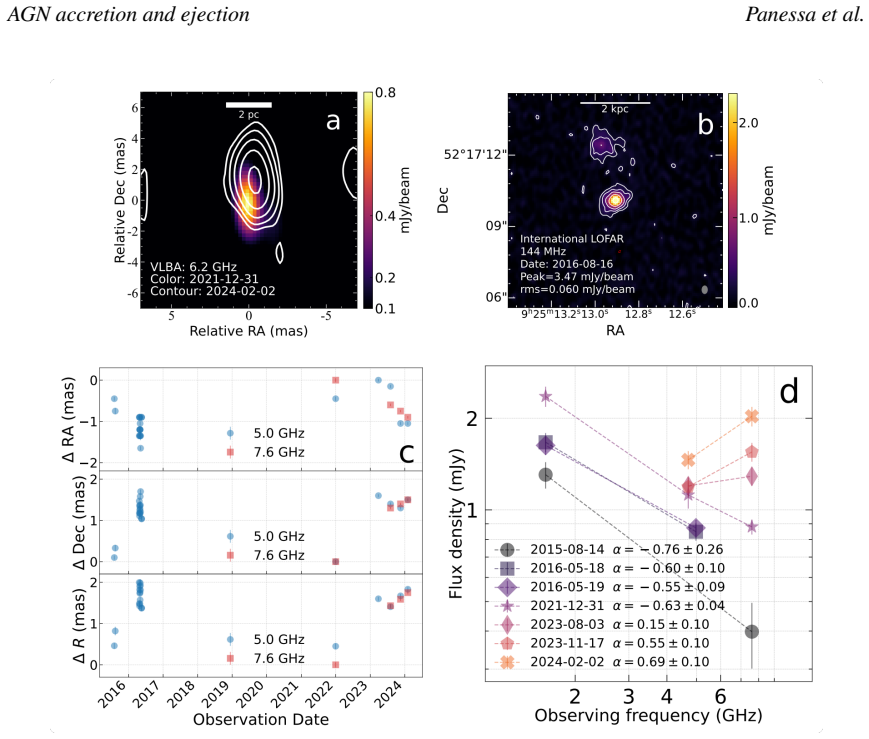
At the full AA4 deployment, the SKA-MID phased into global VLBI arrays will deliver sub-milliarcsecond imaging and μJy sensitivity over 0.35--15 GHz, enabling the first population-level census of radio-quiet AGN nuclei. Flux, spectral and polarisation monitoring will constrain dynamics and environmental coupling while mapping nuclear regions on sub-pc to kpc scales will disentangle compact cores from host emission and resolve the diversity of radio activity across accretion regimes and jet powers from the local Universe to cosmic dawn.
What carries the argument
SKA-MID phased into global VLBI arrays, which supplies the combination of wide frequency range, high sensitivity and sub-milliarcsecond resolution required to separate nuclear from host-galaxy emission.
If this is right
- Flux, spectral and polarisation monitoring will constrain the dynamics and environmental coupling of the emission processes.
- Mapping on sub-pc to kpc scales will separate compact cores from host-galaxy emission.
- The diversity of radio activity across accretion regimes and jet powers can be resolved from the local Universe to cosmic dawn.
- Earlier AA* operations will support pilot studies of the brightest nearby systems.
Where Pith is reading between the lines
- Population statistics from such observations could be compared directly with multi-wavelength accretion indicators to test models of black-hole growth.
- The same data sets might quantify how radio-quiet AGN contribute to the energy budget assumed in galaxy-formation simulations.
- Practical limits on wide-field VLBI calibration could reduce the effective yield of faint sources below the nominal microJy threshold.
Load-bearing premise
The planned SKA-MID sensitivity, resolution and frequency coverage will be achieved on schedule and the resulting data will suffice to disentangle the listed radio-emission processes without major confusion from host-galaxy emission or calibration limits.
What would settle it
A sample of radio-quiet AGN observed at the projected μJy sensitivity and sub-milliarcsecond resolution in which the different emission components remain indistinguishable from one another would falsify the central claim.
Figures
read the original abstract
The accretion-ejection mechanism in Active Galactic Nuclei (AGN) remains a central open problem in astrophysics, tied to the role of AGN feedback in galaxy formation and evolution. Radio-quiet AGN dominate the observed AGN population. Lacking luminous jets, their radio emission traces a rich set of processes spanning the host galaxy kpc scales down to the vicinity of the supermassive black hole: star formation, AGN-driven winds and shocks, free-free emission from photo-ionized gas, low-power jets, and coronal activity close to the inner accretion disk. The Square Kilometre Array (SKA) will probe these processes across a wide frequency range with unprecedented sensitivity, wide-field survey capability, and, critically, high-resolution VLBI imaging. Flux, spectral, and polarization monitoring will constrain dynamics and environmental coupling, while mapping nuclear regions on sub-pc to kpc scales will disentangle compact cores from host emission, resolving the diversity of radio activity across accretion regimes and jet powers from the local Universe to the cosmic dawn. At the full AA4 deployment, the SKA-MID phased into global VLBI arrays will deliver sub-milliarcsecond imaging and $\mu$Jy sensitivity over 0.35--15\,GHz, enabling the first population-level census of radio-quiet AGN nuclei. Earlier AA$\ast$ operations will support pilot studies of the brightest nearby systems.
Editorial analysis
A structured set of objections, weighed in public.
Referee Report
Summary. The paper is a perspective article outlining the scientific potential of SKA-MID phased into global VLBI arrays for radio-quiet AGN studies. It reviews emission processes (star formation, winds, free-free, weak jets, coronal activity) across scales and argues that at full AA4 deployment the array will achieve sub-milliarcsecond resolution and μJy sensitivity from 0.35-15 GHz, enabling the first population-level census of radio-quiet AGN nuclei; earlier AA* operations are noted for pilot studies.
Significance. If the projected performance is realized, the perspective usefully synthesizes the case for high-resolution, wide-frequency VLBI observations to address accretion-ejection and feedback questions in the dominant AGN population. It correctly enumerates the relevant physical processes and ties them to SKA design goals, providing a forward-looking roadmap that could guide observing strategies.
major comments (1)
- [Abstract] Abstract (final sentence): The claim that SKA-MID VLBI 'will deliver sub-milliarcsecond imaging and μJy sensitivity over 0.35--15 GHz, enabling the first population-level census of radio-quiet AGN nuclei' is presented without quantitative support such as expected source counts, detection thresholds, or assessment of confusion from host-galaxy emission. This assumption is load-bearing for the central conclusion.
Simulated Author's Rebuttal
We thank the referee for their positive assessment of the perspective's scope and for the constructive comment on the abstract. We address the point below and will incorporate revisions to strengthen the quantitative basis for the central claim.
read point-by-point responses
-
Referee: [Abstract] Abstract (final sentence): The claim that SKA-MID VLBI 'will deliver sub-milliarcsecond imaging and μJy sensitivity over 0.35--15 GHz, enabling the first population-level census of radio-quiet AGN nuclei' is presented without quantitative support such as expected source counts, detection thresholds, or assessment of confusion from host-galaxy emission. This assumption is load-bearing for the central conclusion.
Authors: We agree this is a valid criticism: the abstract statement is forward-looking and would be strengthened by explicit quantitative grounding. As a perspective article the manuscript synthesizes existing literature rather than presenting new calculations, but we will revise by (i) adding order-of-magnitude source-count estimates extrapolated from current surveys (e.g., FIRST, NVSS, and VLASS) to SKA-MID VLBI sensitivities at 0.35–15 GHz, (ii) tabulating expected detection thresholds using the published SKA-MID system-equivalent flux density and integration-time scaling, and (iii) including a brief discussion of host-galaxy confusion limits based on typical kpc-scale radio surface-brightness distributions. These additions will be placed in a new short subsection and referenced from the abstract. The revised text will retain the perspective tone while making the load-bearing claim quantitatively defensible. revision: yes
Circularity Check
No derivation chain; perspective paper on planned capabilities
full rationale
The manuscript is a forward-looking perspective article. It describes planned SKA-MID VLBI performance (sub-mas resolution, μJy sensitivity, 0.35-15 GHz) and lists target emission processes (star formation, winds, free-free, jets, coronal activity) without presenting equations, parameter fits, or any derivation that reduces to its own inputs. No self-citations are invoked to support a uniqueness theorem or ansatz. The central claim is a projection of instrument specifications rather than a calculated result, so no circularity is present.
Axiom & Free-Parameter Ledger
Reference graph
Works this paper leans on
-
[1]
doi: 10.1111/j.1365-2966.2009.15829.x. D. M. Alexander et al.New Astron. Rev., 101:101733, Dec
-
[2]
doi: 10.1016/j.newar.2025. 101733. T. An.ApJL, 1004(1):L5, June
-
[3]
doi: 10.3847/2041-8213/ae6cde. T. An et al.Nature Communications, 11:143, Jan
-
[4]
doi: 10.1038/s41467-019-14093-2. T. An et al.MNRAS, 519(3):4047–4055, Mar
-
[5]
doi: 10.1093/mnras/stac3774. E. Bañados et al.ApJ, 804(2):118, May
-
[6]
13 AGN accretion and ejection Panessa et al
doi: 10.1088/0004-637X/804/2/118. 13 AGN accretion and ejection Panessa et al. R. D. Baldi, E. Behar, A. Laor, and A. Horesh.MNRAS, 454(4):4277–4281, Dec
-
[7]
doi: 10.1093/mnras/stv2284. R. D. Baldi et al.MNRAS, 508(2):2019–2038, Dec
-
[8]
doi: 10.1093/mnras/stab2613. R. D. Baldi et al.MNRAS, 510(1):1043–1058, Feb
-
[9]
doi: 10.1093/mnras/stab3445. L. Barcos-Muñoz et al.ApJL, 853(2):L28, Feb
-
[10]
doi: 10.3847/2041-8213/aaa28d. E. Behar et al.MNRAS, 451(1):517–526, July
-
[11]
doi: 10.1093/mnras/stv988. E. Behar et al.MNRAS, 478(1):399–406, July
-
[12]
doi: 10.1093/mnras/sty850. S. Belladitta et al.A&A, 635:L7, Mar
-
[13]
doi: 10.1051/0004-6361/201937395. S. Belladitta et al.A&A, 669:A134, Jan
-
[14]
doi: 10.1051/0004-6361/202243855. E. Bempong-Manful et al. InAdvancing Astrophysics with the SKA – II (AASKAII)
-
[15]
arXiv search: Report number AASKAII/Bempong-Manful01. P.N.BestandT.M.Heckman.MNRAS,421(2):1569–1582,Apr.2012. doi: 10.1111/j.1365-2966. 2012.20414.x. P.N.Bestetal.MNRAS,523(2):1729–1755,2023. ISSN13652966. doi: 10.1093/mnras/stad1308. URLhttps://ui.adsabs.harvard.edu/abs/2023MNRAS.523.1729B/abstract. Pub- lisher: Oxford University Press. R. D. Blandford a...
-
[16]
doi: 10.1093/mnras/179.3
-
[17]
doi: 10.1093/mnras/stad2289. S. Chen et al.ApJ, 979(2):241, Feb
-
[18]
doi: 10.3847/1538-4357/ada142. X. Cheng et al.ApJSS, 277(2):56, Apr
-
[19]
doi: 10.3847/1538-4365/adba4c. J. J. Condon.ARA&A, 30:575–611, Jan
-
[20]
S.M.Croometal.MNRAS,399(4):1755–1772,Nov.2009
doi: 10.1146/annurev.aa.30.090192.003043. S.M.Croometal.MNRAS,399(4):1755–1772,Nov.2009. doi: 10.1111/j.1365-2966.2009.15398. x. S. del Palacio et al.A&A, 701:A41, Sept
-
[21]
doi: 10.1051/0004-6361/202554936. C.-A. Faucher-Giguère and E. Quataert.MNRAS, 425(1):605–622, Sept
-
[22]
doi: 10.1111/j. 1365-2966.2012.21512.x. S. Frey et al.A&A, 531:L5, July
work page doi:10.1111/j 2012
-
[23]
doi: 10.1051/0004-6361/201117341. S. Frey et al.A&A, 681:L12, Jan
-
[24]
doi: 10.1051/0004-6361/202348602. J. F. Gallimore, S. A. Baum, C. P. O’Dea, and A. Pedlar.ApJ, 458:136, Feb
-
[25]
doi: 10.1086/504593. G. Ghisellini et al.MNRAS, 438(3):2694–2700, Mar
-
[26]
doi: 10.1093/mnras/stt2394. M. Giroletti and F. Panessa.ApJL, 706(2):L260–L264, Dec
-
[27]
doi: 10.1088/0004-637X/706/ 2/L260. K. Gültekin et al.MNRAS, 516(4):6123–6131, Nov
-
[28]
doi: 10.1093/mnras/stac2608. C. L. Hale et al.MNRAS, 536(3):2187–2211, Jan
-
[29]
doi: 10.1093/mnras/stae2528. M.J.Hardcastleetal. InAdvancingAstrophysicswiththeSKA–II(AASKAII).2026. arXivsearch: Report number AASKAII/Hardcastle01. C.M.Harrison,D.M.Alexander,J.R.Mullaney,andA.M.Swinbank.MNRAS,441(4):3306–3347, July
-
[30]
14 AGN accretion and ejection Panessa et al
doi: 10.1093/mnras/stu515. 14 AGN accretion and ejection Panessa et al. C.M.Harrisonetal.NatureAstronomy,2:198–205,Feb.2018. doi: 10.1038/s41550-018-0403-6. T. M. Heckman and P. N. Best.ARA&A, 52:589–660, Aug
-
[31]
doi: 10.1088/0004-6256/144/4/105. L. Ighina et al.A&A, 647:L11, Mar
-
[32]
doi: 10.1051/0004-6361/202140362. Y. Inoue and A. Doi.ApJ, 869(2):114, Dec
-
[33]
doi: 10.3847/1538-4357/aaeb95. M. Janssen et al.A&A, 626:A75, June
-
[34]
doi: 10.1051/0004-6361/201935181. M. E. Jarvis et al.MNRAS, 485(2):2710–2730, May
-
[35]
doi: 10.1093/mnras/stz556. L. Jiang et al.ApJ, 656(2):680–690, Feb
-
[36]
doi: 10.1086/510831. P. M. Keller et al.MNRAS, 528(4):5692–5702, Mar
-
[37]
doi: 10.1093/mnras/stae418. K. I. Kellermann et al.AJ, 98:1195, Oct
-
[38]
doi: 10.1086/115207. P. Kharb and S. Silpa.Galaxies, 11(1):27, Feb
-
[39]
doi: 10.3390/galaxies11010027. P. Kharb et al.ApJ, 652(1):177–188, Nov
-
[40]
doi: 10.1086/507945. J.-S. Kim et al.A&A, 690:A129, Oct
-
[41]
doi: 10.1051/0004-6361/202449663. R. Kondapally et al. InAdvancing Astrophysics with the SKA – II (AASKAII)
-
[42]
doi: 10.1088/0004-6256/149/2/61. Y.Kudohetal. InAdvancingAstrophysicswiththeSKA–II(AASKAII).2026. arXivsearch: Report number AASKAII/Kudoh01. A.LaorandE.Behar.MNRAS,390(2):847–862,Oct.2008. doi: 10.1111/j.1365-2966.2008.13806. x. Y.Lietal. VLBIwithSKA:Possiblearraysandastrometricscience,
-
[43]
URLhttp://arxiv. org/abs/2404.14663. Y. Liu et al.ApJ, 929(1):69, Apr. 2022a. doi: 10.3847/1538-4357/ac5c50. Y. Liu et al.ApJL, 939(1):L5, Nov. 2022b. doi: 10.3847/2041-8213/ac98b2. Y. Liu et al.A&A, 685:A111, May
-
[44]
doi: 10.1051/0004-6361/202449394. A. P. Lobanov.A&A, 330:79–89, Feb
-
[45]
doi: 10.48550/arXiv.astro-ph/9712132. P. Madau and M. Dickinson.ARA&A, 52:415–486, Aug
work page internal anchor Pith review Pith/arXiv arXiv doi:10.48550/arxiv.astro-ph/9712132
-
[46]
doi: 10.1093/mnras/stt201. J. C. McKinney, A. Tchekhovskoy, and R. D. Blandford.MNRAS, 423(4):3083–3117, July
-
[47]
2012, MNRAS, 425, 1371, doi: 10.1111/j.1365-2966.2012.21554.x
doi: 10.1111/j.1365-2966.2012.21074.x. A.MerloniandS.Heinz.MNRAS,388(3):1011–1030,Aug.2008. doi: 10.1111/j.1365-2966.2008. 13472.x. A. Merloni, S. Heinz, and T. di Matteo.MNRAS, 345(4):1057–1076, Nov
-
[48]
doi: 10.1046/j. 1365-2966.2003.07017.x. A. Mesinger, B. Greig, and E. Sobacchi.MNRAS, 459(3):2342–2353, July
work page doi:10.1046/j 2003
-
[49]
doi: 10.1007/s00159-007-0008-z. B. Mingo et al.MNRAS, 511(3):3250–3271, Apr
-
[50]
doi: 10.1093/mnras/stac140. E. Momjian et al.ApJ, 861(2):86, July
-
[51]
15 AGN accretion and ejection Panessa et al
doi: 10.3847/1538-4357/aac76f. 15 AGN accretion and ejection Panessa et al. R. Morganti et al.A&A, 580:A1, Aug
-
[52]
doi: 10.1051/0004-6361/201525860. D. Mukherjee et al.MNRAS, 479(4):5544–5566, Oct
work page internal anchor Pith review doi:10.1051/0004-6361/201525860
-
[53]
doi: 10.1093/mnras/sty1776. I. M. Mutie et al.MNRAS, 539(2):808–819, May
work page internal anchor Pith review doi:10.1093/mnras/sty1776
-
[54]
doi: 10.1093/mnras/staf524. N. M. Nagar, H. Falcke, A. S. Wilson, and J. S. Ulvestad.A&A, 392:53–82, Sept
-
[55]
doi: 10.1051/0004-6361:20020874. N. M. Nagar, H. Falcke, and A. S. Wilson.A&A, 435(2):521–543, May
-
[56]
doi: 10.1086/176343. K. Nyland et al.MNRAS, 458(2):2221–2268, May
-
[57]
doi: 10.1093/mnras/stw391. C. P. O’Dea.PASP, 110(747):493–532, May
-
[58]
doi: 10.1086/316162. P. Padovani.A&ARv, 24(1):13, Sept
-
[59]
doi: 10.1007/s00159-016-0098-6. P. Padovani et al.A&ARv, 25(1):2, Aug. 2017a. doi: 10.1007/s00159-017-0102-9. P. Padovani et al.A&ARv, 25(1):2, Aug. 2017b. doi: 10.1007/s00159-017-0102-9. F. Panessa and M. Giroletti.MNRAS, 432(2):1138–1143, June
-
[60]
doi: 10.1093/mnras/stt547. F. Panessa et al.Nature Astronomy, 3:387–396, Apr
-
[61]
doi: 10.1038/s41550-019-0765-4. F. Panessa et al.MNRAS, 510(1):718–724, Feb
-
[62]
doi: 10.1093/mnras/stab3426. K. Perger, S. Frey, K. É. Gabányi, and L. V. Tóth.Frontiers in Astronomy and Space Sciences, 4: 9, Aug
-
[63]
doi: 10.3389/fspas.2017.00009. P. O. Petrucci et al.A&A, 678:L4, Oct
-
[64]
R.M.Plotkinetal.MNRAS,419(1):267–286,Jan.2012
doi: 10.1051/0004-6361/202347495. R.M.Plotkinetal.MNRAS,419(1):267–286,Jan.2012. doi: 10.1111/j.1365-2966.2011.19689.x. I. Prandoni et al. InAdvancing Astrophysics with the SKA – II (AASKAII)
-
[65]
doi: 10.1051/0004-6361/202038591. C. Ricci et al.ApJL, 952(2):L28, Aug
-
[66]
doi: 10.3847/2041-8213/acda27. I. Ruffa et al.MNRAS, 522(4):6170–6195, July
-
[67]
doi: 10.1093/mnras/stad1119. P. Saikia, E. Körding, and S. Dibi.MNRAS, 477(2):2119–2127, June
-
[68]
doi: 10.1093/mnras/ sty754. M. T. Sargent et al.ApJSS, 186(2):341–377, Feb
-
[69]
doi: 10.1088/0067-0049/186/2/341. T. Sbarrato et al.MNRAS, 426(1):L91–L95, Oct
-
[70]
doi: 10.1111/j.1745-3933.2012.01332.x. B. Sebastian et al.MNRAS, 499(1):334–354, Nov
-
[71]
doi: 10.1093/mnras/staa2473. E. Shablovinskaya et al.A&A, 690:A232, Oct
-
[72]
doi: 10.1051/0004-6361/202450133. M. Sikora, Ł. Stawarz, and J.-P. Lasota.ApJ, 658(2):815–828, Apr
-
[73]
doi: 10.1086/511972. S. Silpa et al.MNRAS, 507(1):991–1001, Oct. 2021a. doi: 10.1093/mnras/stab1870. S. Silpa et al.MNRAS, 507(2):2550–2561, Oct. 2021b. doi: 10.1093/mnras/stab2110. S. Silpa et al.MNRAS, 513(3):4208–4223, July
-
[74]
doi: 10.1093/mnras/stac1044. C. Spingola et al.A&A, 643:L12, Nov
-
[75]
doi: 10.1051/0004-6361/202039458. C. Spingola et al. InAdvancing Astrophysics with the SKA – II (AASKAII)
-
[76]
doi: 10.1111/j.1745-3933.2011.01147.x. J. S. Ulvestad and L. C. Ho.ApJ, 558(2):561–577, Sept
-
[77]
doi: 10.1086/322307. J. S. Ulvestad and A. S. Wilson.ApJ, 285:439–452, Oct
-
[78]
J.S.Ulvestad,R.R.J.Antonucci,andR.W.Goodrich.AJ,109:81,Jan.1995
doi: 10.1086/162520. J.S.Ulvestad,R.R.J.Antonucci,andR.W.Goodrich.AJ,109:81,Jan.1995. doi: 10.1086/117258. 16 AGN accretion and ejection Panessa et al. M. Volonteri, M. Sikora, and J.-P. Lasota.ApJ, 667(2):704–713, Oct
-
[79]
doi: 10.1086/521186. A. Wang et al.MNRAS, 504(3):3823–3830, July
-
[80]
doi: 10.1093/mnras/stab587. A. Wang et al.MNRAS, 518(1):39–53, Jan. 2023a. doi: 10.1093/mnras/stac3091. A. Wang et al.MNRAS, 523(1):L30–L34, July 2023b. doi: 10.1093/mnrasl/slad051. A. Wang et al.MNRAS, 525(4):6064–6083, Nov. 2023c. doi: 10.1093/mnras/stad2651. A. Wang et al.ApJL, 987(2):L26, July
discussion (0)
Sign in with ORCID, Apple, or X to comment. Anyone can read and Pith papers without signing in.