NanoVer: An open-source framework for interactive molecular dynamics in extended reality (iMD-XR) on commodity hardware
Pith reviewed 2026-07-01 06:56 UTC · model grok-4.3
The pith
NanoVer is an open-source framework that lets multiple users collaboratively manipulate real-time molecular dynamics simulations as tangible objects in shared extended reality on standalone consumer hardware.
A machine-rendered reading of the paper's core claim, the machinery that carries it, and where it could break.
Core claim
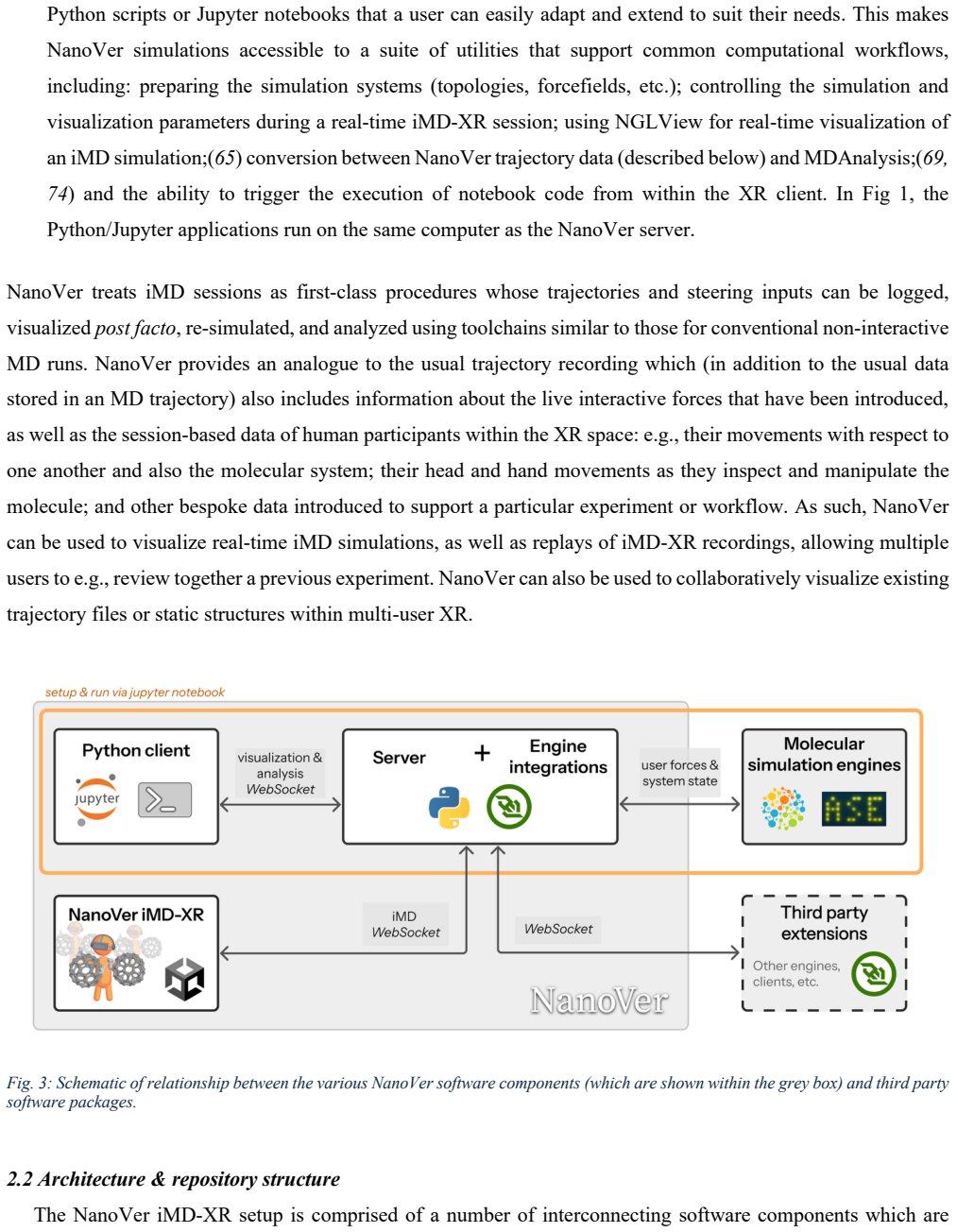
NanoVer supplies a flexible server architecture that simultaneously handles multiple XR clients and Python clients to run and visualize real-time MD simulations in shared XR environments on mobile hardware. The system records sessions, renders static structures or trajectories, and supports new interaction modes such as 3D path sketching for agents, all while enabling fluid movement between AR and VR for tasks including molecular conformational sampling, protein-ligand binding, molecular psychophysics, and AI agent training.
What carries the argument
The NanoVer server architecture that synchronizes multiple XR and Python clients with MD simulations for low-latency shared manipulation.
If this is right
- Groups can co-habit virtual spaces and jointly manipulate live molecular structures.
- Users can sketch 3D conformational paths that automated agents then follow.
- The platform supports training AI agents to sample molecular transitions through human-guided interactions.
- Researchers and educators can move between AR and VR to explore binding events and conformational changes.
Where Pith is reading between the lines
- The client-server split could allow integration of additional simulation backends beyond the ones demonstrated.
- Shared XR sessions might enable remote teams to perform joint molecular design tasks without physical co-location.
- The path-sketching interface suggests extensions to other domains where humans guide automated sampling of dynamical systems.
Load-bearing premise
The server and XR client APIs can sustain real-time synchronization, low-latency interaction, and MD performance across users on mobile hardware without tethered high-end GPUs.
What would settle it
A multi-user test on standalone headsets where latency exceeds thresholds for atomic-precision manipulation or where simulation frame rates drop below interactive levels would show the architecture cannot deliver the claimed performance.
Figures
read the original abstract
This article outlines 'NanoVer', an open-source software framework which enables groups of people to co-habit the same virtual space and manipulate real-time MD (Molecular Dynamics) simulations of flexible 3D molecular structures with atomic-level precision as if they were tangible objects, an approach that we call 'interactive Molecular Dynamics in eXtended Reality' (iMD-XR). Distinct from our earlier iMD work that relied on tethered PC-VR systems with large graphics cards, NanoVer represents a change in philosophy, emphasizing compatibility with standalone mobile consumer XR hardware and corresponding software APIs. The NanoVer architecture enables multiple XR clients and/or Python clients to simultaneously communicate with a flexible server architecture that can carry out a range of tasks, including for example: recording iMD-XR sessions, static structure visualization, and MD trajectory visualization. NanoVer allows researchers, educators, and students to fluidly move between AR and VR environments, to explore creative new approaches to molecular research and education, including for example: molecular conformational sampling, protein-ligand binding, molecular psychophysics, training AI agents to sample molecular transitions, and a new interface which allows iMD-XR participants to sketch 3D conformational paths which automated agents can then follow. As an immersive platform that offers new ways to understand, engineer, communicate, and interact with dynamical behaviour at the nanoscale, NanoVer invites us to imagine new ways for combining human intelligence (e.g., spatial cognition and design reasoning) with machine intelligence. To expand NanoVer's accessibility, we have published a version to the Meta Horizon Store, for easy download by those with a Meta Quest 3/3S headset, to explore pre-recorded iMD-XR trajectory visualizations and set up their own multi-user system.
Editorial analysis
A structured set of objections, weighed in public.
Referee Report
Summary. The paper presents NanoVer, an open-source framework for interactive molecular dynamics in extended reality (iMD-XR) on commodity standalone XR hardware. It describes a flexible server architecture supporting simultaneous XR and Python clients for real-time MD simulation manipulation, session recording, trajectory visualization, and multi-user collaboration in AR/VR environments, with availability on the Meta Horizon Store for Meta Quest headsets.
Significance. If the performance claims are validated, the work could meaningfully advance accessible tools for molecular education, conformational sampling, protein-ligand studies, and human-AI collaboration in chemistry by removing the need for tethered high-end GPUs. The open-source release and shift to commodity hardware represent practical strengths for reproducibility and adoption.
major comments (1)
- [Abstract] Abstract: the claim that the framework 'enables groups of people to co-habit the same virtual space and manipulate real-time MD simulations ... on commodity standalone XR hardware' is load-bearing but unsupported, as the manuscript supplies no latency, frame-rate, atom-count scaling, or multi-user synchronization measurements for MD workloads on mobile XR devices.
minor comments (1)
- The text would benefit from explicit separation between architectural description and any empirical performance data, even if the latter is limited to qualitative observations from the Meta Quest deployment.
Simulated Author's Rebuttal
We thank the referee for their constructive feedback and recognition of NanoVer's potential to advance accessible iMD-XR tools. We address the single major comment below.
read point-by-point responses
-
Referee: [Abstract] Abstract: the claim that the framework 'enables groups of people to co-habit the same virtual space and manipulate real-time MD simulations ... on commodity standalone XR hardware' is load-bearing but unsupported, as the manuscript supplies no latency, frame-rate, atom-count scaling, or multi-user synchronization measurements for MD workloads on mobile XR devices.
Authors: We agree that the abstract claim requires empirical support to be fully substantiated. The manuscript emphasizes the client-server architecture, where the server performs MD computations and standalone XR clients (Meta Quest) handle rendering and interaction, enabling multi-user sessions without tethered high-end hardware. However, the current text does not include quantitative benchmarks. In the revised manuscript we will add a dedicated performance evaluation section reporting latency, frame-rate scaling with atom count, and multi-user synchronization metrics measured on Meta Quest 3/3S devices for representative MD systems. revision: yes
Circularity Check
No circularity: software architecture paper with no derivations or fitted quantities
full rationale
The manuscript describes an open-source framework (NanoVer) for iMD-XR, including server architecture, client APIs, and use cases such as multi-user sessions and trajectory visualization. It contains no equations, no fitted parameters, no predictions derived from inputs, and no load-bearing self-citations or uniqueness theorems. All claims are presented as design and implementation choices rather than results of a derivation chain. The absence of any mathematical or statistical reduction means no opportunity exists for the patterns of self-definitional, fitted-input, or self-citation circularity. The work is self-contained as a software contribution.
Axiom & Free-Parameter Ledger
Reference graph
Works this paper leans on
-
[1]
Fombona-Pascual, J
A. Fombona-Pascual, J. Fombona, E. Vázquez-Cano, VR in chemistry, a review of scientific research on advanced atomic/molecular visualization. Chemistry Education Research and Practice 23, 300-312 (2022). 25. E. Echeverri-Jimenez, M. Oliver-Hoyo, A Roadmap to Support the Development of Chemistry Virtual Reality Learning Environments Merging Chemical Pedago...
2022
-
[2]
Mishra, M
S. Mishra, M. Corro-Flores, D. Krum, N. Forouzesh, Molecular Docking Improved with Human Spatial Perception Using Virtual Reality. IEEE Transactions on Visualization and Computer Graphics 30, 2269-2275 (2024). 44. J. Barrow, W. Hurst, J. Edman, N. Ariesen, C. Krampe, Virtual reality for biochemistry education: the cellular factory. Education and Informati...
2024
-
[3]
D. R. Glowacki, VR models of death and psychedelics: an aesthetic paradigm for design beyond day-to-day phenomenology. Frontiers in Virtual Reality Volume 4 - 2023, (2024). 63. T. K. Metzinger, Why is virtual reality interesting for philosophers? Frontiers in Robotics and AI 5, 101 (2018). 64. S. Yuan, H. S. Chan, Z. Hu, Using PyMOL as a platform for comp...
-
[4]
Wacker et al., Crystal Structure of an LSD-Bound Human Serotonin Receptor
D. Wacker et al., Crystal Structure of an LSD-Bound Human Serotonin Receptor. Cell 168, 377-389.e312 (2017). 87. Intangible-Realities-Laboratory, Visualizing Static Structures. https://github.com/IRL2/nanover-server-py/blob/main/tutorials/mdanalysis/mdanalysis_lsd.ipynb, (2026). 88. Intangible-Realities-Laboratory, Multiple Simulations on a Server. https:...
2017
-
[5]
S. Park, F. Khalili-Araghi, E. Tajkhorshid, K. Schulten, Free energy calculation from steered molecular dynamics simulations using Jarzynski’s equality. The Journal of Chemical Physics 119, 3559-3566 (2003). 108. S. Park, K. Schulten, Calculating potentials of mean force from steered molecular dynamics simulations. The Journal of Chemical Physics 120, 594...
discussion (0)
Sign in with ORCID, Apple, or X to comment. Anyone can read and Pith papers without signing in.