The limits of erasure-based postselection for quantum error mitigation
Pith reviewed 2026-07-01 05:25 UTC · model grok-4.3
The pith
Postselection on dual-rail qubits fully mitigates erasure noise for check error rates under 3 percent and exceeds single-rail performance at kiloquop scales.
A machine-rendered reading of the paper's core claim, the machinery that carries it, and where it could break.
Core claim
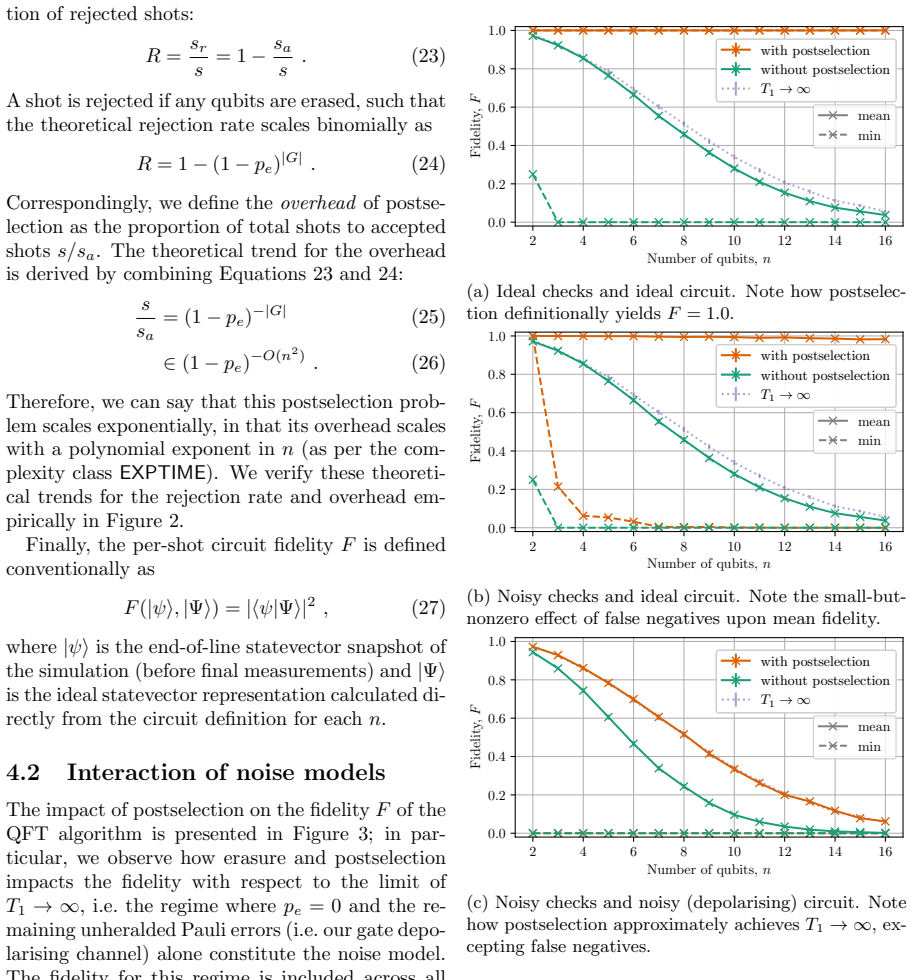
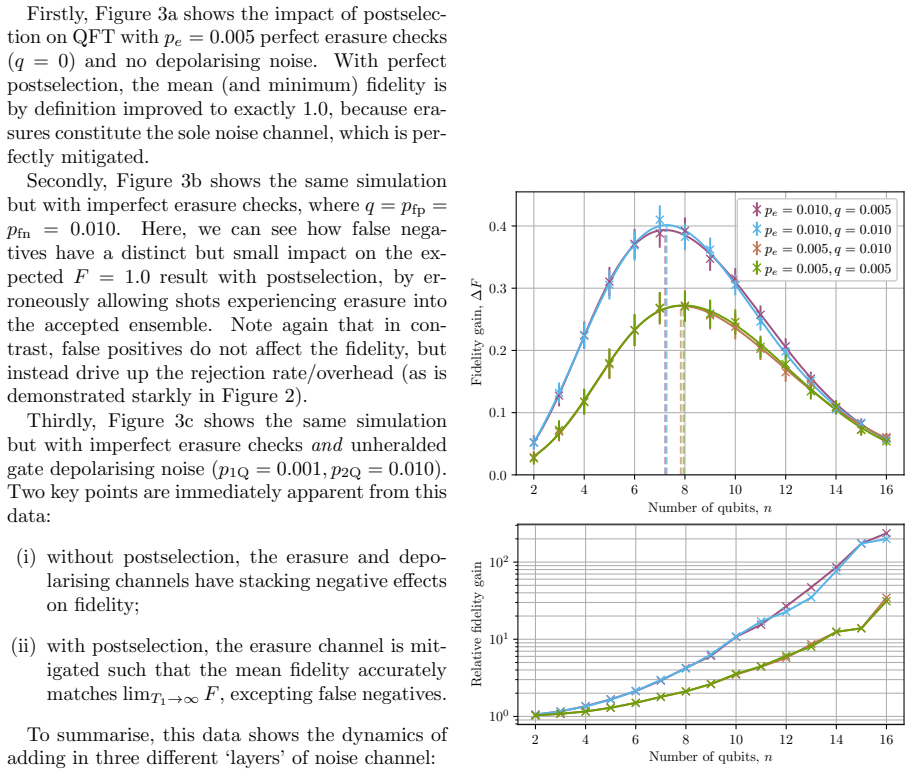
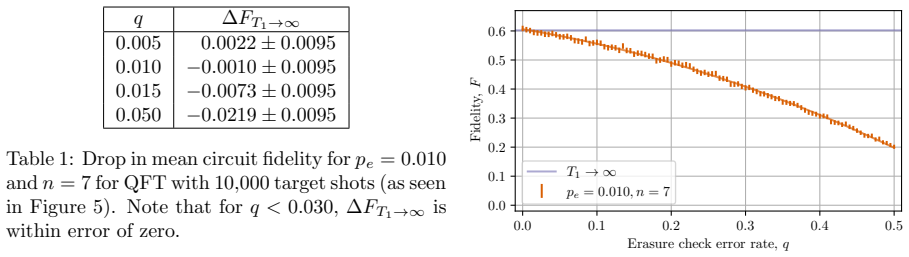
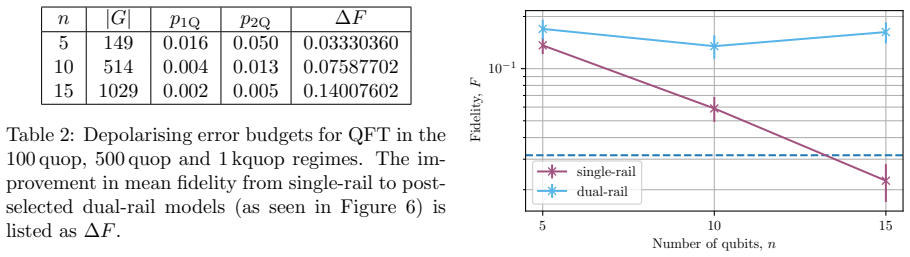
The authors establish that postselection fully mitigates the erasure channel for erasure check error rates less than 3.0%. They further show that a postselected dual-rail system can surpass a fundamental noise floor at the kiloquop scale where a comparable single-rail system cannot. This is demonstrated through numerical simulations that include both erasure noise and gate depolarising noise on the quantum Fourier transform.
What carries the argument
The postselection procedure on dual-rail erasure qubits, which discards shots detecting erased qubits, combined with the numerical framework for circuit-level erasure noise.
Load-bearing premise
The numerical noise model and postselection procedure accurately capture real-device behaviour, including any unmodelled correlations between erasure detection errors and gate depolarisation.
What would settle it
Performing the quantum Fourier transform experiment on dual-rail hardware with varying erasure check error rates and verifying whether the postselected error rate drops to zero below the 3% threshold as predicted by the simulations.
Figures
read the original abstract
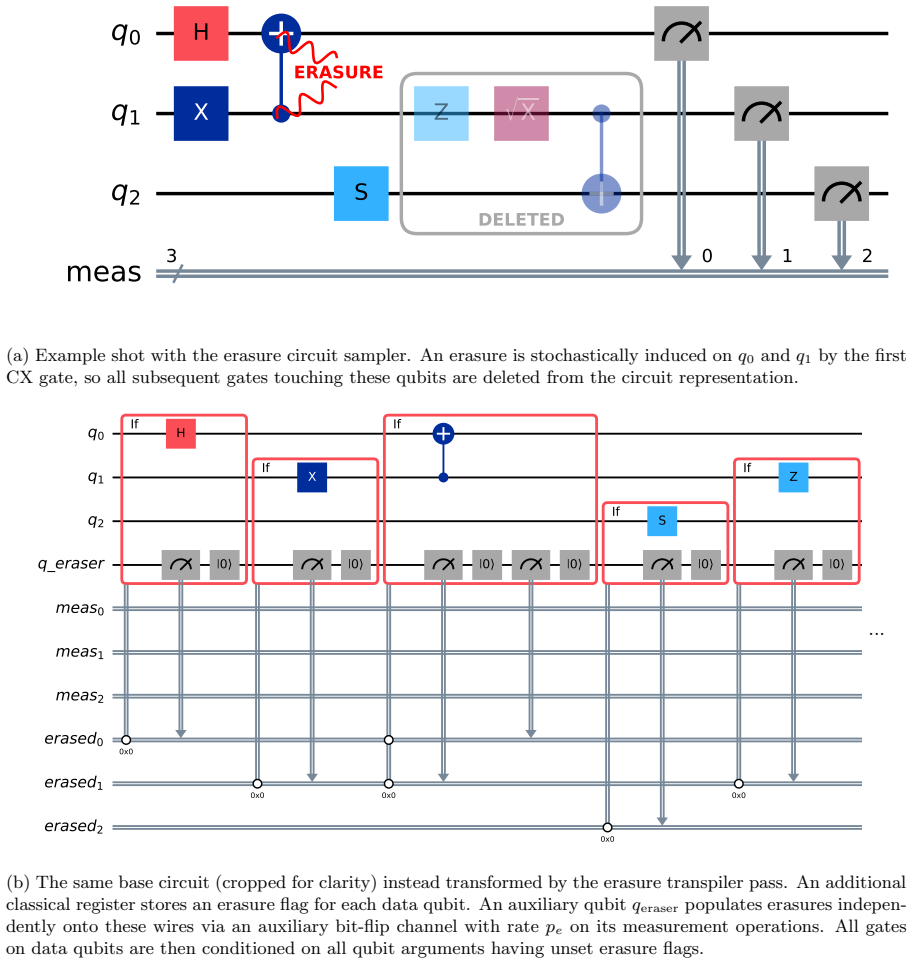
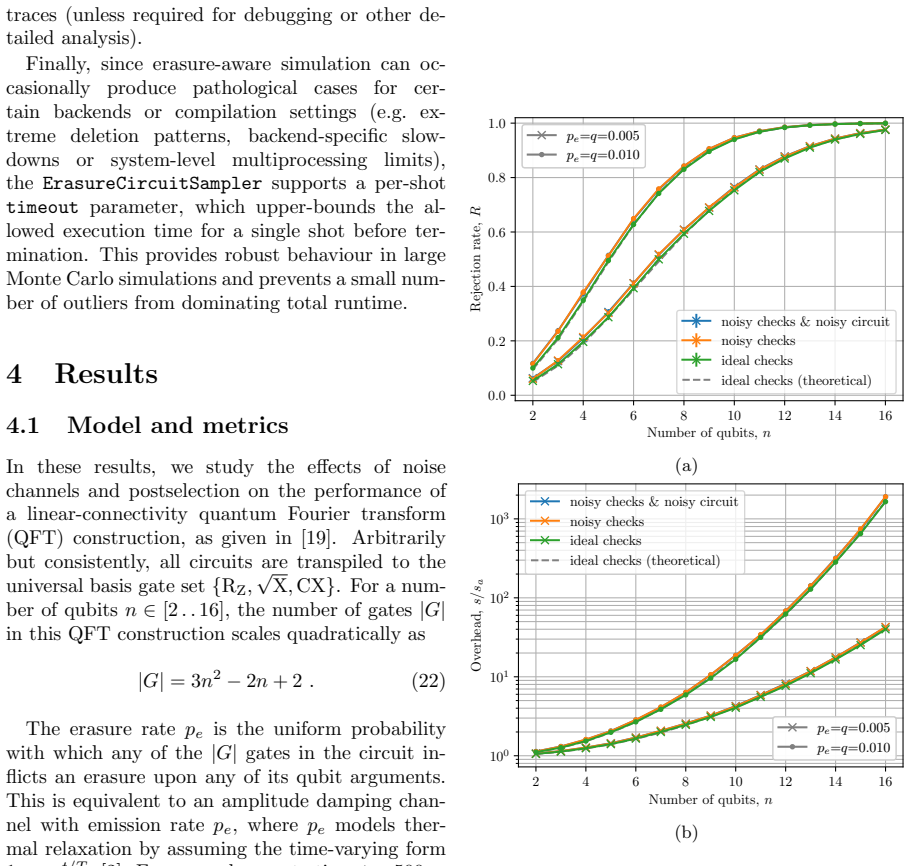
In both classical and quantum error correction, heralded erasures are known to be easier to tolerate than unheralded general stochastic errors. Whilst an established benefit of loss-dominant quantum architectures such as photonic qubits, this fact has received renewed interest, with a pivot towards reconstructing other architectures to be erasure-dominant, such as dual-rail transmons. This work investigates exploiting these 'erasure qubits' in the near term by using postselection as a technique for error mitigation, wherein circuit shots detecting any erased qubits are discarded from the computational ensemble and repeated. Firstly, we outline a numerical framework for representing circuit-level erasure noise and present 'erado', an open-source library capable of simulating erasure noise and postselection. Secondly, we investigate the effects of both erasure noise and noise in the erasure checks themselves on the quantum Fourier transform (QFT), in the additional presence of gate depolarising noise. A worked example is provided of postselection fully mitigating against the erasure channel for erasure check error rates less than 3.0%. We also show how a postselected dual-rail system can surpass a fundamental noise floor at the kiloquop scale where a comparable single-rail system cannot, justifying this approach in the NISQ regime before (and, perhaps, combined with) the practical arrival of QEC.
Editorial analysis
A structured set of objections, weighed in public.
Referee Report
Summary. The manuscript introduces a numerical framework for circuit-level erasure noise and the open-source 'erado' library for simulating erasure and postselection. Through Monte Carlo simulations of the quantum Fourier transform under combined erasure and depolarizing noise, it shows that postselection can completely mitigate the erasure channel for erasure check error rates below 3%, and that postselected dual-rail qubits can exceed the performance limit of single-rail systems at the kiloquop scale.
Significance. The work offers a practical, simulation-backed strategy for error mitigation in near-term erasure-biased hardware such as dual-rail transmons. The release of reproducible code is a notable strength that allows direct verification of the reported thresholds and scale claims.
major comments (2)
- [Abstract] Abstract: the claim that postselection 'fully mitigates' the erasure channel for check error rates less than 3.0% is load-bearing for the central result, yet the abstract provides no explicit statement of the QFT size, circuit depth, or precise fidelity metric used to establish 'full mitigation'; this makes it impossible to judge whether the threshold is robust or specific to the chosen instance.
- [Numerical framework] Numerical framework section: the kiloquop-scale claim that a postselected dual-rail system surpasses the single-rail noise floor rests on the Monte-Carlo noise model; the manuscript should quantify the sensitivity of this crossing point to the assumed independence between erasure-check errors and gate depolarisation, as any unmodelled correlation would directly affect the reported advantage.
minor comments (2)
- The description of the erado library would benefit from an explicit statement of the default noise-parameter ranges and the exact postselection discard rule implemented in the QFT simulations.
- Figure captions should list the precise erasure and depolarising rates together with the number of shots used for each data point to facilitate immediate reproduction.
Simulated Author's Rebuttal
We thank the referee for their positive evaluation and constructive comments, which help clarify the presentation of our results. We address each major comment below.
read point-by-point responses
-
Referee: [Abstract] Abstract: the claim that postselection 'fully mitigates' the erasure channel for check error rates less than 3.0% is load-bearing for the central result, yet the abstract provides no explicit statement of the QFT size, circuit depth, or precise fidelity metric used to establish 'full mitigation'; this makes it impossible to judge whether the threshold is robust or specific to the chosen instance.
Authors: We agree that the abstract would benefit from additional context on the specific instance used to demonstrate full mitigation. The main text reports this for a concrete QFT circuit under the stated noise model, with the fidelity metric defined in the numerical framework section. In the revised manuscript we will update the abstract to state the QFT size, circuit depth, and fidelity metric explicitly. revision: yes
-
Referee: [Numerical framework] Numerical framework section: the kiloquop-scale claim that a postselected dual-rail system surpasses the single-rail noise floor rests on the Monte-Carlo noise model; the manuscript should quantify the sensitivity of this crossing point to the assumed independence between erasure-check errors and gate depolarisation, as any unmodelled correlation would directly affect the reported advantage.
Authors: The Monte Carlo model treats erasure-check errors and gate depolarisation as independent, consistent with standard circuit-level noise assumptions in the absence of device-specific correlation data. We acknowledge that positive correlations could alter the reported crossing point. We will add an explicit statement of this modeling assumption in the numerical framework section together with a qualitative discussion of how correlations would affect the dual-rail advantage; a full quantitative sensitivity sweep is beyond the scope of the current Monte Carlo study but can be noted as a direction for future work. revision: partial
Circularity Check
No significant circularity identified
full rationale
The paper derives its thresholds and performance claims (full mitigation below 3.0% check error; dual-rail surpassing single-rail floor at kiloquop scale) exclusively from direct Monte-Carlo simulations of postselection on a QFT circuit under erasure plus depolarizing noise, implemented in the open-source erado library. No load-bearing analytical step reduces by the paper's own equations to a fitted parameter, self-defined quantity, or self-citation chain; the numerical results are independently reproducible from the stated noise model and procedure without internal redefinition or smuggling of ansatzes.
Axiom & Free-Parameter Ledger
Reference graph
Works this paper leans on
-
[1]
Decoherence bench- marking of superconducting qubits,
J. J. Burnett et al., “Decoherence bench- marking of superconducting qubits,”npj Quantum Information, vol. 5, no. 1, p. 54, Jun. 26, 2019,issn: 2056-6387.doi:10 . 1038/s41534-019-0168-5
2019
-
[2]
M. A. Nielsen and I. L. Chuang,Quan- tum Computation and Quantum Information, 10th Anniversary Edition. Cambridge Uni- versity Press, Dec. 9, 2010,isbn: 978-1-107- 00217-3.doi:10.1017/CBO9780511976667
-
[3]
F. J. MacWilliams and N. J. A. Sloane, The Theory of Error-Correcting Codes. Else- vier, 1977, 788 pp.,isbn: 978-0-444-85010-2. Google Books:nv6WCJgcjxcC
1977
-
[4]
Good Quantum Error-Correcting Codes Exist
A. R. Calderbank and P. W. Shor, “Good quantum error-correcting codes exist,”Phys- ical Review A, vol. 54, no. 2, pp. 1098–1105, Aug. 1, 1996,issn: 1050-2947, 1094-1622. doi:10 . 1103 / PhysRevA . 54 . 1098arXiv: quant-ph/9512032
work page internal anchor Pith review Pith/arXiv arXiv 1996
-
[5]
E. Dennis, A. Kitaev, A. Landahl, and J. Preskill, “Topological quantum memory,” Journal of Mathematical Physics, vol. 43, no. 9, pp. 4452–4505, Sep. 2002,issn: 0022- 2488, 1089-7658.doi:10 . 1063 / 1 . 1499754 arXiv:quant-ph/0110143
work page internal anchor Pith review Pith/arXiv arXiv 2002
-
[6]
Quantum computing, postse- lection, and probabilistic polynomial-time,
S. Aaronson, “Quantum computing, postse- lection, and probabilistic polynomial-time,” Proceedings of the Royal Society A: Mathe- matical, Physical and Engineering Sciences, vol. 461, no. 2063, pp. 3473–3482, Sep. 5, 2005,issn: 1364-5021.doi:10.1098/rspa. 2005.1546arXiv:quant-ph/0412187
-
[7]
Review article: Linear optical quantum computing
P. Kok, W. J. Munro, K. Nemoto, T. C. Ralph, J. P. Dowling, and G. J. Mil- burn, “Linear optical quantum computing with photonic qubits,”Reviews of Modern Physics, vol. 79, no. 1, pp. 135–174, Jan. 24, 2007.doi:10 . 1103 / RevModPhys . 79 . 135 arXiv:quant-ph/0512071
work page internal anchor Pith review Pith/arXiv arXiv 2007
-
[8]
J. Wills, M. T. Haque, and B. Vlastakis, “Error-detected coherence metrology of a dual-rail encoded fixed-frequency multimode superconducting qubit,” Jun. 18, 2025.doi: 10.48550/arXiv.2506.15420arXiv:2506. 15420 [quant-ph], pre-published
-
[9]
Quantum comput- ing with Qiskit,
A. Javadi-Abhari et al., “Quantum comput- ing with Qiskit,” Jun. 19, 2024.doi:10 . 48550 / arXiv . 2405 . 08810arXiv:2405 . 08810 [quant-ph], pre-published
2024
-
[10]
D. J. C. MacKay,Information Theory, In- ference and Learning Algorithms. Cambridge University Press, Sep. 25, 2003, 694 pp.,isbn: 978-0-521-64298-9. Google Books:AKuMj4PN_ EMC
2003
-
[11]
Polynomial codes over certain finite fields,
I. S. Reed and G. Solomon, “Polynomial codes over certain finite fields,”Journal of the Society for Industrial and Applied Math- ematics, vol. 8, no. 2, pp. 300–304, Jun. 1960. doi:10.1137/0108018
-
[12]
Codes for the Quantum Erasure Channel
M. Grassl, T. Beth, and T. Pellizzari, “Codes for the quantum erasure channel,”Physical Review A, vol. 56, no. 1, pp. 33–38, Jul. 1, 1997.doi:10.1103/PhysRevA.56.33arXiv: quant-ph/9610042
work page internal anchor Pith review Pith/arXiv arXiv doi:10.1103/physreva.56.33arxiv: 1997
-
[13]
Linear-time maximum likelihood decoding of surface codes over the quantum erasure channel,
N. Delfosse and G. Z´ emor, “Linear-time maximum likelihood decoding of surface codes over the quantum erasure channel,” Physical Review Research, vol. 2, no. 3, p. 033 042, Jul. 9, 2020.doi:10 . 1103 / PhysRevResearch . 2 . 033042arXiv:1703 . 01517 [quant-ph]
2020
-
[14]
Union- find quantum decoding without union-find,
S. J. Griffiths and D. E. Browne, “Union- find quantum decoding without union-find,” Physical Review Research, vol. 6, no. 1, p. 013 154, Feb. 9, 2024.doi:10 . 1103 / PhysRevResearch . 6 . 013154arXiv:2306 . 09767 [quant-ph]
2024
-
[15]
Erasure qubits: Overcoming theT 1 limit in superconducting circuits,
A. Kubica, A. Haim, Y. Vaknin, H. Levine, F. Brand˜ ao, and A. Retzker, “Erasure qubits: Overcoming theT 1 limit in superconducting circuits,”Physical Review X, vol. 13, no. 4, p. 041 022, Nov. 1, 2023.doi:10 . 1103 / PhysRevX . 13 . 041022arXiv:2208 . 05461 [quant-ph]
2023
-
[16]
Designing fault- tolerant circuits using detector error models,
P.-J. H. S. Derks, A. Townsend-Teague, A. G. Burchards, and J. Eisert, “Designing fault- tolerant circuits using detector error models,” Quantum, vol. 9, p. 1905, Nov. 6, 2025.doi: 10 . 22331 / q - 2025 - 11 - 06 - 1905arXiv: 2407.13826 [quant-ph]. 13
-
[17]
Threshold computation and crypto- graphic security,
Y. Han, L. A. Hemaspaandra, and T. Thier- auf, “Threshold computation and crypto- graphic security,”SIAM Journal on Com- puting, vol. 26, no. 1, pp. 59–78, Feb. 1997,issn: 0097-5397.doi:10 . 1137 / S0097539792240467
1997
-
[18]
Stim: A fast stabilizer circuit simulator,
C. Gidney, “Stim: A fast stabilizer circuit simulator,”Quantum, vol. 5, p. 497, Jul. 6, 2021.doi:10 . 22331 / q - 2021 - 07 - 06 - 497 arXiv:2103.02202 [quant-ph]
-
[19]
Implementation of Shor’s algorithm on a linear nearest neighbour qubit array,
A. G. Fowler, S. J. Devitt, and L. C. L. Hol- lenberg, “Implementation of Shor’s algorithm on a linear nearest neighbour qubit array,” Quantum Information & Computation, vol. 4, no. 4, pp. 237–251, Jul. 1, 2004,issn: 1533-
2004
-
[20]
arXiv:quant-ph/0402196
work page internal anchor Pith review Pith/arXiv arXiv
-
[21]
Beyond NISQ: The megaquop machine,
J. Preskill, “Beyond NISQ: The megaquop machine,”ACM Transactions on Quantum Computing, vol. 6, no. 3, 18:1–18:7, Apr. 29, 2025.doi:10 . 1145 / 3723153arXiv:2502 . 17368 [quant-ph]
2025
-
[22]
A quantum engineer’s guide to superconduct- ing qubits,
P. Krantz, M. Kjaergaard, F. Yan, T. P. Or- lando, S. Gustavsson, and W. D. Oliver, “A quantum engineer’s guide to superconduct- ing qubits,”Applied Physics Reviews, vol. 6, no. 2, p. 021 318, Jun. 17, 2019,issn: 1931- 9401.doi:10.1063/1.5089550arXiv:1904. 06560 [quant-ph]
-
[23]
I. G. Hughes and T. P. A. Hase,Measure- ments and Their Uncertainties: A Practical Guide to Modern Error Analysis. Oxford Uni- versity Press, Jul. 1, 2010, 160 pp.,isbn: 978- 0-19-956633-4. Google Books:zEK1DwAAQBAJ
2010
-
[24]
SWAP-less implementation of quantum algorithms,
B. Klaver et al., “SWAP-less implementation of quantum algorithms,”Physical Review A, vol. 113, no. 1, p. 012 443, Jan. 29, 2026.doi: 10 . 1103 / 2wzk - fnhxarXiv:2408 . 10907 [quant-ph]. 14
2026
discussion (0)
Sign in with ORCID, Apple, or X to comment. Anyone can read and Pith papers without signing in.