Floquet Majorana flat bands and emergent Cooper pair symmetries in p-wave magnet-superconductor heterostructure
Pith reviewed 2026-07-01 04:03 UTC · model grok-4.3
The pith
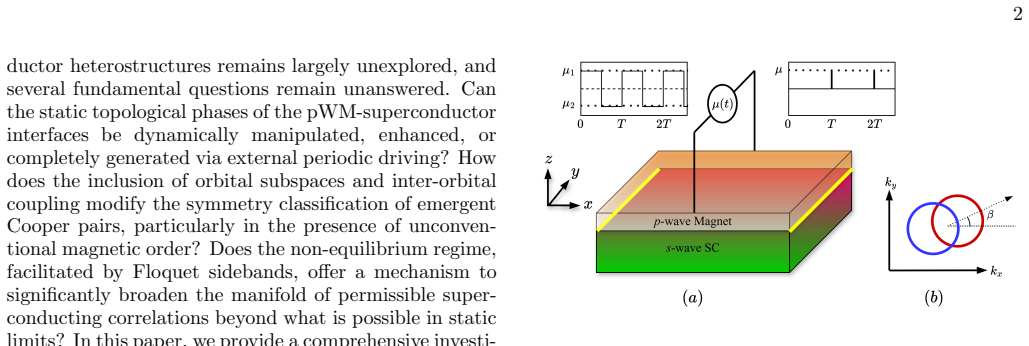
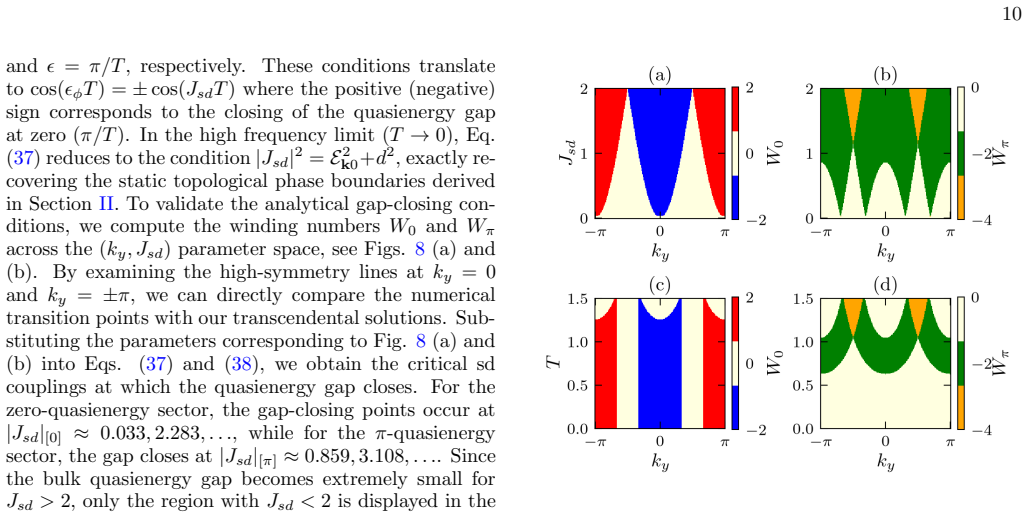
Periodic driving in a p-wave magnet-superconductor heterostructure generates multiple Majorana flat bands and a new nonequilibrium class of Cooper pair correlations.
A machine-rendered reading of the paper's core claim, the machinery that carries it, and where it could break.
Core claim
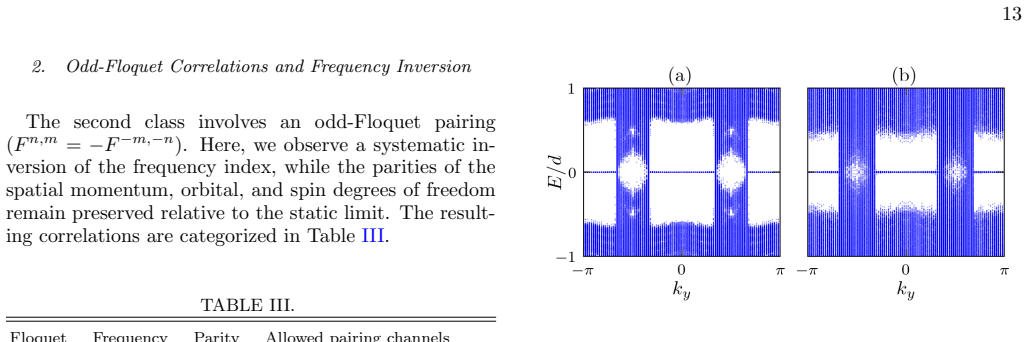
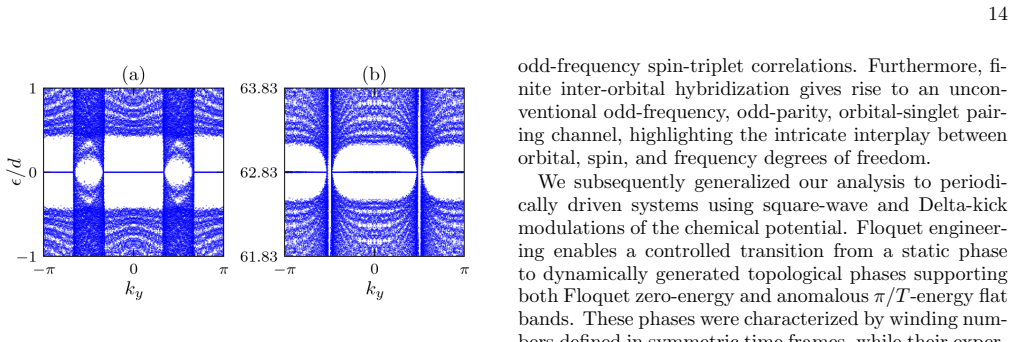
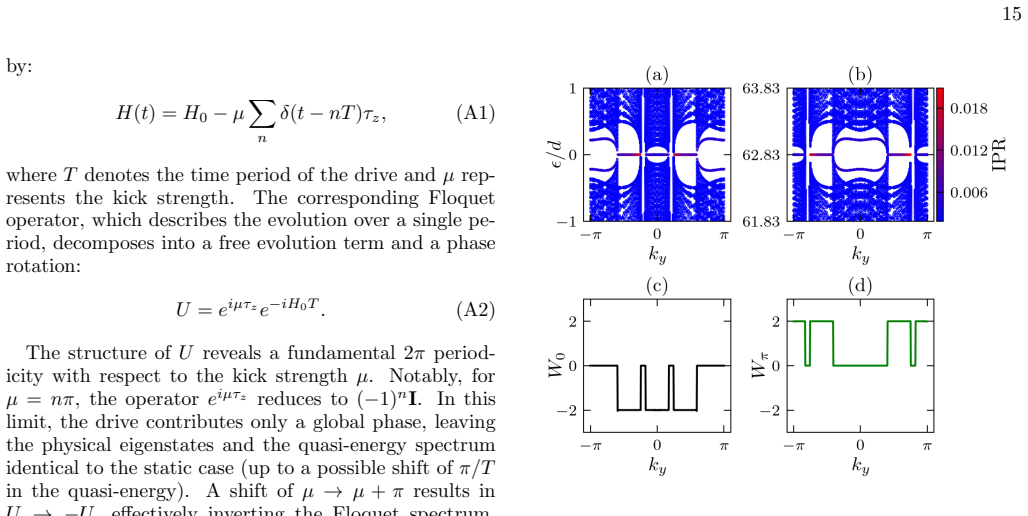
Periodic driving fundamentally reshapes the topological and superconducting landscape by generating multiple nodal points that support higher winding numbers and multiple Majorana flat bands, while the emergent Floquet degree of freedom doubles the number of symmetry-allowed Cooper-pair correlations. The first class of correlations is hosted by the even-Floquet sectors and has a direct counterpart in the static limit. In contrast, the second is a distinct Floquet-generated class that confines to the odd-Floquet sectors, representing a fundamentally nonequilibrium pairing channel that cannot exist in static systems.
What carries the argument
The Floquet degree of freedom from periodic driving, which splits Cooper-pair correlations into even- and odd-Floquet sectors while multiplying nodal points and winding numbers.
If this is right
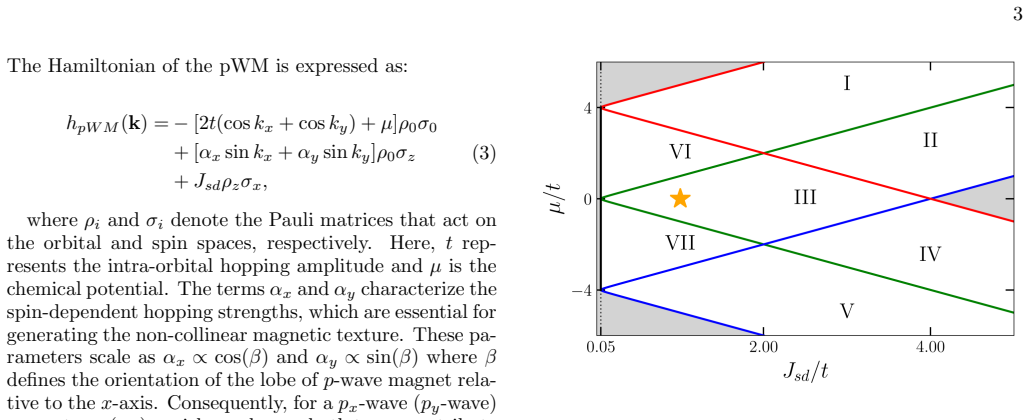
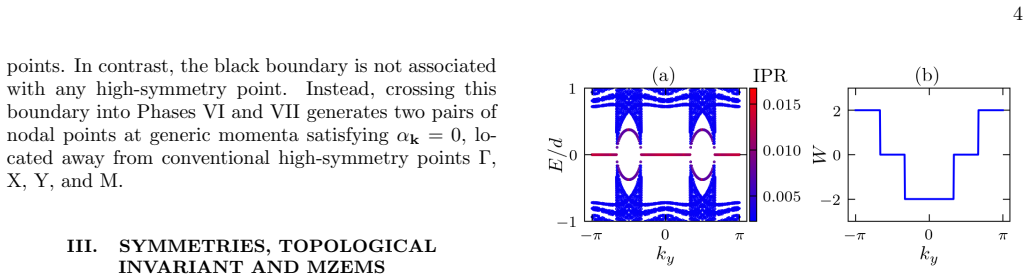
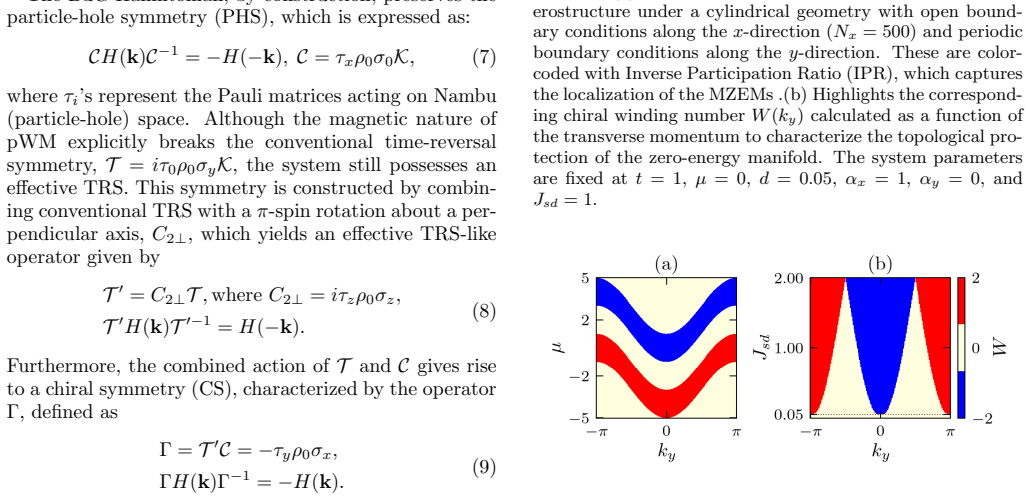
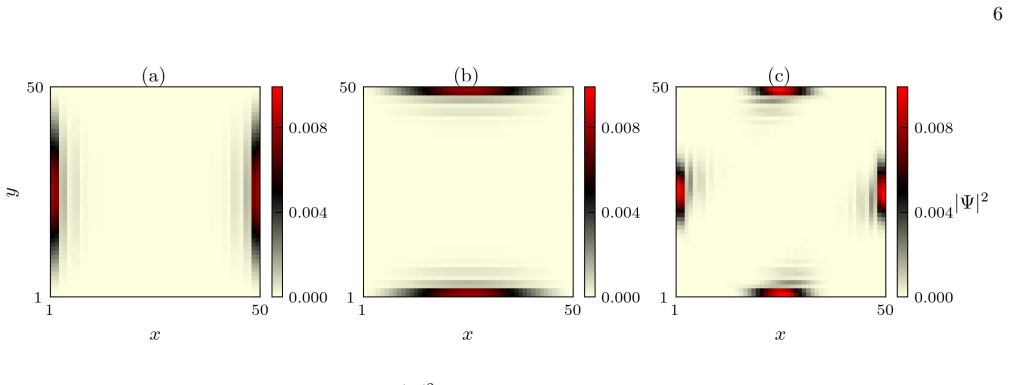
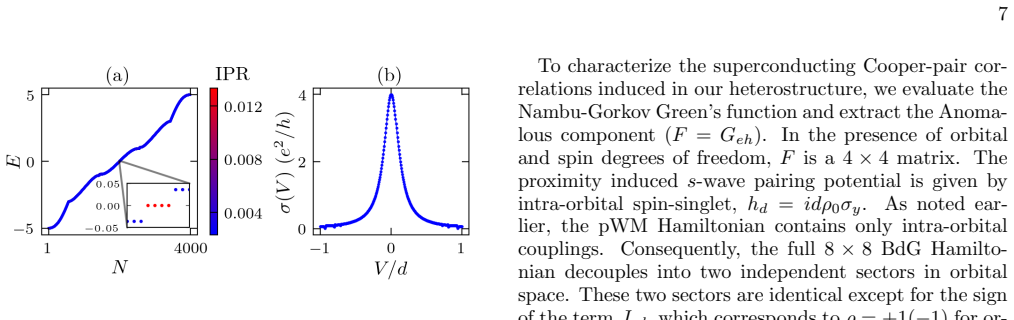
- Seven distinct nodal topological phases appear in the static case, each with Majorana zero-energy flat bands and quantized zero-bias conductance peaks.
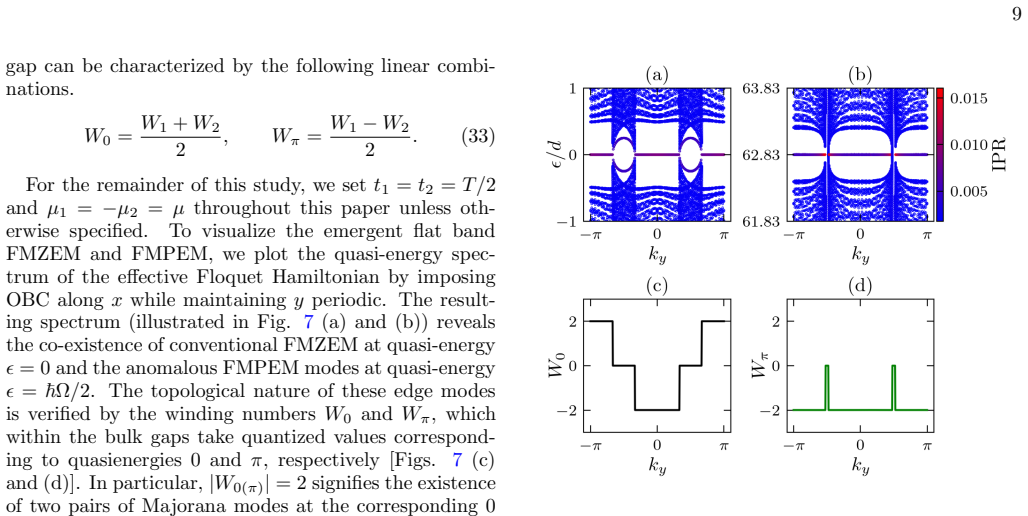
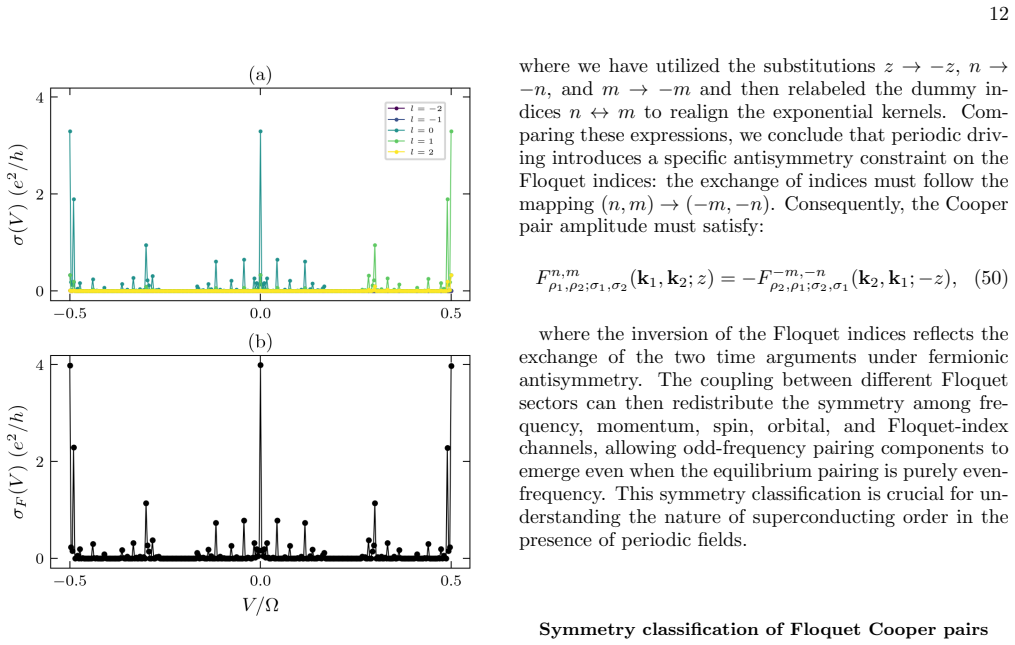
- Driven phases host both zero and pi Majorana flat bands whose transport signatures follow the Floquet sum rule.
- The effective p-wave character produces spin-triplet correlations of even-frequency odd-parity and odd-frequency even-parity types.
- Inter-orbital hopping adds an orbital-singlet pairing term that is simultaneously odd-parity and odd-frequency.
- The topological modes remain robust against strong disorder.
Where Pith is reading between the lines
- The odd-Floquet pairing channel might appear in time-resolved tunneling spectra or in the frequency dependence of conductance under drive.
- Higher winding numbers from multiple nodal points could allow systematic engineering of flat-band multiplicity in other driven heterostructures.
- If the nonequilibrium class proves stable, periodic driving offers a route to expand the space of symmetry-allowed pairings beyond equilibrium constraints.
- Disorder robustness suggests these modes could be tested in fabricated interfaces with controlled impurities.
Load-bearing premise
The chosen tight-binding Hamiltonian for the p-wave magnet-superconductor interface plus the high-frequency Floquet approximation accurately describe the system without significant heating or higher-order corrections.
What would settle it
An experiment on a periodically driven p-wave magnet-superconductor device that detects neither pi Majorana flat bands nor pairing correlations unique to the odd-Floquet sectors would falsify the claim of fundamentally new nonequilibrium channels.
Figures
read the original abstract
We investigate the emergence of topological superconductivity at the two-dimensional heterostructure interface between a $p$-wave magnet (pWM) and an $s$-wave superconductor. By analyzing nodal gap closings, we identify seven distinct nodal topological phases, each characterized by the presence of Majorana zero-energy flat bands and quantized zero-bias conductance peaks. We demonstrate that the effective $p$-wave nature of the system gives rise to spin-triplet pairing correlations with even-frequency, odd-parity and odd-frequency, even-parity symmetries. Notably, the introduction of inter-orbital hopping induces an exotic orbital-singlet term characterized by simultaneous odd-parity and odd-frequency. Furthermore, we explore the transition from static phases to Floquet topological regimes through periodic driving. These driven phases host both zero and $\pi$ Majorana flat bands, with transport signatures governed by the Floquet sum rule. Most significantly, we show that periodic driving fundamentally reshapes the topological and superconducting landscape by generating multiple nodal points that support higher winding numbers and multiple Majorana flat bands, while the emergent Floquet degree of freedom doubles the number of symmetry-allowed Cooper-pair correlations. The first class of correlations is hosted by the even-Floquet sectors and has a direct counterpart in the static limit. In contrast, the second is a distinct Floquet-generated class that confines to the odd-Floquet sectors, representing a fundamentally nonequilibrium pairing channel that cannot exist in static systems. Finally, we demonstrate the robustness of these topological modes against strong disorder, confirming their potential for stable fault-tolerant applications.
Editorial analysis
A structured set of objections, weighed in public.
Referee Report
Summary. The manuscript studies a 2D p-wave magnet / s-wave superconductor heterostructure. It reports seven distinct nodal topological phases identified via gap closings, each hosting Majorana zero-energy flat bands and quantized zero-bias conductance. Static phases exhibit spin-triplet even-frequency odd-parity and odd-frequency even-parity pairings, plus an orbital-singlet odd-parity odd-frequency term induced by inter-orbital hopping. Periodic driving is shown to generate Floquet phases with zero- and π-Majorana flat bands, higher winding numbers, multiple flat bands, and an additional class of Cooper-pair correlations confined to odd-Floquet sectors that have no static counterpart; transport obeys a Floquet sum rule and the modes remain robust to strong disorder.
Significance. If the central claims hold, the work would establish that high-frequency driving can both multiply topological features (higher winding numbers, multiple flat bands) and open an entirely new nonequilibrium pairing channel forbidden in equilibrium, thereby enlarging the symmetry classification of superconducting correlations. The explicit mapping of seven static phases plus disorder robustness would also provide a concrete platform for fault-tolerant topological applications.
major comments (2)
- The assertion that odd-Floquet-sector Cooper-pair correlations constitute a 'fundamentally nonequilibrium pairing channel that cannot exist in static systems' rests on the high-frequency Magnus (or equivalent) expansion cleanly separating even- and odd-Floquet sectors. No explicit bound on the magnitude of omitted commutators, no comparison of odd-sector amplitudes at reduced driving frequencies, and no check that higher-order terms do not generate effective static-like pairings are provided; this directly undermines the load-bearing claim of a new symmetry class.
- The seven nodal topological phases are identified solely by nodal gap closings together with the appearance of Majorana flat bands and quantized conductance. Without explicit evaluation of the winding numbers (or other topological invariants) across the full parameter space of inter-orbital hopping and driving amplitude/frequency, it remains possible that some reported phases are not topologically distinct or that additional phases exist.
minor comments (2)
- The abstract and main text refer to 'Floquet sum rule' for transport without defining the precise relation between zero- and π-mode contributions; a short derivation or reference would clarify the statement.
- Notation for the inter-orbital hopping term and the driving vector potential should be introduced once with explicit matrix structure before being used in the symmetry classification.
Simulated Author's Rebuttal
We thank the referee for their thorough review and valuable feedback on our manuscript. We address the major comments point by point below, providing our responses and indicating the revisions we plan to make.
read point-by-point responses
-
Referee: The assertion that odd-Floquet-sector Cooper-pair correlations constitute a 'fundamentally nonequilibrium pairing channel that cannot exist in static systems' rests on the high-frequency Magnus (or equivalent) expansion cleanly separating even- and odd-Floquet sectors. No explicit bound on the magnitude of omitted commutators, no comparison of odd-sector amplitudes at reduced driving frequencies, and no check that higher-order terms do not generate effective static-like pairings are provided; this directly undermines the load-bearing claim of a new symmetry class.
Authors: We agree that additional evidence is needed to rigorously support the claim of a new nonequilibrium pairing class. While the Floquet formalism naturally introduces the odd sectors absent in static cases, the high-frequency approximation requires validation. In the revised manuscript, we will provide explicit bounds on the commutator terms in the Magnus expansion, compare the odd-sector pairing amplitudes at lower driving frequencies to show their persistence as a distinct feature, and confirm that higher-order terms do not produce effective static pairings in the odd sector. This will be included in a new appendix or section. revision: yes
-
Referee: The seven nodal topological phases are identified solely by nodal gap closings together with the appearance of Majorana flat bands and quantized conductance. Without explicit evaluation of the winding numbers (or other topological invariants) across the full parameter space of inter-orbital hopping and driving amplitude/frequency, it remains possible that some reported phases are not topologically distinct or that additional phases exist.
Authors: We acknowledge that relying primarily on gap closings leaves room for further verification. The phases are distinguished by their unique combinations of flat band multiplicities and conductance features, which are topological indicators. To strengthen this, we will explicitly calculate the winding numbers over the full parameter space of inter-orbital hopping, driving amplitude, and frequency in the revised version. This will map the topological invariants, confirm the seven phases are distinct, and check for any additional phases. revision: yes
Circularity Check
No circularity: claims follow from explicit model + standard Floquet analysis
full rationale
The paper constructs an explicit tight-binding Hamiltonian for the p-wave magnet–s-wave superconductor interface, applies the high-frequency Magnus expansion to obtain effective Floquet Hamiltonians, locates topological transitions by tracking nodal gap closings and computing winding numbers, and extracts even/odd-frequency pairing symmetries from the resulting Bogoliubov–de Gennes spectrum or Green’s functions. The separation into even- and odd-Floquet sectors and the appearance of odd-sector correlations are direct algebraic consequences of the time-periodic drive term; they are not obtained by fitting parameters to the target observables, by redefining static quantities, or by invoking self-citations as uniqueness theorems. The derivation therefore remains self-contained within the chosen microscopic model and conventional Floquet machinery.
Axiom & Free-Parameter Ledger
free parameters (2)
- inter-orbital hopping strength
- driving amplitude and frequency
axioms (2)
- domain assumption The heterostructure is described by a tight-binding Hamiltonian combining p-wave magnetism and s-wave superconductivity.
- domain assumption Floquet theory in the high-frequency limit applies without significant heating or multi-photon processes.
Reference graph
Works this paper leans on
-
[1]
Even-Floquet Correlations The first class of correlations corresponds to the even- Floquet pairing (F n,m =F −m,−n). In this sector, the pairing symmetries mirror those of the static case, where the total wave function satisfies the standard Berezin- skii constraint across frequency, spin, orbital, and parity (momentum) degrees of freedom. These are categ...
-
[2]
Odd-Floquet Correlations and Frequency Inversion The second class involves an odd-Floquet pairing (F n,m =−F −m,−n). Here, we observe a systematic in- version of the frequency index, while the parities of the spatial momentum, orbital, and spin degrees of freedom remain preserved relative to the static limit. The result- ing correlations are categorized i...
-
[3]
Qi and S.-C
X.-L. Qi and S.-C. Zhang, Topological insulators and su- perconductors, Rev. Mod. Phys.83, 1057 (2011)
2011
-
[4]
Tanaka, M
Y. Tanaka, M. Sato, and N. Nagaosa, Symmetry and topology in superconductors –odd-frequency pairing and edge states–, Journal of the Physical Society of Japan81, 011013 (2012)
2012
-
[5]
DeGottardi, M
W. DeGottardi, M. Thakurathi, S. Vishveshwara, and D. Sen, Majorana fermions in superconducting wires: Ef- fects of long-range hopping, broken time-reversal symme- try, and potential landscapes, Phys. Rev. B88, 165111 (2013)
2013
-
[6]
Klinovaja, P
J. Klinovaja, P. Stano, A. Yazdani, and D. Loss, Topo- logical superconductivity and majorana fermions in rkky systems, Phys. Rev. Lett.111, 186805 (2013)
2013
-
[7]
Sato and Y
M. Sato and Y. Ando, Topological superconductors: a re- view, Reports on Progress in Physics80, 076501 (2017)
2017
-
[8]
M. Sato, Y. Tanaka, K. Yada, and T. Yokoyama, Topol- ogy of andreev bound states with flat dispersion, Phys. Rev. B83, 224511 (2011)
2011
-
[9]
Thakurathi, P
M. Thakurathi, P. Simon, I. Mandal, J. Klinovaja, and D. Loss, Majorana kramers pairs in rashba double nanowires with interactions and disorder, Phys. Rev. B 97, 045415 (2018)
2018
-
[10]
C. L. M. Wong, J. Liu, K. T. Law, and P. A. Lee, Majo- rana flat bands and unidirectional majorana edge states in gapless topological superconductors, Phys. Rev. B88, 060504(R) (2013)
2013
-
[11]
Thakurathi, O
M. Thakurathi, O. Deb, and D. Sen, Majorana modes and transport across junctions of superconductors and normal metals, Journal of Physics: Condensed Matter 27, 275702 (2015)
2015
-
[12]
A. B. Hellenes, T. Jungwirth, R. Jaeschke-Ubiergo, A. Chakraborty, J. Sinova, and L. ˇSmejkal, P-wave mag- nets (2024), arXiv:2309.01607 [cond-mat.mes-hall]
work page internal anchor Pith review Pith/arXiv arXiv 2024
-
[13]
Das and A
S. Das and A. Soori, Orientation dependent anomalous hall and spin hall currents at junctions of altermagnets withp-wave magnets, Phys. Rev. B112, 235309 (2025)
2025
-
[14]
Soori, Crossed andreev reflection in collinearp-wave magnet/triplet superconductor junctions, Phys
A. Soori, Crossed andreev reflection in collinearp-wave magnet/triplet superconductor junctions, Phys. Rev. B 111, 165413 (2025)
2025
-
[15]
J. Priessnitz, A. B. Hellenes, R. Comin, and L. ˇSmejkal, Ferroelectricp-wave magnets (2026), arXiv:2603.19107 [cond-mat.mtrl-sci]
-
[16]
Y. Li and P. Sukhachov,p-wave orbital magnetism (2026), arXiv:2604.18695 [cond-mat.mes-hall]
work page internal anchor Pith review Pith/arXiv arXiv 2026
-
[17]
Maeda, Y
K. Maeda, Y. Fukaya, K. Yada, B. Lu, Y. Tanaka, and J. Cayao, Classification of pair symmetries in supercon- ductors with unconventional magnetism, Phys. Rev. B 111, 144508 (2025)
2025
-
[18]
Fukaya, B
Y. Fukaya, B. Lu, K. Yada, Y. Tanaka, and J. Cayao, Superconducting phenomena in systems with unconven- tional magnets, Journal of Physics: Condensed Matter 37, 313003 (2025)
2025
-
[19]
Fukaya, K
Y. Fukaya, K. Maeda, K. Yada, J. Cayao, Y. Tanaka, and B. Lu, Josephson effect and odd-frequency pairing in superconducting junctions with unconventional magnets, Phys. Rev. B111, 064502 (2025)
2025
-
[20]
Nagae, L
Y. Nagae, L. Katayama, and S. Ikegaya, Flat-band zero- energy states and anomalous proximity effects inp-wave magnet–superconductor hybrid systems, Phys. Rev. B 111, 174519 (2025)
2025
- [21]
- [22]
-
[23]
Sharma and M
L. Sharma and M. Thakurathi, Tunable josephson diode effect in singlet superconductor-altermagnet-triplet su- perconductor junctions, Phys. Rev. B112, 104506 (2025)
2025
-
[24]
Yang and Z
Z. Yang and Z. P. Niu, Josephson diode effect in un- conventionalp-wave magnet/superconductor josephson junctions, Phys. Rev. B113, 094515 (2026)
2026
- [25]
-
[26]
Thakurathi, A
M. Thakurathi, A. A. Patel, D. Sen, and A. Dutta, Flo- quet generation of majorana end modes and topological invariants, Phys. Rev. B88, 155133 (2013)
2013
-
[27]
Mondal, R
D. Mondal, R. Kumari, T. Nag, and A. Saha, Transport signatures of single and multiple floquet majorana modes in a one-dimensional rashba nanowire and shiba chain, Phys. Rev. B111, 235441 (2025)
2025
-
[28]
K. Roy, G. Paul, D. Debnath, K. Bhattacharyya, and S. Basu, Floquet-engineered diode performance of a topo- logical josephson junction composed of two kitaev chains coupled via a quantum dot, Phys. Rev. B112, 125407 (2025)
2025
-
[29]
Jiang, T
L. Jiang, T. Kitagawa, J. Alicea, A. R. Akhmerov, D. Pekker, G. Refael, J. I. Cirac, E. Demler, M. D. Lukin, and P. Zoller, Majorana fermions in equilibrium and in driven cold-atom quantum wires, Phys. Rev. Lett.106, 220402 (2011)
2011
-
[30]
Thakurathi, D
M. Thakurathi, D. Loss, and J. Klinovaja, Floquet majorana fermions and parafermions in driven rashba nanowires, Phys. Rev. B95, 155407 (2017)
2017
-
[31]
P.-H. Fu, S. Mondal, J.-F. Liu, Y. Tanaka, and J. Cayao, Floquet engineering spin triplet states in unconventional magnets, Phys. Rev. Lett.136, 066703 (2026)
2026
-
[32]
Triola and A
C. Triola and A. V. Balatsky, Odd-frequency supercon- ductivity in driven systems, Phys. Rev. B94, 094518 (2016)
2016
-
[33]
G. E. Blonder, M. Tinkham, and T. M. Klapwijk, Tran- sition from metallic to tunneling regimes in supercon- ducting microconstrictions: Excess current, charge im- balance, and supercurrent conversion, Phys. Rev. B25, 4515 (1982)
1982
-
[34]
V. L. Berezinskii, New model of the anisotropic phase of superfluidhe 3, JETP Letters20, 628 (1974)
1974
-
[35]
Balatsky and E
A. Balatsky and E. Abrahams, New class of singlet su- perconductors which break the time reversal and parity, Phys. Rev. B45, 13125(R) (1992)
1992
-
[36]
Brekke, P
B. Brekke, P. Sukhachov, H. G. Giil, A. Brataas, and J. Linder, Minimal models and transport properties of unconventionalp-wave magnets, Phys. Rev. Lett.133, 236703 (2024)
2024
-
[37]
A. P. Schnyder, S. Ryu, A. Furusaki, and A. W. W. Lud- wig, Classification of topological insulators and super- conductors in three spatial dimensions, Phys. Rev. B78, 195125 (2008)
2008
-
[38]
D. S. Fisher and P. A. Lee, Relation between conductiv- ity and transmission matrix, Phys. Rev. B23, 6851(R) (1981)
1981
-
[39]
Datta,Electronic Transport in Mesoscopic Systems, Cambridge Studies in Semiconductor Physics and Mi- croelectronic Engineering (Cambridge University Press, 1995)
S. Datta,Electronic Transport in Mesoscopic Systems, Cambridge Studies in Semiconductor Physics and Mi- croelectronic Engineering (Cambridge University Press, 1995)
1995
-
[40]
Sambe, Steady states and quasienergies of a quantum- mechanical system in an oscillating field, Phys
H. Sambe, Steady states and quasienergies of a quantum- mechanical system in an oscillating field, Phys. Rev. A 7, 2203 (1973)
1973
-
[41]
Kundu and B
A. Kundu and B. Seradjeh, Transport signatures of flo- quet majorana fermions in driven topological supercon- ductors, Phys. Rev. Lett.111, 136402 (2013)
2013
-
[42]
H. Aoki, N. Tsuji, M. Eckstein, M. Kollar, T. Oka, and P. Werner, Nonequilibrium dynamical mean-field theory and its applications, Rev. Mod. Phys.86, 779 (2014)
2014
discussion (0)
Sign in with ORCID, Apple, or X to comment. Anyone can read and Pith papers without signing in.