NURBS Splatting: A Unified Differentiable Rendering Framework for Vector Graphics
Pith reviewed 2026-07-01 02:24 UTC · model grok-4.3
The pith
Representing NURBS curves as sampled Gaussian fields reformulates vector graphics rendering as a stable differentiable accumulation process.
A machine-rendered reading of the paper's core claim, the machinery that carries it, and where it could break.
Core claim
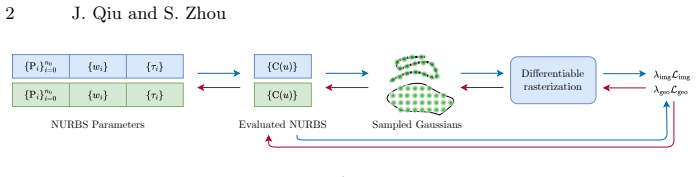
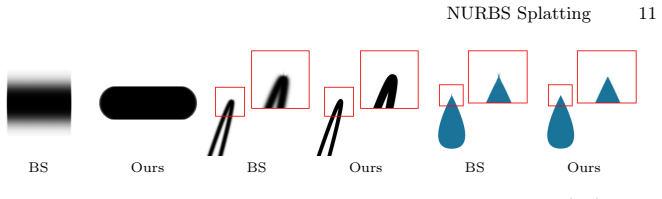
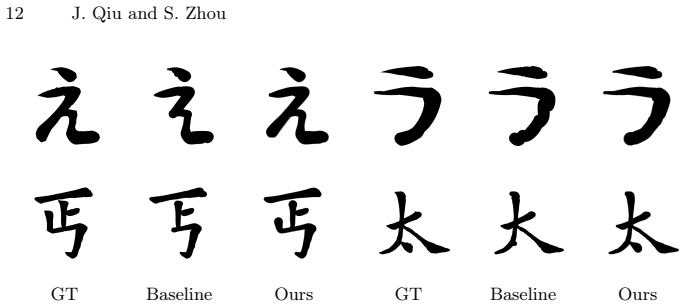
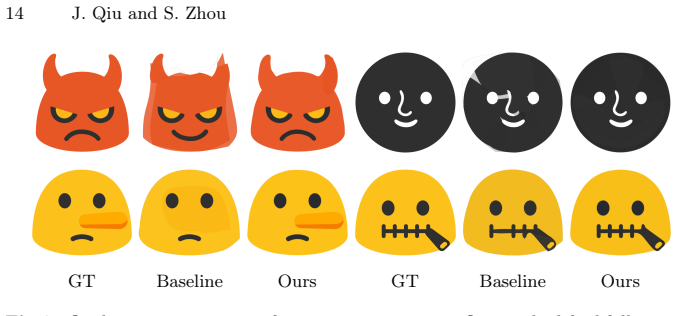
NURBS Splatting represents planar rational curves as continuous Gaussian fields. By sampling Gaussians along the curve parameter domain and inside closed regions, rendering is reformulated as a smooth accumulation process with stable gradients. The method naturally supports long splines, rational weights, non-uniform knots, and closed-region filling, and is demonstrated on calligraphy reconstruction, vectorization frameworks, and long-spline image abstraction.
What carries the argument
NURBS Splatting as continuous Gaussian fields sampled along the parameter domain and inside closed regions, which converts analytic curve rendering into differentiable accumulation.
If this is right
- Calligraphy reconstruction becomes feasible with improved stability over analytic baselines.
- Vectorization frameworks gain the ability to handle rational weights and non-uniform knots without custom gradient fixes.
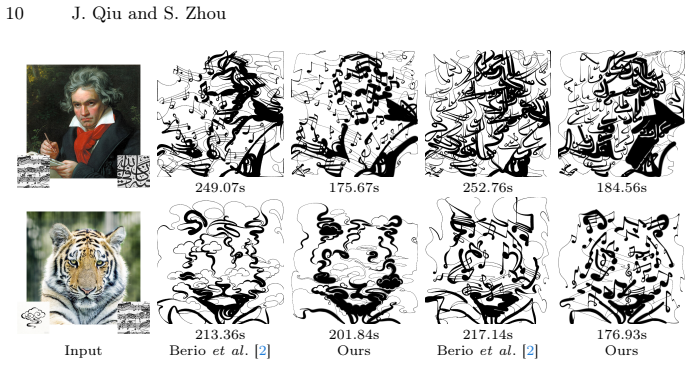
- Long-spline image abstraction produces higher-quality results because the accumulation process avoids gradient instability.
- Closed regions can be filled differentiably by sampling inside boundaries rather than boundary-only evaluation.
Where Pith is reading between the lines
- The same sampling idea might extend to other parametric curve families if their parameter domains admit similar Gaussian placement.
- Optimization loops that currently avoid long splines due to instability could now incorporate them directly.
- The framework suggests a general pattern where any curve representation could be turned into a splattable field for differentiability.
Load-bearing premise
That discrete sampling of Gaussians along the NURBS parameter domain yields gradients stable enough and faithful enough to the analytic curve for the shown reconstruction tasks.
What would settle it
A side-by-side optimization run on long splines where the Gaussian method produces visibly worse reconstruction error or diverges while an analytic baseline converges.
Figures
read the original abstract
Differentiable rendering of planar rational splines remains largely underexplored, despite their widespread use in vector graphics and design. Existing differentiable vector renderers primarily focus on B\'ezier curves and rely on analytic rasterization, which can suffer from gradient instability and limited flexibility. We propose NURBS Splatting, a unified framework that represents planar rational curves as continuous Gaussian fields. By sampling Gaussians along the curve parameter domain and inside closed regions, rendering is reformulated as a smooth accumulation process with stable gradients. Our method naturally supports long splines, rational weights, non-uniform knots, and closed-region filling. We demonstrate its effectiveness in calligraphy reconstruction, vectorization frameworks, and long-spline image abstraction, showing improved stability and reconstruction quality over existing approaches.
Editorial analysis
A structured set of objections, weighed in public.
Referee Report
Summary. The paper proposes NURBS Splatting, a unified differentiable rendering framework for planar rational splines. It represents NURBS curves as continuous Gaussian fields by sampling Gaussians along the curve parameter domain and inside closed regions, reformulating rendering as a smooth accumulation process. The method is claimed to yield stable gradients while naturally supporting long splines, rational weights, non-uniform knots, and closed-region filling. Effectiveness is demonstrated on calligraphy reconstruction, vectorization frameworks, and long-spline image abstraction, with reported improvements in stability and reconstruction quality over existing approaches.
Significance. If the stability and faithfulness claims hold under quantitative validation, the approach could offer a practical alternative to analytic rasterization for differentiable vector graphics, enabling more robust optimization in applications involving complex NURBS geometry.
major comments (1)
- [Abstract] Abstract: The central claim that discrete Gaussian sampling along the NURBS parameter domain produces gradients that remain stable and faithful to the analytic curve (including for rational weights, non-uniform knots, and long splines) is load-bearing but unsupported by any derivation details, error bounds on approximation error (as a function of sample count, Gaussian variance, or curvature), or side-by-side comparisons against analytic rasterization. Without these, the stability advantage cannot be assessed.
Simulated Author's Rebuttal
We thank the referee for the constructive feedback on our manuscript. We address the single major comment below, acknowledging the need for additional support on the stability claims while clarifying the empirical evidence already present.
read point-by-point responses
-
Referee: [Abstract] Abstract: The central claim that discrete Gaussian sampling along the NURBS parameter domain produces gradients that remain stable and faithful to the analytic curve (including for rational weights, non-uniform knots, and long splines) is load-bearing but unsupported by any derivation details, error bounds on approximation error (as a function of sample count, Gaussian variance, or curvature), or side-by-side comparisons against analytic rasterization. Without these, the stability advantage cannot be assessed.
Authors: We agree that the manuscript does not provide a formal derivation of error bounds on the approximation error (as a function of sample count, Gaussian variance, or curvature) or a theoretical analysis of gradient faithfulness to the analytic curve. The stability claim rests on the formulation of rendering as a smooth accumulation of Gaussians (detailed in Section 3), which ensures differentiability by construction, together with empirical demonstrations across the experiments. These include successful optimization on long splines, rational weights, and non-uniform knots (Sections 4.1–4.3), with quantitative improvements in reconstruction quality and stability over analytic baselines. Visual and numerical side-by-side comparisons of rendered results and optimization trajectories are included in the main figures and supplementary material. We will add a dedicated subsection on approximation properties and expanded gradient-stability comparisons in the revision. revision: yes
Circularity Check
No significant circularity; derivation is a modeling reformulation independent of its outputs
full rationale
The paper's core step is to represent NURBS curves as sampled Gaussian fields and reformulate rendering as accumulation; this is an explicit modeling choice presented in the abstract as a direct reformulation, not a quantity fitted or defined in terms of its own predictions. No equations, self-citations, or uniqueness claims appear in the provided text that would reduce the claimed stable gradients or support for rational weights/non-uniform knots back to the method's own inputs by construction. The approach is self-contained as a proposed framework with external demonstrations, meeting the criteria for an honest non-finding.
Axiom & Free-Parameter Ledger
Reference graph
Works this paper leans on
-
[1]
Berio, D., Leymarie, F.F., Asente, P., Echevarria, J.: StrokeStyles: Stroke-based Segmentation and Stylization of Fonts. ACM Trans. Graph.41(3), 28:1–28:21 (Apr 2022).https://doi.org/10.1145/3505246
-
[2]
Berio, D., Stroh, M., Calinon, S., Fol Leymarie, F., Deussen, O., Shamir, A.: Neural Image Abstraction using Long Smoothing B-Splines. ACM Trans. Graph.44(6), 225:1–225:11 (Dec 2025).https://doi.org/10.1145/3763345
-
[3]
CVGIP: Image Understanding55(3), 329–338 (May 1992).https://doi.org/10
Brandt, J.W., Algazi, V.R.: Continuous skeleton computation by Voronoi diagram. CVGIP: Image Understanding55(3), 329–338 (May 1992).https://doi.org/10. 1016/1049-9660(92)90030-7
1992
-
[4]
Chakraborty, S., Batra, V., Phogat, A., Jain, V., Ranawat, J.S., Dhingra, S., Wampler, K., Fisher, M., Lukáč, M.: Image Vectorization via Gradient Recon- struction. Comput. Graph. Forum44(2) (May 2025).https://doi.org/10.1111/ cgf.70055
2025
-
[5]
Chen,X.,Lian,Z.,Tang,Y.,Xiao,J.:Anautomaticstrokeextractionmethodusing manifold learning. In: Peytavie, A., Bosch, C. (eds.) Proceedings of the European AssociationforComputerGraphics:ShortPapers.pp.65–68.EG’17,Eurographics Association, Goslar, DEU (Apr 2017).https://doi.org/10.2312/egsh.20171016
-
[6]
Cox, M.G.: The Numerical Evaluation of B-Splines. IMA Journal of Applied Math- ematics10(2), 134–149 (Oct 1972).https://doi.org/10.1093/imamat/10.2.134
-
[7]
Journal of Approximation Theory6(1), 50–62 (Jul 1972).https://doi.org/10.1016/0021-9045(72)90080-9
de Boor, C.: On calculating with B-splines. Journal of Approximation Theory6(1), 50–62 (Jul 1972).https://doi.org/10.1016/0021-9045(72)90080-9
-
[8]
Computer-Aided Design146, 103199 (May 2022).https://doi.org/10.1016/j.cad.2022.103199
Deva Prasad, A., Balu, A., Shah, H., Sarkar, S., Hegde, C., Krishnamurthy, A.: NURBS-Diff: A Differentiable Programming Module for NURBS. Computer-Aided Design146, 103199 (May 2022).https://doi.org/10.1016/j.cad.2022.103199
-
[10]
Morgan Kaufmann (Sep 2007).https://doi.org/10.1016/B978-1-55860-737-8.X5000-5
Farin, G.: Curves and Surfaces for CAGD: A Practical Guide. Morgan Kaufmann (Sep 2007).https://doi.org/10.1016/B978-1-55860-737-8.X5000-5
-
[11]
https://www.foundertype.com/index.php/FontInfo/index/id/6583.html, accessed: 2026-02-28
Founder Type Foundry: Founder Ouyang Xun Regular Script Font. https://www.foundertype.com/index.php/FontInfo/index/id/6583.html, accessed: 2026-02-28
2026
-
[12]
In: Koyejo, S., Mohamed, S., Agarwal, A., Belgrave, D., Cho, K., Oh, A
Frans, K., Soros, L., Witkowski, O.: CLIPDraw: Exploring text-to-drawing synthe- sis through language-image encoders. In: Koyejo, S., Mohamed, S., Agarwal, A., Belgrave, D., Cho, K., Oh, A. (eds.) Advances in Neural Information Processing Systems. vol. 35, pp. 5207–5218. Curran Associates, Inc. (2022)
2022
-
[13]
https://github.com/googlefonts/noto-emoji, accessed: 2026-03-05
Google Fonts: Noto Emoji. https://github.com/googlefonts/noto-emoji, accessed: 2026-03-05
2026
-
[14]
Hirschorn, O., Jevnisek, A., Avidan, S.: Optimize & Reduce: A Top-Down Ap- proach for Image Vectorization. Proceedings of the AAAI Conference on Artifi- cial Intelligence38(3), 2148–2156 (Mar 2024).https://doi.org/10.1609/aaai. v38i3.27987
-
[15]
In: ACM SIGGRAPH 2024 Conference Pa- pers
Huang, B., Yu, Z., Chen, A., Geiger, A., Gao, S.: 2D Gaussian Splatting for Geo- metrically Accurate Radiance Fields. In: ACM SIGGRAPH 2024 Conference Pa- pers. pp. 1–11. SIGGRAPH ’24, Association for Computing Machinery, New York, NY, USA (Jul 2024).https://doi.org/10.1145/3641519.3657428
-
[16]
Hughes, T.J.R., Cottrell, J.A., Bazilevs, Y.: Isogeometric analysis: CAD, finite elements, NURBS, exact geometry and mesh refinement. Computer Methods in 16 J. Qiu and S. Zhou Applied Mechanics and Engineering194(39), 4135–4195 (Oct 2005).https:// doi.org/10.1016/j.cma.2004.10.008
-
[17]
Iluz, S., Vinker, Y., Hertz, A., Berio, D., Cohen-Or, D., Shamir, A.: Word-As- Image for Semantic Typography. ACM Trans. Graph.42(4), 151:1–151:11 (Jul 2023).https://doi.org/10.1145/3592123
-
[18]
In: 2023 IEEE/CVF Conference on Computer Vision and Pattern Recognition (CVPR)
Jain, A., Xie, A., Abbeel, P.: VectorFusion: Text-to-SVG by Abstracting Pixel- Based Diffusion Models. In: 2023 IEEE/CVF Conference on Computer Vision and Pattern Recognition (CVPR). pp. 1911–1920 (Jun 2023).https://doi.org/10. 1109/CVPR52729.2023.00190
-
[19]
In: Sarhangi, R., Moody, R.V
Kaplan, C.S., Bosch, R.: TSP Art. In: Sarhangi, R., Moody, R.V. (eds.) Renais- sance Banff: Mathematics, Music, Art, Culture. pp. 301–308. Bridges Conference, Southwestern College, Winfield, Kansas (2005)
2005
-
[20]
https://karu- k.booth.pm/items/2985842, accessed: 2026-02-28
Keikan & Midnight Garden: Yoppa Fude Font. https://karu- k.booth.pm/items/2985842, accessed: 2026-02-28
-
[21]
Kerbl, B., Kopanas, G., Leimkuehler, T., Drettakis, G.: 3D Gaussian Splatting for Real-Time Radiance Field Rendering. ACM Trans. Graph.42(4), 139:1–139:14 (Aug 2023).https://doi.org/10.1145/3592433
-
[22]
In: 2022 IEEE/CVF Conference on Computer Vision and Pattern Recognition (CVPR)
Kwon, G., Ye, J.C.: CLIPstyler: Image Style Transfer with a Single Text Condition. In: 2022 IEEE/CVF Conference on Computer Vision and Pattern Recognition (CVPR). pp. 18041–18050 (Jun 2022).https://doi.org/10.1109/CVPR52688. 2022.01753
-
[23]
Li, T.M., Lukáč, M., Gharbi, M., Ragan-Kelley, J.: Differentiable vector graphics rasterization for editing and learning. ACM Trans. Graph.39(6), 193:1–193:15 (Dec 2020).https://doi.org/10.1145/3414685.3417871
-
[25]
In: Belgrave, D., Zhang, C., Lin, H., Pascanu, R., Koniusz, P., Ghassemi, M., Chen, N
Liu, X., Zhou, C., Zhao, N., Huang, S.: Bézier splatting for fast and differen- tiable vector graphics rendering. In: Belgrave, D., Zhang, C., Lin, H., Pascanu, R., Koniusz, P., Ghassemi, M., Chen, N. (eds.) Advances in Neural Information Processing Systems. vol. 38, pp. 51528–51559. Curran Associates, Inc. (2025)
2025
-
[26]
Loop, C., Blinn, J.: Resolution independent curve rendering using programmable graphics hardware. ACM Trans. Graph.24(3), 1000–1009 (Jul 2005).https:// doi.org/10.1145/1073204.1073303
-
[27]
Journal of Computer Science and Technology10(1), 42–52 (1995).https://doi.org/10.1007/BF02939521
Ma, X., Pan, Z., Zhang, F.: The automatic generation of chinese outline font based on stroke extraction. Journal of Computer Science and Technology10(1), 42–52 (1995).https://doi.org/10.1007/BF02939521
-
[28]
Ma, X., Zhou, Y., Xu, X., Sun, B., Filev, V., Orlov, N., Fu, Y., Shi, H.: Towards Layer-wise Image Vectorization. In: 2022 IEEE/CVF Conference on Computer Vision and Pattern Recognition (CVPR). pp. 16293–16302. IEEE, New Orleans, LA, USA (Jun 2022).https://doi.org/10.1109/CVPR52688.2022.01583
-
[29]
In: 2025 IEEE/CVF International Con- ference on Computer Vision (ICCV)
Ma, Z., Jiang, J., Chen, Y., Zhang, L.: BézierGS: Dynamic Urban Scene Re- construction with Bézier Curve Gaussian Splatting. In: 2025 IEEE/CVF Inter- national Conference on Computer Vision (ICCV). pp. 25519–25528 (Oct 2025). https://doi.org/10.1109/ICCV51701.2025.02367
-
[30]
Magne, T., Sorkine-Hornung, O.: Single-Line Drawing Vectorization. Comput. Graph. Forum44(7), e70228 (2025).https://doi.org/10.1111/cgf.70228
-
[31]
MinistryofEducationofthePeople’sRepublicofChina:TableofGeneralStandard Chinese Characters (2013)
2013
-
[32]
Springer-Verlag, Berlin, Hei- delberg (1997) NURBS Splatting 17
Piegl, L., Tiller, W.: The NURBS Book (2nd Ed.). Springer-Verlag, Berlin, Hei- delberg (1997) NURBS Splatting 17
1997
-
[33]
Computer-Aided Design22(4), 241– 245 (May 1990).https://doi.org/10.1016/0010-4485(90)90053-F
Pottmann, H.: Smooth curves under tension. Computer-Aided Design22(4), 241– 245 (May 1990).https://doi.org/10.1016/0010-4485(90)90053-F
-
[34]
In: 2024 IEEE/CVF Conference on Computer Vision and Pattern Recognition (CVPR)
Thamizharasan, V., Liu, D., Agarwal, S., Fisher, M., Gharbi, M., Wang, O., Ja- cobson, A., Kalogerakis, E.: VecFusion: Vector Font Generation with Diffusion. In: 2024 IEEE/CVF Conference on Computer Vision and Pattern Recognition (CVPR). pp. 7943–7952 (Jun 2024).https://doi.org/10.1109/CVPR52733.2024. 00759
-
[35]
Tian, Y., Liu, M., Jiang, H., Tu, Y., Su, D.: SketchRefiner: Text-Guided Sketch Refinement Through Latent Diffusion Models. IEEE Transactions on Visualization and Computer Graphics31(12), 10711–10722 (Dec 2025).https://doi.org/10. 1109/TVCG.2025.3613388
-
[36]
In: ACM SIGGRAPH 2024 Conference Papers
Tojo, K., Shamir, A., Bickel, B., Umetani, N.: Fabricable 3D Wire Art. In: ACM SIGGRAPH 2024 Conference Papers. pp. 1–11. SIGGRAPH ’24, Association for Computing Machinery, New York, NY, USA (Jul 2024).https://doi.org/10. 1145/3641519.3657453
- [37]
-
[38]
Wang, Y., Lian, Z.: DeepVecFont: Synthesizing high-quality vector fonts via dual- modality learning. ACM Trans. Graph.40(6), 265:1–265:15 (Dec 2021).https: //doi.org/10.1145/3478513.3480488
-
[39]
In: 2023 IEEE/CVF Conference on Computer Vision and Pattern Recognition (CVPR)
Wang, Y., Wang, Y., Yu, L., Zhu, Y., Lian, Z.: DeepVecFont-v2: Exploiting Trans- formers to Synthesize Vector Fonts with Higher Quality. In: 2023 IEEE/CVF Con- ference on Computer Vision and Pattern Recognition (CVPR). pp. 18320–18328 (Jun 2023).https://doi.org/10.1109/CVPR52729.2023.01757
-
[40]
Wang, Z., Huang, J., Sun, Z., Gong, Y., Cohen-Or, D., Lu, M.: Layered Image Vectorization via Semantic Simplification. In: 2025 IEEE/CVF Conference on Computer Vision and Pattern Recognition (CVPR). pp. 7728–7738 (Jun 2025). https://doi.org/10.1109/CVPR52734.2025.00724
-
[41]
Wang, Z., Lu, M.: Image-Space Collage and Packing with Differentiable Rendering. In: Proceedings of the Special Interest Group on Computer Graphics and Interac- tiveTechniquesConferenceConferencePapers.AssociationforComputingMachin- ery, New York, NY, USA (2025).https://doi.org/10.1145/3721238.3730690
-
[42]
ACM Trans
Worchel, M., Alexa, M.: Differentiable Rendering of Parametric Geometry. ACM Trans. Graph.42(6), 232:1–232:18 (Dec 2023).https :// doi.org /10 .1145/ 3618387
2023
-
[43]
Wu, S.J., Yang, C.Y., Hsu, J.Y.j.: CalliGAN: Style and Structure-aware Chinese CalligraphyCharacterGenerator(May2020).https://doi.org/10.48550/arXiv. 2005.12500
work page internal anchor Pith review doi:10.48550/arxiv 2005
-
[44]
In: Oh, A., Naumann, T., Globerson, A., Saenko, K., Hardt, M., Levine, S
Xing, X., Wang, C., Zhou, H., Zhang, J., Yu, Q., Xu, D.: DiffSketcher: Text Guided Vector Sketch Synthesis through Latent Diffusion Models. In: Oh, A., Naumann, T., Globerson, A., Saenko, K., Hardt, M., Levine, S. (eds.) Advances in Neural Information Processing Systems. vol. 36, pp. 15869–15889. Curran Associates, Inc. (2023)
2023
-
[45]
In: 2024 IEEE/CVF Conference on Computer Vision and Pattern Recognition (CVPR)
Xing, X., Zhou, H., Wang, C., Zhang, J., Xu, D., Yu, Q.: SVGDreamer: Text Guided SVG Generation with Diffusion Model. In: 2024 IEEE/CVF Conference on Computer Vision and Pattern Recognition (CVPR). pp. 4546–4555 (Jun 2024). https://doi.org/10.1109/CVPR52733.2024.00435 18 J. Qiu and S. Zhou
-
[46]
ACM Trans.Graph.43(4),119:1–119:14(Jul2024).https://doi.org/10.1145/3658129
Xu, X., Lambourne, J., Jayaraman, P., Wang, Z., Willis, K., Furukawa, Y.: Brep- Gen: A B-rep Generative Diffusion Model with Structured Latent Geometry. ACM Trans.Graph.43(4),119:1–119:14(Jul2024).https://doi.org/10.1145/3658129
-
[47]
IP-Adapter: Text Compatible Image Prompt Adapter for Text-to-Image Diffusion Models
Ye, H., Zhang, J., Liu, S., Han, X., Yang, W.: IP-Adapter: Text Compatible Image Prompt Adapter for Text-to-Image Diffusion Models (Aug 2023).https://doi. org/10.48550/arXiv.2308.06721
work page internal anchor Pith review Pith/arXiv arXiv doi:10.48550/arxiv.2308.06721 2023
-
[48]
In: The Thirteenth Inter- national Conference on Learning Representations (2025),https://openreview
Yoon, J., Han, S., Oh, J., Lee, M.: SplineGS: Learning Smooth Trajectories in Gaussian Splatting for Dynamic Scene Reconstruction. In: The Thirteenth Inter- national Conference on Learning Representations (2025),https://openreview. net/forum?id=tMG6btjBfd, accessed: 2026-06-26
2025
-
[49]
Zeng, J., Chen, Q., Liu, Y., Wang, M., Yao, Y.: StrokeGAN: Reducing Mode CollapseinChineseFontGenerationviaStrokeEncoding.ProceedingsoftheAAAI Conference on Artificial Intelligence35(4), 3270–3277 (May 2021).https://doi. org/10.1609/aaai.v35i4.16438
-
[50]
In: 2023 IEEE/CVF International Conference on Computer Vision (ICCV)
Zhang, L., Rao, A., Agrawala, M.: Adding Conditional Control to Text-to-Image Diffusion Models. In: 2023 IEEE/CVF International Conference on Computer Vi- sion (ICCV). pp. 3813–3824 (Oct 2023).https://doi.org/10.1109/ICCV51070. 2023.00355
-
[51]
In: 2018 IEEE/CVF Con- ference on Computer Vision and Pattern Recognition
Zhang, R., Isola, P., Efros, A.A., Shechtman, E., Wang, O.: The Unreasonable Effectiveness of Deep Features as a Perceptual Metric. In: 2018 IEEE/CVF Con- ference on Computer Vision and Pattern Recognition. pp. 586–595 (Jun 2018). https://doi.org/10.1109/CVPR.2018.00068
-
[52]
In: Proceedings of the 3rd Interna- tional Workshop on Multimodal and Responsible Affective Computing
Zhang, X., Liu, Z., Liu, J., Li, X., Qi, M.: SketchDancing: A Text-Driven Frame- work for Vector Sketch Animation Generation. In: Proceedings of the 3rd Interna- tional Workshop on Multimodal and Responsible Affective Computing. pp. 128–
-
[53]
MRAC ’25, Association for Computing Machinery, New York, NY, USA (Oct 2025).https://doi.org/10.1145/3746270.3760235
-
[54]
In: Leonardis, A., Ricci, E., Roth, S., Russakovsky, O., Sattler, T., Varol, G
Zhang, X., Ge, X., Xu, T., He, D., Wang, Y., Qin, H., Lu, G., Geng, J., Zhang, J.: GaussianImage: 1000 FPS Image Representation and Compression by 2D Gaus- sian Splatting. In: Leonardis, A., Ricci, E., Roth, S., Russakovsky, O., Sattler, T., Varol, G. (eds.) Computer Vision – ECCV 2024. pp. 327–345. Springer Nature Switzerland, Cham (2025).https://doi.org...
-
[55]
Zou, Q., Zhu, L., Wu, J., Yang, Z.: SplineGen: Approximating unorganized points through generative AI. Computer-Aided Design178, 103809 (Jan 2025).https: //doi.org/10.1016/j.cad.2024.103809 NURBS Splatting 19 Supplementary Materials S1 Code and Data A vailability Code will be made available upon publication athttps://github.com/AnicoderAndy/nurbs-splattin...
discussion (0)
Sign in with ORCID, Apple, or X to comment. Anyone can read and Pith papers without signing in.