Work Statistics Under Quantum-Jump and Quench Dynamics in Monitored Ising Chains
Pith reviewed 2026-07-02 18:57 UTC · model grok-4.3
The pith
Monitored quantum jumps in Ising chains shift work distributions from comb-like to Gaussian as detection events increase.
A machine-rendered reading of the paper's core claim, the machinery that carries it, and where it could break.
Core claim
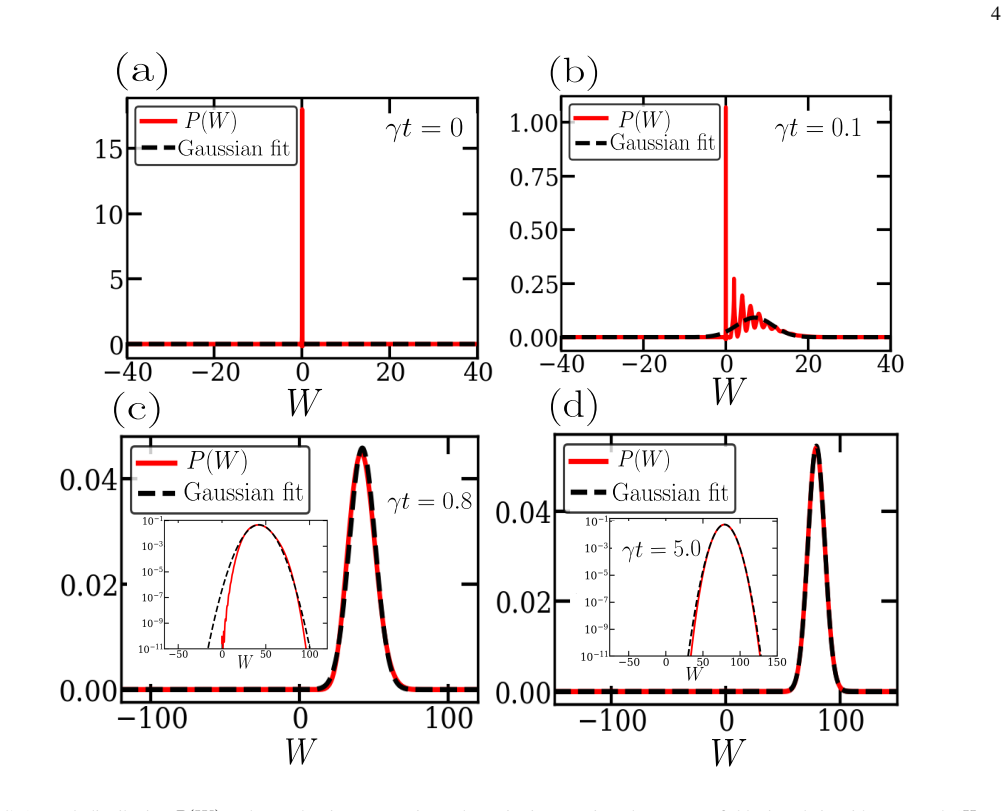
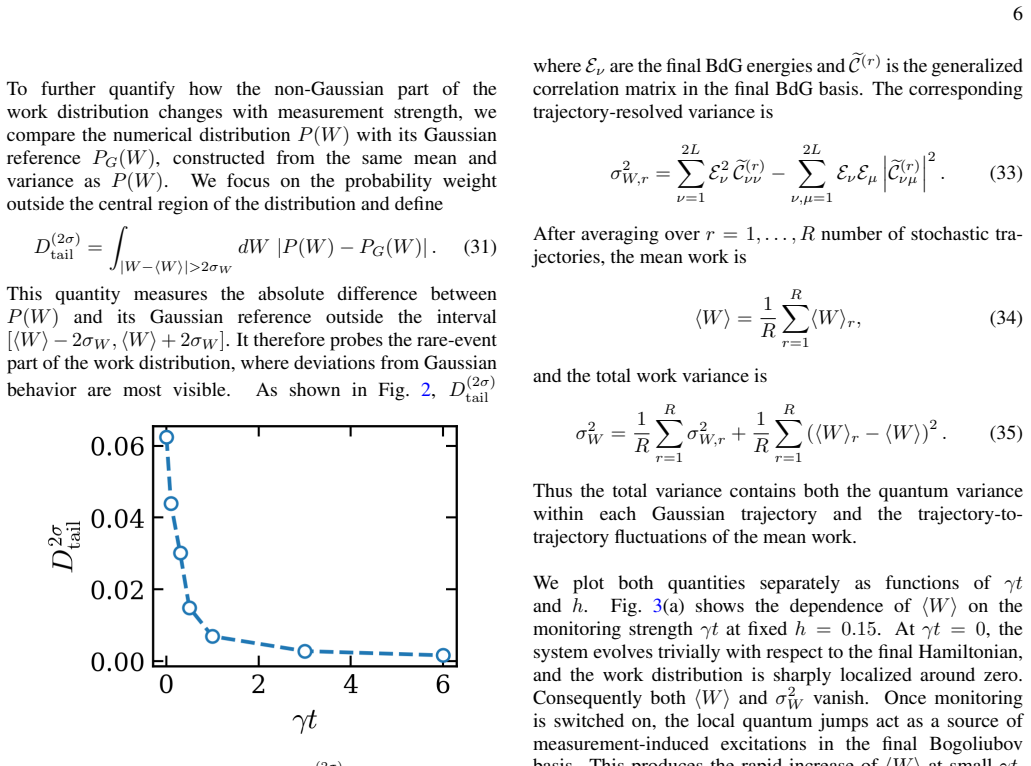
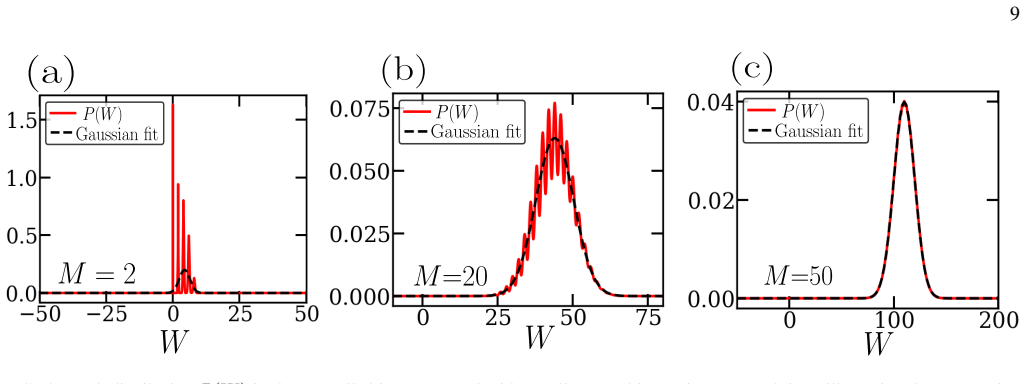
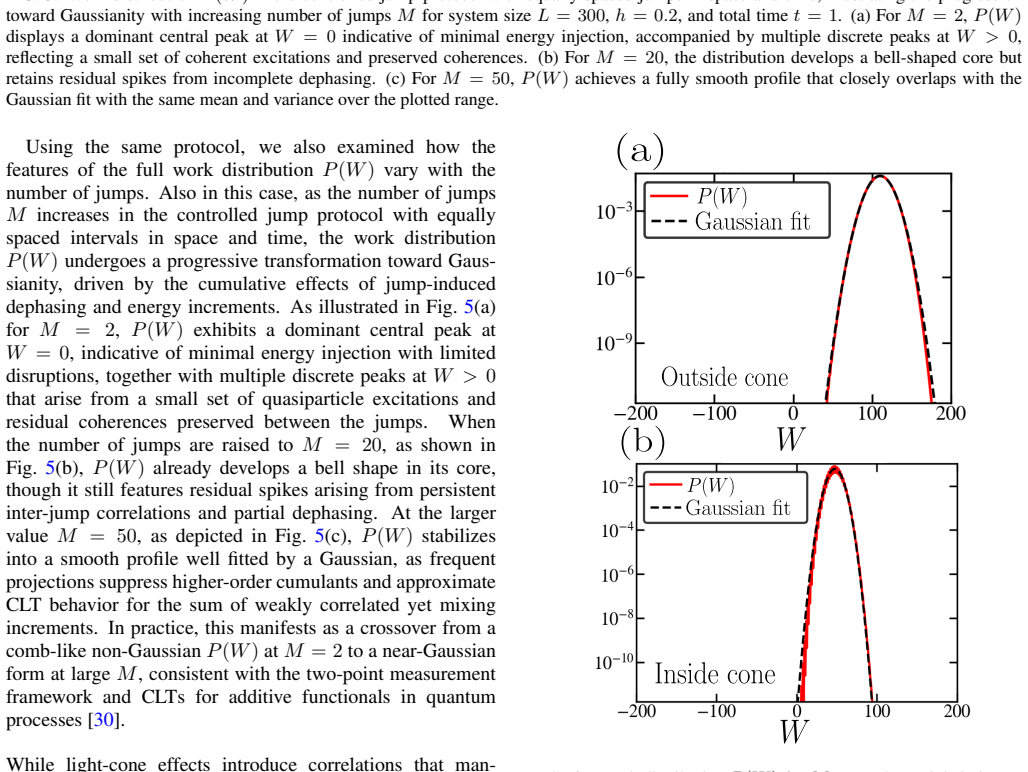
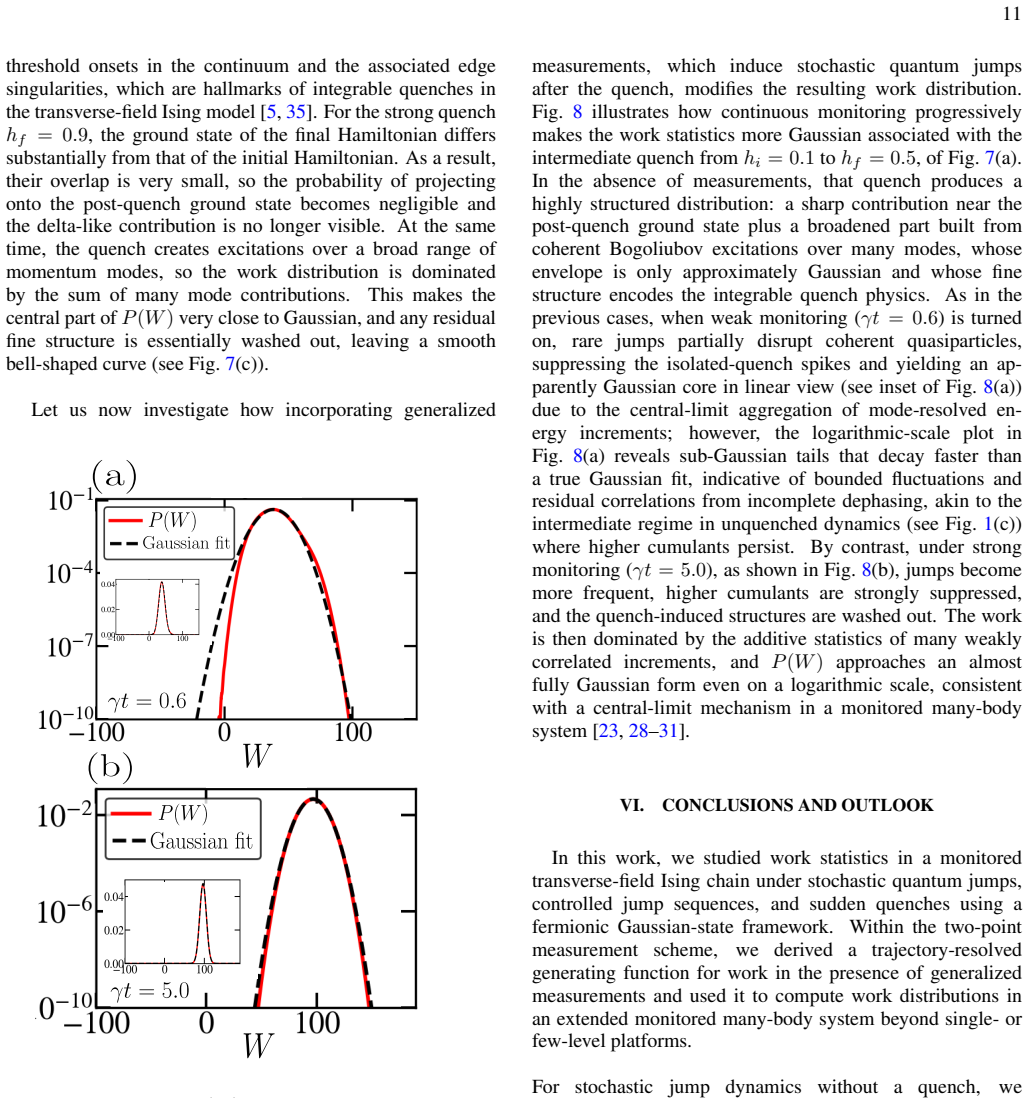
Under stochastic jump dynamics, the work distribution crosses over from a comb-like structure to an essentially Gaussian form with shrinking sub-Gaussian tails as the number of detection events grows. For controlled jump protocols, the energy added by each jump is constant when successive jumps are causally disconnected but decreases and then saturates when they lie within each other's light cone, yielding linear and sublinear growth of the average work, respectively. For monitored quenches, continuous observation washes out the fine structure of the isolated-quench distribution and again drives the statistics toward Gaussian behavior.
What carries the argument
Trajectory-resolved generating function for work statistics in the two-point energy measurement scheme, evaluated via fermionic Gaussian-state formalism.
If this is right
- Stochastic monitoring smooths work distributions toward Gaussian form with shrinking tails.
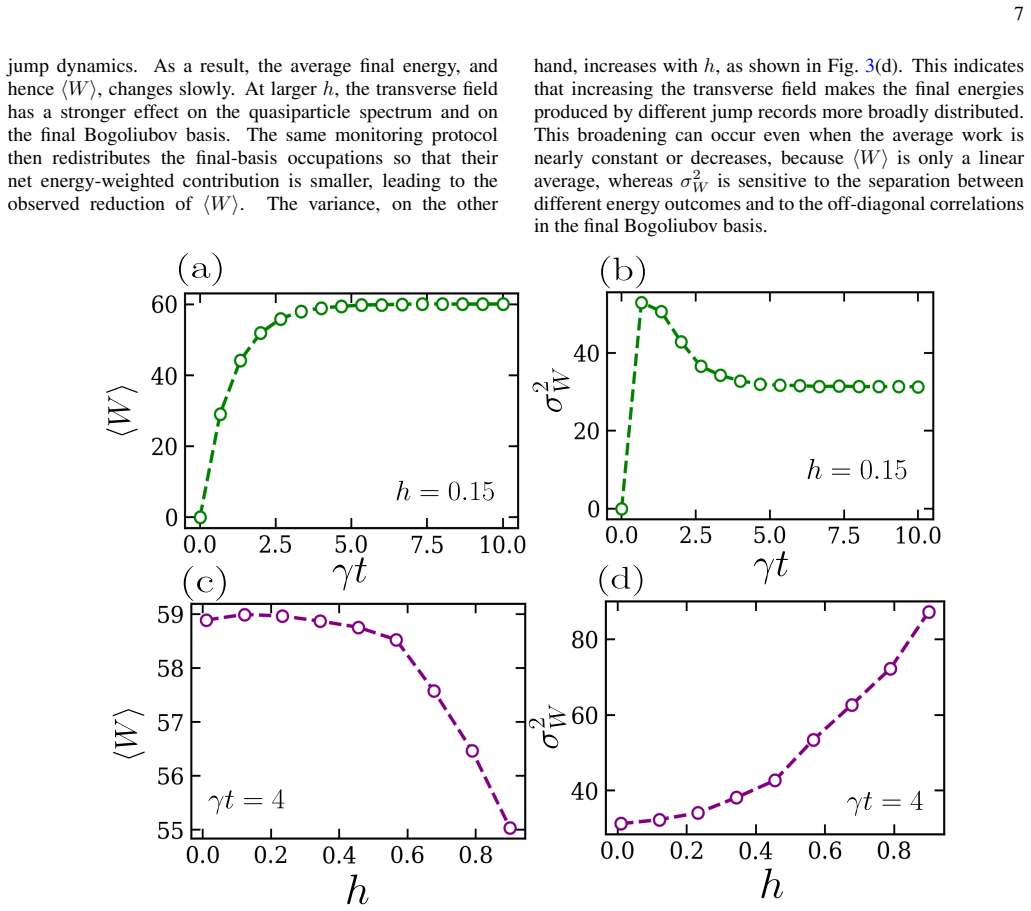
- Causally disconnected controlled jumps add fixed energy per event while light-cone-overlapping jumps add progressively less, producing linear versus sublinear average-work growth.
- Continuous monitoring during a quench erases the discrete features of the isolated-quench work distribution.
- The generating-function approach yields explicit trajectory statistics for both random and controlled monitoring protocols.
Where Pith is reading between the lines
- The light-cone dependence offers a direct dynamical signature that could be used to probe causal structure in monitored many-body systems.
- Gaussianization under monitoring may extend to other integrable chains or to non-integrable models where exact Gaussian-state methods no longer apply.
- The same trajectory-resolved formalism could be applied to heat or entropy statistics under monitored dynamics.
Load-bearing premise
The fermionic Gaussian-state formalism accurately evaluates the trajectory-resolved generating function for work statistics in the two-point energy measurement scheme for the monitored dynamics.
What would settle it
Direct computation or measurement of the work distribution for an Ising chain after successively larger numbers of stochastic jumps, checking whether it remains comb-like or becomes Gaussian with narrowing tails.
Figures


read the original abstract
We investigate work statistics in monitored transverse-field Ising chains subject to both a quantum quench of the transverse field and either stochastic quantum jumps or controlled measurement sequences. For generalized measurements, we derive a trajectory-resolved generating function for work statistics in the two-point energy measurement scheme. Evaluating it using a fermionic Gaussian-state formalism, we show that, under stochastic jump dynamics, the work distribution crosses over from a comb-like structure to an essentially Gaussian form with shrinking sub-Gaussian tails, as the number of detection events grows. For controlled jump protocols, the energy added by each jump is constant when successive jumps are causally disconnected but decreases and then saturates when they lie within each other's light cone, yielding linear and sublinear growth of the average work, respectively. For monitored quenches, continuous observation washes out the fine structure of the isolated-quench distribution and again drives the statistics toward Gaussian behavior.
Editorial analysis
A structured set of objections, weighed in public.
Referee Report
Summary. The manuscript derives a trajectory-resolved generating function for work statistics in the two-point energy measurement scheme applied to monitored transverse-field Ising chains that undergo both a quantum quench of the transverse field and either stochastic quantum jumps or controlled measurement sequences. Evaluating the generating function with the fermionic Gaussian-state formalism, the authors report that stochastic jump dynamics produce a crossover in the work distribution from a comb-like structure to an essentially Gaussian form whose sub-Gaussian tails shrink with increasing numbers of detection events. For controlled jump protocols the energy increment per jump remains constant when jumps are causally disconnected but decreases and saturates inside each other’s light cone, producing linear versus sublinear growth of the average work; continuous monitoring of a quench is shown to erase the fine structure of the isolated-quench distribution and again drive the statistics toward Gaussian behavior.
Significance. If the central derivations hold, the work supplies an exactly solvable benchmark for work statistics in monitored many-body systems, cleanly separating the effects of stochastic versus controlled monitoring and of causal light-cone structure on the first and higher moments of the work distribution. The exact preservation of Gaussianity under the chosen jump operators for the transverse-field Ising model, together with the absence of free parameters in the mapping, constitutes a clear technical strength that allows quantitative statements about distribution crossovers and average-work scaling without uncontrolled approximations.
minor comments (3)
- [§3] §3, paragraph after Eq. (12): the statement that the covariance matrix remains real-symmetric after each jump should be accompanied by an explicit verification that the chosen measurement operators commute with the parity operator, otherwise the Gaussian-state representation could acquire an imaginary part.
- [Figure 4] Figure 4 caption: the legend labels “N_det = 5, 10, 20” but the plotted curves are not identified by color or line style in the figure itself; this makes it impossible to match the curves to the stated detection numbers without consulting the main text.
- [§4.2] §4.2, sentence beginning “When successive jumps lie within each other’s light cone”: the phrase “decreases and then saturates” is used without a quantitative criterion for saturation; a short clause defining the saturation threshold (e.g., relative change < 1 %) would remove ambiguity.
Simulated Author's Rebuttal
We thank the referee for their positive assessment of the manuscript, including the summary of our results on trajectory-resolved work statistics in monitored Ising chains and the recognition of the technical strengths of the Gaussian-state approach. We note the recommendation for minor revision. No specific major comments were raised in the report.
Circularity Check
No significant circularity identified
full rationale
The paper derives a trajectory-resolved generating function for work statistics in the two-point measurement scheme and evaluates it via the fermionic Gaussian-state formalism. For the transverse-field Ising model this is an exact mapping because the initial state is Gaussian and the jump/measurement operators preserve Gaussianity of conditional states. No quoted equation reduces a claimed prediction to a fitted input by construction, no self-citation is shown to be load-bearing for the central claims, and the reported crossovers in work distributions follow from direct evaluation of the derived generating function rather than from re-labeling or self-definition. The derivation chain therefore remains self-contained against external benchmarks.
Axiom & Free-Parameter Ledger
axioms (2)
- domain assumption Fermionic Gaussian-state formalism applies to trajectory-resolved work statistics under quantum jumps and quenches in the Ising chain.
- domain assumption Two-point energy measurement scheme captures the work statistics in this open quantum setting.
Reference graph
Works this paper leans on
-
[1]
drop-then-plateau
= R dW P(W) = 1) follows from the completeness re- lation X {rj } T † tf ,ti({rj, tj})Ttf ,ti({rj, tj}) =1,(13) which is a direct consequence of the unitarity ofUand the completeness ofM r. Settingu=−iβinstead, the Jarzynski equality reads G(−iβ) = Tr h P {rj } Ttf ,ti({rj, tj})T † tf ,ti({rj, tj}) e−βHf i Zi = Zf Zi =e −β∆F , which is satisfied provided ...
-
[2]
Gemmer, M
J. Gemmer, M. Michel, and G. Mahler, Quantum thermody- namics: Emergence of thermodynamic behavior within com- posite quantum systems, Springer, Berlin (2004)
2004
-
[3]
Vinjanampathy and J
S. Vinjanampathy and J. Anders, Quantum thermodynamics, Contemporary Physics57(4), 545–579 (2016)
2016
-
[4]
Kosloff, Quantum thermodynamics: A dynamical viewpoint, Entropy15(6), 2100 (2013)
R. Kosloff, Quantum thermodynamics: A dynamical viewpoint, Entropy15(6), 2100 (2013)
2013
-
[5]
Campisi, P
M. Campisi, P. Hänggi, and P. Talkner, Colloquium: Quantum fluctuation relations: Foundations and applications, Rev. Mod. Phys.83, 771 (2011)
2011
-
[6]
Silva, Statistics of the work done on a quantum critical sys- tem by quenching a control parameter, Phys
A. Silva, Statistics of the work done on a quantum critical sys- tem by quenching a control parameter, Phys. Rev. Lett101, 120603 (2008)
2008
-
[7]
Goold, M
J. Goold, M. Huber, A. Riera, L. del Rio, and P. Skrzypczyk, The role of quantum information in thermodynamics—a topical review, J. Phys. A: Math. Theor.49, 143001 (2016)
2016
-
[8]
Esposito, U
M. Esposito, U. Harbola, and S. Mukamel, Nonequilibrium fluctuations, fluctuation theorems, and counting statistics in quantum systems, Rev. Mod. Phys.81, 1665 (2009)
2009
-
[9]
Binder, L
F. Binder, L. A. Correa, C. Gogolin, J. Anders, and G. Adesso, Thermodynamics in the quantum regime: Fundamental aspects and new directions, Springer, Cham (2018)
2018
-
[10]
J. M. Horowitz and K. Jacobs, Quantum effects improve the energy efficiency of feedback control, Phys. Rev. E89, 042134 (2014)
2014
-
[11]
Seifert, Stochastic thermodynamics, fluctuation theorems and molecular machines, Reports on Progress in Physics75, 126001 (2012)
U. Seifert, Stochastic thermodynamics, fluctuation theorems and molecular machines, Reports on Progress in Physics75, 126001 (2012)
2012
-
[12]
H. M. Wiseman and G. J. Milburn, Quantum measurement and control, Cambridge University Press (2009)
2009
-
[13]
Piccitto, D
G. Piccitto, D. Rossini, and A. Russomanno, The impact of dif- ferent unravelings in a monitored system of free fermions, Eur. Phys. J. B97, 90 (2024)
2024
-
[14]
Manzano and R
G. Manzano and R. Zambrini, Quantum thermodynamics under continuous monitoring: A general framework, A VS Quantum Sci.4, 025302 (2022)
2022
-
[15]
Elouard and M
C. Elouard and M. H. Mohammady, Work, heat and entropy production along quantum trajectories,Thermodynamics in the Quantum Regime: Fundamental Aspects and New Directions, Springer, Cham , 363 (2018)
2018
-
[16]
Malakar and A
M. Malakar and A. Silva, Work statistics and quantum trajecto- ries: No-click limit and non-hermitian hamiltonians, Phys. Rev. B113, 064304 (2026)
2026
-
[17]
F. W. J. Hekking and J. P. Pekola, Quantum jump approach for work and dissipation in a two-level system, Phys. Rev. Lett. 111, 093602 (2013)
2013
-
[18]
J. M. Horowitz and J. M. R. Parrondo, Entropy production along nonequilibrium quantum jump trajectories, New J. Phys. 15, 085028 (2013)
2013
-
[19]
M. J. Kewming and S. Shrapnel, Entropy production and fluc- tuation theorems in a continuously monitored optical cavity at zero temperature, Quantum6, 685 (2022)
2022
-
[20]
Naghiloo, D
M. Naghiloo, D. Tan, P. M. Harrington, J. J. Alonso, E. Lutz, A. Romito, and K. W. Murch, Heat and work along individ- ual trajectories of a quantum bit, Phys. Rev. Lett.124, 110604 (2020)
2020
-
[21]
Skinner, J
B. Skinner, J. Ruhman, and A. Nahum, Measurement-induced phase transitions in the dynamics of entanglement, Phys. Rev. X9, 031009 (2019)
2019
-
[22]
Dalibard, Y
J. Dalibard, Y . Castin, and K. Mølmer, Wave-function approach to dissipative processes in quantum optics, Phys. Rev. Lett.68, 580 (1992)
1992
-
[23]
A. J. Daley, Quantum trajectories and open many-body quan- tum systems, Advances in Physics63, 77 (2014)
2014
-
[24]
M. B. Plenio and P. L. Knight, The quantum-jump approach to dissipative dynamics in quantum optics, Rev. Mod. Phys.70, 101 (1998)
1998
-
[25]
Kurchan, A quantum fluctuation theorem, arXiv:cond- mat/0007360 (2001)
J. Kurchan, A quantum fluctuation theorem, arXiv:cond- mat/0007360 (2001)
-
[26]
Jarzynski, Nonequilibrium equality for free energy differ- ences, Phys
C. Jarzynski, Nonequilibrium equality for free energy differ- ences, Phys. Rev. Lett.78, 2690 (1997)
1997
-
[27]
Talkner, E
P. Talkner, E. Lutz, and P. Hänggi, Fluctuation theorems: Work is not an observable, Phys. Rev. E75, 050102 (2007)
2007
-
[28]
A. E. Rastegin, Non-equilibrium equalities with unital quantum channels, Journal of Statistical Mechanics: Theory and Experi- ment2013, P06016 (2013)
2013
-
[29]
Hoeffding, Probability inequalities for sums of bounded ran- dom variables, Journal of the American Statistical Association 13 58, 13 (1963)
W. Hoeffding, Probability inequalities for sums of bounded ran- dom variables, Journal of the American Statistical Association 13 58, 13 (1963)
1963
-
[30]
Kurtz, Limit theorems and diffusion approximations for den- sity dependent markov chains, Springer Berlin Heidelberg5, 67 (1976)
T. Kurtz, Limit theorems and diffusion approximations for den- sity dependent markov chains, Springer Berlin Heidelberg5, 67 (1976)
1976
-
[31]
Kipnis and S
C. Kipnis and S. R. S. Varadhan, Central limit theorem for addi- tive functionals of reversible markov processes and applications to simple exclusions, Commun. Math. Phys.104, 1 (1986)
1986
-
[32]
G. L. Jones, On the Markov chain central limit theorem, Proba- bility Surveys1, 299 (2004)
2004
-
[33]
Calabrese, F
P. Calabrese, F. H. L. Essler, and M. Fagotti, Quantum quench in the transverse field ising chain: I. time evolution of order parameter correlators, Journal of Statistical Mechanics: Theory and Experiment2012, P07016 (2012)
2012
-
[34]
Bravyi, M
S. Bravyi, M. B. Hastings, and F. Verstraete, Lieb-robinson bounds and the generation of correlations and topological quan- tum order, Phys. Rev. Lett.97, 050401 (2006)
2006
-
[35]
R. B. Nelsen,An Introduction to Copulas, 2nd ed., Springer Series in Statistics (Springer New York NY , 2006)
2006
-
[36]
Smacchia and A
P. Smacchia and A. Silva, Work distribution and edge singular- ities for generic time-dependent protocols in extended systems, Physical Review E88, 042109 (2013)
2013
discussion (0)
Sign in with ORCID, Apple, or X to comment. Anyone can read and Pith papers without signing in.