Data Sharing and Competition in Learning-by-Deploying Industries: Insights from Robotics and Beyond
Pith reviewed 2026-07-02 16:54 UTC · model grok-4.3
The pith
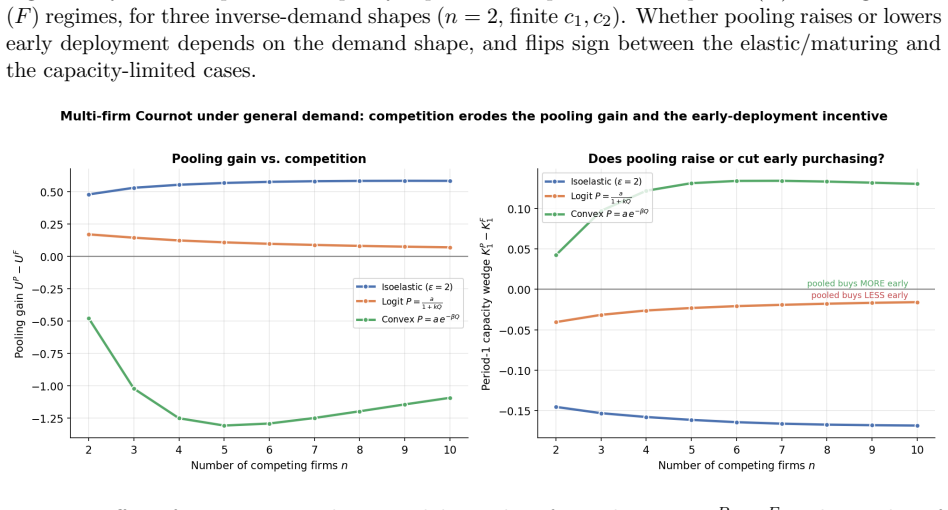
With downstream Cournot competition, pooling data from deployment depresses prices and can make sharing privately unprofitable.
A machine-rendered reading of the paper's core claim, the machinery that carries it, and where it could break.
Core claim
In a two-period model of learning-by-deploying, downstream Cournot competition makes the private value of data pooling fall with the intensity of competition and potentially negative; this occurs because pooling increases total output and depresses price, and the sustainability of pooling is governed by the elasticity of industry demand over the output range that pooling induces.
What carries the argument
The two-period model in which symmetric firms make irreversible capacity choices that feed a learning curve raising future productivity, with the choice between pooled or fragmented learning architecture directly affecting deployment and competition outcomes.
If this is right
- Pooling raises welfare but leads to underinvestment in early deployment when prices are fixed.
- The private value of sharing data decreases as competition intensifies and can turn negative.
- A sustainability threshold for pooling exists and is determined by demand elasticity over the relevant output range under general demand.
- Numerical simulations confirm that the patterns hold across parameter values.
Where Pith is reading between the lines
- If industry demand is inelastic over the relevant range, pooling is less likely to remain privately sustainable.
- The framework could be extended to test data-sharing decisions in other deployment-heavy sectors such as autonomous transport.
- Asymmetric firm sizes or repeated periods might alter the location of the sustainability threshold.
Load-bearing premise
The model assumes symmetric firms, irreversible capacity choices in a two-period setting, and that capacity in use feeds a learning curve that raises future productivity with the learning architecture directly interacting with deployment and competition decisions.
What would settle it
Observe whether firms in a competitive deployment industry like autonomous vehicles or robotics choose to share deployment data or keep it private, and check if the decision aligns with the predicted demand elasticity threshold.
Figures
read the original abstract
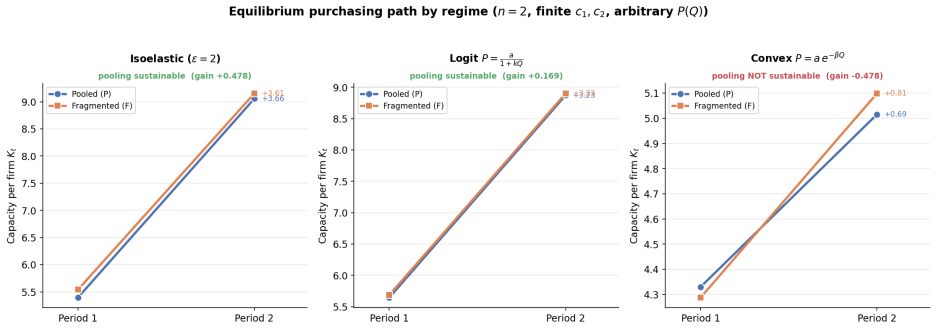
Many modern technologies improve through use. Each unit deployed generates data that trains the next generation, so deployment is both production and an investment in a shared learning stock. We study how the architecture of this learning, whether pooled across firms or fragmented within them, interacts with firms' deployment decisions and with product-market competition. In a two-period model, symmetric firms make irreversible capacity choices, and capacity in use feeds a learning curve that raises future productivity. We call this learning-by-deploying, replacing the production experience of the classic learning-by-doing tradition with deployment-generated data. With exogenous prices, pooling raises welfare but firms underinvest in early deployment. Downstream Cournot competition overturns this: pooling depresses the price, so the private value of sharing falls with competition and can turn negative. We characterize a sustainability threshold governed, under general demand, by the elasticity of industry demand over the output range pooling induces, and confirm the patterns numerically.
Editorial analysis
A structured set of objections, weighed in public.
Referee Report
Summary. The paper develops a two-period model of symmetric firms choosing irreversible capacities that generate deployment data feeding a learning curve for future productivity. It compares pooled versus fragmented learning architectures, showing that with exogenous prices pooling raises welfare but induces underinvestment in early deployment. Under downstream Cournot competition, pooling depresses prices and can make the private value of sharing negative; the paper characterizes a sustainability threshold governed by industry demand elasticity over the output range induced by pooling and confirms the patterns numerically.
Significance. If the derivations hold, the work supplies a clean game-theoretic account of when data pooling is privately sustainable in learning-by-deploying settings, with the elasticity-based threshold offering a general, falsifiable prediction under broad demand. The contrast between exogenous-price and Cournot regimes is a useful contribution to the literature on learning-by-doing extended to data-driven contexts such as robotics.
major comments (2)
- [§3] §3 (model primitives): the central claim that the private value of pooling turns negative under Cournot rests on the interaction between capacity choices and the learning architecture; the two-period irreversible-capacity assumption is load-bearing, and relaxing it to allow capacity adjustment or multi-period horizons could overturn the sign of the private-value result.
- [§4] §4 (Cournot equilibrium): the sustainability threshold is stated to be governed by demand elasticity over the pooling-induced output range under general demand; the derivation should explicitly show that no further curvature or functional-form restrictions are imposed beyond the stated primitives, as any implicit restriction would narrow the claimed generality.
minor comments (2)
- The numerical section reports confirmation of the qualitative patterns but does not list the demand functions, parameter grids, or robustness checks performed; adding these would strengthen reproducibility.
- [§2] Notation for the learning curve (pooled vs. fragmented) should be introduced with an explicit equation early in the model section to avoid ambiguity when comparing welfare and private values.
Simulated Author's Rebuttal
We thank the referee for the constructive comments and the recommendation of minor revision. Below we respond point by point to the major comments.
read point-by-point responses
-
Referee: [§3] §3 (model primitives): the central claim that the private value of pooling turns negative under Cournot rests on the interaction between capacity choices and the learning architecture; the two-period irreversible-capacity assumption is load-bearing, and relaxing it to allow capacity adjustment or multi-period horizons could overturn the sign of the private-value result.
Authors: We agree that the two-period irreversible-capacity assumption is central and load-bearing for the sign of the private-value result. The assumption captures the commitment nature of deployment decisions that generate data under learning-by-deploying. Extending the model to adjustable capacities or longer horizons would require a substantially different dynamic framework and is beyond the scope of the current analysis. We will add a dedicated paragraph in the conclusion acknowledging this limitation and noting that the result is tied to the commitment effect in the two-period setting. revision: partial
-
Referee: [§4] §4 (Cournot equilibrium): the sustainability threshold is stated to be governed by demand elasticity over the pooling-induced output range under general demand; the derivation should explicitly show that no further curvature or functional-form restrictions are imposed beyond the stated primitives, as any implicit restriction would narrow the claimed generality.
Authors: The derivation uses only the maintained primitives: a general (twice continuously differentiable) inverse demand function, symmetric firms, and the standard Cournot first-order conditions. The sustainability threshold is obtained by comparing equilibrium profits under pooled versus fragmented learning and rearranging to isolate the elasticity term evaluated over the relevant output interval; no additional curvature restrictions (beyond those ensuring interior equilibrium) or functional-form assumptions are imposed. We will revise the exposition in §4 (and add a short appendix if needed) to display the derivation steps explicitly, confirming that the result holds under the stated general demand. revision: yes
Circularity Check
No significant circularity identified
full rationale
The paper presents a self-contained two-period theoretical model with symmetric firms, irreversible capacity choices, and a learning-by-deploying curve interacting with Cournot competition. The central claims—the private value of pooling turning negative under competition and the sustainability threshold governed by industry demand elasticity—are derived analytically from the stated primitives (general demand, output ranges induced by pooling) without reduction to fitted parameters, self-referential definitions, or load-bearing self-citations. Numerical confirmation is presented as support for the derived patterns rather than as the source of the results. No load-bearing step reduces by construction to its inputs.
Axiom & Free-Parameter Ledger
Reference graph
Works this paper leans on
-
[1]
and Freund, Robert M
Fine, Charles H. and Freund, Robert M. , title =. Management Science , volume =. 1990 , publisher =
1990
-
[2]
, title =
Van Mieghem, Jan A. , title =. Manufacturing & Service Operations Management , volume =. 2003 , publisher =
2003
-
[3]
Product Selection, Fixed Costs, and Monopolistic Competition , urldate =
Michael Spence , journal =. Product Selection, Fixed Costs, and Monopolistic Competition , urldate =
-
[4]
Cooperative and Noncooperative R & D in Duopoly with Spillovers , urldate =
Claude D'Aspremont and Alexis Jacquemin , journal =. Cooperative and Noncooperative R & D in Duopoly with Spillovers , urldate =
-
[5]
Arrow , journal =
Kenneth J. Arrow , journal =. The Economic Implications of Learning by Doing , urldate =
-
[6]
Science , volume =
Argote, Linda and Epple, Dennis , title =. Science , volume =. 1990 , doi =
1990
-
[7]
and Epple, Dennis , title =
Argote, Linda and Beckman, Sara L. and Epple, Dennis , title =. Management Science , volume =. 1990 , doi =
1990
-
[8]
Lanier , title =
Benkard, C. Lanier , title =. American Economic Review , volume =. 2000 , doi =
2000
-
[9]
Michael , title =
Spence, A. Michael , title =. The Bell Journal of Economics , volume =
-
[10]
The Bell Journal of Economics , volume =
Fudenberg, Drew and Tirole, Jean , title =. The Bell Journal of Economics , volume =
-
[11]
Michael , title =
Ghemawat, Pankaj and Spence, A. Michael , title =. The Quarterly Journal of Economics , volume =. 1985 , doi =
1985
-
[12]
Cabral, Luis M. B. and Riordan, Michael H. , title =. Econometrica , volume =. 1994 , doi =
1994
-
[13]
and Muller, Eitan and Zang, Israel , title =
Kamien, Morton I. and Muller, Eitan and Zang, Israel , title =. American Economic Review , volume =
-
[14]
and Tonetti, Christopher , title =
Jones, Charles I. and Tonetti, Christopher , title =. American Economic Review , volume =. 2020 , doi =
2020
-
[15]
RAND Journal of Economics , volume =
Bergemann, Dirk and Bonatti, Alessandro and Gan, Tan , title =. RAND Journal of Economics , volume =. 2022 , doi =
2022
-
[16]
RAND Journal of Economics , volume =
Hagiu, Andrei and Wright, Julian , title =. RAND Journal of Economics , volume =. 2023 , doi =
2023
-
[17]
Competing with Big Data , journal =
Pr. Competing with Big Data , journal =. 2021 , doi =
2021
-
[18]
RT-1: Robotics Transformer for Real-World Control at Scale
Brohan, Anthony and others , title =. arXiv preprint arXiv:2212.06817 , year =
work page internal anchor Pith review Pith/arXiv arXiv
-
[19]
Open X-Embodiment: Robotic Learning Datasets and RT-X Models
Open X-Embodiment: Robotic Learning Datasets and. arXiv preprint arXiv:2310.08864 , year =
work page internal anchor Pith review Pith/arXiv arXiv
-
[20]
Humanoid Robots , year =
-
[21]
The World Should Pay Attention
China's New Five-Year Plan Prioritizes Robotics. The World Should Pay Attention. , year =
discussion (0)
Sign in with ORCID, Apple, or X to comment. Anyone can read and Pith papers without signing in.