Demographic senescence as multi-level selection in miniature
Pith reviewed 2026-07-02 16:28 UTC · model grok-4.3
The pith
Demographic senescence patterns are formally equivalent to those generated by within-generation multi-level selection.
A machine-rendered reading of the paper's core claim, the machinery that carries it, and where it could break.
Core claim
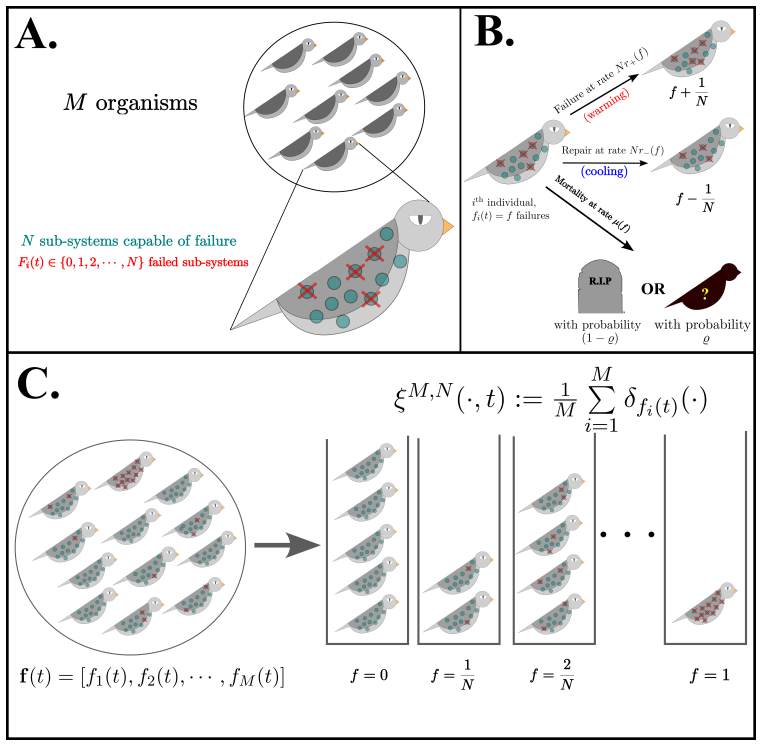
A two-level Moran type process and its scaling limits illustrate that a simple mathematical framework that models multi-level selection in group-structured populations also models damage accumulation patterns and resultant mortality curves in ageing organisms. To verbally make the connection, observe that defectors spread within a group consisting of cooperators and defectors; when groups compete against each other, defector-rich groups suffer, and between-group selection causes such groups to be systematically under-represented. Exactly analogously, senescing individuals accumulate damage to physiological sub-systems, and damage begets damage; individuals who are more damaged are more likel
What carries the argument
Two-level Moran process and its scaling limits, in which intra-organismal sub-systems act as particles, organisms as collectives, and selective disappearance as group selection.
If this is right
- Damage accumulation produces systematic under-representation of damaged individuals in later age classes through selective disappearance.
- The identical mathematical framework generates both population-level multi-level selection outcomes and individual-level senescence patterns.
- Emergent mortality curves require no extra parameters once the two-level process is specified.
- Between-group selection analogs explain the progressive removal of damage-rich individuals from the observed population.
Where Pith is reading between the lines
- Models calibrated on group-structured populations could be directly reused to forecast senescence trajectories under different damage propagation rates.
- The same logic may link senescence to other within-organism selection processes such as tumor progression or immune cell competition.
- Comparative studies across species could test whether differences in observed mortality curves track measurable differences in sub-system damage spread.
Load-bearing premise
The scaling limits of the two-level Moran process accurately capture biological damage accumulation and selective disappearance without additional organism-specific assumptions or parameters.
What would settle it
Mortality curves measured in a real organism whose independently quantified damage accumulation rates produce age-specific death patterns that deviate from the scaling-limit predictions of the two-level Moran process.
Figures
read the original abstract
Multi-level selection and senescence do not at first sight have much in common. Here, we demonstrate that the emergent mortality patterns generated by demographic senescence can be understood as the product of multi-level selection. We formulate a two-level Moran type process and use its scaling limits to illustrate that a simple mathematical framework that models multi-level selection in group-structured populations also models damage accumulation patterns and resultant mortality curves in ageing organisms. To verbally make the connection, observe that defectors spread within a group consisting of cooperators and defectors; when groups compete against each other, defector-rich groups suffer, and between-group selection causes such groups to be systematically under-represented. Exactly analogously, senescing individuals accumulate damage to physiological sub-systems, and `damage begets damage'; individuals who are more damaged are more likely to die, hence damage-rich individuals are systematically under-represented in later age classes. Thus, emergent senescence patterns in complex, integrated organisms are formally equivalent to the patterns generated by a within-generation multi-level selection process in which intra-organismal sub-systems play the role of particles, organisms play the role of collectives, and selective disappearance plays the role of group selection.
Editorial analysis
A structured set of objections, weighed in public.
Referee Report
Summary. The manuscript claims that the emergent mortality patterns of demographic senescence are formally equivalent to those arising from within-generation multi-level selection in a two-level Moran process. Intra-organismal sub-systems act as particles (with damage accumulation analogous to defector spread), organisms act as collectives, and selective disappearance acts as group selection; the same scaling limits that produce multi-level selection outcomes are asserted to generate observed senescence curves without additional parameters.
Significance. If the claimed formal equivalence is rigorously established, the work supplies a parameter-free mathematical bridge between multi-level selection theory and aging biology, allowing senescence patterns to be derived directly from established Moran scaling limits. This could enable new cross-field predictions and tests, particularly if the mapping preserves the structure of the original evolutionary model.
major comments (2)
- [§3] §3 (scaling-limit derivation): the assertion that the standard two-level Moran update rules generate age-dependent mortality curves when re-interpreted with 'damage begets damage' requires an explicit rate-mapping step; without showing that constant-fitness payoffs suffice (rather than damage-dependent fitness functions), the parameter-free equivalence does not follow from the cited scaling limits.
- [Abstract and §4] Abstract and §4 (analogy paragraph): the verbal mapping of defectors to damaged sub-systems and between-group competition to selective disappearance is presented as 'exactly analogous,' yet no equation or table demonstrates that the Moran payoff matrix entries translate directly into biological damage rates while preserving the original scaling behavior.
minor comments (2)
- [§2] Notation for the two-level process (e.g., birth and death rate symbols) is introduced without a consolidated table; a single reference table would improve readability across sections.
- [§2] The manuscript cites the original Moran scaling-limit papers but does not include a brief recap of the key limit equations; adding one sentence would help readers unfamiliar with the evolutionary literature.
Simulated Author's Rebuttal
We are grateful to the referee for their detailed and insightful comments, which have helped us clarify the presentation of our results. We respond to each major comment below.
read point-by-point responses
-
Referee: §3 (scaling-limit derivation): the assertion that the standard two-level Moran update rules generate age-dependent mortality curves when re-interpreted with 'damage begets damage' requires an explicit rate-mapping step; without showing that constant-fitness payoffs suffice (rather than damage-dependent fitness functions), the parameter-free equivalence does not follow from the cited scaling limits.
Authors: We thank the referee for highlighting this aspect of the derivation. Upon re-examination, we recognize that while the scaling limits are applied to the standard Moran process with constant payoffs, an explicit mapping from the update rules to the damage accumulation dynamics would make the argument more transparent. In the revised version, we will insert an explicit rate-mapping step in §3, showing that the constant fitness advantage of defectors corresponds directly to a constant damage propagation rate without requiring damage-dependent fitness functions. This preserves the parameter-free character of the equivalence. revision: yes
-
Referee: Abstract and §4 (analogy paragraph): the verbal mapping of defectors to damaged sub-systems and between-group competition to selective disappearance is presented as 'exactly analogous,' yet no equation or table demonstrates that the Moran payoff matrix entries translate directly into biological damage rates while preserving the original scaling behavior.
Authors: The equivalence is formal through the application of the scaling limits to the reinterpreted process, as detailed in the manuscript. Nevertheless, to make the translation explicit, we will add a table in the revised §4 that lists the Moran payoff matrix entries alongside their biological interpretations (e.g., payoff to damage rate), and verify that the scaling limits remain unchanged under this correspondence. This will strengthen the claim of exact analogy. revision: yes
Circularity Check
No circularity: equivalence derived from independent Moran scaling limits
full rationale
The paper formulates a two-level Moran process and applies its scaling limits to both multi-level selection and senescence damage accumulation. The abstract presents the formal equivalence as arising from this shared mathematical framework rather than by redefining senescence in terms of the selection process or fitting parameters to match mortality curves. The verbal analogy ('exactly analogously') is interpretive and does not constitute a self-definitional reduction or load-bearing self-citation. No quoted step reduces the claimed result to its inputs by construction; the derivation remains self-contained against external benchmarks.
Axiom & Free-Parameter Ledger
axioms (1)
- domain assumption The two-level Moran process and its scaling limits simultaneously describe both multi-level selection in groups and damage accumulation leading to mortality in organisms.
Reference graph
Works this paper leans on
-
[1]
Trends in Ecology & Evolution , author =
Evolutionary Ecology of Senescence and a Reassessment of Williams’ ‘Extrinsic Mortality’ Hypothesis , volume =. Trends in Ecology & Evolution , author =. 2019 , pages =. doi:10.1016/j.tree.2019.02.006 , number =
-
[2]
2024 , publisher=
Four views on free will , author=. 2024 , publisher=
2024
-
[3]
The Zombic Hunch: Extinction of an Intuition? , volume =
Dennett, Daniel , year =. The Zombic Hunch: Extinction of an Intuition? , volume =. doi:10.1017/s1358246100010687 , journal =
-
[4]
gren, J. Arvid and Patten, Manus M. , year =. Genetic conflicts and the case for licensed anthropomorphizing , volume =. Behavioral Ecology and Sociobiology , publisher =. doi:10.1007/s00265-022-03267-6 , number =
-
[5]
Stochastic failure accumulation as a foundation for exponential mortality and selective disappearance , DOI =
Bhat, Ananda Shikhara and Kokko, Hanna , year =. Stochastic failure accumulation as a foundation for exponential mortality and selective disappearance , DOI =
-
[6]
Cooney, Daniel B. , year =. Exploring the Evolution of Altruistic Punishment with a PDE Model of Cultural Multilevel Selection , volume =. Bulletin of Mathematical Biology , publisher =. doi:10.1007/s11538-025-01422-4 , number =
-
[7]
Week, Bob , year =. Stochastic eco-evolutionary dynamics of multivariate traits: A framework for modeling population processes illustrated by the study of drifting G-matrices , volume =. doi:10.1016/j.jtbi.2026.112428 , journal =
-
[8]
Measure-valued diffusions, coalescents and genetic inference , ISBN =
Birkner, Matthias and Blath, Jochen , year =. Measure-valued diffusions, coalescents and genetic inference , ISBN =. doi:10.1017/cbo9781139107020.015 , booktitle =
-
[9]
Intracellular competition shapes plasmid population dynamics , volume =
Rossine, Fernando and Sanchez, Carlos and Eaton, Daniel and Paulsson, Johan and Baym, Michael , year =. Intracellular competition shapes plasmid population dynamics , volume =. Science , publisher =. doi:10.1126/science.adx0665 , number =
-
[10]
Multileveled Selection on Plasmid Replication , volume =. Genetics , author =. 2002 , pages =. doi:10.1093/genetics/161.4.1373 , number =
-
[11]
Williams, George C. , year =. The Tithonus Error in Modern Gerontology , volume =. The Quarterly Review of Biology , publisher =. doi:10.1086/394111 , number =
-
[12]
and Viot, Michel , journal =
Fleming, Wendell H. and Viot, Michel , journal =. Some Measure-Valued Markov Processes in Population Genetics Theory , volume =
-
[13]
Okasha, Samir , year =. Agents and Goals in Evolution , ISBN =. doi:10.1093/oso/9780198815082.001.0001 , publisher =
-
[14]
PLOS Computational Biology , author =
Social evolution under demographic stochasticity , volume =. PLOS Computational Biology , author =. 2019 , pages =. doi:10.1371/journal.pcbi.1006739 , number =
-
[15]
Promoting extinction or minimizing growth?. Evolution , author =. 2023 , pages =. doi:10.1093/evolut/qpad042 , number =
-
[16]
Da Prato, Giuseppe and Zabczyk, Jerzy , year =. Stochastic Equations in Infinite Dimensions , ISBN =. doi:10.1017/cbo9781107295513 , publisher =
-
[17]
1991 , publisher=
Functional Analysis , author=. 1991 , publisher=
1991
-
[18]
, year =
Rice, Sean H. , year =. Evolutionary theory: mathematical and conceptual foundations , isbn =
-
[19]
Parsons, Todd L and Rogers, Tim , year =. Dimension reduction for stochastic dynamical systems forced onto a manifold by large drift: a constructive approach with examples from theoretical biology , volume =. Journal of Physics A: Mathematical and Theoretical , publisher =. doi:10.1088/1751-8121/aa86c7 , number =
-
[20]
Chen, Linan and Stroock, Daniel W. , year =. The. SIAM Journal on Mathematical Analysis , publisher =. doi:10.1137/090764207 , number =
-
[21]
Epstein, Charles L. and Mazzeo, Rafe , year =. Wright–. SIAM Journal on Mathematical Analysis , publisher =. doi:10.1137/090766152 , number =
-
[22]
Rogers, Tim and McKane, Alan J. , year =. Modes of competition and the fitness of evolved populations , volume =. Physical Review E , publisher =. doi:10.1103/physreve.92.032708 , number =
-
[23]
, year =
García-Ojalvo, Jordi and Sancho, Jose M. , year =. Noise in spatially extended systems , isbn =
-
[24]
Constable, George W. A. and McKane, Alan J. , year =. Fast-mode elimination in stochastic metapopulation models , volume =. Physical Review E , publisher =. doi:10.1103/physreve.89.032141 , number =
-
[25]
Stochastic dynamics on slow manifolds , volume =
Constable, George W A and McKane, Alan J and Rogers, Tim , year =. Stochastic dynamics on slow manifolds , volume =. Journal of Physics A: Mathematical and Theoretical , publisher =. doi:10.1088/1751-8113/46/29/295002 , number =
-
[26]
M’Gonigle, Leithen K. and Green, Emma L. and Greenspoon, Philip B. , year =. Structured Landscapes Promote Persistence by Favoring Prudent Predators , volume =. The American Naturalist , publisher =. doi:10.1086/740827 , number =
-
[27]
An Introduction to Superprocesses , ISBN =
Etheridge, Alison , year =. An Introduction to Superprocesses , ISBN =. doi:10.1090/ulect/020 , series =
-
[28]
The American Naturalist , author =
Selection of Intermediate Rates of Increase in Parasite-Host Systems , volume =. The American Naturalist , author =. 1981 , month = mar, pages =. doi:10.1086/283708 , number =
-
[29]
Proceedings of the Royal Society B: Biological Sciences , author =
How populations persist when asexuality requires sex: the spatial dynamics of coping with sperm parasites , volume =. Proceedings of the Royal Society B: Biological Sciences , author =. 2008 , month = jan, pages =. doi:10.1098/rspb.2007.1199 , number =
-
[30]
Weitz, Joshua S. and Fraser, Hunter B. , year =. Explaining mortality rate plateaus , volume =. Proceedings of the National Academy of Sciences , publisher =. doi:10.1073/pnas.261228098 , number =
-
[31]
Local migration promotes competitive restraint in a host–pathogen “tragedy of the commons” , volume =. Nature , author =. 2006 , pages =. doi:10.1038/nature04864 , number =
-
[32]
Population Structure Mediates Sexual Conflict in Water Striders , volume =. Science , author =. 2009 , month = nov, pages =. doi:10.1126/science.1180183 , number =
-
[33]
The role of multilevel selection in the evolution of sexual conflict in the water strider Aquarius remigis , volume =. Evolution , author =. 2010 , month = oct, pages =. doi:10.1111/j.1558-5646.2010.01087.x , number =
-
[34]
and Bargum, Katja and Kokko, Hanna , year =
Rankin, Daniel J. and Bargum, Katja and Kokko, Hanna , year =. The tragedy of the commons in evolutionary biology , volume =. Trends in Ecology & Evolution , publisher =. doi:10.1016/j.tree.2007.07.009 , number =
-
[35]
Okasha, Samir , year =. Evolution and the Levels of Selection , ISBN =. doi:10.1093/acprof:oso/9780199267972.001.0001 , publisher =
-
[36]
Journal of the American Statistical Association , author =
Abraham Wald’s Work on Aircraft Survivability , volume =. Journal of the American Statistical Association , author =. 1984 , pages =. doi:10.1080/01621459.1984.10478038 , number =
-
[37]
Dynamics of Regional Distribution: The Core and Satellite Species Hypothesis , volume =. Oikos , author =. 1982 , pages =. doi:10.2307/3544021 , number =
-
[38]
Bulletin of the Entomological Society of America , author =
Some Demographic and Genetic Consequences of Environmental Heterogeneity for Biological Control , volume =. Bulletin of the Entomological Society of America , author =. 1969 , pages =. doi:10.1093/besa/15.3.237 , number =
-
[39]
Ecology and Evolution , author =
Understanding evolutionary and ecological dynamics using a continuum limit , volume =. Ecology and Evolution , author =. 2021 , pages =. doi:10.1002/ece3.7205 , number =
-
[40]
Snyder, Robin E. and Ellner, Stephen P. , year =. Pluck or Luck: Does Trait Variation or Chance Drive Variation in Lifetime Reproductive Success? , volume =. The American Naturalist , publisher =. doi:10.1086/696125 , number =
-
[41]
Snyder, Robin E. and Ellner, Stephen P. and Hooker, Giles , year =. Time and Chance: Using Age Partitioning to Understand How Luck Drives Variation in Reproductive Success , volume =. The American Naturalist , publisher =. doi:10.1086/712874 , number =
-
[42]
W , year =
Gardiner, C. W , year =. Stochastic methods: a handbook for the natural and social sciences , isbn =
-
[43]
doi:10.1007/978-3-030-89003-2 , isbn =
Pardoux, Étienne , title =. doi:10.1007/978-3-030-89003-2 , isbn =
-
[44]
Week, Bob and Nuismer, Scott L. and Harmon, Luke J. and Krone, Stephen M. , title =. Journal of Theoretical Biology , keywords =. doi:10.1016/j.jtbi.2021.110660 , issn =
-
[45]
Quasistationary distributions for one-dimensional diffusions with killing , volume =
Steinsaltz, David and Evans, Steven , year =. Quasistationary distributions for one-dimensional diffusions with killing , volume =. Transactions of the American Mathematical Society , publisher =. doi:10.1090/s0002-9947-06-03980-8 , number =
-
[46]
Black, Andrew J. and McKane, Alan J. , title =. Trends in Ecology & Evolution , year =. doi:10.1016/j.tree.2012.01.014 , number =
-
[47]
Pawula, R. F. , title =. Physical Review , year =. doi:10.1103/PhysRev.162.186 , number =
-
[48]
Ethier, Stewart N. and Kurtz, Thomas G. , year =. Markov Processes: Characterization and Convergence , ISBN =. doi:10.1002/9780470316658 , journal =
-
[49]
Turnover shapes evolution of birth and death rates , volume =
Kuosmanen, Teemu and S\". Turnover shapes evolution of birth and death rates , volume =. Evolution , publisher =. 2025 , month = may, pages =. doi:10.1093/evolut/qpaf076 , number =
-
[50]
Komarova, Natalia L. and Wodarz, Dominik , year =. Population structure reverses selection of variants with proportionally scaled birth and death rates , volume =. Nature Communications , publisher =. doi:10.1038/s41467-025-66951-x , number =
-
[51]
Journal of The Royal Society Interface , author =
Categorizing update mechanisms for graph-structured metapopulations , volume =. Journal of The Royal Society Interface , author =. doi:10.1098/rsif.2022.0769 , number =
-
[52]
Fontanari, José F. and Serva, Maurizio , year =. Nonlinear group survival in Kimura’s model for the evolution of altruism , volume =. doi:10.1016/j.mbs.2014.01.003 , journal =
-
[53]
A simple model of group selection that cannot be analyzed with inclusive fitness , volume =
van Veelen, Matthijs and Luo, Shishi and Simon, Burton , year =. A simple model of group selection that cannot be analyzed with inclusive fitness , volume =. doi:10.1016/j.jtbi.2014.07.004 , journal =
-
[54]
Cooney, Daniel B. and Rossine, Fernando W. and Morris, Dylan H. and Levin, Simon A. , year =. A PDE Model for Protocell Evolution and the Origin of Chromosomes via Multilevel Selection , volume =. Bulletin of Mathematical Biology , publisher =. doi:10.1007/s11538-022-01062-y , number =
-
[55]
Journal of Mathematical Biology , author =
The replicator dynamics for multilevel selection in evolutionary games , volume =. Journal of Mathematical Biology , author =. 2019 , keywords =. doi:10.1007/s00285-019-01352-5 , abstract =
-
[56]
Journal of Mathematical Biology , author =
Long-time behavior of a. Journal of Mathematical Biology , author =. 2022 , keywords =. doi:10.1007/s00285-022-01776-6 , abstract =
-
[57]
Proceedings of the National Academy of Sciences , author =
Evolutionary dynamics within and among competing groups , volume =. Proceedings of the National Academy of Sciences , author =. 2023 , pages =. doi:10.1073/pnas.2216186120 , abstract =
-
[58]
Journal of Theoretical Biology , author =
A unifying framework reveals key properties of multilevel selection , volume =. Journal of Theoretical Biology , author =. 2014 , keywords =. doi:10.1016/j.jtbi.2013.09.024 , abstract =
-
[59]
Scaling limits of a model for selection at two scales , volume =. Nonlinearity , author =. 2017 , note =. doi:10.1088/1361-6544/aa5499 , abstract =
-
[60]
Theoretical Population Biology , author =
Group selection on the boundary of a stable population , volume =. Theoretical Population Biology , author =. 1973 , pages =. doi:10.1016/0040-5809(73)90007-5 , abstract =
-
[61]
Kimura, Motoo , year =. Diffusion model of intergroup selection, with special reference to evolution of an altruistic character , volume =. Proceedings of the National Academy of Sciences , publisher =. doi:10.1073/pnas.80.20.6317 , number =
-
[62]
IMA Journal of Mathematics Applied in Medicine & Biology , author =
Evolution of an. IMA Journal of Mathematics Applied in Medicine & Biology , author =. 1984 , pages =. doi:10.1093/imammb/1.1.1 , number =
-
[63]
Statistical Science , author =
Effects of unobserved and partially observed covariate processes on system failure: a review of models and estimation strategies , volume =. Statistical Science , author =. 1997 , note =. doi:10.1214/ss/1029963259 , number =
-
[64]
The Journals of Gerontology: Series A , author =
Dynamic. The Journals of Gerontology: Series A , author =. 1999 , pages =. doi:10.1093/gerona/54.6.B247 , number =
-
[65]
, title =
Karatzas, Ioannis and Shreve, Steven E. , title =
-
[66]
Space-Time Approach to Non-Relativistic Quantum Mechanics , author =. Rev. Mod. Phys. , volume =. 1948 , publisher =. doi:10.1103/RevModPhys.20.367 , url =
-
[67]
Transactions of the American Mathematical Society , volume=
On distributions of certain Wiener functionals , author=. Transactions of the American Mathematical Society , volume=. 1949 , doi=
1949
-
[68]
, year =
Karlin, Samuel and Taylor, Howard M. , year =. A second course in stochastic processes , isbn =
-
[69]
Nature Aging , pages=
Aging by the clock and yet without a program , author=. Nature Aging , pages=. 2025 , doi=
2025
-
[70]
The Bulletin of Mathematical Biophysics , author =
A relational theory of biological systems , volume =. The Bulletin of Mathematical Biophysics , author =. 1958 , pages =. doi:10.1007/BF02478302 , number =
-
[71]
Demographic Research , author =
Attrition in heterogeneous cohorts , volume =. Demographic Research , author =. 2010 , pages =. doi:10.4054/DemRes.2010.23.26 , abstract =
-
[72]
Methods in Ecology and Evolution , volume=
Who is afraid of modelling time as a continuous variable? , author=. Methods in Ecology and Evolution , volume=. 2024 , doi =
2024
-
[73]
Stochastic Processes and their Applications , author =
A diffusion process with killing: the time to formation of recurrent deleterious mutant genes , volume =. Stochastic Processes and their Applications , author =. 1982 , keywords =. doi:10.1016/0304-4149(82)90012-6 , abstract =
-
[74]
Theoretical Population Biology , author =
The detection of particular genotypes in finite populations. Theoretical Population Biology , author =. 1981 , pages =. doi:10.1016/0040-5809(81)90017-4 , number =
-
[75]
Nagoya Mathematical Journal , volume=
On a formula concerning stochastic differentials , author=. Nagoya Mathematical Journal , volume=. 1951 , doi =
1951
-
[76]
Advances in Applied Probability , author =
Asymptotic behavior of a general class of mixture failure rates , volume =. Advances in Applied Probability , author =. 2006 , keywords =. doi:10.1239/aap/1143936149 , number =
-
[77]
Theoretical Population Biology , author =
Mortality and aging in a heterogeneous population:. Theoretical Population Biology , author =. 1985 , pages =. doi:10.1016/0040-5809(85)90008-5 , number =
-
[78]
Theoretical Population Biology , author =
A random-walk model of human mortality and aging , volume =. Theoretical Population Biology , author =. 1977 , pages =. doi:10.1016/0040-5809(77)90005-3 , number =
-
[79]
Journal of Gerontology , author =
A. Journal of Gerontology , author =. 1983 , pages =. doi:10.1093/geronj/38.4.398 , number =
-
[80]
Journal of Gerontology , author =
A. Journal of Gerontology , author =. 1983 , pages =. doi:10.1093/geronj/38.4.406 , number =
discussion (0)
Sign in with ORCID, Apple, or X to comment. Anyone can read and Pith papers without signing in.