Computer vision-based neural networks for radioisotope identification in urban environments
Pith reviewed 2026-07-02 16:25 UTC · model grok-4.3
The pith
Treating consecutive gamma-ray spectra as image channels enables CNNs to outperform NMF in urban radioisotope identification at low false positive rates.
A machine-rendered reading of the paper's core claim, the machinery that carries it, and where it could break.
Core claim
The central claim is that the multi-channel waterfall spectrogram representation permits neural network architectures to learn distinctions between source signatures and background fluctuations better than non-negative matrix factorization, with the CNN delivering true detection, classification, and identification rates of 0.4334, 0.3965, and 0.2950 at a false positive rate below one alarm per hour, exceeding the NMF rates of 0.4151, 0.3611, and 0.2625.
What carries the argument
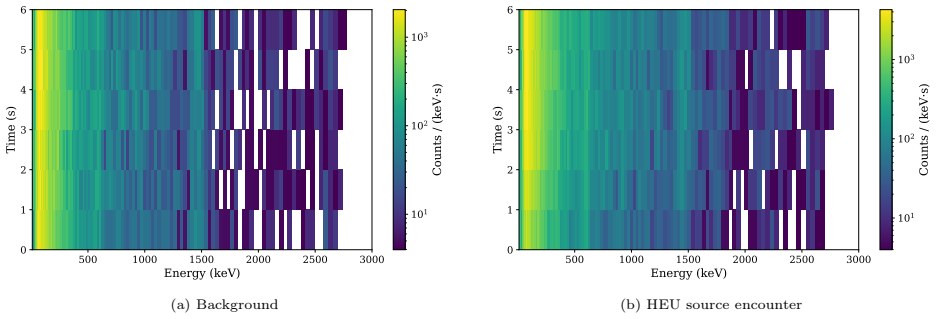
The waterfall spectrogram representation in which consecutive time spectra form separate input channels, analogous to color channels in images, allowing convolutional networks to process spectral and temporal patterns jointly.
If this is right
- The CNN outperforms NMF on all global metrics at the specified false positive rate.
- At stricter false positive constraints, neural networks perform comparably but lower than NMF.
- The approach applies to three architectures: MLP, CNN, and ViT on the RADAI benchmark.
- Further research is needed to improve performance at lower false positive rates.
Where Pith is reading between the lines
- This channel-based representation could be tested on other time-resolved spectral datasets beyond radiation.
- Integration with additional sensor inputs might enhance overall system robustness in urban settings.
- The performance gains suggest potential for deployment in operational mobile search equipment if validated on diverse datasets.
Load-bearing premise
The chosen waterfall spectrogram representation with consecutive time spectra as input channels sufficiently encodes the temporal and spectral distinctions needed to separate source signatures from non-uniform urban backgrounds on the RADAI dataset.
What would settle it
Repeating the evaluation on the RADAI dataset but with single-channel spectrogram inputs instead of multi-channel would show if the channel representation is essential for the reported gains.
Figures
read the original abstract
Algorithm development for radioisotope identification in mobile urban search scenarios face significant challenges from non-uniform backgrounds, momentary source encounters, and severe class imbalance between rare threat signatures and background measurements. We present a machine learning-based approach to this problem that converts list-mode gamma-ray data into two-dimensional waterfall spectrograms and applies computer vision architectures to the resulting images. Rather than treating waterfalls as conventional images, we employ a representation where consecutive time spectra can form input channels, similar to RGB channels in color images. This representation encodes both spectral and temporal information, enabling neural networks to more effectively learn patterns that distinguish source signatures from background fluctuations. We evaluate three architectures, a multilayer perceptron (MLP), convolutional neural network (CNN), and vision transformer (ViT), on the Radiological Anomaly Detection and Identification (RADAI) benchmark dataset. At a false positive rate of less than one false alarm per hour, our CNN outperforms the previous-best non-negative matrix factorization (NMF) method across all global metrics, achieving true detection, classification, and identification rates of 0.4334, 0.3965, and 0.2950 respectively, compared to 0.4151, 0.3611, and 0.2625 for NMF. At lower false positive rate constraints, the neural network approaches show comparable but ultimately lower performance than NMF, indicating opportunities for further research.
Editorial analysis
A structured set of objections, weighed in public.
Referee Report
Summary. The paper claims that converting list-mode gamma-ray data into two-dimensional waterfall spectrograms—with consecutive time spectra stacked as input channels—enables computer vision architectures (MLP, CNN, ViT) to outperform non-negative matrix factorization (NMF) for radioisotope detection, classification, and identification on the RADAI benchmark, specifically reporting CNN true rates of 0.4334/0.3965/0.2950 versus NMF rates of 0.4151/0.3611/0.2625 at false-positive rate <1 per hour.
Significance. If the results hold after additional validation, the work supplies a concrete empirical comparison against a named external baseline on a public benchmark, demonstrating that channel-stacked spectrogram inputs can yield measurable gains in a challenging mobile urban-search setting with non-uniform backgrounds and class imbalance. This provides a reproducible reference point for future instrumentation and detection studies.
major comments (2)
- [Abstract] Abstract: the headline performance margin is presented as arising from the CNN applied to the channel-stacked waterfall representation, yet the text supplies neither an ablation comparing this encoding to alternatives (e.g., single-spectrum inputs or explicit temporal modeling) nor any analysis showing that source-induced channel patterns are distinguishable from urban background fluctuations on the same timescale; without such evidence the reported 0.0325 absolute gain in identification rate cannot be attributed to the network rather than the data representation.
- [Abstract] Abstract: the three global metrics are reported to three or four decimal places with no error bars, confidence intervals, or statistical significance tests against the NMF baseline, and no training protocol, hyperparameter values, or cross-validation procedure is described; these omissions make it impossible to judge whether the claimed superiority at FPR <1/h is robust or reproducible.
minor comments (1)
- The abstract states that three architectures were evaluated but reports quantitative results only for the CNN; the full manuscript should clarify whether MLP and ViT results appear in a table or supplementary material and whether they also exceed NMF at the operating point of interest.
Simulated Author's Rebuttal
We thank the referee for the careful review and constructive feedback on our manuscript. We address each major comment below, indicating the revisions planned for the next version.
read point-by-point responses
-
Referee: [Abstract] Abstract: the headline performance margin is presented as arising from the CNN applied to the channel-stacked waterfall representation, yet the text supplies neither an ablation comparing this encoding to alternatives (e.g., single-spectrum inputs or explicit temporal modeling) nor any analysis showing that source-induced channel patterns are distinguishable from urban background fluctuations on the same timescale; without such evidence the reported 0.0325 absolute gain in identification rate cannot be attributed to the network rather than the data representation.
Authors: We agree that the current manuscript lacks an ablation study isolating the contribution of the channel-stacked representation and does not analyze distinguishability of source patterns from background. In the revised version we will add an ablation comparing multi-channel waterfall inputs against single-spectrum inputs and explicit temporal models, plus a feature analysis demonstrating that channel-wise source signatures differ from background fluctuations on the relevant timescales. This will strengthen attribution of the observed gain. revision: yes
-
Referee: [Abstract] Abstract: the three global metrics are reported to three or four decimal places with no error bars, confidence intervals, or statistical significance tests against the NMF baseline, and no training protocol, hyperparameter values, or cross-validation procedure is described; these omissions make it impossible to judge whether the claimed superiority at FPR <1/h is robust or reproducible.
Authors: The manuscript as submitted indeed omits error estimates, significance testing, and full experimental details. We will revise to report confidence intervals or standard errors on all metrics, include statistical significance tests versus the NMF baseline, and provide a complete description of the training protocol, hyperparameter values, and cross-validation procedure. These additions will allow assessment of robustness and reproducibility. revision: yes
Circularity Check
Empirical ML evaluation on external benchmark with no self-referential reductions
full rationale
The paper reports standard supervised training of MLP/CNN/ViT models on waterfall spectrograms derived from list-mode data, followed by direct comparison of detection/classification/identification rates against an independently published NMF baseline on the public RADAI dataset. No equations, parameter fits, or definitions are shown that would make the reported true-positive rates equivalent to quantities constructed from the same model; the waterfall channel-stacking is an input representation choice, not a self-defining loop. The central claim therefore rests on external data and an external comparator rather than reducing to its own inputs.
Axiom & Free-Parameter Ledger
Reference graph
Works this paper leans on
-
[1]
G. F. Knoll, Radiation Detection and Measurement, 4th Edition, John Wiley & Sons, Hoboken, NJ, 2010
2010
-
[2]
K. J. Bilton, T. H. Y. Joshi, M. S. Bandstra, J. C. Curtis, D. Hellfeld, K. Vetter, Neural network approaches for mobile spectroscopic gamma-ray source detection, Journal of Nuclear Engineering 2 (2) (2021) 190–206.doi:10.3390/jne2020018
-
[3]
J. M. Ghawaly Jr, D. E. Peplow, D. E. Archer, T. H. Y. Joshi, M. S. Bandstra, B. J. Quiter, J. C. Curtis, A. D. Nicholson, Design and generation of a dataset for radiation detection algorithm develop- ment, Available athttps://bdc.lbl.gov/wiki/public/radai-interactive-datasets/, registration required for access (2025)
2025
-
[4]
J. M. Ghawaly Jr, A. D. Nicholson, D. E. Peplow, C. M. Anderson-Cook, K. L. Myers, D. E. Archer, M. J. Willis, B. J. Quiter, Data for training and testing radiation detection algorithms in an urban environment, Scientific Data 7 (2020) 328.doi:10.1038/s41597-020-00672-2
-
[5]
M. Kamuda, J. Zhao, K. Huff, A comparison of machine learning methods for automated gamma-ray spectroscopy, Nuclear Instruments and Methods in Physics Research Section A 954 (2020) 161385. doi:10.1016/j.nima.2018.10.063
-
[6]
G. Daniel, F. Ceraudo, O. Limousin, D. Maier, A. Meuris, Automatic and real-time identification of radionuclides in gamma-ray spectra: A new method based on convolutional neural network trained with synthetic data set, IEEE Transactions on Nuclear Science 67 (4) (2020) 644–653.doi:10.1109/TNS. 2020.2969703
work page doi:10.1109/tns 2020
-
[7]
M. Gomez-Fernandez, W. K. Wong, A. Tokuhiro, K. Welter, A. M. Alhawsawi, H. Yang, et al., Iso- tope identification using deep learning: An explanation, Nuclear Instruments and Methods in Physics Research Section A 988 (2021) 164925.doi:10.1016/j.nima.2020.164925
-
[8]
A. D. Nicholson, D. E. Peplow, J. M. Ghawaly Jr, M. J. Willis, D. E. Archer, Generation of synthetic data for a radiation detection algorithm competition, IEEE Transactions on Nuclear Science 67 (8) (2020) 1968–1980.doi:10.1109/TNS.2020.3001754
-
[9]
P. Olmos, J. C. Diaz, J. M. Perez, P. Gomez, V. Rodellar, P. Aguayo, A. Bru, G. Garcia-Belmonte, J. L. de Pablos, A new approach to automatic radiation spectrum analysis, in: IEEE Transactions on Nuclear Science, Vol. 38, 1991, pp. 971–975.doi:10.1109/23.83860
-
[10]
P. E. Keller, R. T. Kouzes, Gamma spectral analysis via neural networks, in: Proceedings of 1994 IEEE Nuclear Science Symposium, Vol. 1, 1994, pp. 341–345.doi:10.1109/NSSMIC.1994.474365
-
[11]
E. Yoshida, K. Shizuma, S. Endo, T. Oka, Application of neural networks for the analysis of gamma- ray spectra measured with a Ge spectrometer, Nuclear Instruments and Methods in Physics Research Section A 484 (1) (2002) 557–563.doi:10.1016/S0168-9002(01)01962-3
-
[12]
M. E. Medhat, Artificial intelligence methods applied for quantitative analysis of natural radioactive sources, Annals of Nuclear Energy 45 (2012) 73–79.doi:10.1016/j.anucene.2012.02.013
-
[13]
M. J. Aitkenhead, M. Owen, D. M. Chambers, Use of artificial neural networks in measuring charac- teristics of shielded plutonium for arms control, Journal of Analytical Atomic Spectrometry 27 (2012) 432–439.doi:10.1039/C2JA10230G
-
[14]
M. Sheinfeld, S. Levinson, I. Orion, Highly accurate prediction of specific activity using deep learning, Applied Radiation and Isotopes 130 (2017) 115–120.doi:10.1016/j.apradiso.2017.09.023
-
[15]
M. Kamuda, C. J. Sullivan, An automated isotope identification and quantification algorithm for isotope 13 mixtures in low-resolution gamma-ray spectra, Radiation Physics and Chemistry 155 (2019) 281–286. doi:10.1016/j.radphyschem.2018.06.017
-
[16]
Chen, Y.-X
L. Chen, Y.-X. Wei, Nuclide identification algorithm based on K-L transform and neural networks, Nuclear Instruments and Methods in Physics Research Section A 598 (2) (2009) 450–453.doi:10. 1016/j.nima.2008.09.035
2009
- [17]
-
[18]
Unsupervised domain adaptation for radioisotope identification in gamma spectroscopy
P. Lalor, A. Panigrahy, A. Hagen, Unsupervised domain adaptation for radioisotope identification in gamma spectroscopy (2026).arXiv:2603.05719. URLhttps://arxiv.org/abs/2603.05719
work page internal anchor Pith review Pith/arXiv arXiv 2026
-
[19]
J. M. Ghawaly, A. D. Nicholson, D. E. Archer, M. J. Willis, I. Garishvili, B. Longmire, et al., Char- acterization of the autoencoder radiation anomaly detection (arad) model, Engineering Applications of Artificial Intelligence 111 (2022) 104761.doi:10.1016/j.engappai.2022.104761
-
[20]
D. E. Archer, D. E. Hornback, J. O. Johnson, T. M. Miller, A. D. Nicholson, B. W. Patton, D. E. Peplow, B. Ayaz-Maierhofer, Systematic assessment of neutron and gamma backgrounds relevant to operational modeling and detection technology implementation, Tech. Rep. ORNL/TM-2014/687, Oak Ridge National Laboratory (2015).doi:10.2172/1185844
-
[21]
Lei, Robust detection of radiation threat, IEEE Nuclear Science Symposium
E. Lei, Robust detection of radiation threat, IEEE Nuclear Science Symposium. Slides:https:// ericclei.github.io/publications/nss16-windows-slides.pdf(2016)
2016
-
[22]
K. J. Bilton, T. H. Y. Joshi, M. S. Bandstra, J. C. Curtis, B. J. Quiter, R. J. Cooper, K. Vetter, Non- negative matrix factorization of gamma-ray spectra for background modeling, detection, and source identification, IEEE Transactions on Nuclear Science 66 (5) (2019) 827–837.doi:10.1109/TNS.2019. 2907267
-
[23]
D. D. Lee, H. S. Seung, Learning the parts of objects by non-negative matrix factorization, Nature 401 (1999) 788–791.doi:10.1038/44565
-
[24]
T.-Y. Lin, P. Goyal, R. Girshick, K. He, P. Dollár, Focal loss for dense object detection, in: Proceedings of the IEEE International Conference on Computer Vision, 2017, pp. 2980–2988.doi:10.1109/ICCV. 2017.324
-
[25]
M. S. Bandstra, J. C. Curtis, J. M. Ghawaly Jr, A. C. Jones, T. H. Y. Joshi, Explaining machine- learning models for gamma-ray detection and identification, PLoS ONE 18 (6) (2023) e0286829.doi: 10.1371/journal.pone.0286829
-
[26]
J. L. Ba, J. R. Kiros, G. E. Hinton, Layer normalization, arXiv preprint arXiv:1607.06450 (2016). URLhttps://arxiv.org/abs/1607.06450
work page internal anchor Pith review Pith/arXiv arXiv 2016
-
[27]
Ioffe, C
S. Ioffe, C. Szegedy, Batch normalization: Accelerating deep network training by reducing internal covariate shift, in: International Conference on Machine Learning, PMLR, 2015, pp. 448–456. URLhttps://proceedings.mlr.press/v37/ioffe15.html
2015
-
[28]
Heigold, S
A.Dosovitskiy, L.Beyer, A.Kolesnikov, D.Weissenborn, X.Zhai, T.Unterthiner, M.Dehghani, M.Min- derer, G. Heigold, S. Gelly, et al., An image is worth 16x16 words: Transformers for image recognition at scale, in: International Conference on Learning Representations, 2021. URLhttps://openreview.net/forum?id=YicbFdNTTy
2021
-
[29]
T. Akiba, S. Sano, T. Yanase, T. Ohta, M. Koyama, Optuna: A next-generation hyperparameter opti- mization framework, in: Proceedings of the 25th ACM SIGKDD International Conference on Knowledge 14 Discovery & Data Mining, 2019, pp. 2623–2631.doi:10.1145/3292500.3330701. 15 Appendix A. Hyperparameter Search Spaces This appendix provides the complete hyperp...
discussion (0)
Sign in with ORCID, Apple, or X to comment. Anyone can read and Pith papers without signing in.