Dipolar flow of identified hadrons at mid-rapidity using transport models
Pith reviewed 2026-07-02 04:39 UTC · model grok-4.3
The pith
The proton-antiproton difference in even dipolar flow develops at lower beam energies only when partonic interactions are active in the model.
A machine-rendered reading of the paper's core claim, the machinery that carries it, and where it could break.
Core claim
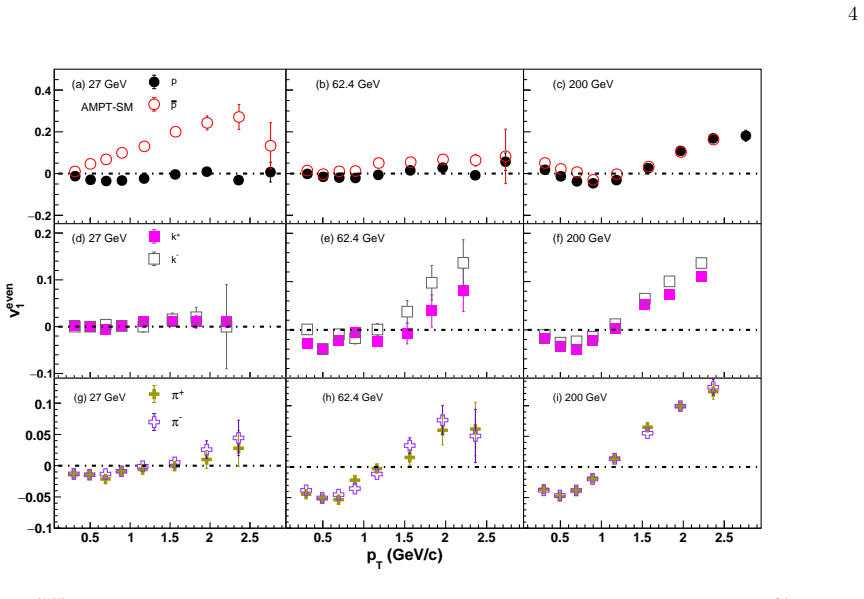
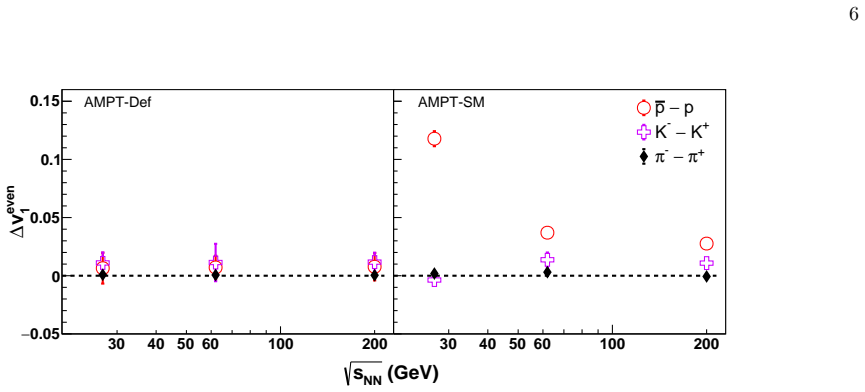
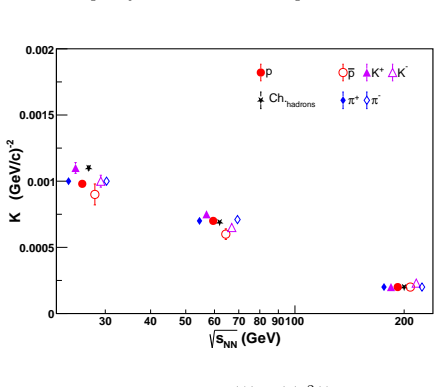
In Au+Au collisions simulated with the AMPT model, the rapidity-even dipolar flow v1^even of protons and antiprotons shows no difference at 200 GeV but develops a splitting as beam energy decreases to 27 GeV. This splitting is absent for pions and kaons and occurs only in the string-melting version of the model that incorporates partonic dynamics, not in the default hadronic version or in HIJING. The results point to v1^even as a probe sensitive to baryon stopping and early-stage partonic effects.
What carries the argument
The rapidity even dipolar flow v1^even for identified hadrons, which encodes sensitivity to baryon transport when partonic interactions and quark coalescence are active in the string-melting AMPT scenario.
If this is right
- The proton-antiproton splitting in v1^even grows as beam energy decreases from 200 to 27 GeV.
- No corresponding splitting appears for pion or kaon pairs at any energy.
- The splitting is absent in both the default AMPT configuration and in HIJING, isolating the role of partonic dynamics.
- Identified-particle v1^even measurements at RHIC Beam Energy Scan energies can serve as a probe of baryon stopping and partonic medium evolution.
Where Pith is reading between the lines
- Confirmation in data would allow this observable to test how baryon number is redistributed during the collision.
- The meson-baryon contrast could help isolate transport mechanisms tied to baryon number rather than to general collective flow.
- Similar measurements at lower energies could map changes in partonic phase duration across a wider range.
Load-bearing premise
The splitting arises specifically from partonic interactions and quark coalescence in the string-melting scenario rather than from other model artifacts or parameter choices.
What would settle it
Experimental data at 27 GeV showing identical v1^even values for protons and antiprotons, or a splitting that also appears for pions and kaons, would indicate the effect is not produced by the modeled partonic dynamics.
Figures


read the original abstract
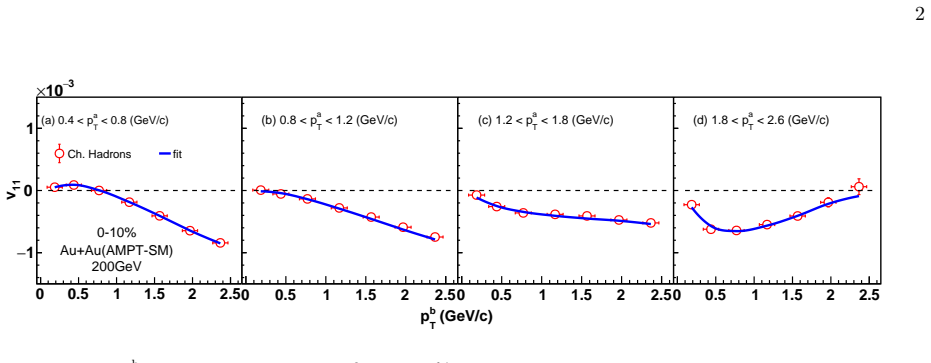
We report a transport model study of the rapidity even component of dipolar flow, $v_{1}^{\mathrm{even}}$, for identified charged hadrons at mid-rapidity in Au+Au collisions at $\sqrt{s_{NN}} = 27-200$ GeV. The analysis is performed using the AMPT model, with comparisons to HIJING to quantify non-flow contributions. The $v_{1}^{\mathrm{even}}$ of identified hadrons ($\pi$, $K$, and $p$) shows no significant difference between particles and anti-particles at $\sqrt{s_{NN}} = 200$ GeV. However, a clear splitting between proton and anti-proton $v_{1}^{\mathrm{even}}$ develops with decreasing beam energy, while no corresponding difference is observed for mesons ($\pi^{\pm}$ and $K^{\pm}$). A comparison of the AMPT string melting and default configurations shows that the splitting arises only in the string melting scenario, where partonic interactions and quark coalescence play a dominant role. These results indicate that the proton-antiproton difference in $v_{1}^{\mathrm{even}}$ is sensitive to baryon transport and early-stage partonic dynamics. Our study highlights the potential of identified-particle $v_{1}^{\mathrm{even}}$ measurements at RHIC Beam Energy Scan energies as a novel probe of baryon stopping and the evolution of the partonic medium.
Editorial analysis
A structured set of objections, weighed in public.
Referee Report
Summary. The paper reports a transport-model study of the rapidity-even dipolar flow v1^even for identified charged hadrons (π, K, p) at mid-rapidity in Au+Au collisions at √sNN = 27–200 GeV using the AMPT model (string-melting and default versions) with HIJING comparisons to assess non-flow. It finds no significant particle–antiparticle difference at 200 GeV, but a proton–antiproton splitting that grows with decreasing beam energy; the splitting appears only in the string-melting configuration and is absent for mesons. The authors conclude that the splitting is sensitive to baryon transport and early-stage partonic dynamics, positioning identified-particle v1^even as a probe of baryon stopping and partonic-medium evolution at RHIC BES energies.
Significance. If the attribution to partonic interactions survives controlled tests, the result would supply a new observable sensitive to the transition from hadronic to partonic dynamics at intermediate BES energies. The work is a pure simulation study with no machine-checked proofs or parameter-free derivations.
major comments (2)
- [Abstract / model comparison] The central attribution—that the p–pbar v1^even splitting arises specifically from partonic interactions and quark coalescence—rests on the observation that the splitting appears only in the AMPT string-melting run and not in the default run. However, these two configurations differ simultaneously in the presence/absence of a parton cascade, the hadronization mechanism (coalescence vs. Lund strings), and the resulting baryon stopping and resonance content. No auxiliary runs isolate the partonic-scattering or coalescence step while holding other elements fixed (see Abstract and the model-comparison paragraphs).
- [Abstract / Results] The abstract and reported results supply no error bars, statistical uncertainties, number of events, or explicit description of the v1^even extraction procedure (e.g., how the even component is isolated from the odd component or from non-flow). This prevents assessment of whether the reported splitting is statistically significant or robust against analysis choices.
minor comments (1)
- [Methods] The HIJING comparison is invoked to quantify non-flow, but the text does not state whether the same v1^even analysis cuts and acceptance are applied identically to HIJING and AMPT.
Simulated Author's Rebuttal
We thank the referee for the careful reading and constructive comments. We address each major comment below.
read point-by-point responses
-
Referee: [Abstract / model comparison] The central attribution—that the p–pbar v1^even splitting arises specifically from partonic interactions and quark coalescence—rests on the observation that the splitting appears only in the AMPT string-melting run and not in the default run. However, these two configurations differ simultaneously in the presence/absence of a parton cascade, the hadronization mechanism (coalescence vs. Lund strings), and the resulting baryon stopping and resonance content. No auxiliary runs isolate the partonic-scattering or coalescence step while holding other elements fixed (see Abstract and the model-comparison paragraphs).
Authors: We agree that the string-melting and default AMPT configurations differ in multiple respects, including the parton cascade, hadronization mechanism, and baryon stopping. The default version lacks any partonic stage, while string-melting incorporates both partonic scattering and quark coalescence. The fact that the proton–antiproton splitting is absent in the default mode (and for mesons) supports our conclusion that the effect is linked to early-stage partonic dynamics. We acknowledge that dedicated auxiliary runs isolating individual components would strengthen the attribution; such runs are computationally demanding and lie outside the scope of the present study. In the revised manuscript we will expand the model-comparison section to discuss these configuration differences and their possible contributions in greater detail. revision: partial
-
Referee: [Abstract / Results] The abstract and reported results supply no error bars, statistical uncertainties, number of events, or explicit description of the v1^even extraction procedure (e.g., how the even component is isolated from the odd component or from non-flow). This prevents assessment of whether the reported splitting is statistically significant or robust against analysis choices.
Authors: We agree that these details are necessary for a proper assessment. The revised manuscript will add error bars and statistical uncertainties to all figures and results, state the number of events simulated for each energy and configuration, and include an explicit description of the v1^even extraction method, including separation of the even component and the HIJING-based non-flow estimate. These additions will also be reflected in an updated abstract. revision: yes
Circularity Check
No circularity: results are direct outputs of transport model simulations
full rationale
The paper reports v1^even measurements obtained by running the AMPT (string-melting and default) and HIJING codes on Au+Au events at specified energies and extracting flow coefficients from the generated particle distributions. No equations, fitted parameters, or self-citations are invoked to derive the reported proton-antiproton splitting; the splitting is simply the numerical difference between the two model configurations. The central attribution to partonic dynamics follows from the explicit presence/absence of parton cascade and coalescence in the two AMPT variants, which is a controlled (if multi-component) model comparison rather than a definitional or fitted reduction. The study is therefore self-contained against external benchmarks and contains no load-bearing steps that reduce to their own inputs by construction.
Axiom & Free-Parameter Ledger
free parameters (1)
- AMPT tunable parameters
axioms (2)
- domain assumption The string-melting configuration of AMPT correctly captures the relevant partonic interactions and quark coalescence physics at these energies.
- domain assumption HIJING provides an adequate baseline for non-flow contributions that can be subtracted from AMPT results.
Reference graph
Works this paper leans on
-
[1]
J. Y. Ollitrault, Phys. Rev. D 46, 229 (1992)
1992
-
[2]
Huovinen, P
P. Huovinen, P. F. Kolb, U. Heinz, P. V. Ruuska- nen, and S.A. Voloshinet al., Phys. Lett. B 503, 58 (2001)
2001
-
[3]
Shen and U
C. Shen and U. Heinz, Phys. Rev. C 85, 054902 (2012)
2012
-
[4]
Snellings, New J
R. Snellings, New J. Phys. 13, 055008 (2011)
2011
-
[5]
A. M. Poskanzer,et al., Phys. Rev. C 58, 1671 (1998)
1998
-
[6]
Stoecker, Nucl
H. Stoecker, Nucl. Phys. A, 750, 121 (2005)
2005
-
[7]
Bozek and I
P. Bozek and I. Wyskiel, Phys. Rev. C 81, 054902 (2010)
2010
-
[8]
Alt,et al.(NA49 Collaboration), Phys
C. Alt,et al.(NA49 Collaboration), Phys. Rev. C 68, 034903 (2003)
2003
-
[9]
Adams,et al.(STAR Collaboration), Phys
J. Adams,et al.(STAR Collaboration), Phys. Rev. Lett. 92, 062301 (2004)
2004
-
[10]
B. B. Back,et al.(PHOBOS Collaboration), Phys. Rev. Lett. 97, 012301 (2006)
2006
-
[11]
Nara,et al., Phys
Y. Nara,et al., Phys. Rev. C, 94, 034906 (2016)
2016
-
[12]
Alver and G
B. Alver and G. Roland, Phys. Rev. C 81 (2010) 054905 (2010)
2010
-
[13]
Teaney, Derek and L
D. Teaney, Derek and L. Yan, Phys. Rev. C 83, 064904 (2011)
2011
-
[14]
Luzum, and J.-Y
M. Luzum, and J.-Y. Ollitrault, Phys. Rev. Lett. 106, 102301 (2011)
2011
-
[15]
Abelev,et al.(ALICE Collaboration), Phys
B. Abelev,et al.(ALICE Collaboration), Phys. Rev. Lett. 111, 232302 (2013)
2013
-
[16]
Adams,et al.(STAR Collaboration) Phys
J. Adams,et al.(STAR Collaboration) Phys. Lett. B 784, 26 (2018)
2018
-
[17]
Aad,et al.(ATLAS Collaboration), Phys
G. Aad,et al.(ATLAS Collaboration), Phys. Rev. C 86, 014907 (2012)
2012
-
[18]
T. Parida, S. Chatterjee, arXiv: 2606.27156 (nucl- th)
work page internal anchor Pith review Pith/arXiv arXiv
-
[19]
X. N. Wang and M. Gyulassy, Phys. Rev. D 44, 3501 (1991)
1991
-
[20]
Zi-Wei Linet al., Phys. Rev. C 72, 064901 (2005)
2005
-
[21]
Zhang, Comput
B. Zhang, Comput. Phys. Commun. 109, 193 (1998)
1998
-
[22]
B. A. Li and C. M. Ko, Phys. Rev. C 52, 2037 (1995)
2037
-
[23]
Jia,et al., J
J. Jia,et al., J. Phys. G 40, 105108 (2013)
2013
-
[24]
Borghini,et al., Phys
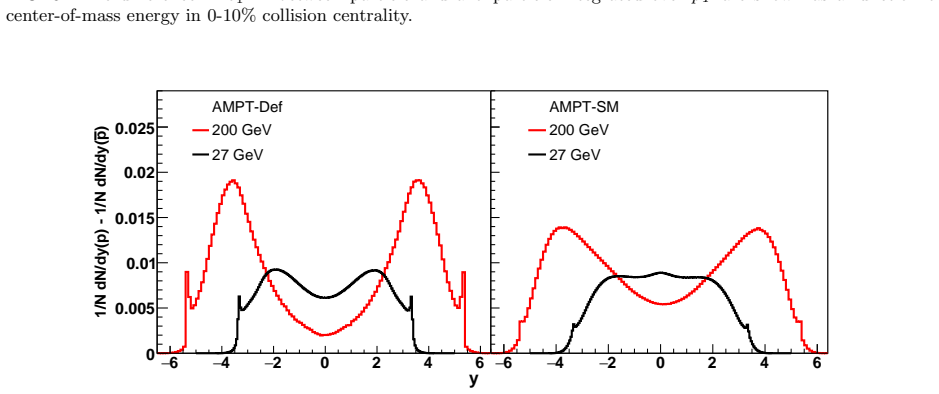
N. Borghini,et al., Phys. Rev. C 62, 034902 (2000). 6 30 40 50 60 100 200 0.05−0 0.05 0.1 0.15 1 even v Δ AMPT-Def 30 40 50 60 100 200 0.05−0 0.05 0.1 0.15 p − p+ K− - K+ π − -πAMPT-SM (GeV) NNs FIG. 5. The difference inv even 1 between particle and anti-particle integrated overp T are shown as a function of center-of-mass energy in 0-10% collision centra...
2000
discussion (0)
Sign in with ORCID, Apple, or X to comment. Anyone can read and Pith papers without signing in.