Rapidity-even directed flow splitting of protons and antiprotons as a probe of baryon stopping in relativistic heavy-ion collisions
Pith reviewed 2026-06-26 01:52 UTC · model grok-4.3
The pith
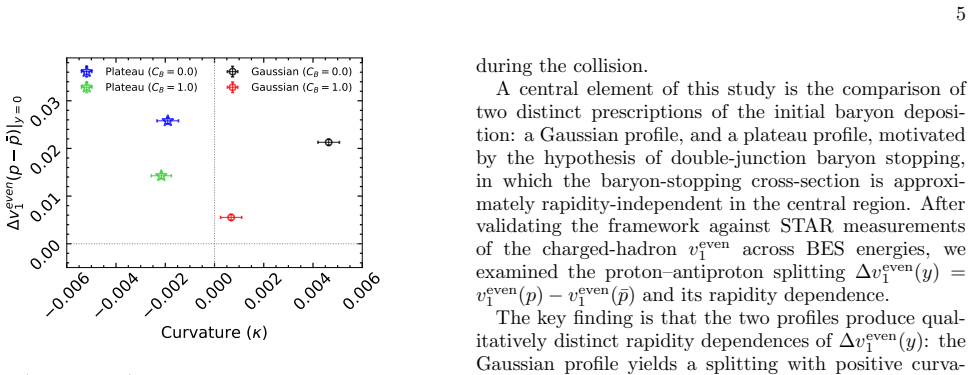
The mid-rapidity curvature of the proton-antiproton difference in even directed flow discriminates the initial baryon rapidity profile in heavy-ion collisions.
A machine-rendered reading of the paper's core claim, the machinery that carries it, and where it could break.
Core claim
Within a (3+1)-dimensional viscous relativistic hydrodynamics plus hadronic transport framework applied to Au+Au collisions at BES energies, the rapidity-even directed flow of protons and antiprotons splits in a manner that tracks the rapidity extension of the initial baryon deposition. The double-junction baryon stopping picture supplies the motivation for a rapidity-even piece of that deposition. The mid-rapidity curvature of the difference, d² Δv₁^even (p−p̄)/dy² |_{y=0}, functions as a robust discriminator among different initial-state baryon rapidity profiles. Simultaneous extraction of Δv₁^even and this curvature therefore constrains both the baryon diffusion coefficient and the stoppi
What carries the argument
The mid-rapidity curvature of the difference Δv₁^even between protons and antiprotons, which discriminates among initial baryon rapidity profiles under the double-junction stopping picture.
If this is right
- The curvature at mid-rapidity serves as a robust discriminator of initial-state baryon rapidity profiles.
- A joint measurement of the flow split and its curvature constrains both baryon diffusion strength and the stopping profile.
- This combination of observables provides direct access to the physics of baryon stopping.
Where Pith is reading between the lines
- The same curvature observable could be examined in smaller collision systems to test whether the double-junction picture remains applicable at lower participant numbers.
- If the curvature signal survives after variations in hadronic rescattering are included, it would strengthen the case that the split originates in the initial state rather than late-stage dynamics.
- Extension to other baryon species such as lambdas might reveal whether the stopping profile is flavor-dependent.
Load-bearing premise
The double-junction baryon stopping picture accurately motivates and describes a rapidity-even component in the baryon deposition in the initial state.
What would settle it
An experimental result in which the mid-rapidity curvature of Δv₁^even (p−p̄) shows no variation across different assumed initial baryon rapidity profiles would falsify the claimed discriminating power.
Figures
read the original abstract
We compare the rapidity-even directed flow $v_1^{\rm even}$ in Au+Au collisions at Beam Energy Scan (BES) energies for baryons and anti-baryons within a (3+1)-dimensional viscous relativistic hydrodynamics coupled to hadronic transport framework. The double-junction baryon stopping picture motivates a rapidity-even component in the baryon deposition in the initial state. We demonstrate that the split in the $v_1^{\rm even}$ of protons and anti-protons is sensitive to the rapidity extension of the baryon deposition that we associate with the double junction baryon stopping. Particularly, we find that the mid-rapidity curvature $\frac{d^2 \Delta v_1^{\rm even} (p-\bar{p})}{dy^2}\vert_{y=0}$ is a robust discriminator of the initial state baryon rapidity profiles. A simultaneous measurement of $\Delta v_1^{\rm even}$ and its curvature at mid-rapidity could constrain both the baryon diffusion strength and the baryon stopping profile, providing access to the physics of baryon stopping in relativistic heavy ion collisions.
Editorial analysis
A structured set of objections, weighed in public.
Referee Report
Summary. The manuscript uses (3+1)D viscous relativistic hydrodynamics coupled to hadronic transport to simulate Au+Au collisions at BES energies. Motivated by the double-junction baryon stopping picture, it reports that the split in rapidity-even directed flow v1^even between protons and antiprotons is sensitive to the rapidity extension of initial baryon deposition, with the mid-rapidity curvature d²Δv1^even(p−p̄)/dy²|_{y=0} serving as a robust discriminator of initial baryon rapidity profiles. It further suggests that simultaneous measurement of Δv1^even and its curvature can constrain both baryon diffusion strength and the stopping profile.
Significance. If the central mapping holds, the work supplies a new, potentially falsifiable observable for baryon stopping and initial-state baryon deposition at finite baryon density. The (3+1)D hydro+transport framework is a standard and appropriate tool for the energy range studied.
major comments (2)
- [Abstract] Abstract: the assertion that the curvature is a 'robust discriminator' of initial baryon rapidity profiles is load-bearing for the headline result, yet the manuscript does not demonstrate that this curvature remains insensitive to variations in the baryon diffusion coefficient (a free parameter in the hydrodynamic stage). Without explicit scans over diffusion strength showing that evolution-induced even components remain sub-dominant, the claimed one-to-one mapping to the initial deposition profile is not established.
- [Abstract] Abstract and results discussion: the paper reports sensitivity of the split to the rapidity extension of baryon deposition but provides no quantitative robustness checks (e.g., variation of hadronic rescattering parameters or comparison of initial vs. final even-component magnitudes). This leaves open whether transport after the hydrodynamic stage can source or dilute the mid-rapidity curvature at a level comparable to the initial-state difference.
minor comments (1)
- [Abstract] The notation Δv1^even(p−p̄) is introduced in the abstract without an explicit definition of the even component extraction procedure; a brief equation or reference in the methods would improve clarity.
Simulated Author's Rebuttal
We thank the referee for the careful reading and constructive comments, which help clarify the scope of our claims. We address the two major comments point by point below and indicate the revisions we will make.
read point-by-point responses
-
Referee: [Abstract] Abstract: the assertion that the curvature is a 'robust discriminator' of initial baryon rapidity profiles is load-bearing for the headline result, yet the manuscript does not demonstrate that this curvature remains insensitive to variations in the baryon diffusion coefficient (a free parameter in the hydrodynamic stage). Without explicit scans over diffusion strength showing that evolution-induced even components remain sub-dominant, the claimed one-to-one mapping to the initial deposition profile is not established.
Authors: We agree that the manuscript does not contain explicit scans over the baryon diffusion coefficient, so the insensitivity of the mid-rapidity curvature to this parameter is not quantitatively demonstrated. The claim of robustness therefore rests on the specific parameter choices used rather than a systematic exploration. In the revised manuscript we will add a dedicated subsection (or appendix) showing results for at least two additional values of the baryon diffusion coefficient, confirming that the curvature at y=0 remains dominated by the initial deposition profile while diffusion-induced even components stay sub-dominant. revision: yes
-
Referee: [Abstract] Abstract and results discussion: the paper reports sensitivity of the split to the rapidity extension of baryon deposition but provides no quantitative robustness checks (e.g., variation of hadronic rescattering parameters or comparison of initial vs. final even-component magnitudes). This leaves open whether transport after the hydrodynamic stage can source or dilute the mid-rapidity curvature at a level comparable to the initial-state difference.
Authors: We acknowledge that the current text lacks quantitative comparisons of the even-component magnitude at the end of hydrodynamics versus after hadronic transport, and does not vary hadronic rescattering parameters. Such checks are needed to close the possibility that the hadronic stage materially alters the curvature. In the revision we will include (i) a direct comparison of the even flow split evaluated at the hydrodynamic freeze-out hypersurface and after UrQMD evolution, and (ii) a brief test with modified hadronic cross sections or resonance widths to quantify any dilution or generation of the mid-rapidity curvature. revision: yes
Circularity Check
No circularity: derivation relies on external frameworks and independent observable definition
full rationale
The paper demonstrates sensitivity of the defined mid-rapidity curvature observable to initial baryon profiles within an external (3+1)D hydro + transport setup motivated by the double-junction picture. No equations reduce by construction to fitted inputs, no self-citations are load-bearing for the central claim, and the observable is defined independently of any result generated inside the paper. The chain is self-contained against external benchmarks.
Axiom & Free-Parameter Ledger
free parameters (2)
- rapidity extension of baryon deposition
- baryon diffusion strength
axioms (2)
- domain assumption Double-junction baryon stopping picture produces a rapidity-even component in initial baryon deposition
- domain assumption (3+1)D viscous relativistic hydrodynamics coupled to hadronic transport correctly evolves the system
Reference graph
Works this paper leans on
-
[1]
L. Adamczyket al.(STAR), Phys. Rev. Lett.112, 032302 (2014), arXiv:1309.5681 [nucl-ex]
Pith/arXiv arXiv 2014
-
[2]
L. Adamczyket al.(STAR), Phys. Rev. Lett.113, 092301 (2014), arXiv:1402.1558 [nucl-ex]
Pith/arXiv arXiv 2014
-
[3]
M. A. Stephanov, K. Rajagopal, and E. V. Shuryak, Phys. Rev. Lett.81, 4816 (1998), arXiv:hep-ph/9806219
Pith/arXiv arXiv 1998
-
[4]
W. Busza, K. Rajagopal, and W. van der Schee, Ann. Rev. Nucl. Part. Sci.68, 339 (2018), arXiv:1802.04801 [hep-ph]
Pith/arXiv arXiv 2018
-
[5]
B. Schenke, C. Shen, and P. Tribedy, Phys. Rev. C102, 044905 (2020), arXiv:2005.14682 [nucl-th]
arXiv 2020
-
[6]
G. S. Denicol, C. Gale, S. Jeon, A. Monnai, B. Schenke, and C. Shen, Phys. Rev. C98, 034916 (2018), arXiv:1804.10557 [nucl-th]
Pith/arXiv arXiv 2018
- [7]
- [8]
-
[9]
H. Rochet al.(JETSCAPE), Phys. Rev. C113, 024907 (2026), arXiv:2510.06996 [nucl-th]
arXiv 2026
- [10]
-
[11]
L. Adamczyket al.(STAR), Phys. Rev. Lett.112, 162301 (2014), arXiv:1401.3043 [nucl-ex]
Pith/arXiv arXiv 2014
-
[12]
T. Parida,Phenomenology of baryon dynamics with di- rected flow in relativistic heavy-ion collisions, Other the- sis (2025), arXiv:2505.06522 [nucl-th]
arXiv 2025
-
[13]
L. Du, C. Shen, S. Jeon, and C. Gale, Phys. Rev. C108, L041901 (2023), arXiv:2211.16408 [nucl-th]
arXiv 2023
- [14]
- [15]
- [16]
- [17]
-
[18]
P. Bozek and I. Wyskiel, Phys. Rev. C81, 054902 (2010), arXiv:1002.4999 [nucl-th]
Pith/arXiv arXiv 2010
-
[19]
T. Parida and S. Chatterjee, Phys. Rev. C106, 044907 (2022), arXiv:2204.02345 [nucl-th]
arXiv 2022
- [20]
- [21]
-
[22]
C. Shen and S. Alzhrani, Phys. Rev. C102, 014909 (2020), arXiv:2003.05852 [nucl-th]
arXiv 2020
-
[23]
J. D. Brandenburg, N. Lewis, P. Tribedy, and Z. Xu, (2022), arXiv:2205.05685 [hep-ph]
arXiv 2022
-
[24]
B. Schenke, S. Jeon, and C. Gale, Phys. Rev. C82, 014903 (2010), arXiv:1004.1408 [hep-ph]
Pith/arXiv arXiv 2010
-
[25]
B. Schenke, S. Jeon, and C. Gale, Phys. Rev. C85, 024901 (2012), arXiv:1109.6289 [hep-ph]
Pith/arXiv arXiv 2012
-
[26]
J.-F. Paquet, C. Shen, G. S. Denicol, M. Luzum, B. Schenke, S. Jeon, and C. Gale, Phys. Rev. C93, 044906 (2016), arXiv:1509.06738 [hep-ph]
Pith/arXiv arXiv 2016
- [27]
-
[28]
C. Shen, Z. Qiu, H. Song, J. Bernhard, S. Bass, and U. Heinz, Comput. Phys. Commun.199, 61 (2016), arXiv:1409.8164 [nucl-th]
Pith/arXiv arXiv 2016
-
[29]
Cooper and G
F. Cooper and G. Frye, Phys. Rev. D10, 186 (1974)
1974
-
[30]
S. A. Basset al., Prog. Part. Nucl. Phys.41, 255 (1998), arXiv:nucl-th/9803035
Pith/arXiv arXiv 1998
- [31]
-
[32]
J. Adamet al.(STAR), Phys. Lett. B784, 26 (2018), arXiv:1804.08647 [nucl-ex]
Pith/arXiv arXiv 2018
-
[33]
M. Luzum and J.-Y. Ollitrault, Phys. Rev. Lett.106, 102301 (2011), arXiv:1011.6361 [nucl-ex]
Pith/arXiv arXiv 2011
discussion (0)
Sign in with ORCID, Apple, or X to comment. Anyone can read and Pith papers without signing in.