Three-qubit nonlocality paradoxes: beyond GHZ
Pith reviewed 2026-07-02 11:54 UTC · model grok-4.3
The pith
All three-qubit nonlocality paradoxes provable by biconditional parity proofs have been fully classified.
A machine-rendered reading of the paper's core claim, the machinery that carries it, and where it could break.
Core claim
The authors establish a complete classification of all three-qubit nonlocality paradoxes that admit a biconditional parity proof. This class contains the GHZ paradox together with every previously published example. The classification is obtained by introducing new structural and combinatorial techniques that systematically generate and enumerate the paradoxes. The enumeration reveals a far richer landscape than earlier constructions assumed, one that violates the regularity conditions underlying all prior work.
What carries the argument
The biconditional parity proof, a logical derivation that combines biconditional statements with parity constraints to produce a contradiction between quantum correlations and any classical probabilistic model.
If this is right
- Every earlier three-qubit paradox fits inside the enumerated set.
- New paradoxes can be generated systematically from the classification rather than found by hand.
- Paradoxes exist that violate the regularity conditions used in all previous constructions.
- The richer set supplies additional resources for nonlocal games that demonstrate quantum advantage.
- The conditional structure of the paradoxes is more varied than previously catalogued.
Where Pith is reading between the lines
- The same classification techniques might be applied to four-qubit or higher systems to test whether similar richness appears.
- Paradoxes outside the biconditional parity class, if they exist, would require entirely different proof methods.
- The enumerated paradoxes could be tested directly in experiments that realize the corresponding measurement settings on three qubits.
- Connections between these paradoxes and specific nonlocal games used in complexity separations remain to be mapped.
Load-bearing premise
That every relevant three-qubit nonlocality paradox either admits a biconditional parity proof or belongs to a class whose complete enumeration inside this method describes the full landscape.
What would settle it
Explicit construction of a three-qubit nonlocality paradox whose logical obstruction cannot be expressed as any biconditional parity proof.
Figures
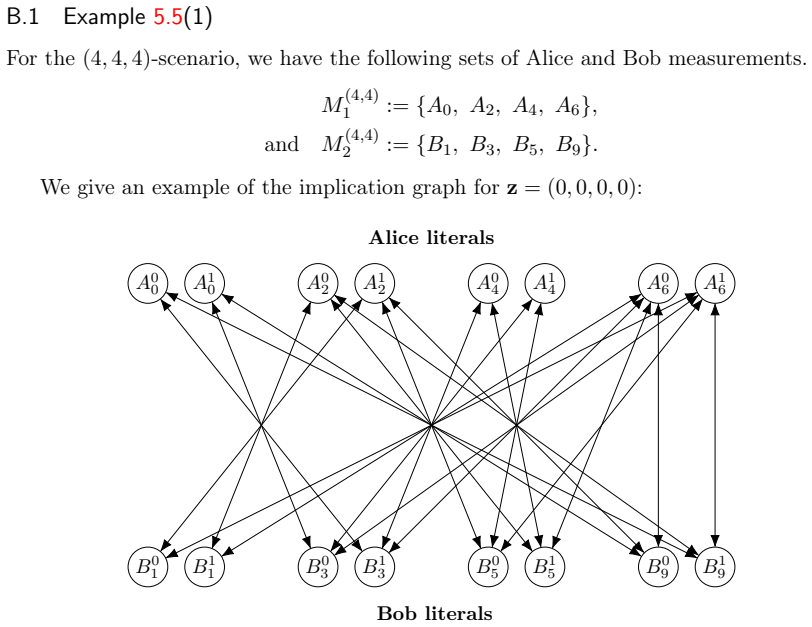
read the original abstract
Quantum nonlocality paradoxes, such as that of GHZ, provide maximally sharp logical obstructions to classical probabilistic models of quantum correlations. They are key resources in a broad variety of information-theoretic tasks that exhibit unconditional quantum advantage. For example, in nonlocal games, which are communication tasks that serve as core technical tools in recent landmark results in quantum computational complexity theory. Their role in establishing quantum advantage motivated their study by Abramsky et al. who introduced an infinite family of three-qubit paradoxes exhibiting novel conditional structure. This was later extended by de Silva et al. into a full classification program. In this work, we completely classify all three-qubit nonlocality paradoxes established via a biconditional parity proof; this is a very large class of paradoxes that encompasses all earlier-known examples. We do this by introducing a suite of new structural and combinatorial techniques. We find that the landscape of nonlocality paradoxes is far richer than previously understood, violating regularity conditions underlying all prior constructions.
Editorial analysis
A structured set of objections, weighed in public.
Referee Report
Summary. The manuscript claims a complete classification of all three-qubit nonlocality paradoxes that can be established via biconditional parity proofs. This class is asserted to be very large and to contain every earlier-known example (including GHZ and the families from Abramsky et al. and de Silva et al.). The classification is obtained by introducing new structural and combinatorial techniques that also demonstrate a richer landscape than previously understood, violating regularity conditions that underpinned all prior constructions.
Significance. If the completeness claim holds, the work would meaningfully advance the classification program for three-qubit paradoxes, supplying an exhaustive enumeration within a proof technique that is central to nonlocal games and unconditional quantum advantage. The new techniques constitute a concrete methodological contribution that could be reused or extended; explicit credit is due for the parameter-free enumeration within the stated scope and for falsifying prior regularity assumptions with concrete counter-examples.
minor comments (2)
- [Introduction] The introduction would benefit from an explicit high-level roadmap (e.g., a diagram or enumerated list) of the new structural and combinatorial techniques before they are deployed in the classification sections.
- Notation for the biconditional parity conditions should be standardized across the main text and any supplementary enumeration tables to avoid ambiguity when readers reconstruct the paradoxes.
Simulated Author's Rebuttal
We thank the referee for their positive assessment of the manuscript, accurate summary of our claims, and recommendation of minor revision. The referee correctly identifies the scope (complete classification within biconditional parity proofs), the methodological contributions, and the falsification of prior regularity assumptions. No major comments were raised in the report.
Circularity Check
Minor self-citation to prior classification; new techniques introduced
full rationale
The paper extends a classification program from de Silva et al. (overlapping authors) but explicitly introduces new structural and combinatorial techniques to enumerate all biconditional parity proofs for three-qubit paradoxes. The central claim is a complete classification within a restricted proof technique class that contains prior examples, with no equations, fitted parameters, or derivations shown to reduce by construction to inputs. The self-citation is not load-bearing for the new enumeration results.
Axiom & Free-Parameter Ledger
Reference graph
Works this paper leans on
-
[1]
Samson Abramsky and Adam Brandenburger. The sheaf-theoretic structure of non- locality and contextuality.New Journal of Physics, 13(11):113036, November 2011. ISSN 1367-2630. DOI: 10.1088/1367-2630/13/11/113036
-
[2]
Logical bell inequalities.Physical Review A, 85(6), June 2012
Samson Abramsky and Lucien Hardy. Logical bell inequalities.Physical Review A, 85(6), June 2012. ISSN 1094-1622. DOI: 10.1103/physreva.85.062114
-
[3]
Minimum quantum resources for strong non-locality
Samson Abramsky, Rui Soares Barbosa, Giovanni Carù, Nadish de Silva, Kohei Kishida, and Shane Mansfield. Minimum quantum resources for strong non-locality. In Mark M. Wilde, editor,12th Conference on the Theory of Quantum Computa- tion, Communication and Cryptography (TQC 2017), volume 73 ofLeibniz Interna- tional Proceedings in Informatics (Lipics), page...
-
[4]
Certified randomness in quantum physics.Nature, 540(7632):213–219, 2016
Antonio Acín and Lluis Masanes. Certified randomness in quantum physics.Nature, 540(7632):213–219, 2016. DOI: 10.1038/nature20119
-
[6]
Plass, and Robert Endre Tarjan
Bengt Aspvall, Michael F. Plass, and Robert Endre Tarjan. A linear-time algorithm for testing the truth of certain quantified boolean formulas. 8:121–123, 1979
1979
-
[7]
Jonathan Barrett, Adrian Kent, and Stefano Pironio. Maximally nonlocal and monog- amous quantum correlations.Physical Review Letters, 97(17), October 2006. ISSN 1079-7114. DOI: 10.1103/physrevlett.97.170409
-
[8]
John S. Bell. On the Einstein Podolsky Rosen paradox.Physics Physique Fizika, 1 (3):195–200, 1964. DOI: 10.1103/PhysicsPhysiqueFizika.1.195
-
[9]
John S. Bell. On the problem of hidden variables in quantum mechanics.Reviews of Modern Physics, 38(3):447–452, 1966. DOI: 10.1103/RevModPhys.38.447
-
[10]
Armin Biere, Marijn J. H. Heule, Hans van Maaren, and Toby Walsh.Handbook of Satisfiability, volume 336 ofFrontiers in Artificial Intelligence and Applications. IOS Press, 2 edition, 2021. ISBN 978-1-64368-160-3
2021
-
[11]
Gilles Brassard, Anne Broadbent, and Alain Tapp. Quantum pseudo-telepathy. Foundations of Physics, 35(11):1877–1907, November 2005. ISSN 1572-9516. DOI: 10.1007/s10701-005-7353-4
-
[12]
SergeyBravyi, DavidGosset, andRobertKönig. Quantumadvantagewithshallowcir- cuits.Science, 362(6412):308–311, October 2018. ISSN 1095-9203. DOI: 10.1126/sci- ence.aar3106
-
[13]
John F. Clauser, Michael A. Horne, Abner Shimony, and Richard A. Holt. Proposed experiment to test local hidden-variable theories.Physical Review Letters, 23(15): 880–884, October 1969. DOI: 10.1103/PhysRevLett.23.880
-
[14]
R. Cleve, P. Hoyer, B. Toner, and J. Watrous. Consequences and limits of nonlocal strategies. InProceedings. 19th IEEE Annual Conference on Computational Complex- ity, 2004., pages 236–249, 2004. DOI: 10.1109/CCC.2004.1313847
-
[15]
Quantum And Relativistic Protocols For Secure Multi-Party Computation
Roger Colbeck. Quantum and relativistic protocols for secure multi-party computa- tion.arXiv preprint arXiv:0911.3814, 2009
work page internal anchor Pith review Pith/arXiv arXiv 2009
-
[16]
Nadish de Silva, Santanil Jana, and Ming Yin. A classification program for nonlocality paradoxes of three qubits.Electronic Proceedings in Theoretical Computer Science, 426:197–214, August 2025. ISSN 2075-2180. DOI: 10.4204/eptcs.426.7
-
[17]
Springer, 5 edition, 2017
Reinhard Diestel.Graph Theory. Springer, 5 edition, 2017
2017
-
[18]
Elitzur, Sandu Popescu, and Daniel Rohrlich
Avshalom C. Elitzur, Sandu Popescu, and Daniel Rohrlich. Quantum nonlocality for each pair in an ensemble.Physics Letters A, 162(1):25–28, January 1992. ISSN 0375-9601. DOI: 10.1016/0375-9601(92)90952-i
-
[19]
Boost- ing device-independent cryptography with tripartite nonlocality.Quantum, 7:980, April 2023
Federico Grasselli, Gláucia Murta, Hermann Kampermann, and Dagmar Bruß. Boost- ing device-independent cryptography with tripartite nonlocality.Quantum, 7:980, April 2023. ISSN 2521-327X. DOI: 10.22331/q-2023-04-13-980
-
[20]
Daniel M. Greenberger, Michael A. Horne, and Anton Zeilinger. Going beyond bell’s theorem. InMenasKafatos, editor,Bell’s Theorem, Quantum Theory and Conceptions of the Universe, pages 69–72. Springer Netherlands, 1989. ISBN 978-94-017-0849-4. DOI: 10.1007/978-94-017-0849-4_10
-
[21]
Daniel M. Greenberger, Michael A. Horne, Abner Shimony, and Anton Zeilinger. 42 Bell’s theorem without inequalities.American Journal of Physics, 58(12):1131–1143, December 1990. ISSN 1943-2909. DOI: 10.1119/1.16243
-
[22]
MIP*=RE.Communications of the ACM, 64(11):131–138, 2021
Zhengfeng Ji, Anand Natarajan, Thomas Vidick, John Wright, and Henry Yuen. MIP*=RE.Communications of the ACM, 64(11):131–138, 2021
2021
-
[23]
Papadimitriou.Computational Complexity
Christos H. Papadimitriou.Computational Complexity. Addison–Wesley, 1994
1994
-
[24]
All the bell inequalities.Foundations of Physics, 29(4):589–614, 1999
Asher Peres. All the bell inequalities.Foundations of Physics, 29(4):589–614, 1999. DOI: 10.1023/A:1018816310000
-
[25]
Quantum nonlocality as an axiom.Foundations of Physics, 24(3):379–385, 1994
Sandu Popescu and Daniel Rohrlich. Quantum nonlocality as an axiom.Foundations of Physics, 24(3):379–385, 1994. DOI: 10.1007/BF02058098
-
[26]
Robert Raussendorf. Contextuality in measurement-based quantum computation. Physical Review A, 88(2), August 2013. ISSN 1094-1622. DOI: 10.1103/phys- reva.88.022322. A Proofs of select results A.1 Proofs of results in Section 4 A.1.1 Proof of Lemma 4.11 Proof.Letu:= tan(λ/2)andz:=e iC. We can write the Charlie tick valueTC,0≡−τ in the following compact fo...
discussion (0)
Sign in with ORCID, Apple, or X to comment. Anyone can read and Pith papers without signing in.