Plenoptic imaging of particle interactions in scintillation detectors
Pith reviewed 2026-07-02 02:42 UTC · model grok-4.3
The pith
Multifocal plenoptic system achieves millimeter 3D localization of particle interactions in scintillators under photon-limited conditions.
A machine-rendered reading of the paper's core claim, the machinery that carries it, and where it could break.
Core claim
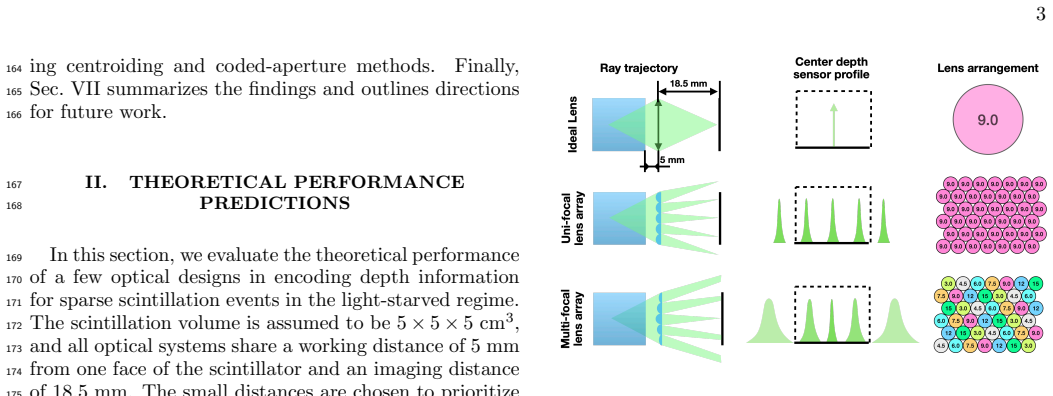
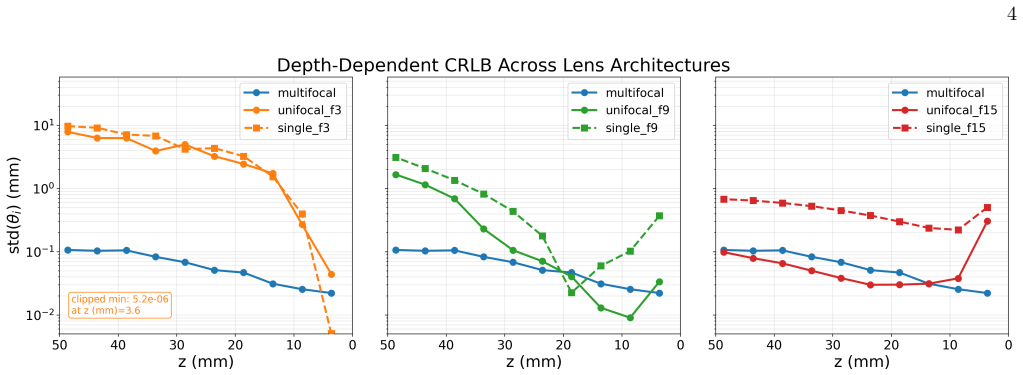
PRISM employs a multifocal microlens array with diverse focal lengths and high effective numerical aperture to encode both lateral position and depth information while collecting more photons. The design improves axial sensitivity as shown by Cramér-Rao analysis in photon-starved regimes. Using an Alternating Descent Conditional Gradient-inspired algorithm on calibrated measurements, the prototype localizes sparse single-vertex events to about 1 mm accuracy in 3D, with initial results for double-vertex events showing better performance at larger axial separations.
What carries the argument
Multifocal microlens array with varying focal lengths that provides simultaneous spatial and depth encoding in photon collection.
If this is right
- The multifocal design improves axial sensitivity over unifocal plenoptic systems under photon-limited conditions.
- The prototype achieves an average 3D localization error of approximately 1 mm for sparse single-vertex events.
- Localization accuracy for double-vertex events improves with increasing axial separation between interactions.
- Multifocal plenoptic imaging mitigates the trade-off between light collection and spatial resolution in scintillation detectors.
Where Pith is reading between the lines
- Similar multifocal designs could extend to other low-light imaging applications in particle detection.
- Further development might enable reconstruction of more complex multi-scattering events beyond the initial double-vertex evaluation.
- The method provides a foundation for photon-efficient 3D imaging that could integrate with existing detector systems.
Load-bearing premise
The optical response can be accurately calibrated and the ADCG-inspired reconstruction algorithm recovers true interaction locations from the measured photon patterns under the assumption of sparse single-vertex events.
What would settle it
Experimental comparison of axial localization precision between the multifocal prototype and a conventional unifocal plenoptic system using identical scintillator and photon statistics would confirm or refute the sensitivity improvement.
Figures
read the original abstract
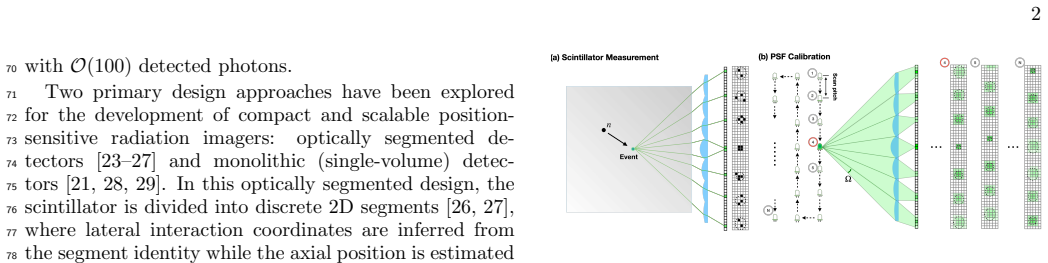
Accurate 3D localization of radiation interactions in scintillation detectors is essential for nuclear and particle physics, safeguards, and medical imaging, but remains difficult in light-starved regimes with limited photon statistics. We present PRISM, a multifocal plenoptic imaging system designed for millimeter-scale 3D position reconstruction in a single-volume scintillator. PRISM uses a multifocal microlens array with diverse focal lengths and high effective numerical aperture to balance photon collection with spatial and depth encoding. A Cram'er--Rao lower bound analysis shows that the multifocal design improves axial sensitivity over conventional unifocal plenoptic systems under photon-limited conditions. We build a prototype system, calibrate its optical response with a tunable light source, and form photon-limited measurements with $\mathcal{O}(100)$ detected photons. For sparse single-vertex events, we reconstruct interaction locations using an Alternating Descent Conditional Gradient-inspired algorithm and demonstrate an average 3D localization error of approximately 1 mm. We also provide an initial evaluation of double-vertex events, showing that localization improves as the axial separation between interactions increases. These results demonstrate that multifocal plenoptic imaging can mitigate the traditional trade-off between light collection and spatial resolution, providing a photon-efficient approach to 3D reconstruction in scintillation detectors and a foundation for future multi-scattering event reconstruction.
Editorial analysis
A structured set of objections, weighed in public.
Referee Report
Summary. The manuscript introduces PRISM, a multifocal plenoptic imaging system for 3D localization of radiation interactions in scintillation detectors. It claims that a Cramér-Rao lower bound (CRLB) analysis demonstrates improved axial sensitivity for the multifocal design relative to conventional unifocal plenoptic systems under photon-limited conditions. A prototype is constructed and calibrated with a tunable light source; photon-limited measurements with O(100) detected photons are reconstructed via an Alternating Descent Conditional Gradient-inspired algorithm, yielding an average 3D localization error of approximately 1 mm for sparse single-vertex events. Initial results for double-vertex events are also reported, indicating improved localization with greater axial separation.
Significance. If the CRLB comparison and experimental localization accuracy are substantiated, the work would offer a meaningful advance in photon-efficient 3D position reconstruction for light-starved scintillation detectors. This directly addresses a persistent challenge in nuclear/particle physics, safeguards, and medical imaging by relaxing the traditional trade-off between light collection and spatial/depth resolution. The explicit statement of modeling assumptions (sparse events, calibrated response) and the combination of theoretical bound with prototype data are strengths that would support broader adoption if the quantitative gaps are closed.
major comments (3)
- [CRLB analysis (abstract and theoretical section)] The central CRLB claim (abstract) that the multifocal design improves axial sensitivity is load-bearing, yet the manuscript provides no derivation details, optical model parameters, photon statistics assumptions, or quantitative comparison metrics between multifocal and unifocal cases. Without these, the improvement cannot be verified or reproduced.
- [Prototype, calibration, and reconstruction (experimental section)] The experimental claim of ~1 mm average 3D localization error for sparse single-vertex events (abstract) depends on the calibration procedure, ADCG-inspired algorithm convergence, and error statistics, but no quantitative information is supplied on calibration accuracy, number of tested events, error distributions, or reconstruction fidelity metrics. These omissions directly affect assessment of the prototype result.
- [Double-vertex events evaluation] The double-vertex evaluation (abstract) states that localization improves with axial separation but supplies no supporting quantitative metrics, separation values, or error trends, leaving this extension of the central claim unsubstantiated.
minor comments (1)
- [Abstract] Notation for photon count as ϴ(100) is clear but would benefit from a brief statement of the exact range or distribution observed in the prototype measurements.
Simulated Author's Rebuttal
We thank the referee for the constructive comments, which identify areas where additional detail will strengthen the manuscript. We address each major comment below and will revise the paper to supply the requested information.
read point-by-point responses
-
Referee: [CRLB analysis (abstract and theoretical section)] The central CRLB claim (abstract) that the multifocal design improves axial sensitivity is load-bearing, yet the manuscript provides no derivation details, optical model parameters, photon statistics assumptions, or quantitative comparison metrics between multifocal and unifocal cases. Without these, the improvement cannot be verified or reproduced.
Authors: We agree that the CRLB section requires expanded detail for reproducibility. The revised manuscript will include the full CRLB derivation, the specific optical model parameters (microlens focal lengths, effective NA, sensor geometry), the photon-statistics model (Poisson with mean O(100)), and tabulated quantitative CRLB values comparing axial variance for the multifocal versus unifocal cases under identical photon budgets. revision: yes
-
Referee: [Prototype, calibration, and reconstruction (experimental section)] The experimental claim of ~1 mm average 3D localization error for sparse single-vertex events (abstract) depends on the calibration procedure, ADCG-inspired algorithm convergence, and error statistics, but no quantitative information is supplied on calibration accuracy, number of tested events, error distributions, or reconstruction fidelity metrics. These omissions directly affect assessment of the prototype result.
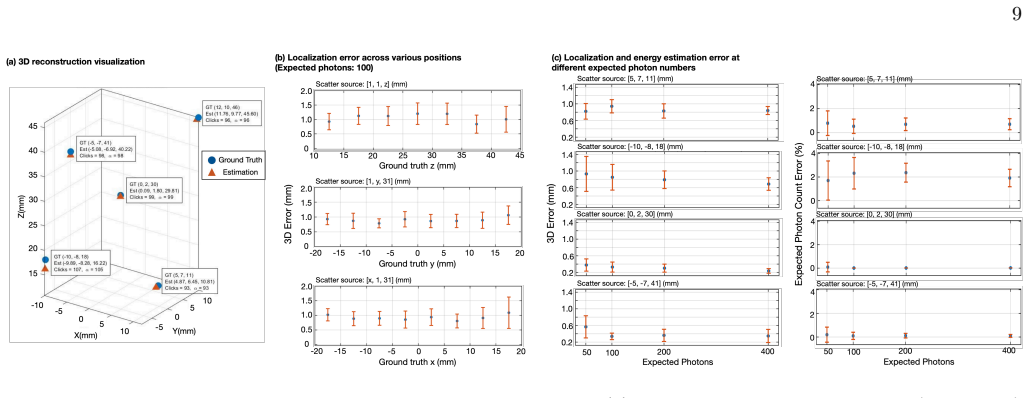
Authors: We will augment the experimental section with the missing quantitative information: measured calibration accuracy (RMS residual from the tunable-source grid), total number of single-vertex events reconstructed, full error distributions (histograms and standard deviations in x, y, z), and algorithm metrics (convergence tolerance, iteration count, and residual norm for the ADCG-inspired solver). revision: yes
-
Referee: [Double-vertex events evaluation] The double-vertex evaluation (abstract) states that localization improves with axial separation but supplies no supporting quantitative metrics, separation values, or error trends, leaving this extension of the central claim unsubstantiated.
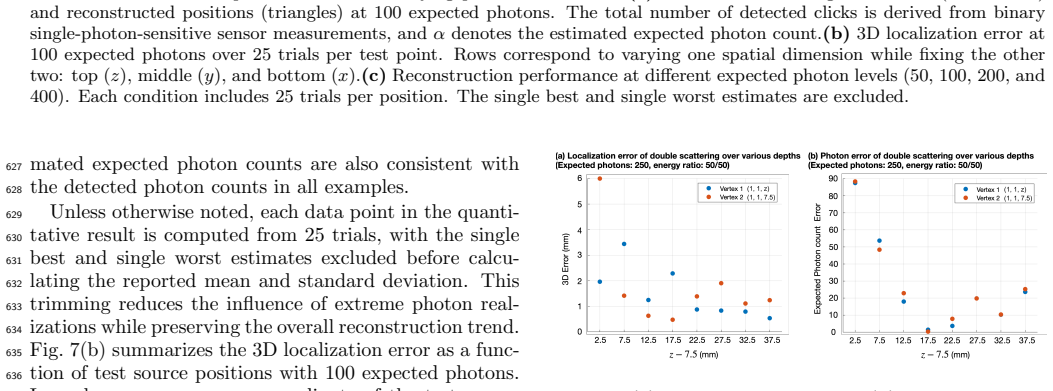
Authors: We will add a quantitative subsection on double-vertex performance, reporting the specific axial separations tested, the corresponding 3D localization errors (mean and spread), and the observed trend of improving accuracy with increasing separation. revision: yes
Circularity Check
No significant circularity detected
full rationale
The paper's derivation chain consists of a standard Cramér-Rao lower bound comparison (external statistical bound on photon-limited axial sensitivity) and direct experimental calibration plus reconstruction on measured photon patterns from a prototype. Neither reduces to a self-defined quantity, a fitted parameter renamed as prediction, nor a self-citation chain; the modeling assumptions (sparse single-vertex events, calibrated response) are stated explicitly and the results are falsifiable against independent measurements. No load-bearing step matches any enumerated circularity pattern.
Axiom & Free-Parameter Ledger
axioms (1)
- standard math The Cramér-Rao lower bound supplies a valid lower limit on the variance of unbiased estimators for interaction position parameters under the stated photon statistics.
Reference graph
Works this paper leans on
-
[1]
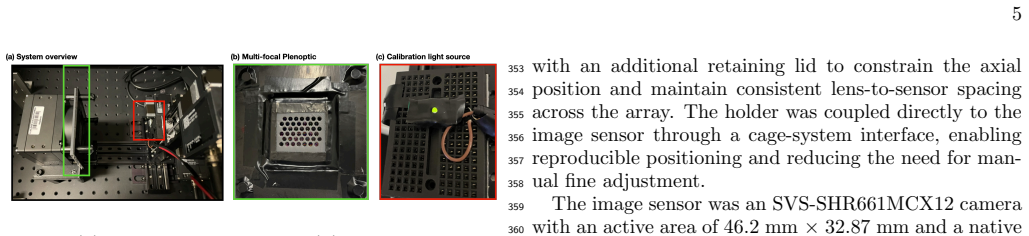
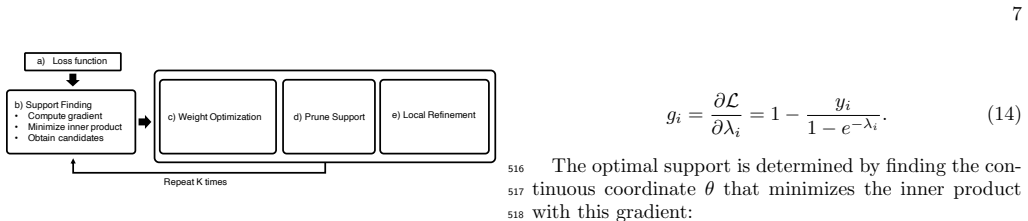
Calibration light source and control380 The calibration system uses a motorized three-axis381 translation stage (X-LSM100A-E03, Zaber Technologies)382 with a travel range of 101.6 mm along each axis, sufficient383 to cover the full scanning volume. The stage provides a384 positioning accuracy of approximately 35µm, enabling385 reproducible placement of th...
-
[2]
This prop-402 erty reduces the number of calibration measurements, al-403 lowing the PSF dictionary to be sampled on a sparse spa-404 6 tial grid
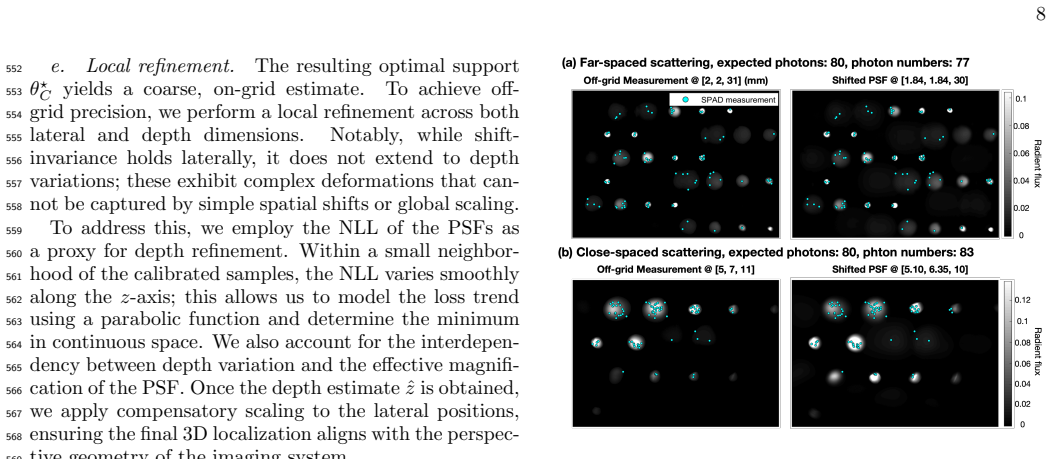
HDR PSF calibration398 The imaging system exhibits approximate local shift399 invariance, meaning that small lateral changes in source400 position produce PSFs that can be approximated as spa-401 tial translations of nearby calibrated PSFs. This prop-402 erty reduces the number of calibration measurements, al-403 lowing the PSF dictionary to be sampled on...
-
[3]
Search for neutrino oscillations on a long base-line at the CHOOZ nuclear power station
M. Apollonioet al.(CHOOZ), Eur. Phys. J.C27, 331850 (2003), arXiv:hep-ex/0301017 [hep-ex].851
work page internal anchor Pith review Pith/arXiv arXiv 2003
-
[4]
Measurement of Neutrino Oscillation with KamLAND: Evidence of Spectral Distortion
T. Arakiet al.(KamLAND), Phys. Rev. Lett.94, 081801852 (2005), arXiv:hep-ex/0406035 [hep-ex].853
work page internal anchor Pith review Pith/arXiv arXiv 2005
-
[5]
N. S. Bowdenet al., Nucl. Instrum. Meth.A572, 985854 (2007).855
2007
-
[6]
Spectroscopy of geo-neutrinos from 2056 days of Borexino data
M. Agostiniet al.(Borexino), Phys. Rev.D92, 031101856 (2015), arXiv:1506.04610 [hep-ex].857
work page internal anchor Pith review Pith/arXiv arXiv 2015
-
[7]
Abreu, Y
Y. Abreu, Y. Amhis, L. Arnold,et al., Journal of Instru-858 mentation16(02), P02025.859
-
[8]
Ashenfelteret al., Nucl
J. Ashenfelteret al., Nucl. Instrum. Meth.A922, 287860 (2019).861
2019
-
[9]
Andriamirado, A
M. Andriamirado, A. B. Balantekin, H. R. Band,et al.862 (PROSPECT Collaboration), Phys. Rev. D103, 032001863 (2021).864
2021
-
[10]
S. A. Dazeley, O. A. Akindele, M. Bergevin, A. Bernstein,865 P. C. Haugen, V. A. Li, and A. F. Papatyi, Nuclear In-866 struments and Methods in Physics Research Section A:867 Accelerators, Spectrometers, Detectors and Associated868 Equipment1082, 170915 (2026).869
2026
-
[11]
D. S. Akerib, S. Alsum, H. M. Ara´ ujo, X. Bai,et al.(LUX870 Collaboration), Phys. Rev. Lett.122, 131301 (2019).871
2019
-
[12]
D. S. Akerib, S. Alsum, H. M. Ara´ ujo, X. Bai,et al.(LUX872 Collaboration), Phys. Rev. D100, 022002 (2019).873
2019
-
[13]
Smy, inInternational Cosmic Ray Conference, Vol
M. Smy, inInternational Cosmic Ray Conference, Vol. 5874 (2008) pp. 1279–1282.875
2008
-
[14]
A. S. Wilhelm, G. Wendel, B. Collins, D. Cowen,876 and I. Jovanovic, Nuclear Instruments and Methods in877 Physics Research Section A1049, 168085 (2023).878
2023
-
[15]
Apillueloet al.(LiquidO Collaboration), Nuclear In-879 struments and Methods in Physics Research Section A880 1071, 170075 (2025).881
J. Apillueloet al.(LiquidO Collaboration), Nuclear In-879 struments and Methods in Physics Research Section A880 1071, 170075 (2025).881
2025
-
[16]
Sutanto, T
F. Sutanto, T. Classen, S. Dazeley, M. Duvall, I. Jo-882 vanovic, V. Li, A. Mabe, E. Reedy, and T. Wu, Nuclear883 Instruments and Methods in Physics Research Section A:884 Accelerators, Spectrometers, Detectors and Associated885 Equipment1006, 165409 (2021).886
2021
-
[17]
H. Gong, X. Huang, S. Fang, Z. Wang, X. Zeng, J. Zhai,887 X. Liang, H. Yuan, S. Yang, Z. Zhang, and L. Wei, Re-888 view of Scientific Instruments96, 053102 (2025).889 12
2025
-
[18]
Vetter, M
K. Vetter, M. Burks, C. Cork, M. Cunningham,890 D. Chivers, E. Hull, T. Krings, H. Manini, L. Mihailescu,891 K. Nelson, D. Protic, J. Valentine, and D. Wright, Nu-892 clear Instruments and Methods in Physics Research Sec-893 tion A: Accelerators, Spectrometers, Detectors and As-894 sociated Equipment579, 363 (2007), proceedings of the895 11th Symposium on...
2007
-
[19]
Vetter, R
K. Vetter, R. Barnowksi, A. Haefner, T. H. Joshi,898 R. Pavlovsky, and B. J. Quiter, Nuclear Instruments899 and Methods in Physics Research Section A: Acceler-900 ators, Spectrometers, Detectors and Associated Equip-901 ment878, 159 (2018), radiation Imaging Techniques and902 Applications.903
2018
-
[20]
C. G. Wahl, S. Brown, W. Kaye, K. Moran, F. Zhang,904 J. Sowers, J. M. Jaworski, Y. A. Boucher, H. Yang,905 T. Slatina, and Z. He, in2018 IEEE Nuclear Science906 Symposium and Medical Imaging Conference Proceedings907 (NSS/MIC)(2018) pp. 1–5.908
2018
-
[21]
Goodman, D
D. Goodman, D. Chichester, and Z. He, in2019 IEEE909 Nuclear Science Symposium and Medical Imaging Con-910 ference (NSS/MIC)(2019) pp. 1–3.911
2019
-
[22]
Hecla, K
J. Hecla, K. Knecht, D. Gunter, A. Haefner, D. Hellfeld,912 T. H. Y. Joshi, A. Moran, V. Negut, R. Pavlovsky, and913 K. Vetter, IEEE Transactions on Nuclear Science68,914 2539 (2021).915
2021
-
[23]
Single-Volume Neutron Scatter Camera for High-Efficiency Neutron Imaging and Spectroscopy
J. Braverman, J. Brennan, E. Brubaker, B. Cabrera-916 Palmer, S. Czyz, P. Marleau, J. Mattingly, A. Nowack,917 J. Steele, M. Sweany,et al., arXiv preprint918 arXiv:1802.05261 (2018).919
work page internal anchor Pith review Pith/arXiv arXiv 2018
-
[24]
V. A. Li, T. M. Classen, S. A. Dazeley, M. J. Duvall,920 I. Jovanovic, A. N. Mabe, E. T. Reedy, and F. Sutanto,921 Nucl. Instrum. Meth.A942, 162334 (2019).922
2019
-
[25]
T. Wu, F. Sutanto, V. Li, T. Classen, S. Dazeley,923 and I. Jovanovic, Nuclear Instruments and Methods in924 Physics Research Section A: Accelerators, Spectrome-925 ters, Detectors and Associated Equipment1057, 168699926 (2023).927
2023
-
[26]
V. Li, F. Sutanto, T. Classen, S. Dazeley, I. Jovanovic,928 and T. Wu, Nuclear Instruments and Methods in Physics929 Research Section A: Accelerators, Spectrometers, Detec-930 tors and Associated Equipment1046, 167624 (2023).931
2023
-
[27]
Weinfurther, J
K. Weinfurther, J. Mattingly, E. Brubaker, and J. Steele,932 Nuclear Instruments and Methods in Physics Research933 Section A883, 115 (2018).934
2018
-
[28]
J. J. Manfredi, E. Adamek, J. A. Brown, E. Brubaker,935 B. Cabrera-Palmer, J. Cates, R. Dorrill, A. Druetzler,936 J. Elam, P. L. Feng,et al., inHard X-Ray, Gamma-Ray,937 and Neutron Detector Physics XXII, Vol. 11494 (SPIE,938
-
[29]
Galindo-Tellez, K
A. Galindo-Tellez, K. Keefe, E. Adamek, E. Brubaker,940 B. Crow, R. Dorrill, A. Druetzler, C. Felix, N. Kaneshige,941 J. Learned,et al., Journal of Instrumentation16(04),942 P04013.943
-
[30]
Folsom,A Compact Neutron Scatter Camera Using944 Optical Coded-Aperture Imaging, Ph.D
M. Folsom,A Compact Neutron Scatter Camera Using944 Optical Coded-Aperture Imaging, Ph.D. thesis, University945 of Tennessee, Knoxville (2020).946
2020
-
[31]
Ziock and M
K. Ziock and M. Blackston, Nuclear Instruments and947 Methods in Physics Research Section A: Accelerators,948 Spectrometers, Detectors and Associated Equipment949 916, 56 (2019).950
2019
-
[32]
Harvey and A
T. Harvey and A. Enqvist, inEPJ Web of Conferences,951 Vol. 253 (EDP Sciences, 2021) p. 07008.952
2021
-
[33]
R. Ng, M. Levoy, M. Br´ edif, G. Duval, M. Horowitz, and953 P. Hanrahan,Light Field Photography with a Hand-Held954 Plenoptic Camera, Stanford Computer Science Technical955 Report CSTR 2005-02 (Stanford University, 2005).956
2005
-
[34]
Dalmasson, G
J. Dalmasson, G. Gratta, A. Jamil, S. Kravitz, M. Malek,957 K. Wells, J. Bentley, S. Steven, and J. Su, Phys. Rev. D958 97, 052006 (2018).959
2018
-
[35]
T. Dieminger, S. Alonso-Monsalve, C. Alt, C. Brus-960 chini, N. B¨ uhrer, E. Charbon, K. Kaneyasu, M. Franks,961 T. Weber, and D. Sgalaberna, An ultrafast plenoptic-962 camera system for high-resolution 3d particle tracking963 in unsegmented scintillators (2026), arXiv:2511.09442964 [physics.ins-det].965
-
[36]
Cram´ er,Mathematical methods of statistics, Vol
H. Cram´ er,Mathematical methods of statistics, Vol. 9966 (Princeton university press, 1999).967
1999
-
[37]
M. K. Stevenet al., PTR Prentice-Hall, Englewood Cliffs,968 NJ10, 148 (1993).969
1993
-
[38]
J. Chao, E. S. Ward, and R. J. Ober, Journal of the970 Optical Society of America A33, B36 (2016).971
2016
-
[39]
C. Wang, N. Chen, and W. Heidrich, IEEE Transactions972 on Computational Imaging8, 905 (2022).973
2022
-
[40]
C.-J. Ho, Y. Belhe, S. Rotenberg, R. Ramamoorthi, T.-974 M. Li, and N. Antipa, inProceedings of the IEEE/CVF975 International Conference on Computer Vision(2025) pp.976 28042–28051.977
2025
-
[41]
Paszke, S
A. Paszke, S. Gross, F. Massa, A. Lerer, J. Bradbury,978 G. Chanan, T. Killeen, Z. Lin, N. Gimelshein, L. Antiga,979 et al., Advances in neural information processing systems980 32(2019).981
2019
-
[42]
X. Dai, K. Yanny, K. Monakhova, and N. Antipa, ACM982 Transactions on Graphics44, 1 (2025).983
2025
-
[43]
N. Boyd, G. Schiebinger, and B. Recht, SIAM Journal984 on Optimization27, 616 (2017).985
2017
-
[44]
Nocedal and S
J. Nocedal and S. J. Wright,Numerical optimization986 (Springer, 2006).987
2006
-
[45]
See supplemental material.988
-
[46]
Llopart, J
X. Llopart, J. Alozy, R. Ballabriga, M. Campbell,989 R. Casanova, V. Gromov, E. Heijne, T. Poikela,990 E. Santin, V. Sriskaran, L. Tlustos, and A. Vitkovskiy,991 Journal of Instrumentation17(01), C01044.992
-
[47]
Pozzi, R
S. Pozzi, R. Lopez, P. Marleau, and S. Clarke, Nuclear993 Instruments and Methods in Physics Research Section A:994 Accelerators, Spectrometers, Detectors and Associated995 Equipment1064, 169307 (2024).996
2024
-
[48]
W. M. Steinberger, M. L. Ruch, N. Giha, A. DiFulvio,997 P. Marleau, S. D. Clarke, and S. A. Pozzi, Scientific Re-998 ports10, 1855 (2020).999
2020
-
[49]
Kneale, M
L. Kneale, M. Smy, and M. Malek, Nuclear Instruments1000 and Methods in Physics Research Section A: Acceler-1001 ators, Spectrometers, Detectors and Associated Equip-1002 ment1053, 168375 (2023).1003
2023
-
[50]
Akindele, A
O. Akindele, A. Bernstein, M. Bergevin, S. Dazeley,1004 F. Sutanto, A. Mullen, and J. Hecla, Phys. Rev. Appl.1005 19, 034060 (2023).1006
2023
-
[51]
Limits on Neutrino Oscillations from the CHOOZ Experiment
M. Apollonioet al.(CHOOZ), Phys. Lett.B466, 4151007 (1999), arXiv:hep-ex/9907037 [hep-ex].1008
work page internal anchor Pith review Pith/arXiv arXiv 1999
-
[52]
M. Apollonioet al.(CHOOZ), Phys. Rev.D61, 0120011009 (2000), arXiv:hep-ex/9906011 [hep-ex].1010
work page internal anchor Pith review Pith/arXiv arXiv 2000
-
[53]
Phys.4, 273 (2021).1011
Commun. Phys.4, 273 (2021).1011
2021
-
[54]
Ashenfelteret al.(PROSPECT), Phys
J. Ashenfelteret al.(PROSPECT), Phys. Rev. Lett.121,1012 251802 (2018).1013
2018
-
[55]
Abreuet al.(SoLid), JINST12, P04024.1014
Y. Abreuet al.(SoLid), JINST12, P04024.1014
-
[56]
Abreuet al.(SoLid), JINST13(05), P05005.1015 13
Y. Abreuet al.(SoLid), JINST13(05), P05005.1015 13
-
[57]
First Results from KamLAND: Evidence for Reactor Anti-Neutrino Disappearance
K. Eguchiet al.(KamLAND), Phys. Rev. Lett.90,1016 021802 (2003), arXiv:hep-ex/0212021 [hep-ex].1017
work page internal anchor Pith review Pith/arXiv arXiv 2003
- [58]
-
[59]
R. Ng, M. Levoy, M. Br´ edif, G. Duval, M. Horowitz,1021 and P. Hanrahan,Light field photography with a hand-1022 held plenoptic camera, Ph.D. thesis, Stanford university1023 (2005).1024
2005
-
[60]
Lumsdaine and T
A. Lumsdaine and T. Georgiev, inProceedings of the1025 IEEE International Conference on Computational Pho-1026 tography (ICCP)(IEEE, 2009) pp. 1–8.1027
2009
-
[61]
Perwass and L
C. Perwass and L. Wietzke, inHuman vision and elec-1028 tronic imaging XVII, Vol. 8291 (SPIE, 2012) pp. 45–59.1029
2012
-
[62]
Georgiev and A
T. Georgiev and A. Lumsdaine, Journal of Electronic1030 Imaging19, 021106 (2010).1031
2010
-
[63]
Bocchieri, E
A. Bocchieri, E. Charbon, and A. Velten, Communica-1032 tions Engineering3, 135 (2024).1033 Supplemental Material for Plenoptic imaging of particle interactions in scintillation detectors I. ADDITIONAL RECONSTRUCTION RESUL TS Fig. S1 provides a detailed decomposition of the 3D localization error presented in the main text. Specifically, we report the reco...
2024
discussion (0)
Sign in with ORCID, Apple, or X to comment. Anyone can read and Pith papers without signing in.