Observation of Flat Bands in Type-II Weyl Semimetal TaRhTe₄
Pith reviewed 2026-07-02 09:15 UTC · model grok-4.3
The pith
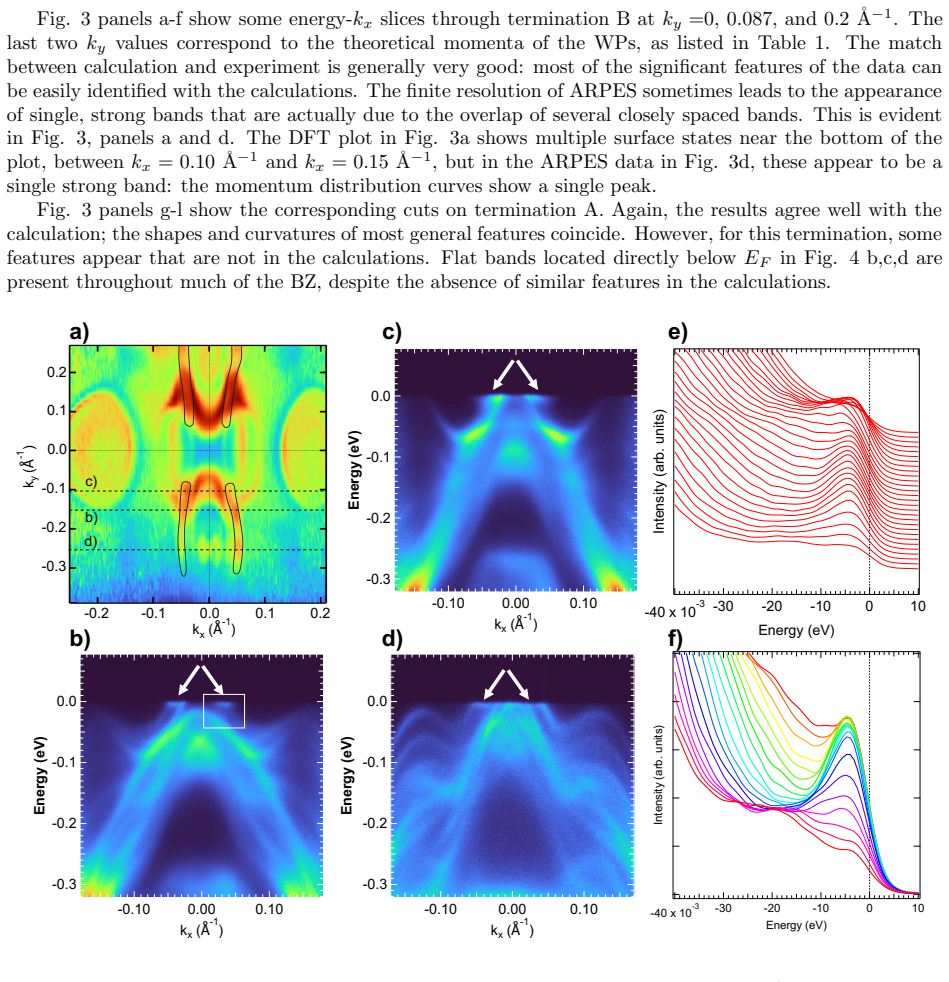
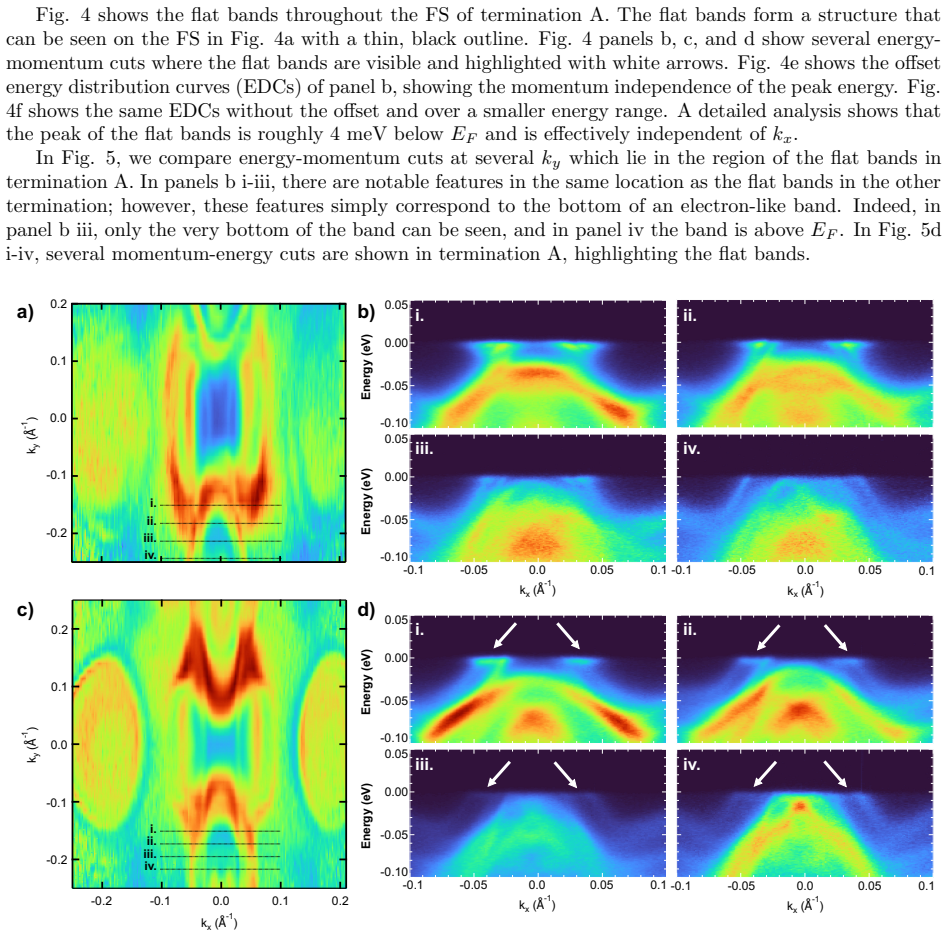
Flat bands near the chemical potential are observed in bulk TaRhTe4, a type-II Weyl semimetal.
A machine-rendered reading of the paper's core claim, the machinery that carries it, and where it could break.
Core claim
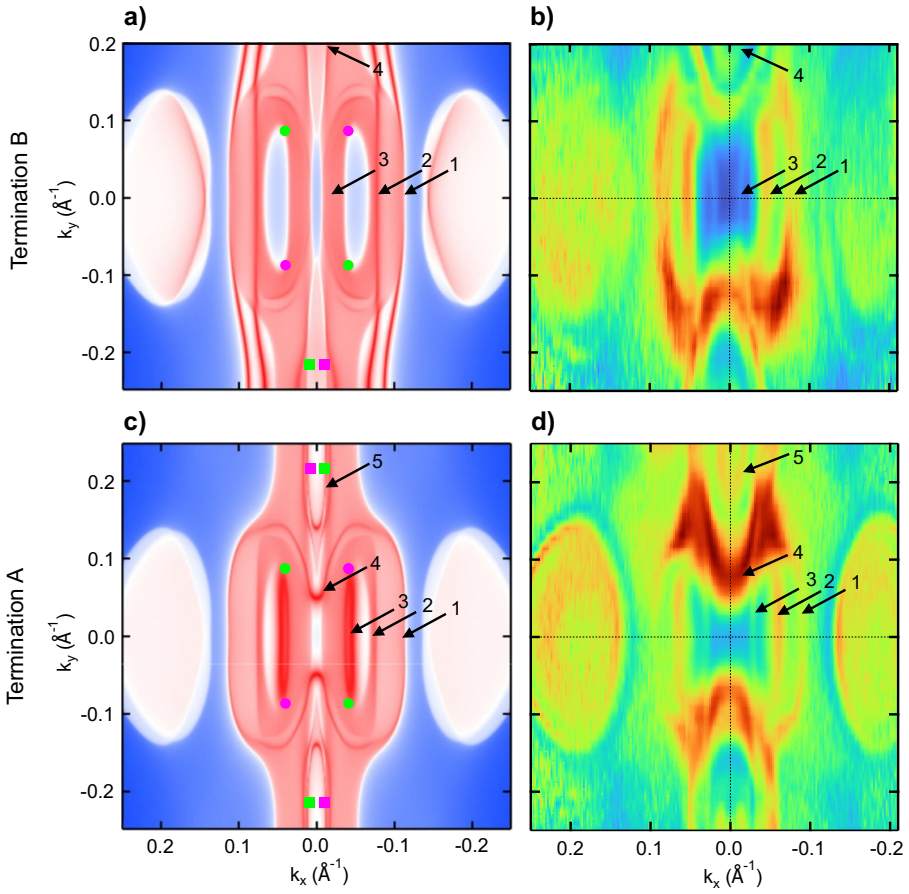
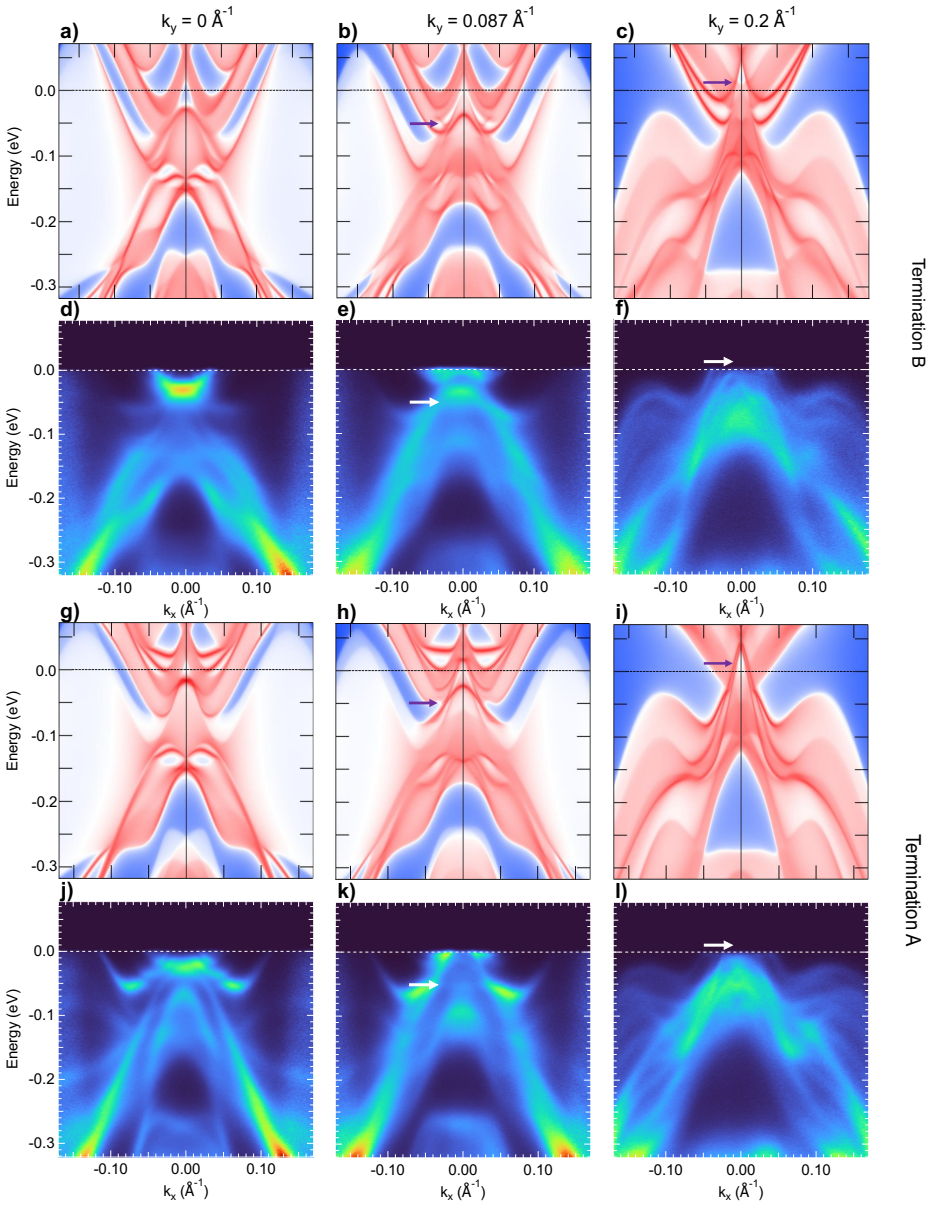
The authors claim that ARPES measurements on TaRhTe4 reveal flat bands near the chemical potential. These bands, not predicted by DFT, indicate that nontrivial topology can coexist with flat bands near the Fermi level in this bulk noncentrosymmetric van-der Waals type-II Weyl semimetal.
What carries the argument
Angle-resolved photoemission spectroscopy revealing flat bands near the chemical potential in TaRhTe4.
Load-bearing premise
The ARPES spectra capture the bulk flat bands without significant surface reconstruction or artifacts mimicking flat dispersion.
What would settle it
If ARPES or other measurements show that the bands are actually dispersive or the flatness is due to matrix element effects, the observation would be invalidated.
Figures
read the original abstract
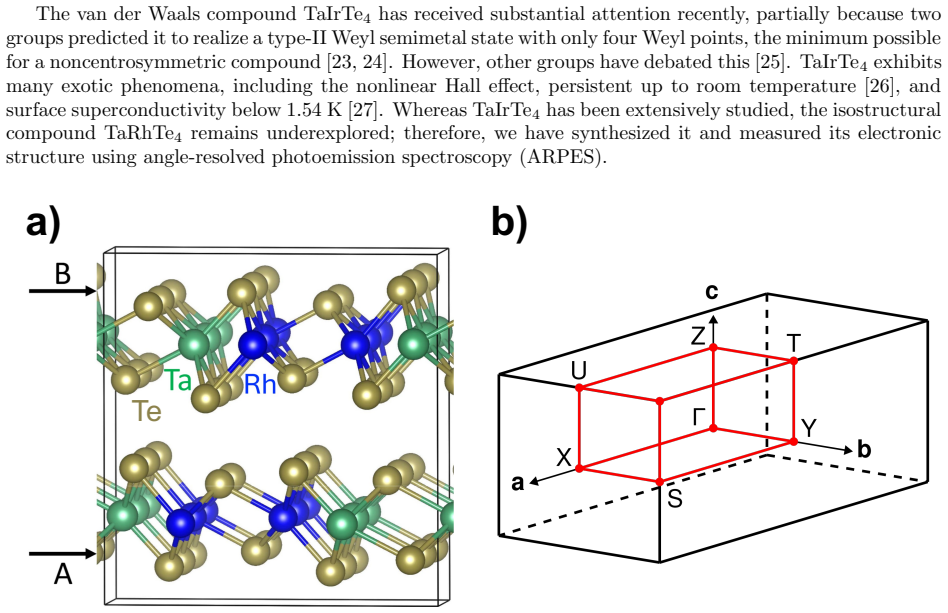
Flat bands have been theoretically predicted for decades but have only recently been realized in quantum materials such as magic-angle twisted bilayer graphene, kagome and Lieb lattices, and rare-earth metal compounds. To date, only twisted layered materials have enabled tuning of flat-band energies near the electronic chemical potential, thereby influencing transport and thermodynamic properties. Here, we report the presence of flat bands near the chemical potential in bulk TaRhTe$_{4}$, a noncentrosymmetric van-der Waals type-II Weyl semimetal. Flat bands are rarely observed in Weyl semimetals, particularly in nonmagnetic bulk systems, and the observed flat bands were not predicted by density functional theory calculations. TaRhTe$_{4}$ therefore provides a platform in which nontrivial topology coexists with flat bands near the Fermi level, as evidenced by our angle-resolved photoemission spectroscopy measurements.
Editorial analysis
A structured set of objections, weighed in public.
Referee Report
Summary. The manuscript reports the observation via ARPES of flat bands near the chemical potential in bulk TaRhTe4, a noncentrosymmetric van der Waals type-II Weyl semimetal. These bands were not predicted by DFT and are presented as evidence that nontrivial topology can coexist with flat bands near EF in a nonmagnetic bulk system.
Significance. If the bulk assignment and flatness quantification hold, the result would be significant: flat bands near EF are rare in Weyl semimetals, and their presence in a vdW type-II system could open routes to studying topology-flat-band interplay in transport and thermodynamics without requiring twisted-layer engineering.
major comments (2)
- [Abstract] Abstract: The claim that the flat bands are bulk states is load-bearing for the central result, yet the text supplies no photon-energy-dependent data, kz mapping, or multiple-Brillouin-zone checks to exclude surface termination states or matrix-element suppression that can produce apparent flat dispersion in vdW materials.
- [Abstract] Abstract: No quantitative metric, fitting procedure, or resolution limit is given for establishing band flatness (e.g., dispersion slope < threshold or R^{2} of linear fit), so the strength of the 'flat band' assignment relative to possible artifacts cannot be evaluated.
Simulated Author's Rebuttal
We thank the referee for their detailed and constructive report. The two major comments highlight important points regarding the assignment of the observed bands as bulk states and the quantitative characterization of their flatness. We address each below and will revise the manuscript to incorporate additional data and analysis where needed.
read point-by-point responses
-
Referee: [Abstract] Abstract: The claim that the flat bands are bulk states is load-bearing for the central result, yet the text supplies no photon-energy-dependent data, kz mapping, or multiple-Brillouin-zone checks to exclude surface termination states or matrix-element suppression that can produce apparent flat dispersion in vdW materials.
Authors: We agree that explicit confirmation of the three-dimensional bulk character is essential for the central claim. The current manuscript relies on the use of bulk single crystals and consistency with the overall band structure, but does not present photon-energy-dependent ARPES or kz dispersion maps. In the revised version we will add photon-energy scans across multiple Brillouin zones, extract kz dispersion, and discuss possible surface contributions and matrix-element effects to strengthen the bulk assignment. revision: yes
-
Referee: [Abstract] Abstract: No quantitative metric, fitting procedure, or resolution limit is given for establishing band flatness (e.g., dispersion slope < threshold or R^{2} of linear fit), so the strength of the 'flat band' assignment relative to possible artifacts cannot be evaluated.
Authors: We acknowledge that a quantitative definition of flatness was not provided. In the revised manuscript we will include a clear metric: linear fits to the observed dispersions near EF, the extracted slope (in eV Å), the experimental momentum and energy resolution, and the resulting bandwidth upper bound. This will allow direct evaluation of the flat-band character relative to resolution limits. revision: yes
Circularity Check
Purely observational report with no derivation or self-referential steps
full rationale
The manuscript is an experimental observation paper whose central claim is the direct reporting of flat bands near E_F in TaRhTe4 via ARPES measurements. No equations, parameter fitting, predictions, or theoretical derivations are present in the provided text. The result is not obtained by reducing any quantity to a fitted input or self-citation; it is presented as raw spectroscopic evidence. No load-bearing self-citations, uniqueness theorems, or ansatzes appear. The derivation chain is empty by construction, making the circularity score 0.
Axiom & Free-Parameter Ledger
axioms (1)
- domain assumption ARPES spectra reflect the intrinsic bulk electronic band structure in van der Waals materials
Reference graph
Works this paper leans on
-
[1]
Localization of electronic wave functions due to local topology
Sutherland, B. Localization of electronic wave functions due to local topology. In:Phys. Rev. B34 (8 Oct. 1986), pp. 5208–5211.doi:10.1103/PhysRevB.34.5208
-
[2]
Wu, C. et al. Flat Bands and Wigner Crystallization in the Honeycomb Optical Lattice. In:Phys. Rev. Lett.99 (7 Aug. 2007), p. 070401.doi:10.1103/PhysRevLett.99.070401
-
[3]
Su´ arez Morell, E. et al. Flat bands in slightly twisted bilayer graphene: Tight-binding calculations. In: Phys. Rev. B82 (12 Sept. 2010), p. 121407.doi:10.1103/PhysRevB.82.121407
-
[4]
Cao, Y. et al. Correlated insulator behaviour at half-filling in magic-angle graphene superlattices. In: Nat.556.7699 (Mar. 2018), pp. 80–84.doi:10.1038/nature26154
-
[5]
Cao, Y. et al. Unconventional superconductivity in magic-angle graphene superlattices. In:Nat.556.7699 (Mar. 2018), pp. 43–50.doi:10.1038/nature26160
work page internal anchor Pith review doi:10.1038/nature26160 2018
-
[6]
Lisi, S. et al. Observation of flat bands in twisted bilayer graphene. In:Nat. Phys.17.2 (Sept. 2020), pp. 189–193.doi:10.1038/s41567-020-01041-x
-
[7]
Bistritzer, R. and MacDonald, A. H. Moir´ e bands in twisted double-layer graphene. In:Proceedings of the National Academy of Sciences108.30 (2011), pp. 12233–12237.doi:10.1073/pnas.1108174108
-
[8]
Ochi, M. et al. Robust flat bands inRCo 5 (R= rare earth) compounds. In:Phys. Rev. B91 (16 Apr. 2015), p. 165137.doi:10.1103/PhysRevB.91.165137
-
[9]
Nytko, E. A. et al. A Structurally Perfect S = 1/2 Metal-Organic Hybrid Kagom´ e Antiferromagnet. In:Journal of the American Chemical Society130.10 (2008). PMID: 18275194, pp. 2922–2923.doi: 10.1021/ja709991u
-
[10]
Kang, M. et al. Topological flat bands in frustrated Kagome lattice CoSn. In:Nature Communications 11.1 (Aug. 2020).doi:10.1038/s41467-020-17465-1
-
[11]
Yang, J. et al. Observation of flat band, Dirac nodal lines and topological surface states in Kagome Superconductor CSTI3BI5. In:Nature Communications14.1 (July 2023).doi:10.1038/s41467-023- 39620-0
-
[12]
Ramankutty, S. et al. Comparative study of rare earth hexaborides using high resolution angle-resolved photoemission. In:Journal of Electron Spectroscopy and Related Phenomena208 (2016). Special Issue: Electronic structure and function from state-of-the-art spectroscopy and theory, pp. 43–50.issn: 0368- 2048.doi:https://doi.org/10.1016/j.elspec.2015.11.00...
work page doi:10.1016/j.elspec.2015.11.009.url:https://www.sciencedirect 2016
-
[13]
Yano, M. et al. Electronic structure of CeRu 2X2 (X= Si,Ge) in the paramagnetic phase studied by soft x-ray ARPES and hard x-ray photoelectron spectroscopy. In:Phys. Rev. B77 (3 Jan. 2008), p. 035118.doi:10 . 1103 / PhysRevB . 77 . 035118.url:https : / / link . aps . org / doi / 10 . 1103 / PhysRevB.77.035118
2008
-
[14]
Danzenb¨ acher, S. et al. Hybridization Phenomena in Nearly-Half-Filledf-Shell Electron Systems: Photoemission Study of EuNi 2P2. In:Phys. Rev. Lett.102 (2 Jan. 2009), p. 026403.doi:10.1103/ PhysRevLett.102.026403.url:https://link.aps.org/doi/10.1103/PhysRevLett.102.026403
-
[15]
Si, Q. and Steglich, F. Heavy Fermions and Quantum Phase Transitions. In:Science329.5996 (2010), pp. 1161–1166.doi:10.1126/science.1191195
-
[16]
Tsui, D. C., Stormer, H. L., and Gossard, A. C. Two-Dimensional Magnetotransport in the Extreme Quantum Limit. In:Phys. Rev. Lett.48 (22 May 1982), pp. 1559–1562.doi:10.1103/PhysRevLett. 48.1559
-
[17]
Hasan, M. Z. and Kane, C. L. Colloquium: Topological insulators. In:Rev. Mod. Phys.82 (4 Nov. 2010), pp. 3045–3067.doi:10.1103/RevModPhys.82.3045.url:https://link.aps.org/doi/10. 1103/RevModPhys.82.3045
work page doi:10.1103/revmodphys.82.3045.url:https://link.aps.org/doi/10 2010
-
[18]
Colloquium: Topological band theory
Bansil, A., Lin, H., and Das, T. Colloquium: Topological band theory. In:Rev. Mod. Phys.88 (2 June 2016), p. 021004.doi:10.1103/RevModPhys.88.021004. 10
-
[19]
Dirac, P. A. M. The quantum theory of the electron. In:Proc. R. Soc. Lond., Ser. A117.778 (Feb. 1928), pp. 610–624.issn: 0950-1207.doi:10.1098/rspa.1928.0023
-
[20]
Elektron und gravitation
Weyl, H. Elektron und gravitation. I. In:Z. Phys.56.5–6 (May 1929), pp. 330–352.doi:10.1007/ bf01339504
1929
-
[21]
Soluyanov, A. A. et al. Type-II Weyl semimetals. In:Nat.527.7579 (Nov. 2015), pp. 495–498.doi: 10.1038/nature15768
-
[22]
Xu, Y. et al. Electronic correlations and flattened band in magnetic Weyl semimetal candidate Co3So2S2. In:Nat. Commun.11.1 (Aug. 2020).doi:10.1038/s41467-020-17234-0
-
[23]
Haubold, E. et al. Experimental realization of type-II Weyl state in noncentrosymmetric TaIrTe 4. In: Phys. Rev. B95 (24 June 2017), p. 241108.doi:10.1103/PhysRevB.95.241108
-
[24]
Belopolski, I. et al. Signatures of a time-reversal symmetric Weyl semimetal with only four Weyl points. In:Nat. Commun.8 (1 Oct. 2017).doi:10.1038/s41467-017-00938-1
-
[25]
Zhou, X. et al. Coexistence of tunable Weyl points and topological nodal lines in ternary transition- metal telluride TaIrTe4. In:Phys. Rev. B97.24 (June 2018).doi:10.1103/physrevb.97.241102
-
[26]
Kumar, D. et al. Room-temperature nonlinear Hall effect and wireless radiofrequency rectification in Weyl semimetal TaIrTe4. In:Nat. Nanotechnol.16.4 (Jan. 2021), pp. 421–425.doi:10.1038/s41565- 020-00839-3
-
[27]
Xing, Y. et al. Surface superconductivity in the type II Weyl semimetal TaIrTe 4. In:Natl. Sci. Rev. 7.3 (Dec. 2019), pp. 579–587.issn: 2095-5138.doi:10.1093/nsr/nwz204
-
[28]
Zhang, X. et al. Layer dependent topological phases and transitions in TaRhTe 4: From monolayer and bilayer to bulk. In:Phys. Rev. Mater.8 (9 Sept. 2024), p. 094201.doi:10.1103/PhysRevMaterials. 8.094201
-
[29]
Liu, J. et al. van der Waals Stacking-Induced Topological Phase Transition in Layered Ternary Transi- tion Metal Chalcogenides. In:Nano Lett.17.1 (Dec. 2016), pp. 467–475.doi:10.1021/acs.nanolett. 6b04487
-
[30]
Shipunov, G. et al. Layered van der Waals Topological Metals of TaTMTe 4 (TM = Ir, Rh, Ru) Family. In:J. Phys. Chem. Lett.12.28 (2021). PMID: 34264086, pp. 6730–6735.doi:10.1021/acs.jpclett. 1c01648
-
[31]
Behnami, M. et al. Signature of chiral anomaly in the Weyl semimetal TaRhTe 4. In:Phys. Rev. B112 (4 July 2025), p. 045101.doi:10.1103/n7lw-7xqj
-
[32]
Sadhukhan, B. and Nag, T. The orbital-driven topological phase transition and planar Hall responses in ternary tellurides Weyl semi-metals. In: (2025). arXiv:2509.19818 [cond-mat.mtrl-sci]
work page internal anchor Pith review Pith/arXiv arXiv 2025
-
[33]
Mar, A., Jobic, S., and Ibers, J. A. Metal-metal vs tellurium-tellurium bonding in WTe2 and its ternary variants TaIrTe4 and NbIrTe4. In:J. Am. Chem. Soc.114.23 (1992), pp. 8963–8971.doi: 10.1021/ja00049a029
-
[34]
Koepernik, K. et al. TaIrTe 4: A ternary type-II Weyl semimetal. In:Phys. Rev. B93 (20 May 2016), p. 201101.doi:10.1103/PhysRevB.93.201101
-
[35]
Canfield, P. C. New materials physics. In:Reports on Progress in Physics83.1 (Nov. 2019), p. 016501. doi:10.1088/1361-6633/ab514b.url:https://doi.org/10.1088/1361-6633/ab514b
work page doi:10.1088/1361-6633/ab514b.url:https://doi.org/10.1088/1361-6633/ab514b 2019
-
[36]
Canfield, P. C. et al. Use of frit-disc crucibles for routine and exploratory solution growth of single crystalline samples. In:Philos. Mag.96.1 (2016), pp. 84–92.doi:10.1080/14786435.2015.1122248
-
[37]
Canfield Crucible Sets
LSP Ceramics. Canfield Crucible Sets. Accessed September 2025.url:https://www.lspceramics. com/
2025
-
[38]
Hohenberg, P. and Kohn, W. Inhomogeneous Electron Gas. In:Phys. Rev.136 (3B Nov. 1964), B864– B871.doi:10.1103/PhysRev.136.B864
-
[39]
Kohn, W. and Sham, L. J. Self-Consistent Equations Including Exchange and Correlation Effects. In: Phys. Rev.140 (4A Nov. 1965), A1133–A1138.doi:10.1103/PhysRev.140.A1133. 11
-
[40]
Perdew, J. P., Burke, K., and Ernzerhof, M. Generalized Gradient Approximation Made Simple. In: Phys. Rev. Lett.77 (18 Oct. 1996), pp. 3865–3868.doi:10.1103/PhysRevLett.77.3865
-
[41]
Becke, A. D. and Johnson, E. R. A simple effective potential for exchange. In:J. Chem. Phys.124.22 (June 2006), p. 221101.issn: 0021-9606.doi:10.1063/1.2213970
-
[42]
Bl¨ ochl, P. E. Projector augmented-wave method. In:Phys. Rev. B50 (24 Dec. 1994), pp. 17953–17979. doi:10.1103/PhysRevB.50.17953
-
[43]
Kresse, G. and Furthm¨ uller, J. Efficient iterative schemes forab initiototal-energy calculations using a plane-wave basis set. In:Phys. Rev. B54 (16 Oct. 1996), pp. 11169–11186.doi:10.1103/PhysRevB. 54.11169
-
[44]
Kresse, G. and Furthm¨ uller, J. Efficiency of ab-initio total energy calculations for metals and semicon- ductors using a plane-wave basis set. In:Comput. Mater. Sci.6.1 (1996), pp. 15–50.issn: 0927-0256. doi:https://doi.org/10.1016/0927-0256(96)00008-0
-
[45]
Monkhorst, H. J. and Pack, J. D. Special points for Brillouin-zone integrations. In:Phys. Rev. B13 (12 June 1976), pp. 5188–5192.doi:10.1103/PhysRevB.13.5188
-
[46]
Marzari, N. and Vanderbilt, D. Maximally localized generalized Wannier functions for composite energy bands. In:Phys. Rev. B56 (20 Nov. 1997), pp. 12847–12865.doi:10.1103/PhysRevB.56.12847
-
[47]
Maximally localized Wannier functions for entangled energy bands
Souza, I., Marzari, N., and Vanderbilt, D. Maximally localized Wannier functions for entangled energy bands. In:Phys. Rev. B65 (3 Dec. 2001), p. 035109.doi:10.1103/PhysRevB.65.035109
-
[48]
Lopez Sancho, M. P., Lopez Sancho, J. M., and Rubio, J. Quick iterative scheme for the calculation of transfer matrices: application to Mo (100). In:J. Phys. F: Met. Phys.14.5 (1984), pp. 1205–1215. issn: 0305-4608.doi:10.1088/0305-4608/14/5/016
-
[49]
Lopez Sancho, M. P. et al. Highly convergent schemes for the calculation of bulk and surface Green functions. In:J. Phys. F: Met. Phys.15.4 (Apr. 1985), pp. 851–858.doi:10.1088/0305-4608/15/4/ 009
-
[50]
Wu, Q. et al. WannierTools: An open-source software package for novel topological materials. In: Comput. Phys. Commun.224 (2018), pp. 405–416.issn: 0010-4655.doi:https://doi.org/10.1016/ j.cpc.2017.09.033
2018
-
[51]
Jiang, R. et al. Tunable vacuum ultraviolet laser based spectrometer for angle resolved photoemission spectroscopy. In:Rev. Sci. Instrum.85.3 (Mar. 2014), p. 033902.issn: 0034-6748.doi:10.1063/1. 4867517. Acknowledgements This work was supported by the U.S. Department of Energy, Office of Basic Energy Sciences, Division of Materials Science and Engineerin...
work page doi:10.1063/1 2014
discussion (0)
Sign in with ORCID, Apple, or X to comment. Anyone can read and Pith papers without signing in.