The orbital-driven topological phase transition and planar Hall responses in ternary tellurides Weyl semi-metals
Pith reviewed 2026-05-18 14:59 UTC · model grok-4.3
The pith
The orbital character of d states in TaRhTe4 and TaIrTe4 determines whether these compounds host hybrid or type-II Weyl points.
A machine-rendered reading of the paper's core claim, the machinery that carries it, and where it could break.
Core claim
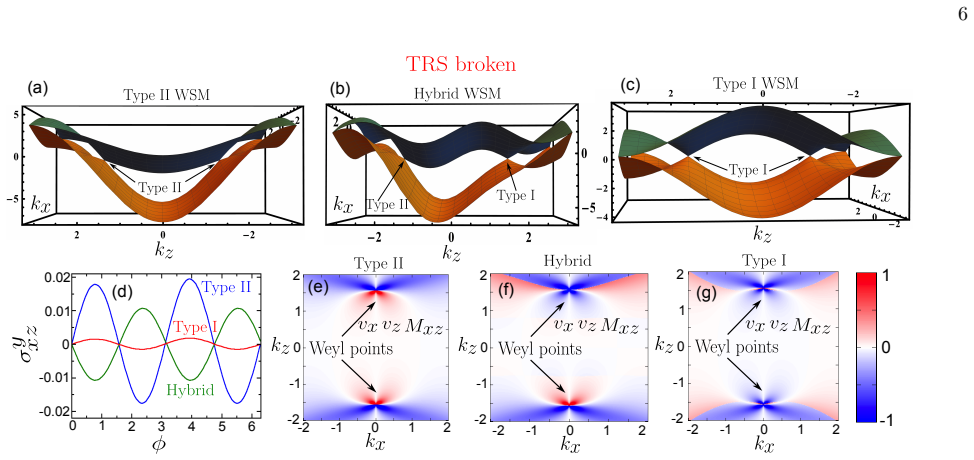
The WSM phases in TaXTe4 are controlled by the orbital character of the d_xz and d_z2 states of X=Ir/Rh atoms. Replacing Rh with Ir enhances the d_z2 orbital contribution near the Fermi level at the expense of d_xz states. This transforms the type-I WPs into type-II resulting in a conversion of hybrid WSM TaRhTe4 to type-II WSM TaIrTe4. The orbital-driven transition also produces an enhancement of planar Hall effects, which the authors link via a tight-binding model to velocity-modulated off-diagonal effective mass anisotropy.
What carries the argument
Relative orbital weights of d_xz versus d_z2 states near the Fermi level, which fix whether Weyl points are type-I or type-II and thereby set the overall Weyl semimetal class.
If this is right
- TaRhTe4 remains a hybrid Weyl semimetal containing both type-I and type-II points even after spin-orbit coupling is included.
- TaIrTe4 converts to a pure type-II Weyl semimetal once spin-orbit coupling is turned on.
- Long Fermi arcs appear that connect Weyl points of opposite chirality.
- Planar Hall conductivity rises because of the orbital change and the associated mass anisotropy.
Where Pith is reading between the lines
- Elemental substitution to adjust orbital balance could serve as a design handle in other telluride families or related compounds.
- Direct spectroscopic measurement of orbital character would provide an independent test of the proposed mechanism.
- The same orbital tuning might be used to engineer the strength of chiral-anomaly transport signatures in related materials.
Load-bearing premise
Density functional theory with standard functionals and spin-orbit coupling accurately gives the relative orbital weights of the d_xz and d_z2 states and the Weyl point types that result from them.
What would settle it
Angle-resolved photoemission spectroscopy or orbital-projected band calculations that show no increase in d_z2 weight and no conversion of type-I points to type-II points when Rh is replaced by Ir would falsify the orbital-control claim.
Figures



read the original abstract
We study electronic properties of the ternary tellurides TaXTe$_4$ (X=Rh, Ir) using density functional theory and investigate chiral anomaly mediated planar Hall response from ab initio calculations. We show that TaRhTe$_4$ is a hybrid Weyl semimetal (WSM), hosting Weyl points (WPs) of both type-I, type-II, and TaIrTe$_4$ is a type-I WSM in absence of spin-orbit coupling (SOC). TaRhTe$_4$ continues to remain a hybrid WSM while TaIrTe$_4$ converts into a type-II WSM under the application of SOC. We observe long Fermi arcs connecting WPs of opposite chirality. We report orbital-driven topological phase transition in ternary tellurides. The WSM phases in TaXTe$_4$ are controlled by the orbital character of the $d_{xz}$ and $d_{z^2}$ states of X=Ir/Rh atoms. Replacing Rh with Ir enhances the $d_{z^2}$ orbital contribution near the Fermi level at the expense of $d_{xz}$ states. This transforms the type-I WPs into type-II resulting in a conversion of hybrid WSM TaRhTe$_4$ to type-II WSM TaIrTe$_4$. This systematic study opens new routes for engineering topological materials relying beyond strong SOC and sheds light on the effect of orbital degree of freedom on the electronic properties of tellurides. We further report an enhancement of planar Hall effects due to orbital-driven topological phase transition in TaXTe$_4$ and we make resort to a tight-binding model to correlate the above findings with the velocity modulated off-diagonal effective mass anisotropy in different types of WSMs.
Editorial analysis
A structured set of objections, weighed in public.
Referee Report
Summary. The manuscript uses density functional theory to study the electronic structure of TaRhTe4 and TaIrTe4, reporting that TaRhTe4 is a hybrid Weyl semimetal hosting both type-I and type-II Weyl points while TaIrTe4 becomes a type-II Weyl semimetal once spin-orbit coupling is included. The central claim is that this topological conversion is orbital-driven: substitution of Rh by Ir increases the d_z2 weight near the Fermi level at the expense of d_xz states of the X atom, thereby converting type-I Weyl points to type-II. Long Fermi arcs are identified, planar Hall responses are computed, and a tight-binding model is introduced to relate the observations to off-diagonal effective-mass anisotropy.
Significance. If substantiated, the work supplies a concrete example of orbital-character control over Weyl-point type in ternary tellurides, offering a tuning knob that does not rely solely on atomic spin-orbit strength. The direct ab initio band-structure output combined with a separate tight-binding analysis constitutes a reproducible computational pipeline that could be extended to related compounds.
major comments (2)
- [Orbital projections and topological phase transition discussion] The assertion that the d_z2 versus d_xz orbital reweighting is the causal driver of the type-I to type-II conversion (abstract and orbital-projection analysis) is not isolated from the simultaneous increase in atomic SOC and the change in equilibrium lattice parameters between the Rh and Ir compounds. No auxiliary calculation—SOC scaling on a fixed structure, constrained-orbital DFT, or tight-binding parametrization that varies only the d-orbital matrix elements while holding velocity anisotropy fixed—is reported.
- [Computational methods] Convergence parameters (k-point mesh density, plane-wave cutoff) and the specific exchange-correlation functional employed for the orbital-projected bands and Weyl-point locations are not stated, leaving the quantitative reliability of the reported d-orbital weights and the type-I/type-II classification open to moderate uncertainty.
minor comments (2)
- [Abstract] The abstract states that TaIrTe4 is type-I in the absence of SOC; the corresponding band-structure figure or table should be explicitly referenced so that readers can locate the zero-SOC Weyl-point data.
- [Tight-binding analysis] The tight-binding model is invoked to correlate findings with effective-mass anisotropy, yet the explicit Hamiltonian form, hopping parameters, or fitting procedure are not supplied; these should appear in the main text or supplementary material.
Simulated Author's Rebuttal
We thank the referee for the careful reading of our manuscript and the constructive comments. We address the two major points below and will revise the manuscript to incorporate clarifications and additional analysis where needed.
read point-by-point responses
-
Referee: The assertion that the d_z2 versus d_xz orbital reweighting is the causal driver of the type-I to type-II conversion (abstract and orbital-projection analysis) is not isolated from the simultaneous increase in atomic SOC and the change in equilibrium lattice parameters between the Rh and Ir compounds. No auxiliary calculation—SOC scaling on a fixed structure, constrained-orbital DFT, or tight-binding parametrization that varies only the d-orbital matrix elements while holding velocity anisotropy fixed—is reported.
Authors: We agree that the orbital reweighting occurs in the presence of both stronger SOC for Ir and different equilibrium lattice constants. Our orbital-projected bands nevertheless show a direct correlation between the enhanced d_z2 weight near the Fermi level and the increased tilt of the Weyl cones that converts type-I to type-II points. To isolate the orbital contribution more cleanly, the revised manuscript will add a tight-binding analysis in which only the d-orbital on-site energies and nearest-neighbor hoppings are varied to reproduce the observed d_z2/d_xz reweighting while the SOC strength and lattice parameters are held fixed at the TaRhTe4 values. This will demonstrate that the orbital character alone is sufficient to drive the topological conversion. revision: yes
-
Referee: Convergence parameters (k-point mesh density, plane-wave cutoff) and the specific exchange-correlation functional employed for the orbital-projected bands and Weyl-point locations are not stated, leaving the quantitative reliability of the reported d-orbital weights and the type-I/type-II classification open to moderate uncertainty.
Authors: We thank the referee for noting the omission. The revised manuscript will include an explicit Computational Methods section stating the exchange-correlation functional, plane-wave cutoff, and k-point meshes used for the self-consistent calculations, orbital projections, and Weyl-point searches. These parameters were chosen to ensure convergence of the orbital weights and the topological classification to the level reported. revision: yes
Circularity Check
No circularity: claims rest on direct DFT orbital projections and separate TB model
full rationale
The paper derives its central result—that Rh-to-Ir substitution enhances d_z2 weight at the expense of d_xz and thereby converts hybrid WSM to type-II WSM—directly from ab initio DFT band-structure output and orbital projections on the two compounds. A separate tight-binding model is invoked only to correlate the planar Hall response with velocity anisotropy; no parameter is fitted to a subset of the target data and then re-presented as a prediction, no self-citation supplies a load-bearing uniqueness theorem, and no ansatz is smuggled in. The derivation chain is therefore self-contained against external benchmarks and receives the default non-circularity finding.
Axiom & Free-Parameter Ledger
free parameters (1)
- DFT exchange-correlation functional
axioms (2)
- domain assumption Kohn-Sham density functional theory framework
- domain assumption Inclusion of spin-orbit coupling via relativistic pseudopotentials
Forward citations
Cited by 1 Pith paper
-
Semiclassical theory of frequency dependent linear magneto-optical transport in Weyl semimetals
Semiclassical theory predicts that strong intervalley scattering induces sign reversal of longitudinal magneto-optical conductivity in the weak AC regime for untilted Weyl semimetals with orbital moment, suppressing t...
Reference graph
Works this paper leans on
-
[1]
and is shown in Fig. 1(a). The layered structure can be described by a unit cell containing four formula units which form two layers (along thec-axis). The cor- responding lattice parameters are:a= 3.75672 (3.77) ˚A,b= 12.5476 (12.421) ˚A, andc= 13.166 (13.184) ˚A for TaRhTe4 (TaIrTe4). Within each layer, the transi- tion metal ions are octahedrally coord...
-
[2]
is a fractional translation of a Bravais lattice vector.These materials preserve time reversal symmetry due to their non-magnetic structures. The electronic band structure along Γ-Xwithout SOC and with SOC cases are found to be similar for both isostructural and isoelectronic compounds TaRhTe 4 and TaIrTe4, see Fig. 1(b). However, there are significant di...
work page 2024
-
[3]
Colloquium: Topological insulators,
M. Z. Hasan and C. L. Kane, “Colloquium: Topological insulators,” Rev. Mod. Phys.82, 3045–3067 (2010)
work page 2010
-
[4]
Weyl and dirac semimetals in three-dimensional solids,
N. P. Armitage, E. J. Mele, and A. Vishwanath, “Weyl and dirac semimetals in three-dimensional solids,” Rev. Mod. Phys.90, 015001 (2018)
work page 2018
- [5]
-
[6]
A. Vishwanath, “Where the weyl things are,” Physics 8, 84 (2015)
work page 2015
-
[7]
Creating weyl nodes and controlling their en- ergy by magnetization rotation,
M. P. Ghimire, J. I. Facio, J.-S. You, L. Ye, J. G. Check- elsky, S. Fang, E. Kaxiras, M. Richter, and J. van den Brink, “Creating weyl nodes and controlling their en- ergy by magnetization rotation,” Phys. Rev. Res.1, 032044 (2019)
work page 2019
-
[8]
Quantum hall effects in a weyl semimetal: Possible application in py- rochlore iridates,
K.-Y. Yang, Y.-M. Lu, and Y. Ran, “Quantum hall effects in a weyl semimetal: Possible application in py- rochlore iridates,” Phys. Rev. B84, 075129 (2011)
work page 2011
-
[9]
Quantized circular photogalvanic effect in weyl semimetals,
F. De Juan, A. G. Grushin, T. Morimoto, and J. E. Moore, “Quantized circular photogalvanic effect in weyl semimetals,” Nature communications8, 15995 (2017)
work page 2017
-
[10]
Electronic structure and unconventional nonlinear response in double weyl semimetal Srsi2,
B. Sadhukhan and T. Nag, “Electronic structure and unconventional nonlinear response in double weyl semimetal Srsi2,” Phys. Rev. B104, 245122 (2021)
work page 2021
-
[11]
Weyl semimetal in a topological insulator multilayer,
A. A. Burkov and L. Balents, “Weyl semimetal in a topological insulator multilayer,” Phys. Rev. Lett.107, 127205 (2011)
work page 2011
-
[12]
Nernst and magnetothermal conductivity in a lattice model of weyl fermions,
G. Sharma, P. Goswami, and S. Tewari, “Nernst and magnetothermal conductivity in a lattice model of weyl fermions,” Phys. Rev. B93, 035116 (2016)
work page 2016
-
[13]
Spin nernst ef- fect in a p-band semimetal inbi,
Y. Zhang, Q. Xu, K. Koepernik, C. Fu, J. Gooth, J. van den Brink, C. Felser, and Y. Sun, “Spin nernst ef- fect in a p-band semimetal inbi,” New Journal of Physics 22, 093003 (2020)
work page 2020
-
[14]
Giant anisotropic nonlinear optical re- sponse in transition metal monopnictide weyl semimet- als,
L. Wu, S. Patankar, T. Morimoto, N. L. Nair, E. The- walt, A. Little, J. G. Analytis, J. E. Moore, and J. Orenstein, “Giant anisotropic nonlinear optical re- sponse in transition metal monopnictide weyl semimet- als,” Nature Physics13, 350–355 (2017)
work page 2017
-
[15]
Predicted unusual magnetoresponse in type-ii weyl semimetals,
Z.-M. Yu, Y. Yao, and S. A. Yang, “Predicted unusual magnetoresponse in type-ii weyl semimetals,” Phys. Rev. Lett.117, 077202 (2016)
work page 2016
-
[16]
Quantum transport in topo- logical semimetals under magnetic fields,
H.-Z. Lu and S.-Q. Shen, “Quantum transport in topo- logical semimetals under magnetic fields,” Frontiers of Physics12, 127201 (2017)
work page 2017
-
[17]
Effect of chirality imbalance on hall transport of prrhc2,
B. Sadhukhan and T. Nag, “Effect of chirality imbalance on hall transport of prrhc2,” Phys. Rev. B107, L081110 (2023)
work page 2023
-
[18]
Understanding the three-dimensional quantum hall ef- fect in generic multi-weyl semimetals,
F. Xiong, C. Honerkamp, D. M. Kennes, and T. Nag, “Understanding the three-dimensional quantum hall ef- fect in generic multi-weyl semimetals,” Phys. Rev. B 106, 045424 (2022)
work page 2022
-
[19]
Transport in three-dimensional topological insulators: Theory and experiment,
D. Culcer, “Transport in three-dimensional topological insulators: Theory and experiment,” Physica E: Low- dimensional Systems and Nanostructures44, 860–884 (2012), sI:Topological Insulators
work page 2012
-
[20]
Mesoscopic transport in two-dimensional topological insulators,
G. Gusev, Z. Kvon, E. Olshanetsky, and N. Mikhailov, “Mesoscopic transport in two-dimensional topological insulators,” Solid State Communications302, 113701 (2019)
work page 2019
-
[21]
Spin-helical transport in normal and superconducting topological insulators,
G. Tkachov and E. Hankiewicz, “Spin-helical transport in normal and superconducting topological insulators,” physica status solidi (b)250, 215–232 (2013)
work page 2013
-
[22]
Third- order hall effect in the surface states of a topological insulator,
T. Nag, S. K. Das, C. Zeng, and S. Nandy, “Third- order hall effect in the surface states of a topological insulator,” Phys. Rev. B107, 245141 (2023)
work page 2023
-
[23]
Topological magnus responses in two- and three-dimensional systems,
S. K. Das, T. Nag, and S. Nandy, “Topological magnus responses in two- and three-dimensional systems,” Phys. Rev. B104, 115420 (2021)
work page 2021
-
[24]
M. Papaj and L. Fu, “Magnus hall effect,” Phys. Rev. Lett.123, 216802 (2019)
work page 2019
-
[25]
Third-order nonlinear hall effect induced by the berry- 8 connection polarizability tensor,
S. Lai, H. Liu, Z. Zhang, J. Zhao, X. Feng, N. Wang, C. Tang, Y. Liu, K. Novoselov, S. A. Yang,et al., “Third-order nonlinear hall effect induced by the berry- 8 connection polarizability tensor,” Nature Nanotechnol- ogy16, 869–873 (2021)
work page 2021
-
[26]
Role of time reversal sym- metry and tilting in circular photogalvanic responses,
B. Sadhukhan and T. Nag, “Role of time reversal sym- metry and tilting in circular photogalvanic responses,” Phys. Rev. B103, 144308 (2021)
work page 2021
-
[27]
M. Z. Shi, B. Lei, C. S. Zhu, D. H. Ma, J. H. Cui, Z. L. Sun, J. J. Ying, and X. H. Chen, “Magnetic and trans- port properties in the magnetic topological insulators M nBi2T e4(Bi2T e3)n (n= 1,2),” Phys. Rev. B100, 155144 (2019)
work page 2019
-
[28]
Surface-dominated transport on a bulk topological insulator,
L. Barreto, L. K¨ uhnemund, F. Edler, C. Tegenkamp, J. Mi, M. Bremholm, B. B. Iversen, C. Frydendahl, M. Bianchi, and P. Hofmann, “Surface-dominated transport on a bulk topological insulator,” Nano Let- ters14, 3755–3760 (2014)
work page 2014
-
[29]
Chiral anomaly and clas- sical negative magnetoresistance of weyl metals,
D. T. Son and B. Z. Spivak, “Chiral anomaly and clas- sical negative magnetoresistance of weyl metals,” Phys. Rev. B88, 104412 (2013)
work page 2013
-
[30]
Chiral anomaly and diffusive magneto- transport in weyl metals,
A. A. Burkov, “Chiral anomaly and diffusive magneto- transport in weyl metals,” Phys. Rev. Lett.113, 247203 (2014)
work page 2014
-
[31]
𭟋 2 and chiral anomalies in topological dirac semimetals,
A. A. Burkov and Y. B. Kim, “𭟋 2 and chiral anomalies in topological dirac semimetals,” Phys. Rev. Lett.117, 136602 (2016)
work page 2016
-
[32]
The chiral anomaly and thermopower of weyl fermions in the half-heusler gdptbi,
M. Hirschberger, S. Kushwaha, Z. Wang, Q. Gibson, S. Liang, C. A. Belvin, B. A. Bernevig, R. J. Cava, and N. P. Ong, “The chiral anomaly and thermopower of weyl fermions in the half-heusler gdptbi,” Nature Ma- terials15, 1161–1165 (2016)
work page 2016
-
[33]
Observation of the chiral- anomaly-induced negative magnetoresistance in 3d weyl semimetal taas,
X. Huang, L. Zhao, Y. Long, P. Wang, D. Chen, Z. Yang, H. Liang, M. Xue, H. Weng, Z. Fang, X. Dai, and G. Chen, “Observation of the chiral- anomaly-induced negative magnetoresistance in 3d weyl semimetal taas,” Phys. Rev. X5, 031023 (2015)
work page 2015
-
[34]
The adler-bell-jackiw anomaly and weyl fermions in a crystal,
H. Nielsen and M. Ninomiya, “The adler-bell-jackiw anomaly and weyl fermions in a crystal,” Physics Let- ters B130, 389–396 (1983)
work page 1983
-
[35]
Evidence for the chiral anomaly in the dirac semimetal na¡sub¿3¡/sub¿bi,
J. Xiong, S. K. Kushwaha, T. Liang, J. W. Krizan, M. Hirschberger, W. Wang, R. J. Cava, and N. P. Ong, “Evidence for the chiral anomaly in the dirac semimetal na¡sub¿3¡/sub¿bi,” Science350, 413–416 (2015), https://www.science.org/doi/pdf/10.1126/science.aac6089
-
[36]
Hidden type- ii weyl points in the weyl semimetal nbp,
S.-C. Wu, Y. Sun, C. Felser, and B. Yan, “Hidden type- ii weyl points in the weyl semimetal nbp,” Phys. Rev. B96, 165113 (2017)
work page 2017
-
[37]
Observation of weyl nodes in taas,
B. Lv, N. Xu, H. Weng, J. Ma, P. Richard, X. Huang, L. Zhao, G. Chen, C. Matt, F. Bisti,et al., “Observation of weyl nodes in taas,” Nature Physics11, 724 (2015)
work page 2015
-
[38]
Experimental discovery of a topologi- cal weyl semimetal state in tap,
S.-Y. Xu, I. Belopolski, D. S. Sanchez, C. Zhang, G. Chang, C. Guo, G. Bian, Z. Yuan, H. Lu, T.-R. Chang,et al., “Experimental discovery of a topologi- cal weyl semimetal state in tap,” Science advances1, e1501092 (2015)
work page 2015
-
[39]
Weyl semimetal phase in the non-centrosymmetric compound taas,
L. Yang, Z. Liu, Y. Sun, H. Peng, H. Yang, T. Zhang, B. Zhou, Y. Zhang, Y. Guo, M. Rahn,et al., “Weyl semimetal phase in the non-centrosymmetric compound taas,” Nature physics11, 728 (2015)
work page 2015
-
[40]
Discovery of a weyl fermion state with fermi arcs in niobium arsenide,
S.-Y. Xu, N. Alidoust, I. Belopolski, Z. Yuan, G. Bian, T.-R. Chang, H. Zheng, V. N. Strocov, D. S. Sanchez, G. Chang,et al., “Discovery of a weyl fermion state with fermi arcs in niobium arsenide,” Nature Physics11, 748 (2015)
work page 2015
-
[41]
Weyl semimetal phase in noncentrosymmet- ric transition-metal monophosphides,
H. Weng, C. Fang, Z. Fang, B. A. Bernevig, and X. Dai, “Weyl semimetal phase in noncentrosymmet- ric transition-metal monophosphides,” Phys. Rev. X5, 011029 (2015)
work page 2015
-
[42]
Experimen- tal discovery of weyl semimetal taas,
B. Q. Lv, H. M. Weng, B. B. Fu, X. P. Wang, H. Miao, J. Ma, P. Richard, X. C. Huang, L. X. Zhao, G. F. Chen, Z. Fang, X. Dai, T. Qian, and H. Ding, “Experimen- tal discovery of weyl semimetal taas,” Phys. Rev. X5, 031013 (2015)
work page 2015
-
[43]
Discovery of a weyl fermion semimetal and topological fermi arcs,
S.-Y. Xu, I. Belopolski, N. Alidoust, M. Neupane, G. Bian, C. Zhang, R. Sankar, G. Chang, Z. Yuan, C.-C. Lee,et al., “Discovery of a weyl fermion semimetal and topological fermi arcs,” Science349, 613–617 (2015)
work page 2015
-
[44]
Y. Sun, S.-C. Wu, and B. Yan, “Topological surface states and fermi arcs of the noncentrosymmetric weyl semimetals taas, tap, nbas, and nbp,” Phys. Rev. B92, 115428 (2015)
work page 2015
-
[45]
A. A. Soluyanov, D. Gresch, Z. Wang, Q. Wu, M. Troyer, X. Dai, and B. A. Bernevig, “Type-ii weyl semimetals,” Nature527, 495 (2015)
work page 2015
-
[46]
F.-Y. Li, X. Luo, X. Dai, Y. Yu, F. Zhang, and G. Chen, “Hybrid weyl semimetal,” Phys. Rev. B94, 121105 (2016)
work page 2016
-
[47]
Hybrid weyl semimetal under crossed electric and magnetic fields: Field tuning of spectrum type,
Z. Alisultanov, “Hybrid weyl semimetal under crossed electric and magnetic fields: Field tuning of spectrum type,” Physics Letters A382, 3211–3215 (2018)
work page 2018
-
[48]
Tunable hybrid- order weyl semimetal via staggered magnetic flux,
C. Xu, J. Wang, X. Luo, and X. Lu, “Tunable hybrid- order weyl semimetal via staggered magnetic flux,” Journal of Physics: Condensed Matter36, 395501 (2024)
work page 2024
-
[49]
N. Xu, Z. W. Wang, A. Magrez, P. Bugnon, H. Berger, C. E. Matt, V. N. Strocov, N. C. Plumb, M. Radovic, E. Pomjakushina, K. Conder, J. H. Dil, J. Mesot, R. Yu, H. Ding, and M. Shi, “Evidence of a coulomb- interaction-induced lifshitz transition and robust hybrid weyl semimetal inT d−mote2,” Phys. Rev. Lett.121, 136401 (2018)
work page 2018
-
[50]
R. Saxena, N. Basak, P. Chatterjee, S. Rao, and A. Saha, “Thermoelectric properties of inversion sym- metry broken weyl semimetal–weyl superconductor hy- brid junctions,” Phys. Rev. B107, 195426 (2023)
work page 2023
-
[51]
A fer- romagnetic hybrid weyl semimetal in two dimensions: the monolayer agcrs2,
M. Li, Y. Liu, X. Dai, G. Liu, and X. Zhang, “A fer- romagnetic hybrid weyl semimetal in two dimensions: the monolayer agcrs2,” Journal of Materials Science58, 281–290 (2023)
work page 2023
-
[52]
Chiral anomaly as the origin of the planar hall effect in weyl semimetals,
S. Nandy, G. Sharma, A. Taraphder, and S. Tewari, “Chiral anomaly as the origin of the planar hall effect in weyl semimetals,” Phys. Rev. Lett.119, 176804 (2017)
work page 2017
-
[53]
Large planar hall effect in bismuth thin films,
S.-Y. Yang, K. Chang, and S. S. P. Parkin, “Large planar hall effect in bismuth thin films,” Phys. Rev. Res. 2, 022029 (2020)
work page 2020
-
[54]
Anisotropic pla- nar hall effect in the type-ii topological weyl semimetal wte2,
P. Li, C. Zhang, Y. Wen, L. Cheng, G. Nichols, D. G. Cory, G.-X. Miao, and X.-X. Zhang, “Anisotropic pla- nar hall effect in the type-ii topological weyl semimetal wte2,” Phys. Rev. B100, 205128 (2019)
work page 2019
-
[55]
Planar hall ef- fect in tilted weyl semimetals,
D. Ma, H. Jiang, H. Liu, and X. C. Xie, “Planar hall ef- fect in tilted weyl semimetals,” Phys. Rev. B99, 115121 (2019)
work page 2019
-
[56]
Prob- ing the chiral anomaly by planar hall effect in dirac semimetal cd3as2 nanoplates,
M. Wu, G. Zheng, W. Chu, Y. Liu, W. Gao, H. Zhang, J. Lu, Y. Han, J. Zhou, W. Ning, and M. Tian, “Prob- ing the chiral anomaly by planar hall effect in dirac semimetal cd3as2 nanoplates,” Phys. Rev. B98, 161110 (2018)
work page 2018
-
[57]
Giant planar hall effect in the dirac semimetal ZrTe5−δ,
P. Li, C. H. Zhang, J. W. Zhang, Y. Wen, and X. X. Zhang, “Giant planar hall effect in the dirac semimetal ZrTe5−δ,” Phys. Rev. B98, 121108 (2018). 9
work page 2018
-
[58]
Pla- nar hall effect in the weyl semimetal gdptbi,
N. Kumar, S. N. Guin, C. Felser, and C. Shekhar, “Pla- nar hall effect in the weyl semimetal gdptbi,” Phys. Rev. B98, 041103 (2018)
work page 2018
-
[59]
Giant planar hall effect in topological metals,
A. A. Burkov, “Giant planar hall effect in topological metals,” Phys. Rev. B96, 041110 (2017)
work page 2017
-
[60]
Giant planar hall effect in epitaxial (ga,mn)as devices,
H. X. Tang, R. K. Kawakami, D. D. Awschalom, and M. L. Roukes, “Giant planar hall effect in epitaxial (ga,mn)as devices,” Phys. Rev. Lett.90, 107201 (2003)
work page 2003
-
[61]
Giant planar hall effect in epitaxial fe 3o4 thin films and its temperature depen- dence,
A. Fern´ andez-Pacheco, J. M. De Teresa, J. Orna, L. Morellon, P. A. Algarabel, J. A. Pardo, M. R. Ibarra, C. Magen, and E. Snoeck, “Giant planar hall effect in epitaxial fe 3o4 thin films and its temperature depen- dence,” Phys. Rev. B78, 212402 (2008)
work page 2008
-
[62]
S. Liang, J. Lin, S. Kushwaha, J. Xing, N. Ni, R. J. Cava, and N. P. Ong, “Experimental tests of the chiral anomaly magnetoresistance in the dirac-weyl semimet- als na3Bi and gdptbi,” Phys. Rev. X8, 031002 (2018)
work page 2018
-
[63]
Current jetting distorted planar hall effect in a weyl semimetal with ultrahigh mobility,
J. Yang, W. L. Zhen, D. D. Liang, Y. J. Wang, X. Yan, S. R. Weng, J. R. Wang, W. Tong, L. Pi, W. K. Zhu, and C. J. Zhang, “Current jetting distorted planar hall effect in a weyl semimetal with ultrahigh mobility,” Phys. Rev. Mater.3, 014201 (2019)
work page 2019
-
[64]
Nontopological origin of the planar hall ef- fect in the type-ii dirac semimetal nite 2,
Q. Liu, F. Fei, B. Chen, X. Bo, B. Wei, S. Zhang, M. Zhang, F. Xie, M. Naveed, X. Wan, F. Song, and B. Wang, “Nontopological origin of the planar hall ef- fect in the type-ii dirac semimetal nite 2,” Phys. Rev. B 99, 155119 (2019)
work page 2019
-
[65]
Origin of planar hall effect in type-ii weyl semimetal mote2,
D. Liang, Y. Wang, W. Zhen, J. Yang, S. Weng, X. Yan, Y. Han, W. Tong, W. Zhu, L. Pi,et al., “Origin of planar hall effect in type-ii weyl semimetal mote2,” Aip Advances9(2019)
work page 2019
-
[66]
J. Meng, H. Xue, M. Liu, W. Jiang, Z. Zhang, J. Ling, L. He, R. Dou, C. Xiong, and J. Nie, “Planar hall effect induced by anisotropic orbital magnetoresistance in type-ii dirac semimetal pdte2,” Journal of Physics: Condensed Matter32, 015702 (2019)
work page 2019
-
[67]
Evidence for topological type-ii weyl semimetal wte 2,
P. Li, Y. Wen, X. He, Q. Zhang, C. Xia, Z.-M. Yu, S. A. Yang, Z. Zhu, H. N. Alshareef, and X.-X. Zhang, “Evidence for topological type-ii weyl semimetal wte 2,” Nature communications8, 2150 (2017)
work page 2017
-
[68]
Observation of fermi arcs in the type-ii weyl semimetal candidate wte2,
Y. Wu, D. Mou, N. H. Jo, K. Sun, L. Huang, S. L. Bud’ko, P. C. Canfield, and A. Kaminski, “Observation of fermi arcs in the type-ii weyl semimetal candidate wte2,” Phys. Rev. B94, 121113 (2016)
work page 2016
-
[69]
Fermi arcs and their topological character in the can- didate type-ii weyl semimetal mote 2,
A. Tamai, Q. S. Wu, I. Cucchi, F. Y. Bruno, S. Ricc` o, T. K. Kim, M. Hoesch, C. Barreteau, E. Giannini, C. Besnard, A. A. Soluyanov, and F. Baumberger, “Fermi arcs and their topological character in the can- didate type-ii weyl semimetal mote 2,” Phys. Rev. X6, 031021 (2016)
work page 2016
-
[70]
Experimen- tal observation of topological fermi arcs in type-ii weyl semimetal mote 2,
K. Deng, G. Wan, P. Deng, K. Zhang, S. Ding, E. Wang, M. Yan, H. Huang, H. Zhang, Z. Xu,et al., “Experimen- tal observation of topological fermi arcs in type-ii weyl semimetal mote 2,” Nature Physics12, 1105 (2016)
work page 2016
-
[71]
Experimental realization of type-ii weyl state in noncentrosymmetric tairte 4,
E. Haubold, K. Koepernik, D. Efremov, S. Khim, A. Fe- dorov, Y. Kushnirenko, J. van den Brink, S. Wurmehl, B. B¨ uchner, T. K. Kim, M. Hoesch, K. Sumida, K. Taguchi, T. Yoshikawa, A. Kimura, T. Okuda, and S. V. Borisenko, “Experimental realization of type-ii weyl state in noncentrosymmetric tairte 4,” Phys. Rev. B95, 241108 (2017)
work page 2017
-
[72]
Signatures of a time-reversal symmet- ric weyl semimetal with only four weyl points,
I. Belopolski, P. Yu, D. S. Sanchez, Y. Ishida, T.-R. Chang, S. S. Zhang, S.-Y. Xu, H. Zheng, G. Chang, G. Bian,et al., “Signatures of a time-reversal symmet- ric weyl semimetal with only four weyl points,” Nature communications8, 942 (2017)
work page 2017
-
[73]
Large, non- saturating magnetoresistance in wte 2,
M. N. Ali, J. Xiong, S. Flynn, J. Tao, Q. D. Gib- son, L. M. Schoop, T. Liang, N. Haldolaarachchige, M. Hirschberger, N. P. Ong,et al., “Large, non- saturating magnetoresistance in wte 2,” Nature514, 205 (2014)
work page 2014
-
[74]
J. Jiang, F. Tang, X. C. Pan, H. M. Liu, X. H. Niu, Y. X. Wang, D. F. Xu, H. F. Yang, B. P. Xie, F. Q. Song, P. Dudin, T. K. Kim, M. Hoesch, P. K. Das, I. Vobornik, X. G. Wan, and D. L. Feng, “Signature of strong spin-orbital coupling in the large nonsaturat- ing magnetoresistance material wte 2,” Phys. Rev. Lett. 115, 166601 (2015)
work page 2015
-
[75]
Magne- totransport and de haas–van alphen measurements in the type-ii weyl semimetal tairte 4,
S. Khim, K. Koepernik, D. V. Efremov, J. Klotz, T. F¨ orster, J. Wosnitza, M. I. Sturza, S. Wurmehl, C. Hess, J. van den Brink, and B. B¨ uchner, “Magne- totransport and de haas–van alphen measurements in the type-ii weyl semimetal tairte 4,” Phys. Rev. B94, 165145 (2016)
work page 2016
-
[76]
Mote 2: An uncompensated semimetal with extremely large magnetoresistance,
S. Thirupathaiah, R. Jha, B. Pal, J. Matias, P. K. Das, P. Sivakumar, I. Vobornik, N. Plumb, M. Shi, R. Ribeiro,et al., “Mote 2: An uncompensated semimetal with extremely large magnetoresistance,” Physical Review B95, 241105 (2017)
work page 2017
-
[77]
Observation of superconductivity in the pressurized weyl-semimetal candidate TaIrTe4,
S. Cai, E. Emmanouilidou, J. Guo, X. Li, Y. Li, K. Yang, A. Li, Q. Wu, N. Ni, and L. Sun, “Observation of superconductivity in the pressurized weyl-semimetal candidate TaIrTe4,” Phys. Rev. B99, 020503 (2019)
work page 2019
-
[78]
Origin of superconductivity in the weyl semimetal WTe2 under pressure,
P. Lu, J.-S. Kim, J. Yang, H. Gao, J. Wu, D. Shao, B. Li, D. Zhou, J. Sun, D. Akinwande, D. Xing, and J.-F. Lin, “Origin of superconductivity in the weyl semimetal WTe2 under pressure,” Phys. Rev. B94, 224512 (2016)
work page 2016
-
[79]
Superconductivity in weyl semimetal candidate mote2,
Y. Qi, P. G. Naumov, M. N. Ali, C. R. Rajamathi, W. Schnelle, O. Barkalov, M. Hanfland, S.-C. Wu, C. Shekhar, Y. Sun,et al., “Superconductivity in weyl semimetal candidate mote2,” Nature communications7, 11038 (2016)
work page 2016
-
[80]
Surface superconductivity in the type ii weyl semimetal tairte4,
Y. Xing, Z. Shao, J. Ge, J. Wang, Z. Zhu, J. Liu, Y. Wang, Z. Zhao, J. Yan, D. Mandrus,et al., “Surface superconductivity in the type ii weyl semimetal tairte4,” arXiv preprint arXiv:1805.10883 (2018)
discussion (0)
Sign in with ORCID, Apple, or X to comment. Anyone can read and Pith papers without signing in.