Electron stability constrains neutrino time delays
Pith reviewed 2026-07-03 19:32 UTC · model grok-4.3
The pith
Observed stability of high-energy electrons rules out Lorentz-invariance violation as an explanation for time delays in high-energy cosmic neutrinos.
A machine-rendered reading of the paper's core claim, the machinery that carries it, and where it could break.
Core claim
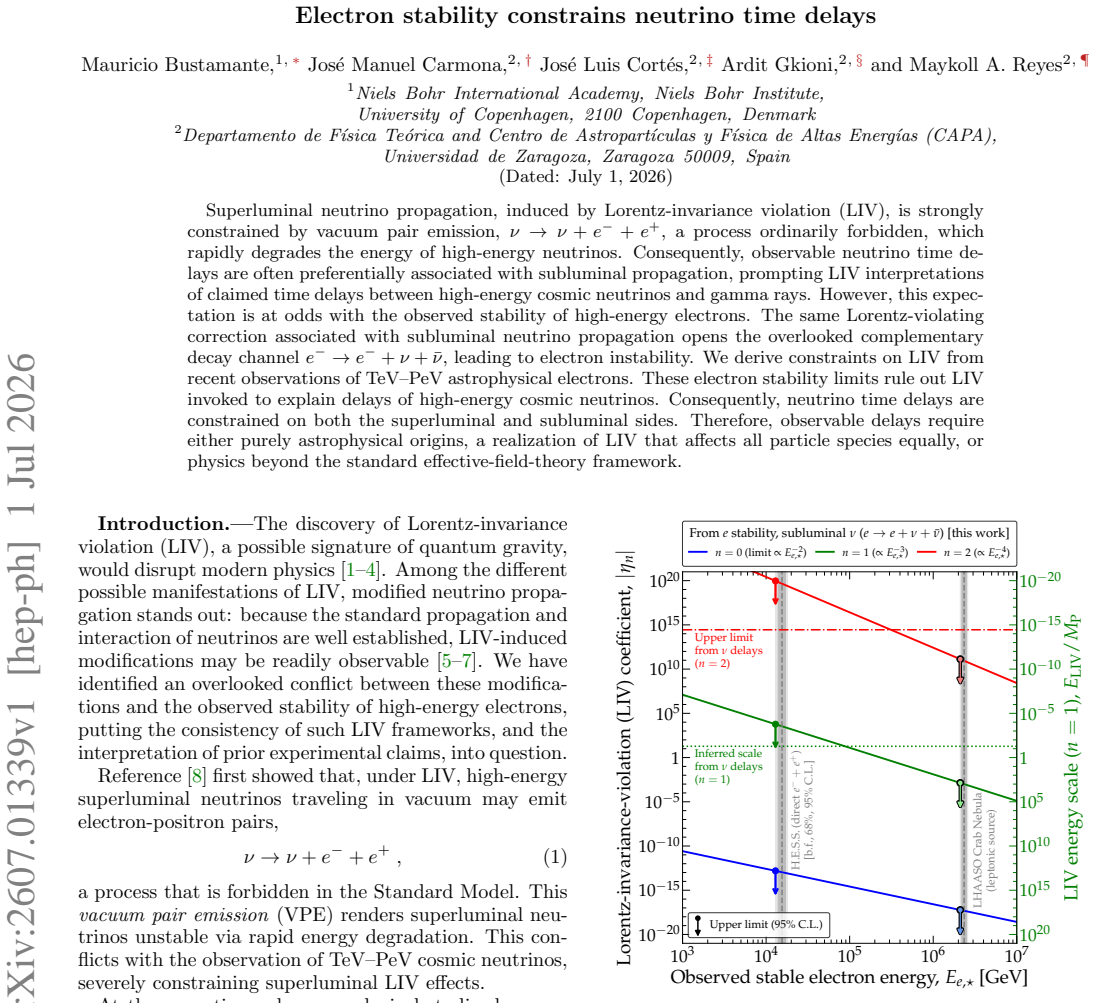
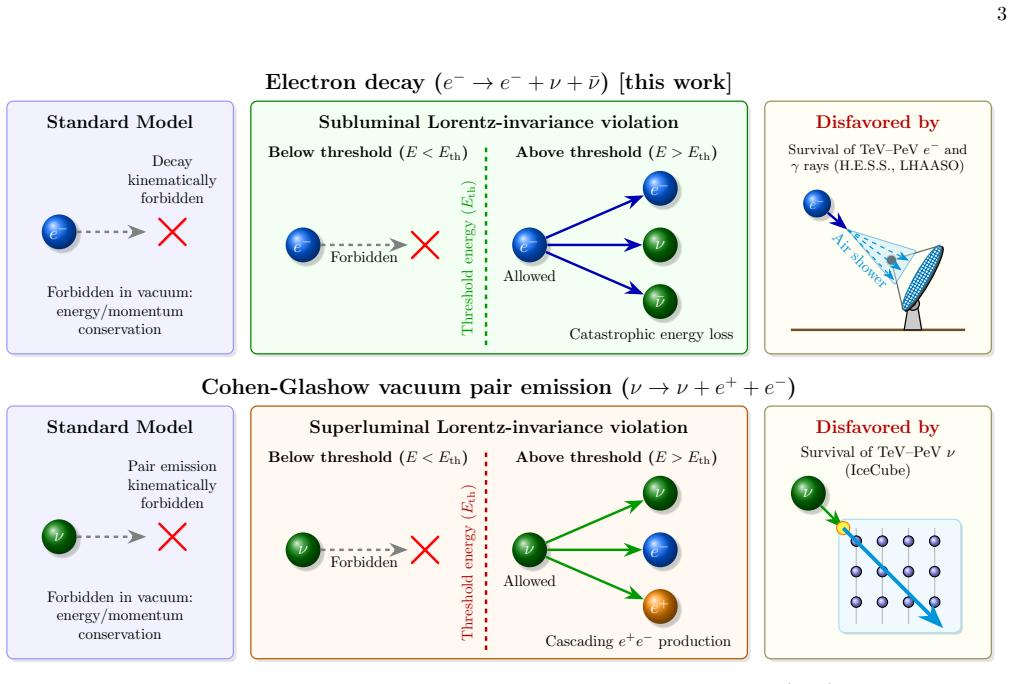
The same Lorentz-violating correction associated with subluminal neutrino propagation opens the decay channel e− → e− + ν + ν-bar, leading to electron instability. Constraints derived from recent observations of TeV--PeV astrophysical electrons rule out LIV invoked to explain delays of high-energy cosmic neutrinos. Consequently, neutrino time delays are constrained on both the superluminal and subluminal sides, requiring either purely astrophysical origins, LIV affecting all particle species equally, or physics beyond the standard effective-field-theory framework.
What carries the argument
The shared Lorentz-violating correction term that produces subluminal neutrino propagation and simultaneously enables the electron decay e− → e− + ν + ν-bar.
If this is right
- Neutrino time delays cannot be explained by subluminal LIV in the standard framework.
- Observable delays must have astrophysical origins.
- LIV must affect all particles equally to avoid electron instability.
- Physics beyond effective field theory is required for any LIV-based explanation of delays.
Where Pith is reading between the lines
- This implies that multi-messenger astronomy must rely on astrophysical models for time delay interpretations.
- Similar stability constraints could be applied to other high-energy particles to test LIV universality.
- The result motivates consideration of non-EFT realizations of Lorentz violation in particle physics.
Load-bearing premise
The Lorentz-violating correction term takes the same form for electrons as it does for neutrinos.
What would settle it
An observation of time delays in high-energy cosmic neutrinos consistent with subluminal LIV, accompanied by stable high-energy electrons without the predicted decay, would falsify the constraint derived in the paper.
Figures
read the original abstract
Superluminal neutrino propagation, induced by Lorentz-invariance violation (LIV), is strongly constrained by vacuum pair emission, $\nu \to \nu + e^- + e^+$, a process ordinarily forbidden, which rapidly degrades the energy of high-energy neutrinos. Consequently, observable neutrino time delays are often preferentially associated with subluminal propagation, prompting LIV interpretations of claimed time delays between high-energy cosmic neutrinos and gamma rays. However, this expectation is at odds with the observed stability of high-energy electrons. The same Lorentz-violating correction associated with subluminal neutrino propagation opens the overlooked complementary decay channel $e^- \to e^- + \nu + \bar{\nu}$, leading to electron instability. We derive constraints on LIV from recent observations of TeV--PeV astrophysical electrons. These electron stability limits rule out LIV invoked to explain delays of high-energy cosmic neutrinos. Consequently, neutrino time delays are constrained on both the superluminal and subluminal sides. Therefore, observable delays require either purely astrophysical origins, a realization of LIV that affects all particle species equally, or physics beyond the standard effective-field-theory framework.
Editorial analysis
A structured set of objections, weighed in public.
Referee Report
Summary. The manuscript claims that Lorentz-invariance violation (LIV) corrections invoked to produce subluminal neutrino propagation (and thereby explain claimed time delays between high-energy cosmic neutrinos and gamma rays) necessarily induce the decay channel e⁻ → e⁻ + ν + ν-bar. Observed stability of TeV–PeV astrophysical electrons then rules out such LIV models, implying that any observable neutrino delays must arise from astrophysical effects, from LIV that affects all species equally, or from physics outside standard EFT frameworks.
Significance. If the central assumption holds, the result would tighten constraints on LIV interpretations of neutrino time delays by linking the neutrino and electron sectors through a previously overlooked decay channel, complementing existing superluminal bounds from vacuum pair emission. The approach usefully exploits existing electron stability data rather than introducing new parameters.
major comments (1)
- [Abstract] Abstract (paragraph beginning 'However, this expectation is at odds...'): The derivation that the LIV correction for subluminal neutrinos opens the electron decay channel assumes the relevant operator (e.g., a term producing δv ≈ −(E/M)^n) takes identical form for electrons and neutrinos. In the SME and dimension-5/6 EFTs the coefficients (c^{μν}, d^{μν}, etc.) are independent per fermion species; models routinely set electron coefficients to zero while retaining nonzero neutrino coefficients. The manuscript provides no justification for universality or restriction to universal-LIV scenarios, rendering the exclusion of neutrino-specific LIV models unsupported.
Simulated Author's Rebuttal
We thank the referee for their careful reading and constructive comment. The point raised is valid and we will revise the manuscript to clarify the scope of our assumptions regarding LIV coefficients.
read point-by-point responses
-
Referee: [Abstract] Abstract (paragraph beginning 'However, this expectation is at odds...'): The derivation that the LIV correction for subluminal neutrinos opens the electron decay channel assumes the relevant operator (e.g., a term producing δv ≈ −(E/M)^n) takes identical form for electrons and neutrinos. In the SME and dimension-5/6 EFTs the coefficients (c^{μν}, d^{μν}, etc.) are independent per fermion species; models routinely set electron coefficients to zero while retaining nonzero neutrino coefficients. The manuscript provides no justification for universality or restriction to universal-LIV scenarios, rendering the exclusion of neutrino-specific LIV models unsupported.
Authors: We agree that the derivation relies on the LIV correction taking the same functional form for electrons and neutrinos, as is standard in the phenomenological parametrizations (e.g., δv ≈ −(E/M)^n) commonly invoked for neutrino time-delay explanations. In the full SME or higher-dimensional EFTs the coefficients are indeed species-dependent and can be set independently. We will revise the abstract, introduction, and conclusions to explicitly restrict our claims to the case of universal LIV coefficients across species (or models in which the electron coefficient is not independently tuned to zero). This narrows the excluded class but still eliminates the specific subluminal LIV scenarios previously proposed for high-energy neutrino delays. The revision will be made in the next version. revision: yes
Circularity Check
No circularity; constraints rest on external electron stability observations
full rationale
The paper's derivation assumes a shared form of the LIV correction term between neutrinos and electrons to open the e− → e− + ν + ν-bar channel, then applies independent astrophysical observations of TeV–PeV electron stability to bound the parameters. This chain does not reduce any quantity to a fit or definition internal to the paper, invoke load-bearing self-citations, or rename known results. The central claim therefore remains self-contained against external benchmarks and receives the default non-circularity outcome.
Axiom & Free-Parameter Ledger
axioms (1)
- domain assumption The Lorentz-violating correction that produces subluminal neutrino propagation takes an analogous form for electrons, opening the decay e− → e− + ν + ν-bar.
Reference graph
Works this paper leans on
-
[1]
Quantum Spacetime Phenomenology
G. Amelino-Camelia, Quantum-Spacetime Phenomenol- ogy, Living Rev. Rel.16, 5 (2013), arXiv:0806.0339 [gr- qc]
work page internal anchor Pith review Pith/arXiv arXiv 2013
-
[2]
Modern tests of Lorentz invariance
D. Mattingly, Modern tests of Lorentz invariance, Living Rev. Rel.8, 5 (2005), arXiv:gr-qc/0502097 [gr-qc]
work page internal anchor Pith review Pith/arXiv arXiv 2005
-
[3]
Quantum gravity phenomenology at the dawn of the multi-messenger era - A review
A. Addaziet al., Quantum gravity phenomenology at the dawn of the multi-messenger era—A review, Prog. Part. Nucl. Phys.125, 103948 (2022), arXiv:2111.05659 [hep- ph]
-
[4]
R. Alves Batistaet al., White paper and roadmap for quantum gravity phenomenology in the multi- messenger era, Class. Quant. Grav.42, 032001 (2025), arXiv:2312.00409 [gr-qc]
-
[5]
V. A. Kosteleck´ y and M. Mewes, Lorentz and CPT vi- olation in neutrinos, Phys. Rev. D69, 016005 (2004), arXiv:hep-ph/0309025
work page internal anchor Pith review Pith/arXiv arXiv 2004
- [6]
-
[7]
V. A. Kosteleck´ y and M. Mewes, Neutrinos with Lorentz- violating operators of arbitrary dimension, Phys. Rev. D 85, 096005 (2012), arXiv:1112.6395 [hep-ph]
work page internal anchor Pith review Pith/arXiv arXiv 2012
-
[8]
A. G. Cohen and S. L. Glashow, Pair Creation Con- strains Superluminal Neutrino Propagation, Phys. Rev. Lett.107, 181803 (2011), arXiv:1109.6562 [hep-ph]
work page internal anchor Pith review Pith/arXiv arXiv 2011
-
[9]
S. Adri´ an-Mart´ ınezet al.(ANTARES), Stacked search for time shifted high energy neutrinos from gamma ray bursts with the ANTARES neutrino telescope, Eur. Phys. J. C77, 20 (2017), arXiv:1608.08840 [astro- ph.HE]
work page internal anchor Pith review Pith/arXiv arXiv 2017
-
[10]
In-vacuo-dispersion features for GRB neutrinos and photons
G. Amelino-Camelia, G. D’Amico, G. Rosati, and N. Loret, In-vacuo-dispersion features for GRB neu- trinos and photons, Nature Astron.1, 0139 (2017), arXiv:1612.02765 [astro-ph.HE]
work page internal anchor Pith review Pith/arXiv arXiv 2017
-
[11]
Lorentz violation from gamma-ray burst neutrinos
Y. Huang and B.-Q. Ma, Lorentz violation from gamma- ray burst neutrinos, Communications Physics1, 62 (2018), arXiv:1810.01652 [hep-ph]
work page internal anchor Pith review Pith/arXiv arXiv 2018
-
[12]
Limits on Neutrino Lorentz Violation from Multimessenger Observations of TXS 0506+056
J. Ellis, N. E. Mavromatos, A. S. Sakharov, and E. K. Sarkisyan-Grinbaum, Limits on Neutrino Lorentz Violation from Multimessenger Observa- tions of TXS 0506+056, Phys. Lett. B789, 352 (2019), arXiv:1807.05155 [astro-ph.HE]
work page internal anchor Pith review Pith/arXiv arXiv 2019
-
[13]
Consistent Lorentz violation features from near-TeV IceCube neutrinos
Y. Huang, H. Li, and B.-Q. Ma, Consistent Lorentz vio- lation features from near-TeV IceCube neutrinos, Phys. Rev. D99, 123018 (2019), arXiv:1906.07329 [hep-ph]
work page internal anchor Pith review Pith/arXiv arXiv 2019
-
[14]
G. Amelino-Camelia, M. G. Di Luca, G. Gubitosi, G. Rosati, and G. D’Amico, Could quantum gravity slow down neutrinos?, Nature Astron.7, 996 (2023), arXiv:2209.13726 [gr-qc]
-
[15]
G. Amelino-Camelia, G. D’Amico, G. Fabiano, D. Frat- tulillo, G. Gubitosi, A. Moia, and G. Rosati, On testing in-vacuo dispersion with the most energetic neutrinos: KM3-230213A case study, Phys. Lett. B868, 139764 6 (2025), arXiv:2502.13093 [astro-ph.HE]
-
[16]
M. Bustamante, J. Ellis, R. Konoplich, and A. S. Sakharov, Probing Lorentz invariance with a high- energy neutrino flare, Phys. Rev. D111, 123031 (2025), arXiv:2408.15949 [astro-ph.HE]
-
[17]
F. Aharonianet al.(H.E.S.S.), High-Statistics Mea- surement of the Cosmic-Ray Electron Spectrum with H.E.S.S., Phys. Rev. Lett.133, 221001 (2024), arXiv:2411.08189 [astro-ph.HE]
-
[18]
Z. Caoet al.(LHAASO), Peta electron volt gamma-ray emission from the Crab Nebula, Science373, 425 (2021), arXiv:2111.06545 [astro-ph.HE]
-
[19]
Caoet al.(LHAASO), Ultrahigh-energy photons up to 1.4 petaelectronvolts from 12γ-ray Galactic sources, Nature594, 33 (2021)
Z. Caoet al.(LHAASO), Ultrahigh-energy photons up to 1.4 petaelectronvolts from 12γ-ray Galactic sources, Nature594, 33 (2021)
2021
-
[20]
B. Telalovic and M. Bustamante, Flavor anisotropy in the high-energy astrophysical neutrino sky, JCAP05, 013, arXiv:2310.15224 [astro-ph.HE]
-
[21]
B. Telalovic and M. Bustamante, No flavor anisotropy in the high-energy neutrino sky upholds Lorentz invariance, JHEP02, 024, arXiv:2503.15468 [hep-ph]
-
[22]
Lorentz-Violating Extension of the Standard Model
D. Colladay and V. A. Kosteleck´ y, Lorentz violating ex- tension of the Standard Model, Phys. Rev.D58, 116002 (1998), arXiv:hep-ph/9809521 [hep-ph]
work page internal anchor Pith review Pith/arXiv arXiv 1998
- [23]
-
[24]
Model dependence of the bremsstrahlung effects from the superluminal neutrino at OPERA
F. Bezrukov and H. M. Lee, Model dependence of the bremsstrahlung effects from the superluminal neu- trino at OPERA, Phys. Rev. D85, 031901 (2012), arXiv:1112.1299 [hep-ph]
work page internal anchor Pith review Pith/arXiv arXiv 2012
-
[25]
J. M. Carmona, J. L. Cort´ es, and D. Maz´ on, Uncer- tainties in Constraints from Pair Production on Super- luminal Neutrinos, Phys. Rev. D85, 113001 (2012), arXiv:1203.2585 [hep-ph]
work page internal anchor Pith review Pith/arXiv arXiv 2012
- [26]
-
[27]
Aielloet al.(KM3NeT), Observation of an ultra-high- energy cosmic neutrino with KM3NeT, Nature638, 376 (2025)
S. Aielloet al.(KM3NeT), Observation of an ultra-high- energy cosmic neutrino with KM3NeT, Nature638, 376 (2025)
2025
-
[28]
O. Adrianiet al.(KM3NeT), KM3NeT constraint on Lorentz-violating superluminal neutrino velocity, Com- mun. Phys.8, 457 (2025), arXiv:2502.12070 [astro- ph.HE]
-
[29]
P. Martin, L. de Guillebon, E. Collard, I. Mertz, L. Mohrmann, G. Principe, M. Lemoine-Goumard, A. Marcowith, R. Terrier, and M. D. Filipovi´ c, Ex- tended gamma-ray emission from particle escape in pul- sar wind nebulae - Application to HESS J1809-193 and HESS J1825-137, Astron. Astrophys.690, A116 (2024), arXiv:2407.07583 [astro-ph.HE]
-
[30]
Direct detection of a break in the teraelectronvolt cosmic-ray spectrum of electrons and positrons
G. Ambrosiet al.(DAMPE), Direct detection of a break in the teraelectronvolt cosmic-ray spectrum of electrons and positrons, Nature552, 63 (2017), arXiv:1711.10981 [astro-ph.HE]
work page internal anchor Pith review Pith/arXiv arXiv 2017
-
[31]
O. Adrianiet al.(CALET), Direct Measurement of the Spectral Structure of Cosmic-Ray Electrons+Positrons in the TeV Region with CALET on the International Space Station, Phys. Rev. Lett.131, 191001 (2023), arXiv:2311.05916 [astro-ph.HE]
-
[32]
F. Aharonianet al.(HEGRA), The Crab nebula and pul- sar between 500-GeV and 80-TeV. Observations with the HEGRA stereoscopic air Cerenkov telescopes, Astrophys. J.614, 897 (2004), arXiv:astro-ph/0407118
work page internal anchor Pith review Pith/arXiv arXiv 2004
-
[33]
A. A. Abdoet al.(Fermi-LAT), Gamma-ray flares from the Crab Nebula, Science331, 739 (2011), arXiv:1011.3855 [astro-ph.HE]
work page internal anchor Pith review Pith/arXiv arXiv 2011
- [34]
-
[35]
Y. Shi, Y. Cui, and L. Yang, LHAASO J1849-0002: A Hybrid Lepto-Hadronic Interpretation of PeV Gamma- Ray Emission, (2026), arXiv:2606.06974 [astro-ph.HE]
work page internal anchor Pith review Pith/arXiv arXiv 2026
-
[36]
M. G. Aartsenet al.(IceCube), First observation of PeV- energy neutrinos with IceCube, Phys. Rev. Lett.111, 021103 (2013), arXiv:1304.5356 [astro-ph.HE]
work page internal anchor Pith review Pith/arXiv arXiv 2013
-
[37]
Testing the equivalence principle and Lorentz invariance with PeV neutrinos from blazar flares
Z.-Y. Wang, R.-Y. Liu, and X.-Y. Wang, Testing the equivalence principle and Lorentz invariance with PeV neutrinos from blazar flares, Phys. Rev. Lett.116, 151101 (2016), arXiv:1602.06805 [astro-ph.HE]
work page internal anchor Pith review Pith/arXiv arXiv 2016
-
[38]
IceCube and GRB neutrinos propagating in quantum spacetime
G. Amelino-Camelia, L. Barcaroli, G. D’Amico, N. Loret, and G. Rosati, IceCube and GRB neutrinos propagating in quantum spacetime, Phys. Lett. B761, 318 (2016), arXiv:1605.00496 [gr-qc]
work page internal anchor Pith review Pith/arXiv arXiv 2016
-
[39]
J. M. Carmona, J. L. Cort´ es, A. Gkioni, F. Rescic, M. A. Reyes, and T. Terzi´ c, Electron and Photon De- cay in Higher-dimensional Lorentz-Invariance-Violating QED, In preparation. 7 Supplemental Material for Electron stability constrains neutrino time delays Appendix A: Kinematics of electron decay We derive the threshold conditions for e−(p)→e −(p′) +...
1983
discussion (0)
Sign in with ORCID, Apple, or X to comment. Anyone can read and Pith papers without signing in.