Surface code logical operations on a superconducting quantum processor
Pith reviewed 2026-07-03 19:55 UTC · model grok-4.3
The pith
A superconducting processor executes logical CNOT and other Clifford gates on distance-three surface-code patches using lattice-surgery primitives.
A machine-rendered reading of the paper's core claim, the machinery that carries it, and where it could break.
Core claim
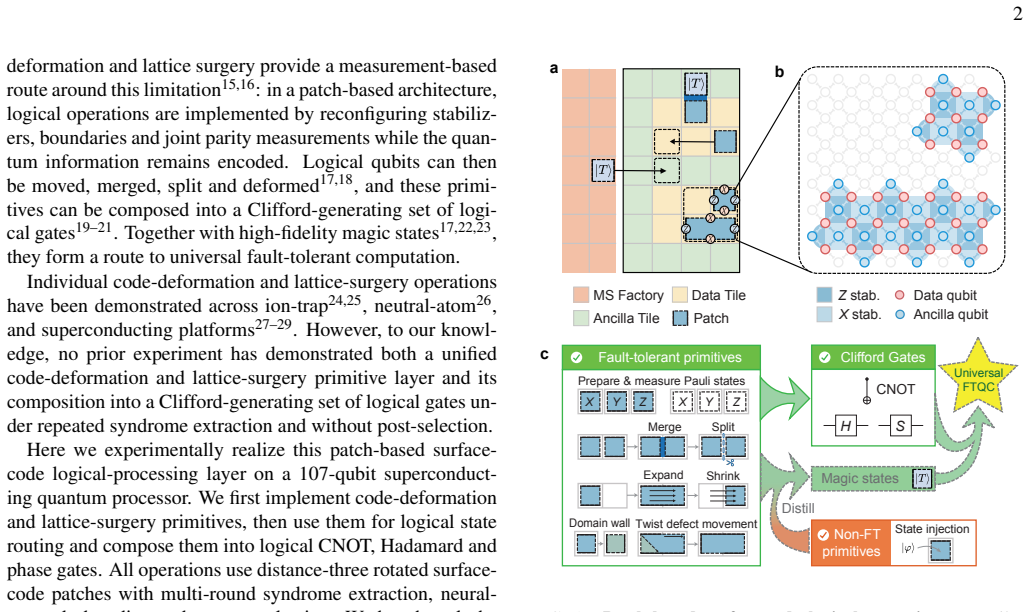
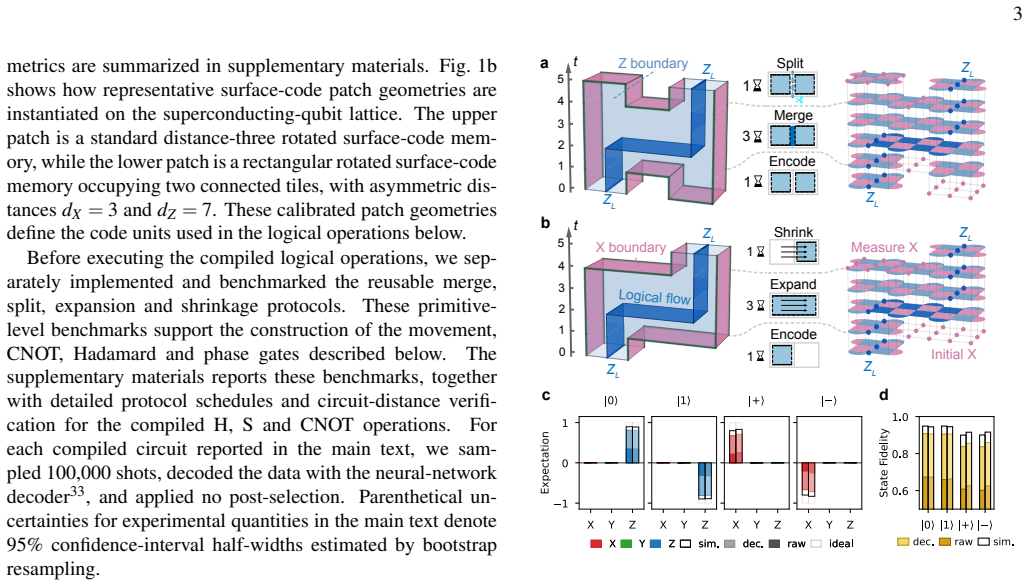
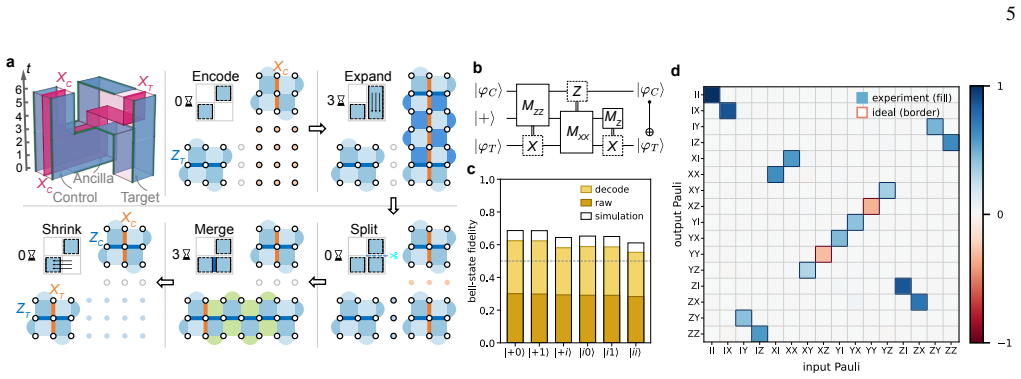
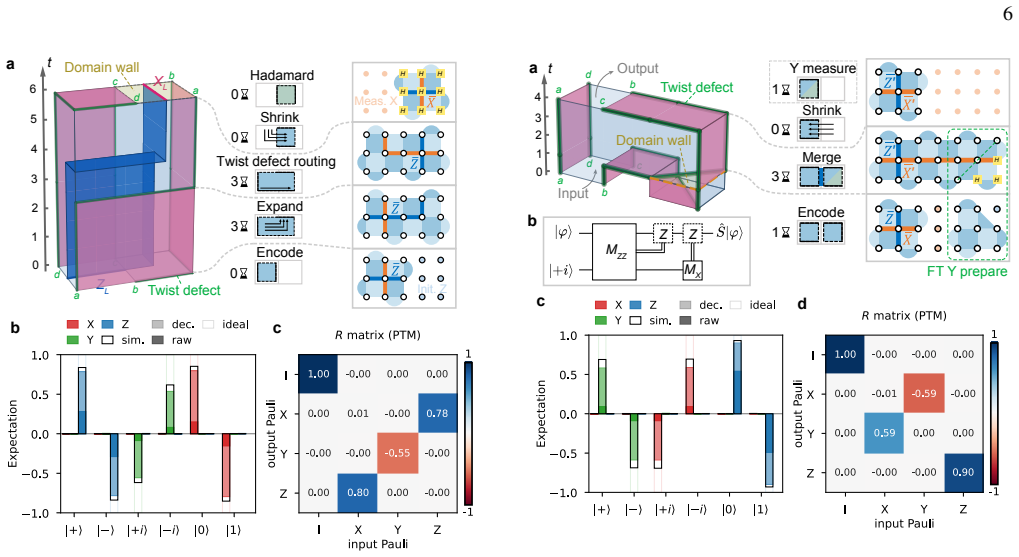
We experimentally realize key elements of patch-based surface-code logical processing on a 107-qubit superconducting quantum processor. We first implement a reusable primitive layer comprising merge and split, patch expansion and shrinkage, and deformations mediated by domain walls and twist defects. We then compose these primitives to realize logical state routing, the logical controlled-NOT gate, and the single-qubit Hadamard and phase gates, which together form a Clifford-generating set. All operations are implemented on distance-three rotated surface-code patches with multi-round syndrome extraction and neural-network decoding, without post-selection.
What carries the argument
Lattice-surgery primitives (merge, split, expansion, shrinkage, domain walls, twist defects) acting on distance-three rotated surface-code patches, combined with multi-round syndrome extraction and neural-network decoding.
If this is right
- Logical routing of quantum states between separate patches can be achieved by composing merge, split, and deformation operations.
- A logical controlled-NOT gate is realized between two distance-three patches through lattice surgery without post-selection.
- Single-qubit Hadamard and phase gates together with the logical CNOT generate the full Clifford group on the encoded qubits.
- All operations maintain the distance-three error-correction threshold through repeated syndrome measurements decoded by a neural network.
Where Pith is reading between the lines
- Extending the same primitives to distance-five or higher patches would test whether logical error rates continue to drop with code distance during active gates.
- The demonstrated Clifford set could serve as a foundation for injecting non-Clifford states to reach universal fault-tolerant computation.
- Real-time neural-network decoding on hardware of this scale indicates a practical path for handling the classical processing load of larger surface-code processors.
Load-bearing premise
The neural-network decoder correctly identifies and corrects errors across the multi-round syndrome extraction cycles on distance-3 patches without introducing undetected logical errors that would invalidate the gate fidelities.
What would settle it
Observing that the logical error rate extracted from the final patch states fails to decrease (or increases) when the number of syndrome-extraction rounds is increased would falsify the claim that the operations preserve error-correction protection.
Figures
read the original abstract
Fault-tolerant quantum computation requires logical operations that manipulate encoded information while preserving quantum error-correction protection. In planar surface-code architectures, code deformation and lattice surgery provide a local, measurement-based route to such operations. Here we experimentally realize key elements of patch-based surface-code logical processing on a 107-qubit superconducting quantum processor. We first implement a reusable primitive layer comprising merge and split, patch expansion and shrinkage, and deformations mediated by domain walls and twist defects. We then compose these primitives to realize logical state routing, the logical controlled-NOT gate, and the single-qubit Hadamard and phase gates, which together form a Clifford-generating set. All operations are implemented on distance-three rotated surface-code patches with multi-round syndrome extraction and neural-network decoding, without post-selection. Our results advance superconducting surface-code experiments from protected logical memory to active, patch-based fault-tolerant logical operations.
Editorial analysis
A structured set of objections, weighed in public.
Referee Report
Summary. The paper claims an experimental realization of patch-based surface-code logical processing on a 107-qubit superconducting processor. It implements a primitive layer of merge/split, patch expansion/shrinkage, and domain-wall/twist-defect deformations, then composes these into logical routing, CNOT, Hadamard, and phase gates (a Clifford-generating set) on distance-3 rotated surface-code patches. All operations use multi-round syndrome extraction and neural-network decoding without post-selection.
Significance. If the results hold, the work advances superconducting surface-code experiments from logical memory to active, patch-based logical operations at a scale of 107 qubits. The reusable primitive layer and explicit composition to a Clifford set provide a concrete experimental pathway for lattice-surgery-based fault tolerance. The absence of post-selection on d=3 patches is a notable experimental strength if supported by the data.
major comments (2)
- [Abstract] Abstract and decoder description: The central claim that operations are realized 'without post-selection' rests on the neural-network decoder producing no undetected logical errors on multi-round syndrome data from d=3 patches. No quantitative logical-error rates, error budgets, or raw fidelity numbers are stated, and no cross-validation against MWPM or lookup-table decoding on the experimental syndrome streams is reported. This directly affects whether the measured gate fidelities can be trusted.
- [Results] Results on gate composition: The logical CNOT, H, and S gates are obtained by composing the primitives, but without reported logical error rates per gate or comparison to the underlying physical error rates, it is not possible to confirm that the distance-3 protection is preserved through the multi-round cycles.
minor comments (1)
- Figure captions should explicitly state the number of syndrome extraction rounds and the training data used for the neural-network decoder to allow direct assessment of the d=3 performance.
Simulated Author's Rebuttal
We thank the referee for the constructive comments highlighting the need for quantitative metrics to support the no-post-selection claims and distance-3 protection. We agree these details strengthen the paper and have revised the manuscript to incorporate logical error rates, error budgets, and decoder cross-validation.
read point-by-point responses
-
Referee: [Abstract] Abstract and decoder description: The central claim that operations are realized 'without post-selection' rests on the neural-network decoder producing no undetected logical errors on multi-round syndrome data from d=3 patches. No quantitative logical-error rates, error budgets, or raw fidelity numbers are stated, and no cross-validation against MWPM or lookup-table decoding on the experimental syndrome streams is reported. This directly affects whether the measured gate fidelities can be trusted.
Authors: We agree that explicit quantitative support is required. The revised manuscript adds a dedicated decoder performance subsection reporting logical error rates per operation (extracted from the full neural-network-decoded dataset with no post-selection), including error budgets broken down by physical error sources. We also include a direct comparison of the neural-network decoder against MWPM on the experimental syndrome streams from the d=3 patches, confirming consistent logical error suppression. These additions allow independent assessment of the gate fidelities. revision: yes
-
Referee: [Results] Results on gate composition: The logical CNOT, H, and S gates are obtained by composing the primitives, but without reported logical error rates per gate or comparison to the underlying physical error rates, it is not possible to confirm that the distance-3 protection is preserved through the multi-round cycles.
Authors: We concur that per-gate logical error rates and physical comparisons are needed to verify preservation of distance-3 protection. The revised Results section now reports logical error rates for each composed gate (CNOT, H, S) over the multi-round cycles and directly compares them to the measured physical error rates on the device. The data show logical rates suppressed relative to physical rates, consistent with d=3 error correction being maintained through the primitive compositions. revision: yes
Circularity Check
No circularity: experimental outcomes with no derivation chain or fitted predictions
full rationale
The manuscript presents direct experimental results from a 107-qubit processor implementing merge/split, deformations, routing, CNOT, Hadamard and phase gates on d=3 surface-code patches using multi-round syndrome extraction and neural-network decoding. No equations, ansatzes, or first-principles derivations are claimed; no parameters are fitted to data and then relabeled as predictions; no self-citation chain is invoked to justify uniqueness or load-bearing premises. The neural-network decoder is an applied post-processing step whose correctness is an empirical assumption (not a definitional loop), and the paper does not reduce any reported fidelity or operation to its own inputs by construction. This is a standard experimental report whose claims stand or fall on hardware data rather than internal redefinition.
Axiom & Free-Parameter Ledger
Reference graph
Works this paper leans on
-
[1]
He, T. et al. Experimental quantum error correction below the surface code threshold via all-microwave leakage suppression. Physical Review Letters135, 260601 (2025). 32
2025
-
[2]
Gao, D. et al. Establishing a new benchmark in quantum computational advantage with 105-qubit zuchongzhi 3.0 processor. Physical Review Letters134, 090601 (2025)
2025
-
[3]
Jiang, T. et al. One- and two-dimensional cluster states for topological phase simulation and measurement-based quantum computation. Nature Physics22, 430–438 (2026)
2026
-
[4]
P., Tuckett, D
Bonilla Ataides, J. P., Tuckett, D. K., Bartlett, S. D., Flammia, S. T. & Brown, B. J. The xzzx surface code. Nature communications12, 2172 (2021)
2021
-
[5]
Arute, F. et al. Quantum supremacy using a programmable superconducting processor. Nature574, 505–510 (2019)
2019
- [6]
-
[7]
G., Devitt, S
Horsman, C., Fowler, A. G., Devitt, S. & Van Meter, R. Surface code quantum computing by lattice surgery. New Journal of Physics14, 123011 (2012)
2012
-
[8]
A game of surface codes: Large-scale quantum computing with lattice surgery
Litinski, D. A game of surface codes: Large-scale quantum computing with lattice surgery. Quantum3, 128 (2019)
2019
-
[9]
BeliefMatching: An implementation of the belief-matching decoder (v0.1.0).https://github.com/oscarhiggott/ BeliefMatching(2023)
Higgott, O. BeliefMatching: An implementation of the belief-matching decoder (v0.1.0).https://github.com/oscarhiggott/ BeliefMatching(2023)
2023
-
[10]
PyMatching: A python package for quantum error-correction decoding with minimum-weight perfect matching.https: //github.com/oscarhiggott/PyMatching(2025)
Higgott, O. PyMatching: A python package for quantum error-correction decoding with minimum-weight perfect matching.https: //github.com/oscarhiggott/PyMatching(2025)
2025
- [11]
-
[12]
Bausch, J. et al. Learning high-accuracy error decoding for quantum processors. Nature635, 834–840 (2024)
2024
-
[13]
Chuang, I. L. & Nielsen, M. A. Prescription for experimental determination of the dynamics of a quantum black box. Journal of Modern Optics44, 2455–2467 (1997)
1997
-
[14]
Lacroix, N., Bourassa, A., Heras, F. J. H. et al. Scaling and logic in the colour code on a superconducting quantum processor. Nature645, 614–619 (2025)
2025
- [15]
-
[16]
Erhard, A. et al. Entangling logical qubits with lattice surgery. Nature589, 220–224 (2021)
2021
-
[17]
Ryan-Anderson, C. et al. High-fidelity teleportation of a logical qubit using transversal gates and lattice surgery. Science385, 1327–1331 (2024)
2024
-
[18]
Bluvstein, D. et al. A fault-tolerant neutral-atom architecture for universal quantum computation. Nature649, 39–46 (2026)
2026
-
[19]
Besedin, I. et al. Lattice surgery realized on two distance-three repetition codes with superconducting qubits. Nature Physics22, 189–194 (2026)
2026
-
[20]
A superconducting surface-code processor with lattice-surgery logical operations
Wang, Y .et al. A superconducting surface-code processor with lattice-surgery logical operations (2026). arXiv.2606.06598
work page internal anchor Pith review Pith/arXiv arXiv 2026
-
[21]
Inplace access to the surface code Y basis
Gidney, C. Inplace access to the surface code Y basis. Quantum8, 1310 (2024)
2024
-
[22]
Quantum error correction below the surface code threshold
Google Quantum AI & Collaborators. Quantum error correction below the surface code threshold. Nature638, 920–926 (2025)
2025
-
[23]
P., McLauchlan, C., Campbell, E
Geh ´er, G. P., McLauchlan, C., Campbell, E. T., Moylett, A. E. & Crawford, O. Error-corrected Hadamard gate simulated at the circuit level. Quantum8, 1394 (2024)
2024
-
[24]
J., Laubscher, K., Kesselring, M
Brown, B. J., Laubscher, K., Kesselring, M. S. & Wootton, J. R. Poking holes and cutting corners to achieve Clifford gates with the surface code. Physical Review X7, 021029 (2017)
2017
-
[25]
Logical blocks for fault-tolerant topological quantum computation
Bomb ´ın, H.et al. Logical blocks for fault-tolerant topological quantum computation. PRX Quantum4, 020303 (2023)
2023
-
[26]
Stim: a fast stabilizer circuit simulator
Gidney, C. Stim: a fast stabilizer circuit simulator. Quantum5, 497 (2021)
2021
-
[27]
Krentel, M. W. The complexity of optimization problems. Journal of Computer and System Sciences36, 490–509 (1988)
1988
-
[28]
Hirai, Y ., Ikari, S., Ueno, Y . & Suzuki, Y . A 2d×d×dspacetime volume implementation of a logical S gate in the surface code (2026). arXiv.2604.13632
work page internal anchor Pith review Pith/arXiv arXiv 2026
discussion (0)
Sign in with ORCID, Apple, or X to comment. Anyone can read and Pith papers without signing in.