A Validation Framework for Quantum Simulation of Spin Dynamics against Inelastic Neutron Scattering and Classical Simulation
Pith reviewed 2026-07-03 13:13 UTC · model grok-4.3
The pith
A cross-pipeline framework validates quantum simulations of spin dynamics by mapping observables to inelastic neutron scattering and classical many-body results while propagating uncertainties explicitly.
A machine-rendered reading of the paper's core claim, the machinery that carries it, and where it could break.
Core claim
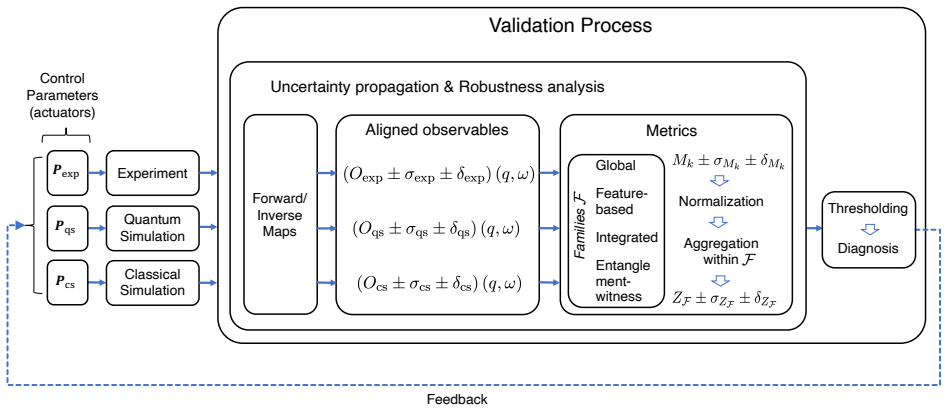
The central claim is that quantitative validation of quantum simulations of dynamical spin response is achievable through a cross-pipeline framework anchored by inelastic neutron scattering and classical many-body simulation. The framework rests on explicit forward and inverse observable maps, covariance- or resampling-based uncertainty propagation, robustness tests for structured distortion, and a hierarchy of complementary metric families. It distinguishes stochastic uncertainty from robustness-induced distortion, propagates both through the comparison chain, and uses the resulting information for layered validation at pipeline, solver, and model levels, supplemented by actuator-aware feed
What carries the argument
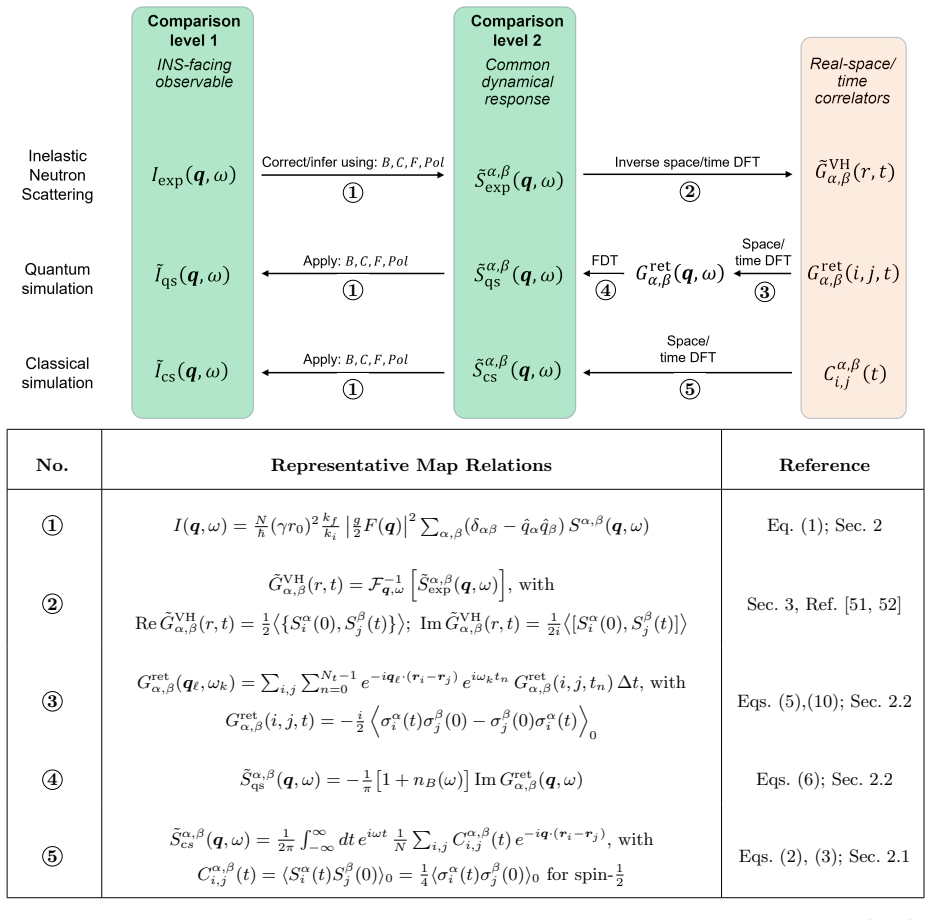
The cross-pipeline validation framework that employs forward and inverse observable maps, covariance- or resampling-based uncertainty propagation, and robustness tests for structured distortion to enable layered comparisons across experimental, classical, and quantum data sources.
If this is right
- Layered validation becomes possible at pipeline, solver, and model levels with explicit uncertainty and distortion information attached to each metric.
- Stochastic uncertainty can be separated from robustness-induced distortion in every comparison step.
- Actuator-aware feedback can be applied to improve agreement while preserving the physical origin of remaining mismatches.
- The same structure supports future extensions to upstream uncertainty modeling, adaptive feedback, asymmetric validation, and fault-tolerant workflows.
Where Pith is reading between the lines
- The framework could be tested on systems where classical simulation remains feasible but quantum hardware runs are limited, to check whether the maps preserve enough information for useful validation.
- Extensions to other dynamical observables beyond spin response would require new forward and inverse maps but could reuse the uncertainty and distortion propagation machinery.
- Community infrastructure for sharing mapped datasets and metric hierarchies might allow independent groups to reproduce the layered validation steps on the same physical model.
Load-bearing premise
The chosen forward and inverse observable maps together with the covariance or resampling uncertainty propagation faithfully transmit the physical content of each data source without introducing unaccounted systematic bias.
What would settle it
Observation of a persistent mismatch between mapped quantum simulation results and the neutron-scattering or classical data after all propagated uncertainties and accounted distortions are included would falsify the claim of valid layered validation at the model level.
Figures
read the original abstract
Quantitative validation of quantum simulations of dynamical spin response remains challenging because experiment, classical simulation, and quantum simulation do not produce the same native observables. This problem has become increasingly important as quantum simulation protocols for dynamical response have progressed from theory to hardware-level benchmarking against neutron-scattering data, while the longer term goal is validation in regimes that may eventually become classically intractable, including in future fault-tolerant implementations. Here, we develop a cross-pipeline validation framework for quantum simulation, using inelastic neutron scattering and classical many-body simulation as complementary experimental and computational anchors, based on explicit forward and inverse observable maps, covariance- or resampling-based uncertainty propagation, robustness tests for structured distortion, and a hierarchy of complementary metric families. The framework distinguishes stochastic uncertainty from robustness-induced distortion, carries both explicitly through the comparison chain, and uses the resulting metric-level uncertainty and distortion information to support layered validation at the pipeline, solver, and model levels. We also introduce actuator-aware feedback logic aimed at improving agreement without obscuring the physical origin of any remaining mismatch. We close by outlining future extensions of this methodology, including upstream uncertainty and distortion modeling, adaptive feedback, asymmetric validation beyond full classical benchmarking, fault-tolerant workflows, and community infrastructure for reproducible validation.
Editorial analysis
A structured set of objections, weighed in public.
Referee Report
Summary. The paper claims to develop a cross-pipeline validation framework for quantum simulations of dynamical spin response. It uses inelastic neutron scattering and classical many-body simulation as anchors, relying on explicit forward and inverse observable maps, covariance- or resampling-based uncertainty propagation, robustness tests for structured distortion, a hierarchy of complementary metric families, actuator-aware feedback logic, and layered validation at pipeline/solver/model levels, while outlining future extensions including upstream modeling and fault-tolerant workflows.
Significance. If the proposed framework can be shown to work as described, it would address a genuine methodological gap in validating quantum simulations of spin dynamics against experiment when native observables differ and when regimes exceed classical reach. The explicit treatment of both uncertainty and distortion through the comparison chain, together with the metric hierarchy and feedback logic, represents a structured approach that could support reproducible benchmarking if the underlying maps prove bias-free in practice.
major comments (1)
- [Abstract and framework description sections] The manuscript describes the framework architecture, metric families, and actuator-aware feedback but supplies no concrete implementation, worked numerical example, or test case demonstrating that the forward/inverse observable maps plus covariance/resampling propagation distinguish stochastic uncertainty from robustness-induced distortion or support the claimed layered validation. This is load-bearing for the central claim, as the abstract and framework sections assert these capabilities without evidence that the maps transmit physical content without unaccounted systematic bias.
Simulated Author's Rebuttal
We thank the referee for their careful reading and for highlighting the importance of concrete demonstrations to support the framework's claims. We address the single major comment below.
read point-by-point responses
-
Referee: [Abstract and framework description sections] The manuscript describes the framework architecture, metric families, and actuator-aware feedback but supplies no concrete implementation, worked numerical example, or test case demonstrating that the forward/inverse observable maps plus covariance/resampling propagation distinguish stochastic uncertainty from robustness-induced distortion or support the claimed layered validation. This is load-bearing for the central claim, as the abstract and framework sections assert these capabilities without evidence that the maps transmit physical content without unaccounted systematic bias.
Authors: We agree that the current manuscript presents the validation framework at an architectural and methodological level without including a specific numerical test case or implementation example. This leaves the central claims about distinguishing stochastic uncertainty from distortion, the behavior of the observable maps, and the layered validation without direct empirical illustration in the text. In revision we will add a compact worked example based on a small spin-1/2 Heisenberg chain. The example will apply the forward and inverse maps, propagate uncertainties via both covariance and resampling routes, run structured-distortion robustness tests, and show how the metric hierarchy plus actuator-aware feedback separate uncertainty from bias. The added section will also explicitly check for unaccounted systematic bias in the maps. We view this addition as necessary to make the load-bearing claims verifiable while preserving the paper's primary contribution as a framework description. revision: yes
Circularity Check
No significant circularity identified
full rationale
The manuscript is a methods proposal that describes a cross-pipeline validation framework using forward/inverse observable maps, uncertainty propagation, and metric hierarchies. No equations, fitted parameters, or derivations are presented that reduce any claimed result to quantities defined by the authors' own prior choices or self-citations. The central claims rest on architectural descriptions and stated assumptions rather than any self-referential construction, making the derivation self-contained as a methodological outline.
Axiom & Free-Parameter Ledger
Reference graph
Works this paper leans on
-
[1]
Auerbach,Interacting electrons and quantum magnetism(Springer Science & Business Media, 2012)
A. Auerbach,Interacting electrons and quantum magnetism(Springer Science & Business Media, 2012)
2012
-
[2]
Savary and L
L. Savary and L. Balents, Reports on Progress in Physics80, 016502 (2017)
2017
-
[3]
S. B. Roy,Experimental techniques in magnetism and magnetic materials(Cambridge Univer- sity Press, 2023). 38
2023
-
[4]
Schollw¨ ock, Annals of Physics326, 96 (2011)
U. Schollw¨ ock, Annals of Physics326, 96 (2011)
2011
-
[5]
I. M. Georgescu, S. Ashhab, and F. Nori, Reviews of Modern Physics86, 153 (2014)
2014
-
[6]
A. J. Daley, I. Bloch, C. Kokail, S. Flannigan, N. Pearson, M. Troyer, and P. Zoller, Nature 607, 667 (2022)
2022
-
[7]
Fauseweh, Nature Communications15, 2123 (2024)
B. Fauseweh, Nature Communications15, 2123 (2024)
2024
-
[8]
Monroe, W
C. Monroe, W. C. Campbell, L.-M. Duan, Z.-X. Gong, A. V. Gorshkov, P. W. Hess, R. Islam, K. Kim, N. M. Linke, G. Pagano,et al., Reviews of Modern Physics93, 025001 (2021)
2021
-
[9]
Altman, K
E. Altman, K. R. Brown, G. Carleo, L. D. Carr, E. Demler, C. Chin, B. DeMarco, S. E. Economou, M. A. Eriksson, K.-M. C. Fu,et al., PRX Quantum2, 017003 (2021)
2021
-
[10]
A. T. Boothroyd,Principles of neutron scattering from condensed matter(Oxford University Press, 2020)
2020
-
[11]
Fannes, B
M. Fannes, B. Nachtergaele, and R. F. Werner, Communications in Mathematical Physics 144, 443 (1992)
1992
-
[12]
Verstraete, T
F. Verstraete, T. Nishino, U. Schollw¨ ock, M. C. Ba˜ nuls, G. K. Chan, and M. E. Stoudenmire, Nature Reviews Physics5, 273 (2023)
2023
-
[13]
S. R. White, Physical Review Letters69, 2863 (1992)
1992
-
[14]
S. R. White, Physical Review B48, 10345 (1993)
1993
-
[15]
Verstraete, V
F. Verstraete, V. Murg, and J. I. Cirac, Advances in Physics57, 143 (2008)
2008
-
[16]
M. B. Hastings, Journal of Statistical Mechanics: Theory and Experiment2007, P08024 (2007)
2007
-
[17]
Chiesa, F
A. Chiesa, F. Tacchino, M. Grossi, P. Santini, I. Tavernelli, D. Gerace, and S. Carretta, Nature Physics15, 455 (2019)
2019
-
[18]
N. M. Eassa, J. Gibbs, Z. Holmes, A. Sornborger, L. Cincio, G. Hester, P. Kairys, M. Motta, J. Cohn, and A. Banerjee, Physical Review B110, 184414 (2024)
2024
-
[19]
M. L. Baez, M. Goihl, J. Haferkamp, J. Bermejo-Vega, M. Gluza, and J. Eisert, Proceedings of the National Academy of Sciences117, 26123 (2020)
2020
-
[20]
Bauer, V
N. Bauer, V. Ale, P. Laurell, S. Huang, S. Watabe, D. A. Tennant, and G. Siopsis, Physical Review A111, 022442 (2025)
2025
-
[21]
Benchmarking quantum simulation with neutron-scattering experiments
Y.-T. Lee, K. Kumaran, B. Pokharel, A. Scheie, C. L. Sarkis, D. A. Tennant, T. Humble, A. Schleife, A. Kandala, and A. Banerjee, “Benchmarking quantum simulation with neutron- scattering experiments,” (2026), arXiv:2603.15608 [quant-ph]
work page internal anchor Pith review Pith/arXiv arXiv 2026
-
[22]
Y.-T. Lee, B. Pokharel, J. Cohn, A. Schleife, and A. Banerjee, Physical Review Letters136, 050603 (2026)
2026
-
[23]
S. Fomichev, K. Hejazi, I. Loaiza, M. S. Zini, A. Delgado, A.-C. Voigt, J. E. Mueller, and J. M. Arrazola, arXiv preprint arXiv:2405.11015 (2024). 39
-
[24]
S. Fomichev, P. A. Casares, J. Soni, U. Azad, A. Kunitsa, A.-C. Voigt, J. E. Mueller, and J. M. Arrazola, arXiv preprint arXiv:2506.15784 (2025)
-
[25]
Kunitsa, D
A. Kunitsa, D. Dhawan, S. Fomichev, J. M. Arrazola, M. Zhang, and T. F. Stetina, The Journal of Chemical Physics163(2025)
2025
-
[26]
Eisert, D
J. Eisert, D. Hangleiter, N. Walk, I. Roth, D. Markham, R. Parekh, U. Chabaud, and E. Kashefi, Nature Reviews Physics2, 382 (2020)
2020
-
[27]
Proctor, K
T. Proctor, K. Young, A. D. Baczewski, and R. Blume-Kohout, Nature Reviews Physics7, 105 (2025)
2025
-
[28]
Acuaviva, D
A. Acuaviva, D. Aguirre, R. Pe˜ na, and M. Sanz, Quantum Science and Technology11, 025004 (2026)
2026
-
[29]
Hashim, L
A. Hashim, L. B. Nguyen, N. Goss, B. Marinelli, R. K. Naik, T. Chistolini, J. Hines, J. P. Marceaux, Y. Kim, P. Gokhale,et al., PRX Quantum6, 030202 (2025)
2025
-
[30]
Zhang, G
H. Zhang, G. B. Hal´ asz, S. Ghosh, S. Jesse, T. Z. Ward, D. A. Tennant, M. A. McGuire, and J. Yan, Physical Review Letters136, 226301 (2026)
2026
-
[31]
G. L. Squires,Introduction to the Theory of Thermal Neutron Scattering, 3rd ed. (Cambridge University Press, 2012)
2012
-
[32]
S. W. Lovesey,Theory of Neutron Scattering from Condensed Matter. Volume 2: Polariza- tion Effects and Magnetic Scattering, International Series of Monographs on Physics, Vol. 2 (Clarendon Press, Oxford, 1986)
1986
-
[33]
M. Knap, A. Kantian, T. Giamarchi, I. Bloch, M. D. Lukin, and E. Demler, Physical Review Letters111, 147205 (2013)
2013
-
[34]
Mitarai and K
K. Mitarai and K. Fujii, Physical Review Research1, 013006 (2019)
2019
- [35]
-
[36]
S. R. White and A. E. Feiguin, Physical Review Letters93, 076401 (2004)
2004
-
[37]
A. E. Feiguin and S. R. White, Physical Review B—Condensed Matter and Materials Physics 72, 020404 (2005)
2005
-
[38]
A. J. Daley, C. Kollath, U. Schollw¨ ock, and G. Vidal, Journal of Statistical Mechanics: Theory and Experiment2004, P04005 (2004)
2004
-
[39]
S. R. White and I. Affleck, Physical Review B—Condensed Matter and Materials Physics77, 134437 (2008)
2008
-
[40]
T. D. K¨ uhner and S. R. White, Physical Review B60, 335 (1999)
1999
-
[41]
Jeckelmann, Physical Review B66, 045114 (2002)
E. Jeckelmann, Physical Review B66, 045114 (2002)
2002
-
[42]
Jeckelmann, Progress of Theoretical Physics Supplement176, 143 (2008)
E. Jeckelmann, Progress of Theoretical Physics Supplement176, 143 (2008)
2008
-
[43]
Nocera and G
A. Nocera and G. Alvarez, Physical Review E94, 053308 (2016). 40
2016
-
[44]
K. A. Hallberg, Physical Review B52, R9827 (1995)
1995
-
[45]
P. E. Dargel, A. Honecker, R. Peters, R. Noack, and T. Pruschke, Physical Review B—Condensed Matter and Materials Physics83, 161104 (2011)
2011
-
[46]
P. E. Dargel, A. Woellert, A. Honecker, I. McCulloch, U. Schollw¨ ock, and T. Pruschke, Physical Review B—Condensed Matter and Materials Physics85, 205119 (2012)
2012
-
[47]
Holzner, A
A. Holzner, A. Weichselbaum, I. P. McCulloch, U. Schollw¨ ock, and J. von Delft, Physical Review B—Condensed Matter and Materials Physics83, 195115 (2011)
2011
-
[48]
F. A. Wolf, J. A. Justiniano, I. P. McCulloch, and U. Schollw¨ ock, Physical Review B91, 115144 (2015)
2015
-
[49]
R. G. Pereira, S. R. White, and I. Affleck, Physical Review Letters100, 027206 (2008)
2008
-
[50]
Barthel, U
T. Barthel, U. Schollw¨ ock, and S. R. White, Physical Review B—Condensed Matter and Materials Physics79, 245101 (2009)
2009
-
[51]
Scheie, P
A. Scheie, P. Laurell, B. Lake, S. E. Nagler, M. B. Stone, J.-S. Caux, and D. A. Tennant, Nature Communications13, 5796 (2022)
2022
-
[52]
A. Scheie, J. Willsher, E. A. Ghioldi, K. Wang, P. Laurell, J. E. Moore, C. D. Batista, J. Knolle, and D. A. Tennant, “Nonlinear light cone spreading of correlations in a triangular quantum magnet: a hard quantum simulation target,” (2026), arXiv:2602.02433
-
[53]
Joint Committee for Guides in Metrology (JCGM),Evaluation of Measurement Data — Guide to the Expression of Uncertainty in Measurement, 1st ed., JCGM 100:2008 (BIPM, 2008)
2008
-
[54]
Joint Committee for Guides in Metrology (JCGM),Guide to the Expression of Uncertainty in Measurement — Part 6: Developing and Using Measurement Models, JCGM GUM-6:2020 (BIPM, 2020)
2020
-
[55]
Saltelli, M
A. Saltelli, M. Ratto, T. Andres, F. Campolongo, J. Cariboni, D. Gatelli, M. Saisana, and S. Tarantola,Global Sensitivity Analysis: The Primer(Wiley, Chichester, 2008)
2008
-
[56]
Guide to the Expression of Uncertainty in Measurement
Joint Committee for Guides in Metrology (JCGM),Evaluation of Measurement Data — Sup- plement 1 to the “Guide to the Expression of Uncertainty in Measurement” — Propagation of Distributions Using a Monte Carlo Method, 1st ed., JCGM 101:2008 (BIPM, 2008)
2008
-
[57]
Eurachem guide: The fitness for purpose of analytical methods – a laboratory guide to method validation and related topics,
H. Cantwell, “Eurachem guide: The fitness for purpose of analytical methods – a laboratory guide to method validation and related topics,” Eurachem Guide (2025), 3rd ed
2025
-
[58]
J. R. Taylor,An Introduction to Error Analysis: The Study of Uncertainties in Physical Mea- surements, 3rd ed. (University Science Books, 2022)
2022
-
[59]
M. A. Nielsen and I. L. Chuang,Quantum computation and quantum information(Cambridge university press, 2010)
2010
-
[60]
Chang, E
Y. Chang, E. G. van Loon, B. Eskridge, B. Busemeyer, M. A. Morales, C. E. Dreyer, A. J. Millis, S. Zhang, T. O. Wehling, L. K. Wagner,et al., npj Computational Materials10, 129 (2024). 41
2024
-
[61]
Y. Gal, P. Koumoutsakos, F. Lanusse, G. Louppe, and C. Papadimitriou, Nature Reviews Physics4, 573 (2022)
2022
-
[62]
Robert, E
J. Robert, E. Lhotel, G. Remenyi, S. Sahling, I. Mirebeau, C. Decorse, B. Canals, and S. Petit, Physical Review B92, 064425 (2015)
2015
-
[63]
J. Thompson, P. A. McClarty, D. Prabhakaran, I. Cabrera, T. Guidi, and R. Coldea, arXiv preprint arXiv:1703.04506 (2017)
work page internal anchor Pith review Pith/arXiv arXiv 2017
-
[64]
Scheie, J
A. Scheie, J. Kindervater, S. Zhang, H. J. Changlani, G. Sala, G. Ehlers, A. Heinemann, G. S. Tucker, S. M. Koohpayeh, and C. Broholm, Proceedings of the National Academy of Sciences 117, 27245 (2020)
2020
-
[65]
Magnetic order, magnons, and crystal fields in van der Waals CeSiI
W. Simeth, C. A. Occhialini, M. E. Ziebel, N. W. Hewage, S. J. Li, D. Pajerowski, T. Kim, B. Zager, J. Pelliciari, K. Barros,et al., arXiv preprint arXiv:2605.28698 (2026)
work page internal anchor Pith review Pith/arXiv arXiv 2026
-
[66]
Cowan,Statistical Data Analysis(Oxford University Press, Oxford, 1998)
G. Cowan,Statistical Data Analysis(Oxford University Press, Oxford, 1998)
1998
-
[67]
Efron and R
B. Efron and R. J. Tibshirani,An introduction to the bootstrap(Chapman and Hall/CRC, 1994)
1994
-
[68]
A. C. Davison and D. V. Hinkley,Bootstrap methods and their application(Cambridge uni- versity press, 2013)
2013
-
[69]
Saltelli, K
A. Saltelli, K. Chan, and E. M. Scott,Sensitivity Analysis(Wiley, Chichester, 2000)
2000
-
[70]
J. W. Cooley and J. W. Tukey, Mathematics of computation19, 297 (1965)
1965
-
[71]
Ehler, K
M. Ehler, K. Gr¨ ochenig, and A. Klotz, SIAM Review68, 93 (2026)
2026
-
[72]
W. L. Briggs and V. E. Henson,The DFT: an owner’s manual for the discrete Fourier trans- form(SIAM, 1995)
1995
-
[73]
Plonka, D
G. Plonka, D. Potts, G. Steidl, and M. Tasche,Numerical fourier analysis(Springer, 2018)
2018
-
[74]
J. O. Smith,Mathematics of the Discrete Fourier Transform (DFT), with Audio Applications, 2nd ed. (W3K Publishing, Stanford, CA, 2007) online book, Center for Computer Research in Music and Acoustics (CCRMA), Stanford University
2007
-
[75]
Slepian, Bell System Technical Journal57, 1371 (1978)
D. Slepian, Bell System Technical Journal57, 1371 (1978)
1978
-
[76]
D. J. Thomson, Proceedings of the IEEE70, 1055 (1982)
1982
-
[77]
C. E. Shannon, Proceedings of the IRE37, 10 (1949)
1949
-
[78]
Patel, S
D. Patel, S. J. S. Tan, Y. Suba¸ sı, and A. T. Sornborger, PRX Quantum7, 020302 (2026)
2026
- [79]
-
[80]
Rubner, C
Y. Rubner, C. Tomasi, and L. J. Guibas, inSixth international conference on computer vision (IEEE Cat. No. 98CH36271)(IEEE, 1998) pp. 59–66
1998
discussion (0)
Sign in with ORCID, Apple, or X to comment. Anyone can read and Pith papers without signing in.