Classical and Loop Quantum Cosmology of Interacting Dark Energy: A Dynamical System Analysis with Superfluid Dark Matter and Dust Matter
Pith reviewed 2026-07-03 08:48 UTC · model grok-4.3
The pith
Loop quantum cosmology removes the stable late-time attractors found in classical interacting dark energy models with pressureless dark matter.
A machine-rendered reading of the paper's core claim, the machinery that carries it, and where it could break.
Core claim
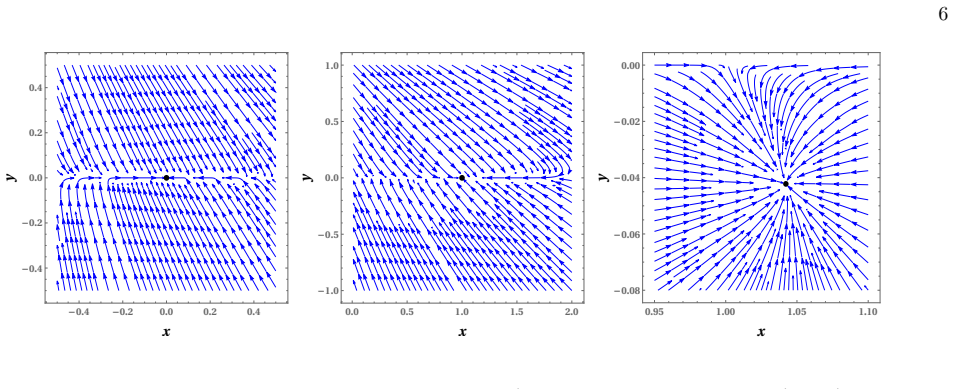
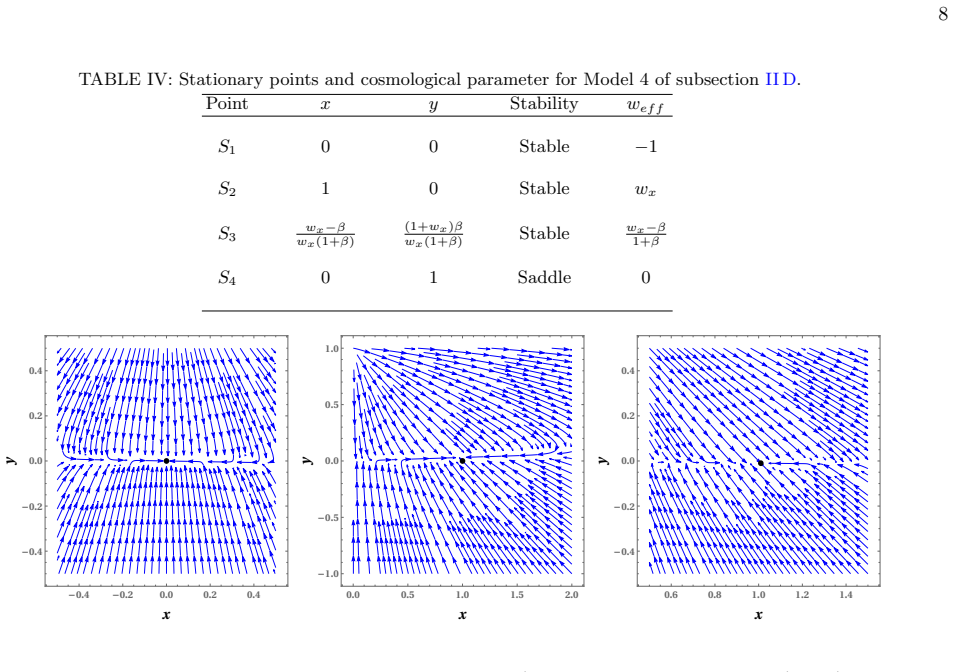
In classical Einstein gravity the pressureless dark matter model with the chosen interactions admits stable late-time attractors, whereas the superfluid dark matter model admits only saddle and non-hyperbolic critical points. Extending the analysis to loop quantum cosmology, the effective Friedmann equation supplied by quantum geometry replaces the Big Bang singularity with a nonsingular bounce and alters the phase-space flow so that the stable attractors disappear; consequently every interacting model possesses solely saddle and non-hyperbolic critical points.
What carries the argument
The autonomous dynamical system obtained from the Friedmann and continuity equations with interaction terms Q=α ρ̇_m and Q=β ρ̇_d, together with the loop-quantum-cosmology effective Friedmann equation that encodes the quantum bounce.
If this is right
- Stable late-time attractors present in the classical pressureless dark matter models vanish once quantum geometric corrections are included.
- All interacting dark-sector models in loop quantum cosmology are restricted to saddle and non-hyperbolic critical points.
- The quantum bounce modifies the entire phase-space dynamics rather than only the early universe.
- The distinction between superfluid and pressureless dark matter affects the nature of critical points in classical gravity but is less decisive once loop quantum corrections are active.
Where Pith is reading between the lines
- Late-time cosmology in these models may never settle into a simple de Sitter phase dominated by dark energy.
- The expansion history at intermediate redshifts could carry signatures of the altered attractor structure.
- Similar dynamical-system studies with different interaction forms or additional matter components would test whether the loss of stable points is generic.
Load-bearing premise
The chosen phenomenological interaction terms and the generalized cubic equation of state for superfluid dark matter correctly describe the energy transfer and dark matter properties.
What would settle it
A numerical integration or observational constraint showing that the universe approaches a stable accelerated-expansion state at late times in the pressureless interacting model would contradict the loop-quantum-cosmology phase-space result.
Figures
read the original abstract
We study the cosmological dynamics of interacting dark energy and dark matter in Classical Einstein Gravity and Loop Quantum Cosmology. Two dark matter scenarios are considered: superfluid dark matter described by a generalized cubic equation of state and the standard pressureless fluid. The dark energy component is modeled using both a generalized nonlinear equation of state and a constant equation of state. We examine two phenomenological interaction terms, $Q=\alpha\dot{\rho}_m$ and $Q=\beta\dot{\rho}_d$, which govern the energy transfer between the dark sectors. In classical gravity, the pressureless matter model exhibits stable late-time attractors, whereas the superfluid dark matter model admits only saddle and non-hyperbolic critical points. Extending the analysis to Loop Quantum Cosmology, quantum geometric corrections replace the Big Bang singularity with a nonsingular quantum bounce, and significantly modify the phase-space dynamics. As a result, the stable attractors of the classical pressureless matter model disappear, and all interacting models possess only saddle and non-hyperbolic critical points. These findings highlight the significant influence of both dark matter properties and quantum gravitational effects on the asymptotic evolution of interacting dark-sectors.
Editorial analysis
A structured set of objections, weighed in public.
Referee Report
Summary. The paper performs a dynamical systems analysis of interacting dark energy and dark matter cosmologies, considering both classical GR and loop quantum cosmology (LQC). It examines two dark matter models (superfluid DM with generalized cubic EOS and pressureless dust), two DE EOS choices (generalized nonlinear and constant w), and two phenomenological interactions (Q=α ρ̇_m and Q=β ρ̇_d). In classical gravity the pressureless case yields stable late-time attractors while the superfluid case yields only saddles and non-hyperbolic points; in LQC the quantum bounce replaces the singularity and removes all stable attractors, leaving only saddles and non-hyperbolic points in every interacting model examined.
Significance. If the autonomous-system construction and linear stability analysis are valid, the result shows that LQC geometric corrections can qualitatively alter the late-time phase-space structure of interacting dark-sector models, eliminating classical stable attractors. This provides a concrete illustration of how quantum-gravity effects can influence asymptotic cosmology even at low energies. The work employs standard dynamical-systems techniques and supplies explicit critical-point classifications, but the conclusions remain tied to the specific phenomenological interaction forms chosen.
major comments (2)
- [§4] §4 (LQC autonomous system derivation): substituting Q=α ρ̇_m (or β ρ̇_d) into the LQC-modified continuity equations does not automatically guarantee a closed autonomous vector field. Because the effective Friedmann and continuity equations contain the factor (1−ρ/ρ_c) multiplying the Hubble term, ρ̇_m itself depends on the modified H and densities; the resulting system may retain explicit time dependence or require additional algebraic constraints that are not stated. This directly affects both the location of the critical points and the subsequent Jacobian linearization used to classify them as saddles or non-hyperbolic.
- [§3.2, §5.1] §3.2 and §5.1 (classical vs. LQC comparison): the disappearance of all stable attractors in LQC is asserted for every interacting model, yet the paper does not provide an explicit check that the same interaction terms remain consistent with the LQC effective equations without introducing non-autonomous pieces. If the autonomy fails, the central claim that “all interacting models possess only saddle and non-hyperbolic critical points” rests on an incomplete dynamical system.
minor comments (2)
- [§2] Notation for the generalized cubic EOS of superfluid DM and the nonlinear DE EOS should be collected in a single table for clarity; currently the parameters appear piecemeal across sections.
- [Tables 2–5] The stability classification tables would benefit from an additional column listing the eigenvalues explicitly rather than only the qualitative type (stable/saddle/non-hyperbolic).
Simulated Author's Rebuttal
We thank the referee for the careful reading and constructive comments. Below we respond point by point to the major comments, clarifying the construction of the autonomous system while agreeing to strengthen the exposition where needed.
read point-by-point responses
-
Referee: [§4] §4 (LQC autonomous system derivation): substituting Q=α ρ̇_m (or β ρ̇_d) into the LQC-modified continuity equations does not automatically guarantee a closed autonomous vector field. Because the effective Friedmann and continuity equations contain the factor (1−ρ/ρ_c) multiplying the Hubble term, ρ̇_m itself depends on the modified H and densities; the resulting system may retain explicit time dependence or require additional algebraic constraints that are not stated. This directly affects both the location of the critical points and the subsequent Jacobian linearization used to classify them as saddles or non-hyperbolic.
Authors: We thank the referee for this observation. Substituting Q = α ρ̇_m into the continuity equation yields the algebraic rearrangement ρ̇_m = −3H(ρ_m + p_m)/(1 + α), which eliminates the derivative on the right-hand side. An analogous rearrangement holds for Q = β ρ̇_d. Because the LQC Friedmann equation supplies H as an explicit algebraic function of the total density ρ = ρ_m + ρ_de, the right-hand sides depend only on the densities. We then introduce the dimensionless variables x = ρ_de/ρ_c and y = ρ_m/ρ_c and evolve with respect to the number of e-folds N (d/dN = H^{-1} d/dt). The resulting vector field is closed and autonomous. We will expand §4 with the explicit algebraic steps and the definitions of the dimensionless variables to make this construction fully transparent. revision: yes
-
Referee: [§3.2, §5.1] §3.2 and §5.1 (classical vs. LQC comparison): the disappearance of all stable attractors in LQC is asserted for every interacting model, yet the paper does not provide an explicit check that the same interaction terms remain consistent with the LQC effective equations without introducing non-autonomous pieces. If the autonomy fails, the central claim that “all interacting models possess only saddle and non-hyperbolic critical points” rests on an incomplete dynamical system.
Authors: The autonomy follows directly from the algebraic elimination described above; the (1 − ρ/ρ_c) factor enters only through the expression for H and does not introduce explicit time dependence. The change in the nature of the fixed points arises because this factor modifies both the location of the critical points and the entries of the Jacobian matrix, causing the eigenvalues that were negative in the classical case to acquire positive real parts or to vanish. We will add a short subsection in the revised manuscript that tabulates, for each model, the critical-point coordinates, the Jacobian eigenvalues, and the resulting classification in both the classical and LQC settings, thereby providing the explicit verification requested. revision: partial
Circularity Check
No circularity; derivation is a standard autonomous-system analysis from the modified Friedmann and continuity equations.
full rationale
The paper sets up the dynamical system directly from the Friedmann and continuity equations with the stated phenomenological interaction terms Q=α ρ̇_m and Q=β ρ̇_d, plus the LQC correction factor (1−ρ/ρ_c). Critical-point classification follows from linearization of that vector field. No step reduces a claimed prediction or attractor property to a fitted parameter by construction, nor does any load-bearing premise rest on a self-citation chain. The analysis is self-contained against the input equations; the skeptic concern about residual time derivatives is a question of correctness of the autonomy claim, not a circular reduction of the result to its inputs.
Axiom & Free-Parameter Ledger
free parameters (3)
- interaction parameter α
- interaction parameter β
- EOS parameters for superfluid DM and nonlinear DE
axioms (2)
- domain assumption FLRW metric and standard cosmological equations hold
- ad hoc to paper The interaction terms are of the form Q=α ρ̇_m or Q=β ρ̇_d
Reference graph
Works this paper leans on
-
[1]
A. G. Riesset al.[Supernova Search Team], Astron. J.116(1998) 1009 doi:10.1086/300499 [astro-ph/9805201]
work page internal anchor Pith review Pith/arXiv arXiv doi:10.1086/300499 1998
-
[2]
Modified Gravity Theories on a Nutshell: Inflation, Bounce and Late-time Evolution
S. Nojiri, S. D. Odintsov and V. K. Oikonomou, Phys. Rept.692(2017) 1 doi:10.1016/j.physrep.2017.06.001 [arXiv:1705.11098 [gr-qc]]
work page internal anchor Pith review Pith/arXiv arXiv doi:10.1016/j.physrep.2017.06.001 2017
-
[3]
Nojiri, S.D
S. Nojiri, S.D. Odintsov, Phys. Rept.505, 59 (2011)
2011
-
[4]
Nojiri, S.D
S. Nojiri, S.D. Odintsov, eConfC0602061, 06 (2006) [Int. J. Geom. Meth. Mod. Phys.4, 115 (2007)]
2006
-
[5]
S. Capozziello, M. De Laurentis, Phys. Rept.509, 167 (2011); V. Faraoni and S. Capozziello, Fundam. Theor. Phys.170(2010). doi:10.1007/978-94-007-0165-6
-
[6]
A. de la Cruz-Dombriz and D. Saez-Gomez, Entropy14(2012) 1717 doi:10.3390/e14091717 [arXiv:1207.2663 [gr-qc]]
work page internal anchor Pith review Pith/arXiv arXiv doi:10.3390/e14091717 2012
-
[7]
G. J. Olmo, Int. J. Mod. Phys. D20(2011) 413 doi:10.1142/S0218271811018925 [arXiv:1101.3864 [gr-qc]]
work page internal anchor Pith review Pith/arXiv arXiv doi:10.1142/s0218271811018925 2011
-
[8]
S. Nojiri and S. D. Odintsov, Phys. Rev. D68(2003) 123512 doi:10.1103/PhysRevD.68.123512 [hep-th/0307288]
work page internal anchor Pith review Pith/arXiv arXiv doi:10.1103/physrevd.68.123512 2003
-
[9]
Fluid Interpretation of Cardassian Expansion
P. Gondolo and K. Freese, Phys. Rev. D68(2003) 063509 doi:10.1103/PhysRevD.68.063509 [hep-ph/0209322]
work page internal anchor Pith review Pith/arXiv arXiv doi:10.1103/physrevd.68.063509 2003
-
[10]
G. R. Farrar and P. J. E. Peebles, Astrophys. J.604(2004) 1 doi:10.1086/381728 [astro-ph/0307316]
work page internal anchor Pith review Pith/arXiv arXiv doi:10.1086/381728 2004
-
[11]
R. G. Cai and A. Wang, JCAP0503(2005) 002 doi:10.1088/1475-7516/2005/03/002 [hep-th/0411025]
work page internal anchor Pith review Pith/arXiv arXiv doi:10.1088/1475-7516/2005/03/002 2005
-
[12]
Z. K. Guo, R. G. Cai and Y. Z. Zhang, JCAP0505(2005) 002 doi:10.1088/1475-7516/2005/05/002 [astro-ph/0412624]
work page internal anchor Pith review Pith/arXiv arXiv doi:10.1088/1475-7516/2005/05/002 2005
-
[13]
B. Wang, J. Zang, C. Y. Lin, E. Abdalla and S. Micheletti, Nucl. Phys. B778(2007) 69 doi:10.1016/j.nuclphysb.2007.04.037 [astro-ph/0607126]
work page internal anchor Pith review Pith/arXiv arXiv doi:10.1016/j.nuclphysb.2007.04.037 2007
-
[14]
O. Bertolami, F. Gil Pedro and M. Le Delliou, Phys. Lett. B654(2007) 165 doi:10.1016/j.physletb.2007.08.046 [astro- ph/0703462 [ASTRO-PH]]
-
[15]
J. H. He and B. Wang, JCAP0806(2008) 010 doi:10.1088/1475-7516/2008/06/010 [arXiv:0801.4233 [astro-ph]]
work page internal anchor Pith review Pith/arXiv arXiv doi:10.1088/1475-7516/2008/06/010 2008
-
[16]
Large-scale instability in interacting dark energy and dark matter fluids
J. Valiviita, E. Majerotto and R. Maartens, JCAP0807(2008) 020 doi:10.1088/1475-7516/2008/07/020 [arXiv:0804.0232 [astro-ph]]
work page internal anchor Pith review Pith/arXiv arXiv doi:10.1088/1475-7516/2008/07/020 2008
-
[17]
B. M. Jackson, A. Taylor and A. Berera, Phys. Rev. D79(2009) 043526 doi:10.1103/PhysRevD.79.043526 [arXiv:0901.3272 [astro-ph.CO]]
work page internal anchor Pith review Pith/arXiv arXiv doi:10.1103/physrevd.79.043526 2009
-
[18]
Thermodynamics of dark energy interacting with dark matter and radiation
M. Jamil, E. N. Saridakis and M. R. Setare, Phys. Rev. D81(2010) 023007 doi:10.1103/PhysRevD.81.023007 [arXiv:0910.0822 [hep-th]]
work page internal anchor Pith review Pith/arXiv arXiv doi:10.1103/physrevd.81.023007 2010
-
[19]
J. H. He, B. Wang and E. Abdalla, Phys. Rev. D83(2011) 063515 doi:10.1103/PhysRevD.83.063515 [arXiv:1012.3904 [astro-ph.CO]]
work page internal anchor Pith review Pith/arXiv arXiv doi:10.1103/physrevd.83.063515 2011
-
[20]
Y. L. Bolotin, A. Kostenko, O. A. Lemets and D. A. Yerokhin, Int. J. Mod. Phys. D24(2014) no.03, 1530007 doi:10.1142/S0218271815300074 [arXiv:1310.0085 [astro-ph.CO]]
work page internal anchor Pith review Pith/arXiv arXiv doi:10.1142/s0218271815300074 2014
-
[21]
A. A. Costa, X. D. Xu, B. Wang, E. G. M. Ferreira and E. Abdalla, Phys. Rev. D89(2014) no.10, 103531 doi:10.1103/PhysRevD.89.103531 [arXiv:1311.7380 [astro-ph.CO]]
work page internal anchor Pith review Pith/arXiv arXiv doi:10.1103/physrevd.89.103531 2014
-
[22]
C. G. Boehmer, G. Caldera-Cabral, R. Lazkoz and R. Maartens, Phys. Rev. D78(2008) 023505 doi:10.1103/PhysRevD.78.023505 [arXiv:0801.1565 [gr-qc]]
work page internal anchor Pith review Pith/arXiv arXiv doi:10.1103/physrevd.78.023505 2008
-
[23]
Dark Energy Interacting with Dark Matter in Classical Einstein and Loop Quantum Cosmology
S. Li and Y. Ma, Eur. Phys. J. C68(2010) 227 doi:10.1140/epjc/s10052-010-1338-y [arXiv:1004.4350 [astro-ph.CO]]
work page internal anchor Pith review Pith/arXiv arXiv doi:10.1140/epjc/s10052-010-1338-y 2010
-
[24]
W. Yang, S. Pan and J. D. Barrow, arXiv:1706.04953 [astro-ph.CO]
work page internal anchor Pith review Pith/arXiv arXiv
-
[25]
K. Bamba, S. Capozziello, S. Nojiri and S. D. Odintsov, Astrophys. Space Sci.342(2012) 155 doi:10.1007/s10509-012- 1181-8 [arXiv:1205.3421 [gr-qc]]
work page internal anchor Pith review Pith/arXiv arXiv doi:10.1007/s10509-012- 2012
-
[26]
Theory of Dark Matter Superfluidity
L. Berezhiani and J. Khoury, Phys. Rev. D92(2015) 103510 doi:10.1103/PhysRevD.92.103510 [arXiv:1507.01019 [astro- ph.CO]]
work page internal anchor Pith review Pith/arXiv arXiv doi:10.1103/physrevd.92.103510 2015
-
[27]
Dark Matter Superfluidity and Galactic Dynamics
L. Berezhiani and J. Khoury, Phys. Lett. B753(2016) 639 doi:10.1016/j.physletb.2015.12.054 [arXiv:1506.07877 [astro- ph.CO]]
work page internal anchor Pith review Pith/arXiv arXiv doi:10.1016/j.physletb.2015.12.054 2016
-
[28]
Galaxy Clusters in the Context of Superfluid Dark Matter
A. Hodson, H. Zhao, J. Khoury and B. Famaey, Astron. Astrophys.607(2017) A108 doi:10.1051/0004-6361/201630069 [arXiv:1611.05876 [astro-ph.CO]]
work page internal anchor Pith review Pith/arXiv arXiv doi:10.1051/0004-6361/201630069 2017
-
[29]
Phenomenological consequences of superfluid dark matter with baryon-phonon coupling
L. Berezhiani, B. Famaey and J. Khoury, arXiv:1711.05748 [astro-ph.CO]
work page internal anchor Pith review Pith/arXiv arXiv
-
[30]
Dark Matter Self-interactions and Small Scale Structure
S. Tulin and H. B. Yu, Phys. Rept.730(2018) 1 doi:10.1016/j.physrep.2017.11.004 [arXiv:1705.02358 [hep-ph]]
work page internal anchor Pith review Pith/arXiv arXiv doi:10.1016/j.physrep.2017.11.004 2018
-
[31]
Dynamics of interacting quintessence
M. Shahalam, S. D. Pathak, M. M. Verma, M. Y. Khlopov and R. Myrzakulov, Eur. Phys. J. C75, no.8, 395 (2015) doi:10.1140/epjc/s10052-015-3608-1 [arXiv:1503.08712 [gr-qc]]
work page internal anchor Pith review Pith/arXiv arXiv doi:10.1140/epjc/s10052-015-3608-1 2015
-
[32]
Dynamics of coupled phantom and tachyon fields
M. Shahalam, S. D. Pathak, S. Li, R. Myrzakulov and A. Wang, Eur. Phys. J. C77, no.10, 686 (2017) doi:10.1140/epjc/s10052-017-5255-1 [arXiv:1702.04720 [gr-qc]]
work page internal anchor Pith review Pith/arXiv arXiv doi:10.1140/epjc/s10052-017-5255-1 2017
-
[33]
S. D. Odintsov and V. K. Oikonomou, Phys. Rev. D98(2018) no.2, 024013 doi:10.1103/PhysRevD.98.024013 [arXiv:1806.07295 [gr-qc]]. 18
work page internal anchor Pith review Pith/arXiv arXiv doi:10.1103/physrevd.98.024013 2018
-
[34]
S. D. Odintsov and V. K. Oikonomou, Phys. Rev. D97(2018) no.12, 124042 doi:10.1103/PhysRevD.97.124042 [arXiv:1806.01588 [gr-qc]]
work page internal anchor Pith review Pith/arXiv arXiv doi:10.1103/physrevd.97.124042 2018
-
[35]
S. D. Odintsov and V. K. Oikonomou, arXiv:1902.01422 [gr-qc]
work page internal anchor Pith review Pith/arXiv arXiv 1902
-
[36]
C. G. Boehmer and N. Chan, doi:10.1142/9781786341044.0004 arXiv:1409.5585 [gr-qc]
-
[37]
C. G. Boehmer, T. Harko and S. V. Sabau, Adv. Theor. Math. Phys.16(2012) no.4, 1145 doi:10.4310/ATMP.2012.v16.n4.a2 [arXiv:1010.5464 [math-ph]]
work page internal anchor Pith review Pith/arXiv arXiv doi:10.4310/atmp.2012.v16.n4.a2 2012
-
[38]
M. Sami, M. Shahalam, M. Skugoreva, A. Toporensky, M. Shahalam, M. Skugoreva and A. Toporensky, Phys. Rev. D86, 103532 (2012) doi:10.1103/PhysRevD.86.103532 [arXiv:1207.6691 [hep-th]]
work page internal anchor Pith review Pith/arXiv arXiv doi:10.1103/physrevd.86.103532 2012
-
[39]
Light mass galileon and late time acceleration of the Universe
R. Myrzakulov and M. Shahalam, Gen. Rel. Grav.47, no.7, 81 (2015) doi:10.1007/s10714-015-1915-3 [arXiv:1407.7798 [gr-qc]]
work page internal anchor Pith review Pith/arXiv arXiv doi:10.1007/s10714-015-1915-3 2015
-
[40]
M. Shahalam, R. Myrzakulov and M. Y. Khlopov, Gen. Rel. Grav.51, no.9, 125 (2019) doi:10.1007/s10714-019-2610-6 [arXiv:1905.06856 [gr-qc]]
-
[41]
M. Shahalam and S. Myrzakul, Gen. Rel. Grav.53, no.4, 45 (2021) doi:10.1007/s10714-021-02796-1 [arXiv:2011.06930 [gr-qc]]
-
[42]
Dynamical system analysis in descending dark energy model
M. Shahalam, S. Ayoub, P. Avlani and R. Myrzakulov, Int. J. Geom. Meth. Mod. Phys.23, no.08, 2550227 (2026) doi:10.1142/s0219887825502275 [arXiv:2402.01270 [gr-qc]]
work page internal anchor Pith review Pith/arXiv arXiv doi:10.1142/s0219887825502275 2026
- [43]
-
[44]
Y. Myrzakulov, M. Shahalam, S. Myrzakul and K. Yerzhanov, Annals Phys.485, 170315 (2026) doi:10.1016/j.aop.2025.170315
-
[45]
Galileon versus Quintessence: A comparative phase space analysis and late-time cosmic relevance
M. Shahalam, Eur. Phys. J. C86, no.4, 340 (2026) doi:10.1140/epjc/s10052-026-15595-2 [arXiv:2604.04582 [gr-qc]]
work page internal anchor Pith review Pith/arXiv arXiv doi:10.1140/epjc/s10052-026-15595-2 2026
-
[46]
Dynamical systems analysis of anisotropic cosmologies in $R^n$-gravity
N. Goheer, J. A. Leach and P. K. S. Dunsby, Class. Quant. Grav.24(2007) 5689 doi:10.1088/0264-9381/24/22/026 [arXiv:0710.0814 [gr-qc]]
work page internal anchor Pith review Pith/arXiv arXiv doi:10.1088/0264-9381/24/22/026 2007
-
[47]
Dynamical behavior in mimetic F(R) gravity
G. Leon and E. N. Saridakis, JCAP1504(2015) no.04, 031 doi:10.1088/1475-7516/2015/04/031 [arXiv:1501.00488 [gr-qc]]
work page internal anchor Pith review Pith/arXiv arXiv doi:10.1088/1475-7516/2015/04/031 2015
-
[48]
J. Q. Guo and A. V. Frolov, Phys. Rev. D88(2013) no.12, 124036 doi:10.1103/PhysRevD.88.124036 [arXiv:1305.7290 [astro-ph.CO]]
work page internal anchor Pith review Pith/arXiv arXiv doi:10.1103/physrevd.88.124036 2013
-
[49]
Dynamics of the anisotropic Kantowsky-Sachs geometries in $R^n$ gravity
G. Leon and E. N. Saridakis, Class. Quant. Grav.28(2011) 065008 doi:10.1088/0264-9381/28/6/065008 [arXiv:1007.3956 [gr-qc]]
work page internal anchor Pith review Pith/arXiv arXiv doi:10.1088/0264-9381/28/6/065008 2011
-
[50]
J. C. C. de Souza and V. Faraoni, Class. Quant. Grav.24(2007) 3637 doi:10.1088/0264-9381/24/14/006 [arXiv:0706.1223 [gr-qc]]
work page internal anchor Pith review Pith/arXiv arXiv doi:10.1088/0264-9381/24/14/006 2007
-
[51]
Dynamical Analysis of an Integrable Cubic Galileon Cosmological Model
A. Giacomini, S. Jamal, G. Leon, A. Paliathanasis and J. Saavedra, Phys. Rev. D95(2017) no.12, 124060 doi:10.1103/PhysRevD.95.124060 [arXiv:1703.05860 [gr-qc]]
work page internal anchor Pith review Pith/arXiv arXiv doi:10.1103/physrevd.95.124060 2017
-
[52]
Dynamical behavior in $f(T,T_G)$ cosmology
G. Kofinas, G. Leon and E. N. Saridakis, Class. Quant. Grav.31(2014) 175011 doi:10.1088/0264-9381/31/17/175011 [arXiv:1404.7100 [gr-qc]]
work page internal anchor Pith review Pith/arXiv arXiv doi:10.1088/0264-9381/31/17/175011 2014
-
[53]
Dynamical analysis of generalized Galileon cosmology
G. Leon and E. N. Saridakis, JCAP1303(2013) 025 doi:10.1088/1475-7516/2013/03/025 [arXiv:1211.3088 [astro-ph.CO]]
work page internal anchor Pith review Pith/arXiv arXiv doi:10.1088/1475-7516/2013/03/025 2013
-
[54]
T. Gonzalez, G. Leon and I. Quiros, Class. Quant. Grav.23(2006) 3165 doi:10.1088/0264-9381/23/9/025 [astro- ph/0702227]
-
[55]
A. Alho, S. Carloni and C. Uggla, JCAP1608(2016) no.08, 064 doi:10.1088/1475-7516/2016/08/064 [arXiv:1607.05715 [gr-qc]]
work page internal anchor Pith review Pith/arXiv arXiv doi:10.1088/1475-7516/2016/08/064 2016
-
[56]
Future dynamics in f(R) theories
D. Muller, V. C. de Andrade, C. Maia, M. J. Reboucas and A. F. F. Teixeira, Eur. Phys. J. C75(2015) no.1, 13 doi:10.1140/epjc/s10052-014-3227-2 [arXiv:1405.0768 [astro-ph.CO]]
work page internal anchor Pith review Pith/arXiv arXiv doi:10.1140/epjc/s10052-014-3227-2 2015
-
[57]
M. M. Ivanov and A. V. Toporensky, Grav. Cosmol.18(2012) 43 doi:10.1134/S0202289312010100 [arXiv:1106.5179 [gr-qc]]
work page internal anchor Pith review Pith/arXiv arXiv doi:10.1134/s0202289312010100 2012
-
[58]
R. D. Boko, M. J. S. Houndjo and J. Tossa, Int. J. Mod. Phys. D25(2016) no.10, 1650098 doi:10.1142/S021827181650098X [arXiv:1605.03404 [gr-qc]]
work page internal anchor Pith review Pith/arXiv arXiv doi:10.1142/s021827181650098x 2016
-
[59]
S. D. Odintsov, V. K. Oikonomou and P. V. Tretyakov, Phys. Rev. D96(2017) no.4, 044022 doi:10.1103/PhysRevD.96.044022 [arXiv:1707.08661 [gr-qc]]
work page internal anchor Pith review Pith/arXiv arXiv doi:10.1103/physrevd.96.044022 2017
-
[60]
L. N. Granda and D. F. Jimenez, arXiv:1710.07273 [gr-qc]
work page internal anchor Pith review Pith/arXiv arXiv
-
[61]
F. F. Bernardi and R. G. Landim, Eur. Phys. J. C77(2017) no.5, 290 doi:10.1140/epjc/s10052-017-4858-x [arXiv:1607.03506 [gr-qc]]
work page internal anchor Pith review Pith/arXiv arXiv doi:10.1140/epjc/s10052-017-4858-x 2017
-
[62]
K. Kleidis and V. K. Oikonomou, arXiv:1808.04674 [gr-qc]
work page internal anchor Pith review Pith/arXiv arXiv
-
[63]
Loop Quantum Cosmology: A Status Report
A. Ashtekar and P. Singh, Class. Quant. Grav.28(2011) 213001 [arXiv:1108.0893 [gr-qc]]
work page internal anchor Pith review Pith/arXiv arXiv 2011
-
[64]
Quantum Nature of the Big Bang
A. Ashtekar, T. Pawlowski and P. Singh, Phys. Rev. Lett.96(2006) 141301 [gr-qc/0602086]
work page internal anchor Pith review Pith/arXiv arXiv 2006
-
[65]
Quantum Nature of the Big Bang: An Analytical and Numerical Investigation
A. Ashtekar, T. Pawlowski and P. Singh, Phys. Rev. D73(2006) 124038 [gr-qc/0604013]
work page internal anchor Pith review Pith/arXiv arXiv 2006
-
[66]
Quantum Nature of the Big Bang: Improved dynamics
A. Ashtekar, T. Pawlowski and P. Singh, Phys. Rev. D74(2006) 084003 [gr-qc/0607039]
work page internal anchor Pith review Pith/arXiv arXiv 2006
-
[67]
Qualitative study in Loop Quantum Cosmology
L. Areste Salo, J. Amoros and J. de Haro, Class. Quant. Grav.34(2017) no.23, 235001 doi:10.1088/1361-6382/aa9311 [arXiv:1612.05480 [gr-qc]]
work page internal anchor Pith review Pith/arXiv arXiv doi:10.1088/1361-6382/aa9311 2017
-
[68]
H. H. Xiong, T. Qiu, Y. F. Cai and X. Zhang, Mod. Phys. Lett. A24(2009) 1237 doi:10.1142/S0217732309030667 [arXiv:0711.4469 [hep-th]]
work page internal anchor Pith review Pith/arXiv arXiv doi:10.1142/s0217732309030667 2009
-
[69]
On $R+\alpha R^2$ Loop Quantum Cosmology
J. Amoros, J. de Haro and S. D. Odintsov, Phys. Rev. D89(2014) no.10, 104010 doi:10.1103/PhysRevD.89.104010 [arXiv:1402.3071 [gr-qc]]
work page internal anchor Pith review Pith/arXiv arXiv doi:10.1103/physrevd.89.104010 2014
-
[70]
Y. F. Cai and E. Wilson-Ewing, JCAP1403(2014) 026 doi:10.1088/1475-7516/2014/03/026 [arXiv:1402.3009 [gr-qc]]
work page internal anchor Pith review Pith/arXiv arXiv doi:10.1088/1475-7516/2014/03/026 2014
-
[71]
Viability of the matter bounce scenario in Loop Quantum Cosmology from BICEP2 last data
J. de Haro and J. Amoros, JCAP1408(2014) 025 doi:10.1088/1475-7516/2014/08/025 [arXiv:1403.6396 [gr-qc]]
work page internal anchor Pith review Pith/arXiv arXiv doi:10.1088/1475-7516/2014/08/025 2014
-
[72]
Loop Quantum Cosmology Scalar Field Models
K. Kleidis and V. K. Oikonomou, Int. J. Geom. Meth. Mod. Phys.15(2018) no.05, 1850071 doi:10.1142/S0219887818500718 [arXiv:1801.02578 [gr-qc]]
work page internal anchor Pith review Pith/arXiv arXiv doi:10.1142/s0219887818500718 2018
-
[73]
Pre-inflationary dynamics in loop quantum cosmology: Power-law potentials
M. Shahalam, M. Sharma, Q. Wu and A. Wang, Phys. Rev. D96, no.12, 123533 (2017) doi:10.1103/PhysRevD.96.123533 19 [arXiv:1710.09845 [gr-qc]]
work page internal anchor Pith review Pith/arXiv arXiv doi:10.1103/physrevd.96.123533 2017
-
[74]
Preinflationary dynamics of $\alpha-$attractor in loop quantum cosmology
M. Shahalam, M. Sami and A. Wang, Phys. Rev. D98, no.4, 043524 (2018) doi:10.1103/PhysRevD.98.043524 [arXiv:1806.05815 [astro-ph.CO]]
work page internal anchor Pith review Pith/arXiv arXiv doi:10.1103/physrevd.98.043524 2018
-
[75]
Preinflationary dynamics of power-law potential in loop quantum cosmology
M. Shahalam, Universe4, 87 (2018) doi:10.3390/universe4080087 [arXiv:1807.04620 [gr-qc]]
work page internal anchor Pith review Pith/arXiv arXiv doi:10.3390/universe4080087 2018
-
[76]
Preinflationary dynamics in loop quantum cosmology: Monodromy Potential
M. Sharma, M. Shahalam, Q. Wu and A. Wang, JCAP11, 003 (2018) doi:10.1088/1475-7516/2018/11/003 [arXiv:1808.05134 [gr-qc]]
work page internal anchor Pith review Pith/arXiv arXiv doi:10.1088/1475-7516/2018/11/003 2018
-
[77]
M. Shahalam, M. Al Ajmi, R. Myrzakulov and A. Wang, Class. Quant. Grav.37, no.19, 195026 (2020) doi:10.1088/1361- 6382/aba486 [arXiv:1912.00616 [gr-qc]]
-
[78]
Loop Quantum Cosmology Corrected Gauss-Bonnet Singular Cosmology
K. Kleidis and V. K. Oikonomou, Int. J. Geom. Meth. Mod. Phys.15(2017) no.04, 1850064 doi:10.1142/S0219887818500640 [arXiv:1711.09270 [gr-qc]]
work page internal anchor Pith review Pith/arXiv arXiv doi:10.1142/s0219887818500640 2017
-
[79]
M. Sami, P. Singh and S. Tsujikawa, Phys. Rev. D74(2006) 043514 doi:10.1103/PhysRevD.74.043514 [gr-qc/0605113]
work page internal anchor Pith review Pith/arXiv arXiv doi:10.1103/physrevd.74.043514 2006
-
[80]
S. Nojiri, S. D. Odintsov and S. Tsujikawa, Phys. Rev. D71(2005) 063004 doi:10.1103/PhysRevD.71.063004 [hep- th/0501025]
discussion (0)
Sign in with ORCID, Apple, or X to comment. Anyone can read and Pith papers without signing in.