Resilient Liquid Democracy: Mitigating Voting Power Imbalances via Secure Delegation Networks
Pith reviewed 2026-07-03 11:12 UTC · model grok-4.3
The pith
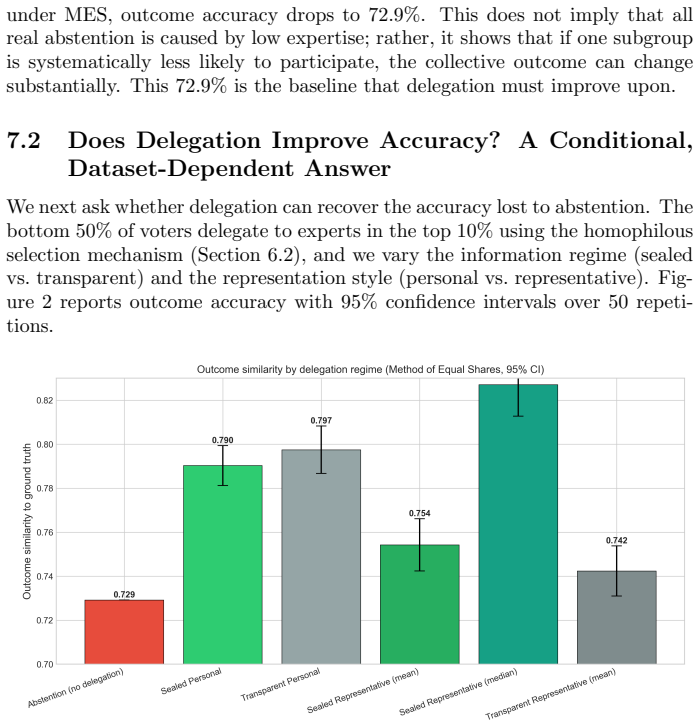
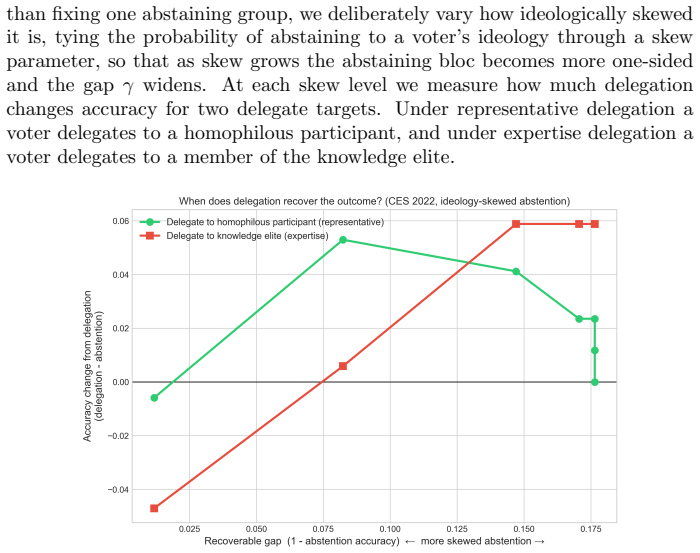
Delegation in liquid democracy improves representational accuracy only when abstention is large and systematically unrepresentative.
A machine-rendered reading of the paper's core claim, the machinery that carries it, and where it could break.
Core claim
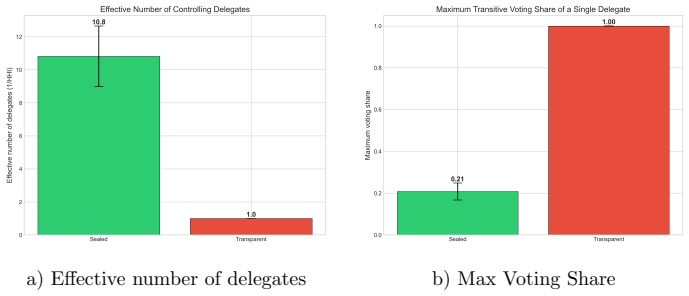
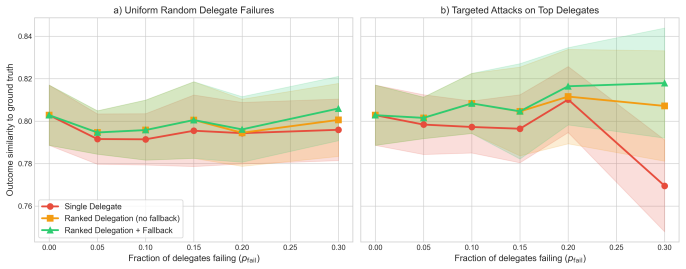
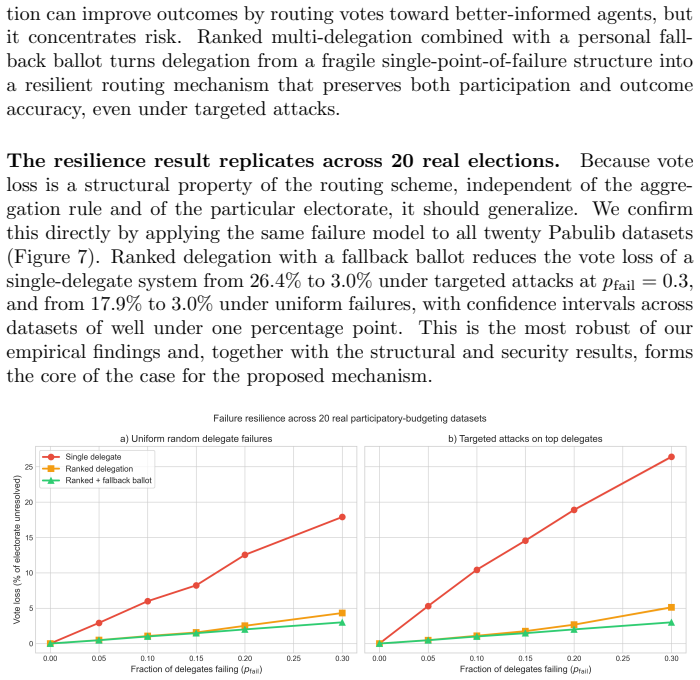
The paper claims that whether delegation improves representational accuracy follows a recoverable-gap law; it helps only when abstention is large and systematically unrepresentative, and is otherwise neutral or harmful, with representative-style delegation safer than delegating to a competence elite. The benefit of sealed formation is primarily structural, sharply reducing power concentration rather than directly improving accuracy. Ranked multi-delegation with personal fallback ballots sharply reduces vote loss under realistic and targeted delegate failures, replicating across all twenty elections.
What carries the argument
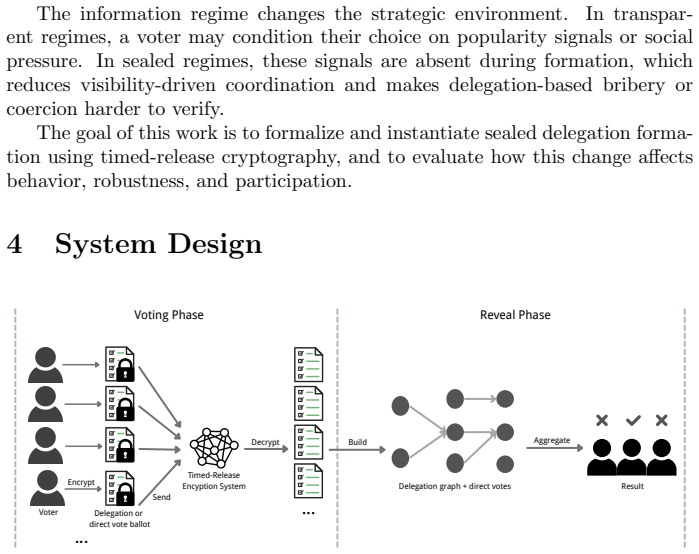
Sealed delegation regime using decentralized timed-release encryption, combined with ranked multi-delegation and personal fallback ballots
If this is right
- Delegation should be applied only when abstention is high and unrepresentative to gain accuracy benefits.
- Sealed formation primarily serves to reduce power concentration in delegation networks.
- Ranked multi-delegation with fallbacks mitigates vote loss from delegate failures across elections.
- Representative delegation is preferable to delegating based on competence measures.
- The protocol ensures pre-reveal secrecy and receipt-freeness while allowing final public audit.
Where Pith is reading between the lines
- Interfaces could monitor abstention to recommend delegation selectively.
- The structural focus on reducing concentration may generalize to other voting power systems.
- Additional experiments on different voting contexts could test the law's robustness.
- Prioritizing anti-herding mechanisms might yield more consistent benefits than accuracy-focused ones.
Load-bearing premise
The decentralized timed-release encryption delivers pre-reveal secrecy and resubmission receipt-freeness, and the datasets accurately capture delegation dynamics without selection bias.
What would settle it
Finding an election where delegation improves accuracy despite low or representative abstention, or demonstrating a way to reveal delegation choices before the tally despite the encryption.
Figures
read the original abstract
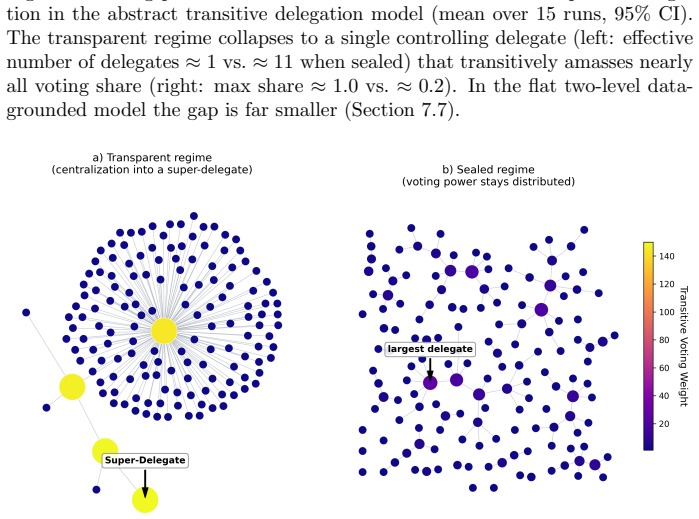
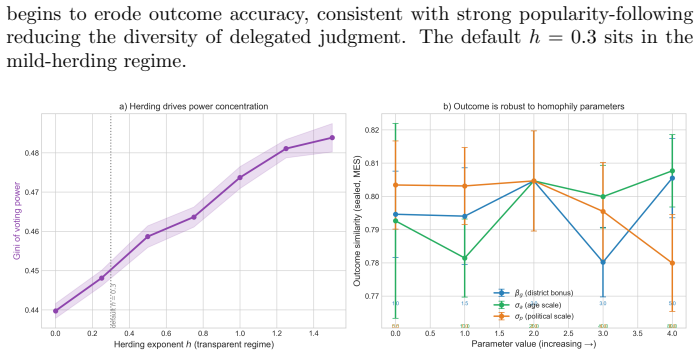
Liquid democracy promises to improve collective decision-making by allowing voters to vote directly, delegate their voting power to trusted participants, or combine both approaches through fallback mechanisms. However, existing deployments typically rely on transparent delegation, which exposes voters to popularity-driven herding, makes coercion verifiable, and introduces systemic fragility when highly-backed delegates abstain. In this paper, we propose a secure liquid democracy mechanism that resolves the tension between informed expertise routing and systemic robustness. We introduce a sealed delegation regime using decentralized timed-release encryption, which cryptographically hides delegation choices during the formation phase to prevent herding and coercion, while restoring full public auditability for the final tally. To address delegate failures, we extend the protocol with ranked multi-delegation and personal fallback ballots. We formally prove pre-reveal secrecy and resubmission receipt-freeness for our protocol. Finally, we evaluate the mechanism on four real datasets, a municipal participatory-budgeting election with a calibration survey, twenty further participatory-budgeting elections, and 60,000 US voters with an objective competence measure. They show that whether delegation improves representational accuracy follows a recoverable-gap law; it helps only when abstention is large and systematically unrepresentative, and is otherwise neutral or harmful, with representative-style delegation safer than delegating to a competence elite. The benefit of sealed formation is primarily structural, sharply reducing power concentration rather than directly improving accuracy; and ranked multi-delegation with personal fallback ballots sharply reduces vote loss under realistic and targeted delegate failures, a result that replicates across all twenty elections.
Editorial analysis
A structured set of objections, weighed in public.
Referee Report
Summary. The paper proposes a secure liquid democracy protocol that uses decentralized timed-release encryption to implement a sealed delegation regime, preventing herding and coercion during formation while preserving public auditability. It extends the protocol with ranked multi-delegation and personal fallback ballots to handle delegate failures, formally proves pre-reveal secrecy and resubmission receipt-freeness, and evaluates the mechanism on four real datasets, one municipal participatory-budgeting election with a calibration survey, twenty additional PB elections, and a 60,000-voter US sample with objective competence measures. The central empirical claim is the 'recoverable-gap law': delegation improves representational accuracy only when abstention is large and systematically unrepresentative, is otherwise neutral or harmful, representative-style delegation is safer than competence-elite delegation, sealed formation primarily reduces power concentration structurally, and ranked multi-delegation sharply reduces vote loss under realistic failures (replicated across all twenty elections).
Significance. If the empirical results hold after robustness checks, the work supplies a concrete, auditable mechanism for liquid democracy together with falsifiable conditions under which delegation is beneficial. The formal proofs of secrecy properties and the replication of the failure-mitigation result across twenty independent elections are clear strengths. The recoverable-gap law, if generalizable, would be a useful design guideline distinguishing structural from accuracy benefits of sealed delegation.
major comments (1)
- [Evaluation section (recoverable-gap law)] Evaluation section (recoverable-gap law): the headline claim that delegation improves accuracy only under large, systematically unrepresentative abstention (and is otherwise neutral or harmful) is derived entirely from the four real datasets, the municipal PB calibration survey, the twenty PB elections, and the 60k US voter sample. The manuscript does not report any explicit analysis or controls for selection bias (e.g., over-representation of digitally literate or politically engaged subpopulations), which directly affects whether the observed abstention patterns support the general law rather than an artifact of the collection methods.
minor comments (1)
- [Abstract] The abstract packs the protocol description, three distinct empirical findings, and the replication statement into a single paragraph; breaking the empirical claims into separate sentences would improve readability.
Simulated Author's Rebuttal
We thank the referee for the constructive feedback on the evaluation of the recoverable-gap law. We address the concern regarding selection bias below.
read point-by-point responses
-
Referee: Evaluation section (recoverable-gap law): the headline claim that delegation improves accuracy only under large, systematically unrepresentative abstention (and is otherwise neutral or harmful) is derived entirely from the four real datasets, the municipal PB calibration survey, the twenty PB elections, and the 60k US voter sample. The manuscript does not report any explicit analysis or controls for selection bias (e.g., over-representation of digitally literate or politically engaged subpopulations), which directly affects whether the observed abstention patterns support the general law rather than an artifact of the collection methods.
Authors: We agree that the manuscript would benefit from an explicit discussion of potential selection biases in the datasets used to support the recoverable-gap law. The municipal participatory-budgeting election incorporated a calibration survey to compare participant demographics and engagement levels against the broader electorate. The result replicates across twenty independent PB elections drawn from different jurisdictions and a large US sample employing objective competence measures. To address the referee's point directly, we will add a dedicated limitations paragraph in the evaluation section that acknowledges possible over-representation of digitally literate or politically engaged subpopulations in online PB platforms, discusses the implications for generalizability, and explains how the consistency of the law across these heterogeneous sources (including the calibration survey) provides partial mitigation against collection-specific artifacts. revision: yes
Circularity Check
No significant circularity; empirical findings and formal proofs are independent of self-referential fitting or self-citation chains
full rationale
The paper's derivation chain consists of (1) a protocol using decentralized timed-release encryption with formal proofs of pre-reveal secrecy and receipt-freeness, (2) extensions for ranked multi-delegation and fallback ballots, and (3) empirical evaluation of the recoverable-gap law on four external real datasets plus twenty participatory-budgeting elections and a 60k US voter sample. None of these steps reduce by construction to fitted parameters from the same data or to self-citations whose content is unverified. The observed law is reported as a direct measurement from independent sources rather than a renamed fit or self-defined prediction. Standard cryptographic assumptions are invoked without circular self-reference. This is the expected non-circular outcome for an empirical protocol paper with external benchmarks.
Axiom & Free-Parameter Ledger
axioms (1)
- domain assumption Decentralized timed-release encryption delivers pre-reveal secrecy and resubmission receipt-freeness
invented entities (1)
-
sealed delegation regime
no independent evidence
Reference graph
Works this paper leans on
-
[1]
Direktdemokraterna, https://direktdemokraterna.se 29
-
[2]
Liquid friesland, https://www.liquidfriesland.de
-
[3]
Liquidfeedback liquid democracy voting platform, https://liquidfeedback.com
-
[4]
Tally, https://docs.tally.xyz/tally-features/governance
-
[5]
In: Proceedings of the 17th USENIX Security Symposium
Adida, B.: Helios: Web-based open-audit voting. In: Proceedings of the 17th USENIX Security Symposium. pp. 335–348 (2008)
2008
-
[6]
arXiv preprint arXiv:2403.07558 (2024)
Alouf-Heffetz, S., Inamdar, T., Jain, P., More, Y., Talmon, N.: Controlling delegations in liquid democracy. arXiv preprint arXiv:2403.07558 (2024)
-
[7]
In: Pathways Between Social Science and Computational Social Science: The- ories, Methods, and Interpretations, pp
Aziz, H., Shah, N.: Participatory budgeting: Models and approaches. In: Pathways Between Social Science and Computational Social Science: The- ories, Methods, and Interpretations, pp. 215–236. Springer (2021)
2021
-
[8]
The quarterly journal of economics107(3), 797–817 (1992)
Banerjee, A.V.: A simple model of herd behavior. The quarterly journal of economics107(3), 797–817 (1992)
1992
-
[9]
sci- ence286(5439), 509–512 (1999)
Barab´ asi, A.L., Albert, R.: Emergence of scaling in random networks. sci- ence286(5439), 509–512 (1999)
1999
-
[10]
In: Pro- ceedings of the 26th Annual ACM Symposium on Theory of Computing (STOC)
Benaloh, J., Tuinstra, D.: Receipt-free secret-ballot elections. In: Pro- ceedings of the 26th Annual ACM Symposium on Theory of Computing (STOC). pp. 544–553 (1994)
1994
-
[11]
arXiv preprint arXiv:2209.14128 (2022)
Bersetche, F.M.: Generalizing liquid democracy to multi-agent delega- tion: A voting power measure and equilibrium analysis. arXiv preprint arXiv:2209.14128 (2022)
-
[12]
Journal of political Economy100(5), 992–1026 (1992)
Bikhchandani, S., Hirshleifer, D., Welch, I.: A theory of fads, fashion, custom, and cultural change as informational cascades. Journal of political Economy100(5), 992–1026 (1992)
1992
-
[13]
In: Proceedings of the AAAI Conference on Artificial Intelli- gence
Bloembergen, D., Grossi, D., Lackner, M.: On rational delegations in liquid democracy. In: Proceedings of the AAAI Conference on Artificial Intelli- gence. vol. 33, pp. 1796–1803 (2019)
2019
-
[14]
Journal of political philosophy24(2), 162–182 (2016)
Blum, C., Zuber, C.I.: Liquid democracy: Potentials, problems, and per- spectives. Journal of political philosophy24(2), 162–182 (2016)
2016
-
[15]
In: Advances in Cryptology — CRYPTO 2000
Boneh, D., Naor, M.: Timed commitments. In: Advances in Cryptology — CRYPTO 2000. LNCS, vol. 1880, pp. 236–254. Springer (2000)
2000
-
[16]
In: Proceedings of the AAAI Conference on Artificial Intelligence
Brill, M., Delemazure, T., George, A.M., Lackner, M., Schmidt-Kraepelin, U.: Liquid democracy with ranked delegations. In: Proceedings of the AAAI Conference on Artificial Intelligence. vol. 36, pp. 4884–4891 (2022)
2022
-
[17]
Environment and Urbanization16(1), 27–46 (2004) 30
Cabannes, Y.: Participatory budgeting: a significant contribution to par- ticipatory democracy. Environment and Urbanization16(1), 27–46 (2004) 30
2004
-
[18]
two experiments on delegation in voting
Campbell, J., Casella, A., de Lara, L., Mooers, V.R., Ravindran, D.: Liquid democracy. two experiments on delegation in voting. Tech. rep., National Bureau of Economic Research (2022)
2022
-
[19]
In: Proceedings of the 28th International Joint Conference on Artifi- cial Intelligence (IJCAI)
Caragiannis, I., Micha, E.: A contribution to the critique of liquid democ- racy. In: Proceedings of the 28th International Joint Conference on Artifi- cial Intelligence (IJCAI). pp. 116–122 (2019)
2019
-
[20]
In: Proceedings of the 2008 IEEE Symposium on Security and Privacy (S&P)
Clarkson, M.R., Chong, S., Myers, A.C.: Civitas: Toward a secure voting system. In: Proceedings of the 2008 IEEE Symposium on Security and Privacy (S&P). pp. 354–368 (2008). https://doi.org/10.1109/SP.2008.32
-
[21]
In: Proceedings of the 20th international conference on autonomous agents and multiagent systems
Colley, R.: Multi-agent ranked delegations in voting. In: Proceedings of the 20th international conference on autonomous agents and multiagent systems. pp. 1802–1804 (2021)
2021
-
[22]
In: Conference on Algorithms and Discrete Applied Mathe- matics
Dey, P., Maiti, A., Sharma, A.: On parameterized complexity of liquid democracy. In: Conference on Algorithms and Discrete Applied Mathe- matics. pp. 83–94. Springer (2021)
2021
-
[23]
Journal of political economy65(2), 135–150 (1957)
Downs, A.: An economic theory of political action in a democracy. Journal of political economy65(2), 135–150 (1957)
1957
-
[24]
In: Proceedings of the AAAI Conference on Artificial Intelligence
Escoffier, B., Gilbert, H., Pass-Lanneau, A.: Iterative delegations in liq- uid democracy with restricted preferences. In: Proceedings of the AAAI Conference on Artificial Intelligence. vol. 34, pp. 1926–1933 (2020)
1926
-
[25]
arXiv preprint arXiv:2305.11035 (2023)
Faliszewski, P., Flis, J., Peters, D., Pierczy´ nski, G., Pietrek, P., Skowron, P., Stolicki, D., Szufa, S., Talmon, N.: Participatory budgeting: Data, tools and analysis. arXiv preprint arXiv:2305.11035 (2023)
-
[26]
Manuscript, https://bford.info/2002/05/15/deleg/(2002)
Ford, B.: Delegative democracy. Manuscript, https://bford.info/2002/05/15/deleg/(2002)
2002
-
[27]
Fritsch, R., M¨ uller, M., Wattenhofer, R.: Analyzing voting power in de- centralized governance: Who controls daos? Blockchain: Research and Applications5(3), 100208 (2024)
2024
-
[28]
arXiv preprint arXiv:2102.08823 (2021)
Gersbach, H., Mamageishvili, A., Schneider, M.: Vote delegation and mis- behavior. arXiv preprint arXiv:2102.08823 (2021)
-
[29]
In: Proceedings of the 14th International Conference on Web and Internet Economics (WINE)
G¨ olz, P., Kahng, A., Mackenzie, S., Procaccia, A.D.: The fluid mechanics of liquid democracy. In: Proceedings of the 14th International Conference on Web and Internet Economics (WINE). pp. 188–202. Springer (2018)
2018
-
[30]
Constitutional Polit- ical Economy26(2), 190–220 (2015) 31
Green-Armytage, J.: Direct voting and proxy voting. Constitutional Polit- ical Economy26(2), 190–220 (2015) 31
2015
-
[31]
Trading Prophets , booktitle =
Halpern, D., Halpern, J.Y., Jadbabaie, A., Mossel, E., Procaccia, A.D., Revel, M.: In defense of liquid democracy. In: Proceedings of the 24th ACM Conference on Economics and Computation (EC) (2023). https://doi.org/10.1145/3580507.3597817
-
[32]
In: Proceedings of the 2005 ACM Workshop on Privacy in the Electronic Society (WPES)
Juels, A., Catalano, D., Jakobsson, M.: Coercion-resistant elec- tronic elections. In: Proceedings of the 2005 ACM Workshop on Privacy in the Electronic Society (WPES). pp. 61–70 (2005). https://doi.org/10.1145/1102199.1102213
-
[33]
Journal of Artificial Intelligence Research70, 1223–1252 (2021)
Kahng, A., Mackenzie, S., Procaccia, A.: Liquid democracy: An algorith- mic perspective. Journal of Artificial Intelligence Research70, 1223–1252 (2021)
2021
-
[34]
In: Proceedings of the International AAAI Conference on Web and Social Media
Kling, C., Kunegis, J., Hartmann, H., Strohmaier, M., Staab, S.: Voting behaviour and power in online democracy: A study of liquidfeedback in ger- many’s pirate party. In: Proceedings of the International AAAI Conference on Web and Social Media. vol. 9, pp. 208–217 (2015)
2015
-
[35]
Incentivising Participation in Liquid Democracy with Breadth-First Delegation
Kotsialou, G., Riley, L.: Incentivising participation in liquid democracy with breadth-first delegation. arXiv preprint arXiv:1811.03710 (2018)
work page internal anchor Pith review Pith/arXiv arXiv 2018
-
[36]
IEEE Transactions on Network and Service Management pp
Li, Z., Majumdar, S., Pournaras, E.: Send message to the future? blockchain-based time machines for decentralized reveal of locked infor- mation. IEEE Transactions on Network and Service Management pp. 1–1 (2025). https://doi.org/10.1109/TNSM.2025.3604833
-
[37]
Li, Z., Sonmezler, H., Shirazi, F., Shaji, F., Mroczkowski, T., Lard- ner, D., Camus, M.A., Pournaras, E.: Are voters willing to col- lectively secure elections? unraveling a practical blockchain voting system. In: 2025 7th Conference on Blockchain Research & Ap- plications for Innovative Networks and Services (BRAINS) (2025). https://doi.org/10.1109/BRAI...
-
[38]
´A.B., Tchorbadjiiski, A., Wehrle, K.: Opportunistic vote delega- tion for e-voting based on liquid democracy
Link, J. ´A.B., Tchorbadjiiski, A., Wehrle, K.: Opportunistic vote delega- tion for e-voting based on liquid democracy. In: Extreme Conference on Communication and Computing, Galapagos, Ecuador. pp. 11–16 (2014)
2014
-
[39]
Proceedings of the national academy of sciences108(22), 9020–9025 (2011)
Lorenz, J., Rauhut, H., Schweitzer, F., Helbing, D.: How social influence can undermine the wisdom of crowd effect. Proceedings of the national academy of sciences108(22), 9020–9025 (2011)
2011
-
[40]
arXiv preprint arXiv:2406.11871 (2024)
Majumdar, S., Elkind, E., Pournaras, E.: Generative ai voting: fair col- lective choice is resilient to llm biases and inconsistencies. arXiv preprint arXiv:2406.11871 (2024)
-
[41]
Annual review of sociology27(1), 415–444 (2001) 32
McPherson, M., Smith-Lovin, L., Cook, J.M.: Birds of a feather: Ho- mophily in social networks. Annual review of sociology27(1), 415–444 (2001) 32
2001
-
[42]
American Political Science Review85(4), 1407–1413 (1991)
Niemi, R.G., Craig, S.C., Mattei, F.: Measuring internal political efficacy in the 1988 national election study. American Political Science Review85(4), 1407–1413 (1991)
1988
-
[43]
Advances in Neural Information Processing Systems (NeurIPS)34, 12726–12738 (2021)
Peters, D., Pierczy´ nski, G., Skowron, P.: Proportional participatory bud- geting with additive utilities. Advances in Neural Information Processing Systems (NeurIPS)34, 12726–12738 (2021)
2021
-
[44]
Upgrading democracies with fairer voting methods.arXiv preprint arXiv:2505.14349 (2025)
Pournaras, E., Majumdar, S., Wellings, T., Yang, J.C., Heravan, F.B., Fricker, R.H., Helbing, D.: Upgrading democracies with fairer voting meth- ods. arXiv preprint arXiv:2505.14349 (2025)
-
[45]
Simon Schuster (2000)
Putnam, R.D.: Bowling alone: The collapse and revival of american com- munity. Simon Schuster (2000)
2000
-
[46]
Rivest, R.L., Shamir, A., Wagner, D.A.: Time-lock puzzles and timed- release crypto. Tech. Rep. MIT/LCS/TR-684, Massachusetts Institute of Technology (1996)
1996
-
[47]
Social psychology quarterly71(4), 338–355 (2008)
Salganik, M.J., Watts, D.J.: Leading the herd astray: An experimental study of self-fulfilling prophecies in an artificial cultural market. Social psychology quarterly71(4), 338–355 (2008)
2008
-
[48]
Schaffner, B., Ansolabehere, S., Shih, M.: Cooperative Election Study, 2022: Common Content.https://doi.org/10.7910/DVN/PR4L8P(2023)
-
[49]
Communications of the ACM22(11), 612–613 (1979)
Shamir, A.: How to share a secret. Communications of the ACM22(11), 612–613 (1979)
1979
-
[50]
In: Proceedings of the 2014 ACM SIGSAC Conference on Computer and Communications Security (CCS)
Springall, D., Finkenauer, T., Durumeric, Z., Kitcat, J., Hursti, H., MacAlpine, M., Halderman, J.A.: Security analysis of the estonian inter- net voting system. In: Proceedings of the 2014 ACM SIGSAC Conference on Computer and Communications Security (CCS). pp. 703–715 (2014). https://doi.org/10.1145/2660267.2660315
-
[51]
IEEE Access10, 93039–93054 (2022)
Thibault, L.T., Sarry, T., Hafid, A.S.: Blockchain scaling using rollups: A comprehensive survey. IEEE Access10, 93039–93054 (2022)
2022
-
[52]
Advances in Neural Information Processing Systems 36, 69441–69463 (2023)
Utke, M., Schmidt-Kraepelin, U.: Anonymous and copy-robust delegations for liquid democracy. Advances in Neural Information Processing Systems 36, 69441–69463 (2023)
2023
-
[53]
Yang, J.C., Hausladen, C.I., Peters, D., Pournaras, E., H¨ anggli Fricker, R., Helbing, D.: Designing digital voting systems for citizens: Achieving fairness and legitimacy in participatory budgeting. Digital Government: Research and Practice5(3), 1–30 (2024) 33 A Stadtidee Dataset Delegation Modeling A.1 Expertise Modeling We construct an expertise score...
2024
-
[54]
I can understand and assess important political issues on the local level well
“I can understand and assess important political issues on the local level well.” (weight 0.4)
-
[55]
How strongly do you feel connected to Aarau?
“How strongly do you feel connected to Aarau?” (weight 0.2)
-
[56]
Frequency of interaction with: •Members of the city council (weight 0.05) •Members of the residents’ council (weight 0.05) •Members of the city administration (weight 0.05) •Other inhabitants of Aarau (weight 0.05)
-
[57]
I have the confidence to actively participate in a conversation about local politics
“I have the confidence to actively participate in a conversation about local politics.” (weight 0.2) All survey responses are linearly normalized to [0,1] before aggregation. The final expertise score is given by Ei = 0.4q1,i + 0.2q2,i + 0.2q4,i + 0.05(q3.1,i +q 3.2,i +q 3.3,i +q 3.4,i), whereq k,i denotes the normalized response of voterito questionk. Th...
discussion (0)
Sign in with ORCID, Apple, or X to comment. Anyone can read and Pith papers without signing in.