SABER: A Semantic-Aligned Brain Network Analysis Framework via Multi-scale Hypergraphs
Pith reviewed 2026-07-03 17:38 UTC · model grok-4.3
The pith
SABER integrates LLM semantics directly into brain network predictions using multi-scale hypergraphs to improve diagnosis accuracy and stability.
A machine-rendered reading of the paper's core claim, the machinery that carries it, and where it could break.
Core claim
The central discovery is that actively integrating LLM-derived ROI semantics via global self-attention for enriched representations, multi-scale hypergraphs for capturing multi-ROI interactions, and decision-level semantic alignment enables semantics to directly guide brain network-based predictions, resulting in state-of-the-art performance, enhanced stability, and improved interpretability on public brain network datasets.
What carries the argument
Multi-scale hypergraphs combined with a decision-level semantic alignment mechanism that selectively injects textual embeddings into graph representations.
If this is right
- Brain disease classification gains stability in small-sample regimes by letting semantics guide decisions without changing network structure.
- Traditional GNN locality limits are bypassed through explicit modeling of functional subnetworks and high-order ROI interactions.
- Interpretability improves because patient-specific textual embeddings become traceable guides for the final prediction.
- The same pipeline applies to any brain network task where LLM semantics can be aligned at decision time rather than used only as extra features.
Where Pith is reading between the lines
- The method could be tested on other graph-structured medical data such as protein interaction networks paired with clinical notes.
- If the alignment step proves robust, it might reduce reliance on very large labeled brain datasets for training.
- Extensions to dynamic or longitudinal brain networks could check whether the same semantic injection preserves temporal consistency.
Load-bearing premise
That ROI-level semantics extracted from LLMs can be incorporated via global self-attention and decision-level alignment to enrich representations and directly guide predictions without introducing noise, bias, or structural perturbation to the underlying brain networks.
What would settle it
If experiments on ABIDE and ADHD-200 show that removing the decision-level semantic alignment or multi-scale hypergraph components yields no loss in accuracy, stability, or interpretability compared to the full framework, the central claim would be falsified.
Figures
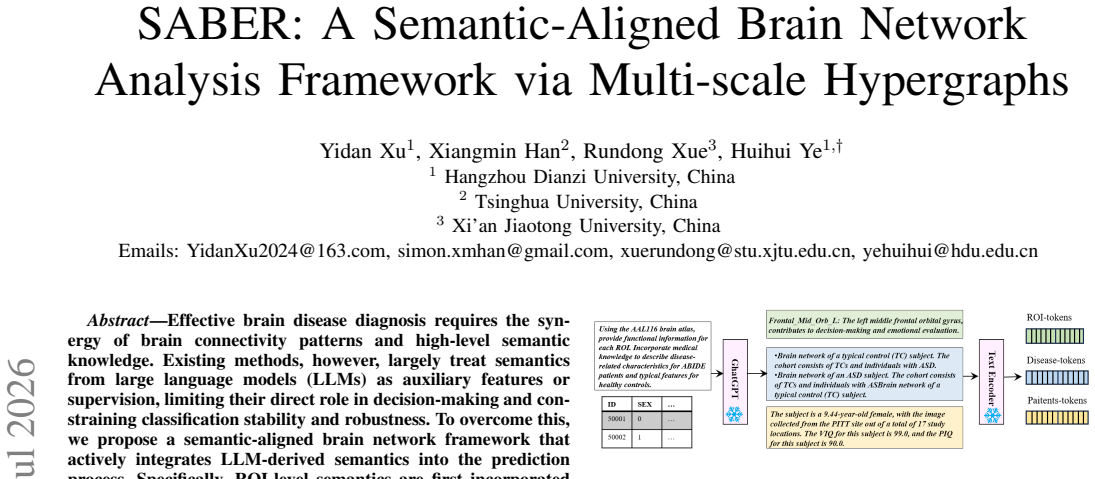
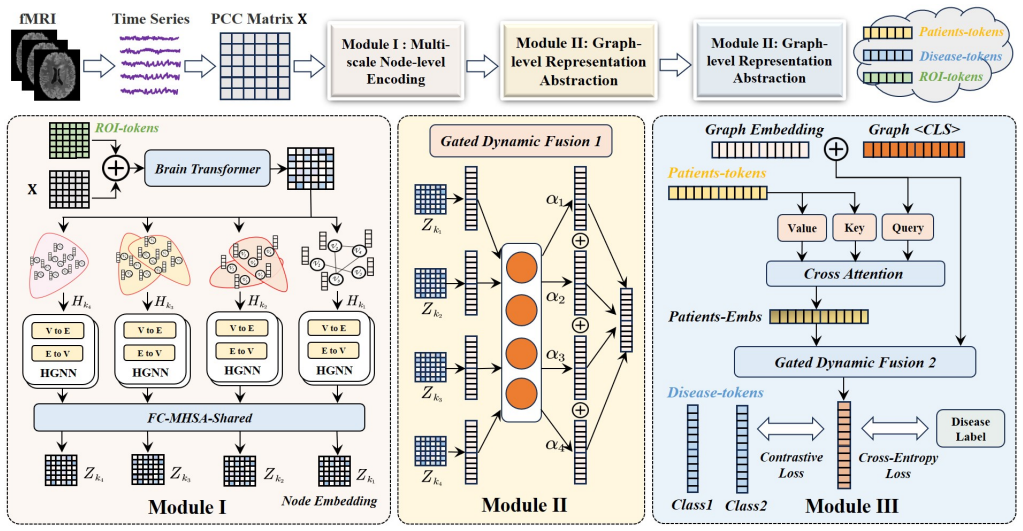
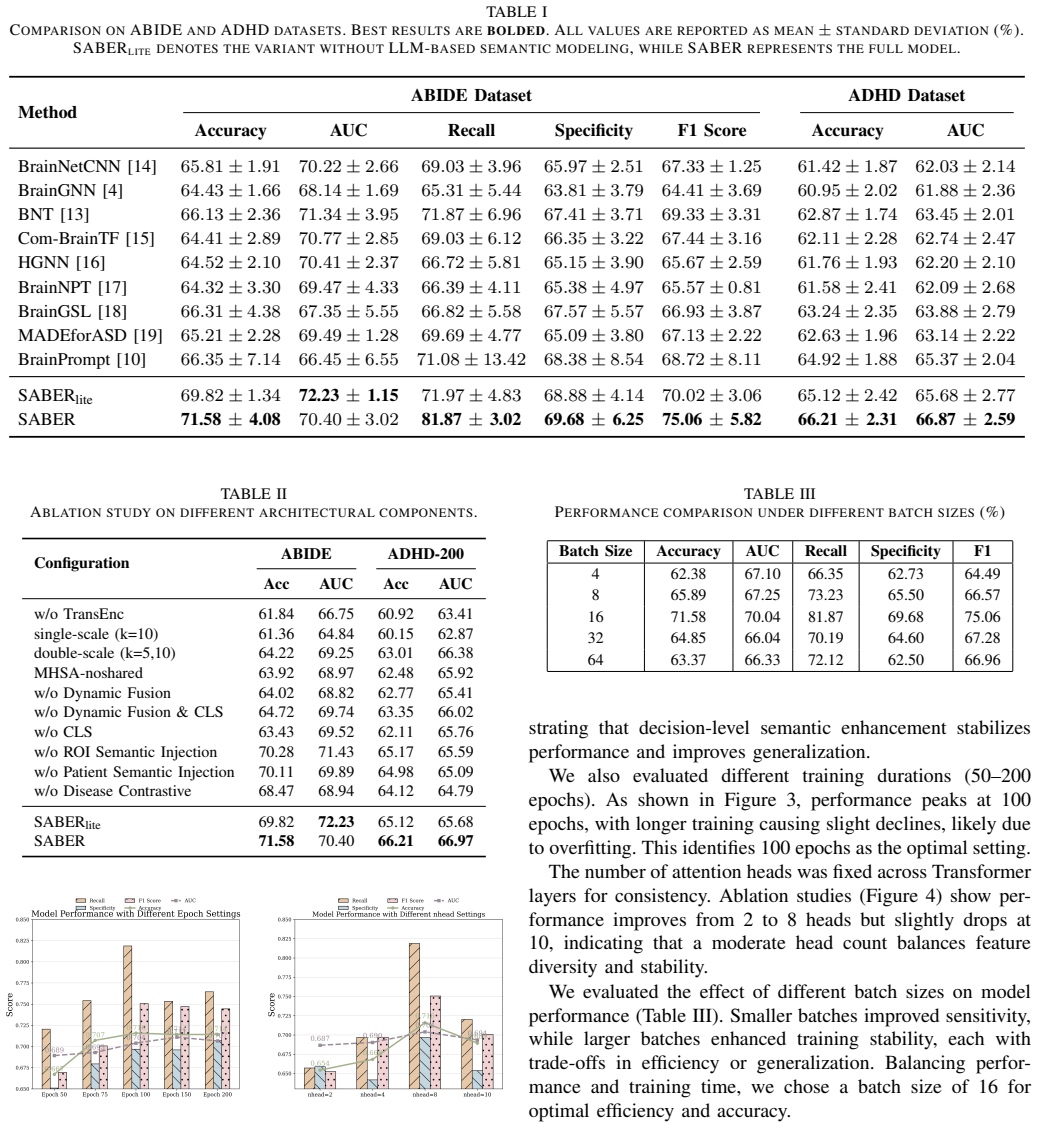
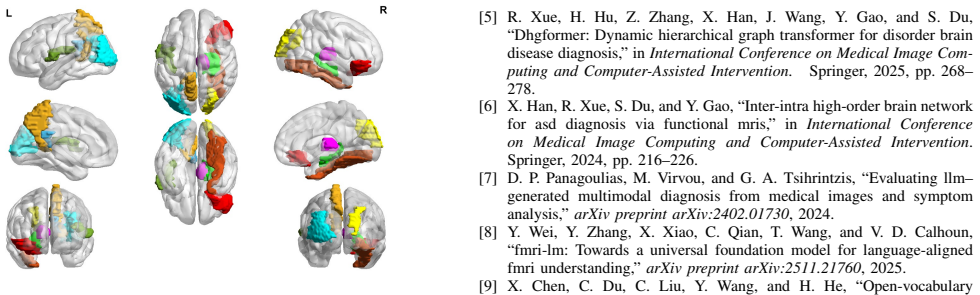
read the original abstract
Effective brain disease diagnosis requires the synergy of brain connectivity patterns and high-level semantic knowledge. Existing methods, however, largely treat semantics from large language models (LLMs) as auxiliary features or supervision, limiting their direct role in decision-making and constraining classification stability and robustness. To overcome this, we propose a semantic-aligned brain network framework that actively integrates LLM-derived semantics into the prediction process. Specifically, ROI-level semantics are first incorporated via global self-attention to enrich node representations and provide whole-brain context. Multi-scale hypergraphs are then constructed to explicitly model functional subnetworks and multi-ROI interactions, addressing the locality limitations of traditional GNNs and capturing high-order dependencies. Finally, a decision-level semantic alignment mechanism selectively injects patient-specific textual embeddings into graph representations, enabling semantics to directly guide predictions without perturbing the underlying network structure. Experiments on public brain network datasets ABIDE and ADHD-200 demonstrate state-of-the-art performance, enhanced stability, and improved interpretability, particularly in small-sample settings.
Editorial analysis
A structured set of objections, weighed in public.
Referee Report
Summary. The paper proposes SABER, a semantic-aligned brain network framework that incorporates ROI-level LLM semantics via global self-attention to enrich node representations, constructs multi-scale hypergraphs to model functional subnetworks and high-order dependencies, and applies a decision-level semantic alignment mechanism to inject patient-specific textual embeddings into graph representations for guiding predictions. It claims this avoids perturbing the underlying brain network structure and demonstrates state-of-the-art performance, enhanced stability, and improved interpretability on the ABIDE and ADHD-200 datasets, particularly in small-sample regimes.
Significance. If the central claims hold, the work could advance multimodal brain network analysis by enabling direct semantic guidance from LLMs in graph-based diagnosis while preserving structural invariants. The multi-scale hypergraph construction for capturing high-order interactions beyond standard GNN locality is a constructive contribution, and the emphasis on small-sample stability and interpretability addresses practical needs in neuroimaging. The decision-level alignment approach, if validated as non-perturbative, offers a potentially reusable fusion strategy.
major comments (2)
- [Abstract; method section on decision-level alignment] Abstract and method description of decision-level semantic alignment: The claim that the mechanism 'selectively injects patient-specific textual embeddings into graph representations, enabling semantics to directly guide predictions without perturbing the underlying network structure' is load-bearing for the central contribution. No quantitative invariance checks (e.g., pre/post-alignment comparison of hypergraph Laplacian spectra, eigenvalue distributions, or node-feature cosine distances on held-out graphs) are referenced, leaving open whether stability gains arise from semantic guidance or from added capacity/regularization.
- [Experiments section] Experiments on ABIDE and ADHD-200 (small-sample settings): The SOTA performance, stability, and interpretability claims require ablation studies that isolate the decision-level alignment from the multi-scale hypergraph and global self-attention components, plus statistical significance tests against baselines. Without these, it is unclear whether the reported margins are attributable to the semantic mechanism rather than model complexity.
minor comments (1)
- [Abstract] The abstract and method overview would benefit from explicit notation for the alignment operation (e.g., how patient-specific embeddings are fused at decision level) to improve reproducibility.
Simulated Author's Rebuttal
We thank the referee for the detailed and constructive comments. We address each major point below and commit to revisions that directly respond to the concerns raised.
read point-by-point responses
-
Referee: [Abstract; method section on decision-level alignment] Abstract and method description of decision-level semantic alignment: The claim that the mechanism 'selectively injects patient-specific textual embeddings into graph representations, enabling semantics to directly guide predictions without perturbing the underlying network structure' is load-bearing for the central contribution. No quantitative invariance checks (e.g., pre/post-alignment comparison of hypergraph Laplacian spectra, eigenvalue distributions, or node-feature cosine distances on held-out graphs) are referenced, leaving open whether stability gains arise from semantic guidance or from added capacity/regularization.
Authors: We agree that the non-perturbative claim is central and that explicit quantitative checks are absent from the current manuscript. The decision-level design is intended to apply alignment only after hypergraph construction, but we acknowledge that empirical verification is needed to rule out confounding effects from capacity or regularization. In the revised version we will add pre/post-alignment comparisons of hypergraph Laplacian spectra, eigenvalue distributions, and node-feature cosine distances computed on held-out graphs from both ABIDE and ADHD-200. revision: yes
-
Referee: [Experiments section] Experiments on ABIDE and ADHD-200 (small-sample settings): The SOTA performance, stability, and interpretability claims require ablation studies that isolate the decision-level alignment from the multi-scale hypergraph and global self-attention components, plus statistical significance tests against baselines. Without these, it is unclear whether the reported margins are attributable to the semantic mechanism rather than model complexity.
Authors: We recognize that the existing experiments do not contain ablations that hold the multi-scale hypergraph and global self-attention fixed while varying only the decision-level alignment module, nor do they report formal statistical significance tests. In the revision we will add these targeted ablations and include paired statistical tests (with p-values) comparing SABER against the strongest baselines on both datasets, with particular emphasis on the small-sample splits. revision: yes
Circularity Check
No circularity: framework relies on external LLM embeddings and standard graph constructions without self-referential fitting or load-bearing self-citations
full rationale
The provided manuscript text contains no equations, derivations, or parameter-fitting steps that reduce a claimed prediction or result to its own inputs by construction. The method description incorporates external LLM-derived ROI semantics via global self-attention and decision-level alignment, then builds multi-scale hypergraphs using conventional constructions; these steps are presented as architectural choices rather than outputs derived from the target performance metrics on ABIDE/ADHD-200. No self-citation chains are invoked to justify uniqueness or forbid alternatives, and the abstract's performance claims are framed as empirical outcomes rather than tautological consequences of the inputs. The derivation chain is therefore self-contained against external benchmarks and does not exhibit any of the enumerated circularity patterns.
Axiom & Free-Parameter Ledger
Reference graph
Works this paper leans on
-
[1]
Hypergraph-guided federated distillation learning for efficient and robust multi-center fmri data analysis,
T. Jin, Y . Xu, Y . Gao, X. Sheng, C. Yan, Y . Sun, X. Han, and Y . Gao, “Hypergraph-guided federated distillation learning for efficient and robust multi-center fmri data analysis,” inInternational Conference on Medical Image Computing and Computer-Assisted Intervention. Springer, 2025, pp. 294–303
2025
-
[2]
Role hypergraph contrastive learning for multivariate time-series analysis,
R. Xue, H. Hu, Z. Zeng, X. Han, Z. Tian, S. Du, and Y . Gao, “Role hypergraph contrastive learning for multivariate time-series analysis,” vol. 40, pp. 27 468–27 476, 2026
2026
-
[3]
arXiv preprint arXiv:2511.19046 (2025)
A. Liu, R. Xue, X. R. Cao, Y . Shen, Y . Lu, X. Li, Q. Chen, and J. Chen, “Medsam3: Delving into segment anything with medical concepts,” arXiv preprint arXiv:2511.19046, 2025
-
[4]
Braingnn: Interpretable brain graph neural network for fmri analysis,
X. Li, Y . Zhou, N. Dvornek, M. Zhang, S. Gao, J. Zhuang, D. Scheinost, L. H. Staib, P. Ventola, and J. S. Duncan, “Braingnn: Interpretable brain graph neural network for fmri analysis,”Medical Image Analysis, vol. 74, p. 102233, 2021
2021
-
[5]
Dhgformer: Dynamic hierarchical graph transformer for disorder brain disease diagnosis,
R. Xue, H. Hu, Z. Zhang, X. Han, J. Wang, Y . Gao, and S. Du, “Dhgformer: Dynamic hierarchical graph transformer for disorder brain disease diagnosis,” inInternational Conference on Medical Image Com- puting and Computer-Assisted Intervention. Springer, 2025, pp. 268– 278
2025
-
[6]
Inter-intra high-order brain network for asd diagnosis via functional mris,
X. Han, R. Xue, S. Du, and Y . Gao, “Inter-intra high-order brain network for asd diagnosis via functional mris,” inInternational Conference on Medical Image Computing and Computer-Assisted Intervention. Springer, 2024, pp. 216–226
2024
-
[7]
Evaluating llm– generated multimodal diagnosis from medical images and symptom analysis,
D. P. Panagoulias, M. Virvou, and G. A. Tsihrintzis, “Evaluating llm– generated multimodal diagnosis from medical images and symptom analysis,”arXiv preprint arXiv:2402.01730, 2024
-
[8]
fMRI-LM: Towards a Universal Foundation Model for Language-Aligned fMRI Understanding
Y . Wei, Y . Zhang, X. Xiao, C. Qian, T. Wang, and V . D. Calhoun, “fmri-lm: Towards a universal foundation model for language-aligned fmri understanding,”arXiv preprint arXiv:2511.21760, 2025
work page internal anchor Pith review Pith/arXiv arXiv 2025
-
[9]
Open-vocabulary auditory neural decoding using fmri-prompted llm,
X. Chen, C. Du, C. Liu, Y . Wang, and H. He, “Open-vocabulary auditory neural decoding using fmri-prompted llm,”arXiv preprint arXiv:2405.07840, 2024
-
[10]
Brainprompt: Multi-level brain prompt enhancement for neurological condition identification,
J. Xu, K. He, Y . Tang, W. Li, M. Lan, X. Dong, Y . Ke, and M. Feng, “Brainprompt: Multi-level brain prompt enhancement for neurological condition identification,” inInternational Conference on Medical Image Computing and Computer-Assisted Intervention. Springer, 2025, pp. 172–182
2025
-
[11]
Aligned with llm: a new multi- modal training paradigm for encoding fmri activity in visual cortex,
S. Ma, L. Wang, S. Hou, and B. Yan, “Aligned with llm: a new multi- modal training paradigm for encoding fmri activity in visual cortex,” arXiv preprint arXiv:2401.03851, 2024
-
[12]
An automated labeling system for subdividing the human cerebral cortex on mri scans into gyral based regions of interest,
R. S. Desikan, F. S ´egonne, B. Fischl, B. T. Quinn, B. C. Dickerson, D. Blacker, R. L. Buckner, A. M. Dale, R. P. Maguire, B. T. Hyman et al., “An automated labeling system for subdividing the human cerebral cortex on mri scans into gyral based regions of interest,”Neuroimage, vol. 31, no. 3, pp. 968–980, 2006
2006
-
[13]
Brain net- work transformer,
X. Kan, W. Dai, H. Cui, Z. Zhang, Y . Guo, and C. Yang, “Brain net- work transformer,”Advances in Neural Information Processing Systems, vol. 35, pp. 25 586–25 599, 2022
2022
-
[14]
Brainnetcnn: Convolutional neural networks for brain networks; towards predicting neurodevelop- ment,
J. Kawahara, C. J. Brown, S. P. Miller, B. G. Booth, V . Chau, R. E. Grunau, J. G. Zwicker, and G. Hamarneh, “Brainnetcnn: Convolutional neural networks for brain networks; towards predicting neurodevelop- ment,”NeuroImage, vol. 146, pp. 1038–1049, 2017
2017
-
[15]
Community- aware transformer for autism prediction in fmri connectome,
A. Bannadabhavi, S. Lee, W. Deng, R. Ying, and X. Li, “Community- aware transformer for autism prediction in fmri connectome,” inInter- national conference on medical image computing and computer-assisted intervention. Springer, 2023, pp. 287–297
2023
-
[16]
Hypergraph neural net- works,
Y . Feng, H. You, Z. Zhang, R. Ji, and Y . Gao, “Hypergraph neural net- works,” inProceedings of the AAAI conference on artificial intelligence, vol. 33, no. 01, 2019, pp. 3558–3565
2019
-
[17]
Brainnpt: Pre-training trans- former networks for brain network classification,
J. Hu, Y . Huang, N. Wang, and S. Dong, “Brainnpt: Pre-training trans- former networks for brain network classification,”IEEE Transactions on Neural Systems and Rehabilitation Engineering, 2024
2024
-
[18]
Graph self-supervised learning with application to brain networks analysis,
G. Wen, P. Cao, L. Liu, J. Yang, X. Zhang, F. Wang, and O. R. Zaiane, “Graph self-supervised learning with application to brain networks analysis,”IEEE Journal of Biomedical and Health Informatics, vol. 27, no. 8, pp. 4154–4165, 2023
2023
-
[19]
MADE-for-ASD: A multi-atlas deep ensemble network for diagnosing autism spectrum disorder,
X. Liu, M. R. Hasan, T. Gedeon, and M. Z. Hossain, “MADE-for-ASD: A multi-atlas deep ensemble network for diagnosing autism spectrum disorder,”Computers in Biology and Medicine, vol. 182, p. 109083, 2024
2024
-
[20]
The autism brain imaging data exchange: towards a large-scale evaluation of the intrinsic brain architecture in autism,
A. Di Martino, C.-G. Yan, Q. Li, E. Denio, F. X. Castellanos, K. Alaerts, J. S. Anderson, M. Assaf, S. Y . Bookheimer, M. Daprettoet al., “The autism brain imaging data exchange: towards a large-scale evaluation of the intrinsic brain architecture in autism,”Molecular psychiatry, vol. 19, no. 6, pp. 659–667, 2014
2014
-
[21]
Dparsf: a matlab toolbox for
C. Yan and Y . Zang, “Dparsf: a matlab toolbox for” pipeline” data analysis of resting-state fmri,”Frontiers in systems neuroscience, vol. 4, p. 1377, 2010
2010
-
[22]
Hypergraph foundation model for brain disease diagnosis,
X. Han, R. Xue, J. Feng, Y . Feng, S. Du, J. Shi, and Y . Gao, “Hypergraph foundation model for brain disease diagnosis,”IEEE Transactions on Neural Networks and Learning Systems, 2025
2025
discussion (0)
Sign in with ORCID, Apple, or X to comment. Anyone can read and Pith papers without signing in.