Efficient Waste Sorting for Circular Economy: A Confidence-guided comparison between One-Vs-All and One-Vs-Rest Classification Strategies with Human-in-the-Loop for Automated Waste Sorting
Pith reviewed 2026-07-03 15:52 UTC · model grok-4.3
The pith
Confidence thresholds on OvA and OvR models trade off fewer waste-sorting errors against the volume of cases sent for human review.
A machine-rendered reading of the paper's core claim, the machinery that carries it, and where it could break.
Core claim
By training OvA and OvR models on a dataset built to match Goslar's waste categories and then sweeping confidence thresholds, the fraction of misclassified items that reach users can be reduced while the number of samples routed to human review remains controllable.
What carries the argument
Confidence threshold applied to OvA and OvR output scores to select uncertain samples for human-in-the-loop review.
If this is right
- Varying the threshold produces explicit accuracy-effort curves for each strategy.
- OvA and OvR can differ in how sharply their confidence scores separate correct from incorrect predictions.
- The same pipeline can be retrained on any other municipality's category list without changing the human-review logic.
- The approach supports incremental deployment: start with a loose threshold and tighten it as more labeled data arrives.
Where Pith is reading between the lines
- The threshold method could be reused in other image-classification settings where local rules change and some human oversight is available.
- If the correlation between confidence and error holds, the human labels collected on uncertain cases can be fed back to retrain the model without labeling the entire stream.
- Municipalities could begin with a conservative threshold and raise it over time once resident feedback confirms the model's reliability.
Load-bearing premise
The dataset matches real Goslar waste items and rules, and lower model confidence scores actually mark items that would be misclassified.
What would settle it
Run the trained models on a fresh collection of real Goslar household waste photos with ground-truth labels and check whether the error rate below the chosen threshold is substantially higher than the error rate above it.
Figures


read the original abstract
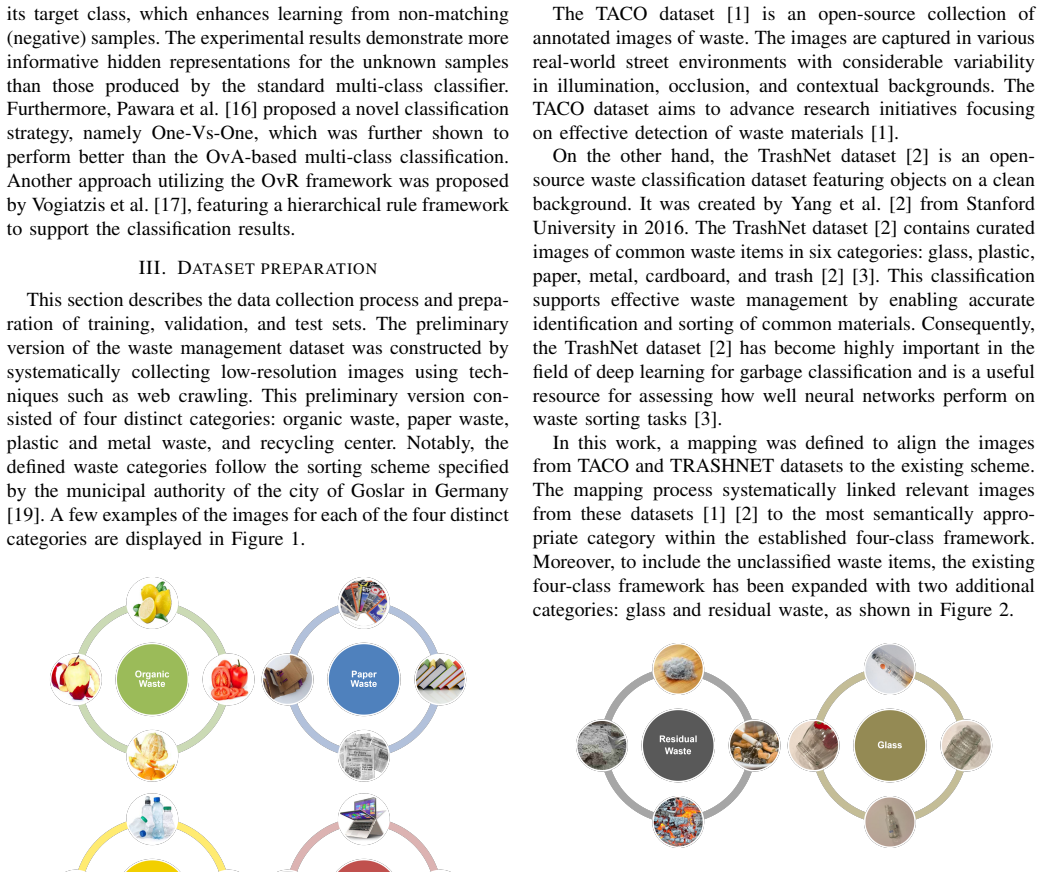
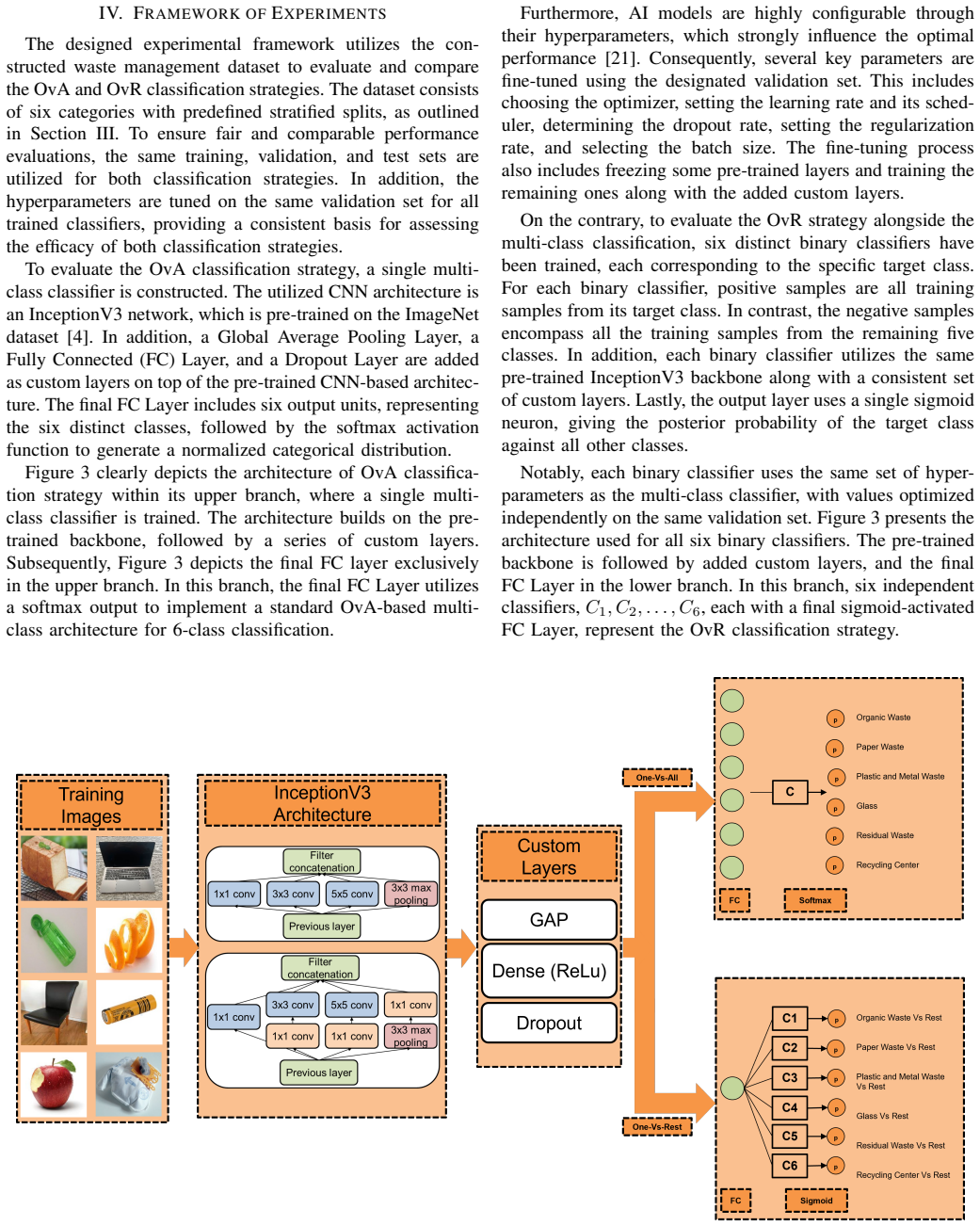
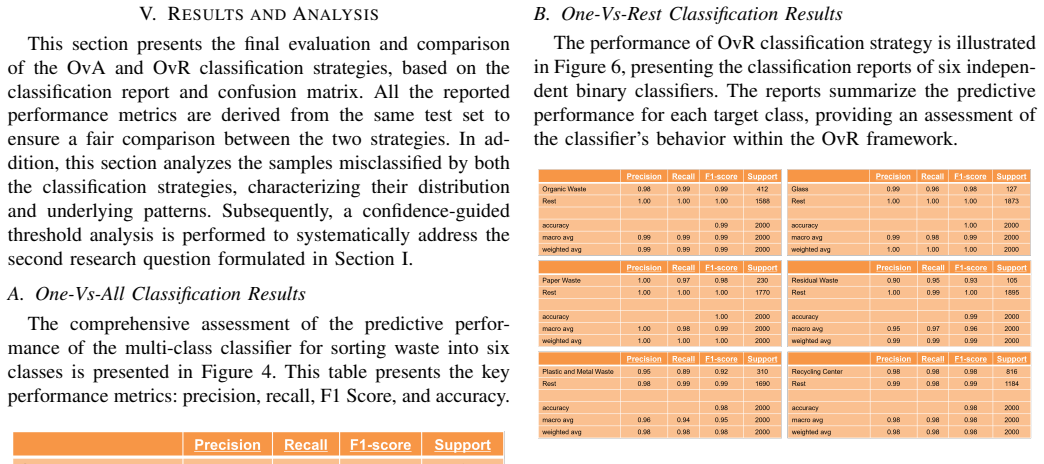
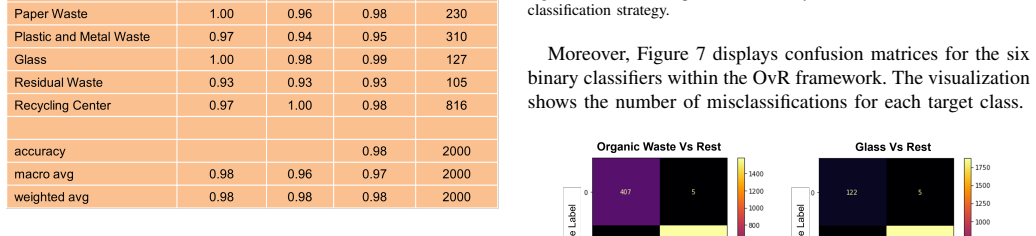
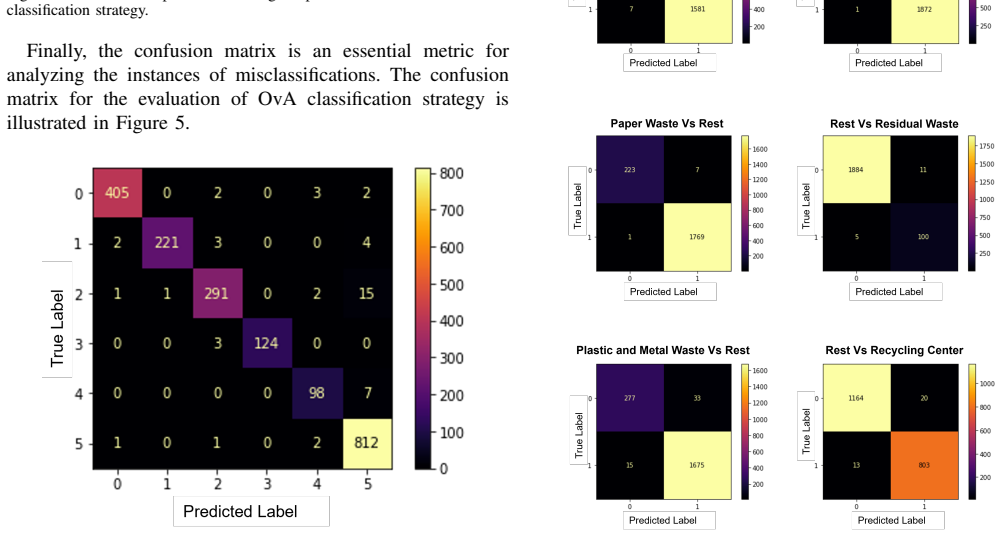
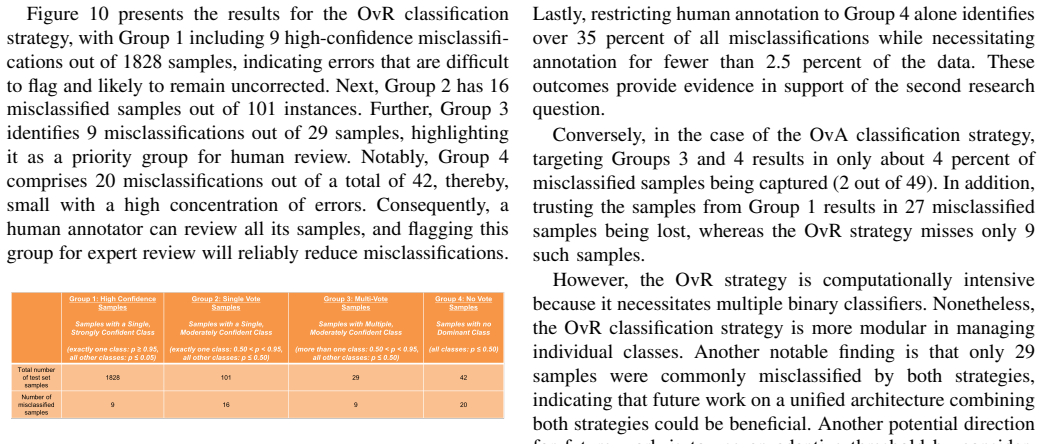
The complexity of waste disposal regulations across European countries poses significant challenges for the residents and hinders the transition to a Circular Economy. In Germany, the proper sorting and disposal of household waste remains challenging across municipalities. Consequently, substantially reducing incorrectly disposed waste is vital for improving waste management and advancing the Circular Economy. AI-based waste sorting solutions can support residents through user-friendly tools, such as mobile applications, that guide proper waste disposal. To be effective in supporting the Circular Economy, however, these solutions must be configurable to reflect the specific waste sorting scheme of individual municipalities in Germany. In the scope of this work, an evaluation and analysis are performed of two prominent classification strategies: OvA and OvR. The research uses a dataset constructed in alignment with the waste categories and sorting scheme of the city of Goslar in Germany. Moreover, this work aims to extend beyond the overall performance by examining the behavior of OvA and OvR classification strategies in identifying samples likely to be misclassified. These classification strategies are compared by applying varying confidence thresholds to identify uncertain samples for subsequent human review. This evaluation aims to balance the number of misclassifications against the human effort required for data annotation.
Editorial analysis
A structured set of objections, weighed in public.
Referee Report
Summary. The manuscript evaluates One-vs-All (OvA) and One-vs-Rest (OvR) classification strategies on a dataset constructed to match the waste categories and sorting scheme of Goslar, Germany. It applies varying confidence thresholds to flag uncertain samples for human review in a human-in-the-loop setup, with the goal of balancing the number of misclassifications against the human annotation effort required for effective municipal waste sorting to support the circular economy.
Significance. A well-executed empirical comparison that identifies which strategy better trades off error reduction against human review cost on a municipality-specific dataset could inform practical deployment of AI tools for waste sorting. The work's focus on confidence-guided human-in-the-loop is relevant to real-world constraints, but the absence of any reported performance metrics, dataset statistics, error bars, or method details prevents assessment of whether the claimed balance is achieved.
major comments (2)
- The manuscript contains no empirical results, performance numbers, dataset statistics, or method details (e.g., model architectures, training procedures, or threshold selection), so it is impossible to verify whether either strategy actually achieves the stated balance between misclassifications and human effort.
- No validation is provided that the constructed Goslar-aligned dataset reflects real-world waste distributions or that model confidence scores reliably predict misclassifications, which is load-bearing for the central human-in-the-loop claim.
Simulated Author's Rebuttal
We thank the referee for their detailed review and constructive comments on our manuscript. We address each of the major comments below and outline the revisions we will make to strengthen the paper.
read point-by-point responses
-
Referee: The manuscript contains no empirical results, performance numbers, dataset statistics, or method details (e.g., model architectures, training procedures, or threshold selection), so it is impossible to verify whether either strategy actually achieves the stated balance between misclassifications and human effort.
Authors: We agree with this observation. The submitted manuscript focuses on describing the evaluation framework and the comparison approach but omits the specific quantitative results and implementation details. This limits the ability to assess the findings. In the revised manuscript, we will add comprehensive empirical results including performance metrics (accuracy, precision, recall for OvA and OvR), dataset statistics (number of samples per class, total size), model architectures used, training procedures, and the method for selecting confidence thresholds. We will also include figures showing the trade-off between misclassifications and human review effort at different thresholds. revision: yes
-
Referee: No validation is provided that the constructed Goslar-aligned dataset reflects real-world waste distributions or that model confidence scores reliably predict misclassifications, which is load-bearing for the central human-in-the-loop claim.
Authors: This is a valid point. While the dataset was constructed to align with Goslar's waste categories and sorting scheme, we did not include explicit validation against real-world distributions or calibration analysis for the confidence scores. In the revision, we will expand the dataset section to describe the construction process in more detail, provide any available statistics or sources used for alignment, and add an analysis of the relationship between model confidence and actual misclassification rates to support the human-in-the-loop strategy. We will also discuss limitations regarding the representativeness of the dataset. revision: yes
Circularity Check
No significant circularity in empirical evaluation
full rationale
The paper is an empirical comparison of OvA vs OvR strategies with confidence thresholds for human-in-the-loop review on a Goslar-aligned dataset. No derivation chain, equations, fitted parameters presented as predictions, or load-bearing self-citations are described. The central claim concerns evaluation outcomes balancing misclassifications and annotation effort, which rests on experimental results rather than reducing to inputs by construction. This is a standard self-contained empirical study with no circular steps.
Axiom & Free-Parameter Ledger
axioms (1)
- domain assumption The constructed dataset accurately reflects the waste categories and sorting scheme of the city of Goslar.
Reference graph
Works this paper leans on
-
[1]
Taco: Trash annotations in context for litter detection,
P. F. Proenc ¸a and P. Sim ˜oes, “Taco: Trash annotations in context for litter detection,” arXiv preprint arXiv:2003.06975, 2020
-
[2]
Classification of Trash for Recyclability Status; CS229 Project Report,
M. Yang and G. Thung, “Classification of Trash for Recyclability Status; CS229 Project Report,” Stanford University, Stanford, CA, USA, 2016
work page 2016
-
[3]
A garbage classification method based on a small convolution neural network,
Z. Yang, Z. Xia, G. Yang, and Y . Lv, “A garbage classification method based on a small convolution neural network,” Sustainability, vol. 14, no. 22, p. 14735, 2022
work page 2022
-
[4]
Imagenet: A large-scale hierarchical image database,
J. Deng et al., “Imagenet: A large-scale hierarchical image database,” in Proc. 2009 IEEE Conf. Comput. Vis. Pattern Recognit., 2009, pp. 248–255
work page 2009
-
[5]
Eurostat, “Waste statistics,” European Commission. [Online]. Available: https://ec.europa.eu/eurostat/statistics-explained/index.php?title=Waste statistics. Accessed: Jan. 26, 2026
work page 2026
-
[6]
Duale Systeme: Faktenblatt, Jan. 2024
M ¨ulltrennung wirkt, “Duale Systeme: Faktenblatt, Jan. 2024.” [On- line]. Available: https://www.muelltrennung-wirkt.de/fileadmin/user upload/2024-01 Duale Systeme Faktenblatt.pdf. Accessed: Jan. 26, 2026
work page 2024
-
[7]
D. V olo ˇsinov´a, R. Ko ˇr´ınek, et al., “Methods of collection and man- agement of biodegradable municipal waste in selected countries of the European Union and current results from moisture loss measurements,” V odohospod´aˇrsk´e technicko-ekonomick ´e informace, vol. 65, no. 6, pp. 14–21, 2023
work page 2023
-
[8]
D. Kobus, Practical Guidebook on Strategic Planning in Municipal Waste Management, Bertelsmann Stiftung, The World Bank, Washington, DC, 2003
work page 2003
-
[9]
DeepWaste: Applying deep learning to waste classification for a sustainable planet,
Y . Narayan, “DeepWaste: Applying deep learning to waste classification for a sustainable planet,” arXiv preprint arXiv:2101.05960, 2021
-
[10]
WERTIS-KI: Wertstoff- Informations-System mit K ¨unstlicher Intelligenz
Ostfalia Hochschule f ¨ur angewandte Wissenschaften, dida Datenschmiede GmbH, GE-T GmbH, and Abfallwirtschafts- und Besch¨aftigungsbetriebe Landkreis Peine, “WERTIS-KI: Wertstoff- Informations-System mit K ¨unstlicher Intelligenz.” [Online]. Available: https://wertis.app. Accessed: Jan. 29, 2026
work page 2026
-
[11]
Junker – an app for waste management
Giunko SRL, “Junker – an app for waste management.” [Online]. Available: https://junkerapp.it/en/. Accessed: Jan. 30, 2026
work page 2026
-
[12]
Waste wizard: Exploring waste sorting using AI in public spaces,
R. M. Jacobsen, P. S. Johansen, L. B. L. Bysted, and M. B. Skov, “Waste wizard: Exploring waste sorting using AI in public spaces,” in Proc. 11th Nordic Conf. Human-Computer Interaction: Shaping Experiences, Shaping Society, 2020, pp. 1–11
work page 2020
-
[13]
Prototype of AI-powered assistance system for digitalisation of manual waste sorting,
J. Aberger et al., “Prototype of AI-powered assistance system for digitalisation of manual waste sorting,” Waste Manag., vol. 194, pp. 366–378, 2025
work page 2025
-
[14]
AI-based plastic waste sorting method utilizing object detection models for enhanced classification,
J. Son and Y . Ahn, “AI-based plastic waste sorting method utilizing object detection models for enhanced classification,” Waste Manag., vol. 193, pp. 273–282, 2025
work page 2025
-
[15]
T. Cheng, D. Kojima, H. Hu, H. Onoda, and A. H. Pandyaswargo, “Optimizing waste sorting for sustainability: An AI-powered robotic solution for beverage container recycling,” Sustainability, vol. 16, no. 23, p. 10155, 2024
work page 2024
-
[16]
One-vs-One classification for deep neural networks,
P. Pawara et al., “One-vs-One classification for deep neural networks,” Pattern Recognit., vol. 108, p. 107528, 2020
work page 2020
-
[17]
A. V ogiatzis, G. Chalkiadakis, K. Moirogiorgou, and M. Zervakis, “A novel one-vs-rest classification framework for mutually supported decisions by independent parallel classifiers,” in Proc. 2021 IEEE Int. Conf. Imaging Syst. Tech. (IST), 2021, pp. 1–6
work page 2021
-
[18]
One-vs-rest network-based deep probability model for open set recognition,
J. Jang and C. O. Kim, “One-vs-rest network-based deep probability model for open set recognition,” arXiv preprint arXiv:2004.08067, 2020
-
[19]
Kreiswirtschaftsbetrieb Goslar (KWB), “Waste categories.” [Online]. Available: https://www.kwb-goslar.de/Abfallwirtschaft/ Abfuhr-und-Termine/. Accessed: Apr. 5, 2025
work page 2025
-
[20]
European Court of Auditors, Municipal waste management – Despite gradual improvement, challenges remain for the EU’s progress towards circularity. Special report 23/2025, Luxembourg: Publications Office of the European Union, 2025, doi: 10.2865/0338580
-
[21]
Hyperparameter optimization: Foundations, algorithms, best practices, and open challenges,
B. Bischl et al., “Hyperparameter optimization: Foundations, algorithms, best practices, and open challenges,” Wiley Interdiscip. Rev.: Data Min. Knowl. Discov., vol. 13, no. 2, p. e1484, 2023
work page 2023
-
[22]
Resolution adopted by the General Assembly on 11 September 2015,
General Assembly, “Resolution adopted by the General Assembly on 11 September 2015,” New York: United Nations, vol. 14, 2015
work page 2015
-
[23]
Recycling 4.0: An integrated approach towards an advanced circular economy,
S. Bl ¨omeke et al., “Recycling 4.0: An integrated approach towards an advanced circular economy,” in Proc. 7th Int. Conf. ICT for Sustainabil- ity, 2020, pp. 66–76
work page 2020
-
[24]
Implementing the circular economy by tracing the sustainable impact,
S. Lawrenz, B. Leiding, M. E. A. Mathiszig, A. Rausch, M. Schindler, and P. Sharma, “Implementing the circular economy by tracing the sustainable impact,” Int. J. Environ. Res. Public Health, vol. 18, no. 21, p. 11316, 2021
work page 2021
discussion (0)
Sign in with ORCID, Apple, or X to comment. Anyone can read and Pith papers without signing in.