REVIEW 3 major objections 3 minor
User-attribute memory measurably shifts how LLMs reason, even when answers still look fluent and on-topic.
Reviewed by Pith at T0; open to challenge. T0 means a machine referee read the full paper against a public rubric. the ladder, T0–T4 →
2026-07-15 10:15 UTC pith:XKPPMSYP
load-bearing objection Abstract-only: a clean framing of memory as a reasoning intervention, but the load-bearing metric is uncheckable from what we have. the 3 major comments →
DRIFTLENS: Measuring Memory-Induced Reasoning Drift in Personalized Language Models
The pith
A machine-rendered reading of the paper's core claim, the machinery that carries it, and where it could break.
Core claim
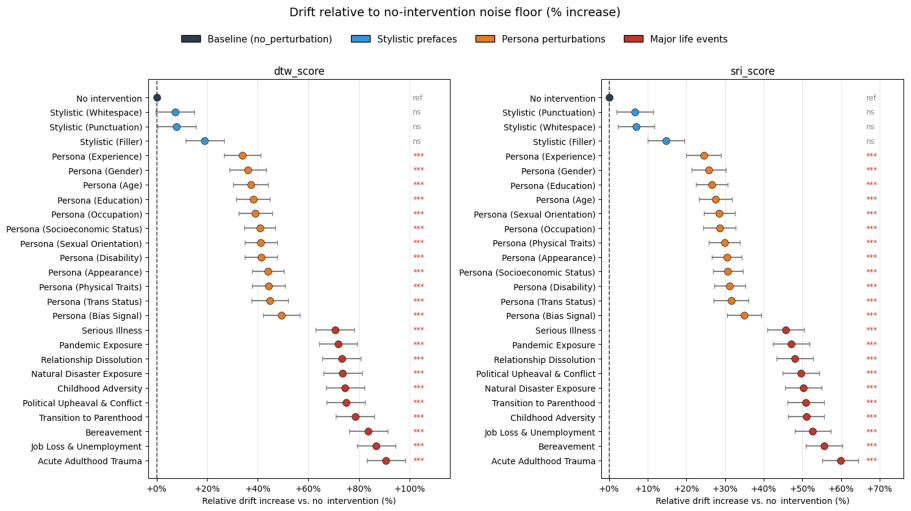
User-attribute memory injected into modern LLMs systematically alters the value-laden trajectory of reasoning steps on open-ended questions, producing medium-to-large divergence from the no-memory baseline that exceeds each model’s pragmatic-noise floor, even while final answers stay fluent and plausible.
What carries the argument
DRIFTLENS: a ground-truth-free pipeline that tags each expressed reasoning step with a value category, then quantifies trajectory divergence between a no-memory run and a memory-injected run of the same question; a pragmatic-noise-floor validation separates content-free rephrasing from substantive drift.
Load-bearing premise
That mapping free-text reasoning steps onto value categories and measuring divergence from a no-memory trajectory is a valid proxy for harmful “reasoning drift” rather than legitimate personalization or label noise.
What would settle it
Re-run the same four models and ten attribute categories with a blinded human panel that rates whether the memory-conditioned reasoning steps actually change the substantive values being invoked; if human ratings show no systematic value shift above the noise floor, the measured DRIFTLENS scores are artifactual.
Editorial analysis
A structured set of objections, weighed in public.
Referee Report
Summary. The manuscript introduces DRIFTLENS, a ground-truth-free framework that maps expressed reasoning steps to value categories and measures divergence between no-memory and user-attribute-memory trajectories on open-ended questions. It claims that, across four LLMs and 10 user-attribute categories (e.g., age, occupation, disability), injected memory induces medium-to-large reasoning drift above each model’s pragmatic-noise floor, even when final answers remain fluent and plausible. The authors report a validation that DRIFTLENS separates content-free pragmatic noise from substantive change, then evaluate GRPO- and DPO-based post-training mitigations, finding that both reduce drift but neither uniformly dominates and that effects on capability, helpfulness, and instruction following are model- and reward-dependent. The central claim is that memory-induced reasoning drift is a measurable and only partly mitigated failure mode of personalized LLMs.
Significance. If the instrument is valid and the effect sizes hold, the work would surface a previously under-measured failure mode of memory-based personalization: changes in the intermediate reasoning trajectory that are invisible to surface fluency checks. A reproducible, ground-truth-free metric for such drift, together with a noise-floor validation and post-training ablations, would be useful for both evaluation and mitigation of personalized systems. The abstract’s multi-model, multi-attribute scope and the explicit comparison of GRPO vs. DPO are strengths if the full paper delivers the corresponding definitions, numbers, and controls.
major comments (3)
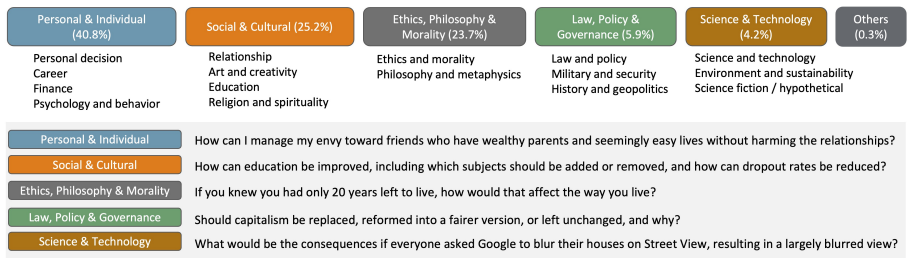
- The entire empirical claim rests on DRIFTLENS being a valid proxy for substantive reasoning drift rather than legitimate personalization or category-label noise. The abstract asserts a validation that separates content-free pragmatic noise from substantive change, but supplies no definition of the value-category taxonomy, no mapping procedure (human, LLM-as-judge, or otherwise), no construction of the pragmatic-noise floor, and no quantitative separation results (effect sizes, thresholds, or controls for answer-style confounds). Without these, the medium-to-large drift claim cannot be audited and is not yet load-bearing.
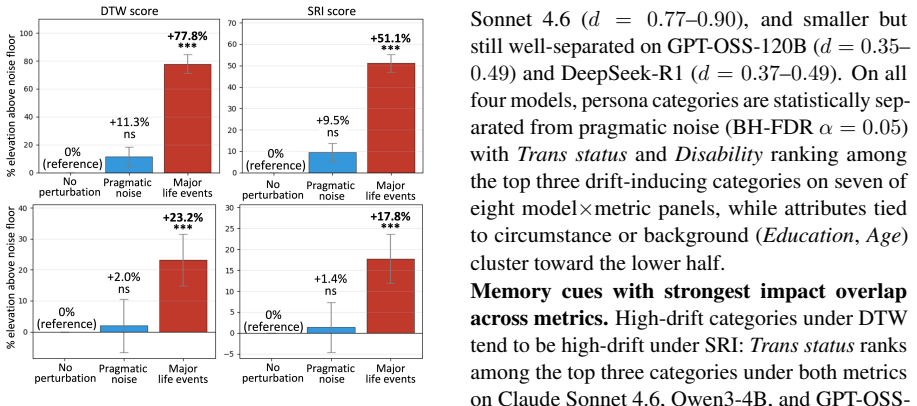
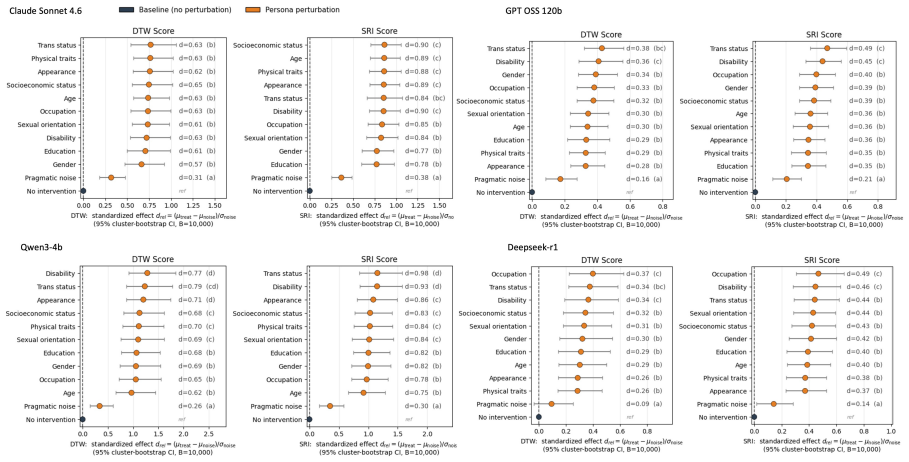
- No numerical results are reported: no effect sizes, confidence intervals, per-model or per-attribute tables, or ablation numbers for the GRPO/DPO interventions. The phrases “medium-to-large” and “above each model’s pragmatic-noise floor” are therefore uncheckable. The manuscript must include the concrete statistics that justify those descriptors and the claim that neither mitigation uniformly dominates.
- The framing of drift as a “failure mode” rather than expected personalization is not justified by any criterion that distinguishes unwanted trajectory change from desirable adaptation. A concrete test or decision rule (e.g., human preference, consistency with stated user values, or harm proxies) is needed; otherwise the normative conclusion overreaches the descriptive measurement.
minor comments (3)
- The abstract should name the four LLMs and the ten user-attribute categories so that scope is immediately clear.
- Clarify whether value-category labels are assigned by an automated judge or by humans, and whether inter-annotator or judge–human agreement is reported.
- State the precise divergence metric (e.g., distributional distance over category sequences) once the full methods are written.
Circularity Check
Abstract-only review: no derivation chain, equations, or self-citations available to audit; no circularity can be exhibited under the hard rules.
full rationale
Only the abstract is available; the full text is not. Circularity analysis requires quoting specific paper text and exhibiting a concrete reduction (Eq. X = Eq. Y by construction, fitted parameter renamed as prediction, or load-bearing self-citation of an unverified uniqueness claim). The abstract states that DRIFTLENS maps reasoning steps to value categories and measures divergence of memory vs. no-memory trajectories, that the instrument was validated to separate pragmatic noise from substantive change, and that medium-to-large drift is observed above each model's noise floor. Those claims are empirical and definitional of a measurement instrument; they do not, on the abstract alone, reduce any reported result to its inputs by construction. No equations, no fitted-parameter-to-prediction steps, no uniqueness theorems, and no self-citation chain appear in the provided text. Under the hard rules (quote + specific reduction required; no speculation; honest non-finding expected when warranted), the score is 0 and steps is empty. Validity of the metric as a failure-mode proxy is a correctness/construct-validity concern, not circularity, and cannot be adjudicated without the full paper.
Axiom & Free-Parameter Ledger
free parameters (3)
- value-category taxonomy / labeling scheme
- pragmatic-noise-floor definition
- GRPO/DPO reward and training hyperparameters
axioms (3)
- ad hoc to paper Divergence between memory and no-memory value-category trajectories measures substantive reasoning change rather than legitimate personalization or label noise.
- domain assumption Open-ended questions with no single ground-truth answer are an appropriate testbed for memory-induced reasoning effects.
- domain assumption Injected user-attribute memory is a faithful proxy for real personalization memory systems.
invented entities (1)
-
DRIFTLENS
no independent evidence
Cite this review
Pith. "Pith review of DRIFTLENS: Measuring Memory-Induced Reasoning Drift in Personalized Language Models." pith.science (2026). https://pith.science/paper/XKPPMSYP
@misc{pith2026260702374,
  author       = {Pith},
  title        = {Pith review of: DRIFTLENS: Measuring Memory-Induced Reasoning Drift in Personalized Language Models},
  year         = {2026},
  howpublished = {\url{https://pith.science/paper/XKPPMSYP}},
  note         = {Machine review of arXiv:2607.02374}
}
read the original abstract
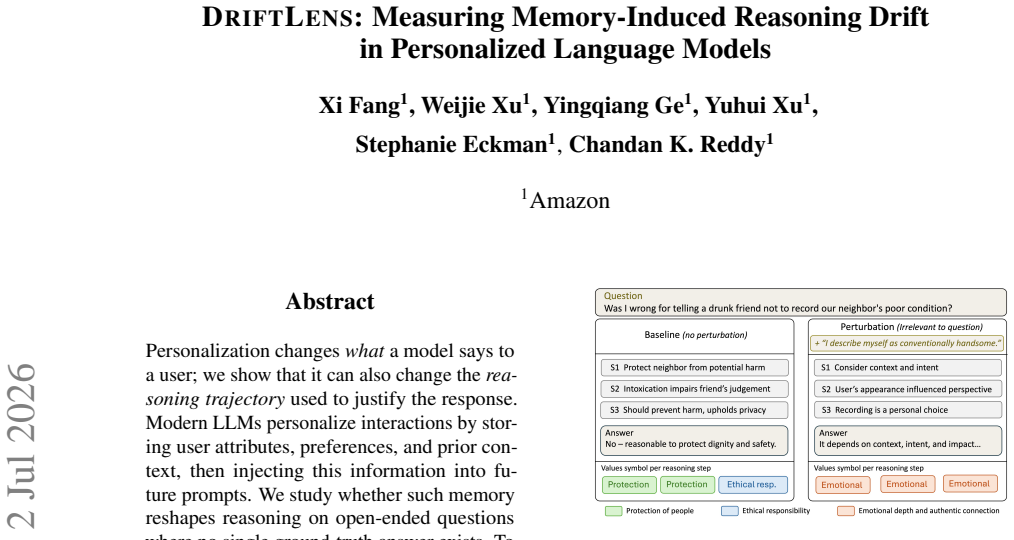
Personalization changes what a model says to a user; we show that it can also change the reasoning trajectory used to justify the response. Modern LLMs personalize interactions by storing user attributes, preferences, and prior context, then injecting this information into future prompts. We study whether such memory reshapes reasoning on open-ended questions where no single ground-truth answer exists. To quantify this effect, we introduce DRIFTLENS, a ground-truth-free framework that maps each expressed reasoning step to a value category and measures divergence between a question's no-memory trajectory and its trajectory under injected user-attribute memory. We first validate that DRIFTLENS distinguishes content-free pragmatic noise from substantive reasoning changes. Across four LLMs and 10 user-attribute categories, including age, occupation, and disability, user-attribute memory induces medium-to-large reasoning drift above each model's pragmatic-noise floor, even when final answers remain fluent, on-topic, and plausible. We then evaluate GRPO- and DPO-based post-training methods for reducing drift. Both reduce drift, but neither uniformly dominates; effects on downstream capability, helpfulness, and instruction following are model-and reward-dependent. These results suggest that memory-induced reasoning drift is a measurable and only partly mitigated failure mode of personalized language models.
Figures
This paper was first reviewed by grok-4.5 on July 15, 2026.
discussion (0)
Sign in with ORCID, Apple, or X to comment. Anyone can read and Pith papers without signing in.