MARVEL: Margin-Aware Robust von Mises-Fischer Expert Learning for Long-Tailed Out-of-Distribution Detection
Pith reviewed 2026-07-03 14:57 UTC · model grok-4.3
The pith
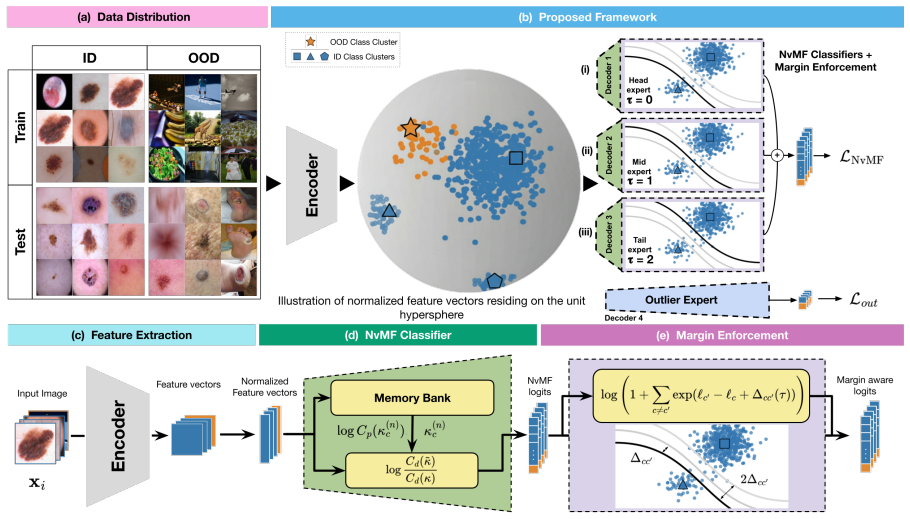
A multi-expert framework with nonlinear von Mises-Fisher classifiers improves OOD detection on long-tailed medical datasets.
A machine-rendered reading of the paper's core claim, the machinery that carries it, and where it could break.
Core claim
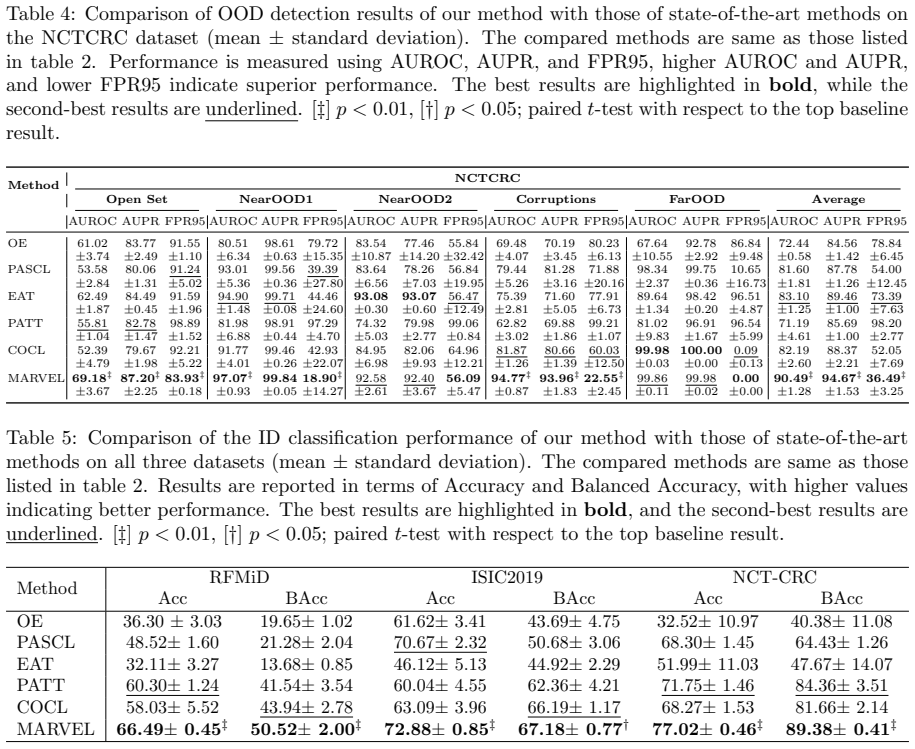
The framework of nonlinear von Mises-Fisher classifiers in a multi-expert margin-aware architecture combined with an outlier expert enables better out-of-distribution detection for long-tailed medical datasets, as evidenced by FPR95 reductions of 8.45%, 13.02%, and 36.90% on the three evaluated datasets.
What carries the argument
Nonlinear von Mises-Fisher (NvMF) classifier that learns non-linear decision boundaries with asymptotic connection to cosine classifiers, used in a multi-expert framework with margin awareness and an outlier expert.
If this is right
- Each component of the framework contributes to improved OOD detection as shown by ablations.
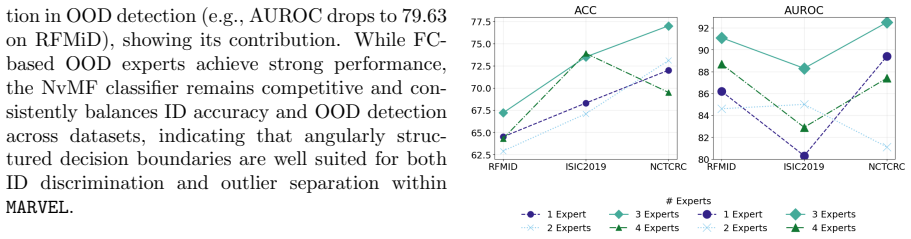
- The approach handles label imbalance by specializing experts on different distribution regions.
- Explicit outlier training strengthens distinction between in-distribution and out-of-distribution data.
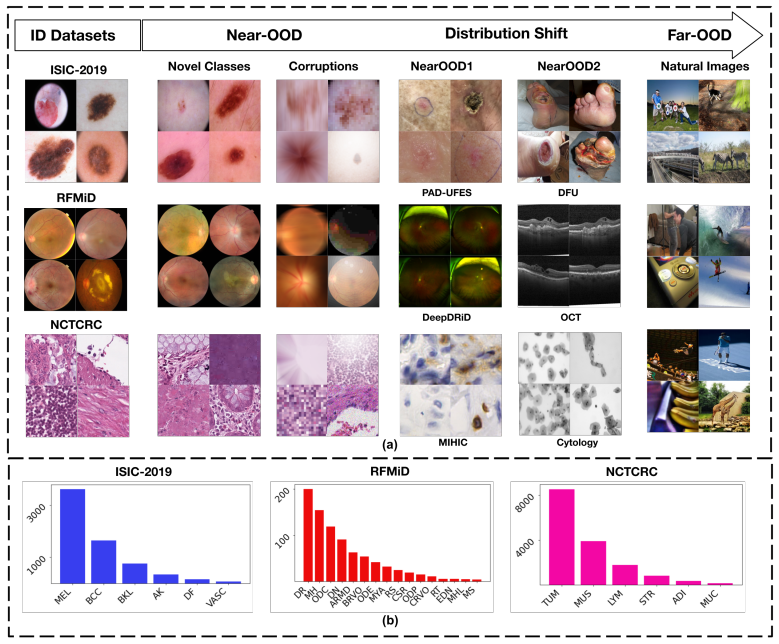
- Results hold across multiple clinically relevant medical datasets with diverse OOD scenarios.
Where Pith is reading between the lines
- The method may generalize to other domains with long-tailed distributions beyond medical imaging.
- Simplifying the nonlinear aspect using the asymptotic connection could reduce computational overhead in deployment.
- Further tests with real-world clinical workflows could reveal additional benefits for deferral systems.
Load-bearing premise
The theoretical asymptotic connection of the nonlinear von Mises-Fisher classifier to cosine classifiers enables effective non-linear boundary learning in practice for out-of-distribution detection.
What would settle it
Observing no improvement in FPR95 or failure of the NvMF component to learn useful non-linear boundaries on the RFMiD, ISIC2019, or NCTCRC datasets would falsify the claim.
Figures
read the original abstract
For clinical deployment, it is essential that automated diagnostic systems remain reliable when confronted with previously unseen cases, yet deep models routinely misclassify out-of-distribution (OOD) inputs with high confidence, underscoring the need for more robust OOD detection methods. Although substantial effort has been devoted to improving model robustness, most of the existing literature assumes balanced datasets, evaluates OOD detection on coarse or non-clinical OOD sources, or lacks comprehensive assessment across diverse OOD scenarios. To address the gaps, we propose a novel methodology trained on diverse and imbalanced medical datasets and evaluated across a clinically reflective OOD spectrum. Our framework comprises three key components: (1) a Nonlinear von Mises-Fisher (NvMF) classifier capable of learning non-linear decision boundaries, with theoretical proof of its asymptotic connection to cosine classifiers; (2) a multi-expert framework in which margin-aware NvMF classifiers specialise in different regions of label distribution to better handle imbalance; and (3) an outlier expert trained explicitly to distinguish inlier from outlier data, thereby strengthening OOD detection. Evaluation on RFMiD, ISIC2019, and NCTCRC datasets demonstrates consistent improvements over state-of-the-art methods, achieving mean FPR95 reductions of 8.45%, 13.02%, and 36.90% respectively. These gains are further supported by comprehensive ablations that validated the contributions of each component. This enables reliable identification of unfamiliar cases for deferral to clinicians, supporting safer AI-assisted diagnosis in real-world workflows. Our code is available at https://github.com/redboxup/MARVEL.
Editorial analysis
A structured set of objections, weighed in public.
Referee Report
Summary. The paper proposes MARVEL, a framework for long-tailed OOD detection on imbalanced medical imaging datasets. It consists of (1) a Nonlinear von Mises-Fisher (NvMF) classifier with a theoretical proof of asymptotic connection to cosine classifiers for learning non-linear boundaries, (2) a multi-expert system of margin-aware NvMF classifiers specialized to different regions of the label distribution, and (3) an outlier expert trained to distinguish inliers from outliers. Experiments on RFMiD, ISIC2019, and NCTCRC report mean FPR95 reductions of 8.45%, 13.02%, and 36.90% over SOTA, supported by ablations; code is released.
Significance. If the empirical gains and theoretical connection hold under rigorous scrutiny, the work would advance reliable OOD detection for clinical long-tailed settings, directly supporting safer deferral workflows. Releasing code strengthens the contribution.
major comments (3)
- [Abstract / §3] Abstract and §3 (theoretical component): the claimed asymptotic connection of NvMF to cosine classifiers is presented as enabling non-linear boundaries, yet no equation or proof sketch is supplied in the summary to verify whether the connection is parameter-free or holds under the nonlinear extension; this is load-bearing for component (1).
- [§4] §4 (experiments): the reported FPR95 reductions lack any description of baselines, training protocols, statistical significance, or OOD source construction, preventing assessment of whether the multi-expert and outlier-expert gains are robust or dataset-specific.
- [§3.3] §3.3 (outlier expert): the explicit training of a dedicated outlier expert is central to the OOD claim, but no loss function, sampling strategy, or integration details are given, raising the risk that performance improvements are driven by this ad-hoc component rather than the NvMF core.
minor comments (2)
- Define NvMF and all acronyms at first use; ensure figure captions fully describe axes and legend entries for the ablation studies.
- [Abstract] The abstract states 'comprehensive ablations' but does not indicate which tables or figures contain them; cross-reference explicitly.
Simulated Author's Rebuttal
We thank the referee for the constructive feedback. Below we respond point-by-point to the major comments.
read point-by-point responses
-
Referee: [Abstract / §3] Abstract and §3 (theoretical component): the claimed asymptotic connection of NvMF to cosine classifiers is presented as enabling non-linear boundaries, yet no equation or proof sketch is supplied in the summary to verify whether the connection is parameter-free or holds under the nonlinear extension; this is load-bearing for component (1).
Authors: Section 3 contains the full proof establishing the asymptotic connection to cosine classifiers, demonstrating that the link is parameter-free and extends to the nonlinear case. The abstract summarizes this result at a high level. We will add a concise equation and one-sentence proof sketch to the abstract to make the theoretical claim self-contained. revision: partial
-
Referee: [§4] §4 (experiments): the reported FPR95 reductions lack any description of baselines, training protocols, statistical significance, or OOD source construction, preventing assessment of whether the multi-expert and outlier-expert gains are robust or dataset-specific.
Authors: Section 4 and the supplementary material specify the SOTA baselines, training protocols with hyperparameters, statistical significance via repeated runs with standard deviations, and the construction of clinically relevant OOD sources. We will expand the experimental section with additional explicit details on these elements to improve clarity and reproducibility. revision: yes
-
Referee: [§3.3] §3.3 (outlier expert): the explicit training of a dedicated outlier expert is central to the OOD claim, but no loss function, sampling strategy, or integration details are given, raising the risk that performance improvements are driven by this ad-hoc component rather than the NvMF core.
Authors: Section 3.3 defines the outlier expert's loss, sampling procedure, and integration via the multi-expert gating mechanism. To eliminate any perception of ad-hoc design, we will insert the explicit loss equation and a schematic of the integration in the revised version. revision: yes
Circularity Check
No circularity in derivation chain from provided text
full rationale
The abstract and description present three components (NvMF classifier with claimed theoretical asymptotic connection to cosine classifiers, multi-expert margin-aware setup, and outlier expert) along with dataset evaluations showing FPR95 improvements. No equations, self-citations, fitted parameters presented as predictions, or self-definitional steps are quoted or visible in the given material. The theoretical proof is asserted as independent support rather than a reduction to inputs, and external benchmarks (RFMiD, ISIC2019, NCTCRC) are referenced, making the central claims self-contained against the provided excerpts.
Axiom & Free-Parameter Ledger
axioms (1)
- domain assumption The NvMF classifier has an asymptotic connection to cosine classifiers
invented entities (1)
-
Outlier expert
no independent evidence
Reference graph
Works this paper leans on
-
[1]
Barry C. Arnold. Pareto Distributions. 2nd ed. Chapman and Hall/CRC, 2015.doi:10.1201/ b18141
2015
-
[2]
Christopher M. Bishop. Pattern Recognition and Machine Learning (Information Science and Statistics). Berlin, Heidelberg: Springer-Verlag, 2006.isbn: 0387310738
2006
-
[3]
Albumentations: fast and flexible image augmentations
A. Buslaev et al. “Albumentations: fast and flexible image augmentations”. In: arXiv preprint arXiv:1809.06839 (2018). eprint:1809.06839
-
[4]
Learning Imbalanced Datasets with Label-Distribution-Aware Margin Loss
Kaidi Cao et al. “Learning Imbalanced Datasets with Label-Distribution-Aware Margin Loss”. In: Advances in Neural Information Processing Systems. 2019
2019
-
[5]
Dataset of fundus images for the diagnosis of ocular toxoplasmosis
Olivia Cardozo et al. “Dataset of fundus images for the diagnosis of ocular toxoplasmosis”. In: Data in Brief 48 (2023), p. 109056.issn: 2352-3409
2023
-
[6]
The DFUC 2020 Dataset: Analysis Towards Diabetic Foot Ulcer Detection
B. Cassidy et al. “The DFUC 2020 Dataset: Analysis Towards Diabetic Foot Ulcer Detection”. In: touchREV Endocrinology 17.1 (Apr. 2021), pp. 5–11.doi:10.17925/EE.2021.17.1.5
-
[7]
N. C. F. Codella et al. Skin Lesion Analysis Toward Melanoma Detection: A Challenge at the 2017 International Symposium on Biomedical Imaging (ISBI), Hosted by the International Skin Imaging Collaboration (ISIC). arXiv:1710.05006. 2017
work page internal anchor Pith review Pith/arXiv arXiv 2017
-
[8]
iNaturalist Research-grade Observations
iNaturalist contributors. iNaturalist Research-grade Observations. 2024
2024
-
[9]
Class-Balanced Loss Based on Effective Number of Samples
Yin Cui et al. “Class-Balanced Loss Based on Effective Number of Samples”. In: CVPR. 2019
2019
-
[10]
Extremely Simple Activation Shaping for Out-of-Distribution Detection
Andrija Djurisic et al. “Extremely Simple Activation Shaping for Out-of-Distribution Detection”. In: The Eleventh International Conference on Learning Representations. 2023.url:https://openreview. net/forum?id=ndYXTEL6cZz
2023
-
[11]
VOS: Learning What You Don’t Know by Virtual Outlier Synthesis
Xuefeng Du et al. “VOS: Learning What You Don’t Know by Virtual Outlier Synthesis”. In: Proceedings of the International Conference on Learning Representations (2022)
2022
-
[12]
Dermatologist-level classification of skin cancer with deep neural networks
Andre Esteva et al. “Dermatologist-level classification of skin cancer with deep neural networks”. In: Nature 542.7639 (2017), pp. 115–118.doi:10.1038/nature21056
-
[13]
Dropout as a Bayesian Approximation: Representing Model Uncertainty in Deep Learning
Yarin Gal and Zoubin Ghahramani. “Dropout as a Bayesian Approximation: Representing Model Uncertainty in Deep Learning”. In:Proceedings of The 33rd International Conference on Machine Learning. Ed. by Maria Florina Balcan and Kilian Q. Weinberger. Vol. 48. Proceedings of Machine Learning Research. New York, New York, USA: PMLR, 20–22 Jun 2016, pp. 1050–1059
2016
-
[14]
The generalized von Mises distribution
Riccardo Gatto and Sreenivasa Rao Jammalamadaka. “The generalized von Mises distribution”. In: Statistical Methodology 4.3 (2007), pp. 341–353
2007
-
[15]
Dynamic Few-Shot Visual Learning Without Forgetting
Spyros Gidaris and Nikos Komodakis. “Dynamic Few-Shot Visual Learning Without Forgetting”. In: Proceedings of the IEEE Conference on Computer Vision and Pattern Recognition (CVPR). June 2018
2018
-
[16]
Does your dermatology classifier know what it doesn’t know? Detect- ing the long-tail of unseen conditions
Abhijit Guha Roy et al. “Does your dermatology classifier know what it doesn’t know? Detect- ing the long-tail of unseen conditions”. In: Medical Image Analysis 75 (2022), p. 102274.issn: 1361-8415.doi:https : / / doi . org / 10 . 1016 / j . media . 2021 . 102274.url:https : / / www . sciencedirect.com/science/article/pii/S1361841521003194
2022
-
[17]
Long-Tailed Out-of-Distribution Detection: Prioritizing Attention to Tail
Yina He et al. “Long-Tailed Out-of-Distribution Detection: Prioritizing Attention to Tail”. In: Proceedings of the AAAI Conference on Artificial Intelligence 39.3 (Apr. 2025), pp. 3446–3454.doi: 10.1609/aaai.v39i3.32357.url:https://ojs.aaai.org/index.php/AAAI/article/view/ 32357
work page doi:10.1609/aaai.v39i3.32357.url:https://ojs.aaai.org/index.php/aaai/article/view/ 2025
-
[18]
A Baseline for Detecting Misclassified and Out-of-Distribution Examples in Neural Networks
Dan Hendrycks and Kevin Gimpel. “A Baseline for Detecting Misclassified and Out-of-Distribution Examples in Neural Networks”. In:Proceedings of International Conference on Learning Representations (2017)
2017
-
[19]
Deep Anomaly Detection with Outlier Exposure
Dan Hendrycks, Mantas Mazeika, and Thomas Dietterich. “Deep Anomaly Detection with Outlier Exposure”. In: Proceedings of the International Conference on Learning Representations (2019)
2019
-
[20]
BCN20000: Dermoscopic lesions in the wild
C. Hern´ andez-P´ erez et al. “BCN20000: Dermoscopic lesions in the wild”. In: Scientific Data 11.1 (June 2024), p. 641.doi:10.1038/s41597-024-01921-3
-
[21]
Generalized ODIN: Detecting Out-of-Distribution Image Without Learning From Out-of-Distribution Data
Yen-Chang Hsu et al. “Generalized ODIN: Detecting Out-of-Distribution Image Without Learning From Out-of-Distribution Data”. In:Proceedings of the IEEE/CVF Conference on Computer Vision and Pattern Recognition (CVPR). June 2020. 22
2020
-
[22]
J. N. Kather, N. Halama, and A. Marx. 100,000 histological images of human colorectal cancer and healthy tissue. Data set. Version v0.1. 2018
2018
-
[23]
Kather, Nikolaus Halama, and Andreas Marx
Jakob N. Kather, Nikolaus Halama, and Andreas Marx. 100,000 histological images of human colorectal cancer and healthy tissue (v0.1) [Data set]. 2018.doi:10.5281/zenodo.1214456.url:https://doi.org/10.5281/zenodo.1214456
work page doi:10.5281/zenodo.1214456.url:https://doi.org/10.5281/zenodo.1214456 2018
-
[24]
Identifying Medical Diagnoses and Treatable Diseases by Image-Based Deep Learning
Daniel S. Kermany et al. “Identifying Medical Diagnoses and Treatable Diseases by Image-Based Deep Learning”. In: Cell 172.5 (2018), 1122–1131.e9.issn: 0092-8674.doi:10 . 1016 / j . cell . 2018.02.010
2018
-
[25]
Supervised contrastive learning,
Prannay Khosla et al. “Supervised Contrastive Learning”. In: arXiv preprint arXiv:2004.11362 (2020)
-
[26]
Adam: A Method for Stochastic Optimization
Diederik P. Kingma and Jimmy Lei Ba. “Adam: A Method for Stochastic Optimization”. In: International Conference on Learning Representations (ICLR). Ithaca, NY: ArXiv, 2015
2015
-
[27]
Generalized Outlier Exposure: Towards a trust- worthy out-of-distribution detector without sacrificing accuracy
Jiin Koo, Sungjoon Choi, and Sangheum Hwang. “Generalized Outlier Exposure: Towards a trust- worthy out-of-distribution detector without sacrificing accuracy”. In: Neurocomputing 577 (2024), p. 127371.issn: 0925-2312
2024
-
[28]
Learning multiple layers of features from tiny images
Alex Krizhevsky. Learning multiple layers of features from tiny images. Technical Report. Univer- sity of Toronto, 2009
2009
-
[29]
ImageNet Classification with Deep Con- volutional Neural Networks
Alex Krizhevsky, Ilya Sutskever, and Geoffrey E Hinton. “ImageNet Classification with Deep Con- volutional Neural Networks”. In: Advances in Neural Information Processing Systems. Ed. by F. Pereira et al. Vol. 25. Curran Associates, Inc., 2012.url:https://proceedings.neurips.cc/ paper_files/paper/2012/file/c399862d3b9d6b76c8436e924a68c45b-Paper.pdf
2012
-
[30]
Simple and Scalable Predic- tive Uncertainty Estimation using Deep Ensembles
Balaji Lakshminarayanan, Alexander Pritzel, and Charles Blundell. “Simple and Scalable Predic- tive Uncertainty Estimation using Deep Ensembles”. In:Advances in Neural Information Processing Systems. Ed. by I. Guyon et al. Vol. 30. Curran Associates, Inc., 2017
2017
-
[31]
A Simple Unified Framework for Detecting Out-of-Distribution Samples and Adversarial Attacks
Kimin Lee et al. “A Simple Unified Framework for Detecting Out-of-Distribution Samples and Adversarial Attacks”. In: Advances in Neural Information Processing Systems. Ed. by S. Bengio et al. Vol. 31. Curran Associates, Inc., 2018
2018
-
[32]
Enhancing The Reliability of Out-of-distribution Image Detection in Neural Networks
Shiyu Liang, Yixuan Li, and R. Srikant. “Enhancing The Reliability of Out-of-distribution Image Detection in Neural Networks”. In: International Conference on Learning Representations. 2018. url:https://openreview.net/forum?id=H1VGkIxRZ
2018
-
[33]
Microsoft COCO: Common Objects in Context
Tsung-Yi Lin et al. “Microsoft COCO: Common Objects in Context”. In: European Conference on Computer Vision (ECCV). 2014, pp. 740–755.doi:10.1007/978-3-319-10602-1_48
-
[34]
Microsoft coco: Common objects in context
Tsung-Yi Lin et al. “Microsoft coco: Common objects in context”. In: European conference on computer vision. Springer. 2014, pp. 740–755
2014
-
[35]
A survey on deep learning in medical image analysis
Geert Litjens et al. “A survey on deep learning in medical image analysis”. In: Medical Image Analysis 42 (2017), pp. 60–88.issn: 1361-8415.doi:https://doi.org/10.1016/j.media.2017.07.005. url:https://www.sciencedirect.com/science/article/pii/S1361841517301135
-
[36]
DeepDRiD: Diabetic Retinopathy—Grading and Image Quality Estimation Challenge
Ruhan Liu et al. “DeepDRiD: Diabetic Retinopathy—Grading and Image Quality Estimation Challenge”. In: Patterns 3.6 (2022), p. 100512.issn: 2666-3899.doi:https : / / doi . org / 10 . 1016/j.patter.2022.100512.url:https://www.sciencedirect.com/science/article/pii/ S2666389922001040
-
[37]
Energy-based Out-of-distribution Detection
Weitang Liu et al. “Energy-based Out-of-distribution Detection”. In: Advances in Neural Information Processing Systems (2020)
2020
-
[38]
SphereFace: Deep Hypersphere Embedding for Face Recognition
Weiyang Liu et al. “SphereFace: Deep Hypersphere Embedding for Face Recognition”. In:The IEEE Conference on Computer Vision and Pattern Recognition (CVPR). 2017
2017
-
[39]
Xiaoxuan Liu et al. “A comparison of deep learning performance against health-care profes- sionals in detecting diseases from medical imaging: a systematic review and meta-analysis”. In: The Lancet Digital Health 1.6 (2019), e271–e297.doi:10.1016/S2589-7500(19)30123-2
-
[40]
Large-Scale Long-Tailed Recognition in an Open World
Ziwei Liu et al. “Large-Scale Long-Tailed Recognition in an Open World”. In: IEEE Conference on Computer Vision and Pattern Recognition (CVPR). 2019
2019
-
[41]
Learning with Mixture of Prototypes for Out-of-Distribution Detection
Haodong Lu et al. “Learning with Mixture of Prototypes for Out-of-Distribution Detection”. In: The Twelfth International Conference on Learning Representations. 2024.url:https://openreview. net/forum?id=uNkKaD3MCs. 23
2024
-
[43]
Out-of-Distribution Detection for Long-Tailed and Fine-Grained Skin Lesion Images
Deval Mehta et al. “Out-of-Distribution Detection for Long-Tailed and Fine-Grained Skin Lesion Images”. In: Medical Image Computing and Computer Assisted Intervention – MICCAI 2022. Ed. by Linwei Wang et al. Cham: Springer Nature Switzerland, 2022, pp. 732–742.isbn: 978-3-031- 16431-6
2022
-
[44]
Long-tailed Visual Recognition via Gaussian Clouded Logit Adjustment
Yang Lu Mengke Li Yiu-ming Cheung. “Long-tailed Visual Recognition via Gaussian Clouded Logit Adjustment”. In: CVPR. 2022, pp. 6929–6938
2022
-
[45]
Long-tail learning via logit adjustment
Aditya Krishna Menon et al. “Long-tail learning via logit adjustment”. In: International Conference on Learning Representations. 2021.url:https://openreview.net/forum?id=37nvvqkCo5
2021
-
[46]
Out-of-distribution detection in long-tailed recognition with calibrated outlier class learning
Wenjun Miao et al. “Out-of-distribution detection in long-tailed recognition with calibrated outlier class learning”. In: Proceedings of the AAAI Conference on Artificial Intelligence. Vol. 38. 2024
2024
-
[47]
POEM: Out-of-Distribution Detection with Posterior Sam- pling
Yifei Ming, Ying Fan, and Yixuan Li. “POEM: Out-of-Distribution Detection with Posterior Sam- pling”. In: Proceedings of the 39th International Conference on Machine Learning. Ed. by Kama- lika Chaudhuri et al. Vol. 162. Proceedings of Machine Learning Research. PMLR, 17–23 Jul 2022, pp. 15650–15665.url:https://proceedings.mlr.press/v162/ming22a.html
2022
-
[48]
How to Exploit Hyperspherical Embeddings for Out-of-Distribution Detection?
Yifei Ming et al. “How to Exploit Hyperspherical Embeddings for Out-of-Distribution Detection?” In: The Eleventh International Conference on Learning Representations. 2023
2023
-
[49]
Reading Digits in Natural Images with Unsupervised Feature Learning
Yuval Netzer et al. Reading Digits in Natural Images with Unsupervised Feature Learning. 2011
2011
-
[50]
VinDr-CXR: An open dataset of chest X-rays with radiologist’s annotations
H. Q. Nguyen, K. Lam, L. T. Le, et al. “VinDr-CXR: An open dataset of chest X-rays with radiologist’s annotations”. In: Scientific Data 9 (2022), p. 429
2022
-
[51]
Chapter 10 Bessel Functions
NIST Digital Library of Mathematical Functions. Chapter 10 Bessel Functions. Revision 1.1.5. 2020.url:https://dlmf.nist.gov/10.40(visited on 10/27/2023)
2020
-
[52]
Retinal Fundus Multi-disease Image Dataset (RFMiD)
Samiksha Pachade et al. Retinal Fundus Multi-disease Image Dataset (RFMiD). 2020
2020
-
[53]
Retinal Fundus Multi-disease Image Dataset (RFMiD)
Samiksha Pachade et al. Retinal Fundus Multi-disease Image Dataset (RFMiD). 2020.doi:10 . 21227/s3g7-st65.url:https://dx.doi.org/10.21227/s3g7-st65
-
[54]
Andre G.C. Pacheco et al. “PAD-UFES-20: A skin lesion dataset composed of patient data and clinical images collected from smartphones”. In: Data in Brief 32 (2020), p. 106221.issn: 2352- 3409.doi:https://doi.org/10.1016/j.dib.2020.106221.url:https://www.sciencedirect. com/science/article/pii/S235234092031115X
work page doi:10.1016/j.dib.2020.106221.url:https://www.sciencedirect 2020
-
[55]
Nearest Neighbor Guidance for Out-of- Distribution Detection
Jaewoo Park, Yoon Gyo Jung, and Andrew Beng Jin Teoh. “Nearest Neighbor Guidance for Out-of- Distribution Detection”. In:Proceedings of the IEEE/CVF International Conference on Computer Vision (ICCV). Oct. 2023, pp. 1686–1695
2023
-
[56]
Hady Ahmady Phoulady and Peter R. Mouton. A New Cervical Cytology Dataset for Nucleus Detection and Image Classification (Cervix93) and Methods for Cervical Nucleus Detection
-
[57]
arXiv:1811.09651 [cs.CV].url:https://arxiv.org/abs/1811.09651
work page internal anchor Pith review Pith/arXiv arXiv
-
[58]
ImageNet Large Scale Visual Recognition Challenge
Olga Russakovsky et al. “ImageNet Large Scale Visual Recognition Challenge”. In: International Journal of Computer Vision (IJCV) 115.3 (2015), pp. 211–252
2015
-
[59]
SSD: A Unified Framework for Self-Supervised Outlier Detection
Vikash Sehwag, Mung Chiang, and Prateek Mittal. “SSD: A Unified Framework for Self-Supervised Outlier Detection”. In: International Conference on Learning Representations. 2021.url:https: //openreview.net/forum?id=v5gjXpmR8J
2021
-
[60]
EBHI-Seg: A novel enteroscope biopsy histopathological hematoxylin and eosin image dataset for image segmentation tasks
L. Shi et al. “EBHI-Seg: A novel enteroscope biopsy histopathological hematoxylin and eosin image dataset for image segmentation tasks”. In: Frontiers in Medicine 10 (2023), p. 1114673
2023
-
[61]
ReAct: Out-of-distribution Detection With Rectified Activations
Yiyou Sun, Chuan Guo, and Yixuan Li. “ReAct: Out-of-distribution Detection With Rectified Activations”. In: Advances in Neural Information Processing Systems. 2021
2021
-
[62]
DICE: Leveraging Sparsification for Out-of-Distribution Detection
Yiyou Sun and Yixuan Li. “DICE: Leveraging Sparsification for Out-of-Distribution Detection”. In: European Conference on Computer Vision. 2022
2022
-
[63]
Out-of-distribution Detection with Deep Nearest Neighbors
Yiyou Sun et al. “Out-of-distribution Detection with Deep Nearest Neighbors”. In: ICML (2022)
2022
-
[64]
Non-parametric Outlier Synthesis
Leitian Tao et al. “Non-parametric Outlier Synthesis”. In: The Eleventh International Conference on Learning Representations. 2023.url:https://openreview.net/forum?id=JHklpEZqduQ. 24
2023
-
[65]
P. Tschandl, C. Rosendahl, and H. Kittler. “The HAM10000 dataset, a large collection of multi- source dermatoscopic images of common pigmented skin lesions”. In: Scientific Data 5 (2018), p. 180161.doi:10.1038/sdata.2018.161
-
[66]
Open-Set Recognition: a Good Closed-Set Classifier is All You Need?
Sagar Vaze et al. “Open-Set Recognition: a Good Closed-Set Classifier is All You Need?” In: International Conference on Learning Representations. 2022
2022
-
[67]
ViM: Out-Of-Distribution with Virtual-logit Matching
Haoqi Wang et al. “ViM: Out-Of-Distribution with Virtual-logit Matching”. In: Proceedings of the IEEE/CVF Conference on Computer Vision and Pattern Recognition. 2022
2022
-
[68]
Partial and Asymmetric Contrastive Learning for Out-of-Distribution Detec- tion in Long-Tailed Recognition
Haotao Wang et al. “Partial and Asymmetric Contrastive Learning for Out-of-Distribution Detec- tion in Long-Tailed Recognition”. In:International Conference on Machine Learning. 2022, pp. 23446– 23458
2022
-
[69]
R. Wang et al. “MIHIC: a multiplex IHC histopathological image classification dataset for lung cancer immune microenvironment quantification”. In: Frontiers in Immunology 15 (Feb. 2024), p. 1334348.doi:10.3389/fimmu.2024.1334348
-
[70]
Understanding Contrastive Representation Learning through Alignment and Uniformity on the Hypersphere
Tongzhou Wang and Phillip Isola. “Understanding Contrastive Representation Learning through Alignment and Uniformity on the Hypersphere”. In:International Conference on Machine Learning. PMLR. 2020, pp. 9929–9939
2020
-
[71]
Xiaosong Wang et al. “ChestX-Ray8: Hospital-Scale Chest X-Ray Database and Benchmarks on Weakly-Supervised Classification and Localization of Common Thorax Diseases”. In:2017 IEEE Conference on Computer Vision and Pattern Recognition (CVPR). 2017, pp. 3462–3471.doi:10.1109/CVPR.2017.369
-
[72]
EAT: Towards Long-Tailed Out-of-Distribution Detection
Tong Wei, Bo-Lin Wang, and Min-Ling Zhang. “EAT: Towards Long-Tailed Out-of-Distribution Detection”. In: Proceedings of the 38th AAAI Conference on Artificial Intelligence (2024)
2024
-
[73]
Alessandro Wollek et al. “Out-of-distribution detection with in-distribution voting using the med- ical example of chest x-ray classification”. In: Medical Physics 51.4 (2024), pp. 2721–2732.doi: https://doi.org/10.1002/mp.16790. eprint:https://aapm.onlinelibrary.wiley.com/doi/ pdf/10.1002/mp.16790.url:https://aapm.onlinelibrary.wiley.com/doi/abs/10.1002/...
-
[74]
Out-of-distribution detection with in-distribution voting using the medical example of chest x-ray classification
Anne Wollek et al. “Out-of-distribution detection with in-distribution voting using the medical example of chest x-ray classification”. In: Medical Physics 51 (2024), pp. 2721–2732.doi:10 . 1002/mp.16790
2024
-
[75]
Scaling for Training Time and Post-hoc Out-of-distribution Detection Enhance- ment
Kai Xu et al. “Scaling for Training Time and Post-hoc Out-of-distribution Detection Enhance- ment”. In: The Twelfth International Conference on Learning Representations. 2024.url:https: //openreview.net/forum?id=RDSTjtnqCg
2024
-
[76]
Generalized Out-of-Distribution Detection: A Survey
Jingkang Yang et al. Generalized Out-of-Distribution Detection: A Survey. 2024. arXiv:2110 . 11334 [cs.CV]
2024
-
[77]
Semantically Coherent Out-of-Distribution Detection
Jingkang Yang et al. “Semantically Coherent Out-of-Distribution Detection”. In: Proceedings of the IEEE/CVF International Conference on Computer Vision (ICCV). Oct. 2021, pp. 8301–8309
2021
-
[78]
LSUN: Construction of a Large-scale Image Dataset using Deep Learning with Humans in the Loop
Fisher Yu et al. “LSUN: Construction of a Large-scale Image Dataset using Deep Learning with Humans in the Loop”. In: arXiv preprint arXiv:1506.03365 (2015)
work page internal anchor Pith review Pith/arXiv arXiv 2015
-
[79]
Unsupervised Out-of-Distribution Detection by Maximum Clas- sifier Discrepancy
Qing Yu and Kiyoharu Aizawa. “ Unsupervised Out-of-Distribution Detection by Maximum Clas- sifier Discrepancy ”. In: 2019 IEEE/CVF International Conference on Computer Vision (ICCV). Los Alamitos, CA, USA: IEEE Computer Society, Nov. 2019, pp. 9517–9525.doi:10.1109/ICCV. 2019.00961.url:https://doi.ieeecomputersociety.org/10.1109/ICCV.2019.00961
-
[80]
Mixture Outlier Exposure: Towards Out-of-Distribution Detection in Fine- Grained Environments
Jingyang Zhang et al. “Mixture Outlier Exposure: Towards Out-of-Distribution Detection in Fine- Grained Environments”. In:Proceedings of the IEEE/CVF Winter Conference on Applications of Computer Vision (WACV). Jan. 2023, pp. 5531–5540
2023
-
[81]
S. Kevin Zhou et al. “A Review of Deep Learning in Medical Imaging: Imaging Traits, Technology Trends, Case Studies With Progress Highlights, and Future Promises”. In:Proceedings of the IEEE 109.5 (2021), pp. 820–838.doi:10.1109/JPROC.2021.3054390. 25
discussion (0)
Sign in with ORCID, Apple, or X to comment. Anyone can read and Pith papers without signing in.