REVIEW 4 major objections 6 minor 21 references
Additive Causal Construction for Transferable and Reconfigurable Cross-System Learning in Multi-Source Image Fusion
T0 review · 4 major / 6 minor · reviewed 2026-07-12 · grok-4.5
Pith's one-line read Multi-source image fusion works better out-of-distribution when shared causal anchors are built first and unreliable cross-system links are gated by uncertainty.
desk verdict Solid dual-region multi-center MVI recipe with useful structural diagnostics; the ACC/CGT/CGR packaging is mostly a re-label of disentanglement + response alignment + uncertainty gating, and the load-bearing γ≈edge-credibility claim is under-tested. read the letter →
The pith
A machine-rendered reading of the paper's core claim, the machinery that carries it, and where it could break.
The reading
What carries the argument
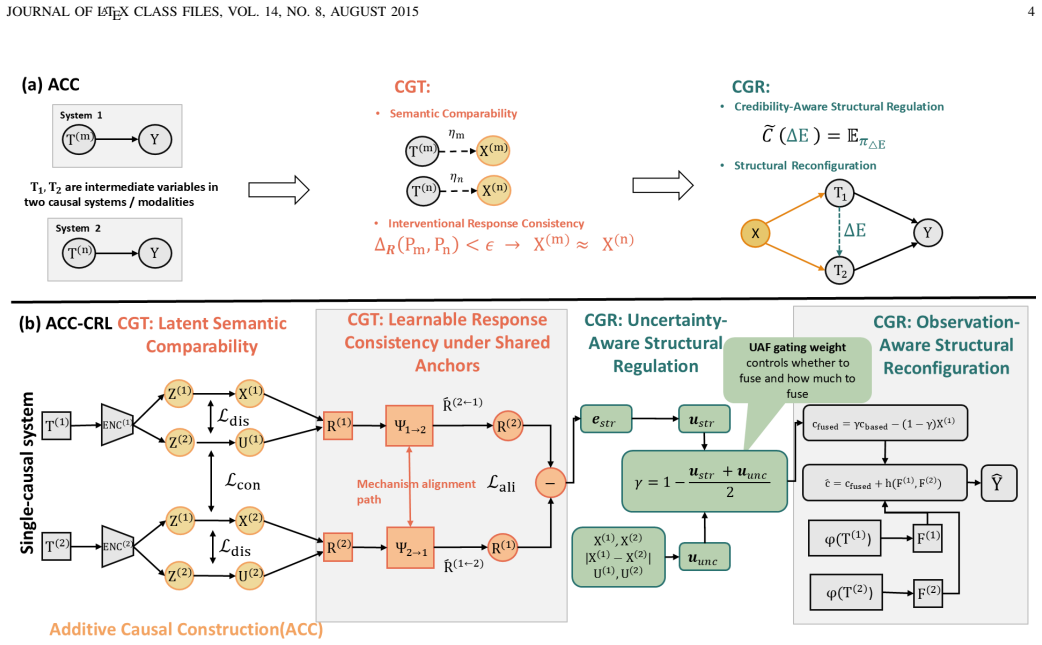
Additive causal construction (ACC), realized as ACC-CRL: content–mechanism decoupling yields shared anchors; bidirectional response alignment produces a structural-mismatch residual; that residual plus predictive uncertainty define a gate γ that strengthens dual-system fusion when reliable and falls back to a conservative representation when not.
What would settle it
On a held-out multi-center or multi-region fusion task, if removing the response-alignment residual from the gate (or replacing it with random/noise scores) leaves OOD metrics unchanged while ID performance stays similar, the claim that structural mismatch correctly targets unstable cross-system edges would fail.
Extended reading notes
Core claim
The paper claims that multi-source fusion under heterogeneous generative mechanisms is best cast as additive causal construction: establish transferable shared anchors via semantic comparability and interventional response consistency (CGT), then reconfigure candidate causal edges by credibility and structural uncertainty (CGR). Instantiated as ACC-CRL, content–mechanism decoupling plus bidirectional response alignment and uncertainty-aware fusion suppress cross-system discrepancy and entanglement, improving OOD generalization while preserving ID performance on ColorMNIST and multi-center MVI prediction.
Load-bearing premise
The method assumes that mismatch in bidirectional task responses under shared anchors, together with a lightweight uncertainty score, is a faithful proxy for whether a cross-system causal link is stable enough to keep.
Editorial analysis
A structured set of objections, weighed in public.
Referee Report
Summary. The paper argues that multi-source image fusion under heterogeneous generative mechanisms suffers from cross-system discrepancy (CSD) and cross-system entanglement (CSE), and proposes Additive Causal Construction (ACC) with two principles: causal graph transferability (CGT) via shared anchors and interventional response consistency, and causal graph reconfigurability (CGR) via credibility-aware structural regulation. ACC-CRL instantiates this by content–mechanism decoupling (contrastive + HSIC), bidirectional response alignment under shared anchors, and an uncertainty-gated fusion variable γ that mixes dual-system content with a conservative single-system fallback (plus an observation-level branch). Experiments on ColorMNIST (controlled shortcut bias) and multi-center MVI prediction (intra- vs peri-tumoral ART MRI) report reduced directional bias / improved retrieval structure on ColorMNIST and a more favorable ID–OOD trade-off on MVI relative to several OOD baselines, with ablations attributing gains to alignment and UAF.
Significance. If the causal-construction reading is correct, the work offers a useful organizing language for multi-source fusion under mechanism shift—treating fusion as prior-guided construction of transferable anchors and reconfigurable edges rather than static multi-input aggregation—and a concrete training recipe (disentanglement + response alignment + uncertainty gating) that is relevant to multi-center medical imaging. Strengths include dual synthetic/clinical evaluation, component ablations tied to CGT/CGR, representation and uncertainty diagnostics (t-SNE, distance gaps, ECE), and appendices that make the first-order Jacobian and gating interpretations explicit. The practical significance for MVI is real if the OOD gains hold under stricter patient-level and multi-sequence settings; the conceptual significance depends on whether γ truly tracks causal-path reliability rather than residual task noise.
major comments (4)
- [§IV.B.1; Eqs. (24)–(33); Appendix C] Appendix C and §IV.B.1 identify the sample-wise gate γ = 1 − ½(u_str + u_unc) with e_str from bidirectional response residuals (Eqs. 24–27) as γ ≈ P(C(e)=1 | e_str, u_unc) and thus as expected cross-system edge credibility. This identification is load-bearing for the claim that CGR suppresses CSE rather than merely reweighting features. The manuscript does not empirically separate residual sources (task-head noise, incomplete HSIC disentanglement in Eq. 21, residual U(1) ̸⊥ U(2) correlations discussed in Appendix B) from true path unreliability. A falsification or diagnostic is needed—e.g., controlled residual injection, correlation of e_str with known shortcut strength independent of task error, or ablations that break response heads while holding content fixed—before γ can be treated as structural credibility rather than a useful heuristic gate.
- [Abstract; §V.B; Table I; Table II] The Abstract and §V claim that ACC-CRL “significantly improves OOD generalization while maintaining ID performance.” On ColorMNIST (Table I), Intervention+UAF reduces h-diff and improves R@1/k-NN structure, but OOD Acc is often not better than Concat/Intervention and can be worse at high bias (e.g., Bias=0.99: 67.28±1.81 vs Concat 69.36±2.49). That pattern is consistent with either successful CSE suppression or over-suppression of useful signal. The paper should either (i) reframe the primary ColorMNIST claim around structural metrics (h-diff, CF, R@1) rather than OOD Acc, or (ii) show regimes where OOD Acc also rises, and explain when accuracy is expected to fall under correct causal regulation.
- [§V.C; Tables III–IV; Fig. 3] On multi-center MVI, OOD gains are mixed relative to strong baselines: IRM reports higher external AUC (0.7143±0.0048 vs ACC-CRL 0.6840±0.0296 in Table IV), while ACC-CRL is stronger on ACC/BACC and the ID–OOD BACC trade-off (Fig. 3). The central claim of superior OOD generalization should be stated with metric-specific precision (BACC/ACC vs AUC) and, ideally, patient-level aggregation in addition to slice-level metrics, given clinical decision units are patients. Without that, “significantly improves OOD” overstates a favorable but incomplete trade-off.
- [§III.B; §IV.B; Eqs. (10)–(18), (32)–(36); Appendix C] CGT/CGR are introduced as graph-level principles (shared anchors, competitive edge selection with threshold δ, candidate system G′ in Eqs. 15–18), but ACC-CRL never constructs or reports an explicit graph, edge set ΔE, or δ-thresholding; regulation is entirely latent via γ and observation fallback (Eqs. 32, 36). The mapping from graph language to representation-space gating is therefore largely definitional (Appendix C). Either provide a structural readout (e.g., estimated edge retention rates, sensitivity to δ, or a simple two-node path recovery experiment) or tone down claims that the method “constructs” and “reconfigures causal diagrams,” framing ACC-CRL as a representation-space approximation with stated limits.
minor comments (6)
- [Fig. 5] Notation drift: shared content is X in the main text but occasionally Z in Fig. 5 caption; unify.
- [Fig. 6; §V.E] Fig. 6 caption defines u = 1 − max(p), while the body defines predictive uncertainty via g_unc and u = 1 − γ; clarify which quantity is plotted.
- [§IV.C; Eq. (37)] Loss weights λ_con, λ_dis, λ_ali, λ_uaf and temperatures τ are free parameters but not reported with values or sensitivity; a short hyperparameter table would aid reproducibility.
- [Header / arXiv line] arXiv date stamp “30 Jun 2026” and journal header “VOL. 14, NO. 8, AUGUST 2015” look like template leftovers; clean for submission.
- [Table III] Table III header says “INTERNAL ODD-DATA COHORT” (likely “ID”); fix typo.
- [§V.C.1–2] Positive-class augmentation count in Cohort 1 and exact ROI cropping protocol should be stated more precisely for external reproducibility.
Circularity Check
Mild self-definitional mapping: Appendix C identifies the learned gate γ with abstract edge credibility ˜Ccross by construction; empirical OOD claims remain externally tested and are not forced by that identification.
-
self definitional
[Appendix C, Eqs. (43)–(48); cf. §IV.B.1 Eqs. (27)–(33)]
"This gate can be interpreted as a differentiable approximation to the posterior reliability of a candidate cross-system relation: γ≈P(C(e)=1|e_str,u_unc). Therefore, its expected credibility can be approximated as ˜Ccross(e)=E[C(e)|e_str,u_unc]≈1·γ+0·(1−γ)=γ. ... Thus, when the estimated cross-system relation is reliable, ACC-CRL strengthens dual-system fusion through c_base; otherwise, it suppresses uncertain cross-system information..."
Abstract CGR credibility ˜Ccross(e)=E[C(e)|π_cross_e] is never measured independently. The paper defines γ from e_str and u_unc, then equates ˜Ccross to γ by declaring γ≈P(C=1|…). The claimed realization of edge-level causal regulation therefore reduces to renaming the gate as credibility; Eq. (48) is identity under that interpretation, not a derived equality.
-
self definitional
[§IV.C Eq. (38); §IV.B.1 Eqs. (27), (30)]
"To maintain consistency between reliability gating and structural consistency, we define L_uaf=E[γ·e_str]. This regularizer penalizes assigning large fusion weights under severe structural mismatch... u_str=σ(e_str/τ), ... γ=1−1/2(u_unc+u_str)."
γ is a decreasing function of e_str (via u_str), and L_uaf multiplies γ by e_str. The objective therefore enforces by construction the property CGR is said to achieve (down-weight fusion when residual mismatch is large). That is intentional regularizer design, not an independent derivation that residual mismatch equals causal-edge unreliability; it only becomes circular if one treats L_uaf success as evidence that γ tracks true edge credibility.
full rationale
The paper’s central empirical claim—that ACC-CRL improves OOD generalization on ColorMNIST and multi-center MVI while remaining competitive in-distribution—is evaluated on held-out bias settings and an external hospital cohort, with comparisons to IRM, VREx, MultiOOD, etc. Those results are not fitted inputs renamed as predictions, nor are they forced by a self-citation uniqueness chain. The only clear circularity is theoretical bookkeeping: ACC defines abstract cross-system edge credibility ˜Ccross(e), ACC-CRL defines a sample-wise gate γ from response residuals and a lightweight uncertainty head, and Appendix C then sets ˜Ccross(e)≈γ by interpreting γ as P(C(e)=1|…). That step is definitional rather than independently derived. Designing L_con, L_dis, L_ali, and L_uaf to realize the stated CGT/CGR properties is ordinary loss engineering, not a prediction that equals its inputs. No load-bearing uniqueness theorem is imported from the authors’ prior work. Score 3 reflects one non-load-bearing self-definitional identification in the theory appendix; the main experimental claims stay externally checkable.
Assumptions & free parameters
free parameters (5)
- Loss weights λ_con, λ_dis, λ_ali, λ_uaf
- Temperature τ in contrastive loss and uncertainty sigmoids
- Reliability threshold δ for retaining cross-system edges
- ColorMNIST bias strengths and OOD bias=0.1 test construction
- Positive-class augmentation count in MVI Cohort 1
assumptions (5)
- domain assumption Semantic comparability plus interventional response consistency (within tolerance ε_X) identifies anchor-equivalent nodes across heterogeneous systems (Eqs. 2–6).
- domain assumption Shared causal content X is independent of system-specific mechanisms U^(m), and stable task responses are driven by X rather than correlated non-causal mechanisms.
- standard math First-order Taylor expansion of response maps under small content interventions equates response alignment to Jacobian/mechanism consistency.
- ad hoc to paper HSIC-based content–mechanism independence plus contrastive pairing recovers shared causal content rather than residual style leakage.
- ad hoc to paper Sample-wise gate γ is a valid approximation of expected cross-system edge credibility for structural reconfiguration.
invented entities (4)
-
Additive Causal Construction (ACC) framework
-
Causal graph transferability (CGT) / shared causal anchors
-
Causal graph reconfigurability (CGR) with structural credibility
-
Cross-system discrepancy (CSD) and cross-system entanglement (CSE)
Cite this review
Pith. "Pith review of Additive Causal Construction for Transferable and Reconfigurable Cross-System Learning in Multi-Source Image Fusion." pith.science (2026). https://pith.science/paper/7E3FV5HZ
@misc{pith2026260702572,
  author       = {Pith},
  title        = {Pith review of: Additive Causal Construction for Transferable and Reconfigurable Cross-System Learning in Multi-Source Image Fusion},
  year         = {2026},
  howpublished = {\url{https://pith.science/paper/7E3FV5HZ}},
  note         = {Machine review of arXiv:2607.02572}
}
read the original abstract
In multi-source image fusion scenarios, heterogeneous inputs are typically driven by distinct generative mechanisms and can be viewed as a composition of multiple causal systems. However, cross-system discrepancy (CSD) and cross-system entanglement (CSE) commonly arise during the fusion process, often leading to significant performance degradation under out-of-distribution (OOD) predictions. To address the CSD and CSE issues, we propose the additive causal construction (ACC) framework, which characterizes information fusion at two levels: firstly, it establishes causal "anchors" shared among multiple systems through intervention consistency to enable causal graph transferability (CGT); and secondly, it formalizes the fusion process as causal construction and models the reliability of constructed paths through uncertainty quantification to ensure causal graph reconfigurability (CGR). Building upon this, we revisit the traditional causal representation learning (CRL) with ACC and propose ACC-CRL as a learnable instantiation of the framework. The method explores joint causal content representations across systems via content-mechanism decoupling, and performs response alignment under shared anchors to mitigate CSD. Furthermore, it incorporates structural uncertainty to adaptively regulate the fusion process, thereby suppressing unstable CSE. We conduct systematic experiments on synthetic data (ColorMNIST) and real-world multi-center medical imaging tasks (microvascular invasion (MVI) prediction). The results demonstrate that the proposed method significantly improves OOD generalization while maintaining in-distribution (ID) performance, validating the effectiveness and robustness of the ACC-CRL strategy based on mechanism alignment and uncertainty modeling in open environments.
Figures


Figures from the paper (3 more)


Reference graph
Works this paper leans on
-
[1]
Multiood: Scaling out- of-distribution detection for multiple modalities,
H. Dong, Y . Zhao, E. Chatzi, and O. Fink, “Multiood: Scaling out- of-distribution detection for multiple modalities,”Advances in Neural Information Processing Systems, vol. 37, pp. 129 250–129 278, 2024
2024
-
[2]
Limitations of out-of-distribution detection in 3d medical image segmentation,
A. Vasiliuk, D. Frolova, M. Belyaev, and B. Shirokikh, “Limitations of out-of-distribution detection in 3d medical image segmentation,”Journal of Imaging, vol. 9, no. 9, p. 191, 2023
2023
-
[3]
Spectrum intervention based invariant causal representation learning for single- domain generalizable medical image segmentation,
W. Liu, Z. Ni, X. Zhu, Q. Chen, L. Ni, and P. Xia, “Spectrum intervention based invariant causal representation learning for single- domain generalizable medical image segmentation,”Medical Image Analysis, vol. 105, p. 103741, 2025. [Online]. Available: https: //www.sciencedirect.com/science/article/pii/S1361841525002889
2025
-
[4]
mixup: Beyond empirical risk minimization,
H. Zhang, M. Cisse, Y . N. Dauphin, and D. Lopez-Paz, “mixup: Beyond empirical risk minimization,”arXiv preprint arXiv:1710.09412, 2017
arXiv 2017
-
[5]
M. Arjovsky, L. Bottou, I. Gulrajani, and D. Lopez-Paz, “Invariant risk minimization,”arXiv preprint arXiv:1907.02893, 2019
arXiv 1907
-
[6]
S. Sagawa, P. W. Koh, T. B. Hashimoto, and P. Liang, “Distributionally robust neural networks for group shifts: On the importance of regular- ization for worst-case generalization,”arXiv preprint arXiv:1911.08731, 2019
arXiv 1911
-
[7]
Causal representation learning from multimodal clinical records under non-random modality missingness,
Z. Liang, Z. Pan, and R. Xiong, “Causal representation learning from multimodal clinical records under non-random modality missingness,” inProceedings of the 2025 Conference on Empirical Methods in Natural Language Processing, 2025, pp. 28 779–28 796
2025
-
[8]
Supervised contrastive learn- ing,
P. Khosla, P. Teterwak, C. Wang, A. Sarna, Y . Tian, P. Isola, A. Maschinot, C. Liu, and D. Krishnan, “Supervised contrastive learn- ing,”Advances in neural information processing systems, vol. 33, pp. 18 661–18 673, 2020
2020
Show all 21 references
-
[9]
Preoperative prediction and risk assessment of microvascular invasion in hepatocellular carcinoma,
J. Li, X. Su, X. Xu, C. Zhao, A. Liu, L. Yang, B. Song, H. Song, Z. Li, and X. Hao, “Preoperative prediction and risk assessment of microvascular invasion in hepatocellular carcinoma,”Critical Reviews in Oncology/Hematology, vol. 190, p. 104107, 2023
2023
-
[10]
Deep learning-based accurate diagnosis and quantitative evaluation of microvascular invasion in hep- atocellular carcinoma on whole-slide histopathology images,
X. Zhang, X. Yu, W. Liang, Z. Zhang, S. Zhang, L. Xu, H. Zhang, Z. Feng, M. Song, J. Zhanget al., “Deep learning-based accurate diagnosis and quantitative evaluation of microvascular invasion in hep- atocellular carcinoma on whole-slide histopathology images,”Cancer Medicine, ...
2024
-
[11]
L. Wang, M. Wu, R. Li, X. Xu, C. Zhu, and X. Feng, “Mvi-mind: a novel deep-learning strategy using computed tomography (ct)-based radiomics for end-to-end high efficiency prediction of microvascular invasion in hepatocellular carcinoma,”Cancers, vol. 14, no. 12, p. 2956, 2022
2022
-
[12]
Predicting microvascular invasion in hepatocellular carcinoma: a dual-institution study on gadoxetate disodium-enhanced mri,
H. Jiang, J. Wei, F. Fu, H. Wei, Y . Qin, T. Duan, W. Chen, K. Xie, J. M. Lee, M. R. Bashiret al., “Predicting microvascular invasion in hepatocellular carcinoma: a dual-institution study on gadoxetate disodium-enhanced mri,”Liver International, vol. 42, no. 5, pp. 1158– 1172, 2022
2022
-
[13]
Mri-based topology deep learning model for noninvasive prediction of microvascular invasion and assisting prognostic stratification in hcc,
T. Zheng, Y . Zhu, H. Jiang, C. Yang, Y . Ye, M. R. Bashir, C. Li, L. Long, S. Luo, B. Songet al., “Mri-based topology deep learning model for noninvasive prediction of microvascular invasion and assisting prognostic stratification in hcc,”Liver International, vol. 45, no. 3, ...
2025
-
[14]
Deep learning with 3d convolutional neural network for noninvasive prediction of microvascular invasion in hepato- cellular carcinoma,
Y . Zhang, X. Lv, J. Qiu, B. Zhang, L. Zhang, J. Fang, M. Li, L. Chen, F. Wang, S. Liuet al., “Deep learning with 3d convolutional neural network for noninvasive prediction of microvascular invasion in hepato- cellular carcinoma,”Journal of Magnetic Resonance Imaging, vol. 54,...
2021
-
[15]
Mri- based clinical-radiomics nomogram model for predicting microvascular invasion in hepatocellular carcinoma,
Q. Wang, Y . Zhou, H. Yang, J. Zhang, X. Zeng, and Y . Tan, “Mri- based clinical-radiomics nomogram model for predicting microvascular invasion in hepatocellular carcinoma,”Medical Physics, vol. 51, no. 7, pp. 4673–4686, 2024
2024
-
[16]
Causal consistency of structural equation models,
P. K. Rubenstein, S. Weichwald, S. Bongers, J. M. Mooij, D. Janzing, M. Grosse-Wentrup, and B. Sch¨olkopf, “Causal consistency of structural equation models,” inProceedings of the 33rd Conference on Uncertainty in Artificial Intelligence (UAI), 2017
2017
-
[17]
Causal inference by using invariant prediction: identification and confidence intervals,
J. Peters, P. B ¨uhlmann, and N. Meinshausen, “Causal inference by using invariant prediction: identification and confidence intervals,”Journal of the Royal Statistical Society Series B: Statistical Methodology, vol. 78, no. 5, pp. 947–1012, 2016
2016
-
[18]
Out-of-distribution generalization via risk extrapolation (rex),
D. Krueger, E. Caballero, J.-H. Jacobsen, A. Zhang, J. Binas, D. Zhang, R. Le Priol, and A. Courville, “Out-of-distribution generalization via risk extrapolation (rex),” inInternational conference on machine learning. PMLR, 2021, pp. 5815–5826
2021
-
[19]
Deep domain generalization via conditional invariant adversarial networks,
Y . Li, X. Tian, M. Gong, Y . Liu, T. Liu, K. Zhang, and D. Tao, “Deep domain generalization via conditional invariant adversarial networks,” in Proceedings of the European conference on computer vision (ECCV), 2018, pp. 624–639. JOURNAL OF LATEX CLASS FILES, VOL. 14, NO. 8, A...
2018
-
[20]
From Response Consistency to Jacobian Consistency: Assume thatf (1) Y andf (2) Y are continuously differentiable with respect to the shared content variable. By first-order Taylor expansion, we have ∆R(m) X(m), δ =J m X(m) δ+O ∥δ∥2 , where Jm X(m) = ∂f (m) Y X(m), U(m) ∂X (m) ...
-
[21]
Interventional Suppression of Spurious Mechanism Cor- relations:Assume that the causal content variableXis inde- pendent of the mechanism variablesU (m), and that spurious correlations betweenU (1) andU (2) are not causally involved in the stable downstream response. Then enfo...
2015
Reviewed July 12, 2026 · model on record in the stance chip above.
Discussion (0). Continue with ORCID to comment.