REVIEW 3 major objections 6 minor 34 references
Lateral path tracking stays accurate when speed and acceleration change if the control law embeds those signals and is robustified against parameter error.
Reviewed by Pith at T0; open to challenge. T0 means a machine referee read the full paper against a public rubric. the ladder, T0–T4 →
T0 review · grok-4.5
2026-07-12 06:03 UTC pith:NXINZ36L
load-bearing objection Solid nonlinear AV lateral-control paper: keeps ˙vx in the error model, proves internal-dynamics ISS and ultimate boundedness for two practical robustifiers, and backs it with multi-vertex sims plus a real Bolt run. the 3 major comments →
Longitudinal-Motion-Aware Lateral Control for Autonomous Vehicles: A Robust Nonlinear Control Framework
The pith
A machine-rendered reading of the paper's core claim, the machinery that carries it, and where it could break.
Core claim
If you keep speed and acceleration inside the tracking-error model and apply input-output feedback linearization, the lateral error can be made to obey a linear dynamics that no longer depends on those signals, while the internal heading dynamics remain input-to-state stable under stated conditions on longitudinal motion; either a sliding-mode-inspired Lyapunov redesign or an incremental nonlinear dynamic inversion law then guarantees ultimate boundedness of the lateral error under bounded parametric uncertainty.
What carries the argument
Longitudinal-motion-aware feedback linearization of the relative-degree-2 map from front steering angle to lateral path error, followed by either Lyapunov redesign (with equivalent-control plus high-slope saturation) or incremental nonlinear dynamic inversion that replaces model terms by measured second derivative of lateral error.
Load-bearing premise
The design and all proofs rest on the usual small-heading-error linearization and on dropping higher-order terms and path-radius rate; if heading error is not small, the linearized plant and the guarantees no longer match the true vehicle.
What would settle it
On a path or initial condition that produces large heading error (or rapid curvature change that violates the neglected Ṙ assumption), measure whether the closed-loop lateral error still enters and stays inside the predicted ultimate bound under the same gains and uncertainty ranges used in the paper.
If this is right
- Lateral controllers can keep consistent path error during simultaneous acceleration and braking instead of retuning for each speed band.
- Practitioners can choose between a model-heavy robust law (Lyapunov redesign) and a sensing-heavy semi-model-free law (INDI) according to available calibration and sensors.
- Explicit knobs ϵ and τ trade tracking tightness against steering chatter, giving a concrete robustness-smoothness dial.
- Internal heading dynamics need not be separately stabilized if longitudinal acceleration and jerk stay within the paper’s mild integrability or magnitude limits.
Where Pith is reading between the lines
- The same longitudinal-motion-aware linearization may transfer to other underactuated ground vehicles whose error maps have relative degree two.
- INDI’s reliance on measured lateral acceleration makes it a natural fit for platforms already carrying high-rate IMUs, while LR suits fleets with well-characterized mass and tire bounds.
- If planners already limit jerk for passenger comfort, they may automatically satisfy the internal-dynamics stability conditions without extra lateral-controller constraints.
Editorial analysis
A structured set of objections, weighed in public.
Referee Report
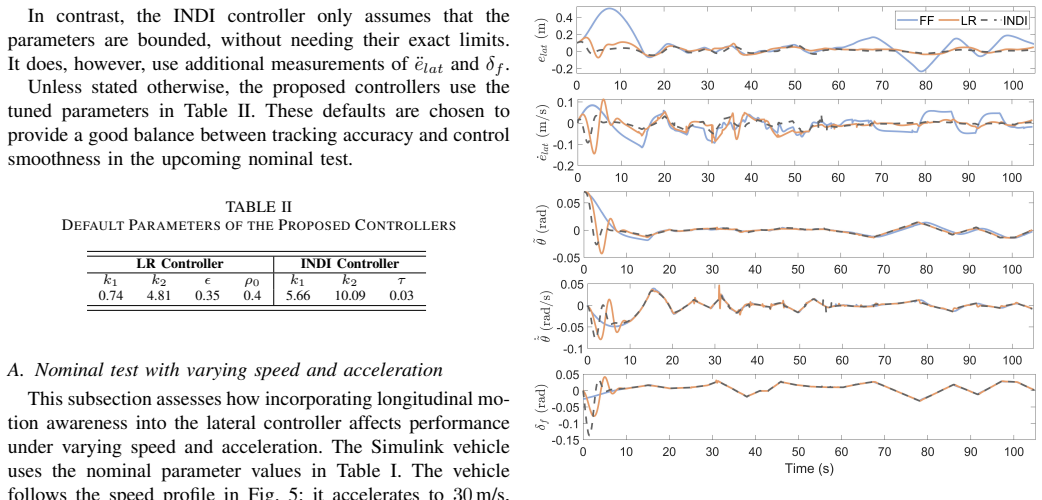
Summary. The paper develops a longitudinal-motion-aware robust nonlinear lateral controller for autonomous vehicles. It derives a bicycle-based tracking-error model that retains dependence on time-varying longitudinal speed and acceleration, applies input–output feedback linearization so that the external lateral-error dynamics become linear and independent of longitudinal motion, and analyzes the resulting internal dynamics for ISS under stated conditions on acceleration/jerk. Two robust designs—Lyapunov redesign (LR) with a sliding-mode-inspired continuous correction, and incremental nonlinear dynamic inversion (INDI)—are given with ultimate-boundedness proofs and explicit robustness-tuning parameters (ε and τ). Simulations on a dual-track model with four uncertainty vertices, and real-vehicle tests on a Chevrolet Bolt EUV, report lower RMS lateral error than a feedback–feedforward baseline and confirm real-time implementability.
Significance. The work addresses a genuine and practically relevant gap: many lateral controllers either freeze longitudinal speed or treat it only as a scheduling/uncertain parameter, which can degrade tracking during acceleration and braking. Embedding vx and ˙vx in the feedback law while keeping external dynamics LTI is a clean design idea. The dual robustification (LR more model-dependent, INDI more sensing-dependent) with distinct trade-offs is useful for practitioners. Strengths include explicit internal-dynamics analysis (Props. 1–2), a continuous LR structure with equivalent control, and an INDI ultimate-boundedness argument that avoids Jacobian linearization and global perturbation bounds (Props. 3–4). Multi-vertex simulations, parameter sweeps on ε/τ, and hardware validation on a Bolt EUV further support the contribution. Within the standard small-heading-error modeling regime, the technical development is solid and of clear interest to the AV control community.
major comments (3)
- [Section II.B] Section II.B, approximations (i)–(iii): the entire subsequent development—relative degree, feedback linearization (20), internal-dynamics ISS (Props. 1–2), and ultimate boundedness (Props. 3–4)—rests on the small-heading-error linearization sin(θ−θ_R)≈θ−θ_R, cos≈1, neglected ˙R, and discarded higher-order terms. The paper cites prior experimental support [10] but does not quantify the domain of validity (e.g., admissible |˜θ| or curvature rate) under which the closed-loop guarantees remain meaningful for the true plant. A short discussion or numerical check of when these approximations break (large initial offset, aggressive urban turns) would make the central claims more precise without changing the proofs.
- [Section VI] Section VI: for safety the speed profile of Fig. 5 is scaled by 7 (max ≈4.28 m/s) and the path is similarly scaled. This is far below the simulation regime (up to 30 m/s) and from the dynamic freeway-style conditions used to motivate the work (Fig. 1, NGSIM). Real-time implementability and low-speed path tracking are demonstrated, but the hardware evidence for “consistent performance across varying speeds and accelerations” under realistic longitudinal transients is limited. The abstract and conclusion should state this limitation explicitly, or the authors should add higher-speed hardware results if available.
- [Section V.A] Section V.A / baseline comparison: the only comparator is the constant-speed-designed feedback–feedforward controller of [10], chosen because it was developed for the same Lincoln MKZ. While the comparison cleanly isolates the benefit of embedding longitudinal motion, it does not address how the proposed laws perform relative to existing LTV, gain-scheduled, or other nonlinear lateral controllers that already allow speed variation. One additional modern baseline (even in simulation only) would substantially strengthen the performance claim that is central to the contribution list.
minor comments (6)
- [Section III, Proposition 1] Assumption 2 and Prop. 1: the integrability/magnitude conditions on ˙vx and ¨vx are reasonable but could be cross-referenced more clearly to typical longitudinal planner limits so readers can see they are not restrictive in practice.
- [Section IV.B, Remark 9] Remark 9 / INDI sensing: ¨elat is obtained via IMU (˙vy). Brief discussion of filtering, delay, or noise sensitivity would help practitioners; the theory assumes continuity of ¨elat on [−τ,0] but does not address measurement quality.
- [Tables II and VI] Table II vs Table VI: default gains differ substantially between simulation (Lincoln MKZ) and real vehicle (Bolt EUV). A short note on retuning procedure and transferability would improve reproducibility.
- [Section V] Fig. 6–10: axis labels and units are sometimes hard to read in the manuscript text; ensure high-resolution figures with consistent units (m, m/s, rad) in the final version.
- [Abstract / Introduction] Typographical: “A Vs” / “A V” spacing appears inconsistently in the abstract and introduction; unify as “AVs” / “AV”.
- [Section IV.A, Remark 6] Eq. (39)–(40): αd and γd bounds are computed from Table I extremes; stating the resulting numerical κ0 explicitly in the text (not only max|αd|=0.846) would make the LR design fully self-contained.
Circularity Check
No circular derivation: ultimate-boundedness and ISS claims are proved from Lyapunov/ISS lemmas on a stated model; experiments tune gains but do not define the theorems.
full rationale
The paper's load-bearing chain is: (i) bicycle + small-heading tracking-error model with retained ˙vx terms (Sec. II); (ii) input–output feedback linearization of elat with relative degree 2 and a global linear diffeomorphism to internal state η (Sec. III, Eqs. 20–25); (iii) LTV unforced internal dynamics analyzed via Ioannou–Sun Lemma 1 and ISS via Khalil Lemma 4.6 (Props. 1–2); (iv) LR and INDI robustifications with explicit Lyapunov ultimate-boundedness proofs (Props. 3–4), without Jacobian linearization or a priori global din bounds. None of these steps defines the claimed result in terms of itself, fits a parameter to data and renames the fit a prediction, or imports a uniqueness theorem from the authors. Self-citations ([6],[7],[9],[10],[16],[19]) supply background models, related AV work, and the FF comparison baseline; they are not used to prove Props. 1–4. Gains (k1,k2,ε,τ) are performance-tuned in simulation/hardware but the theorems hold for any stabilizing k1,k2>0 and characterize the bound as a class-K function of ε or of the INDI sampling τ. The modeling approximations (small heading error, neglected Ṙ) are assumptions, not circular reductions. Score 0 is therefore appropriate.
Axiom & Free-Parameter Ledger
free parameters (4)
- External gains k1, k2 =
sim defaults 0.74/4.81 (LR), 5.66/10.09 (INDI); Bolt 11.52/1.54 (LR), 0.12/4.20 (INDI)
- LR boundary-layer width ε and ρ0 =
sim ε=0.35, ρ0=0.4; Bolt ε=0.25, ρ0=0.50
- INDI sampling lag τ =
sim 0.03 s; Bolt 0.01 s
- FF baseline gains ke, kθ, kθ̇ (real vehicle) =
0.30, 0.15, 0.08
axioms (8)
- domain assumption Bicycle model with linear cornering forces Ff=Cf αf, Fr=Cr αr for small slip angles.
- domain assumption Small heading error: sin(θ−θ_R)≈θ−θ_R, cos≈1; Ṙ neglected; quadratic/higher state terms discarded.
- domain assumption Parameters z∈{Cf,Cr,m,Iz} are uncertain constants with known bounds and nominals; a,b fixed and known.
- domain assumption vx, ˙vx differentiable and bounded with vx,min>0; path radius bounded away from zero so ˙θ_R is bounded.
- domain assumption (A1) (a+b)Cr > am|˙vx,min| so Aη(t) is Hurwitz for all t.
- standard math Lemma 1 (Ioannou–Sun Thm 3.4.11) on GES of LTV systems under eigenvalue and ˙A conditions.
- standard math Khalil Lemma 4.6 / Thm 4.18 for ISS and ultimate boundedness.
- ad hoc to paper For INDI: ¨elat and δf continuous on [−τ,0]; ξ stays in a compact ball so din can be made small by small τ.
read the original abstract
As autonomous vehicles (AVs) operate in increasingly dynamic traffic conditions, lateral control must be performed while longitudinal speed and acceleration vary. Yet many existing lateral controllers rely on constant-speed or operating-point-based assumptions, which can degrade performance during transient longitudinal maneuvers. Moreover, most methods assume precisely known vehicle parameters, despite real-world parametric uncertainties. To address these limitations, this paper presents a longitudinal-motion-aware robust nonlinear lateral control framework for AVs. It first derives a tracking error model that depends on varying longitudinal speed and acceleration. Using this model, feedback linearization is employed to obtain a linear input-output relation for lateral error tracking while embedding longitudinal motion into the control law. The resulting internal dynamics are then analyzed to ensure overall system stability. To address parameter uncertainty, two robust control designs with distinct implementation trade-offs are proposed: (i) a Lyapunov redesign (LR) approach inspired by sliding mode control, and (ii) an incremental nonlinear dynamic inversion (INDI) method. Both are rigorously analyzed and proven to ensure ultimate boundedness, with key robustness-tuning parameters explicitly identified. Simulations demonstrate enhanced tracking accuracy, consistent performance across varying speeds and accelerations, and robustness to model uncertainties, while also examining the effects of the robustness-related parameters. Real-vehicle tests further confirm real-time implementation and practical path-tracking performance on actual hardware.
Figures




Reference graph
Works this paper leans on
-
[1]
Swaroop, String stability of interconnected systems: An application to platooning in automated highway systems
D. Swaroop, String stability of interconnected systems: An application to platooning in automated highway systems . University of California, Berkeley, 1994
1994
-
[2]
Peng, Vehicle lateral control for highway automation
H. Peng, Vehicle lateral control for highway automation . University of California, Berkeley, 1992
1992
-
[3]
Demonstration of integrated longitudinal and lateral control for the operation of au- tomated vehicles in platoons,
R. Rajamani, H.-S. Tan, B. K. Law, and W.-B. Zhang, “Demonstration of integrated longitudinal and lateral control for the operation of au- tomated vehicles in platoons,” IEEE Transactions on Control Systems Technology, vol. 8, no. 4, pp. 695–708, 2000
2000
-
[4]
Buehler, K
M. Buehler, K. Iagnemma, and S. Singh, The DARPA urban challenge: autonomous vehicles in city traffic. Springer Science & Business Media, 2009, vol. 56
2009
-
[5]
Rajamani, Vehicle dynamics and control
R. Rajamani, Vehicle dynamics and control . Springer Science & Business Media, 2011
2011
-
[6]
Lateral string stability for vehi- cle platoons: Formulation, definition, and analysis,
S. Li, S. Darbha, and Y . Zhou, “Lateral string stability for vehi- cle platoons: Formulation, definition, and analysis,” arXiv preprint arXiv:2605.01731, 2026
Pith/arXiv arXiv 2026
-
[7]
Nonlinear oscillatory response of automated vehicle car-following: Theoretical analysis with traffic state and control input limits,
S. Li and Y . Zhou, “Nonlinear oscillatory response of automated vehicle car-following: Theoretical analysis with traffic state and control input limits,” Transportation Research Part B: Methodological , vol. 201, p. 103315, 2025
2025
-
[8]
Dissipation of stop-and-go waves via control of autonomous vehicles: Field experiments,
R. E. Stern, S. Cui, M. L. Delle Monache, R. Bhadani, M. Bunting, M. Churchill, N. Hamilton, R. Haulcy, H. Pohlmann, F. Wu, et al. , “Dissipation of stop-and-go waves via control of autonomous vehicles: Field experiments,” Transportation research part C: emerging technolo- gies, vol. 89, pp. 205–221, 2018
2018
-
[9]
Sequencing-enabled hierarchical cooperative cav on-ramp merging control with enhanced stability and feasibility,
S. Li, Y . Zhou, X. Ye, J. Jiang, and M. Wang, “Sequencing-enabled hierarchical cooperative cav on-ramp merging control with enhanced stability and feasibility,” IEEE Transactions on Intelligent Vehicles , 2024
2024
-
[10]
Lateral control of an autonomous and connected following vehicle with limited preview information,
M. Liu, K. Chour, S. Rathinam, and S. Darbha, “Lateral control of an autonomous and connected following vehicle with limited preview information,” IEEE Transactions on Intelligent Vehicles , vol. 6, no. 3, pp. 406–418, 2020
2020
-
[11]
Uniform finite time safe path tracking control for obstacle avoidance of autonomous vehicle via barrier function approach,
J. Han, J. Zhang, C. He, C. Lv, H. Wei, J. Zhang, and S. Zhao, “Uniform finite time safe path tracking control for obstacle avoidance of autonomous vehicle via barrier function approach,” IEEE Transactions on Intelligent Transportation Systems , vol. 25, no. 8, pp. 9512–9523, 2024
2024
-
[12]
Velocity-dependent robust control for improving vehicle lateral dynamics,
H. Du, N. Zhang, and F. Naghdy, “Velocity-dependent robust control for improving vehicle lateral dynamics,” Transportation research part C: emerging technologies , vol. 19, no. 3, pp. 454–468, 2011
2011
-
[13]
Adaptive fixed-time path tracking control for autonomous vehicles subject to full state constraints and unknown tire cornering stiffness,
T. Zhang, H. Wang, H. Zhao, and W. Che, “Adaptive fixed-time path tracking control for autonomous vehicles subject to full state constraints and unknown tire cornering stiffness,” IEEE Transactions on Intelligent Transportation Systems, 2025
2025
-
[14]
Design and comparison of robust nonlinear controllers for the lateral dynamics of intelligent vehicles,
G. Tagne, R. Talj, and A. Charara, “Design and comparison of robust nonlinear controllers for the lateral dynamics of intelligent vehicles,” IEEE transactions on intelligent transportation systems , vol. 17, no. 3, pp. 796–809, 2015
2015
-
[15]
Physically analyzable ai-based non- linear platoon dynamics modeling during traffic oscillation: A koopman approach,
K. Tian, H. Shi, Y . Zhou, and S. Li, “Physically analyzable ai-based non- linear platoon dynamics modeling during traffic oscillation: A koopman approach,” IEEE Transactions on Intelligent Transportation Systems , 2025
2025
-
[16]
Robust lateral control of a convoy of autonomous & connected vehicles with limited preview,
M. Liu, N. Somisetty, S. Rathinam, and S. Darbha, “Robust lateral control of a convoy of autonomous & connected vehicles with limited preview,”arXiv preprint arXiv:2011.03587 , 2020
Pith/arXiv arXiv 2011
-
[17]
Vehicle lateral dynamics control through afs/dyc and robust gain-scheduling approach,
H. Zhang and J. Wang, “Vehicle lateral dynamics control through afs/dyc and robust gain-scheduling approach,” IEEE Transactions on Vehicular Technology, vol. 65, no. 1, pp. 489–494, 2015
2015
-
[18]
Gain-scheduling lpv synthesis H∞ robust lateral motion control for path following of autonomous vehicle via coordination of steering and braking,
X. Cao, T. Xu, Y . Tian, and X. Ji, “Gain-scheduling lpv synthesis H∞ robust lateral motion control for path following of autonomous vehicle via coordination of steering and braking,” Vehicle System Dynamics , vol. 61, no. 4, pp. 968–991, 2023
2023
-
[19]
Robust lateral control of an autonomous vehicle,
S. Darbha, N. Kumar, and P. Ioannou, “Robust lateral control of an autonomous vehicle,” Authorea Preprints, 2025
2025
-
[20]
Lateral control of an autonomous vehicle,
J. Jiang and A. Astolfi, “Lateral control of an autonomous vehicle,” IEEE Transactions on Intelligent Vehicles , vol. 3, no. 2, pp. 228–237, 2018
2018
-
[21]
Nonlinear systems,
H. Khalil, “Nonlinear systems,” 3rd edition, 2002
2002
-
[22]
Safety-critical control with nonaffine control inputs via a relaxed control barrier function for an autonomous vehicle,
J. Seo, J. Lee, E. Baek, R. Horowitz, and J. Choi, “Safety-critical control with nonaffine control inputs via a relaxed control barrier function for an autonomous vehicle,” IEEE Robotics and Automation Letters , vol. 7, no. 2, pp. 1944–1951, 2022
1944
-
[23]
Robust nonlinear control using barrier lyapunov function under lateral offset error constraint for lateral control of autonomous vehicles,
Y . Hwang, C. M. Kang, and W. Kim, “Robust nonlinear control using barrier lyapunov function under lateral offset error constraint for lateral control of autonomous vehicles,” IEEE Transactions on Intelligent Transportation Systems, vol. 23, no. 2, pp. 1565–1571, 2020
2020
-
[24]
Lateral control of front-wheel-steering rubber-tire vehicles,
H. Peng and M. Tomizuka, “Lateral control of front-wheel-steering rubber-tire vehicles,” 1990
1990
-
[25]
L1 adaptive control of vehicle lateral dynamics,
M. M. Shirazi and A. B. Rad, “ L1 adaptive control of vehicle lateral dynamics,” IEEE Transactions on Intelligent Vehicles , vol. 3, no. 1, pp. 92–101, 2017
2017
-
[26]
P. A. Ioannou and J. Sun, Robust adaptive control. PTR Prentice-Hall Upper Saddle River, NJ, 1996, vol. 1
1996
-
[27]
Optimal trajectories for time-critical street scenarios using discretized terminal manifolds,
M. Werling, S. Kammel, J. Ziegler, and L. Gr ¨oll, “Optimal trajectories for time-critical street scenarios using discretized terminal manifolds,” The International Journal of Robotics Research, vol. 31, no. 3, pp. 346– 359, 2012
2012
-
[28]
Passive fault-tolerant control via sliding-mode-based lyapunov redesign,
M. A. Estrada, L. Fridman, and J. A. Moreno, “Passive fault-tolerant control via sliding-mode-based lyapunov redesign,” IEEE Transactions on Automatic Control , 2024
2024
-
[29]
Continuous state feedback guaranteeing uniform ultimate boundedness for uncertain dynamic systems,
M. Corless and G. Leitmann, “Continuous state feedback guaranteeing uniform ultimate boundedness for uncertain dynamic systems,” IEEE Transactions on Automatic Control, vol. 26, no. 5, pp. 1139–1144, 1981
1981
-
[30]
Stability analysis for incremental nonlinear dynamic inversion control,
X. Wang, E.-J. Van Kampen, Q. Chu, and P. Lu, “Stability analysis for incremental nonlinear dynamic inversion control,” Journal of Guidance, Control, and Dynamics , vol. 42, no. 5, pp. 1116–1129, 2019
2019
-
[31]
Accurate tracking of aggressive quadrotor tra- jectories using incremental nonlinear dynamic inversion and differential flatness,
E. Tal and S. Karaman, “Accurate tracking of aggressive quadrotor tra- jectories using incremental nonlinear dynamic inversion and differential flatness,” IEEE Transactions on Control Systems Technology , vol. 29, no. 3, pp. 1203–1218, 2020
2020
-
[32]
Incremental nonlinear fault-tolerant control of a quadrotor with complete loss of two opposing rotors,
S. Sun, X. Wang, Q. Chu, and C. de Visser, “Incremental nonlinear fault-tolerant control of a quadrotor with complete loss of two opposing rotors,” IEEE Transactions on Robotics , vol. 37, no. 1, pp. 116–130, 2020
2020
-
[33]
A comparative study of nonlinear mpc and differential-flatness-based control for quadrotor agile flight,
S. Sun, A. Romero, P. Foehn, E. Kaufmann, and D. Scaramuzza, “A comparative study of nonlinear mpc and differential-flatness-based control for quadrotor agile flight,” IEEE Transactions on Robotics , vol. 38, no. 6, pp. 3357–3373, 2022
2022
-
[34]
opendbc gm vehicle parameter definitions,
comma.ai, “opendbc gm vehicle parameter definitions,” https://raw.githubusercontent.com/commaai/opendbc/master/opendbc/ car/gm/values.py, 2025, accessed: 2026-04-29
2025
discussion (0)
Sign in with ORCID, Apple, or X to comment. Anyone can read and Pith papers without signing in.