REVIEW 5 minor 8 references
A single simple rule for first-choice voting is optimal, and every top-k rule has an exact closed distortion formula.
Reviewed by Pith at T0; open to challenge. T0 means a machine referee read the full paper against a public rubric. the ladder, T0–T4 →
T0 review · grok-4.5
2026-07-12 01:32 UTC pith:PFVZMYP5
load-bearing objection Clean exact characterizations for first-choice and top-k metric distortion, with a simpler optimal rule and matching constructions that hold up under scrutiny.
New bounds on randomized metric distortion of top-k voting
The pith
A machine-rendered reading of the paper's core claim, the machinery that carries it, and where it could break.
Core claim
For any first-choice mechanism q and any vote vector u the metric distortion is exactly 1 + 2 max_i (q_i (1- u_i)/ u_i). Consequently the unique u-optimal rule is the one that selects proportionally to u_i/(1- u_i), and among the pure power rules only the exponent n/(n-1) is n-optimal. For every k the same geometric analysis supplies an exact maximisation formula that equals the worst-case distortion of any top-k mechanism.
What carries the argument
The exact distortion identity of Corollary 1 (and its top-k generalisation Theorem 5): after fixing an optimal candidate, one maximises a ratio of summed excess distances over summed lower bounds on voter-to-optimum distances; the identity is obtained by matching a simple upper bound with an explicit metric construction that realises every candidate-to-optimum length assignment.
Load-bearing premise
The lower-bound constructions assume that any assignment of distances from candidates to an optimum can be realised by a single metric that is still consistent with every voter's reported top-k list.
What would settle it
Exhibit a concrete vote profile and a metric consistent with it for which some mechanism's realised distortion exceeds the value predicted by the max-formula of Theorem 5 (or of Corollary 1 when k=1).
Editorial analysis
A structured set of objections, weighed in public.
Referee Report
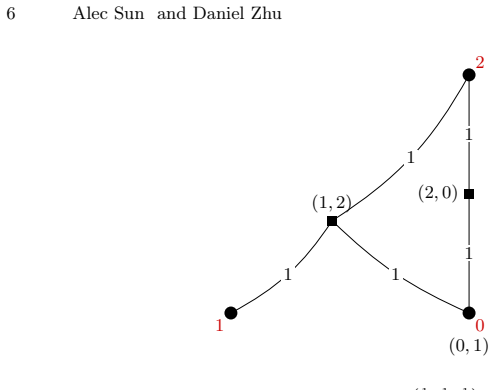
Summary. The paper studies randomized metric distortion under first-choice and top-k voting. For first-choice mechanisms it proves that every rule q has exact distortion D(q)=1+2 max_i(q_i(1- u_i)/ u_i) (Corollary 1, matching a known upper bound with a new lower-bound construction). Consequently the unique u-optimal rule is proportional to u_i/(1- u_i) and, among power rules q^p, only p=n/(n-1) is n-optimal, attaining the classic bound 3-2/n with a single rule. For top-k voting the authors derive an exact max-expression (Theorem 5) for the distortion of any mechanism, obtained by tightening numerator and denominator via ordered-interval constraints and a metric-extension lemma; the expression is realized by an explicit construction. Specializing to cyclic profiles yields a closed-form improvement on the prior 3-2/⌊n/k⌋ lower bound.
Significance. The instance-specific characterization and uniqueness proofs cleanly settle the first-choice questions left open by earlier work, while the single power rule is a simpler alternative to the known two-rule mixture. The top-k exact formula (with matching constructions) is a genuine technical advance that improves known lower bounds on a natural family and supplies a usable analytic tool for further study. The derivations rest on elementary triangle inequalities, the mediant inequality, and fully proved metric-extension arguments; no free parameters are fitted. These contributions are of clear interest to algorithmic social choice and metric distortion.
minor comments (5)
- Abstract and Introduction: the phrase “a formula for the worst-case distortion for any k≥2” is slightly ambiguous; Theorem 5 gives the exact distortion of an arbitrary mechanism (max over edge lengths and optimal candidate), while the universal worst-case profile for k≥3 remains open (as the authors correctly note later). A one-sentence clarification would prevent over-reading.
- Section 4, after Theorem 6: the reduction to {0,1}-edges is stated for k≤2; a brief remark that the same combinatorial form recovers Lemma 1 when k=1 would help readers connect the two regimes.
- Figure 3 and Figure 4 captions are dense; labeling the vertical axis units and the meaning of the blue intervals more explicitly would improve readability without changing content.
- Appendix A, proof of Lemma 6: the AM-GM application is correct but the equality case is written only for the transformed expression; a parenthetical note that equality transfers back to the original function would make the argument fully self-contained.
- References: the arXiv identifier of the present manuscript appears in the header; once published it should be replaced by the journal citation, and any concurrent related work on top-k distortion should be checked for completeness.
Circularity Check
No circularity: exact distortion formulas and uniqueness claims follow from matching metric constructions plus elementary triangle/mediant inequalities, with all lemmas proved in-paper.
full rationale
The derivation chain is self-contained. Corollary 1 equates distortion of any first-choice q to 1+2 max_i(q_i(1- u_i)/ u_i) by matching the known upper bound (Lemma 1, restated from [6] and fully reproved via triangle inequality and mediant in Appendix A) against the explicit two-point metric construction of Theorem 1. Theorems 2–3 then minimize that exact expression over the simplex (power rules via AM-GM/convexity lemmas; u-optimal via mediant equality case), without external uniqueness theorems or fitted parameters. For top-k the same pattern holds: Theorem 4 upper-bounds via Lemmas 2–3 (interval monotonicity from reported order), the matching lower bound is realized by the explicit candidate/voter placement of Steps 1–3 whose triangle inequalities are verified by Lemmas 4–5 (both proved elementarily in Appendix A), and Theorem 5 simply maximizes the resulting ratio. Proposition 1 evaluates the same expression on the cyclic family. No step reduces a claimed prediction to a fitted input, a self-definition, or a load-bearing self-citation; prior citations supply only historical lower bounds that the paper improves or restates with independent proofs.
Axiom & Free-Parameter Ledger
axioms (3)
- domain assumption Agents and candidates lie in a metric space; cost of a candidate is the sum of distances to all voters.
- domain assumption A vote vector ν is consistent with a metric if the fraction of voters whose nearest candidate is i equals ν_i.
- standard math Triangle inequality and non-negativity of distances.
read the original abstract
We prove new upper and lower bounds on metric distortion for randomized social choice mechanisms. Under first-choice voting where each voter reports only their most preferred candidate, we show that selecting a candidate with probability proportional to the $\frac{n}{n-1}$-th power of their vote share achieves the optimal worst-case distortion of $3 - \frac{2}{n}$. This is a simpler single-rule alternative to prior work. We also study instance-specific metric distortion of first-choice mechanisms in terms of the vote vector $\nu$. We show that there is a uniquely optimal rule achieving distortion $1 + \frac{2}{\sum_i \frac{\nu_i}{1 - \nu_i}}$. Finally, we extend our results to top-$k$ voting where each voter reports their $k$ nearest candidates. We derive a formula for the worst-case distortion for any $k\ge 2$. For the cyclic profile family this improves the previously best known $3 - \frac{2}{\lfloor \frac{n}{k} \rfloor}$ lower bound.
Figures



Reference graph
Works this paper leans on
-
[1]
Artificial Intelligence264, 27– 51 (2018)
Anshelevich, E., Bhardwaj, O., Elkind, E., Postl, J., Skowron, P.: Approximat- ing optimal social choice under metric preferences. Artificial Intelligence264, 27– 51 (2018). https://doi.org/https://doi.org/10.1016/j.artint.2018.07.006, https://www.sciencedirect.com/science/article/pii/S0004370218304569
-
[2]
In: Proceedings of the 30th Inter- national Joint Conference on Artificial Intelligence (IJCAI)
Anshelevich, E., Filos-Ratsikas, A., Shah, N., Voudouris, A.A.: Distortion in social choice problems: The first 15 years and beyond. In: Proceedings of the 30th Inter- national Joint Conference on Artificial Intelligence (IJCAI). pp. 4294–4301 (2021). https://doi.org/10.24963/ijcai.2021/589
-
[3]
Artificial Intelligence227, 190– 213 (2015)
Boutilier, C., Caragiannis, I., Haber, S., Lu, T., Procaccia, A.D., Sheffet, O.: Op- timal social choice functions: A utilitarian view. Artificial Intelligence227, 190– 213 (2015). https://doi.org/https://doi.org/10.1016/j.artint.2015.06.003, https://www.sciencedirect.com/science/article/pii/S0004370215000892
-
[4]
Journal of Artificial Intelligence Research58, 123–152 (2017)
Caragiannis, I., Nath, S., Procaccia, A.D., Shah, N.: Subset selection via implicit utilitarian voting. Journal of Artificial Intelligence Research58, 123–152 (2017). https://doi.org/10.1613/jair.5282
-
[5]
In: 61st IEEE Annual Symposium on Foundations of Computer Science (FOCS)
Gkatzelis, V., Halpern, D., Shah, N.: Resolving the optimal metric distortion con- jecture. In: 61st IEEE Annual Symposium on Foundations of Computer Science (FOCS). pp. 1427–1438 (2020).https://doi.org/10.1109/FOCS46700.2020.00134
-
[6]
Proceedings of the AAAI Conference on Artificial Intelligence 31(1) (Feb 2017)
Gross, S., Anshelevich, E., Xia, L.: Vote until two of you agree: Mechanisms with small distortion and sample complexity. Proceedings of the AAAI Conference on Artificial Intelligence 31(1) (Feb 2017). https://doi.org/10.1609/aaai.v31i1. 10587, https://ojs.aaai.org/index.php/AAAI/article/view/10587
-
[7]
In: Pro- ceedings of the 34th AAAI Conference on Artificial Intelligence (AAAI)
Kempe, D.: Communication, distortion, and randomness in metric voting. In: Pro- ceedings of the 34th AAAI Conference on Artificial Intelligence (AAAI). pp. 2087– 2094 (2020). https://doi.org/10.1609/aaai.v34i02.5582
-
[8]
Procaccia, A.D., Rosenschein, J.S.: The distortion of cardinal preferences in voting. In: Cooperative Information Agents X: 10th International Workshop, CIA 2006, Edinburgh, UK, September 11-13, 2006. Proceedings. Lecture Notes in Computer Science, vol. 4149, pp. 317–331. Springer Berlin Heidelberg (2006).https://doi. org/10.1007/11839354_23 14 Alec Sun a...
discussion (0)
Sign in with ORCID, Apple, or X to comment. Anyone can read and Pith papers without signing in.