REVIEW 3 major objections 5 minor 1 cited by
Robot action generation can be sparse and context-conditioned so one policy uses optional sensors when present and still acts when they are missing.
Reviewed by Pith at T0; open to challenge. T0 means a machine referee read the full paper against a public rubric. the ladder, T0–T4 →
Context-conditioned sparse experts in a flow-matching action transformer let a VLA exploit optional depth and specialize by task intent, improving multi-task, long-horizon, and missing-sensor robustness.
T0 review reviewed 2026-07-12 challenge →
load-bearing objection Solid systems paper: intent- and sensor-gated sparse action experts with real missing-depth robustness; physical-depth gains are a bit confounded but not fatal. the 3 major comments →
CoRE-VLA: Towards Scalable and Robust Vision-Language-Action Modeling via Conditional Routing of Experts
The pith
A machine-rendered reading of the paper's core claim, the machinery that carries it, and where it could break.
The reading
Core claim
Formulating VLA action generation as context-conditioned sparse computation—task-intent selection and routing of action-side tokens plus availability-gated modality-specialized experts with modality dropout—yields a unified policy that exploits auxiliary depth when available, remains reliable when depth is absent without retraining, and improves multi-task and long-horizon success over a dense action-generator ablation and a strong pretrained VLA baseline.
What carries the argument
Conditional Routing of Experts (CoRE): inside the action diffusion transformer, a task-intent embedding sparsely selects action-side tokens and routes them to general or modality-specialized experts, while a modality indicator masks the specialized experts whenever the auxiliary sensor is off.
Load-bearing premise
The method assumes that depth estimated from RGB during training is close enough to real depth cameras that the modality experts learn transferable geometric skills usable with physical depth or with depth fully removed.
What would settle it
Train the full CoRE model with estimated depth only, then compare the same real dual-arm tasks with depth removed versus with a physical depth camera and versus a dense no-depth action generator; a large drop without depth, or no gain (or harm) from physical depth, would falsify graceful optional-modality routing.
If this is right
- An RGB-pretrained VLA can be extended with optional sensors by continued training without redesigning the full action backbone.
- Missing-sensor deployment no longer needs a separate policy or sensor-specific fine-tuning pass.
- Long-horizon multi-task learning can reduce interference by assigning different subgoals to different expert paths.
- A physical depth camera can be enabled at inference even when training used only estimated depth.
- The same gating pattern is intended to host other optional physical modalities such as touch or force.
Where Pith is reading between the lines
- If expert mixtures and token-selection patterns track subgoals over a rollout, those routing traces could become a free diagnostic signal for which stage of a long-horizon failure the policy is in.
- One shared checkpoint with availability masks could serve heterogeneous multi-robot fleets that differ only in which cameras they carry.
- Keeping activated compute proportional to a fixed selection ratio while growing expert count suggests the design scales more cleanly as action horizons and embodiment action dimensions grow.
- A small gap between estimated-depth training and physical-depth inference would imply the specialized experts capture geometry-like structure rather than sensor-specific noise—worth testing with other depth estimators.
Editorial analysis
A structured set of objections, weighed in public.
Referee Report
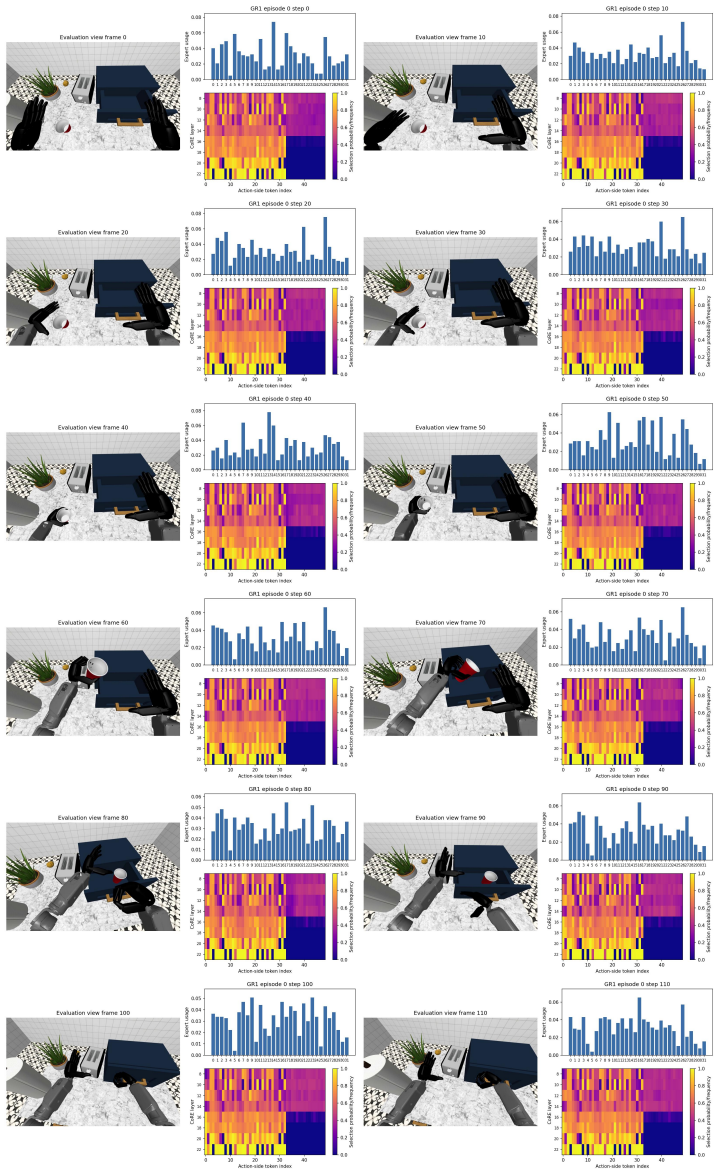
Summary. CoRE-VLA reformulates VLA action generation as context-conditioned sparse computation inside a flow-matching Action DiT. Task-intent embeddings select a capacity-limited subset of action-side tokens and route them to general or modality-specialized experts, while a modality indicator z_mod (with modality dropout in training and availability-based expert masking) gates auxiliary-modality experts so the same policy can use depth when present and fall back to RGB–language–proprioception when absent. The method is evaluated on LIBERO, RoboCasa GR1 Tabletop, and real dual-arm tasks (Vegetables-Picking, Clothes-Folding, zero-shot Fabric-Folding), with a dense Action DiT ablation and π0.5 as baselines. A detailed LIBERO-Long ablation (Table 12) separates intent routing, naive depth, dropout, and specialized experts; routing visualizations and an efficiency analysis are provided in the appendices.
Significance. The paper addresses a practically important deployment problem—heterogeneous and intermittently missing auxiliary sensors—rather than only scaling a fixed observation interface. Strengths include a clear architecture-and-training formulation (modality-specialized experts + dropout + masking), a carefully factorized LIBERO-Long ablation (Table 12) that isolates over-reliance under naive depth addition, competitive multi-task/long-horizon numbers (LIBERO average 98.7%; Long 97.6% with / 97.0% without depth), real-world with/without depth evaluation with full rollout tables, and qualitative router analyses. If the dual-mode claim holds under cleaner real-world modality matching, the work is a useful template for optional-sensor VLA policies and for intent-adaptive action generators beyond dense shared FFNs.
major comments (3)
- [§4.2, Table 3] §4.2 and Table 3: real-world “exploit depth when available” evidence confounds expert gating with a train–test depth domain shift. Training uses only DA-V2 pseudo-depth from RGB; inference with physical Orbbec depth (z_mod=1) improves SR (e.g., Fabric-Folding 70%→80%, Clothes-Folding 50%→65%) relative to depth-off. That lift does not isolate modality-specialized experts learning transferable geometric computation (Eqs. 3–5) from feeding a depth distribution never seen in training. Simulation Table 12 supports matched on/off depth; real-world does not. Please add a matched real-world condition (same checkpoint, DA-V2 depth at inference) and/or qualify claims that physical-depth gains demonstrate learned geometric specialization rather than sensor-domain effects.
- [Abstract; Table 12; §3.1] Table 12 and §3.1: the central dual-mode claim is load-bearing and mostly carried by simulation. Rows 3–4 vs 11–12 cleanly show naive depth over-reliance versus CoRE robustness under matched DA-V2, which is the strongest support for the architecture. The manuscript’s abstract and contribution bullets still lean on real-world physical-depth gains as modality analysis. Align the claim hierarchy with the evidence: state that matched-depth robustness is established on LIBERO-Long, and treat physical-depth deployment as a domain-shift stress test whose positive lift is suggestive but not yet causal for E_mod specialization.
- [§1 contributions; §2.2–2.3] §4.1 training protocol and contribution 1: “first to explicitly formulate” sensor-heterogeneity as a joint architecture-and-training problem is strong relative to Related Work §2.2–2.3 (auxiliary sensors, ForceVLA-style MoE, ChatVLA MoE). The distinction (availability as an action-generator routing condition with dropout/masking, not only extra inputs) is plausible but should be stated more carefully against concurrent modality-robust and MoE-VLA lines, and limited to the depth instantiation actually studied.
minor comments (5)
- [Appendix D] Appendix D gives FLOPs bounds for CoRE vs dense blocks but no wall-clock latency or throughput on the same hardware as the dense Action DiT ablation. For a “scalable / sparse computation” framing, even a short measured comparison (action-generator only and full closed-loop) would help readers.
- [§4.2, Tables 3, 9–11] Real-world evaluation uses 20 rollouts per method/task (Tables 9–11). Reporting binomial CIs or noting variance would make Table 3 score/SR differences easier to interpret, especially on Clothes-Folding where depth-off SR is 50%.
- [§3.1, Eqs. (1)–(5)] Notation: g is defined as AvgPool(C_text) in Eq. (1) and again in the appendix; C vs C(z_mod) and when auxiliary tokens enter cross-attention could be stated once in the main Method with a pointer to Appendix E.
- [§4.2, Figures 3–5] Figures 3–5 are useful qualitative rollouts; adding failure cases or partial-score modes (already tabulated) in the main text would balance the narrative.
- [Appendix A.1] Hyperparameters ρ, p_drop, |E_gen|, |E_mod|, CoRE layer indices (Tables 4–5) are free design choices; a short sensitivity note (even one-axis) would strengthen reproducibility claims beyond the fixed settings used.
Circularity Check
No circularity: empirical VLA systems paper; success metrics are independent rollouts, not tautological rewrites of training losses or fitted constants.
full rationale
CoRE-VLA is an architecture-and-training paper. The load-bearing claims are empirical: multi-task/long-horizon success rates, missing-depth robustness, and real-world gains versus dense DiT and π0.5. The training chain (flow-matching L_act / L_FM, selection regularizer L_sel matching capacity ρ, MoE load-balancing L_moe) is standard conditional-computation practice; none of these objectives is algebraically equivalent to the reported success rates or subgoal scores. Ablations (Table 12) and deployment comparisons (Tables 1–3) evaluate held-out closed-loop rollouts under controlled on/off depth and architecture variants, so the outcomes are not forced by construction from the fitted routing scores p_i, π_i or from modality dropout. There is no uniqueness theorem, no load-bearing self-citation that forbids alternatives, and no renaming of a known empirical law as a first-principles derivation. Domain-shift concerns about DA-V2 vs physical depth affect causal interpretation of real-world depth gains, not circularity of the derivation chain.
Axiom & Free-Parameter Ledger
free parameters (5)
- selection-capacity ratio ρ =
0.5
- modality dropout probability p_drop =
0.2
- expert inventory (|E_gen|, |E_mod|) and CoRE layer indices =
LIBERO: 12 gen + 4 mod; RoboCasa: 32 gen + 8 mod
- λ_sel and λ_moe =
0.01 each (tables)
- inference diffusion/flow steps K =
4
axioms (5)
- domain assumption Rectified-flow / flow-matching linear path x_τ=(1-τ)ε+τa with target velocity a-ε is a valid training objective for continuous action chunks.
- domain assumption Average-pooled VLM text tokens g=AvgPool(C_text) are a sufficient task-intent signal for routing after multimodal attention grounding.
- ad hoc to paper Depth Anything V2 estimates from RGB are adequate noisy proxies for optional depth during multi-task training.
- domain assumption Hard Top-K selection and argmax expert assignment remain trainable via continuous gates p_i and π_i along the selected path.
- domain assumption Shared dense multi-task action generators suffer gradient conflict / negative transfer that sparse intent routing can mitigate.
invented entities (3)
-
CoRE block (intent-conditioned token selection + modality-aware expert routing)
no independent evidence
-
Modality-specialized experts E_mod gated by z_mod
no independent evidence
-
Modality indicator z_mod with availability-based expert masking
no independent evidence
Cite this review
Pith. "Pith review of CoRE-VLA: Towards Scalable and Robust Vision-Language-Action Modeling via Conditional Routing of Experts." pith.science (2026). https://pith.science/paper/KPISQA6H
@misc{pith2026260703693,
  author       = {Pith},
  title        = {Pith review of: CoRE-VLA: Towards Scalable and Robust Vision-Language-Action Modeling via Conditional Routing of Experts},
  year         = {2026},
  howpublished = {\url{https://pith.science/paper/KPISQA6H}},
  note         = {Machine review of arXiv:2607.03693}
}
read the original abstract
Vision-language-action (VLA) models have advanced generalist robotic manipulation, yet real-world deployment reveals a fundamental challenge: robots are equipped with diverse and heterogeneous sensor configurations, auxiliary sensors can fail unexpectedly during operation, and different robot embodiments often lack certain sensors by design. A unified policy that can exploit auxiliary perceptual inputs when available while remaining reliable under sensor absence, whether incidental or by design, is therefore essential for practical deployment. However, existing VLA policies couple action generation to a fixed sensor set through shared dense computation, making them brittle when sensors are missing and limiting their ability to specialize across diverse tasks and long-horizon behaviors. We propose CoRE-VLA, a scalable and robust VLA framework that formulates action generation as context-conditioned sparse computation. Sensor availability gates modality-specialized experts, enabling graceful degradation under missing sensors without retraining. Task intent further routes action-side representations to task-relevant experts, improving specialization across diverse tasks and long-horizon subgoals. While the framework is designed to accommodate different auxiliary sensors, we focus on depth as a representative and practically important auxiliary modality in our experiments. Experiments on LIBERO, RoboCasa GR1 Tabletop, and real-world dual-arm manipulation show that CoRE-VLA achieves strong results on long-horizon and multi-task benchmarks, and outperforms both a dense-action-generator ablation and a strong pretrained VLA baseline, including in zero-shot generalization to unseen scenarios. Modality analysis shows that CoRE-VLA can exploit auxiliary depth when available while remaining robust when depth is unavailable during deployment.
Figures




Forward citations
Cited by 1 Pith paper
-
ETA: A New Agentic Paradigm for Embodied Tasks
A general-purpose LLM planner using only observe, mark_point, and move_to solves 90% of 130 LIBERO manipulation tasks when allowed five attempts per task, with no robot-policy training.
Reference graph
Works this paper leans on
-
[1]
M. J. Kim, K. Pertsch, S. Karamcheti, T. Xiao, A. Balakrishna, S. Nair, R. Rafailov, E. P. Foster, P. R. Sanketi, Q. Vuong, et al. OpenVLA: An open-source vision-language-action model. InConference on Robot Learning, pages 2679–2713. PMLR, 2025
2025
-
[2]
K. Black, N. Brown, D. Driess, A. Esmail, M. Equi, C. Finn, N. Fusai, L. Groom, K. Hausman, B. Ichter, et al.π 0: A vision-language-action flow model for general robot control.arXiv preprint arXiv:2410.24164, 2024
Pith/arXiv arXiv 2024
-
[3]
Physical Intelligence, K. Black, N. Brown, J. Darpinian, K. Dhabalia, D. Driess, A. Esmail, M. Equi, C. Finn, N. Fusai, et al.π 0.5: A vision-language-action model with open-world generalization.arXiv preprint arXiv:2504.16054, 2025
Pith/arXiv arXiv 2025
-
[4]
J. Bjorck, F. Casta ˜neda, N. Cherniadev, X. Da, R. Ding, L. Fan, Y . Fang, D. Fox, F. Hu, S. Huang, et al. GR00T N1: An open foundation model for generalist humanoid robots.arXiv preprint arXiv:2503.14734, 2025
Pith/arXiv arXiv 2025
-
[5]
T. Yu, S. Kumar, A. Gupta, S. Levine, K. Hausman, and C. Finn. Gradient surgery for multi- task learning.Advances in neural information processing systems, 33:5824–5836, 2020
2020
-
[6]
Standley, A
T. Standley, A. Zamir, D. Chen, L. Guibas, J. Malik, and S. Savarese. Which tasks should be learned together in multi-task learning? InInternational conference on machine learning, pages 9120–9132. PMLR, 2020
2020
-
[7]
A. Brohan, N. Brown, J. Carbajal, Y . Chebotar, J. Dabis, C. Finn, K. Gopalakrishnan, K. Haus- man, A. Herzog, J. Hsu, et al. RT-1: Robotics transformer for real-world control at scale.arXiv preprint arXiv:2212.06817, 2022
Pith/arXiv arXiv 2022
-
[8]
Zitkovich, T
B. Zitkovich, T. Yu, S. Xu, P. Xu, T. Xiao, F. Xia, J. Wu, P. Wohlhart, S. Welker, A. Wahid, et al. RT-2: Vision-language-action models transfer web knowledge to robotic control. In Conference on Robot Learning, pages 2165–2183. PMLR, 2023
2023
-
[9]
Octo Model Team, D. Ghosh, H. Walke, K. Pertsch, K. Black, O. Mees, S. Dasari, J. Hejna, T. Kreiman, C. Xu, et al. Octo: An open-source generalist robot policy.arXiv preprint arXiv:2405.12213, 2024
Pith/arXiv arXiv 2024
-
[10]
Shridhar, L
M. Shridhar, L. Manuelli, and D. Fox. Perceiver-Actor: A multi-task transformer for robotic manipulation. InConference on Robot Learning, pages 785–799. PMLR, 2023
2023
-
[11]
Goyal, J
A. Goyal, J. Xu, Y . Guo, V . Blukis, Y .-W. Chao, and D. Fox. RVT: Robotic view transformer for 3D object manipulation. InConference on Robot Learning, pages 694–710. PMLR, 2023
2023
-
[12]
Y . Chen, M. Van der Merwe, A. Sipos, and N. Fazeli. Visuo-tactile transformers for manipula- tion. InConference on Robot Learning, pages 2026–2040. PMLR, 2023
2026
-
[13]
J. Yu, H. Liu, Q. Yu, J. Ren, C. Hao, H. Ding, G. Huang, G. Huang, Y . Song, P. Cai, et al. ForceVLA: Enhancing VLA models with a force-aware MoE for contact-rich manipulation. Advances in Neural Information Processing Systems, 38:93409–93439, 2026
2026
-
[14]
R. A. Jacobs, M. I. Jordan, S. J. Nowlan, and G. E. Hinton. Adaptive mixtures of local experts. Neural computation, 3(1):79–87, 1991
1991
-
[15]
N. Shazeer, A. Mirhoseini, K. Maziarz, A. Davis, Q. Le, G. Hinton, and J. Dean. Outra- geously large neural networks: The sparsely-gated mixture-of-experts layer.arXiv preprint arXiv:1701.06538, 2017
Pith/arXiv arXiv 2017
-
[16]
D. Lepikhin, H. Lee, Y . Xu, D. Chen, O. Firat, Y . Huang, M. Krikun, N. Shazeer, and Z. Chen. GShard: Scaling giant models with conditional computation and automatic sharding.arXiv preprint arXiv:2006.16668, 2020. 9
Pith/arXiv arXiv 2006
-
[17]
Fedus, B
W. Fedus, B. Zoph, and N. Shazeer. Switch transformers: Scaling to trillion parameter models with simple and efficient sparsity.Journal of Machine Learning Research, 23(120):1–39, 2022
2022
-
[18]
D. Raposo, S. Ritter, B. Richards, T. Lillicrap, P. C. Humphreys, and A. Santoro. Mixture- of-Depths: Dynamically allocating compute in transformer-based language models.arXiv preprint arXiv:2404.02258, 2024
Pith/arXiv arXiv 2024
-
[19]
Z. Zhou, Y . Zhu, M. Zhu, J. Wen, N. Liu, Z. Xu, W. Meng, Y . Peng, C. Shen, F. Feng, et al. ChatVLA: Unified multimodal understanding and robot control with vision-language-action model. InProceedings of the 2025 Conference on Empirical Methods in Natural Language Processing, pages 5377–5395, 2025
2025
-
[20]
Z. Zhou, Y . Zhu, X. Liu, Z. Tang, J. Wen, Y . Peng, C. Shen, and Y . Xu. ChatVLA-2: Vision- language-action model with open-world reasoning.Advances in Neural Information Process- ing Systems, 38:45537–45559, 2026
2026
-
[21]
B. Liu, Y . Zhu, C. Gao, Y . Feng, Q. Liu, Y . Zhu, and P. Stone. LIBERO: Benchmarking knowledge transfer for lifelong robot learning.Advances in Neural Information Processing Systems, 36:44776–44791, 2023
2023
-
[22]
S. Nasiriany, A. Maddukuri, L. Zhang, A. Parikh, A. Lo, A. Joshi, A. Mandlekar, and Y . Zhu. RoboCasa: Large-scale simulation of everyday tasks for generalist robots.arXiv preprint arXiv:2406.02523, 2024
Pith/arXiv arXiv 2024
-
[23]
L. Yang, B. Kang, Z. Huang, Z. Zhao, X. Xu, J. Feng, and H. Zhao. Depth Anything V2. Advances in Neural Information Processing Systems, 37:21875–21911, 2024
2024
-
[24]
S. Bai, Y . Cai, R. Chen, K. Chen, X. Chen, Z. Cheng, L. Deng, W. Ding, C. Gao, C. Ge, et al. Qwen3-VL technical report.arXiv preprint arXiv:2511.21631, 2025
Pith/arXiv arXiv 2025
-
[25]
M. J. Kim, C. Finn, and P. Liang. Fine-tuning vision-language-action models: Optimizing speed and success.arXiv preprint arXiv:2502.19645, 2025
Pith/arXiv arXiv 2025
-
[26]
K. Pertsch, K. Stachowicz, B. Ichter, D. Driess, S. Nair, Q. Vuong, O. Mees, C. Finn, and S. Levine. FAST: Efficient action tokenization for vision-language-action models.arXiv preprint arXiv:2501.09747, 2025
Pith/arXiv arXiv 2025
-
[27]
GR00T N1.5: Official libero fine-tuning and evaluation results
NVIDIA. GR00T N1.5: Official libero fine-tuning and evaluation results. GitHub repository, commit6a477aa39f2fd6bc59b13c227e28003a374f3cb3, 2025. URLhttps://github. com/NVIDIA/Isaac-GR00T/tree/6a477aa39f2fd6bc59b13c227e28003a374f3cb3/ examples/Libero. Accessed: 2026-05-16
2025
-
[28]
GR00T N1.7: Official libero fine-tuning and evaluation results
NVIDIA. GR00T N1.7: Official libero fine-tuning and evaluation results. GitHub repository, commit23ace64f17aa5015259b8609d371eb61a357c776, 2026. URLhttps://github. com/NVIDIA/Isaac-GR00T/tree/23ace64f17aa5015259b8609d371eb61a357c776/ examples/LIBERO. Accessed: 2026-05-16
2026
-
[29]
C. Chi, Z. Xu, S. Feng, E. Cousineau, Y . Du, B. Burchfiel, R. Tedrake, and S. Song. Diffusion Policy: Visuomotor policy learning via action diffusion.The International Journal of Robotics Research, 44(10-11):1684–1704, 2025
2025
-
[30]
GR00T N1.5: Official robocasa tabletop fine-tuning and evaluation re- sults
NVIDIA. GR00T N1.5: Official robocasa tabletop fine-tuning and evaluation re- sults. GitHub repository, commit6a477aa39f2fd6bc59b13c227e28003a374f3cb3,
-
[31]
Accessed: 2026-05-16
URLhttps://github.com/NVIDIA/Isaac-GR00T/tree/ 6a477aa39f2fd6bc59b13c227e28003a374f3cb3/examples/RoboCasa. Accessed: 2026-05-16. 10
2026
-
[32]
GR00T N1.6: Official robocasa gr1 tabletop tasks evaluation results
NVIDIA. GR00T N1.6: Official robocasa gr1 tabletop tasks evaluation results. GitHub repository, commit4e62473d5226c55784697944a5c9606a51927bfc,
-
[33]
Accessed: 2026-05-16
URLhttps://github.com/NVIDIA/Isaac-GR00T/ tree/4e62473d5226c55784697944a5c9606a51927bfc/examples/ robocasa-gr1-tabletop-tasks. Accessed: 2026-05-16. 11 A Details of Experiments A.1 Training Configurations We provide detailed implementation and reproducibility information for LIBERO and RoboCasa GR1 in Tables 4 and 5. These tables summarize the dataset set...
2026
This paper was first reviewed by grok-4.5 on July 12, 2026.
discussion (0)
Sign in with ORCID, Apple, or X to comment. Anyone can read and Pith papers without signing in.