REVIEW 3 major objections 29 references
SAGA stabilizes autoregressive video diffusion by suppressing high-frequency latent acceleration at inference time, without retraining.
Reviewed by Pith at T0; open to challenge. T0 means a machine referee read the full paper against a public rubric. the ladder, T0–T4 →
T0 review · grok-4.5
2026-07-10 13:36 UTC pith:2FFW65TC
load-bearing objection Clean training-free stabilizer for chunk-wise AR video diffusion: real multi-backbone gains, modest size, and a load-bearing premise that is only partly stress-tested. the 3 major comments →
SAGA: Stable Acceleration Guidance for Autoregressive Video Generation
The pith
A machine-rendered reading of the paper's core claim, the machinery that carries it, and where it could break.
Core claim
The paper establishes that discrete latent acceleration is an effective signal for exposing unstable high-frequency temporal perturbations in autoregressive video diffusion, and that a training-free combination of Slepian-based acceleration spectral guidance plus structured opposite-correlation AR noise initialization consistently improves temporal quality across chunk-wise backbones while preserving visual fidelity.
What carries the argument
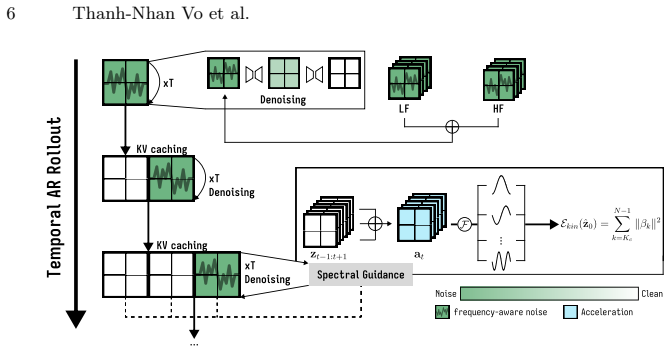
SAGA: structured AR noise initialization (SAN) that superposes two variance-preserving AR(1) streams with opposite correlations so lag-1 autocorrelation is zero, plus acceleration-domain spectral guidance (SG) that projects short-window discrete second differences onto a band-limited Slepian/DPSS basis and descends the high-frequency kinematic energy.
Load-bearing premise
High-frequency energy in short-window latent acceleration is mostly non-physical instability rather than legitimate motion, so suppressing it stabilizes rollout without systematically harming the pretrained generative content.
What would settle it
On matched prompts and seeds, if applying SAGA fails to reduce high-frequency acceleration power while temporal metrics and human preference stay flat or reverse, or if per-frame image quality drops, the central claim does not hold.
Editorial analysis
A structured set of objections, weighed in public.
Referee Report
Summary. The paper proposes SAGA, a training-free inference-time method for stabilizing chunk-wise autoregressive video diffusion. It attributes rollout failures (flicker, jitter, drift) to amplification of high-frequency temporal perturbations in discrete latent acceleration, and counters them with two components: Structured Autoregressive Noise (SAN), a variance-preserving mixture of opposite-correlation AR(1) streams that zeros lag-1 noise correlation while retaining longer-range structure, and Spectral Guidance (SG), which projects short-window latent acceleration onto a DPSS/Slepian basis and takes a gradient step to suppress high-frequency kinematic energy (Eqs. 7–8). Applied without retraining to CausVid, Self-Forcing, and Causal-Forcing, SAGA improves VBench Temporal Quality (e.g., Self-Forcing TQ 97.30→97.91, IQ 69.60→70.51), shows reduced acceleration RMS/HF power on matched videos, and is preferred in a 500-judgment human study. Ablations isolate SAN and SG, compare Slepian vs FFT, and test chunk-wise vs frame-wise rollout and longer horizons.
Significance. If the result holds, SAGA is a practical, plug-in stabilizer for the dominant high-quality AR-diffusion setting (chunk-wise causal DiT rollouts). Training-free applicability across three backbones, multi-metric VBench gains that do not systematically sacrifice image quality when both components are used, paired spectral analysis with bootstrap CIs, and a human preference study are concrete strengths. The acceleration-domain framing and finite-window Slepian implementation are a clear, reusable design pattern for short-context temporal regularization. Gains are modest in absolute terms, but the method is immediately usable and the experimental package is stronger than typical inference-time video guidance papers.
major comments (3)
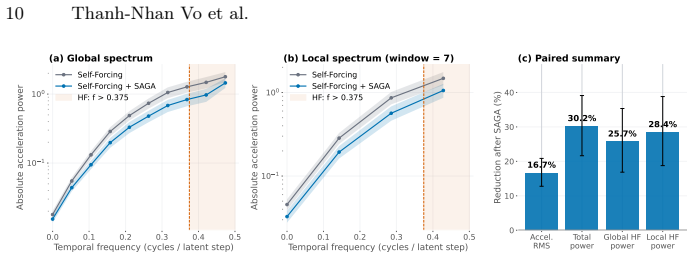
- Sec. 4.1 and Eqs. 7–8 rest on the load-bearing premise that high-frequency discrete latent acceleration over short AR windows is predominantly non-physical instability rather than legitimate motion. The paper’s own evidence only partially tests this: SG alone raises TQ (97.30→97.58) but lowers AQ/IQ (Table 2); frame-wise rollout with insufficient temporal support shows no gain or a slight TQ drop (Table 4); and Fig. 3 reports reductions in the exact quantity being minimized, so it is a weak independent diagnostic of artifact vs. content. A stronger test is needed—e.g., motion-content controls (high-frequency legitimate motion prompts), or a comparison against a non-acceleration high-frequency regularizer—to show that the suppressed energy is not systematically over-smoothing the generative prior.
- Table 3 shows that FFT-based guidance nearly matches Slepian (TQ 97.89 vs 97.91). The manuscript already softens the claim that DPSS is the primary novelty, but the abstract and contributions still foreground “finite-window Slepian projections” as a core element. The central claim should be reframed more explicitly around the acceleration-domain objective itself, with Slepian retained as a principled default rather than a decisive empirical driver, unless additional evidence (e.g., leakage-sensitive windows or qualitative failure modes of FFT) is provided.
- Inference configuration (Sec. 5.1) uses a single global hyperparameter set (η=3, ρ=0.9, NW=1.5, Kc=3) across prompts and three backbones. Free parameters are numerous relative to the reported sensitivity analysis. At minimum, a compact sensitivity or transfer plot for η and Kc (and confirmation that the same set was not tuned on the evaluation prompts) is needed to support the “no per-model retuning” claim that underpins the training-free multi-backbone result.
Circularity Check
No definitional circularity in the method or claims; the only mild circularity is using reduction of the optimized quantity (acceleration energy) as mechanism evidence.
specific steps
-
fitted input called prediction
[Sec. 5.2 Acceleration-Spectrum Analysis / Fig. 3]
"SAGA reduces acceleration RMS by 16.7% and total acceleration power by 30.2%... For f>0.375, SAGA reduces global and local high-frequency acceleration power by 25.7% and 28.4%, respectively. This spectral response aligns with the guidance objective in Sec. 4.3 and supports our hypothesis that autoregressive rollout instability is associated with high-frequency acceleration components"
The guidance step (Eq. 8) is exactly a gradient descent step on E_kin (Eq. 7), the high-frequency Slepian energy of discrete acceleration. Therefore reductions in acceleration RMS, total power, and HF power are expected by construction of the optimizer, not an independent diagnostic that the suppressed energy was non-physical instability. This does not force the VBench or human-preference claims, but it weakens Fig. 3 as mechanism evidence.
full rationale
SAGA is an inference-time guidance method whose central claims are empirical improvements on external VBench temporal metrics (SC/BC/TF/MS), aesthetic/image quality, and human preference, none of which are definitionally equal to the guidance objective E_kin. The kinematic prior (Eqs. 3, 7–8) and structured AR noise (Eqs. 5a–5b) are design choices motivated by a frequency-response analysis (Eq. 4), not fitted parameters that force the reported TQ/IQ gains. Hyperparameters are fixed globally (η=3, ρ=0.9, NW=1.5, Kc=3) rather than re-fit per claim. The sole mild circularity is that Fig. 3’s reductions in acceleration RMS and high-frequency power are near-direct consequences of minimizing E_kin, so that plot is weak as independent mechanism proof; it does not make the main performance claims circular. No self-citation uniqueness theorems, ansatz smuggling, or renaming of known results load-bear the derivation. Score 2 reflects only this minor diagnostic circularity.
Axiom & Free-Parameter Ledger
free parameters (5)
- guidance strength η =
3
- AR coefficient ρ =
0.9
- DPSS time-bandwidth product NW =
1.5
- spectral cutoff index Kc =
3
- SAN mixing angle θ =
π/4
axioms (5)
- standard math Discrete second-difference acceleration attenuates low-frequency motion and amplifies high-frequency variations with gain 4(1−cosω)².
- domain assumption Recursive reuse of generated latents as causal context accumulates temporal errors into flicker/jitter/drift in AR video diffusion.
- domain assumption Natural/inertial motion concentrates acceleration energy in low frequencies; high-frequency acceleration is a useful proxy for non-physical instability.
- standard math DPSS/Slepian sequences maximize in-band energy concentration under finite support and reduce spectral leakage vs plain FFT on short windows.
- ad hoc to paper A single global hyperparameter set (η, ρ, NW, Kc) transfers across prompts and three AR backbones without per-model retuning.
invented entities (2)
-
SAGA acceleration-domain kinematic energy E_kin via Slepian coefficients
independent evidence
-
Structured Autoregressive Noise (SAN) opposite-correlation AR(1) initialization
independent evidence
read the original abstract
Autoregressive video diffusion enables efficient streaming and long-horizon video generation, but repeatedly reusing generated latents as causal context can amplify temporal errors, resulting in flickering, motion jitter, and structural drift. In this paper, we investigate this failure mode from a spectral kinematic perspective and identify discrete latent acceleration as an effective signal for revealing unstable high-frequency temporal perturbations. To this end, we propose SAGA, a training-free \textbf{\textit{s}}table \textbf{\textit{a}}cceleration \textbf{\textit{g}}uidance approach for \textbf{\textit{a}}utoregressive video generation. SAGA integrates an acceleration domain spectral guidance objective based on finite-window Slepian projections with a structured autoregressive noise initialization strategy that suppresses short-range temporal correlations while preserving long-range motion structure. Without retraining or modifying the backbone, SAGA can be directly applied to existing chunk-wise autoregressive diffusion models, which is the prevalent setting for high-quality generation. Extensive experiments show that SAGA consistently improves temporal quality across multiple autoregressive diffusion models. On Self-Forcing, SAGA improves Temporal Quality from 97.30 to 97.91 and Image Quality from 69.60 to 70.51. Moreover, spectral analysis and human preference studies demonstrate that SAGA reduces temporal instability while maintaining visual fidelity.
Figures



Reference graph
Works this paper leans on
-
[1]
In: International Conference on Learning Representations
Bansal,A.,Chu,H.M.,Schwarzschild,A.,Sengupta,R.,Goldblum,M.,Geiping,J., Goldstein, T.: Universal guidance for diffusion models. In: International Conference on Learning Representations. vol. 2024, pp. 51304–51323 (2024) 4
work page 2024
-
[2]
In: Proceedings of the IEEE/CVF international conference on computer vision
Caron, M., Touvron, H., Misra, I., Jégou, H., Mairal, J., Bojanowski, P., Joulin, A.: Emerging properties in self-supervised vision transformers. In: Proceedings of the IEEE/CVF international conference on computer vision. pp. 9650–9660 (2021) 8
work page 2021
-
[3]
Advances in Neural Information Processing Systems37, 24081–24125 (2025) 1, 3
Chen, B., Martí Monsó, D., Du, Y., Simchowitz, M., Tedrake, R., Sitzmann, V.: Diffusion forcing: Next-token prediction meets full-sequence diffusion. Advances in Neural Information Processing Systems37, 24081–24125 (2025) 1, 3
work page 2025
-
[4]
Chen, H., Xia, M., He, Y., Zhang, Y., Cun, X., Yang, S., Xing, J., Liu, Y., Chen, Q., Wang, X., Weng, C., Shan, Y.: Videocrafter1: Open diffusion models for high- quality video generation (2023) 1, 9
work page 2023
-
[5]
In: The Eleventh International Conference on Learning Representations (2023) 4
Chung, H., Kim, J., Mccann, M.T., Klasky, M.L., Ye, J.C.: Diffusion posterior sam- pling for general noisy inverse problems. In: The Eleventh International Conference on Learning Representations (2023) 4
work page 2023
-
[6]
In: International Conference on Learning Representations
Deng, H., Pan, T., Diao, H., Luo, Z., Cui, Y., Lu, H., Shan, S., Qi, Y., Wang, X.: Autoregressive video generation without vector quantization. In: International Conference on Learning Representations. vol. 2025, pp. 44730–44745 (2025) 3
work page 2025
-
[7]
Advances in neural information processing systems34, 8780–8794 (2021) 4
Dhariwal, P., Nichol, A.: Diffusion models beat gans on image synthesis. Advances in neural information processing systems34, 8780–8794 (2021) 4
work page 2021
-
[8]
Han, W., Kang, S., Jun, Y., Chen, M.H., Yang, F.E., Hwang, S.J.: Physics in 2- steps: Locking motion priors before visual refinement erases them. In: ICML 2026 Workshop on Foundations of Deep Generative Models: Understanding Memoriza- tion, Generalization, and Reasoning (2026) 2, 3
work page 2026
-
[9]
Ho, J., Salimans, T.: Classifier-free diffusion guidance (2022) 4
work page 2022
-
[10]
Advances in Neural Information Processing Systems38, 167283–167308 (2026) 1, 2, 3, 4, 8, 9, 10, 14
Huang, X., Li, Z., He, G., Zhou, M., Shechtman, E.: Self forcing: Bridging the train-test gap in autoregressive video diffusion. Advances in Neural Information Processing Systems38, 167283–167308 (2026) 1, 2, 3, 4, 8, 9, 10, 14
work page 2026
-
[11]
Huang, Z., He, Y., Yu, J., Zhang, F., Si, C., Jiang, Y., Zhang, Y., Wu, T., Jin, Q., Chanpaisit, N., Wang, Y., Chen, X., Wang, L., Lin, D., Qiao, Y., Liu, Z.: VBench: Comprehensive benchmark suite for video generative models. In: Proceedings of the IEEE/CVF Conference on Computer Vision and Pattern Recognition (2024) 2, 8, 9, 14
work page 2024
-
[12]
In: Proceedings of the IEEE/CVF international conference on computer vision
Ke, J., Wang, Q., Wang, Y., Milanfar, P., Yang, F.: Musiq: Multi-scale image quality transformer. In: Proceedings of the IEEE/CVF international conference on computer vision. pp. 5148–5157 (2021) 8
work page 2021
-
[13]
arXiv preprint arXiv:2602.14027 (2026) 4
Li, J., Fu, X., Peng, X., Chen, W., Zheng, Y., Zhao, T., Wang, J., Chen, F., Wang, X., So, H.K.H.: Train short, inference long: Training-free horizon extension for autoregressive video generation. arXiv preprint arXiv:2602.14027 (2026) 4
-
[14]
In: Proceedings of the IEEE/CVF Conference on Computer Vision and Pattern Recognition
Li, Z., Zhu, Z.L., Han, L.H., Hou, Q., Guo, C.L., Cheng, M.M.: Amt: All-pairs multi-field transforms for efficient frame interpolation. In: Proceedings of the IEEE/CVF Conference on Computer Vision and Pattern Recognition. pp. 9801– 9810 (2023) 8
work page 2023
-
[15]
In: European conference on computer vision
Liang, J., Fan, Y., Zhang, K., Timofte, R., Van Gool, L., Ranjan, R.: Movideo: Motion-aware video generation with diffusion model. In: European conference on computer vision. pp. 56–74. Springer (2024) 2, 3 16 Thanh-Nhan Vo et al
work page 2024
-
[16]
Sora: A Review on Background, Technology, Limitations, and Opportunities of Large Vision Models
Liu, Y., Zhang, K., Li, Y., Yan, Z., Gao, C., Chen, R., Yuan, Z., Huang, Y., Sun, H., Gao, J., et al.: Sora: A review on background, technology, limitations, and opportunities of large vision models. arXiv preprint arXiv:2402.17177 (2024) 9
work page internal anchor Pith review Pith/arXiv arXiv 2024
-
[17]
arXiv preprint arXiv:2507.16869 (2025) 3
Ma, Y., Feng, K., Hu, Z., Wang, X., Wang, Y., Zheng, M., Wang, B., Wang, Q., He, X., Wang, H., et al.: Controllable video generation: A survey. arXiv preprint arXiv:2507.16869 (2025) 3
-
[18]
Movie Gen: A Cast of Media Foundation Models
Polyak, A., Zohar, A., Brown, A., Tjandra, A., Sinha, A., Lee, A., Vyas, A., Shi, B., Ma, C.Y., Chuang, C.Y., et al.: Movie gen: A cast of media foundation models. arXiv preprint arXiv:2410.13720 (2024) 8, 10
work page internal anchor Pith review Pith/arXiv arXiv 2024
-
[19]
In: International conference on machine learning
Radford, A., Kim, J.W., Hallacy, C., Ramesh, A., Goh, G., Agarwal, S., Sastry, G., Askell, A., Mishkin, P., Clark, J., et al.: Learning transferable visual models from natural language supervision. In: International conference on machine learning. pp. 8748–8763. PmLR (2021) 8
work page 2021
-
[20]
Bell System Technical Journal57(5), 1371–1430 (1978) 2, 4
Slepian, D.: Prolate spheroidal wave functions, fourier analysis, and uncer- tainty—v: The discrete case. Bell System Technical Journal57(5), 1371–1430 (1978) 2, 4
work page 1978
-
[21]
Proceedings of the IEEE70(9), 1055–1096 (1982) 2, 4, 9
Thomson, D.J.: Spectrum estimation and harmonic analysis. Proceedings of the IEEE70(9), 1055–1096 (1982) 2, 4, 9
work page 1982
-
[22]
Wan: Open and Advanced Large-Scale Video Generative Models
Wan, T., Wang, A., Ai, B., Wen, B., Mao, C., Xie, C.W., Chen, D., Yu, F., Zhao, H., Yang, J., Zeng, J., Wang, J., Zhang, J., Zhou, J., Wang, J., Chen, J., Zhu, K., Zhao, K., Yan, K., Huang, L., Feng, M., Zhang, N., Li, P., Wu, P., Chu, R., Feng, R., Zhang, S., Sun, S., Fang, T., Wang, T., Gui, T., Weng, T., Shen, T., Lin, W., Wang, W., Wang, W., Zhou, W.,...
work page internal anchor Pith review Pith/arXiv arXiv 2025
-
[23]
arXiv preprint arXiv:2503.10704 (2025) 2, 4
Wang, J., Zhang, F., Li, X., Tan, V.Y., Pang, T., Du, C., Sun, A., Yang, Z.: Er- ror analyses of auto-regressive video diffusion models: A unified framework. arXiv preprint arXiv:2503.10704 (2025) 2, 4
-
[24]
ACM Computing Surveys57(2), 1–42 (2024) 1, 3
Xing, Z., Feng, Q., Chen, H., Dai, Q., Hu, H., Xu, H., Wu, Z., Jiang, Y.G.: A survey on video diffusion models. ACM Computing Surveys57(2), 1–42 (2024) 1, 3
work page 2024
-
[25]
In: Proceedings of the IEEE/CVF International Conference on Computer Vision
Yang, X., Li, B., Zhang, Y., Yin, Z., Bai, L., Ma, L., Wang, Z., Cai, J., Wong, T.T., Lu, H., et al.: Vlipp: Towards physically plausible video generation with vision and language informed physical prior. In: Proceedings of the IEEE/CVF International Conference on Computer Vision. pp. 12360–12370 (2025) 2, 3
work page 2025
-
[26]
In: International Conference on Learning Representations
Yang, Z., Teng, J., Zheng, W., Ding, M., Huang, S., Xu, J., Yang, Y., Hong, W., Zhang, X., Feng, G., et al.: Cogvideox: Text-to-video diffusion models with an expert transformer. In: International Conference on Learning Representations. vol. 2025, pp. 83048–83077 (2025) 1, 9
work page 2025
-
[27]
Yin, T., Zhang, Q., Zhang, R., Freeman, W.T., Durand, F., Shechtman, E., Huang, X.: From slow bidirectional to fast autoregressive video diffusion models. In: CVPR (2025) 1, 3, 4, 8, 9
work page 2025
-
[28]
ACM Computing Surveys58(12), 1–41 (2026) 3
Yin, Z., Chen, K., Bai, X., Jiang, R., Li, J., Li, H., Liu, J., Xiang, Y., Yu, J., Zhang, M.: A survey: spatiotemporal consistency in video generation. ACM Computing Surveys58(12), 1–41 (2026) 3
work page 2026
-
[29]
Zhu, H., Zhao, M., He, G., Su, H., Li, C., Zhu, J.: Causal forcing: Autoregressive diffusion distillation done right for high-quality real-time interactive video genera- tion. arXiv preprint arXiv:2602.02214 (2026) 1, 3, 8, 9
work page internal anchor Pith review Pith/arXiv arXiv 2026
discussion (0)
Sign in with ORCID, Apple, or X to comment. Anyone can read and Pith papers without signing in.