REVIEW 3 major objections 22 references
A divide-and-conquer QAOA that partitions satellite co-observation graphs into NISQ-sized subgraphs can design large constellations with coverage competitive with classical solvers where full-graph QAOA cannot run.
Reviewed by Pith at T0; open to challenge. T0 means a machine referee read the full paper against a public rubric. the ladder, T0–T4 →
T0 review · grok-4.5
2026-07-10 13:02 UTC pith:D2XN25IK
load-bearing objection Useful applied DC-QAOA package for large satellite MCLP that empirically works under NISQ limits, with an overstated linearization claim and thin classical baselines. the 3 major comments →
Decomposition-Based QAOA for Maximum Coverage Location Problem in Satellite Constellation Design
The pith
A machine-rendered reading of the paper's core claim, the machinery that carries it, and where it could break.
Core claim
Large MCLP instances that arise in satellite constellation design can be solved at practical scale by classical spectral decomposition of a co-observation graph into subgraphs small enough for NISQ QAOA, followed by either quantum-state or graph-state reconstruction of the separator slots; the graph-state merge consistently recovers coverage ratios of roughly 80–99 percent of the classical optimum while remaining tractable where full-graph QAOA cannot be simulated.
What carries the argument
The co-observation graph (vertices = orbital slots, edge weights = shared target-time visibility) together with spectral bisection into qubit-bounded subgraphs and the two Hamiltonian-based merge operators QSR (replicated separator qubits plus post-selection) and GSR (single-copy coverage-weighted separator QUBO).
Load-bearing premise
The equal-share linearization of the exact multi-body coverage product, plus local re-optimization only on separator slots, still leaves the recovered coverage close enough to the true MCLP optimum for design use.
What would settle it
Take any visibility matrix from the paper, solve the identical MCLP exactly with a classical MIP solver and also with the full decomposition pipeline (same q_max, same GSR or QSR), and check whether the coverage ratio falls below the reported range (especially for sparse, low-density matrices or larger satellite budgets).
If this is right
- Constellation sizing problems with several hundred orbital slots become executable on present-day quantum processors without requiring full-graph qubit counts.
- Graph-state reconstruction is the preferred merge: it uses half the qubits of QSR and yields higher, more stable coverage ratios across the tested visibility matrices.
- Runtime stays bounded by the fixed subgraph size rather than by total slots, so wall-clock time grows roughly with the number of subgraphs rather than exponentially.
- The same co-observation-graph-plus-decomposition pattern can be reused for other coverage-cardinality combinatorial problems once the Hamiltonian is rewritten for their reward structure.
Where Pith is reading between the lines
- If the linearization error remains negligible under realistic multi-target, multi-plane visibility, the method could be extended to reconfiguration and transfer problems that share the same cardinality-plus-coverage structure.
- Hardware noise primarily degrades the approximation ratio by roughly ten percentage points on a 12-qubit Heron device; shallow depth (p=3) already limits decoherence, so modest error mitigation would likely close most of the remaining gap.
- The approach may transfer to other facility-location or sensor-placement settings where demand nodes couple only weakly across distant facilities.
Editorial analysis
A structured set of objections, weighed in public.
Referee Report
Summary. The paper formulates satellite constellation design as an MCLP, maps it to a co-observation graph, partitions that graph by recursive spectral bisection into NISQ-sized subgraphs, solves each subgraph with a QAOA circuit on a linearized QUBO Hamiltonian, and reconstructs a global constellation via two quantum merge strategies (QSR and GSR). Across six visibility-matrix instances (J up to 958) and budgets N∈{2,4,6}, GSR-based decomposition reports coverage ratios often in the 80–99% range versus Gurobi optima, with runtimes competitive or better on harder instances, while full-graph QAOA is reported as infeasible under classical simulation. Hardware runs on IBM ibm_kingston (q_max=12, N=4) are included with runtime confidence intervals.
Significance. Applying divide-and-conquer QAOA to coverage-type MCLP (rather than Max-Cut-style graph partitioning) is a genuine and useful extension; the co-observation graph, proportional budget allocation, and especially the GSR merge Hamiltonian are problem-specific contributions that fit satellite design under NISQ constraints. The systematic Table V comparison (coverage, ρ, Δ, runtime) across VM-1–6, N, and q_max, plus real-hardware validation with CIs, is a clear empirical strength. If the approximation and reconstruction gaps are better quantified, the framework would be a solid methods contribution for quantum combinatorial optimization in aerospace applications.
major comments (3)
- §V-A4 and Table VI: the linearization error analysis is internally inconsistent and overstates negligibility. Eq. (23) correctly bounds the absolute pointwise error by ½−(½)^|C|≈½ for |C|∈[81,212]. The text then claims this is “negligible in relative terms (<0.001%)” and Table VI lists “Error Bound Magnitude <0.001%,” which does not follow from Eq. (23). With π_tp∈{1,2} the Hamiltonian (Eqs. 20–26) optimizes a soft fractional-coverage surrogate, not the original indicator MCLP. The reported ρ values in Table V are true-coverage evaluations of bit-strings found under that surrogate; without a quantified surrogate-to-true gap (or ranking-preservation argument) for general visibility structure, the central claim that the method solves MCLP competitively rests on unanalyzed approximation error. Please correct the bound interpretation, report true vs. surrogate objective values, and discuss w
- Table V and §V-A: the “standard QAOA” baseline is classical AerSimulator timeout / memory exhaustion on 2^J statevectors (J=288–958), not a quantum-hardware or even a fair algorithmic baseline. Labeling these rows “Timeout†” and using them to claim superiority of decomposition is misleading; full-graph QAOA was never executable on the same classical or quantum resources. Either restrict the baseline to instances where non-decomposed QAOA can actually run (or be classically simulated), or replace it with strong classical heuristics / MILP warm-starts so that the comparison isolates the value of decomposition rather than simulation limits.
- §III-E (β=50 via grid search over {10,50,100,500}) and §III-F (λ=100): penalty coefficients and other free parameters are selected on the same test instances used for reporting. This is mild but load-bearing hyperparameter circularity for an empirical methods paper. Provide a sensitivity study (or hold-out configurations) showing that coverage ratios and feasibility remain stable under modest β/λ variation, and state clearly that β, λ, α, p, p_merge, and q_max are free parameters of the method.
Circularity Check
Mild hyperparameter tuning of penalty coefficients on the same test instances used for reporting; no structural circularity in the MCLP-to-QUBO mapping, decomposition, or external Gurobi evaluation.
specific steps
-
fitted input called prediction
[Section III-E (QUBO Matrix Construction) and III-F (QSR/GSR)]
"The cardinality penalty coefficient is set to β=50 to balance constraint satisfaction with solution quality. This value is selected via grid search over β∈[10,50,100,500] to minimize constraint violations while maintaining coverage performance across all test instances. … The agreement penalty coefficient is set to λ=100 …"
Penalty weights that appear inside the Hamiltonians optimized by QAOA are chosen by grid search that explicitly references performance on the same visibility-matrix instances later reported in Table V. The reported coverage ratios therefore reflect a post-hoc tuned surrogate rather than a parameter-free run; the effect is mild optimism bias, not an algebraic identity between input and output.
full rationale
This is an empirical algorithmic methods paper whose central claims are computational (scalability of spectral-bisection + MCLP-QAOA + QSR/GSR under q_max ≤ 20, coverage ratios vs Gurobi on six visibility matrices). The derivation chain (co-observation graph from Φ, spectral min-cut, linearized QUBO Hamiltonian, independent QAOA subproblems, separator reconstruction) is constructive and does not redefine its target quantity as an input. Coverage is always scored with the original indicator (Eq. 43) against an independent classical MILP optimum; the linearization (Eq. 22) is an explicit approximation whose error is bounded (Eq. 23), not a self-definition. The only mild circularity is ordinary hyperparameter selection: eta and λ are chosen by grid search that includes the reported instances. That introduces a small optimism bias common to all tuned solvers and does not force the coverage ratios by construction. No self-citation is load-bearing for uniqueness or ansatz; no fitted constant is renamed a prediction. Score remains 1.
Axiom & Free-Parameter Ledger
free parameters (5)
- cardinality penalty β =
50
- QSR agreement penalty λ =
100
- GSR normalization α =
1
- QAOA depth p and merge depth p_merge =
3
- max subgraph size q_max =
{8,12,20}
axioms (5)
- domain assumption Spectral bisection via the Fiedler vector yields balanced partitions with sufficiently small cut weight for co-observation graphs of orbital slots.
- ad hoc to paper Linearizing the multi-body coverage product by equal reward sharing (Eq. 22) preserves ranking of good constellations well enough for reported optimality gaps.
- ad hoc to paper Proportional satellite budget allocation across subgraphs (Eqs. 12–14) plus separator residual budgets preserves global cardinality without large optimality loss.
- domain assumption QAOA with shallow depth and COBYLA-trained parameters yields useful approximate solutions on the constructed QUBOs under ideal simulation.
- domain assumption Co-observation frequency weights w_ij = sum Φ_tip Φ_tjp adequately encode the coupling structure needed for coverage-preserving graph cuts.
invented entities (2)
-
Graph State Reconstruction (GSR) merge Hamiltonian
no independent evidence
-
Co-observation graph for satellite MCLP
no independent evidence
read the original abstract
An increase in earth observation missions has increased the demand of efficient design and optimization of satellite constellations. Maximizing coverage of the target while effectively utilizing the limited orbital resources is one of the critical design challenges for complex combinatorial optimization problems. The maximal covering location problem (MCLP), serves as a base for orbital coverage modeling, is NP-hard and computationally intractable for large-constellation instances. Using heuristics, metaheuristics, and mixed-integer linear programming, classical solvers have achieved optimal or near-optimal results, yet their scalability is limited as the problem size increases. Quantum computing advancements, including the quantum approximate optimization algorithms, offer a potential solution to NP-hard combinatorial optimization problems. Current quantum hardware limitations, such as low qubit counts and circuit depth, restrict solutions for small-scale instance problems. To address this challenge, this paper proposes a scalable quantum optimization framework for MCLP in satellite constellation design. A decomposition-based quantum methodology is proposed, in which large MCLP instances are partitioned into subgraphs by classical decomposition, optimized independently via quantum optimization circuits, and combined using quantum reconstruction strategies. Computational results across different constellation sizes reveal better scalability in less time while maintaining competitive coverage performance compared to classical solvers.
Figures


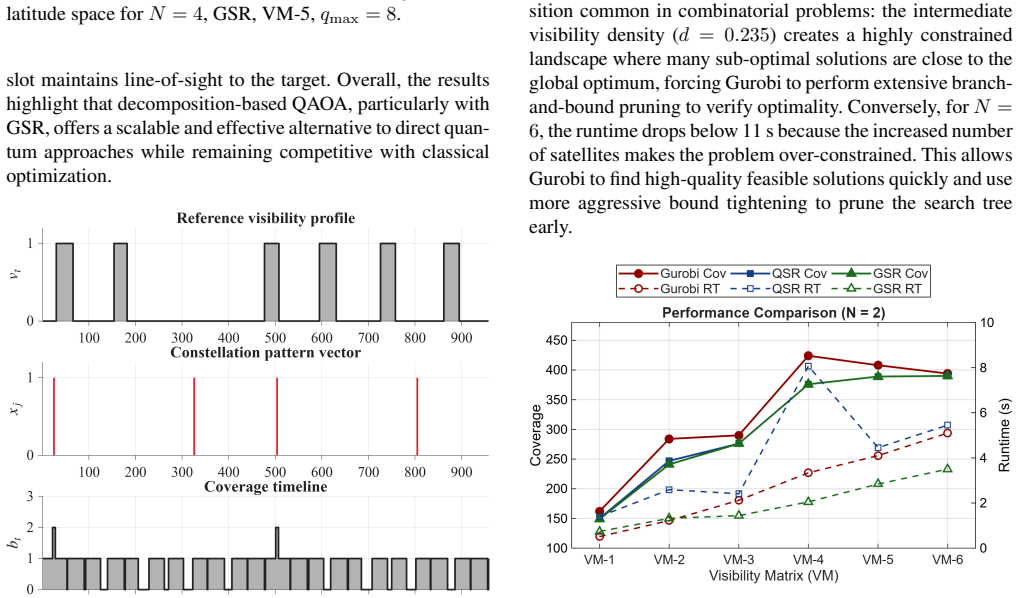


Reference graph
Works this paper leans on
-
[1]
D. O. W. Rogers, D. Won, D. Koh, K. Hong, and H. W. Lee, “Optimal Satellite Constellation Config- uration Design:A Collection of Mixed Integer Linear Programs,”Journal of Spacecraft and Rockets, Mar. 2026
work page 2026
-
[2]
THE MAXIMAL COV- ERING LOCATION PROBLEM,
R. Church and C. R. Velle, “THE MAXIMAL COV- ERING LOCATION PROBLEM,” en,Papers in Re- gional Science, vol. 32, no. 1, pp. 101–118, Jan. 1974
work page 1974
-
[3]
Optimal constellation design based on satellite ground tracks for Earth observation missions,
Y . Imoto, S. Satoh, T. Obata, and K. Yamada, “Optimal constellation design based on satellite ground tracks for Earth observation missions,” en,Acta Astronau- tica, vol. 207, pp. 1–9, Jun. 2023
work page 2023
-
[4]
Satellite Constellation Design for Minimum Worst-Case Revisit Time,
J. Ko, B. Gwon, and J. Ahn, “Satellite Constellation Design for Minimum Worst-Case Revisit Time,” en, International Journal of Aeronautical and Space Sci- ences, vol. 27, no. 1, pp. 916–929, Jan. 2026
work page 2026
-
[5]
H. W. Lee and K. Ho, “Regional Constellation Re- configuration Problem: Integer Linear Programming Formulation and Lagrangian Heuristic Method,” en, Journal of Spacecraft and Rockets, vol. 60, no. 6, pp. 1828–1845, Nov. 2023
work page 2023
-
[6]
A decomposition approach for the prob- abilistic maximal covering location-allocation prob- lem,
F. D. A. Corrêa, L. A. N. Lorena, and G. M. Ribeiro, “A decomposition approach for the prob- abilistic maximal covering location-allocation prob- lem,” en,Computers & Operations Research, vol. 36, no. 10, pp. 2729–2739, Oct. 2009
work page 2009
-
[7]
A Review on Quantum Machine Learning in Applied Systems and Engineering,
Y .-Y . Hong and D. Josh Domingo Lopez, “A Review on Quantum Machine Learning in Applied Systems and Engineering,”IEEE Access, vol. 13, pp. 144 607– 144 631, 2025
work page 2025
-
[8]
A Quantum Approximate Optimization Algorithm
E. Farhi, J. Goldstone, and S. Gutmann,A Quantum Approximate Optimization Algorithm, arXiv:1411.4028 [quant-ph], Nov. 2014
work page internal anchor Pith review Pith/arXiv arXiv 2014
-
[9]
Using quantum comput- ing to solve the maximal covering location problem,
A. Giraldo-Quintero, J. G. Lalinde-Pulido, J. C. Duque, and D. Sierra-Sosa, “Using quantum comput- ing to solve the maximal covering location problem,” en,Computational Urban Science, vol. 2, no. 1, p. 43, Dec. 2022
work page 2022
-
[10]
Two-Step QAOA: Enhancing Quantum Optimization by Decomposing K-hot Constraints in QUBO Formulations
Y . Minato,Two-Step QAOA: Enhancing Quantum Optimization by Decomposing K-hot Constraints in QUBO F ormulations, arXiv:2408.05383 [quant-ph], Feb. 2025
work page internal anchor Pith review Pith/arXiv arXiv 2025
-
[11]
Quantum Optimization for Closed-Loop Scheduling of Earth Observation Satellite Formation,
V . Marchioli, M. Boggio, D. V olpe, L. Massotti, and C. Novara, “Quantum Optimization for Closed-Loop Scheduling of Earth Observation Satellite Formation,” en,SN Computer Science, vol. 6, no. 6, p. 739, Aug. 2025
work page 2025
-
[12]
COMPARATIVE STUDY OF TWO DIVIDE AND CONQUER SORT- ING ALGORITHMS: QUICKSORT AND MERGE- SORT,
O. Esau Taiwo, A. O. Christianah, A. N. Oluwatobi, K. A. Aderonke, and A. J. Kehinde, “COMPARATIVE STUDY OF TWO DIVIDE AND CONQUER SORT- ING ALGORITHMS: QUICKSORT AND MERGE- SORT,” en,Procedia Computer Science, vol. 171, pp. 2532–2540, 2020
work page 2020
-
[13]
Large-Scale Quantum Approximate Optimization via Divide-and-Conquer,
J. Li, M. Alam, and S. Ghosh, “Large-Scale Quantum Approximate Optimization via Divide-and-Conquer,” IEEE Transactions on Computer-Aided Design of In- tegrated Circuits and Systems, vol. 42, no. 6, pp. 1852– 1860, Jun. 2023
work page 2023
-
[14]
QAOA-in- QAOA: Solving Large-Scale MaxCut Problems on 20 Small Quantum Machines,
Z. Zhou, Y . Du, X. Tian, and D. Tao, “QAOA-in- QAOA: Solving Large-Scale MaxCut Problems on 20 Small Quantum Machines,” en,Physical Review Ap- plied, vol. 19, no. 2, p. 024 027, Feb. 2023
work page 2023
-
[15]
M. Ponce, R. Herrman, P. C. Lotshaw, et al., “Graph decomposition techniques for solving combinatorial optimization problems with variational quantum algo- rithms,” en,Quantum Information Processing, vol. 24, no. 2, p. 60, Feb. 2025
work page 2025
-
[16]
A Decomposition Method for the Hybrid Quantum-Classical Solution of the Number Partitioning Problem
Z. Li, T. Seidel, D. Leib, M. Bortz, and R. Heese, “Ef- ficient solution of the number partitioning problem on a quantum annealer: A hybrid quantum-classical de- composition approach,”Journal of Heuristics, vol. 31, no. 2, p. 21, Apr. 2025, arXiv:2312.08940 [math]
work page internal anchor Pith review Pith/arXiv arXiv 2025
-
[17]
J. Qi, C.-H. Huck Yang, P.-Y . Chen, and M.-H. Hsieh, “TensorHyper-VQC: A tensor-train-guided hypernet- work for robust and scalable variational quantum com- puting,” vol. 12, Feb. 2026
work page 2026
-
[18]
Algebraic connectivity of graphs,
M. Fiedler, “Algebraic connectivity of graphs,” en, Czechoslovak Mathematical Journal, vol. 23, no. 2, pp. 298–305, 1973
work page 1973
-
[19]
A tutorial on spectral clustering,
U. V on Luxburg, “A tutorial on spectral clustering,” en,Statistics and Computing, vol. 17, no. 4, pp. 395– 416, Dec. 2007
work page 2007
-
[20]
Spectral par- titioning works: Planar graphs and finite element meshes,
D. A. Spielman and Shang-Hua Teng, “Spectral par- titioning works: Planar graphs and finite element meshes,” inProceedings of 37th Conference on F oun- dations of Computer Science, Burlington, VT, USA: IEEE, 1996, pp. 96–105
work page 1996
-
[21]
Ising formulations of many NP problems,
A. Lucas, “Ising formulations of many NP problems,” Frontiers in Physics, vol. 2, 2014
work page 2014
-
[22]
From the Quantum Approximate Optimization Algorithm to a Quantum Alternating Operator Ansatz,
S. Hadfield, Z. Wang, B. O’Gorman, et al., “From the Quantum Approximate Optimization Algorithm to a Quantum Alternating Operator Ansatz,” en,Algo- rithms, vol. 12, no. 2, p. 34, Feb. 2019. 21
work page 2019
discussion (0)
Sign in with ORCID, Apple, or X to comment. Anyone can read and Pith papers without signing in.