REVIEW 2 major objections 5 minor 76 references
Dark-matter abundance fixes the amplitude of a MHz gravitational-wave signal from the same primordial peak.
Reviewed by Pith at T0; open to challenge. T0 means a machine referee read the full paper against a public rubric. the ladder, T0–T4 →
2026-07-14 10:30 UTC pith:ZKJTIFVE
load-bearing objection Clean algebraic closure that removes free scalar amplitude from SIGW templates and ties MHz peaks to conformal-fermion mass; solid under its stated assumptions. the 2 major comments →
Conformal dark matter and MHz gravitational waves
The pith
A machine-rendered reading of the paper's core claim, the machinery that carries it, and where it could break.
Core claim
Once the dark-matter abundance is used to fix the integrated area of a localized primordial curvature peak through its cubic moment, the peak amplitude of the scalar-induced gravitational-wave spectrum is completely determined by the same peak’s mass scale, frequency, width, and shape factors. There is no free scalar normalization left in the tensor prediction, so a MHz laboratory signal is tied directly to the conformal-fermion mass.
What carries the argument
Abundance-normalized closure relation: the cubic moment that sets the conformal-fermion yield is eliminated against the quadratic radiation-era convolution that sets the induced tensor amplitude, yielding an explicit formula for the peak gravitational-wave density in terms of dark-matter mass, peak frequency, width, and shape factors only.
Load-bearing premise
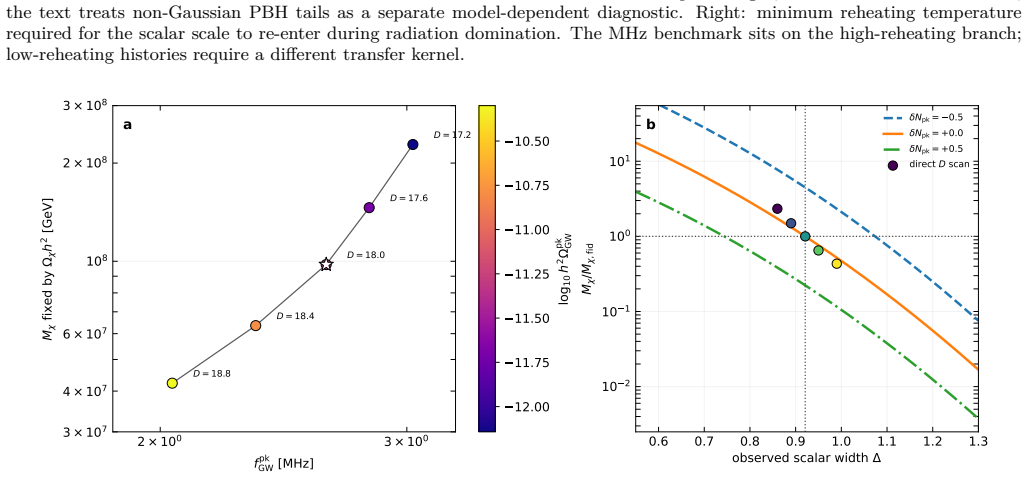
The calculation assumes the MHz modes re-enter the horizon only after the universe has already reheated into radiation, so the standard radiation-era transfer functions apply; a much later reheating would replace those kernels and change the predicted amplitude.
What would settle it
A laboratory MHz stochastic search that either (a) sets a limit stronger than the mass-reach curve implied by the observed dark-matter density at the measured peak frequency and width, or (b) detects a peak whose amplitude, frequency, and width cannot be reproduced by any single curvature spectrum that also yields the correct relic density.
Editorial analysis
A structured set of objections, weighed in public.
Referee Report
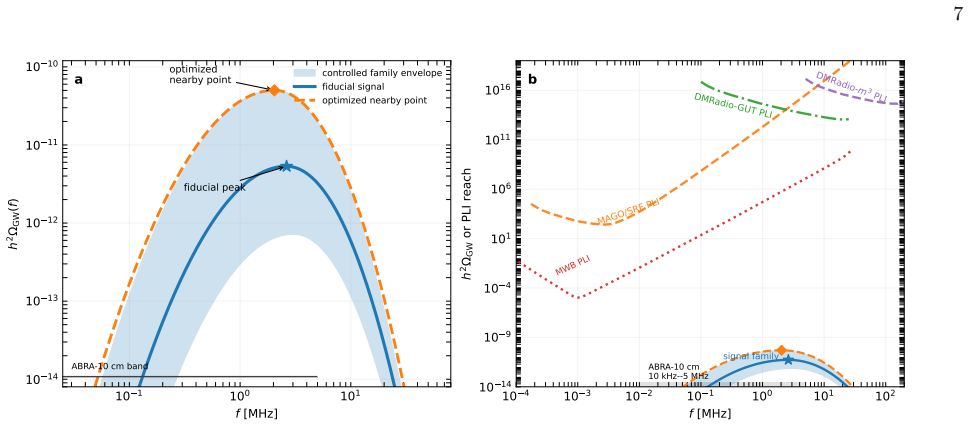
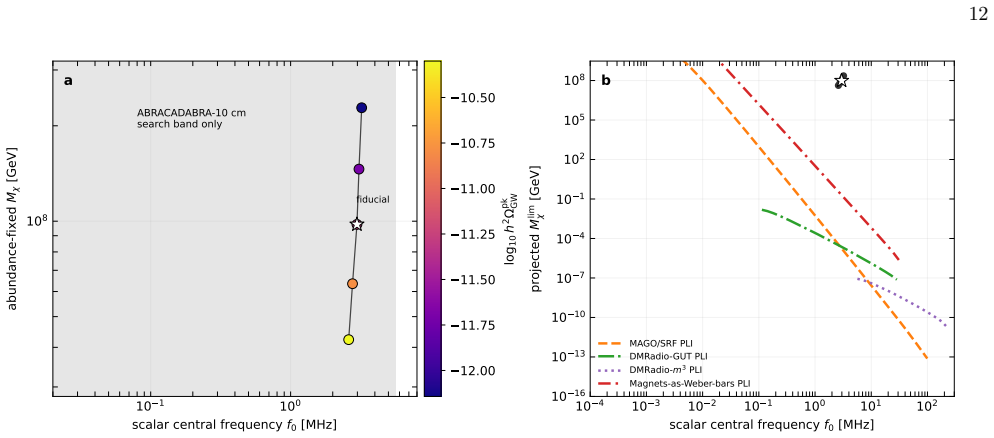
Summary. The paper argues that a localized small-scale peak in the primordial curvature spectrum P_ζ simultaneously produces conformal-fermion dark matter through a cubic moment of P_ζ and a scalar-induced gravitational-wave (SIGW) background through a quadratic radiation-era convolution. By fixing the integrated scalar area A_ζ from the observed relic density Ω_χ h^{2} (Eq. 14), the free normalization of ordinary SIGW templates is eliminated, yielding the closed relation h^{2}Ω_pk_GW = C_V (Ω_χ h^{2})^{2}/(M_χ/GeV)^{2} (f_0/MHz)^{6} imes Δ^{-2} exp(9Δ^{2})/R_3^{2} (Eq. 1 / Eq. 23). A concrete single-field Mukhanov–Sasaki realization with a transient slow-roll dip generates a broad MHz peak (f_pk_GW ≈ 2.63 MHz, h^{2}Ω_pk_GW ≈ 5.3 imes10^{-12}) that lies far below the Gaussian PBH threshold; null HFGW searches then become lower bounds on M_χ while a detection is overconstrained by abundance, frequency, amplitude and width.
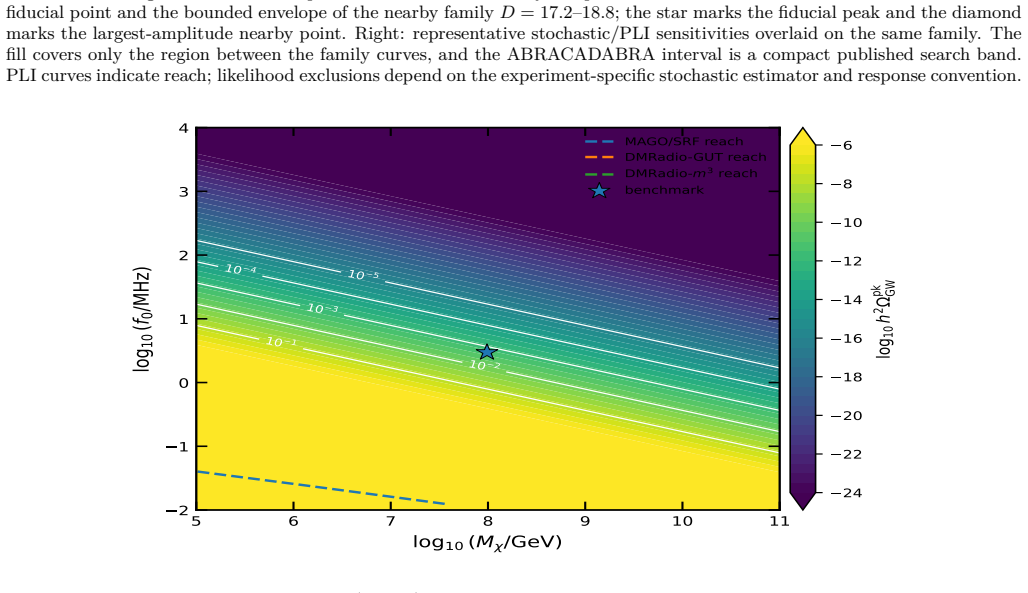
Significance. If the radiation-era kernel and the adopted production coefficient A_χ hold, the result supplies a genuinely predictive link between superheavy conformal dark matter and laboratory MHz gravitational-wave searches. The algebraic elimination of A_ζ is clean, the numerical pipeline (Mukhanov–Sasaki spectrum, cubic shape factor R_3 = 1.6287, radiation-era convolution with documented convergence in Table II) is reproducible, and the closure converts existing and projected HFGW sensitivities into concrete mass reach (Eq. 25) and an inverted mass inference (Eq. 26). The construction therefore turns a free-normalization SIGW template into a falsifiable multi-observable test of one primordial feature.
major comments (2)
- Sec. VII.A, Eqs. (36)–(38): the entire numerical prediction and mass-reach translation rest on the radiation-era kernel, which requires T_reh ≳ 1.12 imes10^{14} GeV. The paper correctly notes that delayed reheating replaces the amplitude by an unspecified factor S_reh, yet provides neither a concrete evaluation of S_reh for any standard reheating history nor a quantitative band on how large the correction can be. Because the central claim is a definite MHz amplitude and mass bound, this external condition should be either justified more tightly or accompanied by an explicit range of S_reh so that the predicted signal and M_lim_χ can be assessed under realistic post-inflationary evolution.
- Sec. II.B, Eq. (11): the production coefficient A_χ ≃ 0.015 is taken from the external conformal-fermion calculation of Refs. [10,11] and is never recomputed or varied for the specific Mukhanov–Sasaki peak used here. Because A_χ enters C_χ and therefore C_V, any O(1) uncertainty in the kernel (spin sum, constraint normalization, or time integral) rescales the entire predicted h^{2}Ω_pk_GW and the inferred mass. A short sensitivity scan or an explicit statement of the uncertainty inherited from the cited production calculation is needed before the closure can be treated as quantitatively robust.
minor comments (5)
- Table I is useful but the final column is somewhat repetitive; a single sentence in the introduction already states the same point.
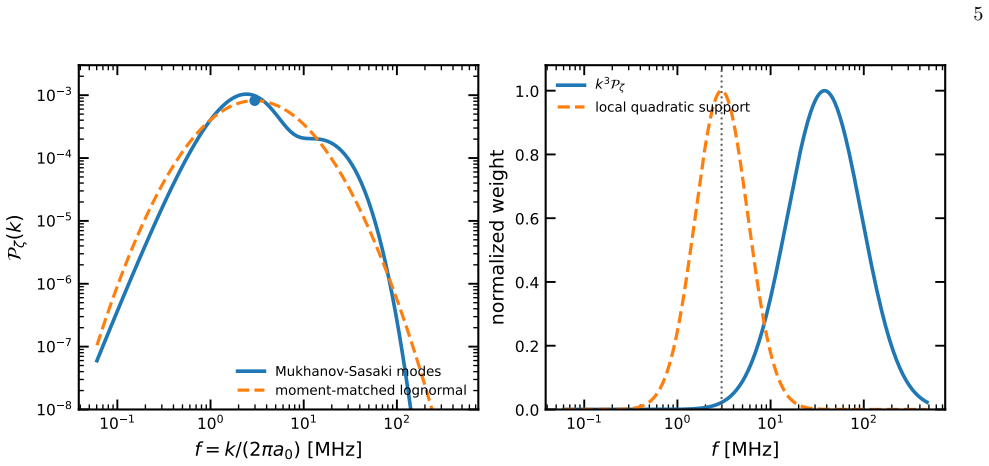
- Fig. 2 (right panel) labels a “local quadratic support proxy” without defining the proxy function; a one-line formula would help the reader.
- Several arXiv preprints in the reference list carry future dates (2026); these should be updated or flagged as “in preparation” if they remain unpublished.
- Notation for the shape factors switches between R_3 and R3, and between C_GW and CGW; a uniform choice would improve readability.
- Eq. (21) gives a convenient analytic fit for C_LN_GW(Δ), but the maximum fractional deviation of 1.6 % is stated without showing the underlying scan; a brief appendix plot would strengthen the claim.
Circularity Check
No significant circularity: central closure is algebraic elimination of A_ζ between independent cubic (DM) and quadratic (SIGW) moments of one P_ζ; shape factors are measured, not fitted to the target.
full rationale
The load-bearing claim (Eq. 1/Eq. 23) follows by direct elimination of the free scalar area A_ζ between the conformal-fermion abundance (Eq. 12, linear in A_ζ via the cubic moment M_3 and R_3) and the radiation-era SIGW peak (Eq. 20, quadratic in A_ζ via C_GW). Both kernels are standard or externally cited (A_χ ≃ 0.015 from Garani et al. [10,11]; SIGW transfer from Ananda/Baumann et al.); the single-field Mukhanov–Sasaki ansatz supplies a concrete P_num_ζ from which R_3 and C_GW are recomputed once, after which the algebra is forced. This is a genuine relation among observables (M_χ, f_0, Δ, Ω_χ h^{2} o h^{2}Ω_pk_GW), not a tautology that renames an input as a prediction. Inflationary parameters (D, σ, N_pk) are chosen to realize a localized peak and then held fixed while both channels are evaluated; they are not fitted to the GW amplitude. Mild self-consistency arises only because the same numerical spectrum sources both moments, but that is the intended demonstration of a single primordial feature, not circular reduction. No self-citation is load-bearing for the kernels, no uniqueness theorem is imported, and no fitted parameter is re-labeled a prediction. Score 1 reflects only the shared-spectrum bookkeeping; the derivation is otherwise self-contained against external benchmarks.
Axiom & Free-Parameter Ledger
free parameters (5)
- D (slow-roll suppression depth) =
18.0 (fiducial)
- σ (feature width in e-folds) =
1.4
- N_pk (feature location) =
53.2
- A_χ (production coefficient) =
≃0.015
- Δ (log-width of peak) =
0.92096
axioms (4)
- domain assumption Conformal fermions are produced solely by curvature inhomogeneities with number density n_χ a³ = (A_χ/4π²) ∫ k³ P_ζ(k) d ln k
- domain assumption Radiation-era second-order tensor kernel (Eqs. 15–17) applies for the MHz modes
- domain assumption Gaussian Press–Schechter estimate with δ_c≈0.4–0.5 is a sufficient PBH-tail diagnostic
- ad hoc to paper Late mass generation via a dark scalar S with exact Z_2 and crossover potential produces no additional stochastic GW background
invented entities (2)
-
Stable conformal fermion χ with late mass M_χ = y_S v_S
no independent evidence
-
Localized single-field slow-roll feature (Gaussian dip in ε(N))
no independent evidence
Cite this review
Pith. "Pith review of Conformal dark matter and MHz gravitational waves." pith.science (2026). https://pith.science/paper/ZKJTIFVE
@misc{pith2026260710607,
  author       = {Pith},
  title        = {Pith review of: Conformal dark matter and MHz gravitational waves},
  year         = {2026},
  howpublished = {\url{https://pith.science/paper/ZKJTIFVE}},
  note         = {Machine review of arXiv:2607.10607}
}
read the original abstract
A localized enhancement of the primordial curvature spectrum can leave two distinct relics: gravitationally produced conformal-fermion dark matter and a scalar-induced stochastic gravitational-wave background. We show that the dark-matter abundance fixes the scalar normalization through the cubic moment of the curvature spectrum, while the induced tensor signal probes its quadratic convolution. This closes the usual normalization freedom in scalar-induced gravitational-wave templates and ties the MHz signal directly to the dark-matter mass, peak scale, and spectral width. A concrete single-field realization demonstrates this mechanism: a Mukhanov--Sasaki evolution produces a broad MHz background that sits safely below the Gaussian primordial-black-hole threshold. In this construction, a null high-frequency search becomes a lower bound on the conformal-fermion mass, while a detection has to reproduce the relic abundance, peak frequency, amplitude, and width from one primordial feature. The result is a testable link between small-scale inflationary structure, superheavy dark matter, and laboratory MHz gravitational-wave searches
Figures



Reference graph
Works this paper leans on
-
[1]
(11), Eq
Combining Eq. (11), Eq. (6), and Eq. (3) yields Ωχh2 =C χ (Mχ GeV ) ( f0 MHz )3 Aζexp (9∆ 2 2 ) R3,(12) which relates the relic density to the integrated peak area and the cubic shape factor. The normalization constant is Cχ= Aχ 4π2 (1.546×10⁻²¹)−3 (3.0856776×1024)3 1 ρc/h2 = 3.3206×10⁻¹⁰, (13) withρc/h2 = 1.05375×10⁻⁵GeV cm−3. The factors con- vert the f...
-
[2]
N. Aghanim et al. Planck 2018 results. vi. cosmologi- cal parameters.Astron. Astrophys., 641:A6, 2020. doi: 10.1051/0004-6361/201833910
-
[3]
Shifted Hybrid Realization of Non-Minimal Higgs Inflation in Light of ACT DR6 and Planck Data
Nadir Ijaz, Pirzada, and Mansoor Ur Rehman. Shifted Hybrid Realization of Non-Minimal Higgs Inflation in Light of ACT DR6 and Planck Data. 7 2026
2026
-
[4]
Pri- mordial black holes from single field models of in- flation.Phys
Juan García-Bellido and Ester Ruiz Morales. Pri- mordial black holes from single field models of in- flation.Phys. Dark Univ., 18:47–54, 2017. doi: 10.1016/j.dark.2017.09.007
-
[5]
On primor- dial black holes from an inflection point.Phys
Cristiano Germani and Tomislav Prokopec. On primor- dial black holes from an inflection point.Phys. Dark Univ., 18:6–10, 2017. doi:10.1016/j.dark.2017.09.001
-
[8]
Controlled penumbral inflation from monodromic valleys, 5 2026
Pirzada and Tianjun Li. Controlled penumbral inflation from monodromic valleys, 5 2026
2026
-
[9]
Dilaton-flattened axion inflation, 4 2026
Pirzada, Ali Muhammad, Tianjun Li, Imtiaz Khan, and Mussawir Khan. Dilaton-flattened axion inflation, 4 2026
2026
-
[10]
Non-minimal dilaton inflation from the effective gluodynamics, 2 2026
Pirzada, Imtiaz Khan, Mussawair Khan, Tianjun Li, and Ali Muhammad. Non-minimal dilaton inflation from the effective gluodynamics, 2 2026
2026
-
[11]
Stochastic dark matter from curvature perturba- tions.Phys
Raghuveer Garani, Michele Redi, and Andrea Tesi. Stochastic dark matter from curvature perturba- tions.Phys. Rev. Lett., 134:101005, 2025. doi: 10.1103/PhysRevLett.134.101005
-
[12]
Par- ticle production from inhomogeneities: general met- ric perturbations.JHEP, 2025(08):037, 2025
Raghuveer Garani, Michele Redi, and Andrea Tesi. Par- ticle production from inhomogeneities: general met- ric perturbations.JHEP, 2025(08):037, 2025. doi: 10.1007/JHEP08(2025)037
-
[13]
Second order cosmological pertur- bations from inflation.Nucl
Viviana Acquaviva, Nicola Bartolo, Sabino Matarrese, and Antonio Riotto. Second order cosmological pertur- bations from inflation.Nucl. Phys. B, 667:119–148, 2003. 13 doi:10.1016/S0550-3213(03)00550-9
-
[14]
Cmb polarization from secondary vector and tensor modes.Phys
Silvia Mollerach, Diego Harari, and Sabino Matar- rese. Cmb polarization from secondary vector and tensor modes.Phys. Rev. D, 69:063002, 2004. doi: 10.1103/PhysRevD.69.063002
-
[15]
Ananda, Chris Clarkson, and David Wands
Kishore N. Ananda, Chris Clarkson, and David Wands. The cosmological gravitational wave background from primordial density perturbations.Phys. Rev. D, 75: 123518, 2007. doi:10.1103/PhysRevD.75.123518
-
[16]
Steinhardt, Keitaro Takahashi, and Kiyotomo Ichiki
Daniel Baumann, Paul J. Steinhardt, Keitaro Takahashi, and Kiyotomo Ichiki. Gravitational wave spectrum in- duced by primordial scalar perturbations.Phys. Rev. D, 76:084019, 2007. doi:10.1103/PhysRevD.76.084019
-
[17]
Gravitational-wave background as a probe of the primordial black-hole abundance.Phys
Ryo Saito and Jun’ichi Yokoyama. Gravitational-wave background as a probe of the primordial black-hole abundance.Phys. Rev. Lett., 102:161101, 2009. doi: 10.1103/PhysRevLett.102.161101
-
[18]
Kazunori Kohri and Takahiro Terada. Semiana- lytic calculation of gravitational wave spectrum non- linearly induced from primordial curvature pertur- bations.Phys. Rev. D, 97:123532, 2018. doi: 10.1103/PhysRevD.97.123532
-
[20]
Scalar induced gravitational waves review.Universe, 7:398, 2021
Guillem Domènech. Scalar induced gravitational waves review.Universe, 7:398, 2021. doi: 10.3390/universe7110398
-
[21]
Iovino, Gabriele Perna, Davide Perrone, Da- vide Racco, and Antonio Riotto
Antonio J. Iovino, Gabriele Perna, Davide Perrone, Da- vide Racco, and Antonio Riotto. Understanding the na- ture of scalar-induced gravitational waves.JCAP, 03: 001, 2026. doi:10.1088/1475-7516/2026/03/001
-
[22]
Nadir Ijaz and Mansoor Ur Rehman. Exploring pri- mordial black holes and gravitational waves with R- symmetric GUT Higgs inflation.Phys. Lett. B, 861: 139229, 2025. doi:10.1016/j.physletb.2024.139229
-
[23]
Daniel J. H. Chung, Edward W. Kolb, and Antonio Ri- otto. Superheavy dark matter.Phys. Rev. D, 59:023501,
-
[24]
doi:10.1103/PhysRevD.59.023501
-
[25]
Daniel J. H. Chung, Edward W. Kolb, and An- tonio Riotto. Nonthermal supermassive dark mat- ter.Phys. Rev. Lett., 81:4048–4051, 1998. doi: 10.1103/PhysRevLett.81.4048
-
[26]
Gian F. Giudice, Edward W. Kolb, and Antonio Riotto. Largest temperature of the radiation era and its cosmo- logical implications.Phys. Rev. D, 64:023508, 2001. doi: 10.1103/PhysRevD.64.023508
-
[27]
Mathias Garny, McCullen Sandora, and Martin S. Sloth. Planckian interacting massive particles as dark matter.Phys. Rev. Lett., 116:101302, 2016. doi: 10.1103/PhysRevLett.116.101302
-
[28]
Pro- duction of purely gravitational dark matter.JHEP, 09: 135, 2018
Yohei Ema, Kazunori Nakayama, and Yong Tang. Pro- duction of purely gravitational dark matter.JHEP, 09: 135, 2018. doi:10.1007/JHEP09(2018)135
-
[29]
Yohei Ema, Kazunori Nakayama, and Yong Tang. Pro- duction of purely gravitational dark matter: the case of fermion and vector boson.JHEP, 07:060, 2019. doi: 10.1007/JHEP07(2019)060
-
[30]
Gravi- tational production of a conformal dark sector.JHEP, 2021(05):010, 2021
Michele Redi, Andrea Tesi, and Hugues Tillim. Gravi- tational production of a conformal dark sector.JHEP, 2021(05):010, 2021. doi:10.1007/JHEP05(2021)010
-
[31]
Jump starting the dark sectorwithaphasetransition.JHEP,2023(01):085, 2023
Michele Redi and Andrea Tesi. Jump starting the dark sectorwithaphasetransition.JHEP,2023(01):085, 2023. doi:10.1007/JHEP01(2023)085
-
[32]
Imtiaz Khan, Pirzada, and G. Mustafa. Post-inflationary quenched production of axion su(2) dark matter, 4 2026
2026
-
[33]
Parametric-resonance production of qcd axions, 2 2026
Pirzada, Yu Gao, and Qiaoli Yang. Parametric-resonance production of qcd axions, 2 2026
2026
-
[34]
Challenges and opportunities of gravitational wave searches above 10 khz.Living Rev
Nancy Aggarwal et al. Challenges and opportunities of gravitational wave searches above 10 khz.Living Rev. Rel., 28:10, 2025. doi:10.1007/s41114-025-00060-5
-
[35]
HFGWplotter_Omega: High frequency gravitational wave plotter for stochastic signals and power-law- integrated sensitivities
Francesco Muia, Andreas Ringwald, and Carlos Tamarit. HFGWplotter_Omega: High frequency gravitational wave plotter for stochastic signals and power-law- integrated sensitivities. Zenodo software release, 2025. Version v1, published June 25, 2025
2025
-
[36]
HFGWplotter_Sh: High frequency gravitational wave plotter for noise-equivalent strain
Francesco Muia, Andreas Ringwald, and Carlos Tamarit. HFGWplotter_Sh: High frequency gravitational wave plotter for noise-equivalent strain. Zenodo software re- lease, 2025. Version v1, published June 25, 2025
2025
-
[37]
Kaliroe M. W. Pappas, Jessica T. Fry, Sabrina Cheng, Arianna Colon Cesani, Jonathan L. Ouellet, Chiara P. Salemi, Inoela Vital, Lindley Winslow, Valerie Dom- cke, Sung Mook Lee, Joshua W. Foster, Reyco Hen- ning, Yonatan Kahn, Nicholas L. Rodd, and Benjamin R. Safdi. High-frequency gravitational wave search with abracadabra-10 cm, 2025
2025
-
[38]
Potential of radio telescopes as high-frequency gravitational wave detectors.Phys
Valerie Domcke and Camilo Garcia-Cely. Potential of radio telescopes as high-frequency gravitational wave detectors.Phys. Rev. Lett., 126:021104, 2021. doi: 10.1103/PhysRevLett.126.021104
-
[39]
Valerie Domcke, Camilo Garcia-Cely, and Nicholas L. Rodd. Novel search for high-frequency gravita- tional waves with low-mass axion haloscopes. Phys. Rev. Lett., 129(4):041101, 2022. doi: 10.1103/PhysRevLett.129.041101
-
[40]
Rapidis et al
Nicholas M. Rapidis et al. Status of dmradio-50l and dmradio-m3, 2022
2022
-
[41]
Overview of the dmradio series of experiments
Alexander Droster. Overview of the dmradio series of experiments. APS April Meeting abstract, 2025. URL https://archive.aps.org/smt/2025/apr-d10/1/
2025
-
[42]
Electromagnetic modeling and science reach of dmradio-m3.Phys
Abrar AlShirawi et al. Electromagnetic modeling and science reach of dmradio-m3.Phys. Rev. D, 112:052001,
-
[43]
doi:10.1103/bwgd-kxsb
-
[44]
Valerie Domcke, Sebastian A. R. Ellis, and Nicholas L. Rodd. Magnets are weber bar gravitational wave de- tectors.Phys. Rev. Lett., 134:231401, 2025. doi: 10.1103/PhysRevLett.134.231401
-
[45]
Flash conceptual design report
FLASH Collaboration. Flash conceptual design report. Conceptual design report, 2024. URLhttps://agenda. infn.it/category/1192/attachments/134864/201897/ FLASH_Conceptual_Design_Report.pdf
2024
-
[46]
Wenskat, B
M. Wenskat, B. Giaccone, J. Branlard, V. Chouhan, C. Dokuyucu, L. Fischer, I. Gonin, A. Grassellino, W. Hillert, T. Khabiboulline, T. Krokotsch, et al. De- tection of high-frequency gravitational waves using srf cavities, 2026
2026
-
[48]
José Reina Valero, Jose R. Navarro Madrid, Diego Blas, Alejandro Díaz Morcillo, Igor García Irastorza, Benito Gimeno, and Juan Monzó Cabrera. High- frequency gravitational waves detection with the babyi- axo haloscopes.Phys. Rev. D, 111:043024, 2025. doi: 10.1103/PhysRevD.111.043024. 14
-
[49]
High-frequency gravitational waves on bread, 2025
Rodolfo Capdevilla, Roni Harnik, Taegyun Kim, and Tom Krokotsch. High-frequency gravitational waves on bread, 2025
2025
-
[50]
Cavity multimodes as an array for high- frequency gravitational waves, 2026
Diego Blas, Yifan Chen, Yuxin Liu, Yanfei Shang, and Jing Shu. Cavity multimodes as an array for high- frequency gravitational waves, 2026
2026
-
[51]
Global detector network to search for high-frequency gravitational waves (gravnet): conceptual design, 2026
Dorian Amaral, Diego Blas, Yuliia Borysenkova, et al. Global detector network to search for high-frequency gravitational waves (gravnet): conceptual design, 2026
2026
-
[52]
Detecting gravitational waves with spin systems, 2025
Jiamin Liang, Mingqiu Li, Yu Gao, Wei Ji, Sichun Sun, and Qi-Shu Yan. Detecting gravitational waves with spin systems, 2025
2025
-
[53]
Kharzeev, Azadeh Maleknejad, and Saba Sha- lamberidze
Dmitri E. Kharzeev, Azadeh Maleknejad, and Saba Sha- lamberidze. Qugrav: Bringing gravitational waves to light with qumodes.Phys. Rev. Research, 8:013140, 2026. doi:10.1103/nbzp-1yn7
-
[54]
High-frequency gravitational waves from first-order phase transitions, 2025
Wen-Yuan Ai, Francesco Muia, Andreas Ringwald, and Carlos Tamarit. High-frequency gravitational waves from first-order phase transitions, 2025
2025
-
[55]
Jonas El Gammal, Aya Ghaleb, Gabriele Franciolini, Theodoros Papanikolaou, Marco Peloso, Gabriele Perna, Mauro Pieroni, Angelo Ricciardone, Robert Rosati, Gi- anmassimo Tasinato, et al. Reconstructing primor- dial curvature perturbations via scalar-induced gravita- tional waves with lisa.JCAP, 2025(05):062, 2025. doi: 10.1088/1475-7516/2025/05/062
-
[56]
Constraints on the sharpness of the curvature power spectrum, 2025
Keisuke Inomata and Xuheng Luo. Constraints on the sharpness of the curvature power spectrum, 2025
2025
-
[57]
Eric Thrane and Joseph D. Romano. Sensitiv- ity curves for searches for gravitational-wave back- grounds.Phys. Rev. D, 88(12):124032, 2013. doi: 10.1103/PhysRevD.88.124032
-
[58]
HFGWplotter_Omega: Gravitational waves plotter for stochastic signals and power-law-integrated sensitivi- ties
Francesco Muia, Andreas Ringwald, and Carlos Tamarit. HFGWplotter_Omega: Gravitational waves plotter for stochastic signals and power-law-integrated sensitivi- ties. GitHub repository, 2025.https://github.com/ ctamaritd/HFGWPlotter_Omega, accessed April 13, 2026
2025
-
[59]
James E. Lidsey, Andrew R. Liddle, Edward W. Kolb, Edmund J. Copeland, T. Barreiro, and M. Ab- ney. Reconstructing the inflaton potential — an overview.Rev. Mod. Phys., 69:373–410, 1997. doi: 10.1103/RevModPhys.69.373
-
[60]
Viatcheslav F. Mukhanov, H. A. Feldman, and Robert H. Brandenberger. Theory of cosmological perturbations. Phys. Rept., 215:203–333, 1992. doi:10.1016/0370- 1573(92)90044-Z
doi:10.1016/0370- 1992
-
[61]
E. D. Stewart and D. H. Lyth. A more accurate analytic calculation of the spectrum of cosmological perturbations produced during inflation.Phys. Lett. B, 302:171–175,
-
[62]
doi:10.1016/0370-2693(93)90379-V
-
[63]
Lev Kofman, Andrei D. Linde, and Alexei A. Starobin- sky. Towards the theory of reheating after infla- tion.Phys. Rev. D, 56:3258–3295, 1997. doi: 10.1103/PhysRevD.56.3258
-
[64]
M. Tristram et al. Improved limits on the tensor-to-scalar ratio using bicep and planck data.Phys. Rev. D, 105(8): 083524, 2022. doi:10.1103/PhysRevD.105.083524
-
[65]
Gravitational waves induced by scalar perturbations during a gradual transition from an early matter era to the radiation era.JCAP, 10:071,
Keisuke Inomata, Kazunori Kohri, Tomohiro Nakama, and Takahiro Terada. Gravitational waves induced by scalar perturbations during a gradual transition from an early matter era to the radiation era.JCAP, 10:071,
-
[66]
doi:10.1088/1475-7516/2019/10/071
-
[67]
Keisuke Inomata, Kazunori Kohri, Tomohiro Nakama, and Takahiro Terada. Enhancement of gravitational waves induced by scalar perturbations due to a sud- den transition from an early matter era to the radi- ation era.Phys. Rev. D, 100(4):043532, 2019. doi: 10.1103/PhysRevD.100.043532
-
[68]
The role of non-gaussianities in primordial black hole forma- tion.Phys
Vicente Atal and Cristiano Germani. The role of non-gaussianities in primordial black hole forma- tion.Phys. Dark Univ., 24:100275, 2019. doi: 10.1016/j.dark.2019.100275
-
[69]
Primordial black hole formation with non- gaussian curvature perturbations.JCAP, 09:073, 2019
Vicente Atal, Jaume Garriga, and Airam Marcos- Caballero. Primordial black hole formation with non- gaussian curvature perturbations.JCAP, 09:073, 2019. doi:10.1088/1475-7516/2019/09/073
-
[70]
Non-gaussianities for primordial black hole formation.JCAP, 08:016, 2021
Marco Taoso and Alfredo Urbano. Non-gaussianities for primordial black hole formation.JCAP, 08:016, 2021. doi:10.1088/1475-7516/2021/08/016
-
[71]
Juan Martin Maldacena. Non-gaussian features of primordial fluctuations in single field inflationary models.JHEP, 05:013, 2003. doi:10.1088/1126- 6708/2003/05/013
doi:10.1088/1126- 2003
-
[72]
De Luca, G
V. De Luca, G. Franciolini, A. Kehagias, M. Peloso, A. Riotto, and C. Ünal. The ineludible non-gaussianity of the primordial black hole abundance.JCAP, 07:048,
-
[73]
doi:10.1088/1475-7516/2019/07/048
-
[74]
Sam Young, Ilia Musco, and Christian T. Byrnes. Pri- mordial black hole formation and abundance: contribu- tion from the non-linear relation between the density and curvature perturbation.JCAP, 11:012, 2019. doi: 10.1088/1475-7516/2019/11/012
-
[75]
Gabriela Sato-Polito, Ely D. Kovetz, and Marc Kamionkowski. Constraints on the primordial curvature power spectrum from primordial black holes.Phys. Rev. D, 100(6):063521, 2019. doi: 10.1103/PhysRevD.100.063521
-
[76]
The threshold for primordial black hole formation: a simple analytic prescription.Phys
Ilia Musco, Valerio De Luca, Gabriele Franciolini, and Antonio Riotto. The threshold for primordial black hole formation: a simple analytic prescription.Phys. Rev. D, 103(6):063538, 2021. doi:10.1103/PhysRevD.103.063538
-
[77]
Iovino, Gabriele Perna, Ville Vaskonen, and Hardi Veermäe
Bernard Carr, Antonio J. Iovino, Gabriele Perna, Ville Vaskonen, and Hardi Veermäe. Primordial black holes: constraints, potential evidence and prospects, 2026
2026
-
[78]
Revisiting con- straints on primordial curvature power spectrum from primordial black holes, 2026
Ashu Kushwaha and Teruaki Suyama. Revisiting con- straints on primordial curvature power spectrum from primordial black holes, 2026
2026
-
[79]
Colin Hill
Samuel Goldstein and J. Colin Hill. A 2% determina- tion ofn eff from primordial element abundance, cosmic microwave background, and baryon acoustic oscillation measurements, 2026
2026
-
[80]
Dorsch, Mark Hindmarsh, Stephan J
Chiara Caprini, Mikael Chala, Glauber C. Dorsch, Mark Hindmarsh, Stephan J. Huber, Thomas Konstandin, Jonathan Kozaczuk, Germano Nardini, Jose Miguel No, Kari Rummukainen, Pedro Schwaller, Geraldine Servant, Anders Tranberg, and David J. Weir. Detecting gravi- tational waves from cosmological phase transitions with lisa: an update.JCAP, 03:024, 2020. doi:...
doi:10.1088/1475- 2020
This paper was first reviewed by grok-4.5 on July 14, 2026.
discussion (0)
Sign in with ORCID, Apple, or X to comment. Anyone can read and Pith papers without signing in.