REVIEW 3 major objections 6 minor 22 references
Improving Wind and Solar Power Prediction with Efficient Wrapper-based Feature Selection: An Empirical Study
T0 review · 3 major / 6 minor · reviewed 2026-08-02 · deepseek-v4-flash
Pith's one-line read Cluster-based feature selection matches sequential selection accuracy while cutting runtime by 21%.
desk verdict A promising, model-agnostic wrapper variant with a decent empirical study, but the headline 21% runtime saving is not supported by the reported numbers and the key non-inferiority test is left undefined. read the letter →
The pith
A machine-rendered reading of the paper's core claim, the machinery that carries it, and where it could break.
The reading
What carries the argument
The key mechanism is the cluster-then-prune procedure in CSFS: features are partitioned into disjoint clusters, and a non-inferiority test authorizes early removal of an entire cluster if dropping it does not degrade model performance with high certainty. This is what turns many expensive single-feature evaluations into fewer cluster-level evaluations; the gain is only realized if the test is safe enough to avoid discarding informative features and permissive enough to actually skip evaluations.
What would settle it
Run CSFS and SFS on a public regression dataset with a fully specified non-inferiority test (e.g., a paired t-test with an explicit margin). If the 21% runtime reduction can only be achieved when the margin is large enough that the final feature sets omit features that materially change RMSE, while a zero margin erases the savings, then the claim of 'comparable performance at 21% lower cost' does not hold as stated.
Extended reading notes
Core claim
The central discovery is that a wrapper-based feature selection algorithm can be made faster without hurting predictive performance by operating on clusters of features rather than individual features. Specifically, the proposed Cluster-based Sequential Feature Selection (CSFS) first groups features using correlation, random grouping, or random-forest importance, then iteratively removes entire clusters when a non-inferiority test indicates the removal does not harm predictive performance, falling back to fine-grained feature-level removal only when needed. Across four dataset variants (wind and solar, with and without system-level or measurement variables), CSFS achieves RMSE comparable to
Load-bearing premise
The whole speed advantage of CSFS rests on a non-inferiority test that the paper never actually defines—its margin, test statistic, and confidence level are unspecified—so whether the method is safe depends on an unknown quantity.
Editorial extensions
If this is right
- Practitioners in renewable-energy forecasting can run feature selection much more frequently or on larger feature sets, because CSFS lowers the computational barrier.
- The method is model-agnostic, so it can be plugged into standard machine-learning pipelines with the same expected speedup.
- The 21% average runtime reduction is a conservative lower bound, since the comparison baseline already includes the same safe-remove shortcut at the feature level.
- The feature importance rankings from the domain-level analysis give concrete guidance: ambient temperature, wind speed, turbulence intensity, and solar irradiance variables dominate the best subsets.
- The finding that wrapper methods outperform filters mainly on the larger dataset variants suggests that the benefit of expensive feature selection grows with input dimensionality.
Reading between the lines
- If the non-inferiority test were fully specified and made public, CSFS could be directly compared across other regression tasks; one testable prediction is that the runtime savings scale with the number of redundant features, so datasets with more correlated feature groups should see larger speedups.
- The reliance on clustering means that the choice of clustering method becomes a hyperparameter; correlation-based clustering seems the most principled default, and the paper's own results hint it may be more reliable than random or importance-based grouping in small feature spaces.
- The literature synthesis suggests that most existing wind and solar prediction studies leave predictive signal on the table by using only two to five features; a direct extension would be to test whether the selected ten-feature sets generalize across sites and years, not just within the single turbine and single station evaluated here.
Signed reviews
Editorial analysis
A structured set of objections, weighed in public.
Referee Report
Summary. The paper reports two literature reviews (a new structured review of 90 wind-turbine power-curve modeling papers and a synthesis of an existing PV forecasting survey), identifies that feature selection is rarely used systematically in these domains, and proposes Cluster-based Sequential Feature Selection (CSFS), a wrapper-based method that clusters features, removes clusters or individual features based on a non-inferiority test, and falls back to forced removal when nothing is safely removable. The method is evaluated on four dataset variants (WT-S1, WT-S2, PV-S1, PV-S2) against backward SFS, filter methods (MI, F-value), and Random Forest feature importance, using MLP, LightGBM, and XGBoost. The main claims are that wrapper-based methods select better feature sets than simpler baselines and that CSFS achieves predictive performance comparable to SFS while reducing computational cost by an average of 21%.
Significance. If the claims are supported, CSFS would be a practically useful contribution: it offers a model-agnostic, open-source wrapper feature-selection method with a plausible speed/accuracy trade-off, and the two use cases are relevant to renewable-energy forecasting. The paper has concrete strengths: the implementation is publicly available, the evaluation uses leakage-aware temporal splits with validation gaps, performance estimates are bootstrapped and repeated, and the literature-review data are released. However, the headline runtime reduction is not supported by the evidence as presented, and the non-inferiority test that drives the method's safe-removal decisions is not specified in the text. These two issues are load-bearing for the central contribution, so the paper requires substantive revision before the main claims can be accepted.
major comments (3)
- [Abstract, §5.2, Fig. 5, §5.4, Conclusion] The claim that CSFS reduces computational cost by an average of 21% is not supported by the reported experiments. The runtime comparison in Fig. 5 is explicitly restricted to target set size |F'|=2, yet the abstract and conclusion present the 21% figure without this caveat. Moreover, the four per-dataset reductions listed in §5.2 are 19.4%, 9.3%, 25.3%, and 39.8%; their unweighted mean is 23.45%, not 20.8% (§5.4) or 21% (abstract/conclusion). No explanation is given for this discrepancy. Because backward selection requires more iterations for smaller target sizes, cluster-level removal likely saves more time at |F'|=2 than at larger sizes, so the reported average may not generalize. The authors should report runtimes for all target sizes and either correct the headline number or clearly qualify it as applying only to |F'|=2.
- [§3.2] The non-inferiority test is never defined. The text states that clusters or features are discarded 'if the removal does not negatively impact predictive performance with a high certainty,' but no margin, test statistic, confidence level, or multiple-comparison handling is given. This test is the mechanism that authorizes early removal of whole clusters and is therefore responsible for CSFS's runtime advantage over SFS. Without a precise specification, the method is not reproducible from the paper, and the reported speedup could in principle be driven entirely by a permissive threshold that removes important features. The authors should provide the full statistical procedure and, ideally, a sensitivity analysis of the margin.
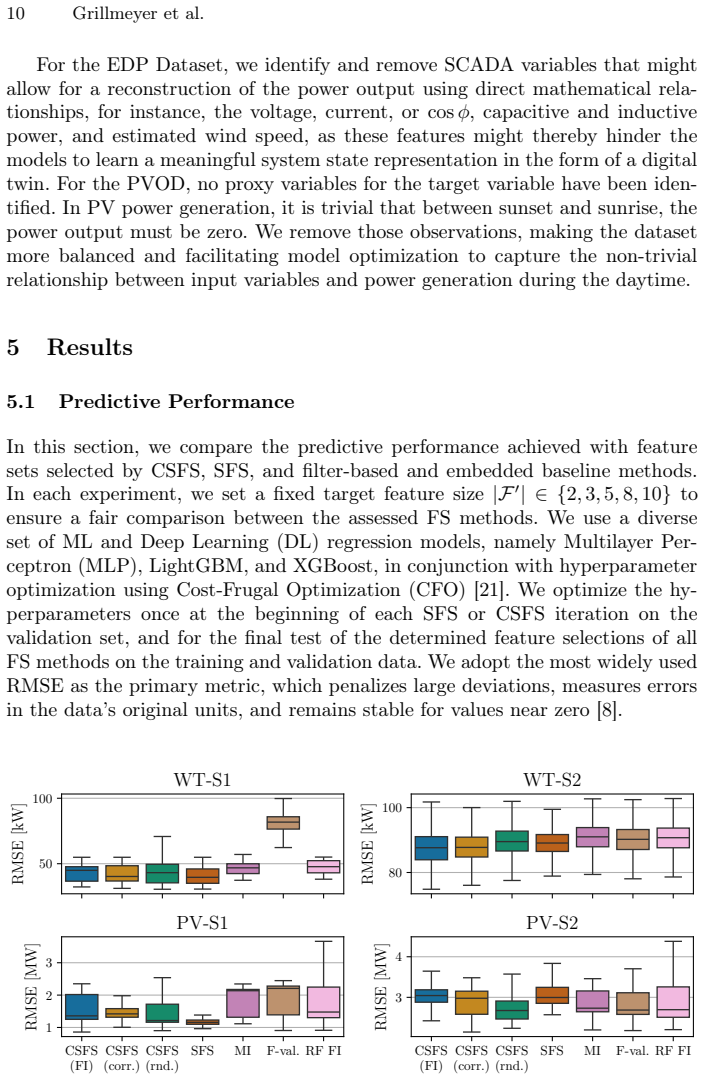
- [§5.1, §5.3, Table 1] The overall conclusion that 'wrapper-based methods overall provide better-performing selections' is contradicted by the PV-S2 scenario. In Fig. 3, PV-S2 shows MI, F-value, and RF FI achieving RMSE around 2.7 MW, comparable to or better than the wrapper methods, and Table 1 reports that the best PV-S2 feature set was found by F-value. The text acknowledges this in passing but does not qualify the global claim or test whether wrapper-vs-baseline differences are statistically significant. Since the paper's second central claim is 'comparable predictive performance' to SFS, the authors should report per-scenario statistical comparisons (e.g., confidence intervals or paired tests) and either restrict the 'wrapper methods better' conclusion to the larger S1 variants or explain the PV-S2 result.
minor comments (6)
- [§3.2 / Fig. 2] No pseudocode or formal algorithm description is provided for CSFS. The process diagram is helpful but insufficient; the safe-remove condition, cluster evaluation order, and force-remove fallback should be specified step-by-step.
- [§5.2] The 'enhanced SFS version that also uses the safe-remove shortcut' is introduced only in §5.1, while §3.2 describes SFS in its original form. This should be clarified earlier, since the comparison baseline is not the standard SFS.
- [§5.4] The statement that whole-cluster removal occurs in 29.5% of all CSFS iterations is not accompanied by a standard deviation or range across datasets and clustering methods. This figure is used to explain the runtime gains, so it should be reported per configuration.
- [Table 1] Some feature names are abbreviated inconsistently (e.g., 'Amb. Temp.', 'Turb. Int.', 'Grd. R. Inv. Ph.2 T.'), and the table does not indicate how ties or near-ties were resolved. A legend or full feature names would improve interpretability.
- [References] References [22] and [23] are identical; one should be removed or replaced with the correct original source for the WRF model.
- [§4.4] The cyclical encoding step says it is added 'for ANN models,' but the runtime comparison aggregates across all models. It would be helpful to state explicitly whether tree-based models received the same features without cyclical encoding or received raw time variables.
Circularity Check
No significant circularity: CSFS is empirically benchmarked against external baselines; self-citations are background only.
full rationale
The paper's central claim is that CSFS, a wrapper-based feature selection method, achieves predictive performance comparable to SFS while reducing runtime. This claim is supported by direct empirical comparison on held-out test data: RMSE values are reported for feature sets selected by CSFS, SFS, filter-based methods, and embedded RF importance, and runtimes are measured and compared in Section 5.2. No fitted parameter is renamed as a prediction, and no result is derived from its own definition or from a self-citation. Self-citations [7] (data leakage) and [8] (metric selection) are used to justify temporal splits and RMSE choice; they are methodological background, not load-bearing support for the proposed algorithm's efficiency or performance. The non-inferiority test in Section 3.2 is underspecified, and the reported '21%' average runtime reduction is inconsistent with the per-dataset numbers (19.4%, 9.3%, 25.3%, 39.8%; mean 23.45%) and with the '20.8%' in Section 5.4. These are important correctness/reproducibility concerns, but they are not circularity: the runtime and accuracy outcomes are measured, not constructed. Thus the derivation chain is self-contained with respect to circularity.
Assumptions & free parameters
free parameters (2)
- Non-inferiority margin / safety threshold
- Clustering configuration (e.g., correlation threshold)
assumptions (5)
- ad hoc to paper Features within a cluster are redundant enough that removing the whole cluster is equivalent to removing members individually
- domain assumption Backward sequential selection better captures joint feature utility than forward selection
- ad hoc to paper Non-inferiority test with unspecified margin correctly identifies removable features
- domain assumption Results from a single wind turbine and single PV station generalize to the domains
- domain assumption The berry-picking search (first 30 results from 11 queries) yields a representative literature sample
Cite this review
Pith. "Pith review of Improving Wind and Solar Power Prediction with Efficient Wrapper-based Feature Selection: An Empirical Study." pith.science (2026). https://pith.science/paper/2WIRAQMS
@misc{pith2026260714024,
  author       = {Pith},
  title        = {Pith review of: Improving Wind and Solar Power Prediction with Efficient Wrapper-based Feature Selection: An Empirical Study},
  year         = {2026},
  howpublished = {\url{https://pith.science/paper/2WIRAQMS}},
  note         = {Machine review of arXiv:2607.14024}
}
read the original abstract
With rising global energy demand and growing awareness of climate change and its impacts, the share of renewable energies in the global energy mix continues to grow. Unlike conventional power generation, the output of renewable energy sources cannot be controlled as consistently due to their dependence on environmental conditions. Therefore, reliable prediction of current and future energy production is essential. In this paper, we report findings from two structured literature reviews on real-world renewable energy prediction tasks: wind turbine power curve modeling and photovoltaic power prediction. For the former, we conducted a comprehensive literature review ourselves, while for the latter, we synthesize the key findings regarding frequently selected input features based on an existing survey. Across both domains, our analysis reveals that despite the large number of available monitoring and environmental variables, only limited or unsystematic methods for feature selection exist. To address this gap, we propose Cluster-based Sequential Feature Selection (CSFS), a novel, model-agnostic, clustering-based wrapper method for automatic, efficient, and reliable feature selection in renewable energy prediction pipelines. To support reproducibility and reuse, we provide an open-source implementation of CSFS on GitHub. We empirically evaluate the proposed approach on both use cases and compare it with established feature selection techniques such as wrapper-based sequential feature selection (SFS), filter-based methods, and Random Forest's embedded feature importance. The results show that the wrapper-based methods overall provide better-performing selections of features. CSFS achieves a predictive performance comparable to SFS while reducing computational cost by an average of 21%.
Figures


Figures from the paper (2 more)


Reference graph
Works this paper leans on
-
[1]
Machines9(5) (2021).https://doi.org/10.3390/ machines9050100
Astolfi, D.: Perspectives on scada data analysis methods for multivariate wind turbine power curve modeling. Machines9(5) (2021).https://doi.org/10.3390/ machines9050100
2021
-
[2]
Online Review13(5) (1989).https://doi.org/10.1108/ eb024320
Bates, M.J.: The design of browsing and berrypicking techniques for the on- line search interface. Online Review13(5) (1989).https://doi.org/10.1108/ eb024320
1989
-
[3]
IET Renewable Power Generation14(19) (2020)
Başaran, K., Bozyiğit, F., Siano, P., et al.: Systematic literature review of photo- voltaic output power forecasting. IET Renewable Power Generation14(19) (2020). https://doi.org/10.1049/iet-rpg.2020.0351
arXiv 2020
-
[4]
Dhal, P., Azad, C.: A comprehensive survey on feature selection in the various fields of machine learning. Appl. Intell.52(4) (2022).https://doi.org/10.1007/ S10489-021-02550-9 16 Grillmeyer et al
2022
-
[5]
10, 2025
EDP Group: Edp open data.https://www.edp.com/en/innovation/data(2018), accessed: Feb. 10, 2025
2018
-
[6]
In: Pattern Recognition in Practice IV, Machine Intelligence and Pattern Recognition, vol
Ferri, F.J., Pudil, P., Hatef, M., et al.: Comparative study of techniques for large- scale feature selection. In: Pattern Recognition in Practice IV, Machine Intelligence and Pattern Recognition, vol. 16. North-Holland (1994).https://doi.org/10. 1016/B978-0-444-81892-8.50040-7
1994
-
[7]
Grillmeyer, D., Hadry, M., Lesch, V., et al.: Quantifying data leakage in failure prediction tasks. In: Proceedings of the 16th ACM/SPEC International Conference on Performance Engineering (2025).https://doi.org/10.1145/3676151.3719368
arXiv 2025
-
[8]
In: Verdecchia, R., Trubiani, C., Calinescu, R., Verbanescu, A.L
Grillmeyer, D., Jahn, V., Hadry, M., Lesch, V., Kounev, S.: Principles over preferences: Quality-aware metric selection for machine learning systems. In: Verdecchia, R., Trubiani, C., Calinescu, R., Verbanescu, A.L. (eds.) Compan- ion of the 17th ACM/SPEC International Conference on Performance Engi- neering, ICPE Companion 2026, Florence, Italy, May 4-8,...
arXiv 2026
Show all 22 references
-
[9]
International Journal of Sustainable Engineering14(6) (2021).https://doi.org/ 10.1080/19397038.2021.1986590
Gupta, P., Singh, R.: PV power forecasting based on data-driven models: a review. International Journal of Sustainable Engineering14(6) (2021).https://doi.org/ 10.1080/19397038.2021.1986590
2021
-
[10]
Earthscan, 2nd edn
Hansen, M.O.L.: Aerodynamics of wind turbines. Earthscan, 2nd edn. (2008)
2008
-
[11]
Solar Energy73(3) (2002)
Ineichen, P., Perez, R.: A new airmass independent formulation for the Linke tur- bidity coefficient. Solar Energy73(3) (2002)
2002
-
[12]
International Renewable Energy Agency, Abu Dhabi (2025)
IRENA: Renewable energy statistics 2025. International Renewable Energy Agency, Abu Dhabi (2025)
2025
-
[13]
Patterns4(9) (2023).https://doi.org/10.1016/j
Kapoor, S., Narayanan, A.: Leakage and the reproducibility crisis in machine- learning-based science. Patterns4(9) (2023).https://doi.org/10.1016/j. patter.2023.100804
2023
-
[14]
Energies13(18) (2020).https://doi
Menezes, D., Mendes, M., Almeida, J.A., et al.: Wind Farm and Resource Datasets: A Comprehensive Survey and Overview. Energies13(18) (2020).https://doi. org/10.3390/en13184702
2020 doi
-
[15]
In: Developments in teracomputing
Michalakes, J., Chen, S., Dudhia, J., et al.: Development of a next-generation regional weather research and forecast model. In: Developments in teracomputing. World Scientific (2001)
2001
-
[16]
Energy Reports9(2023).https://doi.org/10.1016/j.egyr.2023.09.008
Paraschiv, S.: Analysis of the variability of low-carbon energy sources, nuclear technology and renewable energy sources, in meeting electricity demand. Energy Reports9(2023).https://doi.org/10.1016/j.egyr.2023.09.008
2023 doi
-
[17]
Journal of Machine Learning Research12(2011)
Pedregosa, F., Varoquaux, G., Gramfort, A., et al.: Scikit-learn: Machine learning in Python. Journal of Machine Learning Research12(2011)
2011
-
[18]
Solar Energy73(5) (2002)
Perez, R., Ineichen, P., Moore, K., et al.: A new operational model for satellite- derived irradiances: description and validation. Solar Energy73(5) (2002)
2002
-
[19]
Materials for Renewable and Sus- tainable Energy14(1) (2025).https://doi.org/10.1007/s40243-024-00292-5
Sharma, P., Mishra, R.K.: Comprehensive study on photovoltaic cell’s generation and factors affecting its performance: A Review. Materials for Renewable and Sus- tainable Energy14(1) (2025).https://doi.org/10.1007/s40243-024-00292-5
2025 doi
-
[20]
Renewable and Sustainable Energy Reviews20(2013)
Tyagi, V.V., Rahim, N.A.A., Rahim, N.A., et al.: Progress in solar PV technology: Research and achievement. Renewable and Sustainable Energy Reviews20(2013). https://doi.org/10.1016/j.rser.2012.09.028
2013 doi
-
[21]
In: Proceedings of the AAAI Conference on Artificial Intelligence
Wu, Q., Wang, C., Huang, S.: Frugal optimization for cost-related hyperparam- eters. In: Proceedings of the AAAI Conference on Artificial Intelligence. vol. 35 (2021) Performance-Driven Feature Selection for Renewable Energy Prediction 17
2021
-
[23]
Solar Energy230 (2021).https://doi.org/10.1016/j.solener.2021.09.050
Yao, T., Wang, J., Wu, H., et al.: A photovoltaic power output dataset: Multi- source photovoltaic power output dataset with Python toolkit. Solar Energy230 (2021).https://doi.org/10.1016/j.solener.2021.09.050
2021 doi
Reviewed August 2, 2026 · model on record in the stance chip above.
Discussion (0). Continue with ORCID to comment.