REVIEW 3 major objections 3 minor 34 references
This paper argues that desktop computer-use agents fail less from lack of model intelligence and more from a brittle motor interface, and introduces Tactile, an open tool layer that gives agents semantic, verifiable 'hands and feet' for des
Reviewed by Pith at T0; open to challenge. T0 means a machine referee read the full paper against a public rubric. the ladder, T0–T4 →
T0 review · deepseek-v4-flash
2026-08-02 02:04 UTC pith:HDGMSGM3
load-bearing objection A genuinely useful systems integration paper whose headline effect is real but whose cross-agent numbers are an oracle upper bound — worth refereeing, but only after a fixed-policy comparison is reported. the 3 major comments →
Tactile: Giving Computer-Using Agents Hands and Feet
The pith
A machine-rendered reading of the paper's core claim, the machinery that carries it, and where it could break.
Core claim
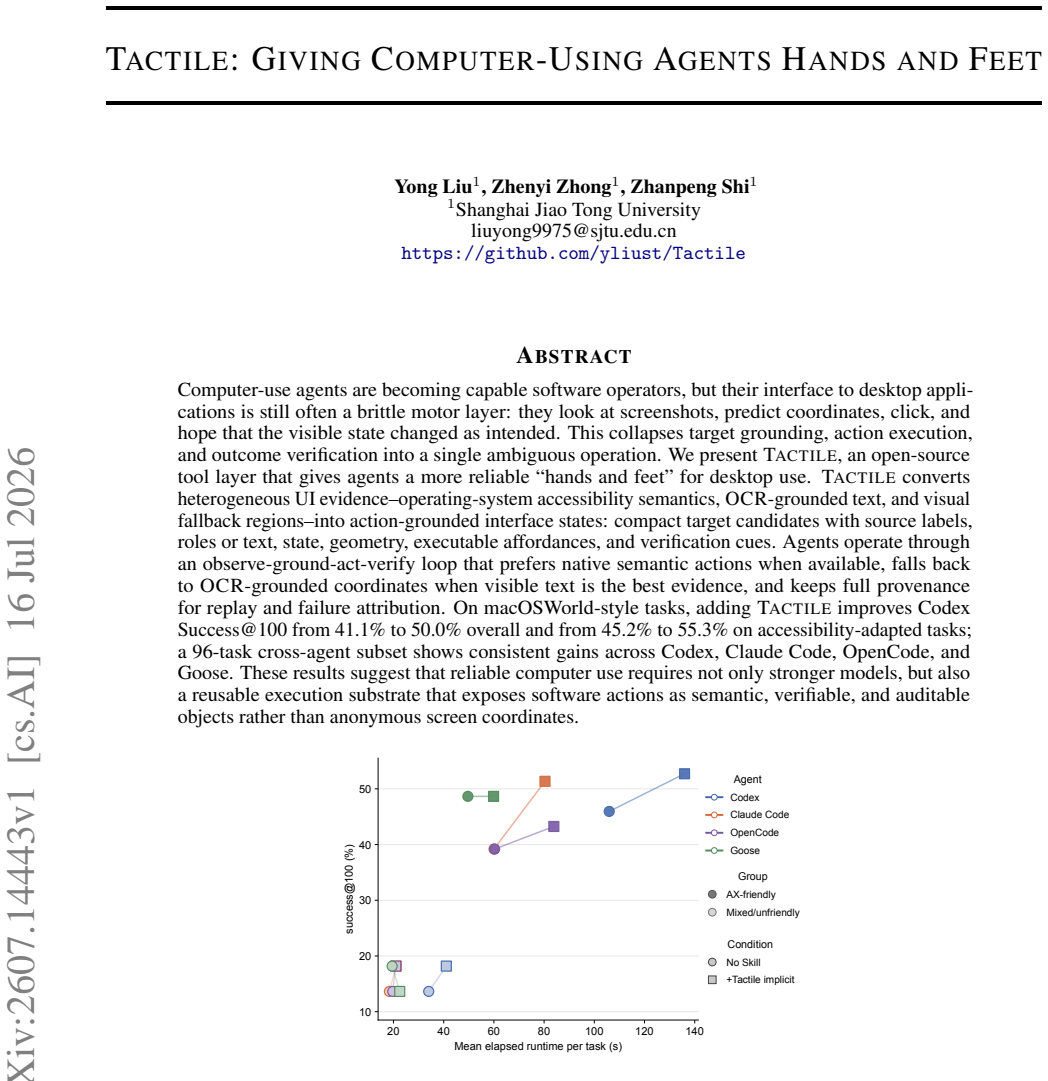
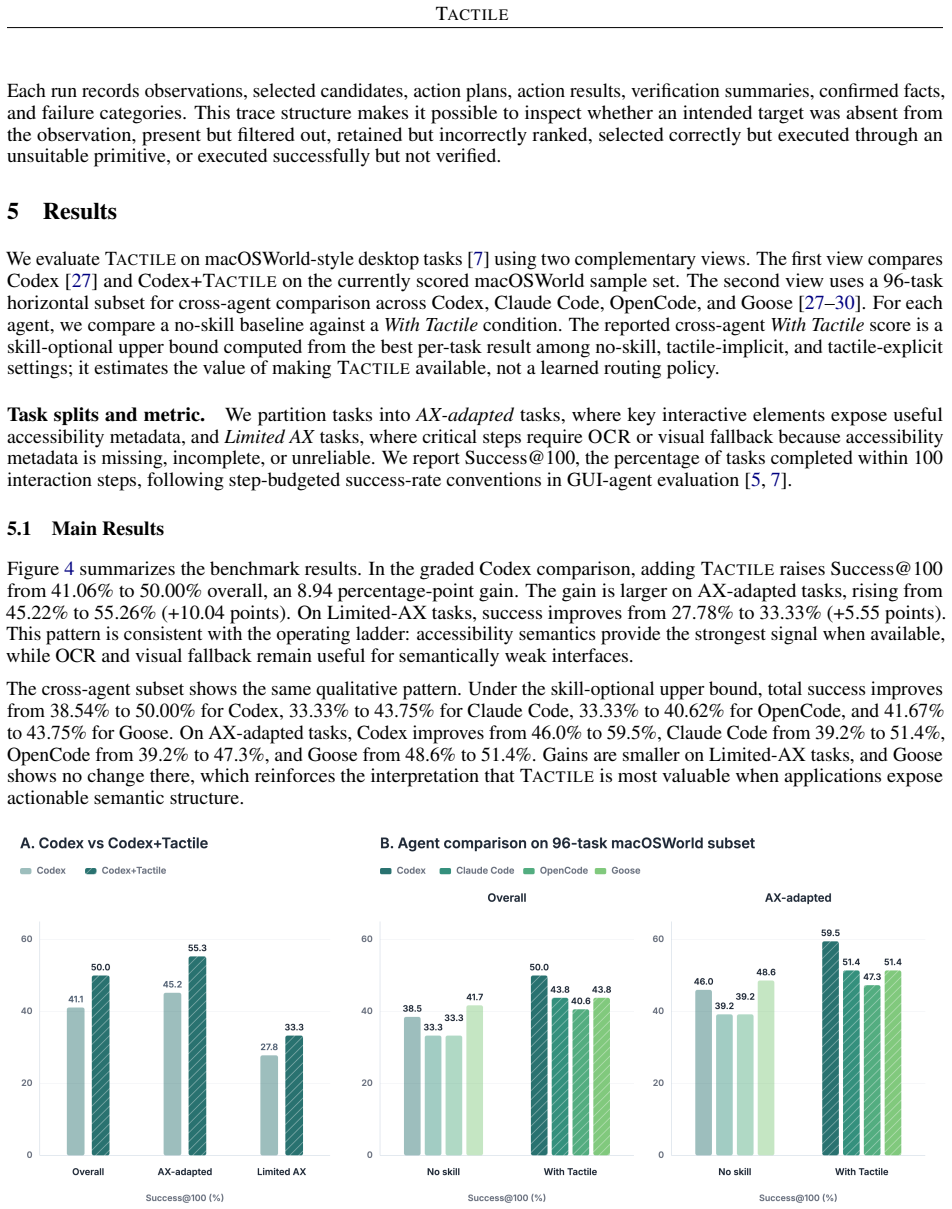
The central discovery is that separating target grounding, action execution, and outcome verification—and preferring accessibility semantics before OCR coordinates before visual fallback—improves grounded desktop operation across agents. Tactile compiles heterogeneous UI evidence into compact target candidates: each candidate carries source labels, role or text, state, geometry, executable affordances, and verification cues; agents choose candidates, and the runtime executes the safest primitive and re-observes to verify. The authors report that this raises Codex Success@100 from 41.1% to 50.0% overall, from 45.2% to 55.3% on accessibility-adapted tasks, and produces consistent gains on a 96
What carries the argument
The action-grounded interface state is the central object: a ranked set of target candidates built from accessibility elements, OCR lines, and visual regions, each with source labels, role/text, state, geometry, executable affordances, and provenance. The accessibility-first operating ladder orders evidence—Level 1 native accessibility semantics, Level 2 OCR-grounded coordinates, Level 3 visual fallback—so each step uses the richest available signal. The observe-ground-act-verify loop separates the four decisions that screenshot-first control collapses: collect evidence, select a candidate, execute the safest primitive (semantic action when available, coordinate click otherwise), and re-obse
Load-bearing premise
The reported gains are attributed to the semantic operating layer, but the cross-agent comparison uses a best-of-three upper bound with no uncertainty estimates, so the improvement could shrink if an agent must commit to a single policy in advance.
What would settle it
Re-run the 96-task cross-agent benchmark with a single pre-committed 'always use Tactile' policy and report confidence intervals; if the Codex gain collapses below noise or another agent's gain inverts, the claim of consistent gains from the semantic substrate would fail. Also verify whether the main Codex graded comparison uses the same upper-bound rule.
If this is right
- Adding Tactile raises Codex Success@100 from 41.1% to 50.0% overall and from 45.2% to 55.3% on accessibility-adapted tasks.
- Gains generalize across four different agents on a 96-task subset, with the largest improvements on tasks where applications expose useful accessibility metadata.
- Accessibility semantics provide the strongest action and verification contracts; OCR and visual fallback remain necessary for semantically opaque interfaces.
- Separating grounding from execution makes failures attributable: traces can show whether a target was absent, filtered, mis-ranked, mis-executed, or unverifiable.
- Because the same accessibility metadata serves screen-reader users and agents, improving human accessibility also improves agent operability.
Where Pith is reading between the lines
- The cross-agent 'With Tactile' score is a best-of-several-settings upper bound compared with a single no-skill baseline; a deployed agent that must commit to one policy in advance could see smaller, or in the weakest case negligible, gains.
- A direct test of the mechanism would compare Tactile against a control that normalizes coordinates and adds verification without semantic targets; if that control matches Tactile's gains, the accessibility-first ladder is not the active ingredient.
- The largest untested upside is policy learning: a router that decides per-step whether to invoke semantic, OCR, or visual tools could beat both the no-skill and always-Tactile baselines.
- Because the implementation is strongest on macOS with only early Windows support, the cross-platform claim is a design commitment, not yet an empirical result.
Editorial analysis
A structured set of objections, weighed in public.
Referee Report
Summary. The paper introduces TACTILE, an open-source MCP-compatible tool layer for macOS desktop agents. It converts accessibility-tree data, OCR text, and visual regions into a compact, action-grounded interface state, and wraps execution in an observe-ground-act-verify loop that prefers native semantic actions over coordinate clicks. The authors evaluate on macOSWorld-style tasks, reporting Success@100 gains for Codex (41.1% to 50.0% overall; 45.2% to 55.3% on accessibility-adapted tasks) and for a 96-task cross-agent subset across Codex, Claude Code, OpenCode, and Goose. The paper is candid that the cross-agent 'With Tactile' score is a skill-optional upper bound, and §5.3 and §7 list limitations including missing uncertainty estimates and the need for stronger baselines.
Significance. If the central causal claim is established, TACTILE would be a useful reusable execution substrate: it makes targetability, actionability, verifiability, and auditability first-class properties, and the accessibility-first ladder is a sensible design principle. The paper has real strengths: it is open-source, evaluated against an external benchmark, includes trace-based examples, and is unusually candid about its limitations. However, the current evidence does not yet support the strength of the abstract's claims because the cross-agent comparison uses an oracle-style upper bound and the main results lack uncertainty quantification.
major comments (3)
- [§5, cross-agent comparisons] The abstract and §5.1 present 'consistent gains across Codex, Claude Code, OpenCode, and Goose' as if they describe a deployable policy. But §5 states: 'The reported cross-agent With Tactile score is a skill-optional upper bound computed from the best per-task result among no-skill, tactile-implicit, and tactile-explicit settings.' Comparing this best-of-three score against a single no-skill baseline inflates the apparent gain by construction, because a real agent must commit to one policy before seeing the task. Please report a fixed-policy comparison and state explicitly whether the headline Codex numbers in §5.1 also use the upper-bound rule; if they do, the abstract's lead numbers are oracle upper bounds and must be labeled as such.
- [§5.1 / §5.3] No uncertainty estimates are reported anywhere. On the 96-task cross-agent subset, the Goose gain is +2.08 percentage points, which is approximately two tasks; without confidence intervals, a paired per-task analysis, or multiple seeds, the 'consistent gains' claim is not robustly supported. §5.3 defers uncertainty to future work, but the abstract states the improvements as definitive. At minimum, report Wilson intervals or bootstrap CIs for each Success@100 estimate and for the deltas, and state the number of tasks in each split.
- [§5, task splits] The partition into AX-adapted and Limited-AX tasks is introduced post hoc and is central to the mechanistic interpretation that accessibility semantics drive the gain. No independent criteria, annotation protocol, or reliability measure are given for this split. Because the headline effect is largest on the AX-adapted subset, the split should be specified before evaluating, or at least independently validated; otherwise the interpretation risks being shaped by the authors' own categorization of the same tasks used in the comparison.
minor comments (3)
- [§4.2] There is an unresolved 'Figure??' reference; the evidence-compiler figure is missing or its cross-reference is broken.
- [Abstract / §5.1] The abstract rounds 41.06% to 41.1% and 50.00% to 50.0%; this is fine, but the abstract omits the upper-bound caveat that the body applies to the cross-agent comparison. A one-sentence qualifier ('under a skill-optional upper-bound evaluation') would prevent over-reading.
- [§5.2] The Zoom trace example is informative, but no success/failure was reported for that specific trace. Stating whether the recorded trajectory completed the task would strengthen the illustrative value.
Circularity Check
Cross-agent 'consistent gains' reduce by construction: the With Tactile score is an oracle max that includes the no-skill baseline.
specific steps
-
fitted input called prediction
[§5 Results, first paragraph; §5.1 Main Results (cross-agent paragraph); Abstract]
"The reported cross-agent With Tactile score is a skill-optional upper bound computed from the best per-task result among no-skill, tactile-implicit, and tactile-explicit settings; it estimates the value of making TACTILE available, not a learned routing policy."
The candidate set used for the 'With Tactile' score includes the no-skill baseline itself, so the per-task maximum is, by construction, at least the no-skill score on every task. The reported 'gains' (e.g., 'total success improves from 38.54% to 50.00% for Codex ... 41.67% to 43.75% for Goose') and the abstract's claim of 'consistent gains across Codex, Claude Code, OpenCode, and Goose' are therefore mathematically guaranteed by the max operation, not empirical evidence that TACTILE adds value. The per-task best setting is fitted to the test data and then presented as the treatment condition's success rate, which is the fitted-input-called-prediction pattern.
full rationale
The paper is a systems-and-evaluation paper, not a formal derivation, and most of its content (tool design, MCP interface, coordinate contracts) is not circular. There are no load-bearing self-citations: the only external code acknowledgment (mediar-ai) is an implementation dependency, not a result used to justify the central claim. The main circularity is confined to the cross-agent evaluation protocol. The 'With Tactile' condition is an oracle upper bound that includes the baseline; hence the cross-agent 'consistent gains' headline is forced by construction and cannot serve as evidence for TACTILE's causal benefit. The paper is transparent about this in §5.3, noting the score is 'an upper bound rather than a learned routing policy,' but the abstract presents the cross-agent improvement as an empirical result without that caveat. The main Codex comparison (41.06% to 50.00%) is stated separately, and the paper does not explicitly say whether it uses the same upper-bound rule; if it is a fixed-policy comparison, that part is not circular, though its statistical support is thin and no uncertainty is reported. The AX-adapted task split is post hoc but not definitionally circular: it groups tasks by accessibility-metadata availability and then observes a larger gain there, which is a mechanism-consistent correlation rather than a result equivalent to its inputs. Overall, one of the paper's two headline claims (cross-agent consistent gains) reduces by construction, so a score of 6 is appropriate; the central Codex result may remain independently meaningful, preventing a higher score.
Axiom & Free-Parameter Ledger
free parameters (3)
- candidate ranking weights
- AX-adapted vs Limited-AX task partition =
post-hoc categorical split; per-group counts not reported
- skill-optional upper-bound selector =
max over {no-skill, implicit, explicit} per task
axioms (4)
- domain assumption macOS Accessibility API exposes faithful, actionable UI semantics (roles, names, states, actions) for AX-adapted tasks
- domain assumption OCR text positions and normalized coordinates map reliably to interactive targets
- domain assumption Success@100 on the currently graded macOSWorld sample set is a valid measure of computer-use agent capability
- domain assumption Baseline no-skill runs are representative of each agent's default ability on these tasks
invented entities (1)
-
action-grounded interface state (candidate targets with source labels, roles, state, geometry, affordances, verification cues)
independent evidence
read the original abstract
Computer-use agents are becoming capable software operators, but their interface to desktop applications is still often a brittle motor layer: they look at screenshots, predict coordinates, click, and hope that the visible state changed as intended. This collapses target grounding, action execution, and outcome verification into a single ambiguous operation. We present Tactile, an open-source tool layer that gives agents a more reliable "hands and feet" for desktop use. Tactile converts heterogeneous UI evidence--operating-system accessibility semantics, OCR-grounded text, and visual fallback regions--into action-grounded interface states: compact target candidates with source labels, roles or text, state, geometry, executable affordances, and verification cues. Agents operate through an observe-ground-act-verify loop that prefers native semantic actions when available, falls back to OCR-grounded coordinates when visible text is the best evidence, and keeps full provenance for replay and failure attribution. On macOSWorld-style tasks, adding Tactile improves Codex Success@100 from 41.1% to 50.0% overall and from 45.2% to 55.3% on accessibility-adapted tasks; a 96-task cross-agent subset shows consistent gains across Codex, Claude Code, OpenCode, and Goose. These results suggest that reliable computer use requires not only stronger models, but also a reusable execution substrate that exposes software actions as semantic, verifiable, and auditable objects rather than anonymous screen coordinates.
Figures


Reference graph
Works this paper leans on
-
[1]
Mind2Web: Towards a generalist agent for the web, 2023
Xiang Deng, Yu Gu, Boyuan Zheng, Shijie Chen, Samuel Stevens, Boshi Wang, Huan Sun, and Yu Su. Mind2Web: Towards a generalist agent for the web, 2023. URLhttps://arxiv.org/abs/2306.06070
Pith/arXiv arXiv 2023
-
[2]
GPT-4V(ision) is a generalist web agent, if grounded, 2024
Boyuan Zheng, Boyu Gou, Jihyung Kil, Huan Sun, and Yu Su. GPT-4V(ision) is a generalist web agent, if grounded, 2024. URLhttps://arxiv.org/abs/2401.01614
Pith/arXiv arXiv 2024
-
[3]
WebV oyager: Building an end-to-end web agent with large multimodal models, 2024
Hongliang He, Wenlin Yao, Kaixin Ma, Wenhao Yu, Yong Dai, Hongming Zhang, Zhenzhong Lan, and Dong Yu. WebV oyager: Building an end-to-end web agent with large multimodal models, 2024. URL https: //arxiv.org/abs/2401.13919
Pith/arXiv arXiv 2024
-
[4]
ScreenAgent: A vision language model-driven computer control agent, 2024
Runliang Niu, Jindong Li, Shiqi Wang, Yali Fu, Xiyu Hu, Xueyuan Leng, He Kong, Yi Chang, and Qi Wang. ScreenAgent: A vision language model-driven computer control agent, 2024. URL https://arxiv.org/abs/ 2402.07945
Pith/arXiv arXiv 2024
-
[5]
OSWorld: Benchmarking multimodal agents for open-ended tasks in real computer environments, 2024
Tianbao Xie, Danyang Zhang, Jixuan Chen, Xiaochuan Li, Siheng Zhao, Ruisheng Cao, Toh Jing Hua, Zhoujun Cheng, Dongchan Shin, Fangyu Lei, Yitao Liu, Yiheng Xu, Shuyan Zhou, Silvio Savarese, Caiming Xiong, Victor Zhong, and Tao Yu. OSWorld: Benchmarking multimodal agents for open-ended tasks in real computer environments, 2024. URLhttps://arxiv.org/abs/2404.07972
Pith/arXiv arXiv 2024
-
[6]
AndroidWorld: A dynamic benchmarking environment for autonomous agents, 2024
Christopher Rawles, Sarah Clinckemaillie, Yifan Chang, Jonathan Waltz, Gabrielle Lau, Marybeth Fair, Alice Li, William Bishop, Wei Li, Folawiyo Campbell-Ajala, Daniel Toyama, Robert Berry, Divya Tyamagundlu, Timothy Lillicrap, and Oriana Riva. AndroidWorld: A dynamic benchmarking environment for autonomous agents, 2024. URLhttps://arxiv.org/abs/2405.14573
Pith/arXiv arXiv 2024
-
[7]
macOSWorld: A multilingual interactive benchmark for gui agents,
Pei Yang, Hai Ci, and Mike Zheng Shou. macOSWorld: A multilingual interactive benchmark for gui agents,
-
[8]
SeeClick: Harnessing gui grounding for advanced visual gui agents, 2024
Kanzhi Cheng, Qiushi Sun, Yougang Chu, Fangzhi Xu, Yantao Li, Jianbing Zhang, and Zhiyong Wu. SeeClick: Harnessing gui grounding for advanced visual gui agents, 2024. URL https://arxiv.org/abs/2401.10935
Pith/arXiv arXiv 2024
-
[9]
OmniParser for pure vision based gui agent,
Yadong Lu, Jianwei Yang, Yelong Shen, and Ahmed Awadallah. OmniParser for pure vision based gui agent,
-
[10]
Accessibility programming guide for OS X
Apple Developer Documentation. Accessibility programming guide for OS X. https://developer.apple. com/library/archive/documentation/Accessibility/Conceptual/AccessibilityMacOSX/ , 2015. Apple Documentation Archive; accessed 2026-06-29
2015
-
[11]
The OS X accessibility model
Apple Developer Documentation. The OS X accessibility model. https://developer.apple.com/ library/archive/documentation/Accessibility/Conceptual/AccessibilityMacOSX/OSXAXmodel. html, 2015. Apple Documentation Archive; accessed 2026-06-29
2015
-
[12]
AXUIElement.h
Apple Developer Documentation. AXUIElement.h. https://developer.apple.com/documentation/ applicationservices/axuielement_h, 2026. Apple Developer Documentation; accessed 2026-06-29
2026
-
[13]
AXUIElementPerformAction(_:_:)
Apple Developer Documentation. AXUIElementPerformAction(_:_:). https://developer.apple.com/ documentation/applicationservices/1462091-axuielementperformaction, 2026. Apple Developer Documentation; accessed 2026-06-29
arXiv 2026
-
[14]
UI Automation Overview
Microsoft Learn. UI Automation Overview. https://learn.microsoft.com/en-us/windows/win32/ winauto/uiauto-uiautomationoverview, 2025. Win32 apps documentation, updated 2025-07-14; accessed 2026-06-29
2025
-
[15]
UI Automation Control Patterns Overview
Microsoft Learn. UI Automation Control Patterns Overview. https://learn.microsoft.com/en-us/ windows/win32/winauto/uiauto-controlpatternsoverview, 2025. Win32 apps documentation; accessed 2026-06-29
2025
-
[16]
Web content accessibility guidelines (WCAG) 2.2
World Wide Web Consortium. Web content accessibility guidelines (WCAG) 2.2. https://www.w3.org/TR/ WCAG22/, 2024. W3C Recommendation, 12 December 2024; accessed 2026-06-29
2024
-
[17]
Accessible rich internet applications (W AI-ARIA) 1.2.https://www.w3.org/ TR/wai-aria-1.2/, 2023
World Wide Web Consortium. Accessible rich internet applications (W AI-ARIA) 1.2.https://www.w3.org/ TR/wai-aria-1.2/, 2023. W3C Recommendation, 6 June 2023; accessed 2026-06-29
2023
-
[18]
Screen2AX: Vision-based approach for automatic macos accessibility generation, 2025
Viktor Muryn, Marta Sumyk, Mariya Hirna, Sofiya Garkot, and Maksym Shamrai. Screen2AX: Vision-based approach for automatic macos accessibility generation, 2025. URLhttps://arxiv.org/abs/2507.16704
Pith/arXiv arXiv 2025
-
[19]
Model context protocol specification
Model Context Protocol. Model context protocol specification. https://modelcontextprotocol.io/ specification/2025-11-25, 2025. Version 2025-11-25; accessed 2026-06-29
2025
-
[20]
Model context protocol: Server tools specification
Model Context Protocol. Model context protocol: Server tools specification. https://modelcontextprotocol. io/specification/2025-11-25/server/tools, 2025. Version 2025-11-25; accessed 2026-06-29. 10 TACTILE
2025
-
[21]
ReAct: Synergizing reasoning and acting in language models, 2022
Shunyu Yao, Jeffrey Zhao, Dian Yu, Nan Du, Izhak Shafran, Karthik Narasimhan, and Yuan Cao. ReAct: Synergizing reasoning and acting in language models, 2022. URLhttps://arxiv.org/abs/2210.03629
Pith/arXiv arXiv 2022
-
[22]
UI-TARS: Pioneering automated GUI interaction with native agents, 2025
Yujia Qin, Yining Ye, Junjie Fang, Haoming Wang, Shihao Liang, Shizuo Tian, Junda Zhang, Jiahao Li, Yunxin Li, Shijue Huang, Wanjun Zhong, Kuanye Li, Jiale Yang, Yu Miao, Woyu Lin, Longxiang Liu, Jiang Xu, Qianli Ma, Jingyu Li, Xiaojun Xiao, Kai Cai, Chuang Li, Yaowei Zheng, Chaolin Jin, Chen Li, Xiao Zhou, Minchao Wang, Haoli Chen, Zhaojian Li, Haihua Li...
Pith/arXiv arXiv 2025
-
[23]
CUA-Skill: Develop skills for computer using agent, 2026
Tianyi Chen, Yinheng Li, Michael Solodko, Sen Wang, Nan Jiang, Tingyuan Cui, Junheng Hao, Jongwoo Ko, Sara Abdali, Qing Xiao, Leon Xu, Suzhen Zheng, Hao Fan, Pashmina Cameron, Justin Wagle, and Kazuhito Koishida. CUA-Skill: Develop skills for computer using agent, 2026. URLhttps://arxiv.org/abs/2601.21123
arXiv 2026
-
[24]
ScreenCaptureKit
Apple Developer Documentation. ScreenCaptureKit. https://developer.apple.com/documentation/ screencapturekit, 2026. Apple Developer Documentation; accessed 2026-06-29
2026
-
[25]
RecognizeTextRequest.https://developer.apple.com/documentation/ vision/recognizetextrequest, 2026
Apple Developer Documentation. RecognizeTextRequest.https://developer.apple.com/documentation/ vision/recognizetextrequest, 2026. Apple Developer Documentation; accessed 2026-06-29
2026
-
[26]
Quartz Event Services
Apple Developer Documentation. Quartz Event Services. https://developer.apple.com/documentation/ coregraphics/quartz-event-services, 2026. Apple Developer Documentation; accessed 2026-06-29
2026
-
[27]
Codex CLI
OpenAI. Codex CLI. https://developers.openai.com/codex/cli, 2026. OpenAI developer documenta- tion; accessed 2026-06-29
2026
-
[28]
Claude Code
Anthropic. Claude Code. https://claude.com/product/claude-code , 2026. Product documentation; accessed 2026-06-29
2026
-
[29]
OpenCode: The open source ai coding agent
OpenCode Project. OpenCode: The open source ai coding agent. https://opencode.ai/ , 2026. Project documentation; accessed 2026-06-29
2026
-
[30]
goose: Your open source ai agent
goose Project. goose: Your open source ai agent. https://goose-docs.ai/, 2026. Project documentation; accessed 2026-06-29
2026
-
[31]
Rethinking irregular scene text recognition, 2019
Shangbang Long, Yushuo Guan, Bingxuan Wang, Kaigui Bian, and Cong Yao. Rethinking irregular scene text recognition, 2019. URLhttps://arxiv.org/abs/1908.11834
Pith/arXiv arXiv 2019
-
[32]
mcp-server-macos-use
mediar-ai. mcp-server-macos-use. https://github.com/mediar-ai/mcp-server-macos-use , 2026. GitHub repository; accessed 2026-06-29. 11
2026
-
[2024]
URLhttps://arxiv.org/abs/2408.00203
-
[2025]
URLhttps://arxiv.org/abs/2506.04135
discussion (0)
Sign in with ORCID, Apple, or X to comment. Anyone can read and Pith papers without signing in.