REVIEW 3 major objections 6 minor 18 references
This paper argues that training with an alternating clean/noisy epoch schedule improves clean, corrupted, and out-of-distribution test accuracy at essentially zero computational cost.
Reviewed by Pith at T0; open to challenge. T0 means a machine referee read the full paper against a public rubric. the ladder, T0–T4 →
T0 review · deepseek-v4-flash
2026-08-02 01:59 UTC pith:5DY22L7C
load-bearing objection A useful empirical paper on interleaved noise schedules, with a shaky theoretical section that should be fixed or de-emphasized. the 3 major comments →
Interleaved Noise Injection Improves Clean, Corrupted, and OOD Performance
The pith
A machine-rendered reading of the paper's core claim, the machinery that carries it, and where it could break.
Core claim
Training a model on clean data for most epochs and replacing a few epochs with heavily corrupted (impulse or Gaussian) inputs—in a square-wave on/off pattern—improves final test accuracy on clean data, on corrupted data, and on out-of-distribution data, compared with training only on clean data or with any monotonic noise schedule. The paper shows this across WideResNet/CIFAR-100, ResNet-50/ImageNet, and ViT/ImageNet, and shows the gains stack on top of existing augmentations (Cutout, SAM, AugMix, VIPAug). The explanation offered is two-part: the noise acts as an input-space regularizer—impulse noise approximating Jacobian regularization and Gaussian noise a curvature penalty—and the alterna
What carries the argument
The engine of the method is a square-wave schedule that alternates P clean epochs with L noisy epochs, so noise is switched on and off rather than decayed. Around that schedule, the paper builds a gradient-norm stabilization rule that rescales each noisy update by the ratio of the last clean gradient norm to the noisy gradient norm, preventing the large loss spikes on corrupted inputs from destabilizing training. The theoretical section expands the loss around the clean sample to second order: impulse noise contributes a Jacobian-norm term plus a Hessian-diagonal (curvature) term, while Gaussian noise contributes only the curvature term. That expansion connects the empirically chosen schedul
Load-bearing premise
The paper's claim that impulse noise regularization is equivalent to Jacobian regularization rests on dropping off-diagonal second-order loss terms because mask entries are independent; at the largest noise levels used, those terms are not negligible, so the stated theoretical mechanism is the fragile link.
What would settle it
A controlled comparison of interleaved noise, shuffled noise epochs, and one contiguous noisy block with identical total noise exposure and training budget would settle whether the alternation itself matters. On the theory side, recomputing the expected second-order term without dropping Hessian off-diagonals for a small batch, at the paper's largest noise level, would test whether impulse noise really reduces to a Jacobian-plus-curvature penalty.
If this is right
- Training only on clean data leaves a measurable accuracy improvement on the table: adding periodic noisy epochs raises clean test accuracy despite seeing clean data for fewer epochs.
- Interleaved noise can be layered on top of Cutout, SAM, AugMix, or VIPAug to improve clean, corruption, and OOD error further, with negligible added cost.
- Noise distribution should be chosen to counter the model's inductive bias: impulse noise for convolutional architectures, Gaussian for attention-based architectures.
- The benefit extends beyond the training distribution: models improve on CIFAR-100-C, ImageNet-C, and ImageNet-R, including structural corruption not containing noise.
- Monotonic and curriculum noise schedules are dominated by interleaving on both clean and noisy accuracy, suggesting schedule design should be revisited in other stochastic-optimization settings.
Where Pith is reading between the lines
- Beyond the paper: if the mechanism is repeated escape from sharp minima, the optimal interleaving period P should scale with landscape roughness; one could test this by measuring loss sharpness along training and adapting P online.
- Beyond the paper: because the Taylor-expansion derivation drops off-diagonal Hessian terms that are not negligible at the noise levels used, the theoretical identification of impulse noise with Jacobian regularization is not fully established; the empirical gains could come primarily from optimization dynamics rather than explicit input regularization.
- Beyond the paper: the architecture-specific noise preference suggests a general heuristic for choosing augmentation corruption type based on the model's feature spectrum, which could extend to other architectures or data modalities.
- Beyond the paper: the square-wave schedule is a special case of periodically modulating optimization noise; testing it in settings like language-model fine-tuning or reinforcement learning, where catastrophic forgetting is a concern, would probe whether the mechanism transfers.
Editorial analysis
A structured set of objections, weighed in public.
Referee Report
Summary. The paper proposes an interleaved noise-injection curriculum: training alternates P clean epochs with L noisy (impulse or Gaussian) epochs, stabilized by a gradient-norm rescaling factor f. The authors report that this schedule improves clean test accuracy relative to clean-only training, and also improves corrupted and out-of-distribution performance on CIFAR-100-C, ImageNet-C, and ImageNet-R for WideResNet, ResNet50, and ViT, both alone and stacked on Cutout, SAM, VIPAug, and AugMix. A second-order Taylor analysis is presented to claim that impulse noise approximates Jacobian regularization and Gaussian noise induces curvature regularization. The paper also reports an architecture-dependent preference: convolutional models benefit more from impulse noise, ViTs more from Gaussian noise, and interprets this via inductive biases.
Significance. The empirical contribution is potentially valuable: a cheap, model-agnostic training schedule that consistently improves clean, corrupted, and OOD metrics across two datasets, three architectures, and four strong baselines, with 5-seed averages and bootstrap errors, is worth publishing if the claims hold. The method is orthogonal to existing regularizers and can be stacked. However, the theoretical mechanism claimed in the abstract and Section 3.1.1 is not established because the derivation drops off-diagonal Hessian terms on incorrect grounds, and the interleaved schedule itself is not derived from the theory but proposed and then rationalized. The empirical results may stand, but the paper's stated theoretical contribution overreaches.
major comments (3)
- [§3.1.1, Eq. (5) and footnote 1] The derivation drops all off-diagonal second-order terms from the Taylor expansion, with the justification that 'the off-diagonal second-order terms scale as σ_t² compared to linear scaling with σ_t of the diagonal terms' and that 'for large enough batch sizes, the off-diagonal terms vanish in expectation.' This is incorrect: independence of mask entries gives E[m_i m_j] = σ_t² for i ≠ j, not zero, and this expectation does not shrink with batch size; only the Monte-Carlo variance of estimating it does. At the maximum σ_t = 0.65 used in the paper, σ_t² = 0.42, which is the same order as the retained O(σ_t) terms. The omitted pairwise Hessian terms can be positive or negative and are not negligible a priori. Consequently, the central theoretical claim that impulse noise 'approximates a Jacobian regularization' (Abstract, §7) is not supported by Eq. (5). The authors should either derive th
- [§4 and §5.3] The paper states the method requires only 'minimal hyperparameter tuning' and that the authors 'explicitly avoid a large hyperparameter sweep,' yet the headline choices f = 0.4 and P = 5 are selected after ablations shown in §5.3.1 and §5.3.3 that maximize the reported clean accuracy. Similarly, the architecture-specific noise preference (impulse for ResNet, Gaussian for ViT) is identified post hoc from the same tables and then explained in §6.2. This is not fatal to the empirical claims, but it undermines the claim that the theory or a principled schedule predicts these outcomes. The authors should either provide a validation-based selection protocol (e.g., choosing f and P on a held-out split before evaluating on test) or tone down the claims of principled prediction. As written, the risk of benchmark overfitting is not addressed.
- [§5.1, Figure 1] The load-bearing assertion 'Training with interleaved noise improves long-term clean test accuracy beyond training on clean data only' is illustrated in Figure 1 with a single optimization run and no error bars, using P = 10, L = 5. The later tabulated results (Table 1) support the claim with multiple seeds, but only for P = 5, L = 1. Since Section 5.1 is cited as the main empirical evidence, the authors should report seed-averaged curves or at least acknowledge that Figure 1 is illustrative only; Table 1 should be the primary evidence.
minor comments (6)
- [Footnote 1] The phrasing 'for large enough batch sizes, the off-diagonal terms vanish in expectation' is mathematically wrong as noted above. Even if the authors intend to appeal to a variance argument, the sentence should be corrected to avoid claiming the expectation itself vanishes.
- [Abstract / §4] The claim 'essentially zero computational cost' should be qualified: computing the clean gradient norm and rescaling in Eq. (11) adds a small but nonzero overhead (e.g., an extra norm computation per epoch). The paper later says this is the only extra cost; it would be clearer to state this in the abstract.
- [§4, last paragraph] 'We explicitly avoid a large hyperparameter sweep...' conflicts with the ablations in §5.3, which do sweep f and P. Please rephrase to clarify that the main results use fixed, pre-chosen values while ablations probe sensitivity.
- [Table 1 caption] The caption says improvements are shown in green and regressions in red, but the printed table does not include colors. State explicitly that parenthetical differences denote changes relative to the baseline.
- [Figure 5] The top-left panel labeled 'linear noise decay' is unclear: is this an interleaved schedule with decaying noise amplitude, or a non-interleaved baseline? Please clarify in the caption or text.
- [§5.3.1, Table 3] The text says 'we find a gradient-norm scaling factor of roughly f ≈ 0.4 performs best across all noise levels in terms of clean accuracy,' but in Table 3, f = 0.2 and f = 0.4 have similar clean error for Gaussian (25.0 vs 24.9), and the differences are within bootstrap errors. Please qualify or provide a significance test.
Circularity Check
No significant circularity: the central empirical claims rest on external benchmark comparisons, and the theory, though flawed in its off-diagonal Hessian treatment, is not a circular reduction.
full rationale
The paper's central empirical claim—interleaved noise injection improves clean, corrupted, and OOD test performance—is supported by direct training comparisons on external benchmarks (CIFAR-100-C, ImageNet-C, ImageNet-R). No step in the derivation chain makes the conclusion an input by construction: the interleaved schedule is defined independently, the reported gains are measured, and the theoretical Section 3.1.1 derives the regularizer terms from a Taylor expansion of the corrupted loss. That expansion, while claimed to 'confirm' the Jacobian-regularization mechanism, is an independent mathematical statement, not a citation of the paper's own conclusion. The hyperparameter choices f=0.4 and P=5 are selected by ablations, but the paper discloses this ('For all reported results we use the gradient norm scaling factor f = 0.4, which was approximately the best performing trial in each case'; 'we chose P based on the strongest performance on the clean data'), and the method is robust over f∈[0.2,0.8] and P∈[5,10]. This is hyperparameter selection, not a fitted quantity renamed as a prediction. The architecture-specific noise preference in Section 6.2 is a post-hoc interpretation of measured results, not a load-bearing derivation. The notable flaw is the footnote to Eq. (5): the claim that 'for large enough batch sizes, the off-diagonal terms vanish in expectation' is mathematically incorrect, since independence of mask entries gives E[m_i m_j]=σ_t² for i≠j, so the off-diagonal expectation does not vanish with batch size. But this is a correctness risk in the explanatory theory, not a circularity: the empirical results do not depend on the dropped terms, and no prediction reduces to a self-citation or to a fitted input. No self-citation chain is load-bearing. Therefore no significant circularity is found.
Axiom & Free-Parameter Ledger
free parameters (3)
- gradient-norm scaling factor f =
0.4
- interleaved period P =
5
- noise level sigma_t =
not specified for main results
axioms (4)
- standard math Second-order Taylor expansion of the loss around the clean input is adequate
- ad hoc to paper Off-diagonal second-order terms vanish in expectation because mask entries are independent
- domain assumption The same scalar f=0.4 and period P=5 transfer across datasets, architectures, and baselines
- domain assumption The noise perturbation delta is independent of the network parameters and the clean-loss Taylor expansion around x is valid
Cite this review
Pith. "Pith review of Interleaved Noise Injection Improves Clean, Corrupted, and OOD Performance." pith.science (2026). https://pith.science/paper/5DY22L7C
@misc{pith2026260714466,
  author       = {Pith},
  title        = {Pith review of: Interleaved Noise Injection Improves Clean, Corrupted, and OOD Performance},
  year         = {2026},
  howpublished = {\url{https://pith.science/paper/5DY22L7C}},
  note         = {Machine review of arXiv:2607.14466}
}
read the original abstract
Noise injection is a well-known technique in stochastic optimization. We report its surprising effectiveness with an interleaved (on-off-on-off...) rather than the usual monotonic decay schedule. We present a theoretical analysis of noise injection, which confirms that corruption by impulse noise approximates a Jacobian regularization, whereas Gaussian noise acts as a curvature penalty. This regularization behavior has been invoked to explain why noise injection increases model robustness. But the interleaved nature of our proposed schedule produces superior results even for the optimization objective: mixing phases of noisy data permits the optimizer to escape local minima and increase exploration without the risk of catastrophically forgetting the important features from the clean data. To stabilize this training scheme against the rapid changes of the loss when switching between clean and noisy data, we introduce a gradient-norm stabilization technique that scales noisy updates based on clean gradient magnitudes. We compare this method with other common augmentation methods and find substantial improvements in corruption tolerance and robustness to real-world distribution shifts on CIFAR-100-C, ImageNet-C, and ImageNet-R for ResNet and ViT architectures, with the best results being achieved by stacking our method on top of other augmentations. Through saliency and attention maps we show that the effect of interleaved noise injection stems from penalizing the failure modes encouraged by the inductive bias of the models: impulse noise works against the locality bias of convolutional (ResNet) architectures, and Gaussian noise reduces the tendency of attention-based models to pick up large-scale spurious features. Interleaved noise injection is therefore an effective tool to improve the test performance on clean, noisy, and out-of-distribution data at essentially zero computational cost.
Figures




Reference graph
Works this paper leans on
-
[3]
Gaussian noise Impulse noise period (P)n inj Clean mCE Struct
Noteninj denotes the total amount of noise injections during the 100 epoch training run. Gaussian noise Impulse noise period (P)n inj Clean mCE Struct. Clean mCE Struct. 0 10043.4±.1 50.7±.1 51.9±.1 42.0±.1 56.0±.2 50.0±.1 1 5028.3±.242.3±.2 41.5±.225.3±.248.8±.2 42.3±.2 2 3326.0±.1 43.9±.2 41.7±.1 25.3±.1 49.0±.1 42.5±.2 5 2025.0±.1 46.3±.1 42.8±.124.9±....
2025
-
[6]
URL https: //link.aps.org/doi/10.1103/PhysRevE.100.053309
doi: 10.1103/PhysRevE.100.053309. URL https: //link.aps.org/doi/10.1103/PhysRevE.100.053309. Yulu Gan and Phillip Isola. Neural thickets: Diverse task experts are dense around pretrained weights.arXiv preprint arXiv:2603.12228,
-
[8]
Dan Hendrycks and Thomas Dietterich. Benchmarking neural network robustness to common corruptions and perturbations.arXiv preprint arXiv:1903.12261,
Pith/arXiv arXiv 1903
-
[9]
Dan Hendrycks, Norman Mu, Ekin D Cubuk, Barret Zoph, Justin Gilmer, and Balaji Lakshminarayanan. Augmix: A simple data processing method to improve robustness and uncertainty.arXiv preprint arXiv:1912.02781,
Pith/arXiv arXiv 1912
-
[10]
Robust learning with jacobian regularization.arXiv preprint arXiv:1908.02729,
Judy Hoffman, Daniel A Roberts, and Sho Yaida. Robust learning with jacobian regularization.arXiv preprint arXiv:1908.02729,
Pith/arXiv arXiv 1908
-
[14]
Wide residual networks.arXiv preprint arXiv:1605.07146,
Sergey Zagoruyko and Nikos Komodakis. Wide residual networks.arXiv preprint arXiv:1605.07146,
-
[17]
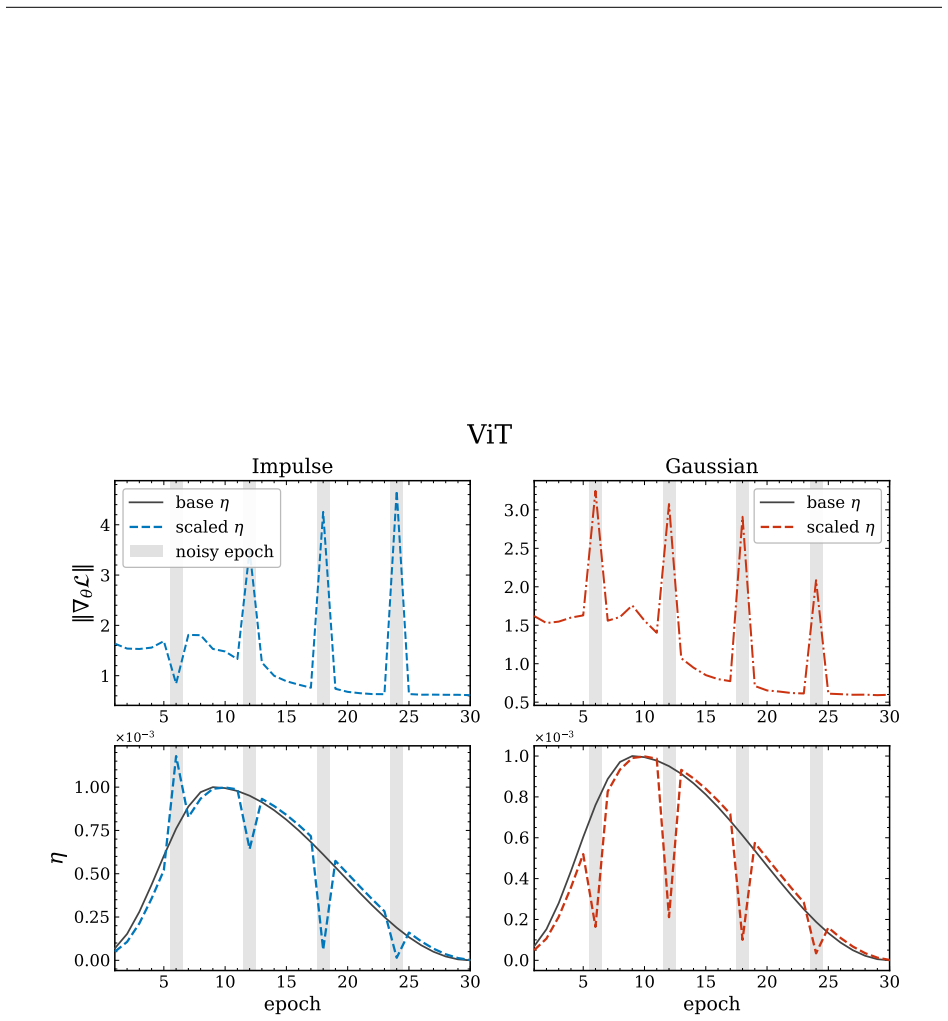
We observe similar spiking when using a ViT for ImageNet-1k, and a WideResNet on CIFAR-100 which we show in Figure 9 and Figure 10 in the appendix. 10 20 30 40 50 2 3 4 5 6 Impulse base scaled noisy epoch 10 20 30 40 50 2.0 2.5 3.0 3.5 Gaussian base scaled 10 20 30 40 50 epoch 0.00 0.02 0.04 0.06 0.08 0.10 10 20 30 40 50 epoch 0.00 0.02 0.04 0.06 0.08 0.1...
2019
-
[1997]
Locality-Attending Vision Transformer.arXiv e-prints, art
Sina Hajimiri, Farzad Beizaee, Fereshteh Shakeri, Christian Desrosiers, Ismail Ben Ayed, and Jose Dolz. Locality-Attending Vision Transformer.arXiv e-prints, art. arXiv:2603.04892, March
-
[2009]
Association for Computing Machinery. ISBN 9781605585161. doi: 10.1145/1553374.1553380. URLhttps://doi.org/10.1145/1553374.1553380. James Bradbury, Roy Frostig, Peter Hawkins, Matthew James Johnson, Chris Leary, Dougal Maclaurin, George Necula, Adam Paszke, Jake VanderPlas, Skye Wanderman-Milne, and Qiao Zhang. JAX: composable transformations of Python+Num...
-
[2010]
Jingfeng Wu, Difan Zou, Vladimir Braverman, and Quanquan Gu. Direction matters: On the implicit bias of stochastic gradient descent with moderate learning rate.arXiv preprint arXiv:2011.02538,
Pith/arXiv arXiv 2011
-
[2016]
A Novel Noise Injection-based Training Scheme for Better Model Robustness.arXiv e-prints, art
Zeliang Zhang, Jinyang Jiang, Minjie Chen, Zhiyuan Wang, Yijie Peng, and Zhaofei Yu. A Novel Noise Injection-based Training Scheme for Better Model Robustness.arXiv e-prints, art. arXiv:2302.10802, February
-
[2017]
Alexey Dosovitskiy, Lucas Beyer, Alexander Kolesnikov, Dirk Weissenborn, Xiaohua Zhai, Thomas Unterthiner, Mostafa Dehghani, Matthias Minderer, Georg Heigold, Sylvain Gelly, et al. An image is worth 16x16 words: Transformers for image recognition at scale.arXiv preprint arXiv:2010.11929,
Pith/arXiv arXiv 2010
-
[2018]
Alvin Chan, Yi Tay, Yew Soon Ong, and Jie Fu
URLhttp://github.com/jax-ml/jax. Alvin Chan, Yi Tay, Yew Soon Ong, and Jie Fu. Jacobian adversarially regularized networks for robustness. arXiv preprint arXiv:1912.10185,
Pith/arXiv arXiv 1912
-
[2019]
Terrance DeVries and Graham W Taylor. Improved regularization of convolutional neural networks with cutout.arXiv preprint arXiv:1708.04552,
-
[2021]
Pierre Foret, Ariel Kleiner, Hossein Mobahi, and Behnam Neyshabur. Sharpness-aware minimization for efficiently improving generalization.arXiv preprint arXiv:2010.01412,
Pith/arXiv arXiv 2010
-
[2023]
A Novel Noise Injection-based Training Scheme for Better Model Robustness
doi: 10.48550/arXiv.2302.10802. Richard M Zur, Yulei Jiang, Lorenzo L Pesce, and Karen Drukker. Noise injection for training artificial neural networks: A comparison with weight decay and early stopping.Medical physics, 36(10):4810–4818,
work page internal anchor Pith review Pith/arXiv arXiv doi:10.48550/arxiv.2302.10802
-
[2024]
Noise injection node regularization for robust learning.arXiv preprint arXiv:2210.15764,
Noam Levi, Itay M Bloch, Marat Freytsis, and Tomer Volansky. Noise injection node regularization for robust learning.arXiv preprint arXiv:2210.15764,
-
[2025]
Enzo Marinari and Giorgio Parisi
doi: 10.1038/s41467-025-58532-9. Enzo Marinari and Giorgio Parisi. Simulated tempering: a new monte carlo scheme.Europhysics letters, 19 (6):451,
discussion (0)
Sign in with ORCID, Apple, or X to comment. Anyone can read and Pith papers without signing in.