REVIEW 4 major objections 6 minor 13 references
Surpassing the Chu Q-factor limit with time-modulated matching requires bang-bang on-off switching, not smooth modulation waveforms.
Reviewed by Pith at T0; open to challenge. T0 means a machine referee read the full paper against a public rubric. the ladder, T0–T4 →
Bang-bang inductor switching is claimed optimal for beating the Chu Q limit via time-modulated matching, with a size–switch-speed–BER bound that loosens for smaller antennas.
T0 review reviewed 2026-07-30 challenge →
load-bearing objection Central bang-bang optimality claim is self-contradictory: the optimizer they recommend cannot meet the Chu-violation goal written in their own equations. the 4 major comments →
Optimality of Bang-Bang Switching for Breaking the Chu Limit via Time-Modulated Matching
The pith
A machine-rendered reading of the paper's core claim, the machinery that carries it, and where it could break.
The reading
Core claim
The optimal inductance trajectory for maximizing violation of the Chu Q-factor limit is a piecewise-constant bang-bang profile. Any differentiable modulation function is suboptimal because the modulation resistance Rmod = L0 h'(t) increases effective dissipation and caps the achievable Q excess; concentrating the switches at current zeros nullifies that penalty for almost the entire duty cycle.
What carries the argument
The inductive modulation condition: a nonlinear second-order ODE obtained from the Euler-Lagrange equation on the integrated Q-excess functional. It forces any C1 trajectory to carry nonzero modulation resistance, so the functional is maximized only on the class of piecewise-constant switching functions.
Load-bearing premise
The claim rests on the premise that jumping the inductance exactly when antenna current is zero fully cancels the energetic cost of switching, letting bang-bang profiles escape the resistance penalty that dooms every smooth waveform.
What would settle it
Simulate or build a Chu-sphere RLC circuit with a time-varying inductor; drive it once with a smooth (e.g. sinusoidal) modulation and once with a bang-bang profile of the same average inductance and period, both synchronized to current zeros where possible. If the time-averaged Q excess of the smooth drive is equal or larger, the optimality claim is false.
If this is right
- Matching-network designers seeking Q below Chu should use switched on-off inductors rather than continuous sinusoidal or other smooth drives.
- The modulation interval needed to achieve a given excess factor α grows nonlinearly, so large violations require long hold times at the extrema.
- Electrically smaller antennas loosen the maximum allowed switch transition time for a target BER in direct antenna modulation.
- For BPSK the switching-time bound becomes infeasible above roughly Pe ≈ 0.0786, marking a hard reliability floor for the technique.
Where Pith is reading between the lines
- Commercial GaN FETs already reach the ~10 ns windows the bound predicts for ρ/λ ≈ 0.02 at BER 10^{-5}, so near-term hardware tests of bang-bang matching are realistic.
- The same modulation-resistance penalty should apply to time-varying capacitors, suggesting bang-bang capacitance switching may be similarly privileged.
- If realistic loads or multipath prevent reliable zero-current switching, the claimed gap between bang-bang and smooth drives will shrink and should be re-measured under those conditions.
Editorial analysis
A structured set of objections, weighed in public.
Referee Report
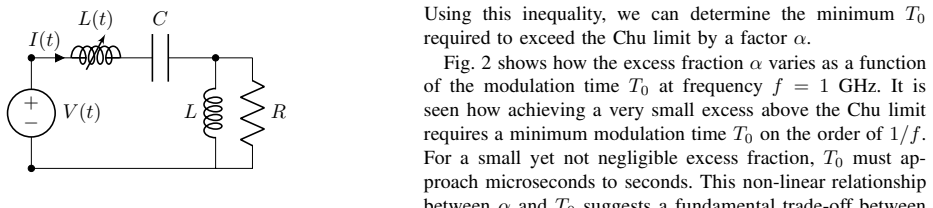
Summary. The manuscript considers a Chu-type electrically small antenna (TM01 mode, RLC model) with a series time-varying inductor L(t)=L0(1+h(t)) and asks which modulation waveform h(t) best violates the Chu Q lower bound. The authors define an instantaneous Q(t)=ωW_stored/P_total in which the modulator's work appears as an effective "modulation resistance" R_mod=L0 h'(t) in the dissipation denominator (Eqs. (13)–(15)). They then (i) analyze sinusoidal modulation and derive a trade-off between Q-excess α and modulation period T0 (Eqs. (4)–(7), Fig. 2); (ii) derive an Euler–Lagrange condition (24) for smooth h; (iii) state Lemma 2, that the functional J[h]=∫(Q−Q_Chu)dt is maximized by piecewise-constant (bang-bang) h with switches synchronized to I(t)=0; and (iv) derive an upper bound on switch transition time τ_sw in terms of antenna size, isolation/BER, and carrier frequency (Eqs. (31)–(34), Fig. 3), concluding that smaller antennas permit slower switches. The headline claim is that bang-bang switching is a "mathematical necessity" for breaking the Chu limit.
Significance. The problem is well motivated: waveform optimization for time-modulated matching networks is a genuinely open and useful question, and the circuit-level derivation showing that dL/dt enters the power balance as an effective resistance R_mod=L0h' (Eqs. (11)–(15)) is a concrete, self-contained modeling contribution. The paper fits no parameters to data and its claims are in principle checkable from its own equations, which is a strength. The §VI bound relating switch speed, electrical size, and BPSK error rate, while algebraically elementary, is the kind of design relation practitioners could use. However, the central optimality claim (Lemma 2) is not merely under-proved: as detailed below, the paper's own equations imply that the proposed bang-bang optimizer cannot satisfy the design constraint (4) it is meant to optimize, and the objective's sign convention is internally contradictory. If those issues were resolved the work could be a useful contribution, but the result as stated does not hold.
major comments (4)
- [§II, §IV.B — Eqs. (4) and (17)] The optimization goal is internally contradictory. Eq. (4) (and (17)) require ∫ΔQ dt ≤ −αQ_Chu with α>0, i.e., Q driven *below* the Chu lower bound — the correct direction for 'breaking' the limit. Yet the text calls α a 'Q-factor excess', defines J in (17) as a functional 'to be maximized', and Lemma 2's proof argues the optimal profile 'achieves the maximum possible Q-factor'. Maximizing Q is the opposite of the stated constraint, and exceeding the Chu lower bound is trivial (it is a lower bound). The variational problem as actually solved in §IV–V is not the problem posed in §II. This sign/direction inconsistency propagates through the whole paper and must be resolved before any optimality statement can be evaluated.
- [§V, Lemma 2 (with Eq. (15))] The proposed optimizer cannot meet its own constraint. In any constant segment of a piecewise-constant h, Eq. (15) gives Q=ω(La+L0(1+h))/(Ra+Rm). Since passivity requires h≥−1, Q≥ωLa/(Ra+Rm)=Q_Chu·Ra/(Ra+Rm): with Rm=0 this equals Q_Chu and never dips below it; with Rm>0 the dip is a static-loss effect unrelated to modulation. Hence ΔQ(t)≥0 a.e. and J≥0, so (4) fails for every α>0. The only term in the model capable of pushing Q below its static value is R_mod=L0h'>0 in D(h') — precisely the term Lemma 2 sets out to eliminate. The paper thus optimizes away the only mechanism that could achieve its objective. Conversely, if the intended goal is to *maximize* Q, the optimum is a constant h (no switching at all), which makes the bang-bang result vacuous. Either reading undermines the central claim.
- [§III — Eqs. (6)–(7), Fig. 2] For the sinusoidal law L(t)=L0(1+cos ω_M t)≥0, Eq. (6) gives ΔQ=ωL(t)/R≥0, so the left side of (7), ω_M T0+sin(ω_M T0), is nonnegative on the relevant range and (7) is unsatisfiable for any α>0. Fig. 2 nevertheless plots positive α versus T0, which can only have been produced with a flipped sign convention. Additionally, (6) omits the modulation resistance R_mod that §IV derives as the essential effect (Eq. (15)), so the sinusoidal section and the variational section use different Q models. The figure and the underlying inequality need to be recomputed under a single, consistent sign convention and Q model.
- [§IV.B–§V — Eq. (24) and Lemma 2 proof] There is no logical bridge from the Euler–Lagrange analysis to bang-bang optimality. Eq. (24) is a necessary condition only for C¹ extremals; constant segments (h'=h''=0) do not satisfy it (they would require ((Ra+Rm)/L0)²=0), so the claimed optimum lies outside the class for which the condition was derived, and no argument (e.g., Pontryagin-type analysis with h' as a bounded control, or a convexity/Lemma-1-based bound) is given to show the extremum over the enlarged class is piecewise constant. Lemma 2's proof is instead a verbal argument whose key premise — that transitions at I(t)=0 nullify the switching cost — does not address the denominator of (15) during the segments, and whose conclusion ('maximum possible Q-factor') contradicts (4) as noted above. As stated, Lemma 2 is unsupported.
minor comments (6)
- [§IV.A, Lemma 1] The proof substitutes the average h0=(1/T0)∫h dt for h(t) in the numerator of Q, but the average of the ratio N(h)/D(h') is not bounded by the ratio evaluated at the average numerator; the step is not justified. Also the inequality directions involving Rlwr/Rupp need care given that Rlwr (a lower bound on L0h') can be negative. The lemma is not load-bearing for the main claim, but as stated its proof is incomplete.
- [§IV.B, Eq. (17)] Writing the constraint '≤ −αQ_Chu' inside the definition of a functional that is then 'to be maximized' conflates the objective and the constraint; please separate J[h]:=∫(Q−Q_Chu)dt from the design inequality.
- [§V, Lemma 2 proof] Undefined notation: 'transition velocity f′' and 'the derivative f′' — f is never defined; presumably h is meant. Also 'bypassing the inherent efficiency of smooth modulation functions' presumably should read 'inefficiency'.
- [§VI, Eqs. (31)–(32)] The substitution Q=1/(kρ)³ uses the Chu *lower* bound as the operating Q in τ_ant, which yields the shortest natural decay and hence the most permissive τ_sw bound; this best-case character should be stated explicitly. Relatedly, the abstract's 'switching time becomes longer as antennas become electrically smaller' should read that the *upper bound on the allowable* switching time increases.
- [Figures] Fig. 2 lacks axis labels and units (T0 axis presumably seconds; is the vertical axis α?). Fig. 3's heatmap has tick labels like −12…−7 with no stated quantity or colorbar (presumably log10(τ_sw) in seconds); axes (ρ/λ, Pe) should be labeled.
- [General] Typos: 'instantananeous' (Lemma 1); 'from to which' (after (33)); integral lower limit 'ta' in Lemma 1's proof; inconsistent h vs f notation in §V. Eq. (22b) would benefit from an explicit intermediate step, as the algebra into (23)–(24) is easy to mis-check.
Circularity Check
No significant circularity: the variational and bang-bang claims are self-contained (if internally inconsistent) circuit-model arguments, not fits or self-citation loops.
full rationale
The paper builds Q(t,h) from a Chu RLC model plus a time-varying inductor (eqs. 1–15), applies a standard Euler–Lagrange argument to obtain the nonlinear ODE (24), then argues informally that piecewise-constant h nullifies Rmod (Lemma 2). The switching-time bound (31)–(34) is ordinary textbook decay plus the BPSK Pe formula. None of these steps redefine the target as an input, fit a parameter and relabel it a prediction, or rest the central claim on an unverified self-citation or author-imported uniqueness theorem. Citations are external (Chu, Alù, Grbic, Tretyakov, Pozar, Proakis). Internal sign/objective contradictions (ΔQ cannot go negative under the proposed optimizer; constants fail (24); sinusoidal section uses a different Q formula) are correctness failures, not circular reductions. Score 0 is therefore appropriate.
Axiom & Free-Parameter Ledger
free parameters (3)
- β (fractional occupancy of symbol period allowed for switching) =
0.25 in Fig. 3
- Isolation requirement S (or target Pe)
- Rm (modulator internal loss resistance)
axioms (6)
- domain assumption Chu ESA equivalent circuit: single TM01 mode with C=ρ/(cR), L=ρR/c and QChu=ωLa/Ra (and later QChu=1/(kρ)^3).
- ad hoc to paper Instantaneous Q(t)=ω Wstored(t)/Ptotal(t) with Ptotal including modulator work Pmod=I² dL/dt, yielding Rmod=L0 h' in the denominator.
- domain assumption Modulation h is Lipschitz with Rlwr ≤ L0 h' ≤ Rupp and does not produce negative instantaneous power (Lemma 1).
- standard math Calculus of variations / Euler–Lagrange necessary condition applies to smooth competitors η with η(0)=η(T0)=0, producing the inductive modulation ODE (24).
- ad hoc to paper Switching cost is nullified if transitions occur when I(t)=0, allowing ideal bang-bang without Rmod penalty (Lemma 2 proof).
- domain assumption Field ring-down A(t)=A0 e^{-t/τant} with τant=Q/(π fc), and BPSK Pe ↔ isolation S via S=10 log10[(1/2)(Qinv(Pe))²].
Cite this review
Pith. "Pith review of Optimality of Bang-Bang Switching for Breaking the Chu Limit via Time-Modulated Matching." pith.science (2026). https://pith.science/paper/PXIQL4CP
@misc{pith2026260723688,
  author       = {Pith},
  title        = {Pith review of: Optimality of Bang-Bang Switching for Breaking the Chu Limit via Time-Modulated Matching},
  year         = {2026},
  howpublished = {\url{https://pith.science/paper/PXIQL4CP}},
  note         = {Machine review of arXiv:2607.23688}
}
read the original abstract
This paper shows that surpassing the Chu limit on $Q$-factors via time-modulated matching requires non-smooth switching strategies. We derive a nonlinear differential condition to show that differentiable modulation functions are sub-optimal, then show that the optimal switching trajectory for maximizing the violation of the Chu limit is a piecewise-constant (Bang-Bang) profile. Finally, we establish an upper-bound connecting the antenna size, switching speed, and bit error rate, which reveals that switching time becomes longer as antennas become electrically smaller.
Figures


Reference graph
Works this paper leans on
-
[1]
PCS antenna design: The challenge of miniaturization,
A. K. Skrivervik, J.-F. Zurcher, O. Staub, and J. Mosig, “ PCS antenna design: The challenge of miniaturization,” IEEE Antennas Propag. Mag , vol. 43, no. 4, pp. 12–27, 2002
2002
-
[2]
Physical limitations of omni-directional an tennas,
L. J. Chu, “Physical limitations of omni-directional an tennas,” J. Appl. Phys., vol. 19, no. 12, pp. 1163–1175, 1948
1948
-
[3]
Beyond Chu’s limit with Flo quet impedance matching,
H. Li, A. Mekawy, and A. Al` u, “Beyond Chu’s limit with Flo quet impedance matching,” Phys. Rev. Lett. , vol. 123, p. 164102, Oct 2019
2019
-
[4]
Space–ti me modu- lation of a multimode electrically small antenna for increa sed matching and efficiency bandwidths,
Z. Fritts, A. Babaee, S. M. Y oung, and A. Grbic, “Space–ti me modu- lation of a multimode electrically small antenna for increa sed matching and efficiency bandwidths,” IEEE Trans. Antennas Propag. , vol. 73, no. 3, pp. 1308–1320, Mar. 2025
2025
-
[5]
Antenna bandwidth engineering through time -varying resistance,
M. Mostafa, N. Ha-V an, P . Jayathurathnage, X. Wang, G. Pt itcyn, and S. Tretyakov, “Antenna bandwidth engineering through time -varying resistance,” Applied Physics Letters , vol. 122, no. 17, 2023
2023
-
[6]
UHF electrically small box cage loop antenna with an embedded no n-Foster load,
J. Church, J.-C. S. Chieh, L. Xu, J. D. Rockway, and D. Arce o, “UHF electrically small box cage loop antenna with an embedded no n-Foster load,” IEEE Antennas Wireless Propag. Lett. , vol. 13, pp. 1329–1332, Jul. 2014
2014
-
[7]
Broadband parametric im pedance matching for small antennas using the Bode-Fano limit: Impr oving on Chu’s limit for loaded small antennas,
P . Loghmannia and M. Manteghi, “Broadband parametric im pedance matching for small antennas using the Bode-Fano limit: Impr oving on Chu’s limit for loaded small antennas,” IEEE Antennas Propag. Mag. , vol. 64, no. 5, pp. 55–68, Oct 2022
2022
-
[8]
An energy-synchrono us direct antenna modulation method for phase shift keying,
K. Schab, D. Huang, and J. J. Adams, “An energy-synchrono us direct antenna modulation method for phase shift keying,” IEEE Open J. Antennas Propag., vol. 1, pp. 41–46, 2020
2020
-
[9]
A novel continuous direct antenna modulatio n system through varactor diode tuning,
I. M. Broadbooks, M. C. Smith, R. M. Radhakrishnan, and D. F. Sievenpiper, “A novel continuous direct antenna modulatio n system through varactor diode tuning,” IEEE Trans. Antennas Propag. , vol. 73, no. 4, pp. 2416–2426, Apr. 2025
2025
-
[10]
Parametric enhan cement of radiation from electrically small antennas,
A. Mekawy, H. Li, Y . Radi, and A. Al` u, “Parametric enhan cement of radiation from electrically small antennas,” Phys. Rev. Appl. , vol. 15, p. 054063, May 2021
2021
-
[11]
Time-varying components for enhancing wi reless transfer of power and information,
P . Jayathurathnage, F. Liu, M. S. Mirmoosa, X. Wang, R. F leury, and S. A. Tretyakov, “Time-varying components for enhancing wi reless transfer of power and information,” Phys. Rev. Appl., vol. 16, p. 014017, Jul 2021
2021
-
[12]
D. M. Pozar, Microwave engineering. John wiley & sons, 2011
2011
-
[13]
J. G. Proakis and M. Salehi, Digital communications . McGraw-hill New Y ork, 2001, vol. 4
2001
This paper was first reviewed by grok-4.5 on July 30, 2026.
discussion (0)
Sign in with ORCID, Apple, or X to comment. Anyone can read and Pith papers without signing in.