REVIEW 4 major objections 5 minor 45 references
UniMem claims that a frozen LLM can expand its own memory on the fly by routing each query to either a retrieval buffer or a trainable parametric unit, and that this autonomous coordination lifts exact-match accuracy by 4.0 points on averag
Reviewed by Pith at T0; open to challenge. T0 means a machine referee read the full paper against a public rubric. the ladder, T0–T4 →
T0 review · deepseek-v4-flash
2026-08-01 00:49 UTC pith:S4WKF53T
load-bearing objection Credible system paper whose headline gain depends on unmeasured cluster quality; deserves refereeing but needs code and cluster-level analysis. the 4 major comments →
UniMem: Complementary Episodic-to-Parametric Memory for Boundary-Agnostic Task Streams
The pith
A machine-rendered reading of the paper's core claim, the machinery that carries it, and where it could break.
Core claim
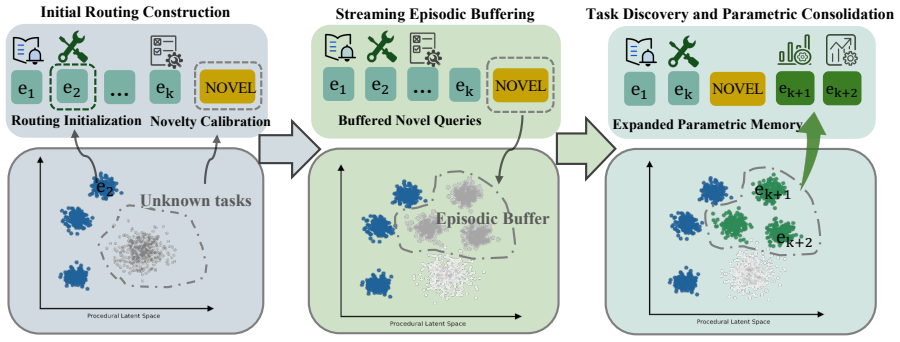
On its own terms, UniMem demonstrates that the stability-plasticity dilemma in streaming LLM deployment can be managed by physically separating task identification from task execution. Each incoming query is scored against learned routing tokens plus a novelty sentinel; only high-confidence matches activate a parametric memory unit, while anything else is sent to an episodic buffer served by retrieval. When the buffer fills, an unsupervised pipeline—using Normalized Compression Distance and HDBSCAN clustering—groups recurring samples into candidate tasks, filters them by outlier removal and cluster cohesion, and promotes only qualifying clusters into new routing tokens paired with Procedural
What carries the argument
The central mechanism is the routing token matrix E = [e_1, ..., e_K, e_NOVEL], where each known-task token e_k is paired with a pluggable parametric memory block P_k, instantiated here as layer-wise learnable key-value slots injected into the frozen transformer's cross-attention with learned gates. The novelty sentinel e_NOVEL is calibrated during initialization to compete with known tokens, and a confidence rule (p* > p0 and p* ≥ τ, with τ = 0.7) decides whether to activate a parametric unit or send the query to the episodic buffer. Task discovery relies on NCD as a string-compression similarity measure, HDBSCAN for label-free clustering, and a strict quality gate before consolidation. Thi
Load-bearing premise
The entire discovery pipeline assumes that a recurring task leaves stable, surface-level textual traces—stable instruction and query phrasing—that show up as compressible patterns in gzip-based NCD; if the same procedure is phrased differently each time or evolves semantically without lexical overlap, clustering will fail or misconsolidate, breaking the central improvement.
What would settle it
Build a streaming sequence where each task's instruction is rewritten every time it appears using different synonyms and sentence structures, so that samples from the same latent task share semantics but not surface text. If UniMem's routing accuracy drops, few or no clusters pass the NCD cohesion threshold, and exact-match scores fall back toward the retrieval-only baseline, then the claim that recurring patterns can be discovered without labels from text would be disproven.
If this is right
- A deployed LLM agent can accumulate task-specific skills without any task-boundary supervision, as long as recurring tasks leave surface-level textual traces.
- Parameter growth becomes proportional to the number of genuinely recurring task patterns, not to the number of tasks or samples, because sparse and one-off tasks stay in the episodic buffer.
- The routing-token mechanism remains reliable at scale: routing accuracy stays above 85% for LLaMA-3.1-8B even with 100 tasks, so the decoupled architecture does not degrade as memory expands.
- Task-specific memory blocks reduce interference compared to a shared memory block, and the advantage grows with task count (EM gap widens from +1.2% at 10 tasks to +2.7% at 50 tasks).
- The framework is modular in its execution memory: any PEFT-style module could replace the Procedural KV Memory, so the routing-plus-consolidation lifecycle is a general recipe for autonomous memory expansion.
Where Pith is reading between the lines
- A natural stress test the paper leaves implicit: if the same task is repeatedly rephrased so that instruction and query strings share little lexical overlap while semantics stay aligned, NCD-based clustering should fail to discover the recurrence, and consolidation would either stall or merge distinct tasks. Running such an adversarial stream would directly expose the dependence on surface-form si
- The reported 4.0-point exact-match gain averages over three backbones; the gain is uneven (e.g., on Qwen3-8B at 100 tasks the improvement over TOKMEM is about 2.7 points, while on LLaMA-3.2-3B it is about 7.0 points). A practitioner choosing a backbone should expect the benefit to depend on the base model's instruction-following strength.
- The conservative consolidation policy (minimum cluster size 50, strict cutoff τ_cluster = 0.85) implies a latency trade-off: sparse tasks accept degraded retrieval-based performance for many rounds before enough evidence accumulates. Adaptive thresholds based on stream statistics could accelerate consolidation for medium-frequency tasks without a wholesale rewrite of the mechanism.
- Because the routing tokens and memory blocks are trained separately, one could reuse a routing layer across multiple backbones or transfer consolidated memory units to a new frozen backbone, potentially enabling portable task expertise across model versions.
Editorial analysis
A structured set of objections, weighed in public.
Referee Report
Summary. The paper proposes UniMem, a framework for LLM memory management in boundary-agnostic streaming task streams. UniMem uses learnable routing tokens to dispatch queries either to task-specific parametric ``Procedural KV'' memory blocks or to an episodic buffer served by retrieval. When the buffer fills, NCD and HDBSCAN are used to cluster buffered queries without task labels; clusters passing a quality gate are consolidated into new routing tokens and parametric memory units via SFT. The paper reports experiments on SNI streaming sequences and a SuperGLUE mixed stream, claiming an average gain of 4.0 EM points across three backbone models and demonstrating autonomous creation of 76 parametric units over 100 novel tasks. The manuscript includes detailed appendices on routing, clustering, baselines, computational budget, and limitations.
Significance. If the results hold, UniMem addresses a practically relevant problem: enabling a frozen LLM to autonomously expand parametric memory in a task-label-free streaming setting while retaining episodic coverage for sparse tasks. The architecture is clearly motivated by complementary learning systems, and the decoupling of routing from execution is a sensible design that goes beyond single-token procedural memory. The paper is strong on protocol transparency: streaming construction, baseline implementations, hyperparameters, and computational budgets are documented in detail, and the arithmetic behind the abstract's 4.0 EM claim is consistent with Table 1. The work would be a useful contribution to continual learning and agent memory, but the empirical evidence as presented is not yet sufficient to rule out that the central consolidation mechanism relies on favorable clustering outcomes that are never directly measured.
major comments (4)
- [§4.2, Fig. 5; App. E.6, Eq. (22)] The central claim that recurring tasks are correctly discovered and consolidated is not directly evaluated. Fig. 5 reports that 76 new units are created for 100 novel tasks, but no cluster purity, precision/recall, confusion matrix, or per-unit error is given. If clusters are impure, SFT will bake mixed task procedures into a single memory block; if clusters fragment, the method silently degenerates to episodic RAG. Both failure modes could leave the aggregate EM numbers unaffected while undermining the intended mechanism. Please report clustering quality against ground-truth task labels and, at minimum, per-consolidation EM changes. Without this, the headline gain is not interpretable as evidence of successful consolidation.
- [App. A, Eq. (8); App. E.4–E.6] Several hand-set thresholds control the entire episodic-to-parametric lifecycle: τroute = 0.7, τcluster = 0.85, k = 0.5, Smin = 50, min_samples = 100, and cache capacity C = 1600. No sensitivity analysis is provided for any of them. A method whose behavior hinges on these values needs at least a local robustness study (e.g., varying τcluster over [0.7, 0.95] and τroute over [0.5, 0.9]) to show that the 4.0 EM gain is not an artifact of a finely tuned operating point.
- [Table 1 and §4.1] Statistical support for the headline comparison is weak. Table 1 is averaged over three runs using the same seed-42 data split, but no standard deviations, confidence intervals, or significance tests are reported. The advantages over the strongest baseline are only +2.44 EM (LLaMA-3.1-8B) and +3.37 EM (Qwen3-8B); with n=3 same-split runs these could easily be within run-to-run noise. Please report variance across seeds and, where feasible, multiple stream orderings.
- [App. E.2–E.3; §1] The task-discovery step relies on surface-form text: xi truncates the instruction and query and NCD is computed at character level. On SNI, tasks share exact instruction strings, so NCD can separate tasks by lexical identity; this partly mitigates the concern that no semantic generalization is needed. However, the paper claims deployment over evolving task streams. If instructions are paraphrased or tasks evolve lexically while preserving procedure, NCD-based clustering may fragment or misgroup. Please test this explicitly, e.g., with rephrased instructions or a synthetic procedure-evolution stream. This is a correctness-risk concern, not a circularity claim: the execution mechanism may be sound even if the discovery step is evaluated only in the easy lexical-identity regime.
minor comments (5)
- [App. A and §3.2] Notation for the number of routing tokens varies: T in Eq. (5) versus K in Eq. (1) and Section 3.2. Please unify.
- [Table 3] The "w/o RAG cache" rows use em-dashes for the 10-task setting; the caption explains this, but it would be clearer to write "n/a" and note why in the table note.
- [Fig. 4] The bars for per-task KV and shared KV are labeled only in the legend; adding values directly on the bars would make the +1.2/+1.9 and +2.7/+2.9 points easier to verify.
- [References] Several preprint references are incomplete or inconsistent (e.g., Hu et al. lists partial author groups; "TOKMEM" is rendered as "TOK-MEM" in §2.2). Please normalize.
- [Availability] No code or data release is mentioned. Given the complexity of the pipeline, releasing code and configuration files would substantially aid reproducibility.
Circularity Check
No significant circularity: central claims are empirical benchmark measurements, not fitted predictions.
full rationale
UniMem's central claims are direct empirical comparisons on SNI and SuperGLUE streams (Tables 1–2, Figure 5), not quantities derived from or fitted to the target result. The routing probability in Eq. 1 is trained with cross-entropy; the Procedural KV Memory in Eq. 2 is trained with a task loss; the NCD/HDBSCAN clustering in Eqs. 14–22 produces clusters that are then SFT-trained. No equation is constructed so that its output equals its input. The observation that sparse tasks remain episodic is a stated, designed consequence of setting Nsparse=10 below HDBSCAN's min_cluster_size=50, and the paper explicitly says this 'tests whether UniMem can avoid premature parameter allocation,' so it is not presented as a surprise or a fitted prediction. The only self-citation is Zhang et al. 2026 in the introduction, which is not load-bearing; the procedural-token foundation is attributed to Wu et al. 2026 (TOKMEM), which is not authored by the present authors. There is no uniqueness-theorem argument, no renamed fitted parameter, and no ansatz smuggled in via self-citation. Unmeasured cluster purity is a correctness risk, but it is not circularity. The paper is self-contained against external benchmarks and no specific reduction or fit-to-target can be quoted. Therefore no significant circularity is found.
Axiom & Free-Parameter Ledger
free parameters (8)
- routing threshold τroute =
0.7
- cluster quality threshold τcluster =
0.85
- HDBSCAN min_cluster_size Smin =
50
- HDBSCAN min_samples =
100
- outlier filter k =
0.5
- episodic buffer capacity C =
1600
- initial known/calibration tasks Nknown, Ncalib =
20 / 20
- sparse-task ratio rsparse / Nsparse =
10% / 10 samples
axioms (4)
- domain assumption The streaming task distribution is composed of discrete, recurring latent task patterns that can be discovered by clustering.
- domain assumption Task identity is recoverable from surface text: xi = Trunc(I_i)||Trunc(q_i) with gzip NCD captures procedural similarity.
- domain assumption A frozen backbone can be adapted by injecting per-task key-value memory via cross-attention without corrupting routing.
- ad hoc to paper Initializing eNOVEL near the centroid of known routing tokens (Eq. 4) creates a well-calibrated novelty signal.
invented entities (3)
-
Routing tokens e_k
no independent evidence
-
Novelty sentinel eNOVEL
no independent evidence
-
Procedural KV memory block P_k
no independent evidence
read the original abstract
Memory is essential for LLM agents to accumulate task experience and reuse task-specific execution strategies. However, real-world deployment over boundary-agnostic and evolving task streams exposes a fundamental stability-plasticity dilemma. External retrieval-based memory can rapidly absorb new evidence, but it often fails to internalize recurring execution patterns and incurs inference-time retrieval overhead. Parametric memory enables stable and efficient execution once learned, but typically relies on explicit task boundaries and fixed parameter budgets. Inspired by the human brain, which balances plasticity and stability through complementary episodic storage and gradual consolidation, we propose UniMem, a self-routing framework for autonomous memory management. UniMem uses learnable routing tokens as memory controllers, enabling adaptive coordination between complementary memory pathways: novel or sparse tasks are retained in an episodic buffer for retrieval-augmented execution, while recurring and reliable patterns are consolidated into expandable parametric memory. By decoupling task identification from task execution with routing tokens and parametric memory blocks, UniMem expands memory on demand without task labels during deployment or uncontrolled parameter growth. Experiments on long-horizon streaming task sequences show that UniMem consistently outperforms baselines while maintaining execution fidelity, achieving an average gain of 4.0 EM points across three backbone models.
Figures


Reference graph
Works this paper leans on
-
[1]
2026 , eprint=
TokMem: One-Token Procedural Memory for Large Language Models , author=. 2026 , eprint=
2026
-
[2]
2023 , eprint=
Reflexion: Language Agents with Verbal Reinforcement Learning , author=. 2023 , eprint=
2023
-
[3]
2024 , eprint=
ExpeL: LLM Agents Are Experiential Learners , author=. 2024 , eprint=
2024
-
[4]
2025 , eprint=
A-MEM: Agentic Memory for LLM Agents , author=. 2025 , eprint=
2025
-
[5]
2025 , eprint=
MEM1: Learning to Synergize Memory and Reasoning for Efficient Long-Horizon Agents , author=. 2025 , eprint=
2025
-
[6]
2025 , eprint=
MemAgent: Reshaping Long-Context LLM with Multi-Conv RL-based Memory Agent , author=. 2025 , eprint=
2025
-
[7]
2025 , eprint=
Zep: A Temporal Knowledge Graph Architecture for Agent Memory , author=. 2025 , eprint=
2025
-
[8]
2025 , eprint=
HopRAG: Multi-Hop Reasoning for Logic-Aware Retrieval-Augmented Generation , author=. 2025 , eprint=
2025
-
[9]
2025 , eprint=
G-Memory: Tracing Hierarchical Memory for Multi-Agent Systems , author=. 2025 , eprint=
2025
-
[10]
2025 , eprint=
From Experience to Strategy: Empowering LLM Agents with Trainable Graph Memory , author=. 2025 , eprint=
2025
-
[11]
Transformer Feed-Forward Layers Are Key-Value Memories
Geva, Mor and Schuster, Roei and Berant, Jonathan and Levy, Omer. Transformer Feed-Forward Layers Are Key-Value Memories. Proceedings of the 2021 Conference on Empirical Methods in Natural Language Processing. 2021. doi:10.18653/v1/2021.emnlp-main.446
-
[12]
Guo, Daya and Yang, Dejian and Zhang, Haowei and Song, Junxiao and Wang, Peiyi and Zhu, Qihao and Xu, Runxin and Zhang, Ruoyu and Ma, Shirong and Bi, Xiao and Zhang, Xiaokang and Yu, Xingkai and Wu, Yu and Wu, Z. F. and Gou, Zhibin and Shao, Zhihong and Li, Zhuoshu and Gao, Ziyi and Liu, Aixin and Xue, Bing and Wang, Bingxuan and Wu, Bochao and Feng, Bei ...
-
[13]
2023 , eprint=
GPT Understands, Too , author=. 2023 , eprint=
2023
-
[14]
2022 , eprint=
P-Tuning v2: Prompt Tuning Can Be Comparable to Fine-tuning Universally Across Scales and Tasks , author=. 2022 , eprint=
2022
-
[15]
2021 , eprint=
The Power of Scale for Parameter-Efficient Prompt Tuning , author=. 2021 , eprint=
2021
-
[16]
2021 , eprint=
Prefix-Tuning: Optimizing Continuous Prompts for Generation , author=. 2021 , eprint=
2021
-
[17]
2021 , eprint=
LoRA: Low-Rank Adaptation of Large Language Models , author=. 2021 , eprint=
2021
-
[18]
2022 , eprint=
IDPG: An Instance-Dependent Prompt Generation Method , author=. 2022 , eprint=
2022
-
[19]
2024 , eprint=
IAPT: Instruction-Aware Prompt Tuning for Large Language Models , author=. 2024 , eprint=
2024
-
[20]
2025 , eprint=
All You Need is One: Capsule Prompt Tuning with a Single Vector , author=. 2025 , eprint=
2025
-
[21]
2022 , eprint=
Learning to Prompt for Continual Learning , author=. 2022 , eprint=
2022
-
[22]
2024 , eprint=
MEMORYLLM: Towards Self-Updatable Large Language Models , author=. 2024 , eprint=
2024
-
[23]
2023 , eprint=
Progressive Prompts: Continual Learning for Language Models , author=. 2023 , eprint=
2023
-
[24]
Mixture-of-LoRAs: An Efficient Multitask Tuning Method for Large Language Models , booktitle =
Wenfeng Feng and Chuzhan Hao and Yuewei Zhang and Yu Han and Hao Wang , year =. Mixture-of-LoRAs: An Efficient Multitask Tuning Method for Large Language Models , booktitle =
-
[25]
2026 , eprint=
ReasonCACHE: Teaching LLMs To Reason Without Weight Updates , author=. 2026 , eprint=
2026
-
[26]
2020 , eprint=
SuperGLUE: A Stickier Benchmark for General-Purpose Language Understanding Systems , author=. 2020 , eprint=
2020
-
[27]
2022 , eprint=
Super-NaturalInstructions: Generalization via Declarative Instructions on 1600+ NLP Tasks , author=. 2022 , eprint=
2022
-
[28]
A continual learning survey: Defying forgetting in classification tasks , ISSN=
Delange, Matthias and Aljundi, Rahaf and Masana, Marc and Parisot, Sarah and Jia, Xu and Leonardis, Ales and Slabaugh, Greg and Tuytelaars, Tinne , year=. A continual learning survey: Defying forgetting in classification tasks , ISSN=. doi:10.1109/tpami.2021.3057446 , journal=
arXiv 2021
-
[29]
Neural Networks , pages=
Continual learning: A systematic literature review , author=. Neural Networks , pages=. 2025 , publisher=
2025
-
[30]
Proceedings of the 43nd International Conference on Machine Learning , year =
Rethinking Personalization in Large Language Models at the Token Level , author=. Proceedings of the 43nd International Conference on Machine Learning , year =
-
[31]
2025 , eprint=
Online Continual Learning: A Systematic Literature Review of Approaches, Challenges, and Benchmarks , author=. 2025 , eprint=
2025
-
[32]
2026 , eprint=
Memory in the Age of AI Agents , author=. 2026 , eprint=
2026
-
[33]
2025 , eprint=
From Human Memory to AI Memory: A Survey on Memory Mechanisms in the Era of LLMs , author=. 2025 , eprint=
2025
-
[34]
2025 , eprint=
A Systematic Review of Key Retrieval-Augmented Generation (RAG) Systems: Progress, Gaps, and Future Directions , author=. 2025 , eprint=
2025
-
[35]
2026 , eprint=
Continual Learning in Large Language Models: Methods, Challenges, and Opportunities , author=. 2026 , eprint=
2026
-
[36]
2023 , eprint=
Orthogonal Subspace Learning for Language Model Continual Learning , author=. 2023 , eprint=
2023
-
[37]
2024 , eprint=
Learning to Route for Dynamic Adapter Composition in Continual Learning with Language Models , author=. 2024 , eprint=
2024
-
[38]
2024 , eprint=
MixLoRA: Enhancing Large Language Models Fine-Tuning with LoRA-based Mixture of Experts , author=. 2024 , eprint=
2024
-
[39]
2023 , eprint=
QLoRA: Efficient Finetuning of Quantized LLMs , author=. 2023 , eprint=
2023
-
[40]
The Thirty-ninth Annual Conference on Neural Information Processing Systems , year=
Language Ranker: A Lightweight Ranking framework for LLM Decoding , author=. The Thirty-ninth Annual Conference on Neural Information Processing Systems , year=
-
[41]
Proceedings of the 62nd Annual Meeting of the Association for Computational Linguistics (Volume 1: Long Papers) , pages=
Word embeddings are steers for language models , author=. Proceedings of the 62nd Annual Meeting of the Association for Computational Linguistics (Volume 1: Long Papers) , pages=
-
[42]
, author=
Why there are complementary learning systems in the hippocampus and neocortex: insights from the successes and failures of connectionist models of learning and memory. , author=. Psychological review , year=
-
[43]
Trends in cognitive sciences , volume=
What learning systems do intelligent agents need? Complementary learning systems theory updated , author=. Trends in cognitive sciences , volume=. 2016 , publisher=
2016
-
[44]
2004 , eprint=
Clustering by compression , author=. 2004 , eprint=
2004
-
[45]
Pacific-Asia conference on knowledge discovery and data mining , pages=
Density-based clustering based on hierarchical density estimates , author=. Pacific-Asia conference on knowledge discovery and data mining , pages=. 2013 , organization=
2013
discussion (0)
Sign in with ORCID, Apple, or X to comment. Anyone can read and Pith papers without signing in.