REVIEW 3 major objections 6 minor 10 references
SPRINT tracks and corrects DM/WFS mis-registrations on-sky at LBT, restoring the AO system to its nominal alignment.
Reviewed by Pith at T0; open to challenge. T0 means a machine referee read the full paper against a public rubric. the ladder, T0–T4 →
A simplified SPRINT loop at LBT recovers and corrects DM/WFS rotation and shift mis-registrations in daytime and on-sky tests, including an unplanned event that raised Strehl from 27% to 67%.
T0 review reviewed 2026-07-31 challenge →
load-bearing objection First on-sky closed-loop SPRINT at LBT works for rotation; shift still has an unresolved scale error the authors already flag. the 3 major comments →
DM/WFS mis-registration tracking: Implementation and on-sky validation of SPRINT at LBT
The pith
A machine-rendered reading of the paper's core claim, the machinery that carries it, and where it could break.
The reading
Core claim
A reduced-complexity, single-iteration SPRINT loop running as an auxiliary process on the LBT real-time computer accurately identifies and corrects both rotation and shift mis-registrations between the adaptive secondary and the pyramid wavefront sensor, returning the system to its nominal registration in daytime and on-sky tests and restoring science-image quality after an unplanned large rotation offset.
What carries the argument
SPRINT: a pseudo-synthetic model of the AO system that infers rotation and shift parameters from the demodulated wavefront-sensor response to a small, already-present sinusoidal probe (KL mode 30 at 80 Hz, ~10 nm).
Load-bearing premise
A single-pass estimator that ignores optical-gain and mis-registration-induced gain changes still produces corrections accurate enough when driven by an unoptimized existing probe.
What would settle it
Repeat the on-sky shift-injection test under the same conditions: if the factor-of-two overestimate persists or if closed-loop Strehl fails to recover after deliberate mis-registration, the single-iteration estimator is inadequate.
If this is right
- LBT can now run a continuous SPRINT auxiliary loop to keep SOUL registered in both shift and rotation during science.
- The same single-iteration code path is ready for integration into ELT instruments that already selected SPRINT as baseline.
- Bootstrapping an AO loop from tip/tilt-only while SPRINT removes large mis-registrations becomes a practical commissioning strategy.
- Existing optical-gain probe signals can double as mis-registration trackers, avoiding extra DM disturbance.
Where Pith is reading between the lines
- The on-sky factor-of-two shift bias may be a fixed scale error in the sensitivity matrices; a one-time empirical recalibration could remove it without restoring full iterative gain estimation.
- If the method remains stable at 300–500 frames per estimate, sub-second update rates become feasible for faster ELT flexure.
- Success with an unoptimized KL-30 probe suggests many current AO systems already possess usable probe signals for SPRINT-like tracking.
Editorial analysis
A structured set of objections, weighed in public.
Referee Report
Summary. The manuscript reports the implementation of a reduced-complexity, single-iteration version of SPRINT as an auxiliary loop in the LBT real-time computer, and its daytime and on-sky validation for tracking rotation and shift DM/WFS mis-registrations on the SOUL pyramid-WFS system. A pre-existing KL-mode-30 / 80 Hz / ~10 nm probe (already used for optical-gain tracking) is demodulated from WFS slopes; offline sensitivity matrices from a pseudo-synthetic model yield mis-registration estimates that are applied to the de-rotator and camera lens. Daytime tests recover commanded rotation and y-shift (including with the AO loop closed only on tip/tilt). On-sky, rotation is recovered across 300/500/1000-frame batches (>95% of estimates within the 0.5° target), and an unplanned rotation event restores LUCI Strehl from 27% to 67%. An on-sky x-shift test recovers the correct sign/direction but overestimates the commanded offset by a factor of ~2.
Significance. This is the first on-sky validation of SPRINT and a concrete operational path for telescopes with integrated DMs (LBT ASM; ELT M4). The unplanned-event Strehl recovery is strong external evidence that the estimator can detect and correct a real mis-registration under science conditions. Reusing an existing optical-gain probe and a Python-2.7 single-iteration implementation (no OOPAO dependency) are practical strengths for observatory deployment. If the remaining shift-scale issue is resolved or bounded, the work materially de-risks SPRINT as the baseline mis-registration tracker for ELT instruments such as HARMONI.
major comments (3)
- [Sec. 4, Fig. 6; Sec. 5] Sec. 4 and Fig. 6: the on-sky x-shift test shows a persistent factor-of-two overestimate of the commanded camera-lens offset that is absent in the corresponding daytime results (Sec. 3). The abstract and Sec. 5 claim that SPRINT “accurately identify and correct for shift and rotation” and returns the system to its nominal configuration “in all cases,” and quote a target of 10% of a subaperture. With loop gain 0.6, a ×2 scale error changes closed-loop overshoot/settling and means the published shift recovery is not yet shown to meet that target. The discrepancy must be diagnosed (sensitivity-matrix scaling, optical-gain coupling into the demodulated KL-30 amplitude, pupil geometry, or commanded vs. true lens motion) or the accuracy claim for shift must be explicitly qualified pending further tests.
- [Sec. 2] Sec. 2: the LBT implementation is deliberately single-iteration and “assumes no gain variations are present,” dropping the iterative gain update of Héritier et al. (2021) and reusing an unoptimized KL-30 probe. For a pyramid WFS, both optical gain and mis-registration-induced gain scale the demodulated mode-30 response that feeds the estimator; a wrong scale in the offline sensitivity matrices produces exactly a multiplicative bias in the shift estimate. The paper should quantify (even with a simple simulation or daytime gain-sweep) how large a gain mismatch can be before the shift estimate exceeds the 10%-subaperture target, and state whether the observed on-sky ×2 bias is consistent with that analysis. Without this, the joint shift+rotation accuracy claim and the ELT-readiness statement rest on an unresolved model assumption.
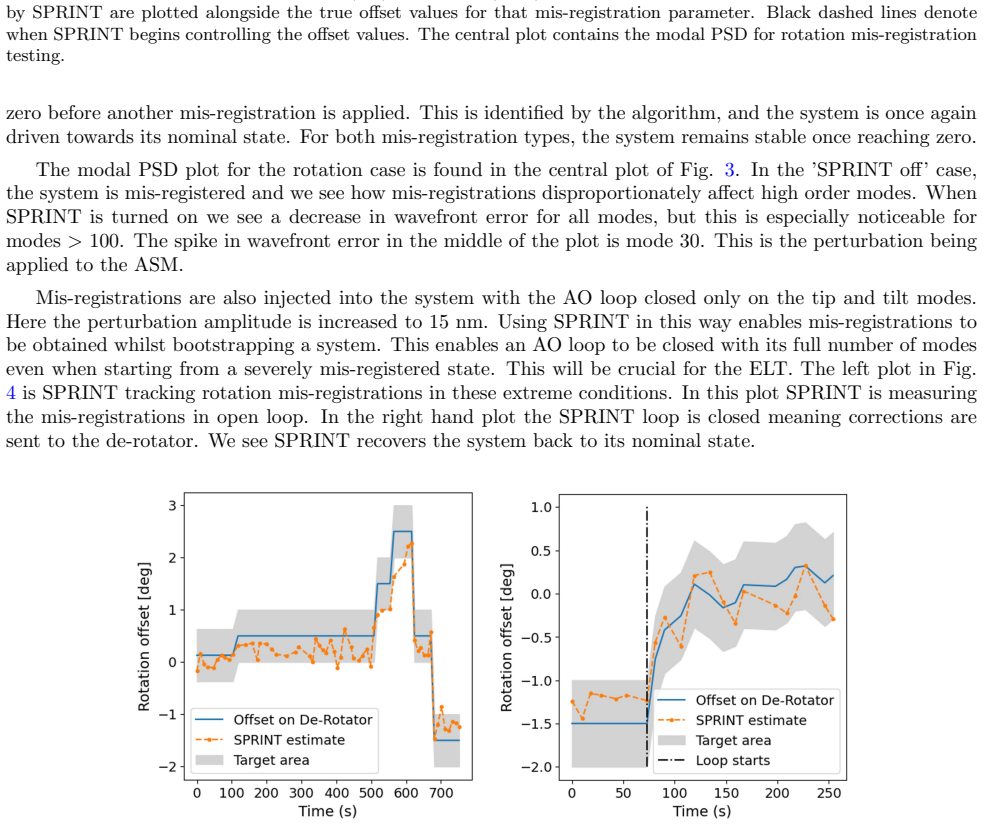
- [Sec. 4; Sec. 5] Sec. 4–5: the tip/tilt-only bootstrap demonstration (important for ELT closed-loop start-up from a severely mis-registered state) is shown only in daytime (Fig. 4); the on-sky attempt is reported as inconclusive under 1.7" seeing. The conclusions correctly flag this as future work, but the present wording that the daytime result is “a significant result in the context of using SPRINT for bootstrapping purposes at the ELT” should be tempered until on-sky confirmation exists, or the limitation should be stated more prominently in the abstract/conclusions.
minor comments (6)
- [Fig. 3] Fig. 3 central panel: the modal PSD spike at mode 30 is identified in the text as the injected probe, but the figure caption does not; a brief call-out would help readers.
- [Fig. 5] Fig. 5: clarify in the caption how sky-rotation offsets were subtracted from the “Offset on De-Rotator” traces so that nominal remains 0°, and note which panel used the standard LBT sky-rotation tracker (saw-tooth) versus SPRINT control before injection.
- [Table 1; Sec. 2] Table 1 and Sec. 2: state the physical meaning of the 10%/0.5° target accuracies in actuator or subaperture units for the LBT ASM/SOUL geometry so readers can compare to ELT-scale requirements.
- [Throughout] Typographical consistency: “IMPLEMENT A TION”, “DA YTIME”, “RESUL TS” and similar spaced capitals in section headings should be normalized; “Karhunen-Lo` eve” encoding; “python 2.7” → “Python 2.7”.
- [Sec. 1] Sec. 1: magnification/anamorphosis are stated as trackable by SPRINT but “have not been implemented here”; a one-sentence note on whether the single-iteration LBT code path could support them without OOPAO would be useful for ELT readers.
- [References] References: ensure Héritier et al. 2021 is cited consistently as the algorithmic source when contrasting iterative vs. single-iteration performance.
Circularity Check
No significant circularity: experimental validation against independently commanded offsets and external Strehl, not a self-derived prediction chain.
full rationale
This is an implementation-and-on-sky-validation paper, not a first-principles derivation. Mis-registration ground truth is set by commanded de-rotator and camera-lens offsets (and, in one case, by an independent LUCI Strehl measurement), which are external to the SPRINT estimator. The algorithm is taken from Héritier et al. 2021 and deliberately simplified to a single-iteration form that assumes no gain variations; that is an engineering choice with acknowledged accuracy cost, not a claim that the estimates are derived from pure theory. Sensitivity matrices are generated offline from a pseudo-synthetic model tuned to the current interaction matrix, then used to invert demodulated KL-30 responses—standard model-based estimation, not fitting a parameter and relabeling it as a prediction. Overlapping authorship on the method citation is normal for a follow-on implementation paper and is not load-bearing for the empirical recovery claims. No step reduces a claimed prediction to its own inputs by construction. Score 0; steps empty.
Axiom & Free-Parameter Ledger
free parameters (4)
- SPRINT loop gain =
0.6 (default)
- Frames per SPRINT estimate (n) =
300 / 500 / 1000
- Perturbation mode, amplitude, frequency =
KL mode 30, 10–15 nm, 80 Hz
- Target accuracy thresholds =
10% of a subaperture; 0.5 degrees
axioms (5)
- ad hoc to paper A single iteration of SPRINT with fixed calibrated interaction matrix and no explicit gain-variation estimation is sufficient for operational mis-registration tracking.
- domain assumption Small sinusoidal DM probes (~10 nm) produce a near-imperceptible science impact while yielding usable demodulated WFS signals.
- domain assumption Commanded de-rotator and camera-lens offsets are accurate ground truth for injected rotation and shift.
- domain assumption Pseudo-synthetic sensitivity matrices generated offline from the current interaction matrix adequately linearize rotation and shift responses near the operating point.
- ad hoc to paper Linear interpolation of skipped AO telemetry frames plus a local frequency scan recovers a usable demodulated KL-30 signal.
Cite this review
Pith. "Pith review of DM/WFS mis-registration tracking: Implementation and on-sky validation of SPRINT at LBT." pith.science (2026). https://pith.science/paper/GK3QUKTX
@misc{pith2026260727941,
  author       = {Pith},
  title        = {Pith review of: DM/WFS mis-registration tracking: Implementation and on-sky validation of SPRINT at LBT},
  year         = {2026},
  howpublished = {\url{https://pith.science/paper/GK3QUKTX}},
  note         = {Machine review of arXiv:2607.27941}
}
read the original abstract
The advent of telescopes with an integrated deformable mirror (DM) presents new challenges for adaptive optics (AO) systems. The alignment between the DM and wavefront sensor (WFS) is expected to regularly evolve during operations due to their large separation. Without tracking and correction, these mis-registrations between the DM and WFS lead to loop instability, preventing diffraction limited performance from being realised. SPRINT\cite{heritier2021} provides an approach to track these mis-registrations during observations. Rotation, shift, and magnification mis-registrations can all be recovered. The Large Binocular Telescope (LBT) currently lacks an operational solution for tracking these mis-registrations, while SPRINT has been selected as the baseline approach for several instruments on the forthcoming Extremely Large Telescope (ELT). We report on the implementation of SPRINT into the LBT real time computer and present experimental results from both daytime and on-sky testing to validate the method.
Figures




Reference graph
Works this paper leans on
-
[1]
Sprint, system parameters recurrent invasive tracking: a fast and least-cost online calibration strategy for adaptive optics,
H´ eritier, C. T., Fusco, T., Oberti, S., Neichel, B., Esposito, S., and Madec, P.-Y., “Sprint, system parameters recurrent invasive tracking: a fast and least-cost online calibration strategy for adaptive optics,”Monthly Notices of the Royal Astronomical Society504, 4274–4290 (May 2021)
2021
-
[2]
Specifications and design of the E-ELT M4 adaptive unit,
Vernet, E., Cayrel, M., Hubin, N., Mueller, M., Biasi, R., Gallieni, D., and Tintori, M., “Specifications and design of the E-ELT M4 adaptive unit,” in [Adaptive Optics Systems III],Proc. SPIE8447, 844761 (2012)
2012
-
[3]
The adaptive secondary mirror for the Large Binocular Telescope: optical acceptance test and preliminary on-sky commissioning results,
Riccardi, A., Xompero, M., Briguglio, R., Quir´ os-Pacheco, F., Busoni, L., Fini, L., Puglisi, A., Esposito, S., Arcidiacono, C., Pinna, E., Ranfagni, P., Salinari, P., Brusa, G., Demers, R., Biasi, R., and Gallieni, D., “The adaptive secondary mirror for the Large Binocular Telescope: optical acceptance test and preliminary on-sky commissioning results,”...
2010
-
[4]
ESO adaptive optics facility,
Arsenault, R., Madec, P.-Y., Hubin, N., Paufique, J., Stroebele, S., Soenke, C., Donaldson, R., Fedrigo, E., Oberti, S., Tordo, S., Downing, M., Kiekebusch, M., Conzelmann, R., Duchateau, M., Jost, A., Hackenberg, W., Bonaccini Calia, D., Delabre, B., Stuik, R., Biasi, R., Gallieni, D., Lazzarini, P., Lelouarn, M., and Glindeman, A., “ESO adaptive optics ...
2008
-
[5]
Estimation of the lateral mis-registrations of the gravity+ adaptive optics system,
Berdeu, A., Bonnet, H., Le Bouquin, J.-B., ´Edouard, C., Gomes, T., Shchekaturov, P., Dembet, R., Pau- mard, T., Oberti, S., Kolb, J., Millour, F., Berio, P., Lai, O., Eisenhauer, F., Garcia, P., Straubmeier, C., Kreidberg, L., H¨ onig, S. F., and Defr` ere, D., “Estimation of the lateral mis-registrations of the gravity+ adaptive optics system,”Astronomy...
2024
-
[6]
HARMONI at ELT: wavefront control in SCAO mode,
Bond, C. Z., Sauvage, J.-F., Schwartz, N., Levraud, N., Chambouleyron, V., Correia, C., Fusco, T., and Neichel, B., “HARMONI at ELT: wavefront control in SCAO mode,” in [Adaptive Optics Systems VIII], Proc. SPIE12185(2022)
2022
-
[7]
SOUL: the Single conjugated adaptive Optics Upgrade for LBT,
Pinna, E., Esposito, S., Hinz, P., Agapito, G., Bonaglia, M., Puglisi, A., Xompero, M., Riccardi, A., Briguglio, R., Arcidiacono, C., Carbonaro, L., Fini, L., Montoya, M., and Durney, O., “SOUL: the Single conjugated adaptive Optics Upgrade for LBT,” in [Adaptive Optics Systems V],Proc. SPIE9909, 99093V (2016)
2016
-
[8]
Oopao: Object oriented python adaptive optics,
H´ eritier, C. T., V´ erinaud, C., and Correia, C. M., “Oopao: Object oriented python adaptive optics,” AO4ELT7(2023)
2023
-
[9]
Soul at lbt: commissioning results, science and future.,
Pinna, E., Rossi, F., Agapito, G., Puglisi, A., Plantet, C., Ghose, E., Matthieu, B., Bonaglia, M., Briguglio, R., Brusa, G., Carbonaro, L., Cavallaro, A., Christou, J., Durney, O., Ertel, S., Esposito, S., Grani, P., Hinz, P., Guerra, J. C., Lefebvre, M., Mazzoni, T., Mechtley, B., Miller, D. L., Montoya, M., Power, J., Rothberg, B., Taylor, G., Vaz, A.,...
2023
-
[10]
On- sky correction of non-common path aberration with the pyramid wavefront sensor,
Esposito, S., Puglisi, A., Pinna, E., Agapito, G., Quir´ os-Pacheco, F., V´ eran, J.-P., and Herriot, G., “On- sky correction of non-common path aberration with the pyramid wavefront sensor,”Astronomy & Astro- physics636, A88 (2020)
2020
This paper was first reviewed by grok-4.5 on July 31, 2026.
discussion (0)
Sign in with ORCID, Apple, or X to comment. Anyone can read and Pith papers without signing in.