REVIEW 3 major objections 6 minor 41 references
An iterative method bridging DFT, disorder averaging, and experiment in intercalated materials: application to Au-intercalated graphene
T0 review · 3 major / 6 minor · reviewed 2026-07-31 · grok-4.5
Pith's one-line read An iterative DFT–tight-binding–disorder–experiment loop builds an effective model that explains how Au clusters reshape graphene’s bands near the van Hove singularity.
desk verdict Solid, usable effective-model pipeline for disordered intercalants; the ARPES match is real but calibrated, and the single-site stand-in for Au clusters is the main caveat. read the letter →
The pith
A machine-rendered reading of the paper's core claim, the machinery that carries it, and where it could break.
The reading
What carries the argument
The iterative DFT/Wannier → truncated ring-hybridized TB impurity → SCTMA disorder average → experiment refinement loop. SCTMA builds a momentum-dependent self-energy from repeated scattering off the energy-dependent six-site ring potential V_eff(ω), producing the configurationally averaged graphene spectral function compared to ARPES.
What would settle it
ARPES (or a controlled calculation) on a phase with the same average Au density but truly isolated single hollow-site atoms versus explicit multi-atom clusters: if the VHS broadening and −2.7 eV kinks appear only for clusters, or if SCTMA with single-site impurities fails when cluster multipoles are required, the mapping fails.
Extended reading notes
Core claim
A dilute random gas of hollow-site Au impurities, hybridized to graphene through the m=±1 and m=±2 Au 5d channels on the six-carbon ring and dressed by a positive local ring potential, yields—after SCTMA disorder averaging—the ARPES signatures of the Au-cluster phase: VHS broadening/extension and kink-like renormalizations near the impurity resonance. DFT supplies the orbitals, symmetries, and order-of-magnitude couplings; experiment fixes the remaining energies and potential.
Load-bearing premise
The real Au-cluster network can be treated, for spectral purposes, as a dilute random gas of single hollow-site Au atoms, with substrate, buffer, and clustering effects absorbed into a few fitted parameters.
Editorial extensions
If this is right
- Dilute intercalated graphene can be described by a compact effective TB model built from DFT-selected orbitals plus a local ring potential and SCTMA averaging.
- For Au clusters, only Au 5d orbitals with m=±1 and ±2 hybridized to the first carbon ring, plus a positive U on that ring, are needed for the main occupied-band ARPES features.
- The same workflow is offered for other sparse intercalants (alkali, rare-earth, halide) where disorder and van Hove or flat-band physics matter.
- Hybridization sets the localized kink near the impurity level; the local potential controls broader linewidth, Dirac-point shift, and VHS–Dirac separation.
Reading between the lines
- If single-site SCTMA already matches cluster-phase ARPES, much of the spectral reconstruction may be local impurity physics rather than long-range cluster-superlattice band folding.
- The large fitted U versus the small Wannier onsite shift suggests electrostatic and substrate screening dominate over bare DFT local potentials in real devices.
- Extending the loop to magnetic or spin–orbit-active intercalants could test whether the same ring-channel truncation still captures ARPES gaps and spin textures.
- Materials engineered for high-Tc candidates via intercalation-driven flat bands may be screened faster by this DFT-guided SCTMA fit than by large disordered supercells alone.
Editorial analysis
A structured set of objections, weighed in public.
Referee Report
Summary. The manuscript proposes an iterative workflow that combines periodic DFT, Wannier truncation into a tight-binding model, disorder averaging in the self-consistent T-matrix approximation (SCTMA), and comparison with ARPES to build an effective model of dilute intercalated 2D systems. Applied to the Au-cluster (“ostrich leather”) phase of intercalated graphene on SiC, DFT/Wannier is used to identify hollow-site Au 5d channels (m=±1, ±2) hybridizing to the six-carbon ring; remaining parameters (ε_α, |t_α|, local ring potential U, broadenings) are refined against ARPES. The resulting SCTMA spectral function is reported to reproduce the main experimental signatures—broadening/extension of the occupied van Hove region and kink-like features near the impurity resonance—and the authors identify hybridization plus a local scattering potential as the essential microscopic ingredients.
Significance. If the workflow is robust, it offers a practical bridge between first-principles local chemistry and large-scale configurational disorder for intercalated van der Waals systems, where pure periodic DFT cannot capture ARPES averaging and pure phenomenology lacks orbital content. The pristine-graphene 6NN TB benchmark against DFT and ARPES is careful, and the Wannier truncation is cross-checked with a periodic TB unfolding. The application targets a concrete experimental puzzle (VHS reconstruction with only mild Dirac-point shift). The main value is methodological and transferable to other sparse intercalants (alkali, rare earth, etc.) linked to flat-band and Lifshitz physics. Strengths include explicit symmetry-channel projection of Au–C couplings and a transparent statement of which parameters DFT constrains versus which are phenomenological.
major comments (3)
- [Sec. V A, V D; Eqs. 36–39; Sec. III D] Sec. V A and V D equate SCTMA spectra of a dilute random gas of single hollow-site Au atoms (n_imp≈2%, Eqs. 36–39) with ARPES of the experimental cluster phase (triangular network d≈2.2 nm, ~3 Au per motif, intra-cluster separation ~√7 a_gr≃0.65 nm). SCTMA explicitly neglects crossed diagrams and coherent inter-impurity scattering (Sec. III D). Shared carbon rings, cluster multipoles, and coherent form factors are therefore outside the model. The microscopic attribution of VHS broadening and kinks to single-site m=±1,±2 ring hybridization plus local U is load-bearing for the central claim, yet the single-site idealization of multi-atom clusters is assumed rather than tested. A minimal check—e.g., a small multi-Au cluster impurity in T-matrix/SCTMA, a comparison of periodic multi-Au supercells vs single-Au, or a clear statement of which spectral features are robust to cluster form factors
- [Table II; Sec. V C–D; Sec. II(v); Fig. 8] Table II and Sec. V C show large phenomenological retuning relative to DFT/Wannier: U from ≈−0.2 eV to +2 eV, ε_α fixed at −2.7 eV (the experimental intensity maximum), and |t_α| adjusted within a distance-dependent range. Sec. II(v) and the Abstract state that comparison with the same ARPES dataset guides refinement, then present the refined SCTMA maps as reproducing that ARPES (Fig. 8). Without a sensitivity analysis (which features survive when U is kept near the Wannier value; when ε_α is varied off the intensity peak; one-parameter scans) or a quantitative goodness-of-fit metric, it is unclear how much of the agreement is forced by the free parameters versus predicted by the DFT-selected channels. The sign and magnitude change in U is especially consequential for the claim that a local scattering potential is an essential ingredient; the QPI citation (Ref. 36, “in preparation”) and
- [Abstract; Sec. VI] The Abstract and Sec. VI state that the method “reproduces the main ARPES signatures” and identifies essential microscopic ingredients. Given the points above, the wording should be tightened to what is actually demonstrated: that a single-site effective impurity model with DFT-selected d-channels and phenomenologically adjusted ε_α, |t_α|, and U can match the main visual features of the cluster-phase ARPES. Claims that the experimental cluster morphology is thereby microscopically explained should be caveated unless additional evidence (cluster-resolved modeling or robustness tests) is supplied.
minor comments (6)
- [Abstract] Abstract typo: “V12an Hove singularity” should be “van Hove singularity”.
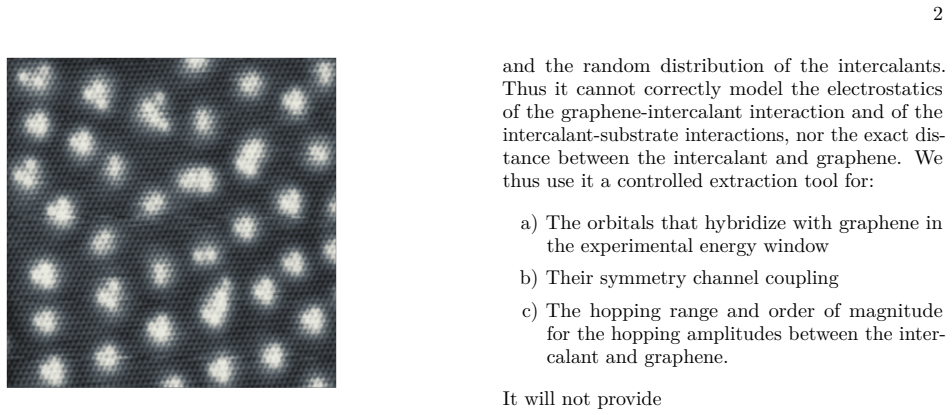
- [Fig. 1] Fig. 1 is referenced as an experimental image of the cluster phase but the caption in the text is incomplete (“Experimental image of the cluster phase and the SCTMA formalism”); ensure the figure and caption fully identify scale and what is shown.
- [Sec. III B 1; Sec. V C] Eq. (12) and η_α=0.17 eV: clarify whether the same η is used for pristine graphene, impurity levels, and SCTMA plots, and how it relates to experimental resolution versus lifetime broadening.
- [Sec. IV] Sec. IV: the −0.55 eV shift aligning theory to ARPES for pristine graphene (changing μ from −377 meV to +173 meV) should be stated once as a global energy reference convention when comparing intercalated spectra as well.
- [Table I; Sec. V B] Table I lists 6s and dz² parameters that are later dropped; a short explicit sentence on why m=0 channels do not affect the occupied VHS window (beyond “minor effect”) would help readers.
- [Sec. V C] Ref. 36 is “in preparation” and is used to support the positive U; if unavailable, weaken that citation or supply the essential QPI observation in the text/SI.
Circularity Check
Phenomenological ε_α, U, and |t_α| are explicitly fine-tuned to the same ARPES dataset the SCTMA spectra are then said to reproduce; the match is largely by construction after the fit.
-
fitted input called prediction
[Abstract; Sec. II(iii–v); Sec. V C–D; Table II]
"comparison of SCTMA calculations with experiment guides their further refinement. ... We adjust the d)–f) parameters above to best fit the experimental data. Within this framework the SCTMA calculations reproduce very well the kink-like renormalizations and an extension of the VHS region, in agreement with ARPES measurements of the cluster phase."
Parameters (ε_α, U, exact |t_α|) are tuned to the ARPES dataset; the same SCTMA output is then reported as reproducing that ARPES. The spectral agreement is statistically forced by the fit, not an independent prediction of the measured features.
-
fitted input called prediction
[Sec. V C, Eqs. (45)–(48) and Table II (U and ε_α rows)]
"The best agreement with the ARPES spectrum is obtained for U∼2 eV, rather than the small negative onsite shift of approximately −0.2 eV extracted from the Wannier Hamiltonian. ... Moreover, the experimental spectral function exhibits a broad region of enhanced intensity around −2.7 eV. The effective Au orbital energies adopted here are therefore consistent... ε_α = −2.7 eV ... U ... 2 eV"
U is flipped in sign and increased by an order of magnitude relative to the DFT/Wannier extraction purely to match ARPES; ε_α is set to the experimental intensity maximum near −2.7 eV. These fitted values then generate the kinks and VHS reshaping offered as evidence for the model.
1 more flagged steps
-
fitted input called prediction
[Sec. V D (roles of hybridization vs U); Conclusions]
"Hybridization with the Au-derived orbitals α carrying m_α=±1 and m_α=±2 produces a localized kink near −2.7 eV, close to the energy of the impurity levels... By contrast, the effect of U extends over a broader energy range... The presence of the same qualitative features in the experimental spectrum therefore supports the inclusion of a finite local ring potential."
Having placed the impurity level at the experimental kink energy and chosen U for best ARPES agreement, the paper infers that hybridization and U are the essential ingredients because those features appear. The causal identification reuses the quantities fixed to produce the features.
full rationale
The paper’s workflow is openly iterative: DFT/Wannier fix orbital content, ring symmetries, and order-of-magnitude hybridizations, while ε_α, U, and the precise |t_α| are declared phenomenological and adjusted for best visual agreement with the target ARPES (Abstract; Sec. II iii–v; Sec. V C; Table II). After that adjustment, Sec. V D and the Abstract present the SCTMA spectra as reproducing the main ARPES signatures (VHS broadening/extension and kinks near −2.7 eV). That reproduction is not an out-of-sample prediction: ε_α is placed at the experimental enhanced-intensity region (−2.7 eV), U is moved from the Wannier value ≈−0.2 eV to +2 eV solely because that gives best ARPES agreement, and |t_α| are chosen inside a DFT-motivated window for the same match. The independent, non-circular content is real—DFT identifies which Au 5d channels (m=±1, ±2) couple to the six-carbon ring and that hybridization is short-ranged—but the load-bearing claim that those ingredients plus local U explain the measured dispersion is established only after fitting to that dispersion. This is partial circularity (fitted input called reproduction), not full self-definition: the orbital/symmetry truncation is not defined by the ARPES fit. Self-citation of the group’s own ARPES (Ref. 1) is the data source being fit, which is normal and not scored as a separate load-bearing uniqueness chain. Score 6 reflects one clear fitted-input-as-prediction loop on the central spectral claim while leaving the DFT channel identification intact.
Assumptions & free parameters
free parameters (6)
- Local ring potential U =
≈2 eV (vs Wannier ≈-0.2 eV)
- Au orbital energies ε_α (retained d channels) =
-2.7 eV
- Symmetry-projected hybridizations |t_α| =
0.50 eV and 0.25 eV
- Phenomenological broadenings η and η_α =
0.17 eV
- Impurity density n_imp =
2%
- Pristine Dirac-point alignment shift =
-0.55 eV
assumptions (6)
- domain assumption SCTMA (repeated single-impurity scattering, no crossed diagrams / coherent multi-impurity interference) adequately describes the dilute disordered spectral function.
- ad hoc to paper Experimental Au clusters may be replaced by random single hollow-site Au atoms at matched average density for momentum-resolved spectra.
- domain assumption Only Au 5d channels with m=±1 and ±2, coupled to the first carbon ring, plus a static on-site U on that ring, dominate the occupied VHS window; 6s/dz2/p and longer-range hoppings are negligible there.
- ad hoc to paper Missing SiC substrate, buffer layer, exact Au–graphene distance, and Au SOC can be absorbed into phenomenological ε_α, U, and |t_α| without changing the identified mechanism.
- domain assumption PBE DFT + Wannier projection correctly identifies symmetry channels and order-of-magnitude Au–C couplings for the hollow-site geometry.
- standard math Standard retarded Green’s function spectral representation and graphene 6NN TB Hamiltonian are valid in the experimental energy window.
invented entities (2)
-
Iterative DFT–TB–SCTMA–experiment effective-model procedure for dilute intercalants
-
Effective positive carbon-ring scattering potential U∼2 eV for the Au-cluster phase
Cite this review
Pith. "Pith review of An iterative method bridging DFT, disorder averaging, and experiment in intercalated materials: application to Au-intercalated graphene." pith.science (2026). https://pith.science/paper/I56BH75V
@misc{pith2026260728296,
  author       = {Pith},
  title        = {Pith review of: An iterative method bridging DFT, disorder averaging, and experiment in intercalated materials: application to Au-intercalated graphene},
  year         = {2026},
  howpublished = {\url{https://pith.science/paper/I56BH75V}},
  note         = {Machine review of arXiv:2607.28296}
}
read the original abstract
Intercalation can strongly modify the electronic dispersion of a host material, as directly revealed by angle-resolved photoemission spectroscopy (ARPES). We develop a general iterative method combining density functional theory (DFT), tight-binding (TB), disorder averaging within the self-consistent T-matrix approximation (SCTMA), and experiment, to construct an effective model of the intercalated system. DFT identifies the relevant microscopic degrees of freedom and constrains selected model parameters, while comparison of SCTMA calculations with experiment guides their further refinement. We apply this method to graphene intercalated with Au clusters and show that it reproduces the main ARPES signatures of the Au-cluster phase, including the broadening of the V12an Hove singularity and the emergence of kink-like features in the dispersion. The essential microscopic ingredients identified by the analysis are the hybridization between selected intercalant orbitals and the graphene states, together with an intercalation-induced local scattering potential.
Figures


Figures from the paper (3 more)


Reference graph
Works this paper leans on
-
[1]
M. N. Nair, M. Cranney, F. Vonau, D. Aubel, P. Le F\`evre, A. Tejeda, F. Bertran, A. Taleb-Ibrahimi, and L. Simon, ``High van Hove singularity extension and Fermi velocity increase in epitaxial graphene functionalized by intercalated gold clusters,'' Phys. Rev. B 85, 245421 (2012), 10.1103/PhysRevB.85.245421
-
[2]
R. Bistritzer and A. H. MacDonald, ``Moir\'e bands in twisted double-layer graphene,'' Proc. Natl. Acad. Sci. USA 108, 12233--12237 (2011), 10.1073/pnas.1108174108
-
[3]
Y. Cao, V. Fatemi, A. Demir, S. Fang, S. L. Tomarken, J. Y. Luo, J. D. Sanchez-Yamagishi, K. Watanabe, T. Taniguchi, E. Kaxiras, R. C. Ashoori, and P. Jarillo-Herrero, ``Correlated insulator behaviour at half-filling in magic-angle graphene superlattices,'' Nature 556, 80--84 (2018), 10.1038/nature26154
-
[4]
Y. Cao, V. Fatemi, S. Fang, K. Watanabe, T. Taniguchi, E. Kaxiras, and P. Jarillo-Herrero, ``Unconventional superconductivity in magic-angle graphene superlattices,'' Nature 556, 43--50 (2018), 10.1038/nature26160
-
[5]
C. Riedl, C. Coletti, T. Iwasaki, A. A. Zakharov, and U. Starke, ``Quasi-free-standing epitaxial graphene on SiC obtained by hydrogen intercalation,'' Phys. Rev. Lett. 103, 246804 (2009), 10.1103/PhysRevLett.103.246804
-
[6]
U. Starke, S. Forti, K. V. Emtsev, and C. Coletti, ``Engineering the electronic structure of epitaxial graphene by transfer doping and atomic intercalation,'' MRS Bull. 37, 1177--1186 (2012), 10.1557/mrs.2012.272
-
[7]
N. Briggs, Z. M. Gebeyehu, A. Vera, T. Zhao, K. Wang, A. De La Fuente Duran, B. Bersch, T. Bowen, K. L. Knappenberger, Jr., and J. A. Robinson, ``Epitaxial graphene/silicon carbide intercalation: A minireview on graphene modulation and unique 2D materials,'' Nanoscale 11, 15440--15447 (2019), 10.1039/C9NR03721G
-
[8]
Y. Dedkov and E. Voloshina, ``Spectroscopic and DFT studies of graphene intercalation systems on metals,'' J. Electron Spectrosc. Relat. Phenom. 219, 77--85 (2017), 10.1016/j.elspec.2016.11.012
Show all 41 references
-
[9]
Gierz, T
I. Gierz, T. Suzuki, R. T. Weitz, D. S. Lee, B. Krauss, C. Riedl, U. Starke, H. H\"ochst, J. H. Smet, C. R. Ast, and K. Kern, ``Electronic decoupling of an epitaxial graphene monolayer by gold intercalation,'' Phys. Rev. B 81, 235408 (2010), 10.1103/PhysRevB.81.235408
2010 doi
-
[10]
K. V. Emtsev, A. A. Zakharov, C. Coletti, S. Forti, and U. Starke, ``Ambipolar doping in quasifree epitaxial graphene on SiC(0001) controlled by Ge intercalation,'' Phys. Rev. B 84, 125423 (2011), 10.1103/PhysRevB.84.125423
2011 doi
-
[11]
N. M. Caffrey, L. I. Johansson, C. Xia, R. Armiento, I. A. Abrikosov, and C. Jacobi, ``Structural and electronic properties of Li-intercalated graphene on SiC(0001),'' Phys. Rev. B 93, 195421 (2016), 10.1103/PhysRevB.93.195421
2016 doi
-
[12]
Forti, S
S. Forti, S. Link, A. St\"ohr, Y. Niu, A. A. Zakharov, C. Coletti, and U. Starke, ``Semiconductor to metal transition in two-dimensional gold and its van der Waals heterostack with graphene,'' Nat. Commun. 11, 2236 (2020), 10.1038/s41467-020-15683-1
2020 doi
-
[13]
Warmuth, A
J. Warmuth, A. Bruix, M. Michiardi, T. H\"anke, M. Bianchi, J. Wiebe, R. Wiesendanger, B. Hammer, P. Hofmann, and A. A. Khajetoorians, ``Band-gap engineering by Bi intercalation of graphene on Ir(111),'' Phys. Rev. B 93, 165437 (2016), 10.1103/PhysRevB.93.165437
2016 doi
-
[14]
Rosenzweig, H
P. Rosenzweig, H. Karakachian, S. Link, K. K\"uster, and U. Starke, ``Tuning the doping level of graphene in the vicinity of the van Hove singularity via ytterbium intercalation,'' Phys. Rev. B 100, 035445 (2019), 10.1103/PhysRevB.100.035445
2019 doi
-
[15]
Rosenzweig, H
P. Rosenzweig, H. Karakachian, D. Marchenko, K. K\"uster, and U. Starke, ``Overdoping graphene beyond the van Hove singularity,'' Phys. Rev. Lett. 125, 176403 (2020), 10.1103/PhysRevLett.125.176403
2020 doi
-
[16]
Zaarour, V
A. Zaarour, V. Malesys, J. Teyssandier, M. Cranney, E. Denys, J. L. Bubendorff, A. Florentin, L. Josien, F. Vonau, D. Aubel, A. Ouerghi, C. Bena, and L. Simon, ``Flat band and Lifshitz transition in long-range-ordered supergraphene obtained by erbium intercalation,'' Phys. Rev...
2023 doi
-
[17]
J. A. Sobota, Y. He, and Z.-X. Shen, ``Angle-resolved photoemission studies of quantum materials,'' Rev. Mod. Phys. 93, 025006 (2021), 10.1103/RevModPhys.93.025006
2021 doi
-
[18]
Gr\"uneis and D
A. Gr\"uneis and D. V. Vyalikh, ``Tunable hybridization between electronic states of graphene and a metal surface,'' Phys. Rev. B 77, 193401 (2008), 10.1103/PhysRevB.77.193401
2008 doi
-
[19]
Marchenko, A
D. Marchenko, A. Varykhalov, M. R. Scholz, G. Bihlmayer, E. I. Rashba, A. Rybkin, A. M. Shikin, and O. Rader, ``Giant Rashba splitting in graphene due to hybridization with gold,'' Nat. Commun. 3, 1232 (2012), 10.1038/ncomms2227
2012 doi
-
[20]
Premlal, M
B. Premlal, M. Cranney, F. Vonau, D. Aubel, et al., ``Surface intercalation of gold underneath a graphene monolayer on SiC(0001) studied by scanning tunneling microscopy and spectroscopy,'' Appl. Phys. Lett. 94, 263115 (2009), 10.1063/1.3168502
2009 doi
-
[21]
Giannozzi, S
P. Giannozzi, S. Baroni, N. Bonini, et al., ``QUANTUM ESPRESSO: A modular and open-source software project for quantum simulations of materials,'' J. Phys.: Condens. Matter 21, 395502 (2009), 10.1088/0953-8984/21/39/395502
2009 doi
-
[22]
Giannozzi, O
P. Giannozzi, O. Andreussi, T. Brumme, et al., ``Advanced capabilities for materials modelling with Quantum ESPRESSO,'' J. Phys.: Condens. Matter 29, 465901 (2017), 10.1088/1361-648X/aa8f79
2017 doi
-
[23]
OpenMX, ``Band unfolding,'' OpenMX 3.9 User's Manual, https://www.openmx-square.org/openmx_man3.9/node169.html
-
[24]
Rubel, A
O. Rubel, A. A. Tal, and K. M. Caron, ``Band unfolding with a general transformation matrix,'' Comput. Phys. Commun. 291, 108794 (2023), 10.1016/j.cpc.2023.108794
2023
-
[25]
W. Ku, T. Berlijn, and C.-C. Lee, ``Unfolding first-principles band structures,'' Phys. Rev. Lett. 104, 216401 (2010), 10.1103/PhysRevLett.104.216401
2010 doi
-
[26]
G. H. Wannier, ``The structure of electronic excitation levels in insulating crystals,'' Phys. Rev. 52, 191--197 (1937), 10.1103/PhysRev.52.191
1937 doi
-
[27]
A. A. Mostofi, J. R. Yates, Y.-S. Lee, I. Souza, D. Vanderbilt, and N. Marzari, ``wannier90: A tool for obtaining maximally-localised Wannier functions,'' Comput. Phys. Commun. 178, 685--699 (2008), 10.1016/j.cpc.2007.11.016
2008 doi
-
[28]
Reich, J
S. Reich, J. Maultzsch, C. Thomsen, and P. Ordej\'on, ``Tight-binding description of graphene,'' Phys. Rev. B 66, 035412 (2002), 10.1103/PhysRevB.66.035412
2002 doi
-
[29]
V. T. Tran, J. Saint-Martin, P. Dollfus, and J.-C. Charlier, ``Third-nearest-neighbor parameterized tight-binding model for graphene nanoribbons,'' AIP Adv. 7, 075212 (2017)
2017
-
[30]
Kundu, ``Tight-binding parameters for graphene,'' Mod
R. Kundu, ``Tight-binding parameters for graphene,'' Mod. Phys. Lett. B 25, 163--173 (2011)
2011
-
[31]
Jung and A
J. Jung and A. H. MacDonald, ``Tight-binding model for graphene -bands from maximally localized Wannier functions,'' Phys. Rev. B 87, 195450 (2013). doi:10.1103/PhysRevB.87.195450
2013 doi
-
[32]
Fang and E
S. Fang and E. Kaxiras, ``Electronic structure theory of weakly interacting bilayers,'' Phys. Rev. B 93, 235153 (2016). doi:10.1103/PhysRevB.93.235153
2016 doi
-
[33]
Kaasbjerg, ``Atomistic T -matrix theory of disordered two-dimensional materials: Bound states, spectral properties, quasiparticle scattering rates, and transport,'' Phys
K. Kaasbjerg, ``Atomistic T -matrix theory of disordered two-dimensional materials: Bound states, spectral properties, quasiparticle scattering rates, and transport,'' Phys. Rev. B 101, 045433 (2020), 10.1103/PhysRevB.101.045433
2020 doi
-
[34]
P. Kot, V. Fodje M\'ela, J. F. Annett, and S. Rossi, ``Band dispersion of graphene with structural defects,'' Phys. Rev. B 101, 235116 (2020), 10.1103/PhysRevB.101.235116
2020 doi
-
[35]
M. N. Nair, M. Cranney, T. Jiang, S. Hajjar-Garreau, D. Aubel, F. Vonau, A. Florentin, E. Denys, M.-L. Bocquet, and L. Simon, ``Noble-metal intercalation process leading to a protected adatom in a graphene hollow site,'' Phys. Rev. B 94, 075427 (2016), 10.1103/PhysRevB.94.075427
2016 doi
-
[36]
C. Bena, P. Kumari, A. Zobelli, M. Cranney, and L. Simon, ``Effects of Au cluster intercalation in graphene: stationary waves and modified QPI features,'' in preparation
-
[37]
B. Y.-K. Hu, E. H. Hwang, and S. Das Sarma, ``Density of states of disordered graphene,'' Phys. Rev. B 78, 165411 (2008), 10.1103/PhysRevB.78.165411
2008 doi
-
[38]
de Juan, E
F. de Juan, E. H. Hwang, and M. A. H. Vozmediano, ``Spectral and optical properties of doped graphene with charged impurities in the self-consistent Born approximation,'' arXiv:1009.2512
-
[39]
Cranney, F
M. Cranney, F. Vonau, P. B. Pillai, et al., ``Superlattice of resonators on monolayer graphene created by intercalated gold nanoclusters,'' Europhys. Lett. 91, 66004 (2010), 10.1209/0295-5075/91/66004
2010 doi
-
[40]
J. L. McChesney, A. Bostwick, T. Ohta, et al., ``Extended van Hove singularity and superconducting instability in doped graphene,'' Phys. Rev. Lett. 104, 136803 (2010), 10.1103/PhysRevLett.104.136803
2010 doi
-
[41]
T. E. Weller, M. Ellerby, S. S. Saxena, R. P. Smith, and N. T. Skipper, ``Superconductivity in the intercalated graphite compounds C _6 Yb and C _6 Ca,'' Nat. Phys. 1, 39--41 (2005), 10.1038/nphys0010
2005 doi
Reviewed July 31, 2026 · model on record in the stance chip above.
Discussion (0). Continue with ORCID to comment.