REVIEW 3 major objections 6 minor 12 references
QuantWAMs: Calibrating at the Right Granularity for World Action Models
T0 review · 3 major / 6 minor · reviewed 2026-07-31 · grok-4.5
Pith's one-line read Post-training quantization for world action models works when calibration matches structure, rollout states, and the joint video–action objective.
desk verdict Careful WAM-specific PTQ that actually closes most of the closed-loop gap under W4A4; novelty is compositional, hygiene is better than average, transfer claims stay soft. read the letter →
The pith
A machine-rendered reading of the paper's core claim, the machinery that carries it, and where it could break.
The reading
What carries the argument
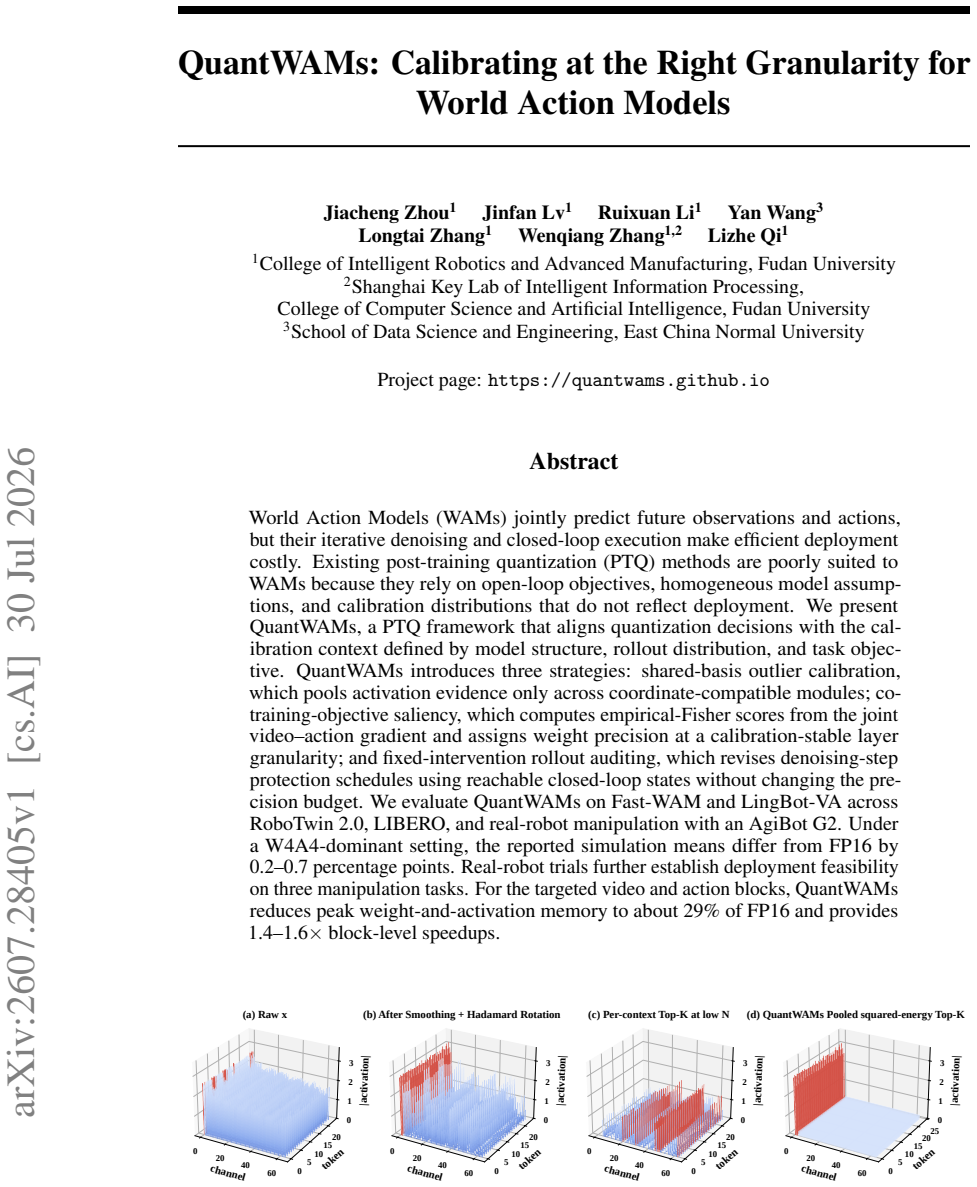
Calibration context: each quantization decision is treated as a finite-sample estimate that must match three axes at once—shared-basis pooling only where modules share quantizer coordinates, joint video–action empirical-Fisher saliency at layer granularity, and fixed-intervention replay that revises denoising-step protection on reachable FP16 rollout states without changing the bit budget.
What would settle it
On the same Fast-WAM or LingBot-VA checkpoints and RoboTwin/LIBERO protocols, a matched W4A4-dominant budget whose masks, layer upgrades, or protected denoising steps are chosen without shared-basis screening, joint co-training Fisher, or fixed-intervention replay would close most of the gap to QuantWAMs’ near-FP16 success; if it does not, or if success collapses under modest calibration-set or rollout-distribution shift, the central claim fails.
Extended reading notes
Core claim
QuantWAMs claims that aligning post-training quantization with the structural, distributional, and objective calibration context of World Action Models recovers near–full-precision closed-loop success under a W4A4-dominant schedule: simulation means differ from FP16 by only 0.2–0.7 points while cutting targeted video/action block peak weight-and-activation memory to roughly 29% of FP16 and delivering 1.4–1.6× block-level speedups.
Load-bearing premise
Local proxies fitted on only 32 calibration trajectories and 32 full-precision rollouts—channel energy masks, layer Fisher scores, and one-step replay errors—remain the right precision choices at deployment even though the method never optimizes closed-loop task return and early errors compound through later states.
Editorial extensions
If this is right
- PTQ for closed-loop multi-stream robot policies should screen which modules may share activation statistics rather than pool by convenience.
- Weight mixed-precision for jointly trained video–action models should score the combined gradient, not fuse single-stream scores after the fact.
- Denoising-step protection schedules should be audited on reachable closed-loop states under a fixed intervention, not on synthetic open-loop inputs alone.
- A mostly 4-bit WAM path can retain near-FP16 task success in simulation while cutting targeted block memory to about 29% of FP16.
- The same calibration recipe can transfer across dual-stream and shared-backbone WAM architectures with architecture-specific grouping rules.
Reading between the lines
- Any embodied policy whose early actions change later observations will inherit the same distributional mismatch unless calibration uses closed-loop states.
- Coordinate-admissible pooling may generalize to other multi-expert or multi-modal transformers where literal channel indices do not mean the same thing across paths.
- If one-step replay still misses long-horizon Jacobian products, future work may need multi-step counterfactual audits rather than larger bit budgets.
- Benchmark-specific 32-trajectory calibration leaves open whether a single frozen schedule transfers to held-out tasks without re-profiling.
Editorial analysis
A structured set of objections, weighed in public.
Referee Report
Summary. QuantWAMs is a post-training quantization framework for World Action Models (WAMs), which jointly denoise future video and actions in closed loop. The authors argue that standard PTQ fails because it uses open-loop objectives, homogeneous-module assumptions, and calibration states that do not match deployment. They organize decisions around a calibration context (structural scope, rollout distribution, objective) and propose three components: (i) shared-basis outlier calibration that pools squared-energy channel statistics only across coordinate-compatible modules, with a random-effects crossover N★ guiding when pooling helps; (ii) co-training-objective saliency that builds a joint video–action empirical Fisher and upgrades the top 20% of candidate Linears by layer-level score; (iii) fixed-intervention rollout auditing that reassigns a fixed K protected denoising steps using one-step unprotected replay on FP16 closed-loop states. On Fast-WAM and LingBot-VA, under a W4A4-dominant schedule, simulation success means on RoboTwin 2.0 and LIBERO differ from FP16 by 0.2–0.7 pp, with ~29% of FP16 peak weight-and-activation memory and 1.4–1.6× block-level speedups on targeted blocks. Real-robot trials on an AgiBot G2 show feasibility on three tasks.
Significance. If the empirical claims hold, this is a useful systems contribution for deploying multi-stream diffusion robot policies under tight memory/latency budgets. The paper’s main conceptual value is making calibration context (coordinate admissibility, closed-loop state distribution, joint objective) explicit rather than treating WAMs as generic transformers. Strengths include trajectory-disjoint cal/profile/val/test roles, three protocol seeds with large episode counts, matched-budget Atom*/SVDQuant* controls, cumulative and factor ablations on LIBERO-Long, an explicit pooling crossover analysis (Prop. 1, Fig. 3), and appropriately cautious language on real-robot non-inferiority and block-level (not end-to-end) efficiency. The work is primarily empirical/engineering rather than a new theoretical quantization guarantee, but it is well scoped for the embodied-AI systems audience.
major comments (3)
- [§4.2, Tables 1–2] §4.2 and Tables 1–2: Matched-budget Atom* and SVDQuant* equalize candidate modules, W8 count budget, outlier fraction, and protected-step cardinalities, but not the co-training backward pass or Dprof/Dval schedule audit. The large gap to QuantWAMs therefore conflates (a) better quantizer structure with (b) privileged calibration signals unavailable to the baselines. A load-bearing control would give baselines the same joint-gradient saliency and/or fixed-intervention schedule indices (or ablate those signals off QuantWAMs while keeping its quantizer). Without that, the claim that the three strategies—not extra information—drive near-FP16 success is only partially supported.
- [§3.3, Eqs. (18)–(21), Limitations] §3.3 Eqs. (18)–(21) and Limitations: Precision decisions are locked by local surrogates on 32 cal trajectories and 32 FP16 rollouts (energy Top-K, diagonal joint Fisher, one-step unprotected ℓt), while the paper correctly notes that closed-loop impact depends on products of transition Jacobians Aj, Bj that are never scored. Tables 1–2 establish strong in-distribution means, but the deployment rhetoric (abstract; §5) should be tightened to “benchmark-specific, in-distribution PTQ” unless the authors add a stress test under distribution shift (e.g., held-out task families, perturbed dynamics, or quantized-state replay for schedule selection). This is the central soft spot of the strongest claim, not an internal contradiction.
- [§4.5, Table 6] Table 6: Real-robot evidence is 10 trials per task (FP16 19/30, QuantWAMs 17/30, Atom* 12/30). The manuscript already disclaims equivalence, which is appropriate, but then “establish deployment feasibility” is doing a lot of work for a three-task, underpowered study on one platform. Either expand trials / report confidence intervals, or move real-robot results to a clearly labeled feasibility appendix and keep the primary claim on simulation Tables 1–2.
minor comments (6)
- [Title, headers] Title and running header alternate “QuantWAMs” / “QuantW AMs” / “QuantW AMs”; normalize spelling throughout.
- [Figure 2] Figure 2 is dense; the three-column overview would benefit from a short caption walk-through mapping each panel to §§3.1–3.3.
- [§3.1, Prop. 1] Eq. (5)–(7): define how bσ²c and bτ²c are estimated in the main text (currently deferred entirely to Appendix A); a one-line estimator would help readers interpret N★ screens.
- [Tables 1–2] Tables 1–2 report “Speedup” and “Mem. (GB)” for targeted blocks only; add an explicit footnote on every table (not only §4.2) that these are not end-to-end control-loop metrics.
- [§4.2 Quantization configuration] Clarify whether λv, λa and the 2%/20%/K hyperparameters were tuned on Dval or fixed a priori from training; free-parameter sensitivity belongs in the appendix if space is tight.
- [§2] Related Work on VLA quantization is brief; a sentence contrasting open-loop action-reconstruction metrics with closed-loop WAM success would sharpen the novelty claim.
Circularity Check
No significant circularity: empirical PTQ methods evaluated on held-out closed-loop benchmarks, not tautological derivations.
full rationale
QuantWAMs presents three calibration procedures (shared-basis Top-K masks under a random-effects pooling model, joint empirical-Fisher layer saliency from the pretrained co-training loss, and fixed-intervention Top-K schedule repair on FP16 rollouts) and reports closed-loop success on RoboTwin 2.0, LIBERO, and real-robot trials against external baselines. None of the load-bearing claims reduces by construction to its inputs. Proposition 1 is a standard finite-sample MSE comparison under an explicit working model and is not used as a closed-loop optimality proof (the paper states this restriction). Joint saliency reuses the original video–action training objective as a gradient-assisted PTQ signal; task success is measured separately on trajectory-disjoint test sets, so the success metric is not forced by the Fisher scores. Schedule indices are proposed from Dprof, accepted or rejected on Dval, and frozen before Dtest—standard proposal-and-validation, not fitted-input-as-prediction. Architecture grouping rules follow coordinate admissibility of the quantizer input and are methodological constraints, not self-defining theorems. No uniqueness theorem, self-citation chain, or renamed known law carries the central 0.2–0.7 pp claim. The paper is self-contained empirical systems work; residual risk is finite-sample surrogate validity (Limitations), not circularity.
Assumptions & free parameters
free parameters (6)
- outlier channel fraction ρ (top 2% BF16 bypass) =
0.02
- weight upgrade budget B = floor(0.2 |L|) =
20% of candidate Linears
- protected denoising-step counts K =
1; 2 and 6
- calibration and profile set sizes =
N_cal=N_prof=32
- rank-window half-width h for N★ screen =
not numerically fixed in main text
- co-training loss weights λv, λa =
training defaults (unspecified numerically)
assumptions (6)
- ad hoc to paper Equal-cost squared-energy Top-K on pooled channel statistics is the right surrogate for which activation channels to keep in high precision.
- domain assumption Literal channel indices may be shared iff modules share a common ordered basis after a group-common Hadamard and only diagonal per-context smoothing (coordinate admissibility).
- ad hoc to paper Random-effects decomposition z=μ+τη+σξ yields a usable pooling risk crossover N★=σ²/τ² for mask decisions.
- domain assumption Diagonal Kronecker-factored empirical Fisher under the joint co-training loss is a sufficient saliency for layer bit allocation.
- domain assumption One-step unprotected replay discrepancy on FP16 reachable states is informative enough to repair which K denoising steps to protect, despite first-order dependence on transition Jacobian products.
- domain assumption Standard PTQ operators (uniform low-bit quantizers, GPTQ compensation via Σ, Hadamard+smoothing) preserve task behavior when the above contexts are correct.
invented entities (3)
-
Calibration context triple (scope G, state distribution D̂, objective L)
-
Fixed-intervention rollout audit profile S_replay_ref
-
Shared-basis pooled-energy Top-K mask groups for MoT / shared-backbone WAMs
Cite this review
Pith. "Pith review of QuantWAMs: Calibrating at the Right Granularity for World Action Models." pith.science (2026). https://pith.science/paper/DDCCKZKU
@misc{pith2026260728405,
  author       = {Pith},
  title        = {Pith review of: QuantWAMs: Calibrating at the Right Granularity for World Action Models},
  year         = {2026},
  howpublished = {\url{https://pith.science/paper/DDCCKZKU}},
  note         = {Machine review of arXiv:2607.28405}
}
abstract
World Action Models (WAMs) jointly predict future observations and actions, but their iterative denoising and closed-loop execution make efficient deployment costly. Existing post-training quantization (PTQ) methods are poorly suited to WAMs because they rely on open-loop objectives, homogeneous model assumptions, and calibration distributions that do not reflect deployment. We present QuantWAMs, a PTQ framework that aligns quantization decisions with the calibration context defined by model structure, rollout distribution, and task objective. QuantWAMs introduces three strategies: shared-basis outlier calibration, which pools activation evidence only across coordinate-compatible modules; co-training-objective saliency, which computes empirical-Fisher scores from the joint video--action gradient and assigns weight precision at a calibration-stable layer granularity; and fixed-intervention rollout auditing, which revises denoising-step protection schedules using reachable closed-loop states without changing the precision budget. We evaluate QuantWAMs on Fast-WAM and LingBot-VA across RoboTwin 2.0, LIBERO, and real-robot manipulation with an AgiBot G2. Under a W4A4-dominant setting, the reported simulation means differ from FP16 by 0.2--0.7 percentage points. Real-robot trials further establish deployment feasibility on three manipulation tasks. For the targeted video and action blocks, QuantWAMs reduces peak weight-and-activation memory to about 29\% of FP16 and provides 1.4--1.6$\times$ block-level speedups.
Figures


Figures from the paper (2 more)


Reference graph
Works this paper leans on
-
[1]
Motus: A unified latent action world model.arXiv preprint arXiv:2512.13030,
Hongzhe Bi, Hengkai Tan, Shenghao Xie, Zeyuan Wang, Shuhe Huang, Haitian Liu, Ruowen Zhao, Yao Feng, Chendong Xiang, Yinze Rong, et al. Motus: A unified latent action world model.arXiv preprint arXiv:2512.13030,
-
[3]
Q-dit: Accurate post-training quantization for diffusion transformers
Lei Chen, Yuan Meng, Chen Tang, Xinzhu Ma, Jingyan Jiang, Xin Wang, Zhi Wang, and Wenwu Zhu. Q-dit: Accurate post-training quantization for diffusion transformers. InProceedings of the Computer Vision and Pattern Recognition Conference, pages 28306–28315, 2025a. Tianxing Chen, Zanxin Chen, Baijun Chen, Zijian Cai, Yibin Liu, Zixuan Li, Qiwei Liang, Xianli...
-
[4]
Elias Frantar, Saleh Ashkboos, Torsten Hoefler, and Dan Alistarh. Gptq: Accurate post-training quantization for generative pre-trained transformers.arXiv preprint arXiv:2210.17323,
-
[6]
Video generators are robot policies.arXiv preprint arXiv:2508.00795,
Junbang Liang, Pavel Tokmakov, Ruoshi Liu, Sruthi Sudhakar, Paarth Shah, Rares Ambrus, and Carl V ondrick. Video generators are robot policies.arXiv preprint arXiv:2508.00795,
-
[8]
Yuhao Xu, Yantai Yang, Zhenyang Fan, Yufan Liu, Yuming Li, Bing Li, and Zhipeng Zhang. Qvla: Not all channels are equal in vision-language-action model’s quantization.arXiv preprint arXiv:2602.03782,
-
[10]
Fast-wam: Do world action models need test-time future imagination?arXiv preprint arXiv:2603.16666,
Tianyuan Yuan, Zibin Dong, Yicheng Liu, and Hang Zhao. Fast-wam: Do world action models need test-time future imagination?arXiv preprint arXiv:2603.16666,
-
[11]
Jingxuan Zhang, Yunta Hsieh, Zhongwei Wan, Haokun Lin, Xin Wang, Ziqi Wang, Yingtie Lei, and Mi Zhang. Quantvla: Scale-calibrated post-training quantization for vision-language-action models.arXiv preprint arXiv:2602.20309,
-
[12]
Tianchen Zhao, Tongcheng Fang, Haofeng Huang, Enshu Liu, Rui Wan, Widyadewi Soedarmadji, Shiyao Li, Zinan Lin, Guohao Dai, Shengen Yan, et al. Vidit-q: Efficient and accurate quantization of diffusion transformers for image and video generation.arXiv preprint arXiv:2406.02540, 2024a. Yilong Zhao, Chien-Yu Lin, Kan Zhu, Zihao Ye, Lequn Chen, Size Zheng, Lu...
Show all 12 references
-
[2011]
Post-training quantization on diffusion models
12 Yuzhang Shang, Zhihang Yuan, Bin Xie, Bingzhe Wu, and Yan Yan. Post-training quantization on diffusion models. InProceedings of the IEEE/CVF conference on computer vision and pattern recognition, pages 1972–1981,
1972
-
[2023]
Causal world modeling for robot control.arXiv preprint arXiv:2601.21998,
Lin Li, Qihang Zhang, Yiming Luo, Shuai Yang, Ruilin Wang, Fei Han, Mingrui Yu, Zelin Gao, Nan Xue, Xing Zhu, et al. Causal world modeling for robot control.arXiv preprint arXiv:2601.21998,
-
[2025]
Worldvla: Towards autoregressive action world model.arXiv preprint arXiv:2506.21539,
Jun Cen, Chaohui Yu, Hangjie Yuan, Yuming Jiang, Siteng Huang, Jiayan Guo, Xin Li, Yibing Song, Hao Luo, Fan Wang, et al. Worldvla: Towards autoregressive action world model.arXiv preprint arXiv:2506.21539,
-
[2026]
World action models are zero-shot policies.arXiv preprint arXiv:2602.15922,
Seonghyeon Ye, Yunhao Ge, Kaiyuan Zheng, Shenyuan Gao, Sihyun Yu, George Kurian, Suneel Indupuru, You Liang Tan, Chuning Zhu, Jiannan Xiang, et al. World action models are zero-shot policies.arXiv preprint arXiv:2602.15922,
Reviewed July 31, 2026 · model on record in the stance chip above.
Discussion (0). Sign in to comment.