REVIEW 3 major objections 5 minor 53 references
CENDRe: Concept Extraction with Natural Domain Representations
T0 review · 3 major / 5 minor · reviewed 2026-08-03 · deepseek-v4-flash
Pith's one-line read CENDRe introduces concept extraction for time-series CNNs that works in both the time and frequency domains, selects the number of concepts automatically, and reports higher importance correctness than prior baselines on synthetic benchmark
desk verdict Genuinely new frequency-domain concept extraction with unusually careful experiments, but the synthetic ground truth is strained and the abstract overstates the sRC comparison. read the letter →
The pith
A machine-rendered reading of the paper's core claim, the machinery that carries it, and where it could break.
The reading
What carries the argument
The load-bearing object is the per-timestep Local Aggregated Descriptor (LAD): a vector formed by concatenating upsampled activations from several probe layers at each timestep, so that similar local patterns produce similar descriptors regardless of position. Concept discovery runs in two stages — mini-batch k-means compresses LADs into micro-centroids, then silhouette-guided hierarchical aggregation groups these into concepts, determining K automatically. The transfer mechanism is the virtual inspection layer: a fixed, differentiable, invertible transform (for example, the real-input fast Fourier transform) inserted into the computation graph so that concept-presence gradients can be evalu
What would settle it
Train a CNN on a synthetic square-triangle dataset, then replace every square and triangle with the noisy baseline and measure accuracy: if accuracy stays high, the model does not rely on the annotated primitives, and the correctness scores against those masks would be high while explaining nothing real. For the frequency claim, verify the model uses only a single injected band (for example, by ablating that band and confirming accuracy drops), then check whether the aggregate frequency mask concentrates in that band; if the mask mass sits elsewhere, the virtual-inspection gradient has failed
Extended reading notes
Core claim
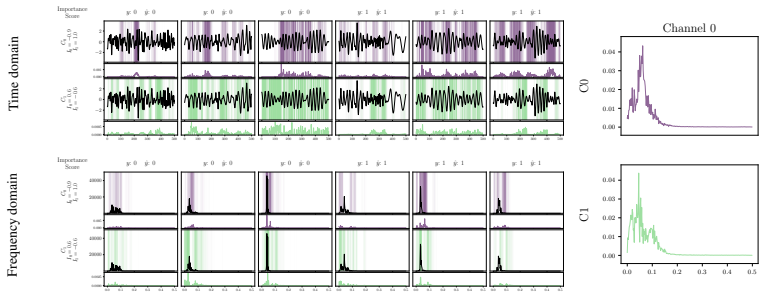
CENDRe claims that a single concept-extraction pipeline can yield concept masks in any invertible, interpretable signal domain. It discovers concepts by clustering per-timestep latent descriptors in two stages, using silhouette-guided aggregation to set the number of concepts K automatically. Each concept is then localized by backpropagating gradients of a contrastive presence score — a measure of how much a latent representation resembles its assigned prototype rather than other concepts' prototypes. Because these gradients are propagated through a differentiable invertible transform such as the Fourier transform, the same concept can be visualized in the frequency domain. On synthetic data
Load-bearing premise
The evaluation assumes that a CNN trained on the synthetic datasets actually relies on the injected class-discriminative primitives; the paper itself acknowledges that models often exploit only a portion of a primitive (a shortcut-learning pattern) and that this assumption is already strained, so if the models chiefly use other cues, the reported correctness scores measure alignment against the wrong reference.
Editorial extensions
If this is right
- Frequency-domain concept explanations become available for time-series CNNs without retraining or modifying the model, enabling inspection of spectral features that time-domain methods miss.
- The number of concepts is selected from latent structure rather than set by the user, removing a bias-inducing hyperparameter and making concept extraction less dependent on manual sweeps.
- Gradient-based localization concentrates masks on the regions driving each concept, which the paper ties to higher importance correctness on synthetic benchmarks.
- The same virtual-inspection mechanism extends to other exactly invertible transforms, such as short-time Fourier and wavelet transforms, giving time-frequency views of the same concepts.
- On bearing-fault signals, concepts localize in frequency bands that experts use for diagnosis, supporting model verification in a safety-relevant application.
Reading between the lines
- Editorial inference: if silhouette-selected K remains stable across seeds and datasets, the method could be used as a cheap model audit before deployment — flagging concepts that align with spurious spectral bands rather than physically meaningful ones; the paper reports stability but does not make this application claim.
- Editorial inference: the same virtual-inspection gradient could serve as a spectral shortcut detector: compare the aggregate frequency mask against known physical fault bands and flag any large mass outside them; this test would extend the method's diagnostic use beyond what the paper explicitly evaluates.
- Editorial inference: because LADs rely on approximate translation equivariance, CENDRe's concept discovery is likely to degrade on architectures without that property, such as transformers or state-space models; a position-aware or attention-weighted variant would be a natural next step, which the paper mentions only as future work.
Signed reviews
Editorial analysis
A structured set of objections, weighed in public.
Referee Report
Summary. CENDRe is a post-hoc concept extraction method for 1D CNNs on time series. It builds per-timestep LADs from probe layers, clusters them in two stages (micro-clusters then concepts), selects the number of concepts automatically via silhouette maximization, localizes concepts with gradient masks in the time and frequency domains through virtual inspection layers, and computes per-concept class importance scores. The paper claims three advances: the first CE method to extract concepts in both time and frequency domains, automatic concept-number selection, and gradient-based localization that concentrates on regions the model actually uses. Experiments on synthetic datasets (SYNTHETICLOCAL, SYNTHETICFREQUENCY) and real bearing-fault data (CWRU, BearingPD) are reported, with the headline claims that CENDRe achieves representation correctness comparable to prior CE methods and significantly higher importance correctness, and that its frequency masks recover ground-truth bands on synthetic data and characteristic fault frequencies on CWRU.
Significance. If the empirical claims hold, CENDRe would be a useful step forward: it is the first time-series CE method with a principled frequency-domain concept visualization, the silhouette-based K selection replaces a manual sweep, and the derivation of the spectral mask (App. A) is clean and parameter-free. The experimental investment is unusually thorough: three architectures, 11 seeds, Holm-corrected Wilcoxon tests, sensitivity analysis over the micro-cluster count J, and disclosed HDBSCAN failure rates. These strengths are real. However, the central evaluation premise — that models trained on the synthetic data rely on the injected primitives — is explicitly admitted in the paper to be strained, and the comparison protocol contains an oracle-K bias. These issues affect the load-bearing claims about importance correctness and frequency-band recovery, so the headline result is not yet established at the level the abstract implies.
major comments (3)
- [Sec. 4 and App. B.2] The synthetic benchmark premise is load-bearing and is explicitly admitted to be strained. The paper states that CE evaluation 'assumes a model trained on these datasets relies on them' (Sec. 4), then reports a 'shortcut-learning pattern' where models exploit only a portion of a primitive (Sec. 5), and App. B.2 says the benchmarks are informative only if model behavior is strongly predictable from dataset construction, 'a property that is already strained.' If the model uses fragments or time-domain artifacts of injected spectral peaks, then the binary primitive masks are the wrong reference, and sRC/sIC measure alignment against a phantom ground truth. The abstract's 'significantly higher importance correctness' and the frequency-band recovery claims rest on this reference. Please add a direct check of model reliance on the primitives — e.g., accuracy drop when the primitive regions are
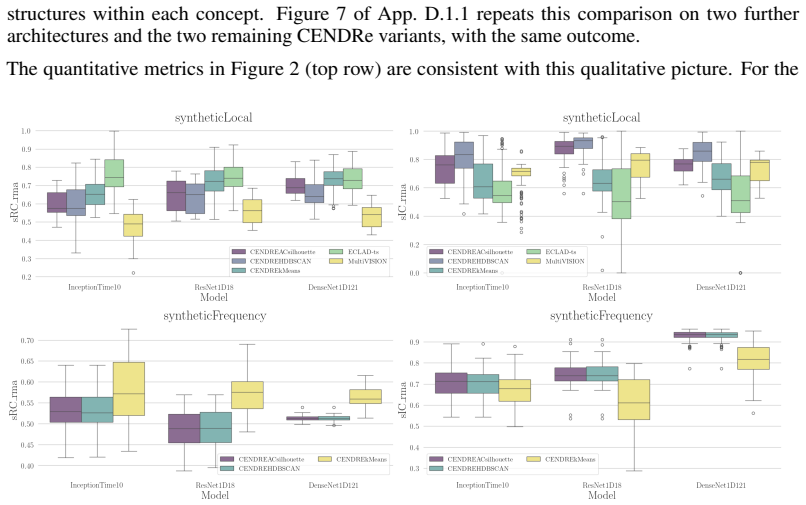
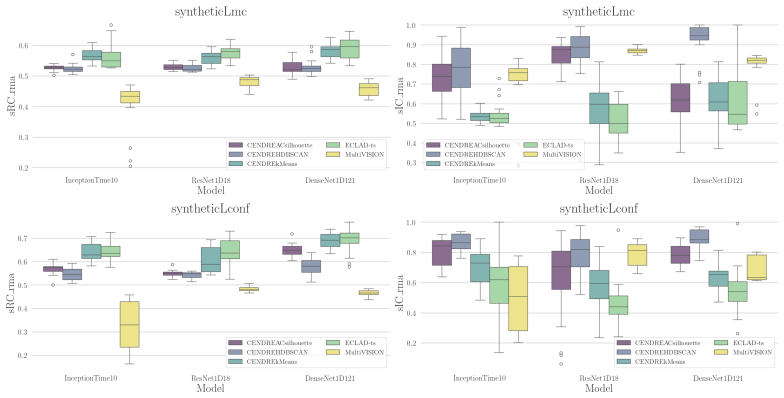
- [Sec. 4.2 and App. D.1.4] The comparison protocol is biased by an oracle K sweep for fixed-K methods. ECLAD-ts, MultiVISION, and CENDRekMeans are evaluated at the K in {2,4,6,8,10} with the highest sRC, whereas CENDResilhouette/HDBSCAN run once with automatic K. Thus the sRC gap on SYNTHETICLOCAL (Tables 5: ECLAD-ts 0.741 vs. CENDResilhouette 0.651) reflects partly selection on the metric. The paper acknowledges this (Sec. 5), but it is load-bearing because the 'comparable representation correctness' and 'higher importance correctness' claims are relative to an oracle-tuned baseline. Please report fixed-K methods at a non-oracle K (e.g., K=4, median of the sweep) or average over the sweep, and re-test the pairwise significance in Fig. 9 under that protocol.
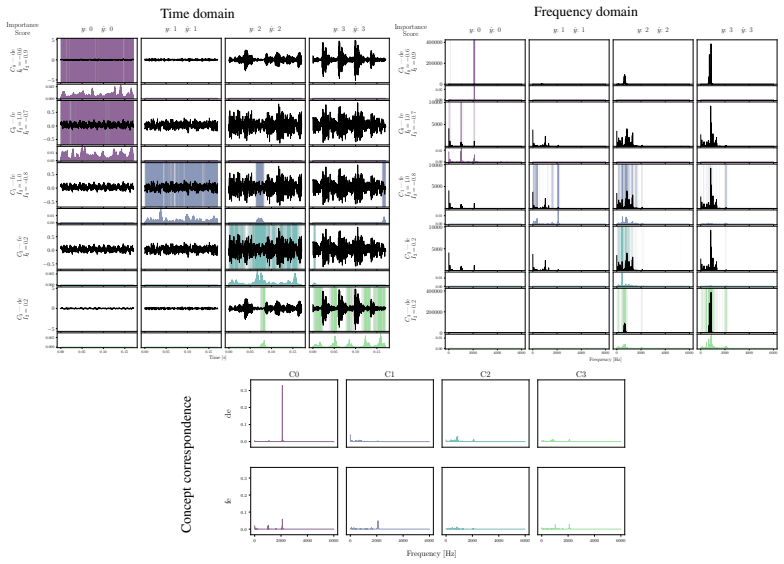
- [App. B.2 / Sec. 5 (SYNTHETICFREQUENCY)] Only CENDRe variants are evaluated on SYNTHETICFREQUENCY because the baselines lack a frequency-domain counterpart. The claim that frequency masks 'recover the ground-truth bands' is therefore not established against any baseline, and it inherits the unverified premise of the first major comment. The time-domain masks for this family are reported as uninterpretable (Fig. 3), so the only evidence of spectral grounding is the frequency-domain mask itself. Without showing that the model's predictions depend on those bands — e.g., by spectral masking of the injected bands and measuring accuracy drop, or by training a model on a version with the bands removed — the correspondence could be an artifact of the gradient propagation rather than faithful explanation. Please add a faithfulness check for the frequency domain.
minor comments (5)
- [Fig. 9] The header 'CENDREACsilhouette' should be 'CENDRe silhouette' to match the text and other figures.
- [Eq. (5)] The factor 0.5 in the definition of Ik,ch is unexplained; the contrast term is already a difference of means, so the constant scaling appears to carry no information. Please clarify or remove.
- [App. D.1.2] For the DWT visualization, the specific wavelet family and number of decomposition levels are not stated. Since the authors require exact invertibility, these details are needed for reproducibility.
- [General] No code or data availability statement is provided. Given the complexity of the pipeline (virtual inspection layers, clustering, metrics), a public implementation would substantially improve reproducibility.
- [Sec. 4.2] The CE method is fit on only 256 samples. With J=50 micro-clusters, this is about 5 samples per micro-cluster before aggregation; a brief comment on how this interacts with silhouette stability would be useful.
Circularity Check
No significant circularity: the derivation is self-contained; the strained synthetic ground-truth assumption is a validity risk, not a circular reduction.
full rationale
The derivation chain is self-contained. CENDRe's concept masks are defined as gradients of a contrastive presence score (Eqs. 3-4) with respect to the input or its FFT, and neither the masks nor the importance score Eq. (5) incorporate the ground-truth primitive masks. The synthetic evaluation compares these gradients against externally injected primitive masks, and the frequency ground truth is the set of injected FFT bins, not a re-labeling of CENDRe's own output. The importance score is an overlap of a concept mask with the logit sensitivity; sIC then weights this by alignment to primitives, so the metric is not forced by construction. The only endogenous quantities are the micro-cluster count J and the silhouette-selected K, and App. E quantifies J's influence (S_J^1 ≈ 0.022 for sRC), so no fitted parameter is renamed as a prediction. Self-citations to ECLAD-ts/ECLAD supply the LAD representation, probe layers, and a baseline, but the main claims (frequency-domain concepts, automatic K, importance correctness) do not reduce to those citations. The admitted shortcut-learning concern (Sec. 5, App. B.2) is a validity risk about whether trained CNNs use the injected primitives, not a circularity in the method's derivation.
Assumptions & free parameters
free parameters (7)
- J (number of micro-clusters) =
50 (default)
- Probe layer selection =
per architecture (Table 4)
- K search range for silhouette =
{2,...,10}
- HDBSCAN min_cluster_size =
5
- Noise tunnel parameters =
5 samples, σ=0.01 masks, σ=0.1 sensitivities, moving average 5
- CE sample budget =
256 samples
- Oracle K sweep for baselines =
K ∈ {2,4,6,8,10}, best sRC
assumptions (6)
- domain assumption Approximate translation equivariance of 1D CNNs makes per-timestep LADs comparable across positions
- domain assumption Models trained on synthetic datasets rely on the injected primitives
- standard math rFFT is a differentiable, invertible mapping (virtual inspection layer)
- standard math Wirtinger calculus conventions of automatic-differentiation libraries (∇_xf E = ∂_x̄f E; real steepest ascent direction 2∇_xf E)
- domain assumption The k-means assignment π(x,t) is treated as fixed when backpropagating through the presence score
- domain assumption RMA and the soft correctness scores sRC/sIC are valid measures of explanation quality
Cite this review
Pith. "Pith review of CENDRe: Concept Extraction with Natural Domain Representations." pith.science (2026). https://pith.science/paper/TRNCRG3A
@misc{pith2026260729621,
  author       = {Pith},
  title        = {Pith review of: CENDRe: Concept Extraction with Natural Domain Representations},
  year         = {2026},
  howpublished = {\url{https://pith.science/paper/TRNCRG3A}},
  note         = {Machine review of arXiv:2607.29621}
}
read the original abstract
Convolutional neural networks (CNNs) are widely used for time-series classification, but their deployment in critical domains requires understanding the temporal and spectral patterns that drive their predictions. Concept extraction (CE) methods identify such patterns by analyzing representations within the models' latent space. However, existing time-series CE methods have three limitations: they operate only in the time domain and overlook frequency features, predefine the number of concepts, and produce localizations misaligned with the regions the model uses. We address these limitations by proposing CENDRe, a concept extraction method for CNNs. It first discovers concepts by clustering per-timestep latent representations in two stages, where silhouette-guided aggregation selects the number of concepts automatically. Then, it localizes each concept through gradients of a presence score that contrasts the latent representations with their prototypes, producing masks that concentrate on the regions driving the concept. These gradients, propagated through a differentiable invertible mapping of the input such as a Fourier transform, yield localizations for the same concepts in the frequency domain. Finally, each concept receives a relevance score that quantifies its contribution to each class. On synthetic benchmarks, CENDRe achieves representation correctness comparable to state-of-the-art CE methods and significantly higher importance correctness. On real bearing-fault data, CENDRe extracts the frequency bands driving the model's predictions, located in regions commonly inspected for fault diagnosis, producing evidence to assess the model that time-domain CE methods cannot.
Figures


Figures from the paper (14 more)






Reference graph
Works this paper leans on
-
[1]
Jason Ansel, Edward Yang, Horace He, Natalia Gimelshein, Animesh Jain, Michael V oznesen- sky, Bin Bao, Peter Bell, David Berard, Evgeni Burovski, Geeta Chauhan, Anjali Chourdia, Will Constable, Alban Desmaison, Zachary DeVito, Elias Ellison, Will Feng, Jiong Gong, Michael Gschwind, Brian Hirsh, Sherlock Huang, Kshiteej Kalambarkar, Laurent Kirsch, Michae...
-
[2]
Clevr-xai: A benchmark dataset for the ground truth evaluation of neural network explanations.Information Fusion, 81:14–40, 2022
Leila Arras, Ahmed Osman, and Wojciech Samek. Clevr-xai: A benchmark dataset for the ground truth evaluation of neural network explanations.Information Fusion, 81:14–40, 2022
2022
-
[3]
Princeton university press, 2021
Karl Johan Åström and Richard Murray.Feedback systems: an introduction for scientists and engineers. Princeton university press, 2021
2021
-
[4]
Random search for hyper-parameter optimization.Journal of machine learning research, 13(2), 2012
James Bergstra and Yoshua Bengio. Random search for hyper-parameter optimization.Journal of machine learning research, 13(2), 2012
2012
-
[5]
FreqRISE: Explaining time series using frequency masking
Thea Brüsch, Kristoffer K Wickstrøm, Mikkel N Schmidt, Tommy S Alstrøm, and Robert Jenssen. Explaining time series models using frequency masking.arXiv preprint arXiv:2406.13584, 2024. doi: 10.48550/arXiv.2406.13584
work page Pith review arXiv doi:10.48550/arxiv.2406.13584 2024
-
[6]
Density-based clustering based on hierarchical density estimates
Ricardo JGB Campello, Davoud Moulavi, and Jörg Sander. Density-based clustering based on hierarchical density estimates. InPacific-Asia conference on knowledge discovery and data mining, pages 160–172. Springer, 2013
2013
-
[7]
An effective screening design for sensitivity analysis of large models.Environmental modelling & software, 22(10):1509–1518, 2007
Francesca Campolongo, Jessica Cariboni, and Andrea Saltelli. An effective screening design for sensitivity analysis of large models.Environmental modelling & software, 22(10):1509–1518, 2007
2007
-
[8]
This looks like that: deep learning for interpretable image recognition.Advances in neural information processing systems, 32, 2019
Chaofan Chen, Oscar Li, Daniel Tao, Alina Barnett, Cynthia Rudin, and Jonathan K Su. This looks like that: deep learning for interpretable image recognition.Advances in neural information processing systems, 32, 2019
2019
Show all 53 references
-
[9]
Time is not enough: Time- frequency based explanation for time-series black-box models
Hyunseung Chung, Sumin Jo, Yeonsu Kwon, and Edward Choi. Time is not enough: Time- frequency based explanation for time-series black-box models. InProceedings of the 33rd ACM International Conference on Information and Knowledge Management, pages 394–403, 2024. doi: 10.1145/36...
2024
-
[10]
Towards prototype-based self-explainable graph neural network
Enyan Dai and Suhang Wang. Towards prototype-based self-explainable graph neural network. ACM Transactions on Knowledge Discovery from Data, 19(2):1–20, 2025
2025
-
[11]
The ucr time series classification archive, October 2018
Hoang Anh Dau, Eamonn Keogh, Kaveh Kamgar, Chin-Chia Michael Yeh, Yan Zhu, Shaghayegh Gharghabi, Chotirat Ann Ratanamahatana, Yanping, Bing Hu, Nurjahan Begum, Anthony Bagnall, Abdullah Mueen, and Hexagon-ML Batista, Gustavo. The ucr time series classification archive, October 2018
2018
-
[12]
Explaining Deep Neural Networks for Bearing Fault Detection with Vibration Concepts
Thomas Decker, Michael Lebacher, and V olker Tresp. Explaining Deep Neural Networks for Bearing Fault Detection with Vibration Concepts. InINDIN, pages 1–6, 2023. doi: 10.1109/INDIN51400.2023.10218170
2023
-
[13]
Deformable protopnet: An interpretable image classifier using deformable prototypes
Jon Donnelly, Alina Jade Barnett, and Chaofan Chen. Deformable protopnet: An interpretable image classifier using deformable prototypes. InProceedings of the IEEE/CVF conference on computer vision and pattern recognition, pages 10265–10275, 2022
2022
-
[14]
A multi-scale cnn for transfer learning in semg-based hand gesture recognition for prosthetic devices.Sensors, 24(22):7147, 2024
Riccardo Fratti, Niccolò Marini, Manfredo Atzori, Henning Müller, Cesare Tiengo, and Franco Bassetto. A multi-scale cnn for transfer learning in semg-based hand gesture recognition for prosthetic devices.Sensors, 24(22):7147, 2024
2024
-
[15]
Towards Automatic Concept- based Explanations
Amirata Ghorbani, James Wexler, James Y Zou, and Been Kim. Towards Automatic Concept- based Explanations. InNeurIPS, volume 32. Curran Associates, Inc., 2019
2019
-
[16]
Deep residual learning for image recognition
Kaiming He, Xiangyu Zhang, Shaoqing Ren, and Jian Sun. Deep residual learning for image recognition. InCVPR, pages 770–778, 2016
2016
-
[17]
Classification of time series by shapelet transformation.Data mining and knowledge discovery, 2014
Jon Hills, Jason Lines, Edgaras Baranauskas, James Mapp, and Anthony Bagnall. Classification of time series by shapelet transformation.Data mining and knowledge discovery, 2014. 11
2014
-
[18]
A simple sequentially rejective multiple test procedure.Scandinavian journal of statistics, pages 65–70, 1979
Sture Holm. A simple sequentially rejective multiple test procedure.Scandinavian journal of statistics, pages 65–70, 1979
1979
-
[19]
Concept extraction for time series with eclad-ts
Antonia Holzapfel, Andres Felipe Posada Moreno, and Sebastian Trimpe. Concept extraction for time series with eclad-ts. InWorld Conference on Explainable Artificial Intelligence, pages 90–112. Springer, 2025
2025
-
[20]
Densely connected convolutional networks
Gao Huang, Zhuang Liu, Laurens Van Der Maaten, and Kilian Q Weinberger. Densely connected convolutional networks. InCVPR, pages 4700–4708, 2017
2017
-
[21]
Inceptiontime: Finding alexnet for time series classification.Data Mining and Knowledge Discovery, 34(6):1936–1962, 2020
Hassan Ismail Fawaz, Benjamin Lucas, Germain Forestier, Charlotte Pelletier, Daniel F Schmidt, Jonathan Weber, Geoffrey I Webb, Lhassane Idoumghar, Pierre-Alain Muller, and François Petitjean. Inceptiontime: Finding alexnet for time series classification.Data Mining and Knowle...
1936
-
[22]
PACE: Posthoc Architecture- Agnostic Concept Extractor for Explaining CNNs
Vidhya Kamakshi, Uday Gupta, and Narayanan C Krishnan. PACE: Posthoc Architecture- Agnostic Concept Extractor for Explaining CNNs. InIJCNN, pages 1–8, 2021. doi: 10.1109/ IJCNN52387.2021.9534369
2021
-
[23]
The simple difference formula: An approach to teaching nonparametric correla- tion.Comprehensive Psychology, 3:11–IT, 2014
Dave S Kerby. The simple difference formula: An approach to teaching nonparametric correla- tion.Comprehensive Psychology, 3:11–IT, 2014
2014
-
[24]
Interpretability Beyond Feature Attribution: Quantitative Testing with Concept Activation Vectors (TCA V)
Been Kim, Martin Wattenberg, Justin Gilmer, Carrie Cai, James Wexler, Fernanda Viegas, and Rory Sayres. Interpretability Beyond Feature Attribution: Quantitative Testing with Concept Activation Vectors (TCA V). InICML, pages 2668–2677. PMLR, 2018
2018
-
[25]
Time-frequency multi-domain 1d convolutional neural network with channel-spatial attention for noise-robust bearing fault diagnosis.Sensors, 23(23): 9311, 2023
Yejin Kim and Young-Keun Kim. Time-frequency multi-domain 1d convolutional neural network with channel-spatial attention for noise-robust bearing fault diagnosis.Sensors, 23(23): 9311, 2023
2023
-
[26]
Atrial fibrillation and atrial flutter detection using deep learning
Dimitri Kraft and Peter Rumm. Atrial fibrillation and atrial flutter detection using deep learning. Sensors, 25(13):4109, 2025
2025
-
[27]
Pywavelets: A python package for wavelet analysis.Journal of Open Source Software, 4(36):1237, 2019
Gregory Lee, Ralf Gommers, Filip Waselewski, Kai Wohlfahrt, and Aaron O’Leary. Pywavelets: A python package for wavelet analysis.Journal of Open Source Software, 4(36):1237, 2019
2019
-
[28]
Condition monitoring of bearing damage in electromechanical drive systems by using motor current signals of electric motors: A benchmark data set for data-driven classification
Christian Lessmeier, James Kuria Kimotho, Detmar Zimmer, and Walter Sextro. Condition monitoring of bearing damage in electromechanical drive systems by using motor current signals of electric motors: A benchmark data set for data-driven classification. InPHM society European ...
2016
-
[29]
Decoupled weight decay regularization.arXiv preprint arXiv:1711.05101, 2017
Ilya Loshchilov and Frank Hutter. Decoupled weight decay regularization.arXiv preprint arXiv:1711.05101, 2017
2017 arXiv
-
[30]
Concept-based explainability for an eeg transformer model
Anders Gjølbye Madsen, William Theodor Lehn-Schiøler, Áshildur Jónsdóttir, Bergdís Arnardóttir, and Lars Kai Hansen. Concept-based explainability for an eeg transformer model. InMLSP, pages 1–6. IEEE, 2023
2023
-
[31]
From confusion to clarity: Protoscore-a framework for evaluating prototype-based xai
Helena Monke, Benjamin Sae-Chew, Benjamin Fresz, and Marco F Huber. From confusion to clarity: Protoscore-a framework for evaluating prototype-based xai. InProceedings of the 2025 ACM Conference on Fairness, Accountability, and Transparency, pages 2215–2231, 2025
2025
-
[32]
Factorial sampling plans for preliminary computational experiments.Quality control and applied statistics, 37(6):307–310, 1992
Max D Morris. Factorial sampling plans for preliminary computational experiments.Quality control and applied statistics, 37(6):307–310, 1992
1992
-
[33]
Modern hierarchical, agglomerative clustering algorithms.arXiv preprint arXiv:1109.2378, 2011
Daniel Müllner. Modern hierarchical, agglomerative clustering algorithms.arXiv preprint arXiv:1109.2378, 2011
2011 arXiv
-
[34]
Generalized eta and omega squared statistics: measures of effect size for some common research designs.Psychological methods, 8(4):434, 2003
Stephen Olejnik and James Algina. Generalized eta and omega squared statistics: measures of effect size for some common research designs.Psychological methods, 8(4):434, 2003
2003
-
[35]
Pearson Education India, 1999
Alan V Oppenheim.Discrete-time signal processing. Pearson Education India, 1999
1999
-
[36]
Concept- based explainable artificial intelligence: A survey.ACM Computing Surveys, 2023
Eleonora Poeta, Gabriele Ciravegna, Eliana Pastor, Tania Cerquitelli, and Elena Baralis. Concept- based explainable artificial intelligence: A survey.ACM Computing Surveys, 2023. 12
2023
-
[37]
Scale-preserving automatic concept extraction (SPACE).Machine Learning, 112(11):4495– 4525, 2023
Andrés Felipe Posada-Moreno, Lukas Kreisköther, Tassilo Glander, and Sebastian Trimpe. Scale-preserving automatic concept extraction (SPACE).Machine Learning, 112(11):4495– 4525, 2023. doi: 10.1007/s10994-023-06373-2
2023 doi
-
[38]
ECLAD: Extracting Concepts with Local Aggregated Descriptors.Pattern Recognition, 147:110146, 2023
Andrés Felipe Posada-Moreno, Nikita Surya, and Sebastian Trimpe. ECLAD: Extracting Concepts with Local Aggregated Descriptors.Pattern Recognition, 147:110146, 2023
2023
-
[39]
Rolling element bearing diagnostics—a tutorial.Me- chanical systems and signal processing, 25(2):485–520, 2011
Robert B Randall and Jerome Antoni. Rolling element bearing diagnostics—a tutorial.Me- chanical systems and signal processing, 25(2):485–520, 2011
2011
-
[40]
A hybrid 1d cnn-bilstm model for epileptic seizure detection using multichannel eeg feature fusion.Biomedical physics & engineering express, 10 (3):035040, 2024
Swathy Ravi and Ashalatha Radhakrishnan. A hybrid 1d cnn-bilstm model for epileptic seizure detection using multichannel eeg feature fusion.Biomedical physics & engineering express, 10 (3):035040, 2024
2024
-
[41]
Silhouettes: a graphical aid to the interpretation and validation of cluster analysis.Journal of computational and applied mathematics, 20:53–65, 1987
Peter J Rousseeuw. Silhouettes: a graphical aid to the interpretation and validation of cluster analysis.Journal of computational and applied mathematics, 20:53–65, 1987
1987
-
[42]
John Wiley & Sons, 2008
Andrea Saltelli, Marco Ratto, Terry Andres, Francesca Campolongo, Jessica Cariboni, Debora Gatelli, Michaela Saisana, and Stefano Tarantola.Global sensitivity analysis: the primer. John Wiley & Sons, 2008
2008
-
[43]
Web-scale k-means clustering
David Sculley. Web-scale k-means clustering. InProceedings of the 19th international conference on World wide web, pages 1177–1178, 2010
2010
-
[44]
Smooth- grad: removing noise by adding noise.arXiv preprint arXiv:1706.03825, 2017
Daniel Smilkov, Nikhil Thorat, Been Kim, Fernanda Viégas, and Martin Wattenberg. Smooth- grad: removing noise by adding noise.arXiv preprint arXiv:1706.03825, 2017
2017 arXiv
-
[45]
Smith and Robert B
Wade A. Smith and Robert B. Randall. Rolling element bearing diagnostics using the Case West- ern Reserve University data: A benchmark study.Mechanical Systems and Signal Processing, 64–65:100–131, 2015
2015
-
[46]
Global sensitivity indices for nonlinear mathematical models and their monte carlo estimates.Mathematics and computers in simulation, 55(1-3):271–280, 2001
Ilya M Sobol. Global sensitivity indices for nonlinear mathematical models and their monte carlo estimates.Mathematics and computers in simulation, 55(1-3):271–280, 2001
2001
-
[47]
Convolutional neural networks for raw signal classification in cnc turning process monitoring
Emmanuel Stathatos, Evangelos Tzimas, Panorios Benardos, and George-Christopher V osniakos. Convolutional neural networks for raw signal classification in cnc turning process monitoring. Sensors, 24(5):1390, 2024
2024
-
[48]
Ex- plainable ai for time series via virtual inspection layers.Pattern Recognition, 150:110309, 2024
Johanna Vielhaben, Sebastian Lapuschkin, Grégoire Montavon, and Wojciech Samek. Ex- plainable ai for time series via virtual inspection layers.Pattern Recognition, 150:110309, 2024
2024
-
[49]
Individual comparisons by ranking methods
Frank Wilcoxon. Individual comparisons by ranking methods. InBreakthroughs in statistics: Methodology and distribution, pages 196–202. Springer, 1992
1992
-
[50]
Ptwt-the pytorch wavelet toolbox.Journal of Machine Learning Research, 25(80):1–7, 2024
Moritz Wolter, Felix Blanke, Jochen Garcke, and Charles Tapley Hoyt. Ptwt-the pytorch wavelet toolbox.Journal of Machine Learning Research, 25(80):1–7, 2024
2024
-
[51]
On completeness-aware concept-based explanations in deep neural networks
Chih-Kuan Yeh, Been Kim, Sercan Arik, Chun-Liang Li, Tomas Pfister, and Pradeep Ravikumar. On completeness-aware concept-based explanations in deep neural networks. InNeurIPS, volume 33, pages 20554–20565, 2020
2020
-
[52]
absence” masks described below. Shared generation parameters are summarized in Table 2. Negatives as primitives.A model can learn “absence of square
Raneen Younis, Sergej Zerr, and Zahra Ahmadi. Multivariate time series analysis: An inter- pretable cnn-based model. InInternational Conference on Data Science and Advanced Analytics (DSAA), pages 1–10. IEEE, 2022. A Derivation of the spectral concept mask This appendix derive...
2022
-
[2024]
doi: 10.1145/3620665.3640366
Reviewed August 3, 2026 · model on record in the stance chip above.
Discussion (0). Continue with ORCID to comment.