REVIEW 3 major objections 5 minor 15 references
CNN cuts charged-particle false hits fourfold in space X-ray detector
Reviewed by Pith at T0; open to challenge. T0 means a machine referee read the full paper against a public rubric. the ladder, T0–T4 →
T0 review · deepseek-v4-flash
2026-08-05 00:51 UTC pith:EBRPFTE6
load-bearing objection Honest, careful measurement of CNN vs grade-based event rejection on a pnCCD, but the headline 3.1% vs 10–12% advantage sits above 4 keV; inside the measured 1.4–4 keV sub-band the CNN is not better, which undercuts the mission-facing claim. the 3 major comments →
Development and Evaluation of a CNN-Based Charged-Particle Event Rejection Algorithm for Soft X-ray Detection in a pnCCD-Based Satellite System
The pith
A machine-rendered reading of the paper's core claim, the machinery that carries it, and where it could break.
Core claim
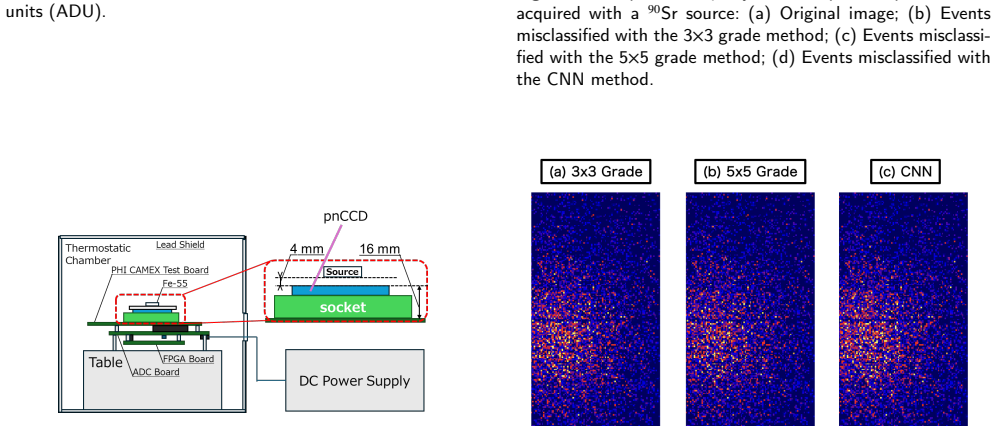
The paper's central claim is that, on this pnCCD prototype, a two-layer CNN with a 5x5 input window, 9,411 trainable parameters, and rotation/reflection augmentation achieves a beta-ray misclassification rate of 3.1 +/- 0.4% while accepting 98.1 +/- 0.2% of Fe-55 X-ray events, compared with 11.9 +/- 0.7% and 10.2 +/- 0.7% misclassification for the 3x3 and 5x5 grade methods, whose X-ray acceptance is 97.8% and 91.9%. The improvement is concentrated above about 4 keV, where grade methods misclassify compact, high-amplitude deposits that can come from charged particles; the CNN rejects these by learning the spatial morphology of charge spread. The paper further claims that the 450 micrometer fu
What carries the argument
The load-bearing object is a two-layer convolutional network that classifies 5x5-pixel charge-distribution patches centered on candidate events, using two 3x3 convolutional layers followed by dropout and two fully connected layers. It replaces the rule-based grade method, which uses event, split, and particle thresholds plus fixed pixel-pattern windows. The CNN's work is to learn the difference between the compact, radially spread charge cloud of an X-ray and the track-like or multi-pixel-heavy pattern of a charged particle, using both spatial correlations and relative signal amplitudes across pixels; that learned morphology is what lets it outperform the fixed windows, especially for compac
Load-bearing premise
Events are labeled by irradiation source: everything in the Fe-55 frames is called an X-ray and everything in the Sr-90 frames is called a charged particle, so if either dataset contains events of the other kind, the reported misclassification and acceptance rates are biased.
What would settle it
Use a beam-tagging or fast-coincidence readout that records each event's true source, X-ray line or electron, independently of the irradiation frame, then recompute the CNN's misclassification and acceptance; if the CNN's rates move toward the grade-method rates when labels are corrected, the claimed fourfold improvement is an artifact of source-based labeling.
If this is right
- In-orbit charged-particle contamination would drop by about a factor of four relative to grade methods while X-ray acceptance stays above 98%.
- The CNN's advantage is strongest above about 4 keV, so it extends the usable spectral range of the pnCCD beyond the nominal 0.4-4 keV trigger band.
- Because the network is compact and runs only on threshold-crossing candidates, real-time onboard FPGA implementation is plausible, though processing speed and power remain unmeasured.
- The classification gain depends on the detector's thick depletion layer; fully depleted sensors with a large sensitive volume will benefit most from this approach.
- The method still needs validation below 1.4 keV and against proton irradiation before it can be adopted for the mission band.
Where Pith is reading between the lines
- The source-based labeling is the main caveat: if Fe-55 frames contain any non-X-ray background or Sr-90 frames contain X-ray-like compact deposits, both the 3.1% and 98.1% figures shift; the paper says some label ambiguity is unavoidable.
- Because training used mainly about-6-keV Mn K lines, the classifier's behavior at 0.4-1.4 keV is an open question; a natural test is to retrain on low-energy line sources and measure acceptance as a function of energy.
- The CMOS comparison is cross-experiment, so a controlled head-to-head with identical source geometry, readout noise, and CNN training would be needed to attribute the difference to depletion depth rather than to other detector characteristics.
- The pile-up check suggests the CNN accepts many candidate pile-up events; a controlled coincidence experiment with two X-rays or an X-ray plus an electron would show whether pile-up inflates the measured X-ray acceptance.
Editorial analysis
A structured set of objections, weighed in public.
Referee Report
Summary. The paper reports the development of an FPGA-based readout for a prototype pnCCD and evaluates charged-particle rejection algorithms for the EAGLE wide-field X-ray monitor on HiZ-GUNDAM, whose science band is 0.4–4 keV. Using Fe-55 X-ray and Sr-90 beta-source irradiations, the authors compare conventional 3x3 and 5x5 grade methods with a compact CNN classifier. They report that over the full measured energy range (1.4–23 keV) the CNN reduces the beta misclassification rate from 11.9%/10.2% to 3.1%, while maintaining 98.1% X-ray acceptance compared with 97.8%/91.9% for the grade methods. The paper candidly states that the measured in-band portion (1.4–4 keV) shows comparable performance (0.7% CNN vs 0.4–0.5% grade) and that the main CNN advantage appears above 4 keV. Several limitations are acknowledged: evaluation is restricted to energies above ~1.4 keV, training X-rays are near 6 keV, only electrons are used as charged particles, and source-based labeling involves unavoidable ambiguity.
Significance. If the measured performance is robust, the CNN approach is a promising candidate for onboard event selection in a pnCCD-based X-ray monitor. The paper's strengths include the use of independent training and validation frames, five-fold cross-validation, Monte Carlo style Poisson uncertainties, and a candid discussion of experimental limitations. The comparison with a thin-depletion CMOS sensor is informative even if source conditions differ. However, the headline claim of a four-fold reduction in misclassification is computed over 1.4–23 keV, while the mission's science band is 0.4–4 keV. In the only measured sub-band inside the mission band (1.4–4 keV), the CNN is not better than the grade methods; if anything, it is slightly worse. Thus the mission-relevant benefit of the CNN is not established by the present data, and the abstract overstates the case. The work is still a useful engineering study, but the central claim needs substantial reframing and additional low-energy validation.
major comments (3)
- [§4.2, Table 4; Abstract] The headline comparison (3.1% vs 10.2–11.9%) is over 1.4–23 keV. Table 4 also gives the 1.4–4.0 keV misclassification rates: 0.4±0.1% (3x3 grade), 0.5±0.2% (5x5 grade), and 0.7±0.2% (CNN). The CNN is therefore not better than the grade methods in the measured portion of EAGLE's 0.4–4 keV band. The Abstract's statement that the CNN 'substantially reduces charged-particle contamination' is not justified for the mission band. The conclusion in §6.1 does acknowledge comparable low-energy performance, but the abstract and the introduction frame the improvement as broadly applicable. Separate the full-range and in-band results clearly in the abstract and avoid claiming mission-relevant improvement without this qualification.
- [§5.4] The evaluation is limited to deposited energies above ~1.4 keV, and the CNN was trained on Fe-55 X-rays near 6 keV. EAGLE's science band is 0.4–4 keV, so the entire 0.4–1.4 keV interval is untested. As the paper itself notes, lower-energy events produce simpler charge distributions and potentially reduce the CNN's advantage. Because the mission's primary science band is exactly the energy range in which the CNN has not been shown to help, the central mission-relevance claim is unsupported by the present measurements. This is not a minor caveat: the abstract's 'promising approach for onboard event selection in future pnCCD-based wide-field X-ray missions' depends on performance in the unmeasured low-energy band.
- [§5.3, §4.1] Event labels are assigned by irradiation source: all Fe-55 events are treated as X-rays and all Sr-90 events as charged particles after simple selection cuts. If the Fe-55 dataset contains non-X-ray background or the Sr-90 dataset contains compact X-ray-like deposits, both the 3.1% misclassification rate and the 98.1% acceptance rate are biased. The paper acknowledges this ambiguity, and the use of separate validation frames reduces circularity, but the reported uncertainties (Poisson only) do not include this systematic. The numerical values should be presented as conditional on the source-based labeling assumption, and a mixed-event or simulated-background validation is needed before the in-orbit performance can be trusted.
minor comments (5)
- [Table 4] The column header formatting is garbled: 'Misclassification rate X-ray acceptance rate1.4 − 23 keV 1.4 − 4.0 keV' is difficult to parse. Please restructure the table so that the energy range for each metric is explicitly clear.
- [§5.2] The CMOS comparison uses a different beta source (Bi-210, max 1.16 MeV) and a different energy range (0.4–7.5 keV) than the pnCCD measurement. This is noted in the text, but the table should carry a footnote so the comparison is not read as a direct apples-to-apples measurement.
- [§4.1] The particle threshold is set to the 14-bit ADC maximum (16383 ADU), which means no real rejection is performed for most sub-MeV electrons. The text explains that this is intended to catch muons, but it should be stated more explicitly that the grade methods effectively operate without a particle threshold for the beta source used here.
- [§5.4] The paper repeatedly says the CNN advantage is 'particularly pronounced at higher deposited energies' but does not quantify the threshold above which the advantage becomes statistically significant. Consider adding a cumulative or energy-binned comparison with confidence bounds.
- [§6.2] The phrase 'charge-transferefficiency' in the future-work paragraph is missing a space. Minor typographical issue.
Circularity Check
No significant circularity; the central result is a measured performance comparison on held-out data, not a derivation from fitted inputs.
full rationale
The central claim—CNN misclassification of beta-like events at 3.1% versus 10.2–11.9% for grade methods—is an experimental measurement, not a derivation. The CNN was trained on an 80% subset of labeled events and evaluated on a held-out 20% test subset plus an independently acquired 100-frame validation dataset for each source. Misclassification and acceptance rates are computed directly from counts of events that pass each classifier; no equation reduces one metric to another, and no fitted parameter is renamed as a prediction. The only self-citation, Ref. [11], is used to introduce the machine-learning approach and to provide a comparative CMOS measurement; it does not supply the pnCCD results, which are measured in this work. The paper also explicitly acknowledges limitations—label ambiguity due to source-based labeling, the 1.4 keV lower energy bound, the energy-band mismatch with the mission band, and the untested 0.4–1.4 keV region. These limit generalization and interpretation of the mission-relevant benefit, but they are not circularity: they do not make the reported 3.1% figure equivalent to the training labels or to any prior self-cited result by construction. Accordingly, there is no circular step to flag.
Axiom & Free-Parameter Ledger
free parameters (5)
- Event threshold =
5 sigma / 1000 ADU (~1.4 keV)
- Split threshold (grade method) =
3 sigma / 600 ADU (~0.8 keV)
- Particle threshold (grade method) =
16383 ADU (14-bit maximum)
- CNN decision threshold =
not stated for headline result (likely 0.5 softmax)
- CNN trained weights and hyperparameters =
9,411 parameters; 2 conv layers, dropout, 2 FC; Adam, batch 32, 250 epochs
axioms (4)
- domain assumption Events in Fe-55 frames are X-rays and events in Sr-90 frames are charged particles
- domain assumption Pixel noise is sufficiently Gaussian that 5-sigma and 3-sigma thresholds provide clean event selection
- ad hoc to paper Fe-55 X-rays near 6 keV are representative of X-ray charge morphologies in the 0.4-4 keV mission band
- domain assumption The AE8/SPENVIS model describes the orbital electron environment for HiZ-GUNDAM
Cite this review
Pith. "Pith review of Development and Evaluation of a CNN-Based Charged-Particle Event Rejection Algorithm for Soft X-ray Detection in a pnCCD-Based Satellite System." pith.science (2026). https://pith.science/paper/EBRPFTE6
@misc{pith2026260800476,
  author       = {Pith},
  title        = {Pith review of: Development and Evaluation of a CNN-Based Charged-Particle Event Rejection Algorithm for Soft X-ray Detection in a pnCCD-Based Satellite System},
  year         = {2026},
  howpublished = {\url{https://pith.science/paper/EBRPFTE6}},
  note         = {Machine review of arXiv:2608.00476}
}
read the original abstract
All-sky surveys in the soft X-ray band are essential for detecting transient objects such as high-redshift gamma-ray bursts (GRBs), which provide key insights into the early universe. HiZ-GUNDAM is a future satellite mission designed to detect and localize high-redshift GRBs. Its wide-field X-ray monitor, EAGLE, combines Lobster Eye Optics with a pnCCD imaging detector operating in the 0.4-4 keV band. Because of limited satellite telemetry, full-frame pnCCD images cannot be downlinked, requiring onboard event selection. Charged particles in the space environment produce background events that can be misidentified as X-ray photons, degrading detection sensitivity and potentially triggering false alerts. In this study, we developed a pnCCD readout system and evaluated charged-particle rejection using conventional grade methods and a convolutional neural network (CNN). Performance was evaluated using X-ray events from an Fe-55 source and electron events from a Sr-90 beta source. The CNN reduced the misclassification rate from 10.2-11.9% for conventional grade methods to 3.1% while maintaining a high acceptance rate for X-ray events. The improvement is particularly pronounced at higher deposited energies, reflecting the CNN's ability to distinguish track-like particle events from X-ray events by capturing detailed spatial features of charge distributions. Comparison with a thin-depletion-layer CMOS sensor further indicates that the thicker depletion layer of the pnCCD enhances discrimination performance. These results demonstrate that CNN-based event classification can substantially reduce charged-particle contamination while maintaining high X-ray acceptance, making it a promising approach for onboard event selection in future pnCCD-based wide-field X-ray missions.
Figures




Reference graph
Works this paper leans on
-
[1]
D.Yonetokuetal.Conceptofhigh-zgamma-rayburstsunravelingthe dark ages and extreme space-time mission—hiz-gundam.Journal of Astronomical Telescopes, Instruments, and Systems, 11(4):044002, 2025
work page 2025
-
[2]
M. Arimoto et al. Conceptual study of the eagle wide-field x-ray monitor onboard hiz-gundam.Journal of Astronomical Telescopes, Instruments, and Systems, 12(2):024006, 2026
work page 2026
-
[3]
AstrophysicalJournal, 233:364–373, 1979
J.R.P.Angel.Lobstereyesasx-raytelescopes. AstrophysicalJournal, 233:364–373, 1979
work page 1979
-
[4]
L. Strüder, P. Holl, G. Lutz, and J. Kemmer. Development of fully depletable CCDs for high energy physics applications. Nuclear Instruments and Methods in Physics Research A, 257(3):594–602, July 1987
work page 1987
- [5]
-
[6]
N. Meidinger et al. Development of the focal plane PNCCD camera system for the X-ray space telescope eROSITA.NuclearInstruments andMethodsinPhysicsResearchA, 624:321–329, (Dec. 2010)
work page 2010
-
[7]
K. Mercier et al. MXT instrument on-board the French-Chinese SVOM mission. In Space Telescopes and Instrumentation 2018: Ultraviolet to Gamma Ray, volume 10699 of Proc. SPIE, page 1069921, 2018
work page 2018
-
[8]
Camex readout asics for pnccds
Sven Herrmann, Werner Buttler, Robert Hartmann, Norbert Mei- dinger, Matteo Porro, and Lothar Strueder. Camex readout asics for pnccds. In2008 IEEE Nuclear Science Symposium Conference Record, pages 2952–2957, 2008
work page 2008
-
[9]
InAstronomicalTelescopes+ Instrumentation, Proc
H.C.Shenetal.Thestatusofpnccdwithanfpga-basedelectronicsys- tem for hiz-gundam. InAstronomicalTelescopes+ Instrumentation, Proc. SPIE, 2024. Shen et al.:Preprint submitted to ElsevierPage 8 of 9 Development and Evaluation of a CNN-Based Charged-Particle Event Rejection Algorithm for Soft X-ray Detection in a pnCCD-Based Satellite System
work page 2024
-
[10]
R. Kondo et al. Design and development of an fpga-based pnccd driver and readout system for future satellite mission hiz-gundam. In AstronomicalTelescopes+Instrumentation, Proc. SPIE, 2024
work page 2024
-
[11]
H. C. Shen et al. Application of the grade selection of X-ray events using machine learning for a CubeSat mission.Journal of Instrumentation, 18:C12012, (Dec. 2023)
work page 2023
-
[12]
TheX-RayAstronomySatelliteASCA
Y.Tanakaetal. TheX-RayAstronomySatelliteASCA. Publications ofthe AstronomicalSocietyof Japan, 46:L37–L41, (Jun. 1994)
work page 1994
-
[13]
K.Mitsudaetal. TheX-RayObservatorySuzaku. Publicationsofthe AstronomicalSocietyof Japan, 59:S1–S7, (Jan. 2007)
work page 2007
-
[14]
N. Ogino et al. Performance verification of next-generation si cmos soft x-ray detector for space applications.Nuclear Instruments and MethodsinPhysicsResearchSectionA:Accelerators,Spectrometers, DetectorsandAssociated Equipment, 987:164843, 2021
work page 2021
-
[15]
D. Heynderickx, B. Quaghebeur, E. Speelman, and E. Daly. Esa’s spaceenvironmentinformationsystem(spenvis):Awwwinterfaceto modelsofthespaceenvironmentanditseffects. In Proceedingsofthe 2000IEEE RadiationEffectsData Workshop, pages 48–50, 2000. Figure 1:Photograph of the small pnCCD used in this study. The pnCCD sensor is mounted at the center of the chip, ...
work page 2000
discussion (0)
Sign in with ORCID, Apple, or X to comment. Anyone can read and Pith papers without signing in.