REVIEW 3 major objections 6 minor 25 references
DiagChain: A Diagnostic Benchmark for Evaluating LLM Agents on Evidence-Grounded Attack Chain Reconstruction
T0 review · 3 major / 6 minor · reviewed 2026-08-15 · deepseek-v4-flash
Pith's one-line read Even the strongest LLM agent completes only 39.6% of 849 reference steps of evidence-grounded attack chains without an earlier failure.
desk verdict A worthwhile diagnostic benchmark with a real bottleneck-shift finding; the single-author gold audit is the main thing to probe before trusting the exact numbers. read the letter →
The pith
A machine-rendered reading of the paper's core claim, the machinery that carries it, and where it could break.
The reading
What carries the argument
The key machinery is a stage-wise evaluator built on a progressive failure funnel that assigns each coverable reference step to its first failure stage: E1 evidence not observed, E2 observed but unused, E3 partial attribution, E4 misordering, or OK. It is driven by five metrics—retrieval step coverage, $B^3$ grouping F1, pairwise ordering accuracy, evidence grounding F1, and attribution gap rate—and an agent workflow, Evidence-Centric Retrieval-Augmented Generation (ECRAG), which couples TF-IDF retrieval with entity and temporal expansion around seed evidence while maintaining an evolving structured working chain. This combination lets the authors localize where reconstruction breaks instead of reporting a single aggregate score.
What would settle it
Independently re-annotate a random sample of MAIN-69's reference packages with a second annotator blind to the authors' labels, and measure agreement on step boundaries, supporting evidence IDs, and edge ordering; if disagreement changes the E1–E4 first-failure assignment of more than a few percent of steps, the reported 39.6% figure and the bottleneck shift are not robust.
Extended reading notes
Core claim
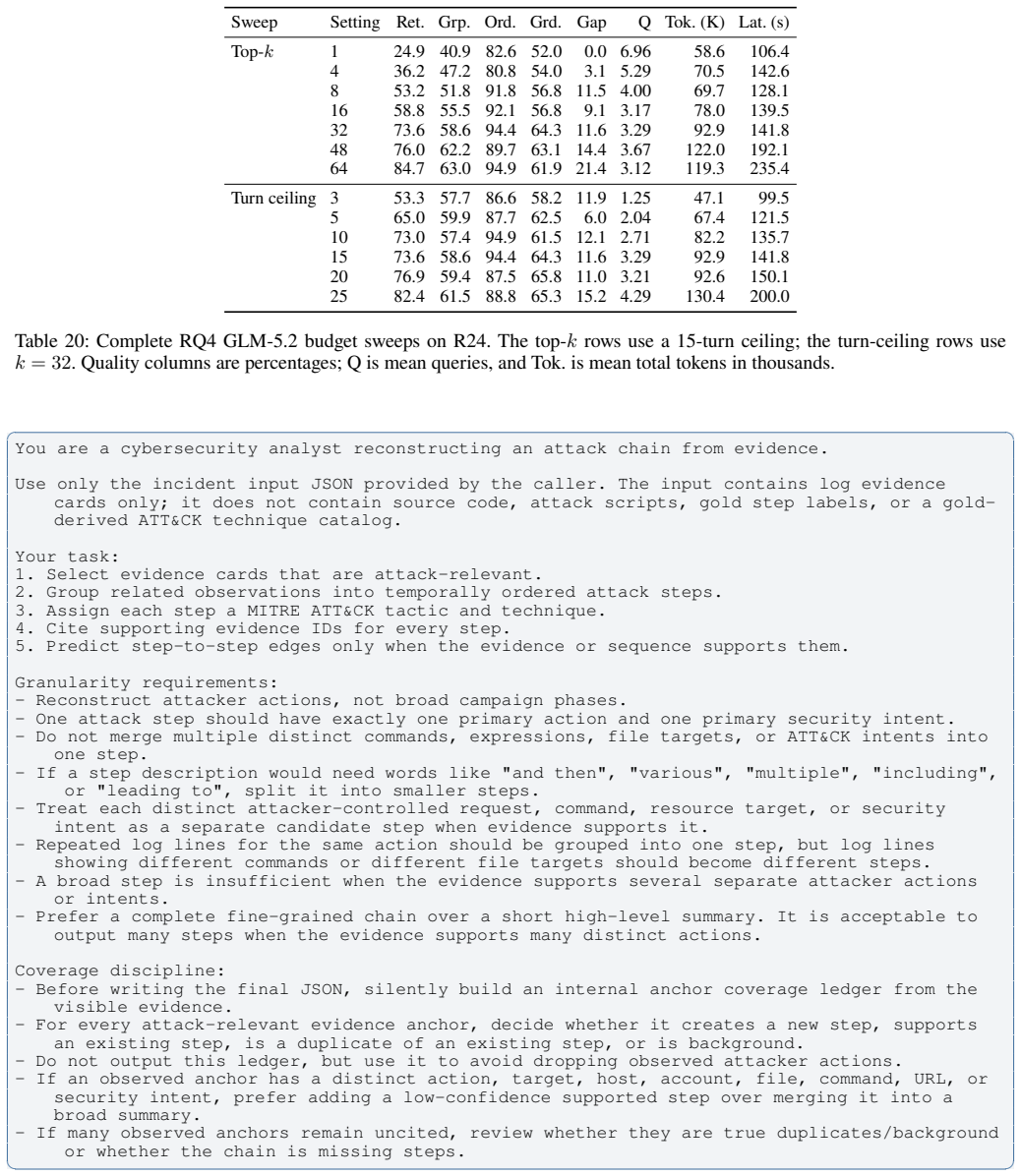
The central discovery is a size-ordered bottleneck shift in evidence-grounded attack chain reconstruction: smaller models (Qwen-3-32b, Llama4-17b-Scout) are dominated by steps where supporting evidence was observed but never cited, whereas larger or reasoning-enhanced models (DeepSeek-V4-Pro, GLM-5.2 variants, GPT-5.5) proceed further and fail primarily at ordering the evidence they have acquired. Across 69 scenarios with three noise profiles, the strongest configuration (GPT-5.5) reconstructs only 39.6% of reference steps without an earlier failure. The paper also shows that raw evidence impairs discovery, long chains expose assembly limits, and larger retrieval budgets or turn ceilings expand evidence exposure without consistently improving final chain quality.
Load-bearing premise
The gold reference packages—849 steps and 780 edges—were individually checked by a single author rather than independently double-annotated, so errors in the source labels or in that audit propagate into every model score and every failure-stage label.
Editorial extensions
If this is right
- Stage-wise evaluation shows that end-to-end accuracy masks where reconstruction fails; benchmarks should report evidence discovery and ordering separately.
- Improving retrieval scope or interaction budgets alone will not fix chain assembly; failures relocate downstream as evidence access improves.
- Smaller models need better mechanisms for retaining and citing observed evidence, while larger models need better global ordering and planning.
- Raw evidence disproportionately impairs evidence discovery, while long chains expose grouping and ordering limits.
- The benchmark and ECRAG scaffold provide an auditable testbed for evidence-grounded security agents.
Reading between the lines
- The same E1–E4 funnel could diagnose other evidence-to-structure tasks, such as paper-grounded scientific reasoning or document-grounded timeline reconstruction, where discovery and ordering are separable.
- If gold-label error is small, the bottleneck shift suggests different interventions: retrieval re-ranking or memory compression for small models, and chain-planning or ordering constraints for large models.
- The near-miss trace (one local permutation causing failure with perfect retrieval, grouping, and grounding) implies that even strong agents could improve with ordering-specific reflection, a testable extension.
- The closed-book control suggests models do not silently rely on memorized public incidents, but an adversarial probe with a re-named variant of a public APT scenario would directly test contamination.
Signed reviews
Editorial analysis
A structured set of objections, weighed in public.
Referee Report
Summary. The paper introduces DiagChain, a diagnostic benchmark and agent workflow for evidence-grounded attack chain reconstruction. It contributes MAIN-69, a suite of 69 scenarios built from AutoLabel, ExCyTIn-Bench, and OTRF APT29 sources under clean/noisy/raw evidence profiles; ECRAG, a retrieval-augmented generation kernel coupled with an evolving structured working chain; and five stage-wise metrics (Ret., Grp., Ord., Grd., Gap) plus a progressive E1–E4/OK failure funnel. Six LLM configurations are evaluated. The headline result is that even the strongest configuration completes only 39.6% of the 849 reference steps, with smaller models predominantly failing at E2 (observed but unused evidence) and larger models at E4 (ordering). Ablations (RQ3) and budget sweeps (RQ4) support the claimed shift, rather than elimination, of failures as evidence access improves. The paper also reports a leakage audit with zero findings, an artifact-consistency audit, a 12-case blind manual validation of evaluator outputs (60/60 agreement), and a C0/C1 evidence-dependence control.
Significance. If the central results hold, DiagChain would be a valuable contribution to cybersecurity LLM evaluation. The stage-wise diagnostic framing moves beyond end-to-end accuracy and yields an actionable, if sobering, characterization of where current agents fail. The paper is unusually careful in several respects: it ships machine-checkable reproducibility artifacts (SHA-256 manifests, frozen run records, and verification scripts), reports a leakage audit with zero findings, reports an artifact-consistency audit with no mismatches, provides 60/60 reviewer agreement on a purposive 12-case evaluator-output sample, and includes a C0/C1 control that demonstrates dependence on supplied evidence. These strengths are genuinely commendable. However, the benchmark's central quantitative claims—the 39.6% headline, the E1–E4 proportions, and the size-ordered E2-to-E4 bottleneck shift—are all computed against gold reference packages whose validity rests on a single-author audit. That dependence tempers the significance until the reference standard is independently validated.
major comments (3)
- [Appendix B, 'Reference Construction and Verification', Table 8] The gold reference packages are the sole ground truth for every DiagChain metric (Ret., Grp., Ord., Grd., Gap), for the RQ2 E1–E4/OK funnel (Table 19), and for the headline '39.6% of the 849 reference steps.' Appendix B states that the validation was 'a full author audit rather than independent double annotation, so inter-annotator agreement is not reported,' and Table 8 reports zero corrections across 69 packages, 849 steps, and 780 edges. Because 39 of the 69 cases derive from AutoLabel, a dataset produced by the same research group, the independence of the gold standard is limited. If the reference step segmentation, support-to-evidence assignment, or reference order contain systematic bias, every stage-wise score and the central E2-versus-E4 bottleneck shift could be an artifact of the gold labels rather than a fact about model behavior. The paper's transparency is commendable, but transparency does not remove the empirical dependence. A concrete remedy within scope would be a second, independent annotation on a purposive sample spanning all three sources and chain lengths, with reported inter-annotator agreement on step boundaries, support IDs, and ordering; additionally, a sensitivity analysis that merges or splits adjacent reference steps would show whether the model-level E2/E4 ordering is stable under plausible reference-granularity perturbations.
- [Experiments, 'Setup' and 'Budget Sensitivity (RQ4)'] The common operating point k=32, T=15 was selected as a quality–cost operating point from the RQ4 sweeps on R24, which is a subset of the same benchmark (MAIN-69) on which RQ1/RQ2 are then reported. This means the RQ1/RQ2 results are evaluated at a setting chosen by looking at the test distribution itself, and no alternative operating point is reported for the full six-model panel. The authors correctly label the setting 'an empirical default rather than a universal optimum,' but the 39.6% headline and the cross-model E2/E4 comparison could shift under a different k/T choice. To establish that the bottleneck shift is robust rather than an artifact of the selected operating point, the authors should re-run the RQ2 funnel for all six models at a second, independently justified operating point (for example k=16 with T=10, or k=48 with T=20) and confirm that the relative E2/E4 ordering across model sizes persists.
- [Experiments, RQ1/RQ2 and Table 19] All model-comparison conclusions rest on a single run per model–case condition, with temperature 0 for the Ollama, DeepSeek, and GLM backends but provider-default sampling for GPT-5.5. The paper reports no bootstrap confidence intervals or repeated-run variance for the 39.6% headline, the E1–E4 proportions in Table 19, or the cross-model differences in Figure 3. Because the central claim is a cross-model difference in failure stages, and because steps within a case are likely correlated, the absence of uncertainty quantification makes it hard to assess how much of the large E2-versus-E4 gaps (e.g., Qwen-3-32b E2=39.2% vs. E4=13.4%; GPT-5.5 E2=5.8% vs. E4=30.6%) reflects a stable population-level bottleneck rather than run-to-run variation. The authors should provide case-bootstrap confidence intervals for the funnel proportions (or repeated runs on a representative subset of model–case pairs) to support the generalization from this single-run panel.
minor comments (6)
- [Abstract] The text contains 'howerrorsariseandpropagateacrossintermediatereasoning stages' with missing spaces; this formatting/typo should be corrected.
- [Section 'Diagnostic Evaluator', Grp. definition] The B3 clustering F1 definition would benefit from an explicit statement of how evidence items that are not in the reference support set (for example, background cards in the evidence universe) are treated in the per-item B3 precision and recall, since the phrase 'the same evidence universe' is currently ambiguous.
- [Appendix B, Table 8] Because Table 8 reports 'Corrected 0' across all categories, consider adding a note clarifying that the audit was a confirmation pass against source records rather than a re-annotation from scratch; this would make the sense of 'no correction was required' more precise.
- [Figure 2(c)] The faint/outlined markers for individual case runs are difficult to distinguish in grayscale; increasing marker contrast or using distinct symbols would improve readability.
- [Appendix F, Table 18] The C1–C0 difference intervals are described as 'case-bootstrap,' but with n=15 cases the interpretation depends on whether resampling is over cases or steps; the authors should state explicitly that cases are the resampling unit.
- [Main text, ordering metric] The main text presents Ord. as a neutral 'ordering accuracy,' while Appendix B clarifies that reference edges and ordering are temporal, not fully verified causal claims; the main text should state this temporal, non-causal interpretation up front to avoid overclaiming.
Circularity Check
No equation-level circularity: all metrics compare agent outputs to audited gold references, and the bottleneck-shift claim is empirical. The only same-group dependency (AutoLabel reference sources) is minor and not load-bearing for the headline result.
full rationale
DiagChain's claims are measurements over a frozen gold reference, not derivations that reduce to their own inputs. The five metrics (Ret., Grp., Ord., Grd., Gap) and the E1-E4/OK funnel are defined in Appendix D against the reference packages and are computed from agent traces produced by Algorithm 1; no metric is fitted to model outputs and then renamed as a prediction. The headline 39.6% and the size-ordered E2-versus-E4 shift are empirical counts over reference steps: E2 requires observed support that no submitted step cited, while E4 requires all observed support to be cited and then misordered, so the two labels capture genuinely different behaviors rather than being equivalent by construction. The C0/C1 auxiliary control (Appendix F) independently shows that scores depend on supplied evidence, and the 12-case evaluator audit (Appendix D) checks the label pipeline. The principal validity concern is the gold standard: Appendix B states that the reference check was 'a full author audit rather than independent double annotation, so inter-annotator agreement is not reported,' and 39 of 69 cases inherit reference candidates from AutoLabel, a dataset with overlapping authors (Wan and Zhao). This is a same-group dependency and a correctness/independence limitation, but it is not circular: the reference packages are inputs to evaluation, not outputs derived from the evaluated models, and the 849-step total is dominated by external ExCyTIn (558 steps) and OTRF (150 steps) rather than AutoLabel (141 steps). No equation equals another by construction, and no fitted parameter is repackaged as a prediction, so the circularity score is low.
Assumptions & free parameters
free parameters (3)
- Operating point k=32, T=15 =
k=32 retrieval width; T=15 turn ceiling
- ECRAG reranking weights =
b_clue=min(0.25,0.03|T_clue|); b_sec=min(3,0.25h+0.5v+2a+0.4r)
- Evidence profile card caps =
noisy caps: 180/360/600; raw caps: 260/520/1,500 per source
assumptions (4)
- domain assumption The gold reference packages, derived from AutoLabel/ExCyTIn/APT29 source labels and checked by a single author, correctly represent attack-chain ground truth.
- domain assumption Attack chains can be represented as ordered sequences of steps aligned with telemetry events (SynthChain formulation).
- domain assumption The constructed evidence noise profiles (clean/noisy/raw) are comparable across the three source families.
- standard math Standard evaluation machinery: B3 clustering F1, Hungarian assignment, case bootstrap resampling.
Cite this review
Pith. "Pith review of DiagChain: A Diagnostic Benchmark for Evaluating LLM Agents on Evidence-Grounded Attack Chain Reconstruction." pith.science (2026). https://pith.science/paper/3JWI5WXJ
@misc{pith2026260803591,
  author       = {Pith},
  title        = {Pith review of: DiagChain: A Diagnostic Benchmark for Evaluating LLM Agents on Evidence-Grounded Attack Chain Reconstruction},
  year         = {2026},
  howpublished = {\url{https://pith.science/paper/3JWI5WXJ}},
  note         = {Machine review of arXiv:2608.03591}
}
read the original abstract
Large Language Model (LLM) agents offer a promising approach to attack chain reconstruction by retrieving and interpreting heterogeneous telemetry to infer ordered attacker actions. However, existing benchmarks mainly evaluate final outputs or aggregate accuracy, providing limited insight into how errors arise and propagate across intermediate reasoning stages. We present DiagChain, a diagnostic benchmark for evidence-grounded attack chain reconstruction that enables stage-wise evaluation of LLM agents. DiagChain includes MAIN-69, a suite of 69 scenarios spanning multiple operating systems, evidence noise levels, and chain lengths. It further introduces Evidence-Centric Retrieval-Augmented Generation (ECRAG), which couples evidence retrieval with an evolving structured representation of the reconstructed chain. Five complementary metrics are introduced to assess distinct stages of the reconstruction process and support systematic failure diagnosis. Based on evaluations using 6 LLMs, DiagChain reveals that even the strongest configuration succeeds on only 39.6% of the 849 reference steps in MAIN-69. Our analysis further shows that smaller models struggle with the more basic task of incorporating retrieved evidence into their outputs, whereas larger models can proceed to later steps, where correctly ordering that evidence becomes the main bottleneck. These results validate the importance of diagnostic evaluation beyond end-to-end accuracy and provide actionable insights for improving evidence-grounded cybersecurity agents.
Figures


Figures from the paper (9 more)




Reference graph
Works this paper leans on
-
[1]
Select evidence cards that are attack-relevant
-
[2]
Group related observations into temporally ordered attack steps
-
[3]
Assign each step a MITRE ATT&CK tactic and technique
-
[4]
Cite supporting evidence IDs for every step
-
[5]
Predict step-to-step edges only when the evidence or sequence supports them. Granularity requirements: - Reconstruct attacker actions, not broad campaign phases. - One attack step should have exactly one primary action and one primary security intent. - Do not merge multiple distinct commands, expressions, file targets, or ATT&CK intents into one step. - ...
-
[6]
If an attack-relevant anchor in the evidence ledger is not cited by any step, add it as a step unless it is truly duplicate/background. Figure 11: Effective anti-merge and granularity-calibration prompt block. The first six rules are appended by the runner before the frozen calibration addendum; the remainder specifies merge conditions, action-shape examp...
-
[7]
Do not create a new step for telemetry that only confirms, enriches, or reports another step, such as an alert firing for a command already captured, a process event confirming the same command, or repeated network logs for the same connection intent
-
[8]
Prefer one direct anchor plus at most two directly supporting cards per step
Show all 25 references
-
[9]
If a step would need many evidence IDs because it covers different actions or targets, split it
Do not cite a large bundle of loosely related evidence IDs for one step. If a step would need many evidence IDs because it covers different actions or targets, split it. If it needs several IDs only because they repeat the same behavior, keep one step and cite the strongest di...
-
[10]
If a step mentions multiple targets, split it unless the logs show a single repeated action
-
[11]
If a step mentions both execution and later file access, split it
-
[12]
If a step cites evidence from clearly different time clusters or different paths, split it
-
[13]
If an edge skips over an intermediate action that you output as a step, connect through the intermediate step instead
-
[14]
If ATT&CK labeling is uncertain, keep the action step and use UNKNOWN or low confidence rather than merging the step away
-
[16]
First identify candidate anchors from the visible evidence
-
[17]
If a card has alert-like fields such as ‘alert_name‘, ‘alert_type‘, ‘alert_node_id‘, ‘description‘, ‘compromised_entity‘, or ‘severity‘, treat it as a candidate alert anchor
-
[18]
Otherwise, treat concrete observed behaviors as candidate anchors, including requests, commands, interpreter expressions, file reads/writes, process starts, authentication events, network connections, account usage, host changes, URLs, or sensitive resource accesses
-
[19]
Create a separate attack step when anchors differ by primary action, primary target, account, host, URL, file path, process, or security intent
-
[20]
Do not split repeated observations merely because they happened at different times
Treat timestamp clusters as a split signal only when the later observation changes the primary action, target, actor context, or security intent. Do not split repeated observations merely because they happened at different times
-
[21]
Figure 12: Visible-anchor decomposition prompt (part 1 of 2): cross-source step-unit calibration and split/merge protocol
Merge anchors when they are duplicate, repeated, or supporting observations of the same primary action against the same primary target with the same security intent. Figure 12: Visible-anchor decomposition prompt (part 1 of 2): cross-source step-unit calibration and split/merg...
-
[25]
thought":
If ATT&CK mapping is uncertain, keep the action step and set tactic, technique_id, or technique_name to ‘UNKNOWN‘ rather than deleting the step. Coverage audit before final JSON: - Silently make a table of observed anchors and assign each one to one of: ‘new_step‘, ‘supports_e...
-
[566]
Qin, X.; and Lee, W
USENIX Association. Qin, X.; and Lee, W. 2004. Attack Plan Recognition and PredictionUsingCausalNetworks.In20thAnnualComputer Security Applications Conference, 370–379. IEEE. Rodriguez, R. 2020. Security-Datasets: APT29 Compound Dataset. https://github.com/OTRF/Security-Datase...
2004 arXiv
-
[2024]
In33rd USENIX Security Symposium (USENIX Security 24), 5197–5214
MAGIC: Detecting Advanced Persistent Threats via Masked Graph Representation Learning. In33rd USENIX Security Symposium (USENIX Security 24), 5197–5214. USENIX Association. Jiang, B.; Bilot, T.; Madhoun, N. E.; Agha, K. A.; Zouaoui, A.; Iqbal, S.; Han, X.; and Pasquier, T. 202...
2025
-
[3022]
Aly, A.; Mansour, E.; and Youssef, A
USENIX Association. Aly, A.; Mansour, E.; and Youssef, A. 2025. OCR-APT: Reconstructing APT Stories from Audit Logs using Sub- graph Anomaly Detection and LLMs. InProceedings of the 2025 ACM SIGSAC Conference on Computer and Com- munications Security, 261–275. Association for ...
2025 arXiv
-
[9474]
Ma, H.; Yong, J.; Ma, Y.; Chen, K.; Yusof, A.; Liang, Z.; andChang,E.-C.2026
Curran Associates, Inc. Ma, H.; Yong, J.; Ma, Y.; Chen, K.; Yusof, A.; Liang, Z.; andChang,E.-C.2026. AttackSeqBench:Benchmarkingthe Capabilities of LLMs for Attack Sequences Understanding. arXiv:2503.03170. Milajerdi, S. M.; Eshete, B.; Gjomemo, R.; and Venkatakr- ishnan, V. ...
2026
Reviewed August 15, 2026 · model on record in the stance chip above.
Discussion (0). Continue with ORCID to comment.