REVIEW 3 major objections 3 minor 30 references
Progressive Learning of a Diffusion-based Inpainting Model for Separating Overlapped Fingerprints
T0 review · 3 major / 3 minor · reviewed 2026-08-05 · deepseek-v4-flash
Pith's one-line read Overlapped fingerprint separation can be reframed as a multi-channel diffusion inpainting task, and the reconstructed component prints match their mated templates at rank-1 rates of 92-96%, roughly doubling the proportion of matched minutia
desk verdict Solid diffusion-based approach with strong synthetic results, but real-overlap transfer is unproven because the only real test is too easy and the synthetic test is in-distribution. read the letter →
The pith
A machine-rendered reading of the paper's core claim, the machinery that carries it, and where it could break.
The reading
What carries the argument
The load-bearing object is the overlap-aware multi-channel conditioning of the U-Net latent diffusion denoiser: the input is expanded to 13 channels by concatenating (a) the latent encoding of the non-overlapped component fingerprint, (b) the latent encoding of the partially overlapped component fingerprint, (c) the downsampled overlap mask, and (d) the standard noisy target latent. The weights of the new input channels are zero-initialized so the network starts from the previous stage, and stacked rank-16 LoRA (low-rank adapter) blocks—plus a batched-paired forward that denoises both components simultaneously—allow a joint composition loss to couple the two reconstructions.
What would settle it
Capture or synthesize controlled overlapping impressions with a mixing rule outside the training family (for example, two inks with partial chemical blending or a sensor ghost with nonlinear persistence), run the trained model with ground-truth masks, and check whether rank-1 identification on a mated gallery stays near 92-96% or collapses toward the naive-unmixing baseline.
Extended reading notes
Core claim
The central claim is that the inverse problem of separating two entangled ridge patterns is best solved by conditional latent diffusion inpainting. Starting from a pretrained general image diffusion model, the authors progressively absorb a fingerprint generative prior, learn single-print hole filling, and then learn to reconstruct each component print from a 13-channel conditioning tensor that supplies the clean non-overlap region, the mixed ridge content inside the overlap, and the overlap mask. A joint composition loss couples the two denoising chains so the two reconstructions re-mix to the observed overlap. On TSOF and TLOF, the resulting probes match their mated templates with very hig
Load-bearing premise
The load-bearing premise is that real overlaps are adequately modeled by the three synthetic mixing functions—min-pixel, alpha blending, and weighted sum—used to create 55,000 training pairs, together with the assumption that accurate component masks are supplied at inference; if real ridge entanglement follows other rules or masks are unavailable, the reported match rates may not carry over.
Editorial extensions
If this is right
- With the final model, rank-1 identification on the expanded 2,022-identity gallery rises from 67.5% to 92.0% on TSOF and from 91.5% to 95.5% on TLOF with MegaMatcher, with similar gains under LFR-Net, so the separation step helps regardless of matcher strength.
- The proportion of matched minutiae in the overlap region roughly doubles on TSOF (27.7% to 47.5%) and increases substantially on TLOF (21.7% to 35.2%), indicating the reconstruction restores true ridge detail rather than just plausible texture.
- Progressive training is load-bearing: skipping the fingerprint-prior stage or the single-print inpainting stage lowers true positive identification rate (Stage 2 only: 79.0; all stages: 90.5 on TSOF), so each stage contributes.
- Vanilla single-print inpainting alone is harmful at high overlap ratios (TPIR 15.0 on TSOF), whereas overlap-aware inpainting preserves the non-overlap region and only fills the overlap, which is what makes the method usable.
- At overlap ratios up to 50%, the reconstructed probes match at roughly the same rate as mask-cropping; the decisive gains appear above 50% overlap, where naive unmixing degrades sharply.
Reading between the lines
- Because inference assumes accurate component masks are available, the method as presented is a separation module, not a full overlap-processing system; the authors still need a detector and segmenter, and the reported numbers assume those inputs are perfect.
- The training mixtures (min-pixel, alpha-blend, weighted-sum) were chosen to mimic ink deposition, but real sensor ghosting and latent-overlap physics may follow other rules; a controlled test with physical overlaps would show whether the learned attribution generalizes beyond the surrogate family.
- The one-step DDIM clean estimate used by the auxiliary losses is reliable only in the low-noise regime (t≤200); the method's coupling loss is therefore a gentle constraint rather than a hard consistency guarantee, so the two reconstructions are not forced to re-mix to the input exactly.
- A natural extension is to apply the same overlap-aware inpainting to more than two components or to other ridge patterns such as palmprints; the paper does not test this, but the conditioning formulation does not obviously depend on the two-finger assumption beyond the paired forward pass.
Editorial analysis
A structured set of objections, weighed in public.
Referee Report
Summary. The paper addresses the separation of overlapped fingerprints by formulating it as a multi-channel conditional inpainting problem in latent diffusion space. Starting from Stable Diffusion v1.5, the authors progressively build the model in three stages: fusing the GenPrint LoRA fingerprint prior (Stage 0), training a vanilla single-fingerprint inpainting model (Stage 1), and finally training an overlap-aware inpainting model whose U-Net conditioning includes the non-overlapped component, the partially overlapped component, and the overlap mask (Stage 2). A fine-tuning step adds an L1 reconstruction loss and a composition loss. Training data consist of 55,000 synthetic overlapped images generated from real fingerprint impressions using three mixing functions: pixel-wise minimum, alpha blending, and weighted summation. Experiments on the TSOF and TLOF public datasets report TPIR/FPIR with MegaMatcher, rank-1 accuracy on an expanded 2,022-identity gallery with two matchers, minutiae correspondence statistics, and ablations showing the contribution of each training stage.
Significance. Overlapped fingerprint separation is a practically relevant but underexplored problem. The paper contributes a novel diffusion-based formulation with a carefully designed multi-stage training scheme and a large synthetic training set built from real component prints. Strengths include the use of external matchers (MegaMatcher and LFR-Net), explicit holding out of FVC2002 DB1 identities 101-110 from training, and ablations that demonstrate the contribution of each stage. If the results transfer to realistic high-overlap latent fingerprints, the method would be a meaningful advance over orientation-field methods and end-to-end networks. However, as detailed below, the evidence for generalization to real-world mixing processes is incomplete, and several evaluation-statistics issues need to be addressed before the central claim can be accepted.
major comments (3)
- [§3.4, Eq. (1)] The training distribution of mixing functions is restricted to three closed-form surrogates: pixel-wise minimum, alpha blending, and weighted summation. The fine-tuning composition loss in Eq. (8) uses a surrogate g-hat from the same family. TSOF is itself a synthetic dataset generated by a similar dark-pixel-dominant mixing process, so the large TSOF gains (e.g., rank-1 92.0 vs 67.5 for naive unmixing) are substantially in-distribution. The only real-overlap test, TLOF, is low-overlap: naive masking already reaches 91.5% rank-1, and the proposed method gains only 4.0 points. Because Eq. (1) states that the true mixing function g is typically unknown, the abstract's claim of matching 'with very high probability' needs support beyond this surrogate family. A held-out-mixing-function experiment (e.g., training on two mixing rules and testing on a third unseen rule) or a real high-overlap l
- [§4.2, Tables 1-2] TSOF and TLOF each contain only 100 images, yet no confidence intervals, bootstrap estimates, or significance tests are provided. The TLOF rank-1 improvement over naive unmixing is 95.5% vs 91.5% on 100 images, i.e., four images, so the difference may not be statistically reliable. The same applies to several fine-tuning comparisons. The paper should report matched-pair confidence intervals or significance tests, especially for the modest TLOF margins and for the claim that separation is beneficial irrespective of matcher strength.
- [§4.3, Table 3] For TLOF, the non-overlap minutiae correspondence drops from 48.87% (naive unmixing) to 39.77%/40.58% with the proposed method. This contradicts the paper's stated expectation that non-overlapping regions should be left unmodified by the separation algorithm. It indicates that the diffusion pipeline modifies non-overlap ridges in low-quality real images, and the overall TLOF matching gain may come from overlap-region improvements while non-overlap quality degrades. The authors should either constrain inference to update only the overlap region, or explicitly analyze and quantify this trade-off, since it affects the claim that the reconstructions are 'close approximations' of the true component fingerprints.
minor comments (3)
- [§4.1] The construction of the 2,022-identity gallery is underspecified. Please state which NIST SD4 impressions were used, whether the 12 TLOF templates are the same as the matcher's enrolled templates, and whether any preprocessing/quality filtering was applied. This matters for interpreting rank-1 accuracy.
- [§3.4, Table 5] The overlap-ratio distribution of TLOF is not reported, although the sensitivity analysis in Table 5 shows that MegaMatcher is already robust below 30% overlap. Reporting the TLOF overlap ratios would help contextualize the modest TLOF gains and the claim that the method is needed for high-overlap cases.
- [§4.2] The comparison with FinSNet is acknowledged to be potentially unfair because FinSNet uses an older VeriFinger SDK. If feasible, the authors should also evaluate FinSNet output with the same MegaMatcher/LFR-Net protocol, or at least present the qualitative comparison with the same matcher.
Circularity Check
No significant circularity: the separation claim is evaluated against external datasets and matchers, and the self-cited components are ablated rather than assumed.
full rationale
The paper's derivation chain is: (1) formulate overlapped-fingerprint separation as conditional inpainting; (2) start from Stable Diffusion and GenPrint's fingerprint prior; (3) train a vanilla inpainting stage; (4) train an overlap-aware stage with multi-channel conditioning; (5) fine-tune with L1 and a composition loss; (6) evaluate on TSOF and TLOF using MegaMatcher and LFR-Net. None of these steps reduces by construction to its own inputs. The conditioning channels z_in, z_ov, and m_o are derived from the observed overlap and masks, while the supervision targets I_A and I_B are ground-truth component prints from real fingerprints; the model output is not algebraically determined by the conditioning. The composition loss in Eqs. (7)-(8) uses a surrogate mixing function \(g\), but this is only a training regularizer and is not used at inference; the final reconstructions are matched by an external commercial matcher and an external learned matcher, with thresholds taken from the MegaMatcher SDK manual. Test identities are explicitly excluded from training (footnote 2), and the expanded gallery adds 2,000 NIST SD4 identities. Self-citations to GenPrint and LFR-Net/AFR-Net are present, but they are not load-bearing in a circular sense: GenPrint's contribution is measured by ablation in Table 4, and LFR-Net is used as an independent evaluation matcher rather than to justify the method's validity. The limitation about requiring masks at inference is disclosed, and the paper does not claim to have solved mask estimation. No fitted parameter is renamed as a prediction, no uniqueness theorem is imported from the authors' prior work, and no known result is merely relabeled. The distributional overlap between synthetic training and TSOF is a generalization concern, not a circularity of the derivation. Overall, the central claim is supported by external benchmarks and the derivation is self-contained in the sense required for a low circularity score.
Assumptions & free parameters
free parameters (6)
- Surrogate mixing function distribution =
probabilities 0.50, 0.35, 0.15 for min / alpha-blend / weighted-sum
- Overlap ratio acceptance range =
r in [0.15, 1.0]; mean 0.68
- Fine-tuning loss weights =
lambda_1 = 1.0, lambda_comp = 0.5
- LoRA ranks per stage =
rank 4 (Stage 0), rank 16 (Stages 1 and 2)
- Inference DDIM schedule =
T = 50 steps
- Curriculum hole sizes for Stage 1 =
average hole area 15% to 60% of the fingerprint
assumptions (5)
- domain assumption The overlapped image is a composition of two component fingerprints governed by Eq. 1 with a single unknown mixing function g in the overlapping region.
- ad hoc to paper Real overlaps are adequately represented by pixel-wise minimum, alpha blending, and weighted summation, applied uniformly in the overlap region.
- domain assumption Fusing GenPrint's rank-4 LoRA parameters into Stable Diffusion v1.5 yields a frozen, valid manifold of single-finger impressions.
- domain assumption Binary component masks M_A and M_B are correct and available at inference.
- standard math Denoising diffusion probabilistic models, DDIM sampling, and the SD1.5 autoencoder define the latent space and noise schedule.
Cite this review
Pith. "Pith review of Progressive Learning of a Diffusion-based Inpainting Model for Separating Overlapped Fingerprints." pith.science (2026). https://pith.science/paper/5LYJIHWK
@misc{pith2026260803937,
  author       = {Pith},
  title        = {Pith review of: Progressive Learning of a Diffusion-based Inpainting Model for Separating Overlapped Fingerprints},
  year         = {2026},
  howpublished = {\url{https://pith.science/paper/5LYJIHWK}},
  note         = {Machine review of arXiv:2608.03937}
}
read the original abstract
Overlapped friction ridge patterns are a recurring problem in latent fingerprints recovered from crime scenes and in live-scan scenarios where residual fingerprints on the sensor may corrupt subsequent acquisitions. Existing approaches for separating overlapped fingerprints either rely on rule-based orientation field completion that requires strong domain knowledge or train end-to-end deep neural networks that do not account for domain-specific considerations. This work introduces a diffusion-based pipeline for separating component fingerprints from an image containing overlapping friction ridge patterns. We formulate the separation problem as an inpainting task and progressively learn a diffusion model for this task in multiple stages. Starting from a pre-trained Stable Diffusion model, we progressively incorporate a fingerprint prior, add the ability to complete partial fingerprints, and finally propose \textbf{overlap-aware inpainting} that reconstructs each component print using a diffusion inpainting model based on multi-channel conditioning. Experiments on two public datasets demonstrate that component fingerprints reconstructed using the proposed diffusion-based inpainting method can match with their mated counterparts with very high probability.
Figures


Figures from the paper (6 more)



Reference graph
Works this paper leans on
-
[1]
R. Cappelli, D. Maio, D. Maltoni, et al. Sfinge (synthetic fingerprint generator). 2004. 2
work page 2004
-
[2]
F. Chen, J. Feng, A. K. Jain, J. Zhou, and J. Zhang. Separat- ing overlapped fingerprints.IEEE Transactions on Informa- tion Forensics and Security, 6(2):346–359, 2011. 1, 2, 6, 7, 10, 11
work page 2011
-
[3]
D. Deb, T. Chugh, J. Engelsma, K. Cao, N. Nain, J. Kendall, and A. K. Jain. Matching fingerphotos to slap fingerprint images.arXiv preprint arXiv:1804.08122, 2018. 6
work page Pith review arXiv 2018
-
[4]
J. J. Engelsma, K. Cao, and A. K. Jain. Learning a fixed- length fingerprint representation.IEEE transactions on pat- tern analysis and machine intelligence, 43(6):1981–1997,
work page 1981
-
[5]
J. Feng, Y . Shi, and J. Zhou. Robust and efficient algorithms for separating latent overlapped fingerprints.IEEE Trans- actions on Information Forensics and Security, 7(5):1498– 1510, 2012. 6, 7, 10, 11
work page 2012
-
[6]
G. Fiumara, P. Flanagan, M. Schwarz, E. Tabassi, and C. Boehnen. Nist special database 301.Gaithersburg, MD, USA, 2018. 6
work page 2018
-
[7]
G. P. Fiumara, P. A. Flanagan, J. D. Grantham, B. Bandini, K. Ko, and J. M. Libert. Nist special database 300: uncom- pressed plain and rolled images from fingerprint cards. 2018. 6
work page 2018
-
[8]
G. P. Fiumara, P. A. Flanagan, J. D. Grantham, K. Ko, K. Marshall, M. Schwarz, E. Tabassi, B. Woodgate, and C. Boehnen. Nist special database 302: Nail to nail finger- print challenge. 2019. 6
work page 2019
Show all 30 references
-
[9]
S. A. Grosz and A. K. Jain. Afr-net: Attention-driven finger- print recognition network.IEEE Transactions on biometrics, behavior, and identity science, 6(1):30–42, 2023. 1, 6
2023
-
[10]
S. A. Grosz and A. K. Jain. Latent fingerprint recognition: Fusion of local and global embeddings.IEEE Transactions on Information Forensics and Security, 18:5691–5705, 2023. 1, 6
2023
-
[11]
S. A. Grosz and A. K. Jain. Universal fingerprint genera- tion: Controllable diffusion model with multimodal condi- tions.IEEE Transactions on Pattern Analysis and Machine Intelligence, 47(2):1028–1041, 2024. 2, 3
2024
-
[12]
J. Ho, A. Jain, and P. Abbeel. Denoising diffusion proba- bilistic models.Advances in neural information processing systems, 33:6840–6851, 2020. 2, 4, 5
2020
-
[13]
E. J. Hu, Y . Shen, P. Wallis, Z. Allen-Zhu, Y . Li, S. Wang, L. Wang, W. Chen, et al. Lora: Low-rank adaptation of large language models.Iclr, 1(2):3, 2022. 3
2022
-
[14]
A. K. Jain and J. Feng. Latent fingerprint matching.IEEE Transactions on pattern analysis and machine intelligence, 33(1):88–100, 2010. 1
2010
-
[15]
X. Liu, K. Raja, R. Wang, H. Qiu, H. Wu, D. Sun, Q. Zheng, N. Liu, X. Wang, G. Huang, et al. A latent fingerprint in the wild database.IEEE Transactions on Information Forensics and Security, 19:3703–3718, 2024. 6
2024
-
[16]
D. Maio, D. Maltoni, R. Cappelli, J. L. Wayman, and A. K. Jain. Fvc2000: Fingerprint verification competition.IEEE transactions on pattern analysis and machine intelligence, 24(3):402–412, 2002. 5
2002
-
[17]
D. Maio, D. Maltoni, R. Cappelli, J. L. Wayman, and A. K. Jain. Fvc2002: Second fingerprint verification competition. In2002 International conference on pattern recognition, vol- ume 3, pages 811–814. IEEE, 2002. 5
2002
-
[18]
D. Maio, D. Maltoni, R. Cappelli, J. L. Wayman, and A. K. Jain. Fvc2004: Third fingerprint verification competition. In International conference on biometric authentication, pages 1–7. Springer, 2004. 5
2004
-
[19]
Malhotra, M
A. Malhotra, M. Vatsa, R. Singh, K. B. Morris, and A. Noore. Multi-surface multi-technique (must) latent fin- gerprint database.IEEE Transactions on Information Foren- sics and Security, 19:1041–1055, 2023. 6
2023
-
[20]
Maltoni, D
D. Maltoni, D. Maio, A. K. Jain, and S. Prabhakar.Hand- book of fingerprint recognition. Springer, 2009. 1
2009
-
[21]
Rombach, A
R. Rombach, A. Blattmann, D. Lorenz, P. Esser, and B. Om- mer. High-resolution image synthesis with latent diffu- sion models. InProceedings of the IEEE/CVF conference on computer vision and pattern recognition, pages 10684– 10695, 2022. 3
2022
-
[22]
Sankaran, M
A. Sankaran, M. Vatsa, and R. Singh. Hierarchical fusion for matching simultaneous latent fingerprint. In2012 IEEE Fifth International Conference on Biometrics: Theory, Ap- plications and Systems (BTAS), pages 377–382. IEEE, 2012. 6
2012
-
[23]
Sankaran, M
A. Sankaran, M. Vatsa, and R. Singh. Multisensor optical and latent fingerprint database.IEEE access, 3:653–665,
-
[24]
Y . Shi, J. Feng, and J. Zhou. Separating overlapped finger- prints using constrained relaxation labeling. InProc. Inter- national Joint Conference on Biometrics, 2011. 2
2011
-
[25]
J. Song, C. Meng, and S. Ermon. Denoising diffusion im- plicit models.ICLR, 2021. 5
2021
-
[26]
B. Yang, S. Gu, B. Zhang, T. Zhang, X. Chen, X. Sun, D. Chen, and F. Wen. Paint by example: Exemplar-based image editing with diffusion models. InProceedings of the IEEE/CVF conference on computer vision and pattern recognition, pages 18381–18391, 2023. 2, 3, 4
2023
-
[27]
D. Yoo, J. Cho, J. Lee, M. Chae, B. Lee, and B. Lee. Finsnet: end-to-end separation of overlapped fingerprints using deep learning.IEEE Access, 8:209020–209029, 2020. 2, 7, 10
2020
-
[28]
Zhang, X
N. Zhang, X. Yang, Y . Zang, X. Jia, and J. Tian. Overlapped fingerprints separation based on adaptive orientation model fitting. In2014 22nd International Conference on Pattern Recognition, pages 678–683. IEEE, 2014. 2
2014
-
[29]
Zhao and A
Q. Zhao and A. K. Jain. Model based separation of overlap- ping latent fingerprints.IEEE Transactions on Information Forensics and Security, 7(3):904–918, 2012. 2
2012
-
[30]
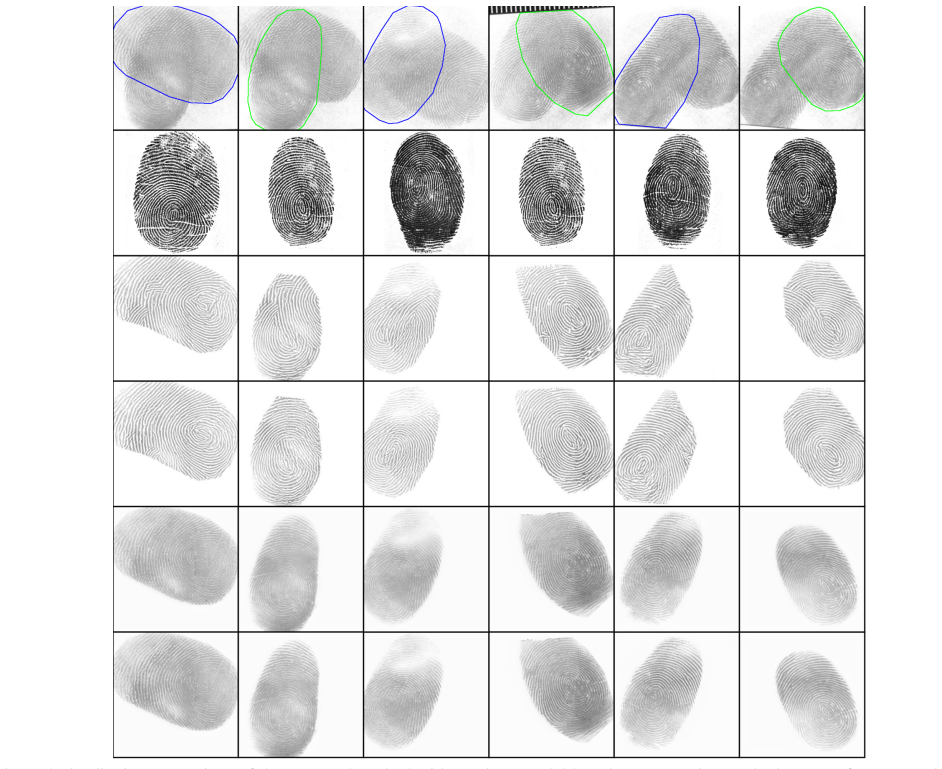
Supplementary Material 7.1. Qualitative Comparison With Baselines In Figure 8, we compare the reconstructed fingerprint images obtained using the proposed method with the results of model-based reconstruction methods reported in [2, 5]. While the first row shows the overlapped...
Reviewed August 5, 2026 · model on record in the stance chip above.
Discussion (0). Sign in to comment.