REVIEW 3 major objections 3 minor 111 references
Estimating the sensitivity of the IceCube Upgrade to probe the interior of the Earth using atmospheric neutrino oscillations
T0 review · 3 major / 3 minor · reviewed 2026-08-10 · deepseek-v4-flash
Pith's one-line read This paper projects that adding three years of IceCube Upgrade data to twelve years of DeepCore data would let atmospheric neutrino oscillations reject the vacuum-oscillation hypothesis at 5.5σ, measure Earth's mass to about 10%, and…
desk verdict A competent, transparent sensitivity projection showing the IceCube Upgrade roughly doubles DeepCore-only reach to Earth matter effects, but the headline numbers assume the unbuilt IC93 geometry and the quoted density/mass precisions are really precisions on rho*Ye with composition fixed. read the letter →
The pith
A machine-rendered reading of the paper's core claim, the machinery that carries it, and where it could break.
The reading
What carries the argument
The central object is the matter potential of Eq. (1), $V_{CC} \approx \pm 7.6\times 10^{-14}\,Y_e\,(\rho/\mathrm{g\,cm^{-3}})\,\mathrm{eV}$, which modifies the $\nu_\mu \to \nu_e$ and $\nu_\mu \to \nu_\mu$ oscillation probabilities as neutrinos cross the Earth. The analysis leans on two resonance features: the MSW resonance near 6--10 GeV for mantle-passing neutrinos, and the parametric (oscillation-length) resonance near 3--6 GeV for neutrinos that cross the core. The Earth is represented by a 12-layered volume-averaged PREM profile, with $Y_e = 0.4656$ for the core and $Y_e = 0.4957$ for the mantle, for the vacuum-rejection, uniform-rejection, and mass-measurement fits, and by a 5-layered version (inner core, outer core, inner mantle, middle mantle, outer mantle) for the correlated-density fit, with total mass and moment of inertia held fixed. Sensitivities are evaluated with a modified $\chi^2$ statistic on Asimov datasets, using a non-nested hypothesis formula for discrete comparisons and Wilks' theorem for nested scans over the scaling factors.
What would settle it
Re-run the same Asimov fits with the core $Y_e$ set to 0.50 instead of 0.4656 while keeping the densities fixed; if the recovered Earth-mass scaling $\alpha$ shifts by more than the quoted $1\sigma$ precision, then the Upgrade is measuring the product $\rho\,Y_e$ as a whole, not density alone, and the paper's composition assumption is not innocuous.
Extended reading notes
Core claim
The paper's central claim is that the IceCube Upgrade turns atmospheric neutrino oscillations into a practical probe of the Earth's radial density profile. Because the matter potential $V_{CC} = \pm\sqrt{2}G_F N_e$ depends on the product of density $\rho$ and the electron-to-nucleon ratio $Y_e$, neutrinos crossing the mantle and core acquire oscillation signatures in specific energy and zenith ranges: the MSW resonance near 6--10 GeV for mantle trajectories and the parametric (oscillation-length) resonance near 3--6 GeV for core-crossing trajectories. Fitting a 12-layered volume-averaged PREM profile against the vacuum hypothesis and against a uniform-density Earth, the paper estimates median sensitivities of $5.5\sigma$ and $2.4\sigma$, respectively, for the combined IC86 (12 yr) + IC93 (3 yr) sample under normal ordering. It further claims that scaling the 12-layered profile by a single factor $\alpha$ lets the data measure the Earth's mass to about 10% at the $1\sigma$ level, and that a 5-layered profile with fixed total mass and moment of inertia constrains correlated layer densities to about 7% (core), 10% (inner mantle), and 23% (middle mantle). All of these results are Asimov (no-fluctuation) median sensitivities from Monte Carlo templates, not yet real data.
Load-bearing premise
The load-bearing premise is that the Earth's chemical composition, quantified by the electron-to-nucleon ratio $Y_e$, is known exactly (FeNi core with $Y_e = 0.4656$, pyrolite mantle with $Y_e = 0.4957$), so every measured matter effect can be attributed to density rather than composition; if the true core or mantle composition differs, the inferred densities, Earth mass, and layer-density constraints would shift.
Editorial extensions
If this is right
- The IceCube Upgrade roughly doubles to triples the expected significance for establishing matter effects compared to DeepCore alone: $5.5\sigma$ versus $1.9\sigma$ at $\theta_{23}=47.5^\circ$ under normal ordering.
- A 1% external prior on $\Delta m^2_{31}$ improves the vacuum-rejection significance by about 30%, to $7.1\sigma$.
- The combined sample can reject a homogeneous Earth at $2.4\sigma$, providing an independent test of radial layering.
- A neutrino-based estimate of the Earth's mass to about 10% would be a new, independent weak-interaction measurement, complementing gravitational determinations.
- Correlated layer-density constraints (core $\sim7\%$, inner mantle $\sim10\%$, middle mantle $\sim23\%$) narrow the density ranges allowed by mass and moment-of-inertia constraints alone.
Reading between the lines
- A future external measurement of $\Delta m^2_{31}$ at sub-percent precision should push the vacuum-rejection significance above the $7.1\sigma$ shown here, because the paper identifies the $\Delta m^2_{31}$--matter-effect degeneracy as the main systematic.
- Because the as-built IC91 detector has one fewer working string than IC93, three years of real data will likely land below these projections; the paper's note that degradation is roughly uniform suggests scaling live-time upward as a rough correction.
- If the Earth-mass measurement matures, the same $\alpha$ scaling could be reinterpreted as a joint constraint on density and composition, giving a neutrino-based check on mineral-physics models of the core.
- The technique's sensitivity to the density jump at the core-mantle boundary could motivate combining these data with other large-volume neutrino detectors to sharpen the location and size of the discontinuity.
Editorial analysis
A structured set of objections, weighed in public.
Referee Report
Summary. This paper presents a Monte Carlo sensitivity projection for using atmospheric neutrino oscillations in the IceCube Upgrade to probe the interior of the Earth. The analysis is built on simulated events for the planned IC93 configuration, with an explicit binned likelihood including roughly 26 nuisance parameters, an Asimov dataset, and a non-nested hypothesis-test statistic for binary comparisons. The four main results are: (i) rejection of the vacuum oscillation hypothesis at 5.5 sigma, or 7.1 sigma with a 1% prior on Delta m^2_31, in a combined IC86 (12 yr) + IC93 (3 yr) fit; (ii) rejection of a uniform-density Earth at 2.4 sigma; (iii) a 1-sigma constraint on the Earth's mass scaling factor alpha of about 10%; and (iv) correlated density constraints of about 7% for the core, 10% for the inner mantle, and 23% for the middle mantle. All headline numbers assume normal mass ordering and the planned seven-string IC93 geometry, with a note added acknowledging that the as-built detector is IC91.
Significance. If the quoted sensitivities are correct as stated, they would demonstrate a substantial improvement of the IceCube Upgrade over DeepCore-only analyses for neutrino-based Earth tomography, making neutrino oscillations a competitive complement to seismic and gravitational probes. The manuscript has clear strengths: a full simulation chain based on established DeepCore/Upgrade tools, an explicit and fairly complete list of nuisance parameters with priors, a transparent Asimov-based statistical procedure, and an unusually honest note about the mismatch between the planned IC93 geometry and the as-built IC91 detector. The results are, however, conditional on two external assumptions that receive less attention in the abstract and conclusions than they deserve: the exact composition of the Earth through Y_e, and the IC93 geometry. These caveats do not invalidate the methodology, but they must be propagated into the headline claims before the paper can be read as a sensitivity estimate for the actual IceCube Upgrade.
major comments (3)
- [Section II / Eq. (1), Sections V.C and V.D] The observable in Eq. (1) is V_CC proportional to rho times Y_e, but Section II fixes Y_e = 0.4656 for the core and Y_e = 0.4957 for the mantle and propagates no uncertainty in Y_e. The paper itself states that neutrino data are not yet sensitive enough to constrain Y_e within its current allowed range, so this is an external modeling assumption rather than a measured input. Because the fit interprets every change in the matter potential as a change in density, an unmodeled fractional change in Y_e biases the inferred scaling factors alpha and alpha_C by a comparable fractional amount. Geochemical uncertainty in the core's light-element content is plausibly several percent, which is comparable to the claimed ~7% core-density precision and non-negligible for the claimed ~10% mass precision. The abstract and conclusions should either propagate a Y_e systematic into the quoted precisions or reframe the claims as sensitivities to the product rho times Y_e.
- [Section V.B and Section II] The uniform-density test hypothesis in Section V.B uses Y_e = 0.5, while the 12-layered PREM hypothesis uses Y_e = 0.4656 in the core and Y_e = 0.4957 in the mantle. The 2.4-sigma rejection therefore does not test density layering alone; it also tests the assumed composition profile. As defined, the test cannot distinguish a uniform-density Earth with a different core composition from a layered-density Earth, so the abstract's claim that the Upgrade can verify the non-homogeneous distribution of matter density is stronger than what is actually demonstrated. The comparison should either adopt a common Y_e profile for both hypotheses or treat Y_e as a nuisance parameter.
- [Section I, Note added, Abstract] All quoted sensitivities are computed for the planned IC93 geometry, while the as-built detector is IC91 with six Upgrade strings deployed and five operational. Section I and the Note added state this clearly, and the Note added says the actual sensitivity will be lower, but the abstract and Section V present the IC93 numbers without this qualifier and no IC91 projection is provided. Because the title and abstract refer to 'the IceCube Upgrade' in the present tense, readers will reasonably take 5.5 sigma, 7.1 sigma, and the ~10% mass precision as statements about the detector that now exists. The abstract and conclusions should clearly label the configuration used, and the authors should provide at least an approximate estimate of the IC91 degradation, given that the detector geometry is already known.
minor comments (3)
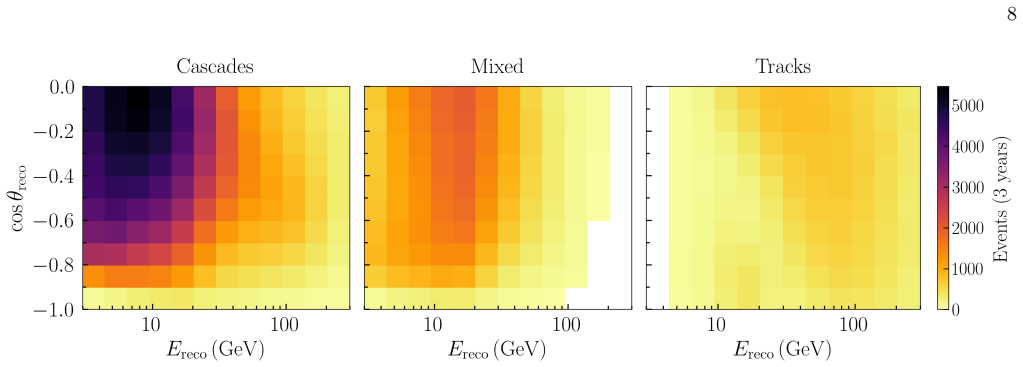
- [Section III / Fig. 3] The text says bins with low event statistics are excluded from the analysis but does not specify the threshold or how the exclusion is applied across PID classes; this should be stated for reproducibility.
- [Eq. (2) / Table II] The pull term in Eq. (2) is written as a Gaussian penalty, but Table II also lists parameters with uniform priors (e.g., ice absorption, A_eff scale); clarify how uniform-prior parameters enter the minimization, for example as hard bounds with no pull term.
- [Note added] The phrase 'These estimates are conservative' is not supported by the analysis shown; since no reoptimization was performed for the reduced geometry, the relation of the IC93 results to IC91 sensitivities is unknown rather than conservative, and the wording should be revised.
Circularity Check
No significant circularity: the paper is a stated simulation-based sensitivity projection whose inputs and assumptions are explicit.
full rationale
This is a simulation-based sensitivity projection, not a derivation of a physical quantity from data. The analysis generates Asimov datasets from the 12-layer PREM and 5-layer PREM hypotheses (Sec. IV.A and IV.C) and then fits scaling parameters alpha and alpha_C. The quoted 5.5 sigma, 2.4 sigma, ~10% mass, and ~7% core-density numbers are expected median sensitivities obtained by comparing MC templates, so none of them is an input disguised as an output. The main caveat, that oscillations are sensitive to the product rho*Ye and that Ye is fixed to 0.4656 for the core and 0.4957 for the mantle, is explicitly stated as an assumption in Section II rather than hidden; it limits the geophysical interpretation of the quoted density and mass precisions but does not make the statistical derivation circular. The external constraints on Earth mass, moment of inertia, and the inner-core/outer-core density ratio are declared inputs used to reduce the parameter space, not results claimed to be measured by neutrinos. The paper relies on Ref. [70] for the Upgrade simulation and reconstruction chain and on Refs. [58,59] for DeepCore data and systematic treatment; these are separate, data-calibrated or code-reproduced results, so the self-citations carry real evidence and are not load-bearing in a circular sense. No equation in the paper reduces by construction to its own input, and no fitted parameter is renamed as a prediction.
Assumptions & free parameters
free parameters (3)
- alpha (uniform Earth-mass scaling factor) =
scan parameter; truth = 1.0
- alpha_C (core density scaling factor) =
scan parameter; truth = 1.0
- Nuisance parameter set (detector, flux, cross section, normalization, oscillation) =
nominal values and priors listed in Table II
assumptions (7)
- standard math Three-flavor neutrino oscillations with the PMNS matrix and Wolfenstein matter potential (Eq. 1) are the correct description of atmospheric neutrino propagation.
- domain assumption The 12-layered volume-averaged PREM profile is the true Earth density model for the Asimov datasets.
- domain assumption Electron fraction Ye is exactly known: 0.4656 for the core and 0.4957 for the mantle.
- domain assumption Normal mass ordering is assumed for the headline sensitivity results.
- domain assumption The total Earth mass ME and moment of inertia IE are exactly known and held fixed in the correlated density measurement.
- standard math The non-nested hypothesis significance formula, Eq. (3) from Ref. [102], is valid for these Asimov comparisons.
- ad hoc to paper The projected detector configuration is IC93 with seven Upgrade strings, rather than the as-built IC91.
Cite this review
Pith. "Pith review of Estimating the sensitivity of the IceCube Upgrade to probe the interior of the Earth using atmospheric neutrino oscillations." pith.science (2026). https://pith.science/paper/YUJRYGZR
@misc{pith2026260806543,
  author       = {Pith},
  title        = {Pith review of: Estimating the sensitivity of the IceCube Upgrade to probe the interior of the Earth using atmospheric neutrino oscillations},
  year         = {2026},
  howpublished = {\url{https://pith.science/paper/YUJRYGZR}},
  note         = {Machine review of arXiv:2608.06543}
}
read the original abstract
The IceCube Upgrade is a densely instrumented central region of the IceCube Neutrino Observatory, deployed during the 2025-26 polar season. It will reduce the detector's energy threshold and improve overall reconstruction capabilities for multi-GeV atmospheric neutrinos, which in turn enhance their sensitivity to Earth matter effects as they traverse through the deep Earth. In this study, we describe the potential of the IceCube Upgrade to observe Earth matter effects on atmospheric neutrinos and estimate the detector's sensitivity to probe key features of the Preliminary Reference Earth Model by utilizing these observations. We highlight the IceCube Upgrade's capability to estimate the mass of the Earth and verify the non-homogeneous distribution of matter density within the Earth. We also estimate the IceCube Upgrade sensitivity to measure the correlated densities of the Earth layers while incorporating constraints from the mass and moment of inertia of the Earth. Neutrino-based results would be independent and complementary to the seismic and gravitational measurements.
Figures


Figures from the paper (10 more)


Reference graph
Works this paper leans on
-
[1]
Robertson and G
E. Robertson and G. S. (U.S.), The interior of the earth: An elementary description, Geological Survey circular (1966)
1966
-
[2]
Moser and L
M. Moser and L. V¨ olgyesi, The inner structure of the earth, Periodica Polytechnica Chemical Engineering26, 155 (1982)
1982
-
[3]
3.5, 3.6, 3.7, and 3.8) in Ref
sinθ13, which is about 0.005 (see Eqs. 3.5, 3.6, 3.7, and 3.8) in Ref. [100]. Therefore, the effect ofδ CP on atmospheric neutrino os- cillations is negligible for GeV-energy neutrinos travers- ing long baselines. We have checked the effect of the minimization and true choices ofδ CP on sensitivities of our studies and found them to be within a few percen...
-
[4]
IC86 (15 yr)
are treated as free parame- ters in the fit. All of the nuisance parameters discussed above are described in detail in Refs. [58, 59, 70]. C. Statistical approach Rejecting the vacuum or uniform density profile with respect to the 12-layered PREM profile involves a binary hypothesis test comparing two non-nested hypotheses. This differs from the case of n...
2026
-
[5]
So far, the study has examined how the sensitivity of this analysis depends on the true value ofθ 23
The dashed curves correspond to the sensitivity from the current DeepCore configuration with 15 years of exposure, while the solid curves represent the sensitivity from a joint fit using 12 years of DeepCore and 3 years of Upgrade simulated data. So far, the study has examined how the sensitivity of this analysis depends on the true value ofθ 23. How- eve...
-
[6]
PREM vs. Vacuum
Solid curves correspond to the joint fit of IC93 and IC86, while dashed curves correspond to IC86 alone. All sensitivity curves are obtained assuming normal mass ordering. It is observed that including the prior on ∆m2 31 enhances the expected sensitivity by approximately 30%. This improvement occurs because incorporating external information on ∆m 2 31 r...
-
[7]
Thorne, An overview of the core-mantle boundary region from seismological studies, (2022), talk given at the Multi-messenger Tomography of Earth (MMTE
M. Thorne, An overview of the core-mantle boundary region from seismological studies, (2022), talk given at the Multi-messenger Tomography of Earth (MMTE
2022
-
[8]
Hirose, Chemical composition and hydrogen content inside earth, (2022), talk given at the Multi-messenger Tomography of Earth (MMTE 2022) Workshop, Salt Lake City, Utah, USA
K. Hirose, Chemical composition and hydrogen content inside earth, (2022), talk given at the Multi-messenger Tomography of Earth (MMTE 2022) Workshop, Salt Lake City, Utah, USA
2022
Show all 111 references
-
[9]
D. E. Loper and T. Lay, The core-mantle boundary re- gion, Journal of Geophysical Research: Solid Earth100, 6397 (1995)
1995
-
[10]
Alf` e, M
D. Alf` e, M. Gillan, and G. Price, Temperature and com- position of the earth’s core, Contemporary Physics48, 63 (2007). 18
2007
-
[11]
F. D. Stacey and P. M. Davis,Physics of the Earth (Cambridge University Press, 2008)
2008
-
[12]
W. F. McDonough, The internal structure of the earth, (2022), talk given at the Multi-messenger Tomogra- phy of Earth (MMTE 2022) Workshop, Salt Lake City, Utah, USA
2022
-
[13]
USAO, USNO, HMNAO and UKHO, The astronomical almanac,http://asa.hmnao.com/(2020), uS Navy
2020
-
[14]
W. Chen, J. C. Li, J. Ray, W. B. Shen, and C. L. Huang, Consistent estimates of the dynamic figure parameters of the earth, Journal of Geodesy89, 179 (2014)
2014
-
[15]
Gilbert and A
F. Gilbert and A. M. Dziewonski, An Application of Normal Mode Theory to the Retrieval of Structural Pa- rameters and Source Mechanisms from Seismic Spectra, Philosophical Transactions of the Royal Society of Lon- don Series A278, 187 (1975)
1975
-
[16]
J. C. Ries, R. J. Eanes, C. K. Shum, and M. M. Watkins, Progress in the determination of the gravitational coef- ficient of the earth, Geophysical Research Letters19, 529 (1992)
1992
-
[17]
J. G. Williams, Contribution to the earth’s obliquity rate, precession, and nutation, Astronomical Journal 108, 711 (1994)
1994
-
[18]
Luzum, N
B. Luzum, N. Capitaine, A. Fienga, W. Folkner, T. Fukushima, J. Hilton, C. Hohenkerk, G. Krasinsky, G. Petit, E. Pitjeva, M. Soffel, and P. Wallace, The IAU 2009 system of astronomical constants: the report of the IAU working group on numerical standards for funda- mental astr...
2011
-
[19]
G. Rosi, F. Sorrentino, L. Cacciapuoti, M. Prevedelli, and G. M. Tino, Precision Measurement of the Newto- nian Gravitational Constant Using Cold Atoms, Nature 510, 518 (2014), arXiv:1412.7954 [physics.atom-ph]
2014 arXiv
-
[20]
Kustowski, G
B. Kustowski, G. Ekstr¨ om, and A. M. Dziewo´ nski, Anisotropic shear-wave velocity structure of the earth’s mantle: A global model, Journal of Geophysical Re- search: Solid Earth113(2008)
2008
-
[21]
Therefore, their values are fixed to those from the latest global fit (NuFit 5.2 [77]), as listed in Ta- ble I
and reactor (θ 13) parameters, within their present uncertainties, is found to be negligible for 11 these analyses. Therefore, their values are fixed to those from the latest global fit (NuFit 5.2 [77]), as listed in Ta- ble I. Furthermore, theδ CP-dependent terms inP(ν e → νµ...
-
[22]
A. M. Dziewonski and D. L. Anderson, Preliminary ref- erence earth model, Phys. Earth Planet. Interiors25, 297 (1981)
1981
-
[23]
Dziewonski, A
A. Dziewonski, A. Hales, and E. Lapwood, Parametri- cally simple earth models consistent with geophysical data, Physics of the Earth and Planetary Interiors10, 12 (1975)
1975
-
[24]
B. L. N. Kennett and E. R. Engdahl, Traveltimes for Global Earthquake Location and Phase Identification, Geophysical Journal International105, 429 (1991)
1991
-
[25]
B. L. N. Kennett, E. R. Engdahl, and R. Buland, Con- straints on seismic velocities in the Earth from trav- eltimes, Geophysical Journal International122, 108 (1995)
1995
-
[26]
Cammarano, A
F. Cammarano, A. Deuss, S. Goes, and D. Giardini, One-dimensional physical reference models for the up- per mantle and transition zone: Combining seismic and mineral physics constraints, Journal of Geophysical Re- search: Solid Earth110(2005)
2005
-
[27]
B. L. N. Kennett, On the density distribution within the Earth, Geophysical Journal International132, 374 (1998)
1998
-
[28]
Ma and H
X. Ma and H. Tkalˇ ci´ c, Ccrem: New reference earth model from the global coda-correlation wavefield, Journal of Geophysical Research: Solid Earth126, e2021JB022515 (2021)
2021
-
[29]
Gandhi, C
R. Gandhi, C. Quigg, M. H. Reno, and I. Sarce- vic, Ultrahigh-energy neutrino interactions, Astropart. Phys.5, 81 (1996), arXiv:hep-ph/9512364
1996 arXiv
-
[30]
R. A. Fischer and W. F. McDonough, Earth’s core com- position and core formation, inTreatise on Geochem- istry, Vol. Vol. 1 (2025) p. 17–71, 3rd ed
2025
-
[31]
oscilla- tion valley
The values ofθ 23 and ∆m 2 31 are the best-fit values as reported by the IceCube DeepCore measurement [58]. The value ofδ CP is taken to be zero, as it has negligible impact on the analyses performed in this work. measured with high precision [73–76]. In addition to oscillatio...
2000
-
[32]
Williams and R
Q. Williams and R. J. Hemley, Hydrogen in the deep earth, Annual Review of Earth and Planetary Sciences 29, 365 (2001)
2001
-
[33]
Hirose, B
K. Hirose, B. Wood, and L. Voˇ cadlo, Light elements in the earth’s core, Nature Reviews Earth & Environment 2, 645 (2021)
2021
-
[34]
B. A. Bolt, The precision of density estimation deep in the earth, Q. J. R. Astron. Soc.32, 367 (1991)
1991
-
[35]
Masters and D
G. Masters and D. Gubbins, On the resolution of density within the earth, Physics of the Earth and Planetary Interiors140, 159 (2003)
2003
-
[36]
Nicolaidis, M
A. Nicolaidis, M. Jannane, and A. Tarantola, Neutrino tomography of the earth, J. Geophys. Res.96, 21811 (1991)
1991
-
[37]
M. G. Aartsenet al.(IceCube), Measurement of the multi-TeV neutrino cross section with IceCube using Earth absorption, Nature551, 596 (2017), arXiv:1711.08119 [hep-ex]
2017 arXiv
-
[38]
Placci and E
A. Placci and E. Zavattini,On the possibility of us- ing high-energy neutrinos to study the earth’s interior, Tech. Rep. (CERN, Geneva, 1973)
1973
-
[39]
L. V. Volkova and G. T. Zatsepin, On the problem of neutrino penetration though the earth. (talk, in rus- sian), Izv. Akad. Nauk Ser. Fiz.38N5, 1060 (1974)
1974
-
[40]
M. C. Gonzalez-Garcia, F. Halzen, M. Maltoni, and H. K. M. Tanaka, Radiography of earth’s core and man- tle with atmospheric neutrinos, Phys. Rev. Lett.100, 061802 (2008), arXiv:0711.0745 [hep-ph]
2008 arXiv
-
[41]
Donini, S
A. Donini, S. Palomares-Ruiz, and J. Salvado, Neu- trino tomography of Earth, Nature Phys.15, 37 (2019), arXiv:1803.05901 [hep-ph]
2019 arXiv
-
[42]
Abbasiet al.(IceCube), Updated Earth Tomog- raphy Using Atmospheric Neutrinos at IceCube, PoS ICRC2025, 1211 (2025), arXiv:2507.09763 [astro- ph.HE]
R. Abbasiet al.(IceCube), Updated Earth Tomog- raphy Using Atmospheric Neutrinos at IceCube, PoS ICRC2025, 1211 (2025), arXiv:2507.09763 [astro- ph.HE]
2025 arXiv
-
[43]
Capozzi and S
F. Capozzi and S. T. Petcov, Neutrino tomography of the Earth with ORCA detector, Eur. Phys. J. C82, 461 (2022), arXiv:2111.13048 [hep-ph]
2022 arXiv
-
[44]
M. G. Aartsenet al.(IceCube-PINGU), Letter of In- tent: The Precision IceCube Next Generation Upgrade (PINGU), (2014), arXiv:1401.2046 [physics.ins-det]
2014 arXiv
-
[45]
Winter, Atmospheric neutrino oscillations for Earth tomography, Nucl
W. Winter, Atmospheric neutrino oscillations for Earth tomography, Nucl. Phys. B908, 250 (2016), arXiv:1511.05154 [hep-ph]
2016 arXiv
-
[46]
C. Rott, A. Taketa, and D. Bose, Spectrometry of the Earth using Neutrino Oscillations, Sci. Rep.5, 15225 (2015), arXiv:1502.04930 [physics.geo-ph]
2015 arXiv
-
[47]
Bourret, J
S. Bourret, J. Coelho, E. Kaminski, and V. Van Elewyck, Probing the Earth Core Compo- sition with Neutrino Oscillation Tomography, PoS ICRC2019, 1024 (2020)
2020
-
[48]
Kumar and S
A. Kumar and S. K. Agarwalla, Validating the Earth’s core using atmospheric neutrinos with ICAL at INO, 19 JHEP08, 139, arXiv:2104.11740 [hep-ph]
-
[49]
P. B. Denton and R. Pestes, Neutrino oscillations through the Earth’s core, Phys. Rev. D104, 113007 (2021), arXiv:2110.01148 [hep-ph]
2021 arXiv
-
[50]
Jes´ us-Valls, S
C. Jes´ us-Valls, S. T. Petcov, and J. Xia, Neutrino oscillation tomography of the Earth with the Hyper- Kamiokande detector, Eur. Phys. J. C85, 703 (2025), arXiv:2411.12344 [hep-ex]
2025 arXiv
-
[51]
K. J. Kelly, P. A. N. Machado, I. Martinez-Soler, and Y. F. Perez-Gonzalez, DUNE atmospheric neutrinos: Earth tomography, JHEP05, 187, arXiv:2110.00003 [hep-ph]
-
[52]
A. K. Upadhyay, A. Kumar, S. K. Agarwalla, and A. Dighe, Probing dark matter inside Earth using atmo- spheric neutrino oscillations at INO-ICAL, Phys. Rev. D107, 115030 (2023), arXiv:2112.14201 [hep-ph]
2023 arXiv
-
[53]
Maderer, E
L. Maderer, E. Kaminski, J. A. B. Coelho, S. Bourret, and V. Van Elewyck, Unveiling the outer core composi- tion with neutrino oscillation tomography, Front. Earth Sci.11, 1008396 (2023), arXiv:2208.00532 [hep-ex]
2023 arXiv
-
[54]
J. C. D’Olivo Saez, J. A. H. Lara, I. Romero, and O. A. Sampayo, Oscillation tomografy study of Earth’s composition and density with atmospheric neutrinos, Eur. Phys. J. C82, 614 (2022), arXiv:2207.11257 [physics.geo-ph]
2022 arXiv
-
[55]
A. K. Upadhyay, A. Kumar, S. K. Agarwalla, and A. Dighe, Locating the core-mantle boundary using oscillations of atmospheric neutrinos, JHEP04, 068, arXiv:2211.08688 [hep-ph]
-
[56]
Raikwal and S
D. Raikwal and S. Choubey, Earth tomography with the ICAL detector at INO, Phys. Rev. D109, 073011 (2024), arXiv:2309.12573 [hep-ph]
2024 arXiv
-
[57]
Abbasiet al.(IceCube), The Design and Performance of IceCube DeepCore, Astropart
R. Abbasiet al.(IceCube), The Design and Performance of IceCube DeepCore, Astropart. Phys.35, 615 (2012), arXiv:1109.6096 [astro-ph.IM]
2012 arXiv
-
[58]
A. K. Upadhyay, A. Kumar, S. K. Agarwalla, and A. Dighe, Constraining the core radius and density jumps inside Earth using atmospheric neutrino oscilla- tions, (2024), arXiv:2405.04986 [hep-ph]
2024 arXiv
-
[59]
Chattopadhyay, J
S. Chattopadhyay, J. Krishnamoorthi, and A. K. Upadhyay (IceCube), Demonstrating the ability of IceCube DeepCore to probe Earth’s interior with atmospheric neutrino oscillations, Eur. Phys. J. Spec. Top. 10.1140/epjs/s11734-025-01741-6 (2025), arXiv:2502.18995 [hep-ph]
2025
-
[60]
A. K. Upadhyay (IceCube), Establishing Earth’s Mat- ter Effect in Atmospheric Neutrino Oscillations at Ice- Cube DeepCore, Springer Proc. Phys.322, 463 (2026), arXiv:2601.23047 [hep-ph]
2026
-
[61]
Krishnamoorthi, Exploring Layered Structure Inside Earth Using Atmospheric Neutrino Oscillation at Ice- Cube DeepCore, Springer Proc
J. Krishnamoorthi, Exploring Layered Structure Inside Earth Using Atmospheric Neutrino Oscillation at Ice- Cube DeepCore, Springer Proc. Phys.322, 447 (2026), arXiv:2601.23057 [hep-ph]
2026
-
[62]
Chattopadhyay, Study of the Internal Structure of the Earth Using Neutrino Oscillations at IceCube DeepCore, Springer Proc
S. Chattopadhyay, Study of the Internal Structure of the Earth Using Neutrino Oscillations at IceCube DeepCore, Springer Proc. Phys.322, 417 (2026), arXiv:2601.23079 [hep-ph]
2026
-
[63]
M. G. Aartsenet al.(IceCube), The IceCube Neu- trino Observatory: Instrumentation and Online Sys- tems, JINST12(03), P03012, [Erratum: JINST 19, E05001 (2024)], arXiv:1612.05093 [astro-ph.IM]
2024 arXiv
-
[64]
Henningsenet al., A self-monitoring precision cal- ibration light source for large-volume neutrino tele- scopes, JINST15(07), P07031, arXiv:2005.00778 [astro-ph.IM]
F. Henningsenet al., A self-monitoring precision cal- ibration light source for large-volume neutrino tele- scopes, JINST15(07), P07031, arXiv:2005.00778 [astro-ph.IM]
2005 arXiv
-
[65]
Abbasiet al.(IceCube), Measurement of Atmo- spheric Neutrino Oscillation Parameters Using Convo- lutional Neural Networks with 9.3 Years of Data in Ice- Cube DeepCore, Phys
R. Abbasiet al.(IceCube), Measurement of Atmo- spheric Neutrino Oscillation Parameters Using Convo- lutional Neural Networks with 9.3 Years of Data in Ice- Cube DeepCore, Phys. Rev. Lett.134, 091801 (2025), arXiv:2405.02163 [hep-ex]
2025 arXiv
-
[66]
Abbasiet al.(IceCube), Measurement of atmospheric neutrino mixing with improved IceCube DeepCore cali- bration and data processing, Phys
R. Abbasiet al.(IceCube), Measurement of atmospheric neutrino mixing with improved IceCube DeepCore cali- bration and data processing, Phys. Rev. D108, 012014 (2023), arXiv:2304.12236 [hep-ex]
2023
-
[67]
Classen, C
L. Classen, C. Dorn, A. Kappes, T. Karg, M. Kossatz, A. Kretzschmann, H.-W. Ortjohann, J. Reubelt, K.-H. Sulanke, and R. Weigel (IceCube), A multi-PMT Opti- cal Module for the IceCube Upgrade, PoSICRC2019, 855 (2020), arXiv:1908.10802 [astro-ph.HE]
2020 arXiv
-
[68]
Abbasiet al.(IceCube), Design and performance of the multi-PMT optical module for IceCube Upgrade, PoSICRC2021, 1070 (2021), arXiv:2107.11383 [astro- ph.IM]
R. Abbasiet al.(IceCube), Design and performance of the multi-PMT optical module for IceCube Upgrade, PoSICRC2021, 1070 (2021), arXiv:2107.11383 [astro- ph.IM]
2021 arXiv
-
[69]
Mechbal and N
S. Mechbal and N. Feigl (IceCube), Characterization and testing of the IceCube Upgrade mDOM, PoS ICRC2023, 1183 (2023)
2023
-
[70]
Abbasiet al.(IceCube), D-Egg: a dual PMT op- tical module for IceCube, JINST18(04), P04014, arXiv:2212.14526 [astro-ph.IM]
R. Abbasiet al.(IceCube), D-Egg: a dual PMT op- tical module for IceCube, JINST18(04), P04014, arXiv:2212.14526 [astro-ph.IM]
-
[71]
Pontecorvo, Mesonium and anti-mesonium, Sov
B. Pontecorvo, Mesonium and anti-mesonium, Sov. Phys. JETP6, 429 (1957)
1957
-
[72]
Khera and F
N. Khera and F. Henningsen (IceCube), POCAM in the IceCube Upgrade, PoSICRC2021, 1049 (2021), arXiv:2108.05298 [astro-ph.HE]
2021 arXiv
-
[73]
Rongen and D
M. Rongen and D. Chirkin (IceCube), Advances in Ice- Cube ice modelling & what to expect from the Up- grade, JINST16(09), C09014, arXiv:2108.03291 [astro- ph.IM]
-
[74]
Abbasiet al.(IceCube), The Acoustic Module for the IceCube Upgrade, PoSICRC2021, 1059 (2021), arXiv:2108.05631 [astro-ph.IM]
R. Abbasiet al.(IceCube), The Acoustic Module for the IceCube Upgrade, PoSICRC2021, 1059 (2021), arXiv:2108.05631 [astro-ph.IM]
2021 arXiv
-
[75]
W. Kang, J. Lee, S. Rodan, C. Rott, and C. T¨ onnis, The Camera System for the IceCube Upgrade, Phys. Sci. Forum8, 49 (2023)
2023
-
[76]
R. E. Anthony, A. T. Ringler, M. DuVernois, K. R. An- derson, and D. C. Wilson, Six decades of seismology at south pole, antarctica: Current limitations and future opportunities to facilitate new geophysical observa- tions, Seismological Research Letters92, 2718 (2021), https:...
2021
-
[77]
Abbasiet al.(IceCube), Physics potential of the IceCube Upgrade for atmospheric neutrino oscillations, (2025), arXiv:2509.13066 [hep-ex]
R. Abbasiet al.(IceCube), Physics potential of the IceCube Upgrade for atmospheric neutrino oscillations, (2025), arXiv:2509.13066 [hep-ex]
2025
-
[78]
Wolfenstein, Neutrino Oscillations in Matter, Phys
L. Wolfenstein, Neutrino Oscillations in Matter, Phys. Rev. D17, 2369 (1978)
1978
-
[79]
Z. Maki, M. Nakagawa, and S. Sakata, Remarks on the unified model of elementary particles, Prog. Theor. Phys.28, 870 (1962)
1962
-
[80]
Capozzi, W
F. Capozzi, W. Giar` e, E. Lisi, A. Marrone, A. Mel- chiorri, and A. Palazzo, Neutrino masses and mixing: Entering the era of subpercent precision, Phys. Rev. D 111, 093006 (2025), arXiv:2503.07752 [hep-ph]
2025 arXiv
-
[81]
Esteban, M
I. Esteban, M. C. Gonzalez-Garcia, M. Maltoni, I. Martinez-Soler, J. P. Pinheiro, and T. Schwetz, NuFit- 6.0: updated global analysis of three-flavor neutrino os- cillations, JHEP12, 216, arXiv:2410.05380 [hep-ph]. 20
-
[82]
NuFIT v6.0 (2024),http://www.nu-fit.org/
2024
-
[83]
P. F. de Salas, D. V. Forero, S. Gariazzo, P. Mart ´ ınez- Mirav´ e, O. Mena, C. A. Ternes, M. T´ ortola, and J. W. F. Valle, 2020 global reassessment of the neutrino oscillation picture, JHEP02, 071, arXiv:2006.11237 [hep-ph]
2020 arXiv
-
[84]
Esteban, M
I. Esteban, M. C. Gonzalez-Garcia, M. Maltoni, T. Schwetz, and A. Zhou, The fate of hints: up- dated global analysis of three-flavor neutrino oscilla- tions, JHEP09, 178, arXiv:2007.14792 [hep-ph]
2007 arXiv
-
[85]
M. V. Chizhov and S. T. Petcov, Enhancing Mecha- nisms of Neutrino Transitions in a Medium of Nonperi- odic Constant - Density Layers and in the Earth, Phys. Rev. D63, 073003 (2001), arXiv:hep-ph/9903424
2001 arXiv
-
[86]
S. P. Mikheev and A. Y. Smirnov, Resonance en- hancement of oscillations in matter and solar neu- trino spectroscopy, Sov. J. Nucl. Phys.42, 913 (1985), [Yad.Fiz.42:1441-1448,1985]
1985
-
[87]
S. P. Mikheev and A. Y. Smirnov, Resonant amplifica- tion of neutrino oscillations in matter and solar neutrino spectroscopy, Nuovo Cim. C9, 17 (1986)
1986
-
[88]
Petcov, Diffractive-Like (or Parametric-Resonance- Like?) Enhancement of the Earth (Day-Night) Effect for Solar Neutrinos Crossing the Earth Core, Phys
S. Petcov, Diffractive-Like (or Parametric-Resonance- Like?) Enhancement of the Earth (Day-Night) Effect for Solar Neutrinos Crossing the Earth Core, Phys. Lett. B434, 321 (1998), arXiv:hep-ph/9805262
1998 arXiv
-
[89]
Chizhov, M
M. Chizhov, M. Maris, and S. T. Petcov, On the Os- cillation Length Resonance in the Transitions of Solar and Atmospheric Neutrinos Crossing the Earth Core, (1998), arXiv:hep-ph/9810501
1998 arXiv
-
[90]
S. T. Petcov, New Enhancement Mechanism of the Transitions in the Earth of the Solar and Atmospheric Neutrinos Crossing the Earth Core, Nucl. Phys. B Proc. Suppl.77, 93 (1999), arXiv:hep-ph/9809587
1999 arXiv
-
[91]
Chizhov and S
M. Chizhov and S. Petcov, New Conditions for a Total Neutrino Conversion in a Medium, Phys.Rev.Lett.83, 1096 (1999), arXiv:hep-ph/9903399 [hep-ph]
1999 arXiv
-
[92]
Kumar, A
A. Kumar, A. Khatun, S. K. Agarwalla, and A. Dighe, A New Approach to Probe Non-Standard Interactions in Atmospheric Neutrino Experiments, JHEP04, 159, arXiv:2101.02607 [hep-ph]
-
[93]
V. K. Ermilova, V. A. Tsarev, and V. A. Chechin, Para- metric resonance of neutrino oscillations in matter (in Russian), Kr. Soob. Fiz. [Short Notices of the Lebedev Institute]5, 26 (1986)
1986
-
[94]
E. K. Akhmedov, Neutrino oscillations in inhomoge- neous matter (in Russian), Sov. J. Nucl. Phys.47, 301 (1988)
1988
-
[95]
Krastev and A
P. Krastev and A. Smirnov, Parametric effects in neu- trino oscillations, Physics Letters B226, 341 (1989)
1989
-
[96]
E. K. Akhmedov, Parametric resonance of neutrino os- cillations and passage of solar and atmospheric neutri- nos through the earth, Nucl. Phys. B538, 25 (1999), arXiv:hep-ph/9805272
1999 arXiv
-
[97]
E. K. Akhmedov, A. Dighe, P. Lipari, and A. Y. Smirnov, Atmospheric neutrinos at Super-Kamiokande and parametric resonance in neutrino oscillations, Nucl. Phys. B542, 3 (1999), arXiv:hep-ph/9808270
1999 arXiv
-
[98]
Kumar, A
A. Kumar, A. Khatun, S. K. Agarwalla, and A. Dighe, From oscillation dip to oscillation valley in atmospheric neutrino experiments, Eur. Phys. J. C81, 190 (2021), arXiv:2006.14529 [hep-ph]
2021 arXiv
-
[99]
Elleret al.(IceCube), A model independent parametrization of the optical properties of the refrozen IceCube drill holes, PoSICRC2023, 1034 (2023), arXiv:2307.15298 [astro-ph.HE]
P. Elleret al.(IceCube), A model independent parametrization of the optical properties of the refrozen IceCube drill holes, PoSICRC2023, 1034 (2023), arXiv:2307.15298 [astro-ph.HE]
2023 arXiv
-
[100]
Abbasiet al., Graph Neural Networks for low-energy event classification & reconstruction in IceCube, JINST 17(11), P11003, arXiv:2209.03042 [hep-ex]
R. Abbasiet al., Graph Neural Networks for low-energy event classification & reconstruction in IceCube, JINST 17(11), P11003, arXiv:2209.03042 [hep-ex]
-
[101]
Honda, M
M. Honda, M. Sajjad Athar, T. Kajita, K. Kasahara, and S. Midorikawa, Atmospheric neutrino flux calcula- tion using the NRLMSISE-00 atmospheric model, Phys. Rev. D92, 023004 (2015), arXiv:1502.03916 [astro- ph.HE]
2015 arXiv
-
[102]
Cowan, K
G. Cowan, K. Cranmer, E. Gross, and O. Vitells, Asymptotic formulae for likelihood-based tests of new physics, Eur. Phys. J. C71, 1554 (2011), [Erra- tum: Eur.Phys.J.C 73, 2501 (2013)], arXiv:1007.1727 [physics.data-an]
2011 arXiv
-
[103]
G. D. Barr, T. K. Gaisser, S. Robbins, and T. Stanev, Uncertainties in Atmospheric Neutrino Fluxes, Phys. Rev. D74, 094009 (2006), arXiv:astro-ph/0611266
2006 arXiv
-
[104]
Cooper-Sarkar, P
A. Cooper-Sarkar, P. Mertsch, and S. Sarkar, The high energy neutrino cross-section in the Standard Model and its uncertainty, JHEP08, 042, arXiv:1106.3723 [hep-ph]
-
[105]
Fischer, R
L. Fischer, R. Naab, and A. Trettin, Treating detec- tor systematics via a likelihood free inference method, JINST18(10), P10019, arXiv:2305.02257 [hep-ex]
-
[107]
E. K. Akhmedov, R. Johansson, M. Lindner, T. Ohls- son, and T. Schwetz, Series expansions for three flavor neutrino oscillation probabilities in matter, JHEP04, 078, arXiv:hep-ph/0402175
-
[108]
S. S. Wilks, The Large-Sample Distribution of the Like- lihood Ratio for Testing Composite Hypotheses, Annals Math. Statist.9, 60 (1938)
1938
-
[109]
Ciuffoli, J
E. Ciuffoli, J. Evslin, and X. Zhang, Confidence in a neutrino mass hierarchy determination, JHEP01, 095, arXiv:1305.5150 [hep-ph]
-
[110]
Anet al.(JUNO), Neutrino Physics with JUNO, J
F. Anet al.(JUNO), Neutrino Physics with JUNO, J. Phys. G43, 030401 (2016), arXiv:1507.05613 [physics.ins-det]
2016 arXiv
-
[111]
Abuslemeet al.(JUNO), Sub-percent precision mea- surement of neutrino oscillation parameters with JUNO, Chin
A. Abuslemeet al.(JUNO), Sub-percent precision mea- surement of neutrino oscillation parameters with JUNO, Chin. Phys. C46, 123001 (2022), arXiv:2204.13249 [hep-ex]
2022
-
[2022]
Workshop, Salt Lake City, Utah, USA
Reviewed August 10, 2026 · model on record in the stance chip above.
Discussion (0). Continue with ORCID to comment.